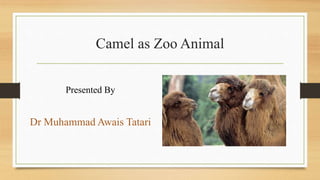





Camel as Zoo Animal
Presented By
Dr Muhammad Awais Tatari
Scientific Classification
 Class: mammalia (Mammals)
 Order: Cetartiodactyla
 Family: Camelidae
 Genus: Camelus
 Species: bactrianus (Bactrian camel)
dromedarius (dromedary camel)
Quick Facts
Life span: life expectancy is 17.8 years
Gestation: 12 to 14 months, depending on species
Number of young at birth: 1, rarely 2
Age of maturity: Females, 3 years; males, 5 to 7 years
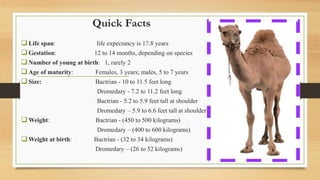
Size: Bactrian - 10 to 11.5 feet long
Dromedary - 7.2 to 11.2 feet long
Bactrian - 5.2 to 5.9 feet tall at shoulder
Dromedary – 5.9 to 6.6 feet tall at shoulder
Weight: Bactrian - (450 to 500 kilograms)
Dromedary – (400 to 600 kilograms)
Weight at birth: Bactrian - (32 to 34 kilograms)
Dromedary – (26 to 52 kilograms)
Fun Fact
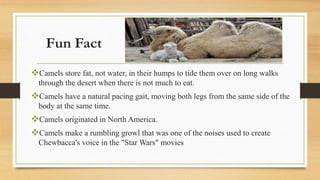
Camels store fat, not water, in their humps to tide them over on long walks
through the desert when there is not much to eat.
Camels have a natural pacing gait, moving both legs from the same side of the
body at the same time.
Camels originated in North America.
Camels make a rumbling growl that was one of the noises used to create
Chewbacca's voice in the "Star Wars" movies
Range
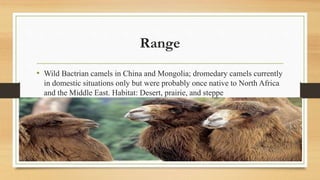
• Wild Bactrian camels in China and Mongolia; dromedary camels currently
in domestic situations only but were probably once native to North Africa
and the Middle East. Habitat: Desert, prairie, and steppe
Ships of the desert
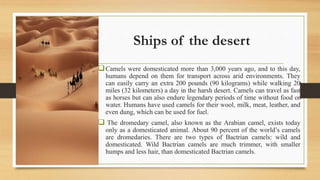
Camels were domesticated more than 3,000 years ago, and to this day,
humans depend on them for transport across arid environments. They
can easily carry an extra 200 pounds (90 kilograms) while walking 20
miles (32 kilometers) a day in the harsh desert. Camels can travel as fast
as horses but can also endure legendary periods of time without food or
water. Humans have used camels for their wool, milk, meat, leather, and
even dung, which can be used for fuel.
 The dromedary camel, also known as the Arabian camel, exists today
only as a domesticated animal. About 90 percent of the world’s camels
are dromedaries. There are two types of Bactrian camels: wild and
domesticated. Wild Bactrian camels are much trimmer, with smaller
humps and less hair, than domesticated Bactrian camels.
One hump or two?
The dromedary camel has one hump and the Bactrian camel has two. What’s
the easiest way to remember the names? Think of the capital letter D lying on
its side with just one hump: D stands for dromedary. Now think of the capital
letter B on its side with two humps: B for Bactrian! But what’s in those
humps? They store fat, not water. The fat becomes an energy source for the
camel.
 The length of time a camel can survive on this stored energy depends on
climate and the animal’s activity levels. The size of the hump can change,
depending on the amount of food the camel eats. When food is scarce, the
camel’s body uses the fat stored in the hump, causing the hump to lean over
and droop.
 A camel can go a week or more without water, and it can last for several
months without food. It can survive a 40 percent weight loss and then drink
up to 32 gallons (145 liters) of water in one drinking session!
At home in the sand
Swirling desert sand can be a problem for most of us, but
camels have special adaptations for the pesky stuff. A thin
nictitating membrane on each eye, like a clear inner eyelid,
protects the eyes from sandstorms while still letting in
enough light for camels to see.
Double rows of extra-long eyelashes also help keep sand
out of the eyes. And camels can close their nostrils to keep
sand out of their nose, too! Their large, broad feet are
heavily callused; they expand
when stepped on and contract when lifted to simplify
walking in sand or snow.
Hot and cold
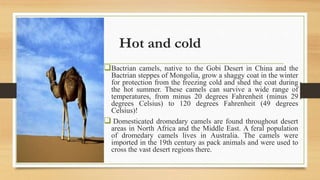
Bactrian camels, native to the Gobi Desert in China and the
Bactrian steppes of Mongolia, grow a shaggy coat in the winter
for protection from the freezing cold and shed the coat during
the hot summer. These camels can survive a wide range of
temperatures, from minus 20 degrees Fahrenheit (minus 29
degrees Celsius) to 120 degrees Fahrenheit (49 degrees
Celsius)!
 Domesticated dromedary camels are found throughout desert
areas in North Africa and the Middle East. A feral population
of dromedary camels lives in Australia. The camels were
imported in the 19th century as pack animals and were used to
cross the vast desert regions there.
Food in the desert
Camels are diurnal and spend their day eating. They
are very clever at finding food in their harsh desert
environment. Each half of the split upper lip moves
independently, so camels can get near the ground for
eating short grass. These tough but flexible lips can
break off and eat vegetation such as thorns or salty
plants; they even eat fish.
 Camels are ruminants, like cows, and they regurgitate
the food back up from their stomach to chew it again.
When they do that, smelly gasses come up as well,
making for some pretty potent breath!
 At the San Diego Zoo and San Diego Zoo Safari Park,
the camels are offered Bermuda and Sudan hay and
herbivore pellets.
Say what?!
Highly social, camels live in herds with a dominant
adult male; males that have been chased out of the
group form bachelor herds. They make many sounds,
including moaning and groaning sounds, high-pitched
bleats, loud bellows, and rumbling roars. Mothers and
their newborns hum to each other.
 A friendly way one camel may greet another is by
blowing in its face. Various positions of the head, neck,
ears, and tail have different meanings in camel society,
too. For example, ears forward indicates alertness; the
tail curled over the back is a sign of submission.
Baby humps
When she is about a give birth, an expectant
mother removes herself from the herd and finds a
private area covered with vegetation for her
calving spot. After a gestation of 12 to 14 months,
a newborn camel is able to walk beside the mother
within half an hour. The calf has no humps but
small peaks of hide, each topped with a tassel of
curly hair to indicate where the humps will form.
 Mother and young return to the herd in about two
weeks. Camel calves nurse for 10 to 18 months,
depending on species and the availability of food.
They do not reach full adult size until about age
seven.
THANK YOU FOR WATCHING

Camel as zoo animal

  • 1.
    Camel as ZooAnimal Presented By Dr Muhammad Awais Tatari
  • 2.
    Scientific Classification  Class:mammalia (Mammals)  Order: Cetartiodactyla  Family: Camelidae  Genus: Camelus  Species: bactrianus (Bactrian camel) dromedarius (dromedary camel)
  • 3.
    Quick Facts Life span:life expectancy is 17.8 years Gestation: 12 to 14 months, depending on species Number of young at birth: 1, rarely 2 Age of maturity: Females, 3 years; males, 5 to 7 years Size: Bactrian - 10 to 11.5 feet long Dromedary - 7.2 to 11.2 feet long Bactrian - 5.2 to 5.9 feet tall at shoulder Dromedary – 5.9 to 6.6 feet tall at shoulder Weight: Bactrian - (450 to 500 kilograms) Dromedary – (400 to 600 kilograms) Weight at birth: Bactrian - (32 to 34 kilograms) Dromedary – (26 to 52 kilograms)
  • 4.
    Fun Fact Camels storefat, not water, in their humps to tide them over on long walks through the desert when there is not much to eat. Camels have a natural pacing gait, moving both legs from the same side of the body at the same time. Camels originated in North America. Camels make a rumbling growl that was one of the noises used to create Chewbacca's voice in the "Star Wars" movies
  • 5.
    Range • Wild Bactriancamels in China and Mongolia; dromedary camels currently in domestic situations only but were probably once native to North Africa and the Middle East. Habitat: Desert, prairie, and steppe
  • 6.
    Ships of thedesert Camels were domesticated more than 3,000 years ago, and to this day, humans depend on them for transport across arid environments. They can easily carry an extra 200 pounds (90 kilograms) while walking 20 miles (32 kilometers) a day in the harsh desert. Camels can travel as fast as horses but can also endure legendary periods of time without food or water. Humans have used camels for their wool, milk, meat, leather, and even dung, which can be used for fuel.  The dromedary camel, also known as the Arabian camel, exists today only as a domesticated animal. About 90 percent of the world’s camels are dromedaries. There are two types of Bactrian camels: wild and domesticated. Wild Bactrian camels are much trimmer, with smaller humps and less hair, than domesticated Bactrian camels.
  • 7.
    One hump ortwo? The dromedary camel has one hump and the Bactrian camel has two. What’s the easiest way to remember the names? Think of the capital letter D lying on its side with just one hump: D stands for dromedary. Now think of the capital letter B on its side with two humps: B for Bactrian! But what’s in those humps? They store fat, not water. The fat becomes an energy source for the camel.  The length of time a camel can survive on this stored energy depends on climate and the animal’s activity levels. The size of the hump can change, depending on the amount of food the camel eats. When food is scarce, the camel’s body uses the fat stored in the hump, causing the hump to lean over and droop.  A camel can go a week or more without water, and it can last for several months without food. It can survive a 40 percent weight loss and then drink up to 32 gallons (145 liters) of water in one drinking session!
  • 8.
    At home inthe sand Swirling desert sand can be a problem for most of us, but camels have special adaptations for the pesky stuff. A thin nictitating membrane on each eye, like a clear inner eyelid, protects the eyes from sandstorms while still letting in enough light for camels to see. Double rows of extra-long eyelashes also help keep sand out of the eyes. And camels can close their nostrils to keep sand out of their nose, too! Their large, broad feet are heavily callused; they expand when stepped on and contract when lifted to simplify walking in sand or snow.
  • 9.
    Hot and cold Bactriancamels, native to the Gobi Desert in China and the Bactrian steppes of Mongolia, grow a shaggy coat in the winter for protection from the freezing cold and shed the coat during the hot summer. These camels can survive a wide range of temperatures, from minus 20 degrees Fahrenheit (minus 29 degrees Celsius) to 120 degrees Fahrenheit (49 degrees Celsius)!  Domesticated dromedary camels are found throughout desert areas in North Africa and the Middle East. A feral population of dromedary camels lives in Australia. The camels were imported in the 19th century as pack animals and were used to cross the vast desert regions there.
  • 10.
    Food in thedesert Camels are diurnal and spend their day eating. They are very clever at finding food in their harsh desert environment. Each half of the split upper lip moves independently, so camels can get near the ground for eating short grass. These tough but flexible lips can break off and eat vegetation such as thorns or salty plants; they even eat fish.  Camels are ruminants, like cows, and they regurgitate the food back up from their stomach to chew it again. When they do that, smelly gasses come up as well, making for some pretty potent breath!  At the San Diego Zoo and San Diego Zoo Safari Park, the camels are offered Bermuda and Sudan hay and herbivore pellets.
  • 11.
    Say what?! Highly social,camels live in herds with a dominant adult male; males that have been chased out of the group form bachelor herds. They make many sounds, including moaning and groaning sounds, high-pitched bleats, loud bellows, and rumbling roars. Mothers and their newborns hum to each other.  A friendly way one camel may greet another is by blowing in its face. Various positions of the head, neck, ears, and tail have different meanings in camel society, too. For example, ears forward indicates alertness; the tail curled over the back is a sign of submission.
  • 12.
    Baby humps When sheis about a give birth, an expectant mother removes herself from the herd and finds a private area covered with vegetation for her calving spot. After a gestation of 12 to 14 months, a newborn camel is able to walk beside the mother within half an hour. The calf has no humps but small peaks of hide, each topped with a tassel of curly hair to indicate where the humps will form.  Mother and young return to the herd in about two weeks. Camel calves nurse for 10 to 18 months, depending on species and the availability of food. They do not reach full adult size until about age seven.
  • 13.
    THANK YOU FORWATCHING