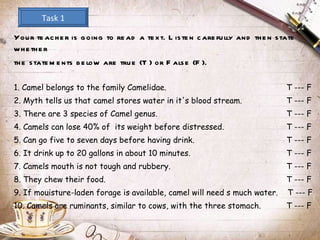
Your teacher is going to read a text. Listen carefully and then state whether  the statements below are true (T) or False (F). 1. Camel belongs to the family   Camelidae.   T --- F 2. Myth tells us that camel stores water in it's blood stream.    T --- F 3. There are 3 species of Camel genus.    T --- F 4. Camels can lose 40% of  its weight before distressed.   T --- F 5. Can go five to seven days before having drink.   T --- F 6. It drink up to 20 gallons in about 10 minutes.    T --- F 7. Camels mouth is not tough and rubbery.      T --- F 8. They chew their food.    T --- F 9. If mouisture-laden forage is available, camel will need s much water.   T --- F 10. Camels are ruminants, similar to cows, with the three stomach.    T --- F Task 1
Listen to the text once again. The following words are taken from the text, but they are not well arranged. Rearranged the jumbled letters with the help of the clues on the right. 1. g-i-n-d- e -u-r-n = lasting 2. o- s- t-e-r-s =put something somewhere and keep it for  future 3. m-u- h -p = round lump on camel's back 4.   s-e-v-s-e- r -e-r = supply of something kept for use when needed 5. h-k-i-n-r- s = cause something became smaller 6.  D -s-e-s-r-i-t-d-e = great worry 7. r-e-s- m -u-t-i-o = tiny drops of water on surface 8. b-a-l- p -t-a-l-e-a = pleasant or acceptable 9. m-a- d -g-a-e = harm, loss 10. r-e-v - e- s -e = very bad, difficult Task 2
Text of Listening Task 1 Camel belongs to the family Camelidae. There are two species of genus: Camelus, the single-humped Arabia or Dromedary of Africa, and the Middle East; and the double-humped Bactrian of China and Central Asia. One of the most enduring and misunderstood myths about camel is it’s ability to go days without water. Myth tells us that the camel stores water in its hump. The truth is the humps are a fatty deposit that provides energy when food is scarce. When a camel’s energy reserves become low from lack of food, the hump shrink become soft and will actually flop over to one side. The camel stores water in its blood-stream, an interesting physiological process. The camel has developed, over the centuries, unique water saving biology. Capable of losing forty percent of its body’s weight before becoming distressed, it is able to go five to seven days before having to drink. The amount it drinks when water is available would cause severe problems in most animals, up to 21 gallons in about 10 minutes. If moisture-laden forage is available, a camel will not need a much water. The water it drinks can be too salty or brackish for other animals. The camel’s mouth, stomach, and teeth have all developed to allow it to eat plants that are not palatable to other desert animals. The camel’s mouth is tough and rubbery so that thorns and branches won’t damage it. Camels are ruminants, similar to cows, with three stomach. They don’t chew their food. They eat by swallowing their food whole and allowing it to be partially digested by the stomachs before being chewed as a cud later. Source : http://www.touregypt.net/featurestories/camel.html

Listening Corner

  • 1.
    Your teacher isgoing to read a text. Listen carefully and then state whether the statements below are true (T) or False (F). 1. Camel belongs to the family Camelidae. T --- F 2. Myth tells us that camel stores water in it's blood stream. T --- F 3. There are 3 species of Camel genus. T --- F 4. Camels can lose 40% of its weight before distressed. T --- F 5. Can go five to seven days before having drink. T --- F 6. It drink up to 20 gallons in about 10 minutes. T --- F 7. Camels mouth is not tough and rubbery. T --- F 8. They chew their food. T --- F 9. If mouisture-laden forage is available, camel will need s much water. T --- F 10. Camels are ruminants, similar to cows, with the three stomach. T --- F Task 1
  • 2.
    Listen to thetext once again. The following words are taken from the text, but they are not well arranged. Rearranged the jumbled letters with the help of the clues on the right. 1. g-i-n-d- e -u-r-n = lasting 2. o- s- t-e-r-s =put something somewhere and keep it for future 3. m-u- h -p = round lump on camel's back 4. s-e-v-s-e- r -e-r = supply of something kept for use when needed 5. h-k-i-n-r- s = cause something became smaller 6. D -s-e-s-r-i-t-d-e = great worry 7. r-e-s- m -u-t-i-o = tiny drops of water on surface 8. b-a-l- p -t-a-l-e-a = pleasant or acceptable 9. m-a- d -g-a-e = harm, loss 10. r-e-v - e- s -e = very bad, difficult Task 2
  • 3.
    Text of ListeningTask 1 Camel belongs to the family Camelidae. There are two species of genus: Camelus, the single-humped Arabia or Dromedary of Africa, and the Middle East; and the double-humped Bactrian of China and Central Asia. One of the most enduring and misunderstood myths about camel is it’s ability to go days without water. Myth tells us that the camel stores water in its hump. The truth is the humps are a fatty deposit that provides energy when food is scarce. When a camel’s energy reserves become low from lack of food, the hump shrink become soft and will actually flop over to one side. The camel stores water in its blood-stream, an interesting physiological process. The camel has developed, over the centuries, unique water saving biology. Capable of losing forty percent of its body’s weight before becoming distressed, it is able to go five to seven days before having to drink. The amount it drinks when water is available would cause severe problems in most animals, up to 21 gallons in about 10 minutes. If moisture-laden forage is available, a camel will not need a much water. The water it drinks can be too salty or brackish for other animals. The camel’s mouth, stomach, and teeth have all developed to allow it to eat plants that are not palatable to other desert animals. The camel’s mouth is tough and rubbery so that thorns and branches won’t damage it. Camels are ruminants, similar to cows, with three stomach. They don’t chew their food. They eat by swallowing their food whole and allowing it to be partially digested by the stomachs before being chewed as a cud later. Source : http://www.touregypt.net/featurestories/camel.html