
PREVALENCE OF PARVO VIRUS
INFECTION IN CANINE CASES
OF MOBILE VET CONSULTANCY
SERVICE
LALITPUR, NEPAL
Internee
PRADHUMAN YADAV
Internship Site
Jaulakhel, Lalitpur
Advisor
Dr. Bala Ram Thapa
Program Director at Directorate of Livestock Market Promotion
INTRODUCTION
The Parvo viral infection in canine population was first recognized in
1978 that caused Parvovirus enteritis or myocarditis in U.S.A. After
that, this was observed in Canada, Australia and England. And in
following year in France, Holland, Belgium, Switzerland, Sweden,
West German and other countries (Anon, 1979; Mc Candlish et al
.,1979).
The canine parvovirus (CPV) infection is a highly contagious viral
illness that affects dogs.
Susceptible Hosts
Wide varieties of hosts are affected with parvo virus infection. They
are cattle, pig, dog, cat, man, rat, mice, chicken, and hamsters. Breeds
like Doberman, English Springers, Labrador are at risk.
Mean age and range:
Most severe illness may occur in pups 6-16 weeks of age.
Mode of transmission
The virus is transmitted through direct or indirect contact with the
infected animal or its excretions. Viruses are excreted in large
quantity through the excreta of the hosts.
Virus excretion continues for 12-14 days from infected animal
(Pollock, 1981).
Clinical signs
Slight to high rise of temperature (Initial stage)
Vomiting
Bloody Diarrhea
Loss of appetite
Treatment of Parvo Virus infection
Symptomatic treatment
 Anti Vomiting drug
 Anti diarrhoeal drug
Supportive treatment
 Fluid therapy
OBJECTIVES
General objective
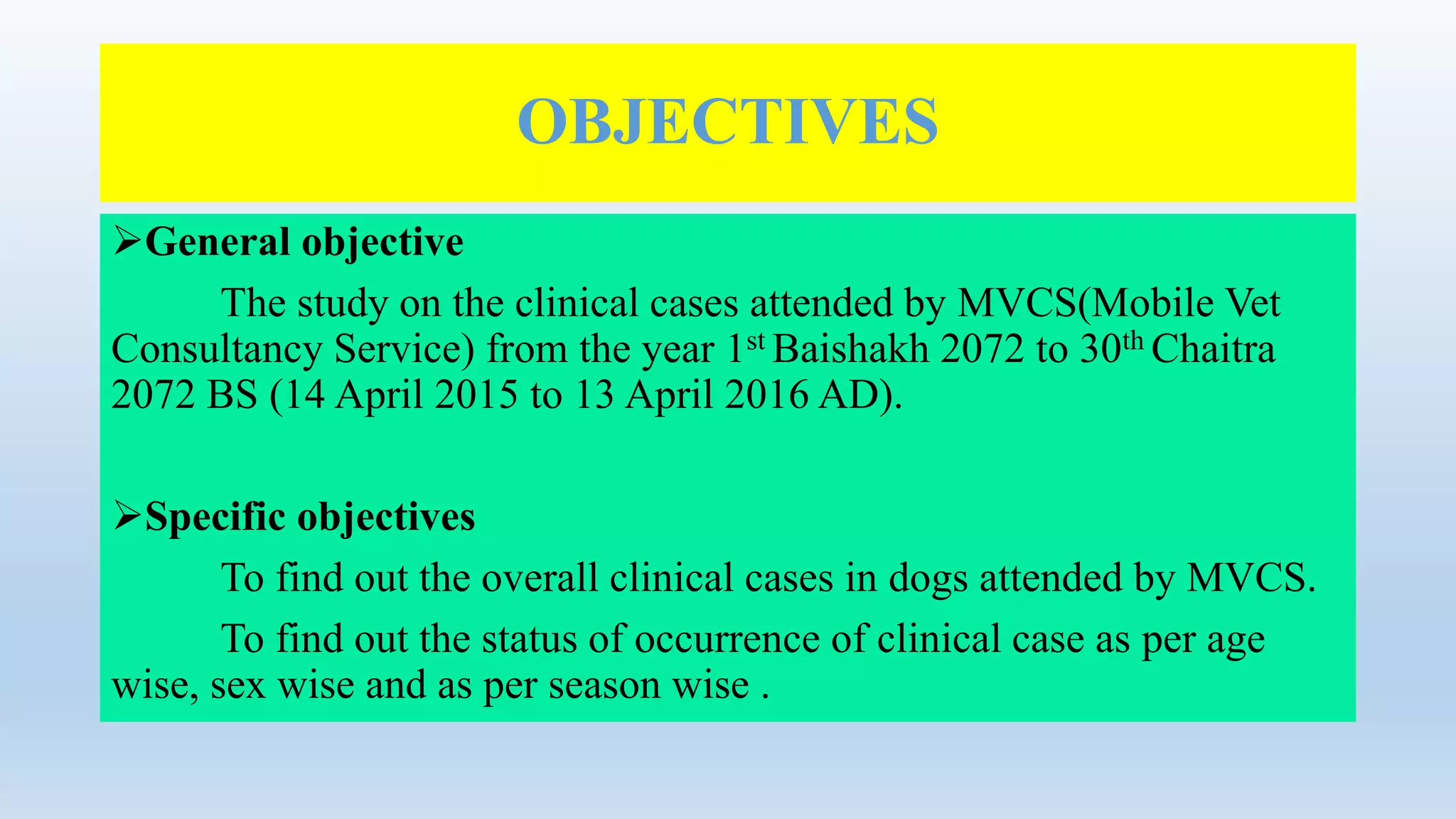
The study on the clinical cases attended by MVCS(Mobile Vet
Consultancy Service) from the year 1st Baishakh 2072 to 30th Chaitra
2072 BS (14 April 2015 to 13 April 2016 AD).
Specific objectives
To find out the overall clinical cases in dogs attended by MVCS.
To find out the status of occurrence of clinical case as per age
wise, sex wise and as per season wise .
Justification of study
The studies on the clinical case are very useful to find out the
occurrence pattern of the disease, distribution of disease according to
various factors like age, sex and time.
Very few studies had been conducted in Nepal to determine the
prevalence of parvo virus.
Limitations of study
This study was done only within limited period of time.
Due to this, the analysis had to be completely based on secondary
data in Mobile Vet Consultancy Service, Jawalakhel, Lalitpur.
Sampling error may exist.
Methodology
Study Area
-Jaulakhel Lalitpur
Data collection technique
-case record book date 2072(1st Baishakh 2072 to 30th Chaitra)
-Total Number Of cases were 3674, among them 455 cases were
Canine Parvo virus
Data analysis
-MS-Excel 2010
Result of Study
Breed-wise distribution of clinical case
1120
706
664
262
186
146 132 112 82 66 42 36 30 20 16 14 14 8 4 4 4 2 2 2
0
200
400
600
800
1000
1200
Numberofcases
Sex-wise distribution of clinical case
0
500
1000
1500
2000
2500
Male
Female
No.ofcases
Male Female
Sex 2176 1498
Area-wise distribution of clinical case
2594
872
140
38 10 8 4 6 2
0
500
1000
1500
2000
2500
3000
Lalitpur Kathmandu Bhaktapur Banepa Pokhara Chitwan hetauda Dhading Kurintar
No.ofcasesinnumber
Age-wise distribution of clinical case
82
450
214
122
98 94
70 78
50 40
70
384
276
206
190188184
210
198
104110
58
74
44 36
20 10 4 4 2 6
0
50
100
150
200
250
300
350
400
450
500
1m
2m
3m
4m
5m
6m
7m
8m
9m
10m
11m
1yr
2yrs
3yrs
4yrs
5yrs
6yrs
7yrs
8yrs
9yrs
10yrs
11yrs
12yrs
13yrs
14yrs
15yrs
16yrs
17yrs
18yrs
19yrs
20yrs
No.ofcasseinnumber
Distribution of Parvo Virus Cases
3674
455
0 500 1000 1500 2000 2500 3000 3500 4000
Total Case
Parvo Virus case
NO. OF CASES
Month-wise distribution of parvo viral case
21%
16%
12%
1%4%3%
1%
5%
9%
8%
11%
9% Baishakh
Jestha
Ashar
Shrawan
Bhadra
Asoj
Kartik
Mangsir
Poush
Magh
Falgun
Chaitra
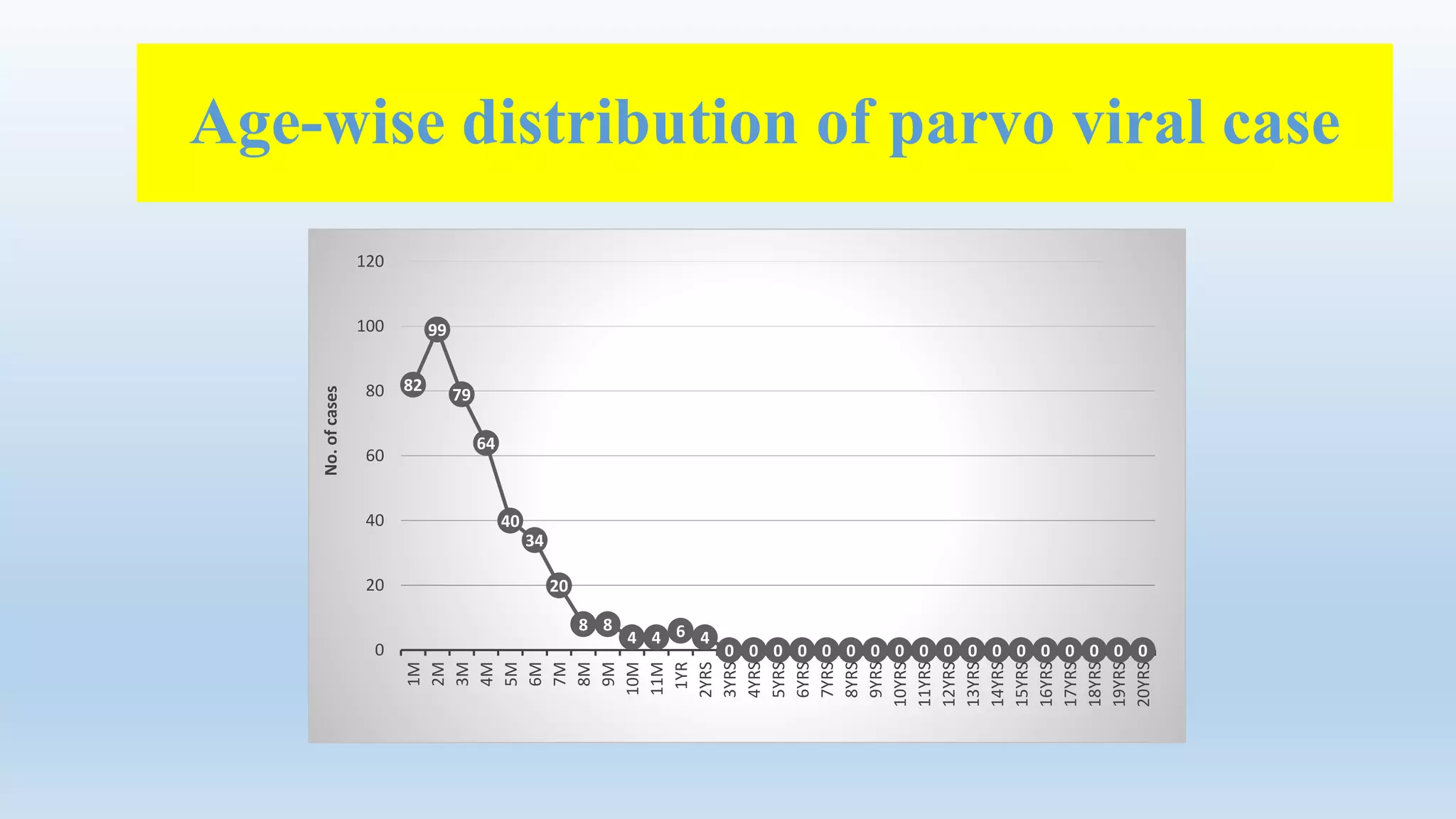
Age-wise distribution of parvo viral case
82
99
79
64
40
34
20
8 8
4 4 6 4
0 0 0 0 0 0 0 0 0 0 0 0 0 0 0 0 0 00
20
40
60
80
100
120
1M
2M
3M
4M
5M
6M
7M
8M
9M
10M
11M
1YR
2YRS
3YRS
4YRS
5YRS
6YRS
7YRS
8YRS
9YRS
10YRS
11YRS
12YRS
13YRS
14YRS
15YRS
16YRS
17YRS
18YRS
19YRS
20YRS
No.ofcases
Discussion of Study
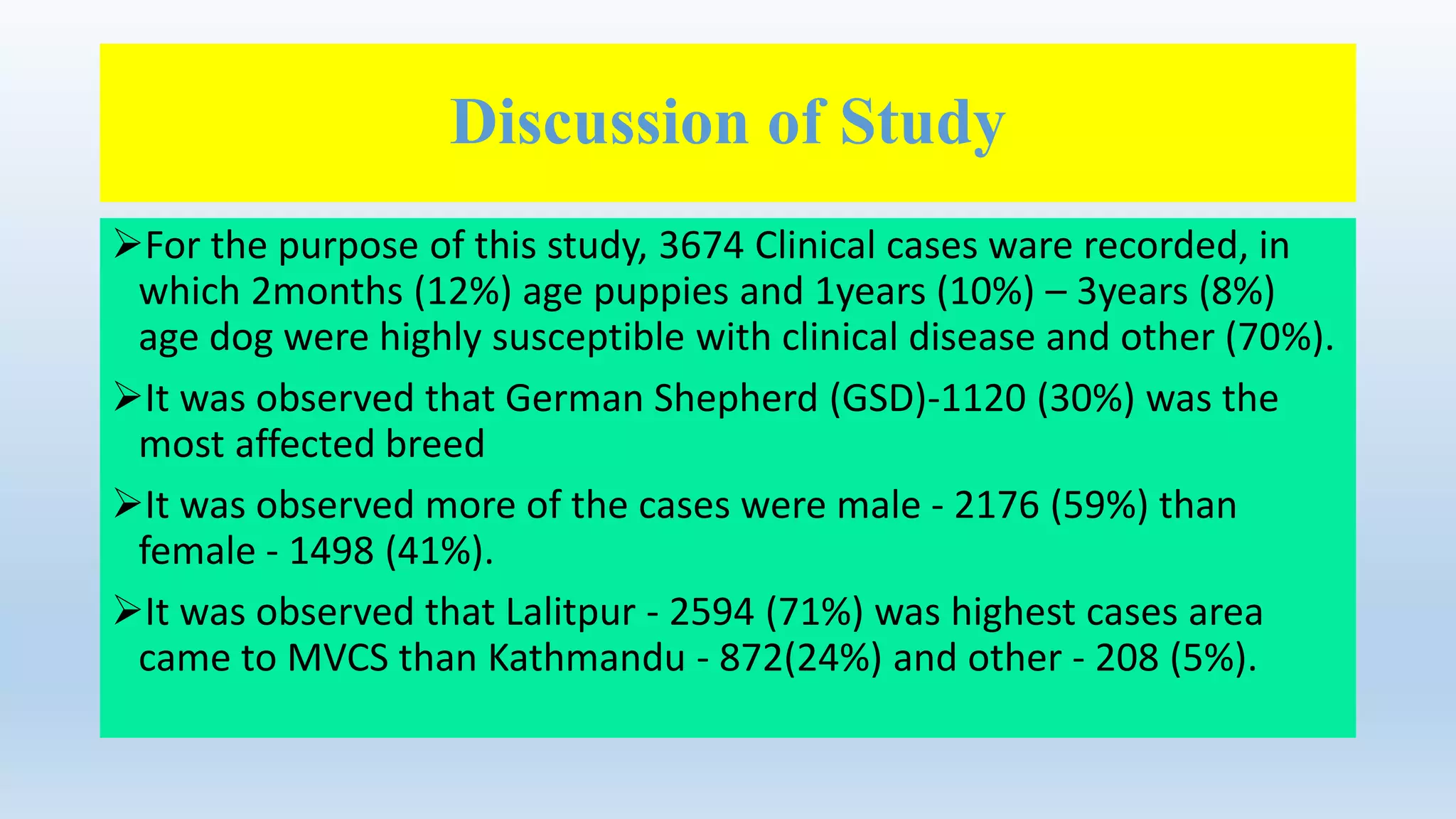
For the purpose of this study, 3674 Clinical cases ware recorded, in
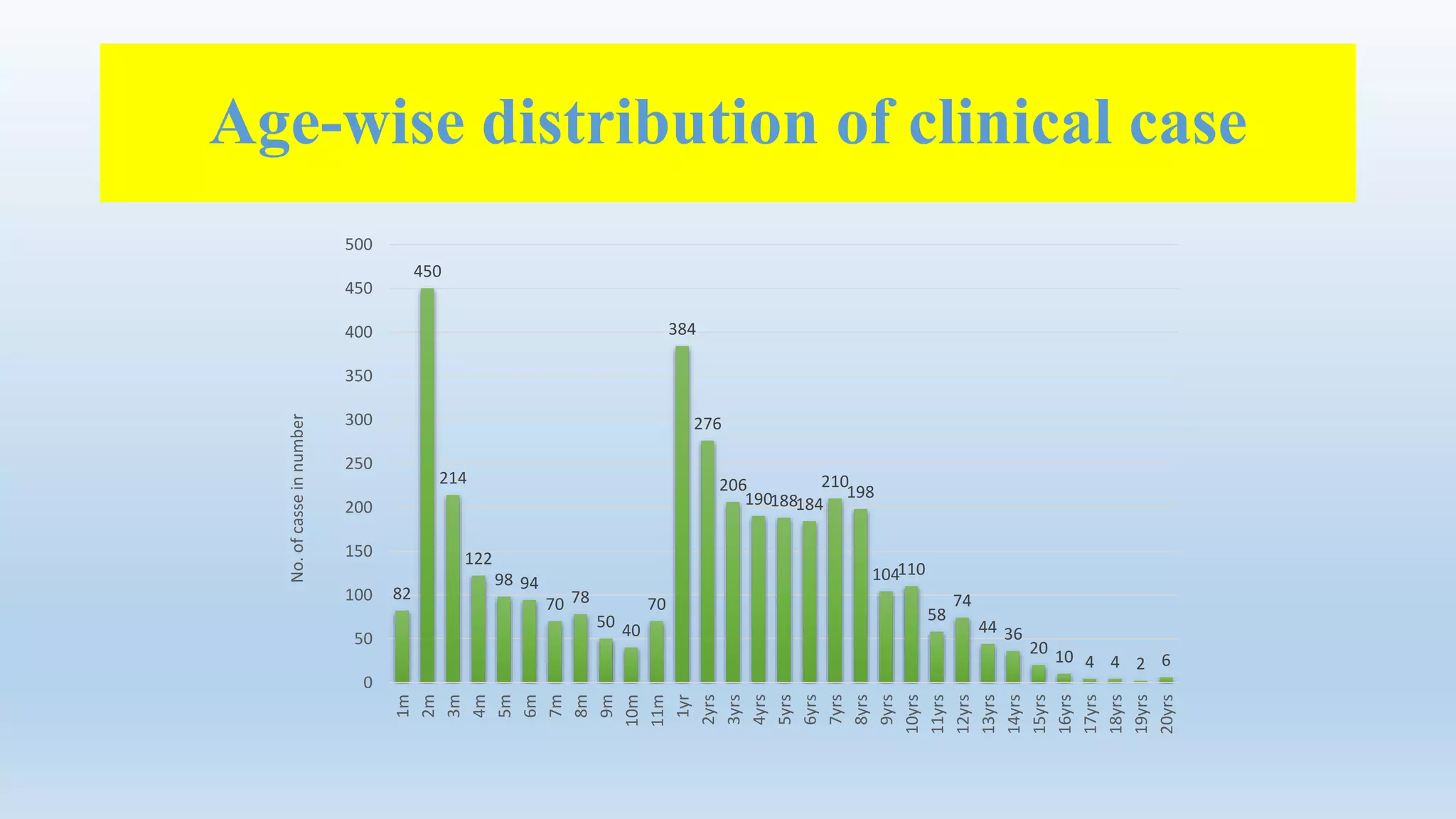
which 2months (12%) age puppies and 1years (10%) – 3years (8%)
age dog were highly susceptible with clinical disease and other (70%).
It was observed that German Shepherd (GSD)-1120 (30%) was the
most affected breed
It was observed more of the cases were male - 2176 (59%) than
female - 1498 (41%).
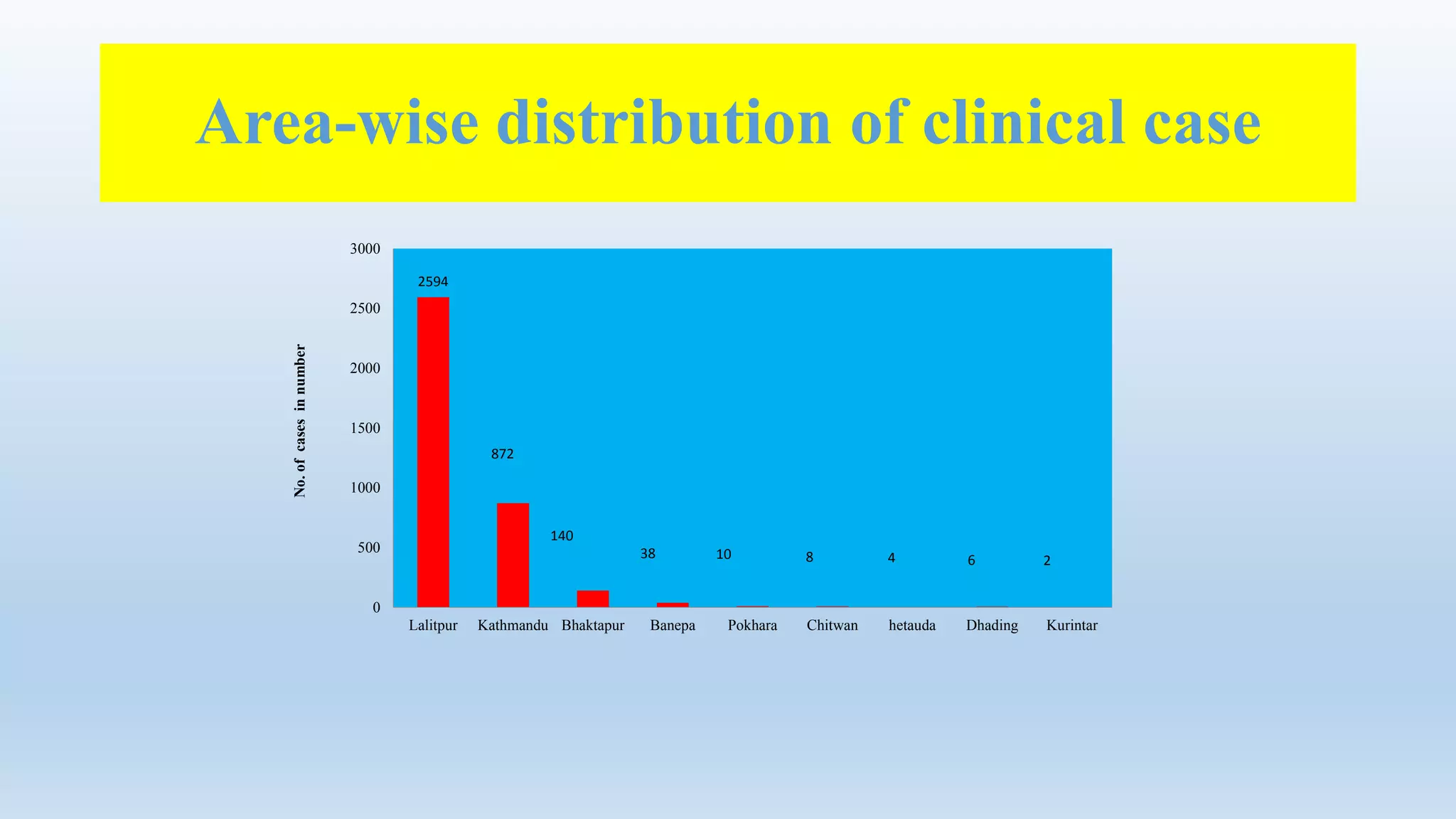
It was observed that Lalitpur - 2594 (71%) was highest cases area
came to MVCS than Kathmandu - 872(24%) and other - 208 (5%).
Contd….
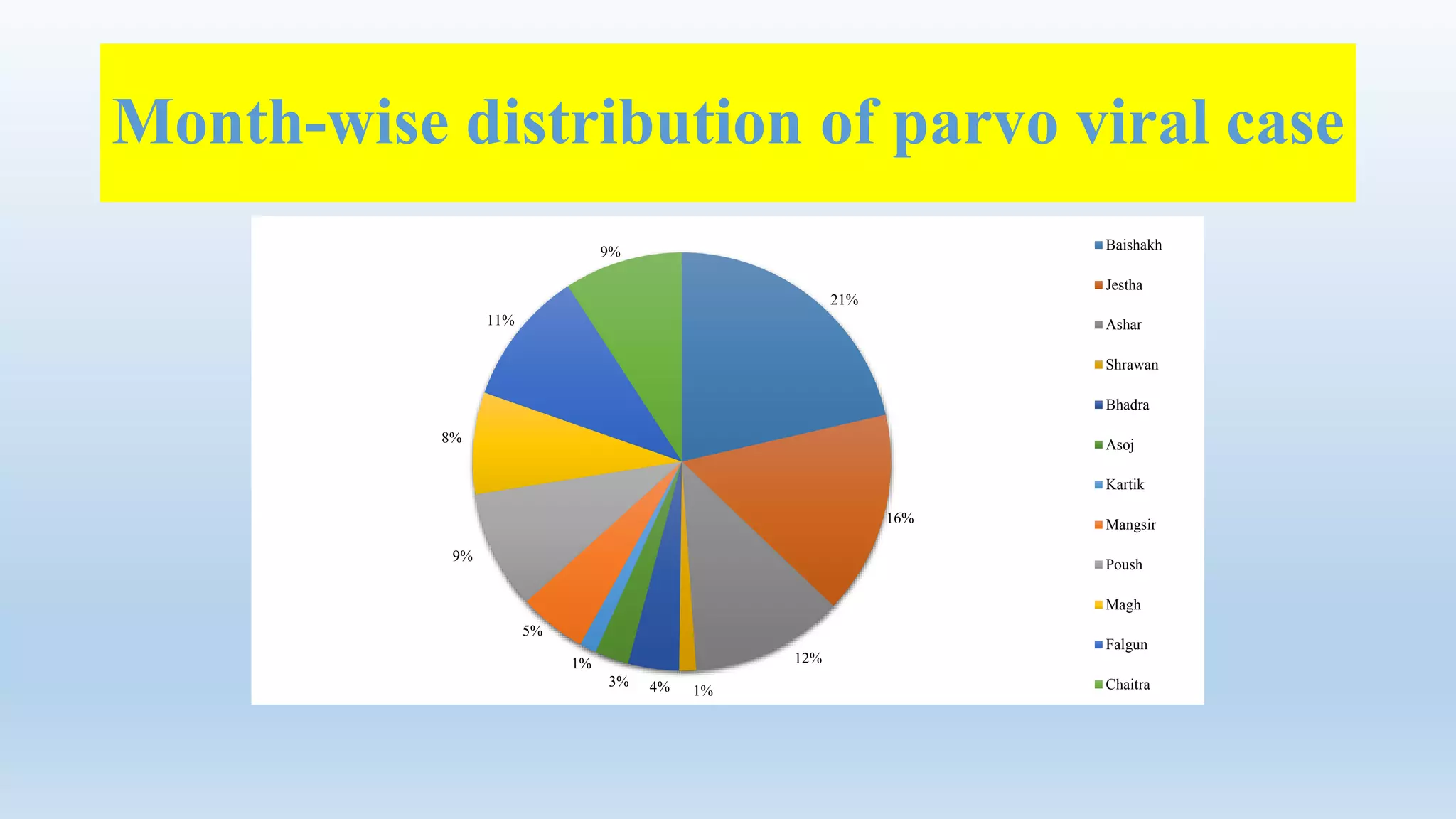
The study show that Baishakh (21%) and Jestha (16%) is more occurring
season for the Parvoviral infection and rest are Ashar(12%),
Shrawan(1%), Bhadra(4%), Asoj(3%), Kartik(1%), Mangsir(5%),
Poush(9%), Magh(8%), Falgun(11%) and Chaitra(9%).
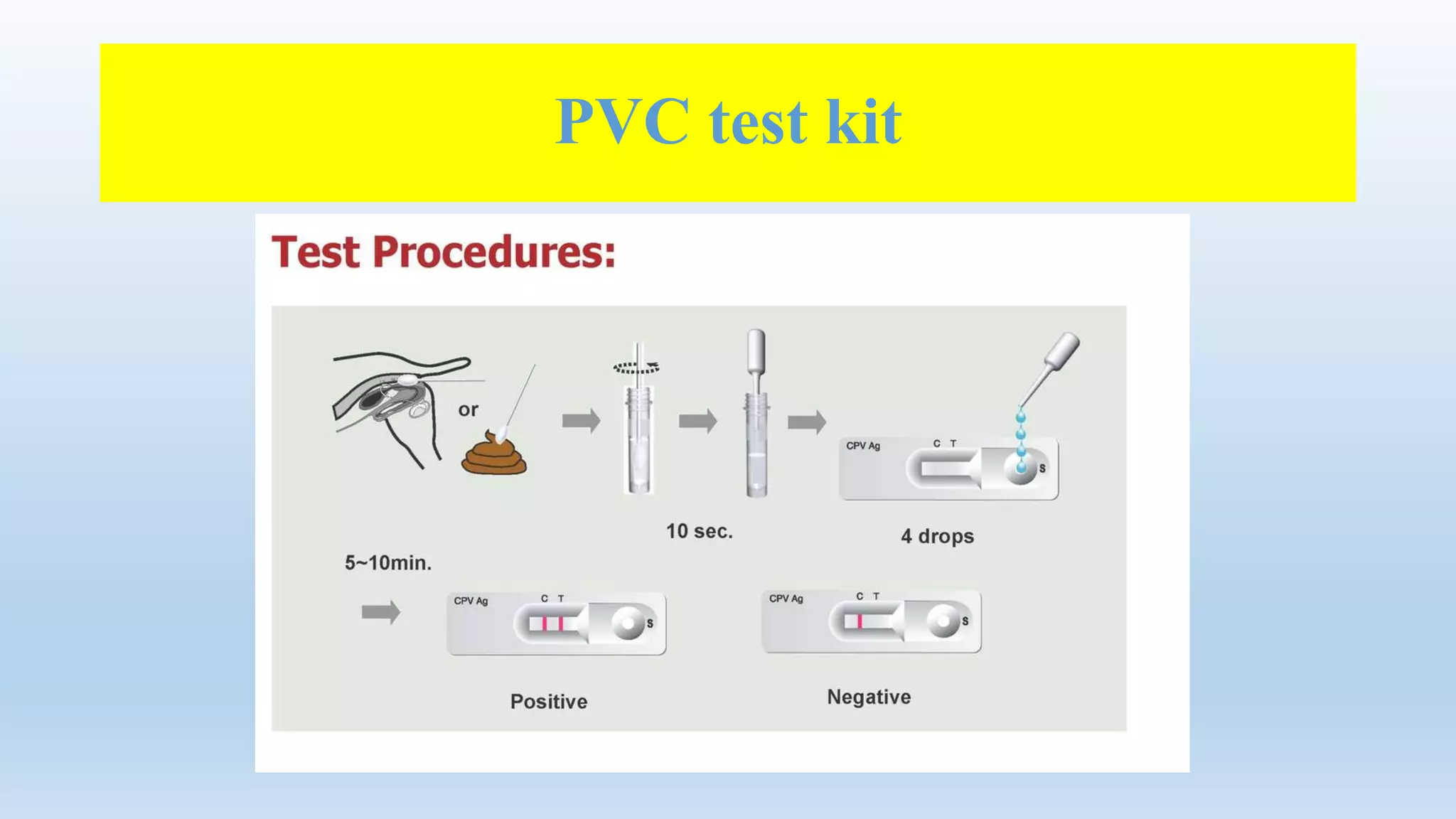
Among 3674 cases, 452 cases are seen positive while doing CPV Test
KIT
The study shows 1-4 months age dogs are more susceptible to the
Parvoviral infection. i.e. 1 month (18%), 2 months (22%), 3 months
(17%), 4 months (14%) and other (29%).
Photographs taken during study period
PVC test kit
Conclusion
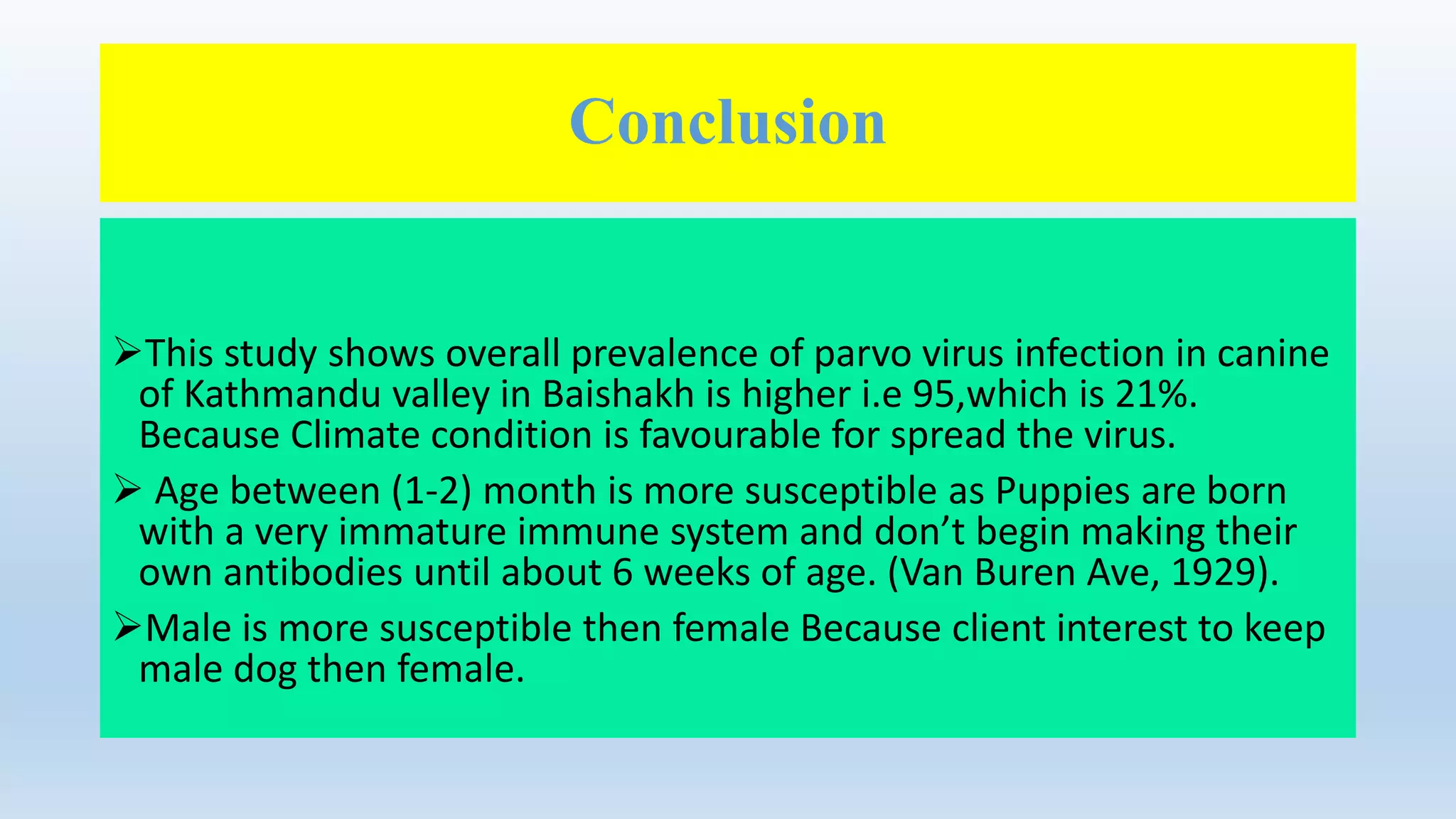
This study shows overall prevalence of parvo virus infection in canine
of Kathmandu valley in Baishakh is higher i.e 95,which is 21%.
Because Climate condition is favourable for spread the virus.
 Age between (1-2) month is more susceptible as Puppies are born
with a very immature immune system and don’t begin making their
own antibodies until about 6 weeks of age. (Van Buren Ave, 1929).
Male is more susceptible then female Because client interest to keep
male dog then female.
Suggestions
• Owners should be immediately consult veterinarian if their pets get
diarrhea and vomition.
• Vaccination should be done in schedule.
• Regular monitoring should be done for the parvo virus suspected
dogs.
• Isolation of parvo infected dog should be done from the kennel.
• Disinfect the dog’s environment.
• Treating the infected dog.
• vaccination all pets that have contact with affected pet.
Acknowledgement
Dr. Krishna Bahadur Shrestha, Principal, HICAST
Dr. Upendra Man Singh, Vet. Co-ordinator, HICAST
Dr. Dr. Bala Ram Thapa , Advisor.
MOBILE VET CONSULTANCY SERVICE ( MVCS)
Dr. Indra Narayan Ray
Dr. Sajana Thapa
Mr. Krishna Poudel
Mr. Surendra Thakur
All my friends and family.
THANK YOU

canine parvo virus

  • 1.
    PREVALENCE OF PARVOVIRUS INFECTION IN CANINE CASES OF MOBILE VET CONSULTANCY SERVICE LALITPUR, NEPAL Internee PRADHUMAN YADAV
  • 2.
    Internship Site Jaulakhel, Lalitpur Advisor Dr.Bala Ram Thapa Program Director at Directorate of Livestock Market Promotion
  • 3.
    INTRODUCTION The Parvo viralinfection in canine population was first recognized in 1978 that caused Parvovirus enteritis or myocarditis in U.S.A. After that, this was observed in Canada, Australia and England. And in following year in France, Holland, Belgium, Switzerland, Sweden, West German and other countries (Anon, 1979; Mc Candlish et al .,1979). The canine parvovirus (CPV) infection is a highly contagious viral illness that affects dogs.
  • 4.
    Susceptible Hosts Wide varietiesof hosts are affected with parvo virus infection. They are cattle, pig, dog, cat, man, rat, mice, chicken, and hamsters. Breeds like Doberman, English Springers, Labrador are at risk. Mean age and range: Most severe illness may occur in pups 6-16 weeks of age.
  • 5.
    Mode of transmission Thevirus is transmitted through direct or indirect contact with the infected animal or its excretions. Viruses are excreted in large quantity through the excreta of the hosts. Virus excretion continues for 12-14 days from infected animal (Pollock, 1981).
  • 6.
    Clinical signs Slight tohigh rise of temperature (Initial stage) Vomiting Bloody Diarrhea Loss of appetite
  • 7.
    Treatment of ParvoVirus infection Symptomatic treatment  Anti Vomiting drug  Anti diarrhoeal drug Supportive treatment  Fluid therapy
  • 8.
    OBJECTIVES General objective The studyon the clinical cases attended by MVCS(Mobile Vet Consultancy Service) from the year 1st Baishakh 2072 to 30th Chaitra 2072 BS (14 April 2015 to 13 April 2016 AD). Specific objectives To find out the overall clinical cases in dogs attended by MVCS. To find out the status of occurrence of clinical case as per age wise, sex wise and as per season wise .
  • 9.
    Justification of study Thestudies on the clinical case are very useful to find out the occurrence pattern of the disease, distribution of disease according to various factors like age, sex and time. Very few studies had been conducted in Nepal to determine the prevalence of parvo virus.
  • 10.
    Limitations of study Thisstudy was done only within limited period of time. Due to this, the analysis had to be completely based on secondary data in Mobile Vet Consultancy Service, Jawalakhel, Lalitpur. Sampling error may exist.
  • 11.
    Methodology Study Area -Jaulakhel Lalitpur Datacollection technique -case record book date 2072(1st Baishakh 2072 to 30th Chaitra) -Total Number Of cases were 3674, among them 455 cases were Canine Parvo virus Data analysis -MS-Excel 2010
  • 12.
    Result of Study Breed-wisedistribution of clinical case 1120 706 664 262 186 146 132 112 82 66 42 36 30 20 16 14 14 8 4 4 4 2 2 2 0 200 400 600 800 1000 1200 Numberofcases
  • 13.
    Sex-wise distribution ofclinical case 0 500 1000 1500 2000 2500 Male Female No.ofcases Male Female Sex 2176 1498
  • 14.
    Area-wise distribution ofclinical case 2594 872 140 38 10 8 4 6 2 0 500 1000 1500 2000 2500 3000 Lalitpur Kathmandu Bhaktapur Banepa Pokhara Chitwan hetauda Dhading Kurintar No.ofcasesinnumber
  • 15.
    Age-wise distribution ofclinical case 82 450 214 122 98 94 70 78 50 40 70 384 276 206 190188184 210 198 104110 58 74 44 36 20 10 4 4 2 6 0 50 100 150 200 250 300 350 400 450 500 1m 2m 3m 4m 5m 6m 7m 8m 9m 10m 11m 1yr 2yrs 3yrs 4yrs 5yrs 6yrs 7yrs 8yrs 9yrs 10yrs 11yrs 12yrs 13yrs 14yrs 15yrs 16yrs 17yrs 18yrs 19yrs 20yrs No.ofcasseinnumber
  • 16.
    Distribution of ParvoVirus Cases 3674 455 0 500 1000 1500 2000 2500 3000 3500 4000 Total Case Parvo Virus case NO. OF CASES
  • 17.
    Month-wise distribution ofparvo viral case 21% 16% 12% 1%4%3% 1% 5% 9% 8% 11% 9% Baishakh Jestha Ashar Shrawan Bhadra Asoj Kartik Mangsir Poush Magh Falgun Chaitra
  • 18.
    Age-wise distribution ofparvo viral case 82 99 79 64 40 34 20 8 8 4 4 6 4 0 0 0 0 0 0 0 0 0 0 0 0 0 0 0 0 0 00 20 40 60 80 100 120 1M 2M 3M 4M 5M 6M 7M 8M 9M 10M 11M 1YR 2YRS 3YRS 4YRS 5YRS 6YRS 7YRS 8YRS 9YRS 10YRS 11YRS 12YRS 13YRS 14YRS 15YRS 16YRS 17YRS 18YRS 19YRS 20YRS No.ofcases
  • 19.
    Discussion of Study Forthe purpose of this study, 3674 Clinical cases ware recorded, in which 2months (12%) age puppies and 1years (10%) – 3years (8%) age dog were highly susceptible with clinical disease and other (70%). It was observed that German Shepherd (GSD)-1120 (30%) was the most affected breed It was observed more of the cases were male - 2176 (59%) than female - 1498 (41%). It was observed that Lalitpur - 2594 (71%) was highest cases area came to MVCS than Kathmandu - 872(24%) and other - 208 (5%).
  • 20.
    Contd…. The study showthat Baishakh (21%) and Jestha (16%) is more occurring season for the Parvoviral infection and rest are Ashar(12%), Shrawan(1%), Bhadra(4%), Asoj(3%), Kartik(1%), Mangsir(5%), Poush(9%), Magh(8%), Falgun(11%) and Chaitra(9%). Among 3674 cases, 452 cases are seen positive while doing CPV Test KIT The study shows 1-4 months age dogs are more susceptible to the Parvoviral infection. i.e. 1 month (18%), 2 months (22%), 3 months (17%), 4 months (14%) and other (29%).
  • 21.
  • 22.
  • 23.
    Conclusion This study showsoverall prevalence of parvo virus infection in canine of Kathmandu valley in Baishakh is higher i.e 95,which is 21%. Because Climate condition is favourable for spread the virus.  Age between (1-2) month is more susceptible as Puppies are born with a very immature immune system and don’t begin making their own antibodies until about 6 weeks of age. (Van Buren Ave, 1929). Male is more susceptible then female Because client interest to keep male dog then female.
  • 24.
    Suggestions • Owners shouldbe immediately consult veterinarian if their pets get diarrhea and vomition. • Vaccination should be done in schedule. • Regular monitoring should be done for the parvo virus suspected dogs. • Isolation of parvo infected dog should be done from the kennel. • Disinfect the dog’s environment. • Treating the infected dog. • vaccination all pets that have contact with affected pet.
  • 25.
    Acknowledgement Dr. Krishna BahadurShrestha, Principal, HICAST Dr. Upendra Man Singh, Vet. Co-ordinator, HICAST Dr. Dr. Bala Ram Thapa , Advisor. MOBILE VET CONSULTANCY SERVICE ( MVCS) Dr. Indra Narayan Ray Dr. Sajana Thapa Mr. Krishna Poudel Mr. Surendra Thakur All my friends and family.
  • 26.