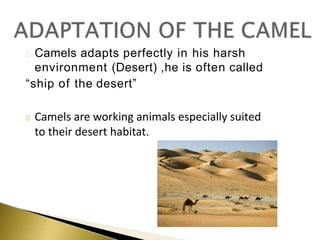
Camels adapts perfectly in his harsh
environment (Desert) ,he is often called
“ship of the desert”
Camels are working animals especially suited
to their desert habitat.
ADAPTATION TO
FOOD
Due to the harsh environment, plants in the
desert are dry or have thorns, but this plants
are the only food for the camels to eat since
he is a herbivore.
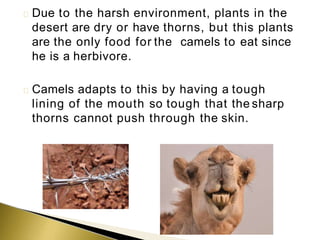
Camels adapts to this by having a tough
lining of the mouth so tough that the sharp
thorns cannot push through the skin.
As we know in the desert. It’s really hard for
plants to grow there, so there’s only a few
plants for the camels to find and eat.
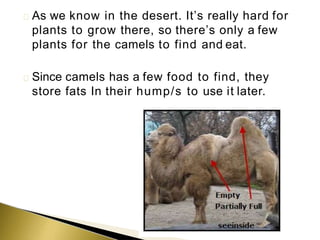
Since camels has a few food to find, they
store fats In their hump/s to use it later.
A camel does not chew its food well before
swallowing it. The animal's stomach has three
sections, one of which stores the poorly
chewed food. This food, is later returned to
the mouth in a ball-like glob, and the camel
chews it. The chewed food is then swallowed
and goes to the other parts of the stomach to
be completely digested.
ADAPTATION TO
SCARCITY OF
WATER
As we know that the desert doesn’t have that
much of water because it has a hot climate
and it doesn’t rain much there.
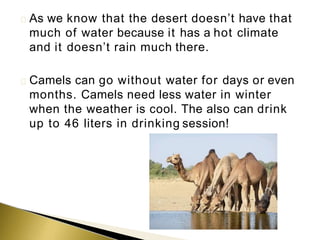
Camels can go without water for days or even
months. Camels need less water in winter
when the weather is cool. The also can drink
up to 46 liters in drinking session!
ADAPTATION TO
WEATHER
The climate in the desert is not good for
surviving. Winds sometimes can make a
sandstorm which cares a big amount of sand in
the air.
Camels Adapts to this by:
Camels’ Nostrils can be closed to Keep out
blowing sand.
Camels have Two rows of long eyelashes
to Protect it against blowing sand and the sun
Camel's ears are covered with hair, even on the
inside. The hair helps keep out sand or dust that
might blow into the ears.
ADAPTATION TO
TEMPERATURE
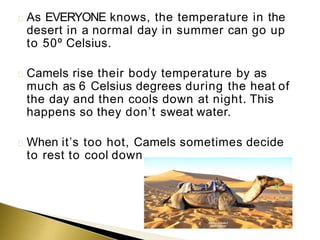
As EVERYONE knows, the temperature in the
desert in a normal day in summer can go up
to 50º Celsius.
Camels rise their body temperature by as
much as 6 Celsius degrees during the heat of
the day and then cools down at night. This
happens so they don’t sweat water.
When it’s too hot, Camels sometimes decide
to rest to cool down
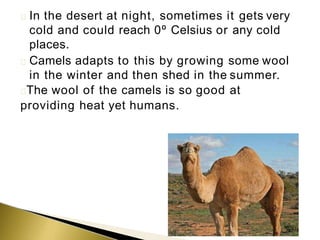
In the desert at night, sometimes it gets very
cold and could reach 0º Celsius or any cold
places.
Camels adapts to this by growing some wool
in the winter and then shed in the summer.
The wool of the camels is so good at
providing heat yet humans.
When camels rest, they have to sit down on
their knees ,but due to the hot temperature.
Sands becomes hot too.
Camels have Thick leathery patches on it’s
knees to Protect it from getting burn when it
kneels on the hot desert sand
ADAPTATION TO
THE TERRAINS OF
THE DESERT
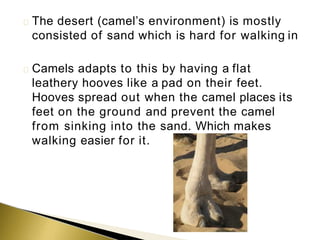
The desert (camel’s environment) is mostly
consisted of sand which is hard for walking in
Camels adapts to this by having a flat
leathery hooves like a pad on their feet.
Hooves spread out when the camel places its
feet on the ground and prevent the camel
from sinking into the sand. Which makes
walking easier for it.
The desert is a pretty huge area for camels to
travel in it and carry it’s own weight.
Camels have a long strong legs that could
help it travel for a long distances and carry
heavy weights.
Humans used camels for transporting and
carrying their goods for trading ,because it
could hold out the heavy weights and the
longs roads thanks to it’s legs.
Animal Adaptations In Tropical Rainforests
What is Tropical Rainforest?
The tropical rainforest is a hot, moist biome
where it rains all year long.
It is abundant with many species of wildlife and
vegetation.
The world’s largest tropical rainforests are in
South America, Africa, and Southeast Asia.
How Have Sloths Adapted to the Tropical
Rainforests?
The sloth moves very slowly, which makes it
harder for predators to see them.
Most interestingly, because of their slow
movement, algae grows on their fur which helps
them in camouflaging with the trees.
They also have three extra
neck bones to allow them
to turn their heads at 270°.
This is a very useful adaptation in a world where
predators can be above or below them.
Sloths cannot walk but are good swimmers when
the rainforest floods.
Sloths have longer arms than their legs for
climbing easily and curved feet for grasping
branches firmly.
They eat leaves that are hard to digest, but their
complex stomach breaks down and ferments them
easily.
Animal Adaptations In Grassland
How Have Bison Adapted to the Grassland?
Bison have specialized teeth and digestive systems
that help in breaking down tough grass.
Bison drink water only once a day.
They can eat snow if liquid
water is not available.
Despite their size, they are
able to run up to 30 miles
per hour if they are faced
with a threat.
Bison sport a pair of sharp,
curved horns, which they use to fend off predators
Camel adaptation.pptx

Camel adaptation.pptx

  • 1.
    Camels adapts perfectlyin his harsh environment (Desert) ,he is often called “ship of the desert” Camels are working animals especially suited to their desert habitat.
  • 2.
  • 3.
    Due to theharsh environment, plants in the desert are dry or have thorns, but this plants are the only food for the camels to eat since he is a herbivore. Camels adapts to this by having a tough lining of the mouth so tough that the sharp thorns cannot push through the skin.
  • 4.
    As we knowin the desert. It’s really hard for plants to grow there, so there’s only a few plants for the camels to find and eat. Since camels has a few food to find, they store fats In their hump/s to use it later.
  • 5.
    A camel doesnot chew its food well before swallowing it. The animal's stomach has three sections, one of which stores the poorly chewed food. This food, is later returned to the mouth in a ball-like glob, and the camel chews it. The chewed food is then swallowed and goes to the other parts of the stomach to be completely digested.
  • 6.
  • 7.
    As we knowthat the desert doesn’t have that much of water because it has a hot climate and it doesn’t rain much there. Camels can go without water for days or even months. Camels need less water in winter when the weather is cool. The also can drink up to 46 liters in drinking session!
  • 8.
  • 9.
    The climate inthe desert is not good for surviving. Winds sometimes can make a sandstorm which cares a big amount of sand in the air. Camels Adapts to this by: Camels’ Nostrils can be closed to Keep out blowing sand. Camels have Two rows of long eyelashes to Protect it against blowing sand and the sun Camel's ears are covered with hair, even on the inside. The hair helps keep out sand or dust that might blow into the ears.
  • 10.
  • 11.
    As EVERYONE knows,the temperature in the desert in a normal day in summer can go up to 50º Celsius. Camels rise their body temperature by as much as 6 Celsius degrees during the heat of the day and then cools down at night. This happens so they don’t sweat water. When it’s too hot, Camels sometimes decide to rest to cool down
  • 12.
    In the desertat night, sometimes it gets very cold and could reach 0º Celsius or any cold places. Camels adapts to this by growing some wool in the winter and then shed in the summer. The wool of the camels is so good at providing heat yet humans.
  • 13.
    When camels rest,they have to sit down on their knees ,but due to the hot temperature. Sands becomes hot too. Camels have Thick leathery patches on it’s knees to Protect it from getting burn when it kneels on the hot desert sand
  • 14.
  • 15.
    The desert (camel’senvironment) is mostly consisted of sand which is hard for walking in Camels adapts to this by having a flat leathery hooves like a pad on their feet. Hooves spread out when the camel places its feet on the ground and prevent the camel from sinking into the sand. Which makes walking easier for it.
  • 16.
    The desert isa pretty huge area for camels to travel in it and carry it’s own weight. Camels have a long strong legs that could help it travel for a long distances and carry heavy weights. Humans used camels for transporting and carrying their goods for trading ,because it could hold out the heavy weights and the longs roads thanks to it’s legs.
  • 17.
    Animal Adaptations InTropical Rainforests What is Tropical Rainforest? The tropical rainforest is a hot, moist biome where it rains all year long. It is abundant with many species of wildlife and vegetation. The world’s largest tropical rainforests are in South America, Africa, and Southeast Asia.
  • 18.
    How Have SlothsAdapted to the Tropical Rainforests? The sloth moves very slowly, which makes it harder for predators to see them. Most interestingly, because of their slow movement, algae grows on their fur which helps them in camouflaging with the trees. They also have three extra neck bones to allow them to turn their heads at 270°.
  • 19.
    This is avery useful adaptation in a world where predators can be above or below them. Sloths cannot walk but are good swimmers when the rainforest floods. Sloths have longer arms than their legs for climbing easily and curved feet for grasping branches firmly. They eat leaves that are hard to digest, but their complex stomach breaks down and ferments them easily.
  • 20.
    Animal Adaptations InGrassland How Have Bison Adapted to the Grassland? Bison have specialized teeth and digestive systems that help in breaking down tough grass. Bison drink water only once a day. They can eat snow if liquid water is not available. Despite their size, they are able to run up to 30 miles per hour if they are faced with a threat. Bison sport a pair of sharp, curved horns, which they use to fend off predators