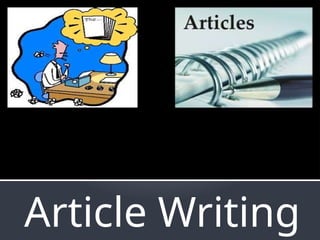
Article Writing
What should you include?
 In an article, you need to reason and
write an article as if it was going to be
published in a school magazine, or the
like. So, remember you are writing for
an audience – you want them to believe
what you write and to think your way.
Aspects to include in your
article
 Every article must have a headline related to the topic. It
is short, catchy and may even be clever.
 You should use a rhetorical question at least once in the
article. Because questions make people think about
what you are writing and the reader will feel you are
trying to talk to them.
 You should use words which include the reader: ‘we’, ‘us’
‘our’ etc. ‘Is this what we want for our school?’ for
instance – which combines the rhetorical question and
includes the inclusive pronouns.
 You could ‘paint a picture’ – to illustrate a point. ‘Let’s say
we don’t recycle and the rubbish keeps on piling higher
and higher…’
How is a conversational tone created in magazine
articles?
 Find examples (quotations) of:
 Contractions
 Colloquial informal language
 Humour
 Direct reader address
 Rhetorical features
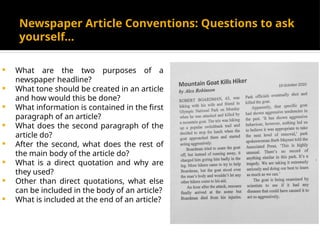
Newspaper Article Conventions: Questions to ask
yourself…
 What are the two purposes of a
newspaper headline?
 What tone should be created in an article
and how would this be done?
 What information is contained in the first
paragraph of an article?
 What does the second paragraph of the
article do?
 After the second, what does the rest of
the main body of the article do?
 What is a direct quotation and why are
they used?
 Other than direct quotations, what else
can be included in the body of an article?
 What is included at the end of an article?
Thinking of arguments…
 You need to think of logical arguments to support
your point. Possibly you need to think of four counter
arguments that the other side would say is important.
Some example topics:
 Are mobile phones always a good thing?
 Why daily PE should be essential for everyone
 Space exploration – is it a waste of money?
 Is smoking in any way a good thing?
Pick one of the above and write down four reasons for and
against the topic.
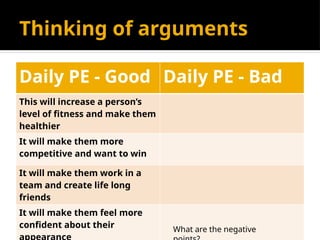
Thinking of arguments
Daily PE - Good Daily PE - Bad
This will increase a person’s
level of fitness and make them
healthier
It will make them more
competitive and want to win
It will make them work in a
team and create life long
friends
It will make them feel more
confident about their What are the negative
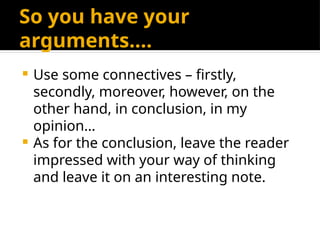
So you have your
arguments….
 Use some connectives – firstly,
secondly, moreover, however, on the
other hand, in conclusion, in my
opinion…
 As for the conclusion, leave the reader
impressed with your way of thinking
and leave it on an interesting note.
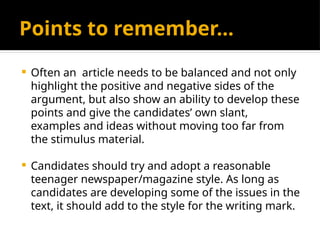
Points to remember…
 Often an article needs to be balanced and not only
highlight the positive and negative sides of the
argument, but also show an ability to develop these
points and give the candidates’ own slant,
examples and ideas without moving too far from
the stimulus material.
 Candidates should try and adopt a reasonable
teenager newspaper/magazine style. As long as
candidates are developing some of the issues in the
text, it should add to the style for the writing mark.

Article Writing PowerPoint.pptx for English Language IGCSE

  • 1.
  • 2.
    What should youinclude?  In an article, you need to reason and write an article as if it was going to be published in a school magazine, or the like. So, remember you are writing for an audience – you want them to believe what you write and to think your way.
  • 3.
    Aspects to includein your article  Every article must have a headline related to the topic. It is short, catchy and may even be clever.  You should use a rhetorical question at least once in the article. Because questions make people think about what you are writing and the reader will feel you are trying to talk to them.  You should use words which include the reader: ‘we’, ‘us’ ‘our’ etc. ‘Is this what we want for our school?’ for instance – which combines the rhetorical question and includes the inclusive pronouns.  You could ‘paint a picture’ – to illustrate a point. ‘Let’s say we don’t recycle and the rubbish keeps on piling higher and higher…’
  • 4.
    How is aconversational tone created in magazine articles?  Find examples (quotations) of:  Contractions  Colloquial informal language  Humour  Direct reader address  Rhetorical features
  • 5.
    Newspaper Article Conventions:Questions to ask yourself…  What are the two purposes of a newspaper headline?  What tone should be created in an article and how would this be done?  What information is contained in the first paragraph of an article?  What does the second paragraph of the article do?  After the second, what does the rest of the main body of the article do?  What is a direct quotation and why are they used?  Other than direct quotations, what else can be included in the body of an article?  What is included at the end of an article?
  • 6.
    Thinking of arguments… You need to think of logical arguments to support your point. Possibly you need to think of four counter arguments that the other side would say is important. Some example topics:  Are mobile phones always a good thing?  Why daily PE should be essential for everyone  Space exploration – is it a waste of money?  Is smoking in any way a good thing? Pick one of the above and write down four reasons for and against the topic.
  • 7.
    Thinking of arguments DailyPE - Good Daily PE - Bad This will increase a person’s level of fitness and make them healthier It will make them more competitive and want to win It will make them work in a team and create life long friends It will make them feel more confident about their What are the negative
  • 8.
    So you haveyour arguments….  Use some connectives – firstly, secondly, moreover, however, on the other hand, in conclusion, in my opinion…  As for the conclusion, leave the reader impressed with your way of thinking and leave it on an interesting note.
  • 9.
    Points to remember… Often an article needs to be balanced and not only highlight the positive and negative sides of the argument, but also show an ability to develop these points and give the candidates’ own slant, examples and ideas without moving too far from the stimulus material.  Candidates should try and adopt a reasonable teenager newspaper/magazine style. As long as candidates are developing some of the issues in the text, it should add to the style for the writing mark.