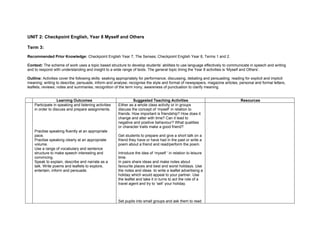
UNIT 2: Checkpoint English, Year 8 Myself and Others
Term 3:
Recommended Prior Knowledge: Checkpoint English Year 7, The Senses; Checkpoint English Year 8, Terms 1 and 2.
Context: The scheme of work uses a topic based structure to develop students’ abilities to use language effectively to communicate in speech and writing
and to respond with understanding and insight to a wide range of texts. The general topic lining the Year 8 activities is ‘Myself and Others’.
Outline: Activities cover the following skills: seaking appropriately for performance; discussing, debating and persuading; reading for explicit and implicit
meaning; writing to describe, persuade, inform and analyse; recognise the style and format of newspapers, magazine articles, personal and formal letters,
leaflets, reviews; notes and summaries; recognition of the term irony; awareness of punctuation to clarify meaning.
Learning Outcomes Suggested Teaching Activities Resources
Participate in speaking and listening activities
in order to discuss and prepare assignments.
Practise speaking fluently at an appropriate
pace.
Practise speaking clearly at an appropriate
volume.
Use a range of vocabulary and sentence
structure to make speech interesting and
convincing.
Speak to explain, describe and narrate as a
talk. Write poems and leaflets to explore,
entertain, inform and persuade.
Either as a whole class activity or in groups
discuss the concept of ‘myself’ in relation to
friends. How important is friendship? How does it
change and alter with time? Can it lead to
negative and positive behaviour? What qualities
or character traits make a good friend?
Get students to prepare and give a short talk on a
friend they have or have had in the past or write a
poem about a friend and read/perform the poem.
Introduce the idea of ‘myself ‘ in relation to leisure
time.
In pairs share ideas and make notes about
favourite places and best and worst holidays. Use
the notes and ideas to write a leaflet advertising a
holiday which would appeal to your partner. Use
the leaflet and take it in turns to act the role of a
travel agent and try to ‘sell’ your holiday.
.
Set pupils into small groups and ask them to read
Recognise implied meaning, such as the
inference of character or the meaning
contained in an images.
Learn a range of vocabulary appropriate to
their needs. Learn the use of irony.
Recognise explicit meaning, select, collate and
summarise facts and ideas, using their own
words where appropriate to demonstrate
understanding.
Participate in speaking and listening activities
in order to discuss and prepare assignments.
Write for a variety of purposes, such as to
inform, explore and analyse as a report.
Speak, discuss, argue and persuade in a
debate.
the poem Ozymandias by Shelley. What can they
see in the poem? What do they think the poem is
about?
Introduce and discuss the idea of irony and how
the poem is ironic.
Use the words and phrases in Resources (1) to
help develop a vocabulary list to write a paragraph
describing a ruin in a deserted place.
As a class or group activity discuss how the
descriptive paragraph might be adapted to an
opening for a story. Develop the idea of story
openings.(2)
Discuss how technology has changed our view of
travelling.
Read extracts from information texts which
describe methods and forms of travelling.
Remind or introduce the term summary.
Summarise one of the reading extracts
Introduce idea of personal interests and use of
leisure time. Organise a class survey. See
Resources (3) Present findings with graphs and a
written report highlighting the most interesting
things discovered.
As a follow up to the survey on personal interests,
organise a debate: computer games and TV are a
waste of time and are no good for your social life.
Read some reviews of films and books in
newspapers and magazines.
(1)
vast trunkless legs of stone, boundless, no sound
and no movement, barren scene, Shattered
visage, bare, colossal wreck, lone, wide expanse,
huge arch, sense of loneliness
(2)
Reading between the Lines, Fiction and Poetry -
Sue Bonnett – Letts Educational –2001 ISBN
1840855762 p.10 – 38.
(3)Survey: What are your interests/hobbies? How
much time do you spend on each of them? Why
do you enjoy what you do? Are you a beginner, an
expert or in between?
(4)Unit 7 Checkpoint English 1
(5)
Letter Examples
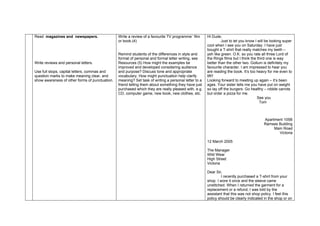
Read magazines and newspapers.
Write reviews and personal letters.
Use full stops, capital letters, commas and
question marks to make meaning clear, and
show awareness of other forms of punctuation.
Write a review of a favourite TV programme` film
or book.(4)
Remind students of the differences in style and
format of personal and formal letter writing, see
Resources (5) How might the examples be
improved and developed considering audience
and purpose? Discuss tone and appropriate
vocabulary. How might punctuation help clarify
meaning? Set task of writing a personal letter to a
friend telling them about something they have just
purchased which they are really pleased with, e.g.
CD, computer game, new book, new clothes, etc.
Hi Dude,
Just to let you know I will be looking super
cool when I see you on Saturday. I have just
bought a T-shirt that really matches my teeth –
yeh like green. O.K. so you rate all three Lord of
the Rings films but I think the third one is way
better than the other two. Gollum is definitely my
favourite character. I am impressed to hear you
are reading the book. It’s too heavy for me even to
lift!!
Looking forward to meeting up again – it’s been
ages. Your sister tells me you have put on weight
so lay off the burgers. Go healthy – nibble carrots
but order a pizza for me.
See you
Tom
Apartment 105B
Ramses Building
Main Road
Victoria
12 March 2005
The Manager
Wild Wear
High Street
Victoria
Dear Sir,
I recently purchased a T-shirt from your
shop. I wore it once and the sleeve came
unstitched. When I returned the garment for a
replacement or a refund, I was told by the
assistant that this was not shop policy. I feel this
policy should be clearly indicated in the shop or on
the garments so the consumers are aware of it.
Yours faithfully
Thomas Fuller

Cambridge Checkpoint

  • 1.
    UNIT 2: CheckpointEnglish, Year 8 Myself and Others Term 3: Recommended Prior Knowledge: Checkpoint English Year 7, The Senses; Checkpoint English Year 8, Terms 1 and 2. Context: The scheme of work uses a topic based structure to develop students’ abilities to use language effectively to communicate in speech and writing and to respond with understanding and insight to a wide range of texts. The general topic lining the Year 8 activities is ‘Myself and Others’. Outline: Activities cover the following skills: seaking appropriately for performance; discussing, debating and persuading; reading for explicit and implicit meaning; writing to describe, persuade, inform and analyse; recognise the style and format of newspapers, magazine articles, personal and formal letters, leaflets, reviews; notes and summaries; recognition of the term irony; awareness of punctuation to clarify meaning. Learning Outcomes Suggested Teaching Activities Resources Participate in speaking and listening activities in order to discuss and prepare assignments. Practise speaking fluently at an appropriate pace. Practise speaking clearly at an appropriate volume. Use a range of vocabulary and sentence structure to make speech interesting and convincing. Speak to explain, describe and narrate as a talk. Write poems and leaflets to explore, entertain, inform and persuade. Either as a whole class activity or in groups discuss the concept of ‘myself’ in relation to friends. How important is friendship? How does it change and alter with time? Can it lead to negative and positive behaviour? What qualities or character traits make a good friend? Get students to prepare and give a short talk on a friend they have or have had in the past or write a poem about a friend and read/perform the poem. Introduce the idea of ‘myself ‘ in relation to leisure time. In pairs share ideas and make notes about favourite places and best and worst holidays. Use the notes and ideas to write a leaflet advertising a holiday which would appeal to your partner. Use the leaflet and take it in turns to act the role of a travel agent and try to ‘sell’ your holiday. . Set pupils into small groups and ask them to read
  • 2.
    Recognise implied meaning,such as the inference of character or the meaning contained in an images. Learn a range of vocabulary appropriate to their needs. Learn the use of irony. Recognise explicit meaning, select, collate and summarise facts and ideas, using their own words where appropriate to demonstrate understanding. Participate in speaking and listening activities in order to discuss and prepare assignments. Write for a variety of purposes, such as to inform, explore and analyse as a report. Speak, discuss, argue and persuade in a debate. the poem Ozymandias by Shelley. What can they see in the poem? What do they think the poem is about? Introduce and discuss the idea of irony and how the poem is ironic. Use the words and phrases in Resources (1) to help develop a vocabulary list to write a paragraph describing a ruin in a deserted place. As a class or group activity discuss how the descriptive paragraph might be adapted to an opening for a story. Develop the idea of story openings.(2) Discuss how technology has changed our view of travelling. Read extracts from information texts which describe methods and forms of travelling. Remind or introduce the term summary. Summarise one of the reading extracts Introduce idea of personal interests and use of leisure time. Organise a class survey. See Resources (3) Present findings with graphs and a written report highlighting the most interesting things discovered. As a follow up to the survey on personal interests, organise a debate: computer games and TV are a waste of time and are no good for your social life. Read some reviews of films and books in newspapers and magazines. (1) vast trunkless legs of stone, boundless, no sound and no movement, barren scene, Shattered visage, bare, colossal wreck, lone, wide expanse, huge arch, sense of loneliness (2) Reading between the Lines, Fiction and Poetry - Sue Bonnett – Letts Educational –2001 ISBN 1840855762 p.10 – 38. (3)Survey: What are your interests/hobbies? How much time do you spend on each of them? Why do you enjoy what you do? Are you a beginner, an expert or in between? (4)Unit 7 Checkpoint English 1 (5) Letter Examples
  • 3.
    Read magazines andnewspapers. Write reviews and personal letters. Use full stops, capital letters, commas and question marks to make meaning clear, and show awareness of other forms of punctuation. Write a review of a favourite TV programme` film or book.(4) Remind students of the differences in style and format of personal and formal letter writing, see Resources (5) How might the examples be improved and developed considering audience and purpose? Discuss tone and appropriate vocabulary. How might punctuation help clarify meaning? Set task of writing a personal letter to a friend telling them about something they have just purchased which they are really pleased with, e.g. CD, computer game, new book, new clothes, etc. Hi Dude, Just to let you know I will be looking super cool when I see you on Saturday. I have just bought a T-shirt that really matches my teeth – yeh like green. O.K. so you rate all three Lord of the Rings films but I think the third one is way better than the other two. Gollum is definitely my favourite character. I am impressed to hear you are reading the book. It’s too heavy for me even to lift!! Looking forward to meeting up again – it’s been ages. Your sister tells me you have put on weight so lay off the burgers. Go healthy – nibble carrots but order a pizza for me. See you Tom Apartment 105B Ramses Building Main Road Victoria 12 March 2005 The Manager Wild Wear High Street Victoria Dear Sir, I recently purchased a T-shirt from your shop. I wore it once and the sleeve came unstitched. When I returned the garment for a replacement or a refund, I was told by the assistant that this was not shop policy. I feel this policy should be clearly indicated in the shop or on
  • 4.
    the garments sothe consumers are aware of it. Yours faithfully Thomas Fuller