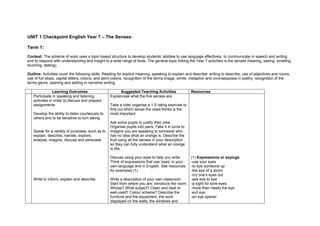
UNIT 1 Checkpoint English Year 7 – The Senses:
Term 1:
Context: The scheme of work uses a topic-based structure to develop students’ abilities to use language effectively, to communicate in speech and writing
and to respond with understanding and insight to a wide range of texts. The general topic linking the Year 7 activities is the senses (hearing, seeing, smelling,
touching, tasting).
Outline: Activities cover the following skills: Reading for explicit meaning; speaking to explain and describe; writing to describe; use of adjectives and nouns,
use of full stops, capital letters, colons, and semi-colons; recognition of the terms image, simile. metaphor and onomatopoeia in poetry; recognition of the
terms genre, opening and setting in narrative writing.
Learning Outcomes Suggested Teaching Activities Resources
Participate in speaking and listening
activities in order to discuss and prepare
assignments.
Develop the ability to listen courteously to
others and to be sensitive to turn taking
Speak for a variety of purposes, such as to
explain, describe, narrate, explore,
analyse, imagine, discuss and persuade.
Write to inform, explain and describe.
Explain/ask what the five senses are.
Take a vote/ organise a 1-5 rating exercise to
find out which sense the class thinks is the
most important.
Ask some pupils to justify their view.
Organise pupils into pairs. Take it in turns to
imagine you are speaking to someone who
has no idea what an orange is. Describe the
fruit using all the senses in your description
so they can fully understand what an orange
is like.
Discuss using your eyes to help you write.
Think of expressions that use ‘eyes’ in your
own language and in English. See resources
for examples.(1)
Write a description of your own classroom.
Start from where you are; introduce the room;
Whose? What subject? Clean and neat or
well-used? Colour scheme? Describe the
furniture and the equipment, the work
displayed on the walls, the windows and
(1) Expressions or sayings
-use your eyes
-to eye someone up
-the eye of a storm
-cry one’s eyes out
-see eye to eye
-a sight for sore eyes
-more than meets the eye
-evil eye
-an eye opener
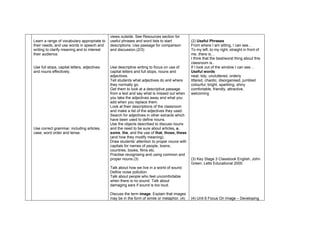
Learn a range of vocabulary appropriate to
their needs, and use words in speech and
writing to clarify meaning and to interest
their audience.
Use full stops, capital letters, adjectives
and nouns effectively.
Use correct grammar, including articles,
case, word order and tense.
views outside. See Resources section for
useful phrases and word lists to start
descriptions. Use passage for comparison
and discussion.(2/3)
Use descriptive writing to focus on use of
capital letters and full stops, nouns and
adjectives.
Tell students what adjectives do and where
they normally go.
Get them to look at a descriptive passage
from a text and say what is missed out when
you take the adjectives away and what you
add when you replace them.
Look at their descriptions of the classroom
and make a list of the adjectives they used.
Search for adjectives in other extracts which
have been used to define nouns.
Use the objects described to discuss nouns
and the need to be sure about articles, a,
some, the, and the use of that, those, these
(and how they modify meaning).
Draw students’ attention to proper nouns with
capitals for names of people, towns,
countries, books, films etc.
Practise recognising and using common and
proper nouns.(3)
Talk about how we live in a world of sound.
Define noise pollution.
Talk about people who feel uncomfortable
when there is no sound. Talk about
damaging ears if sound is too loud.
Discuss the term image. Explain that images
may be in the form of simile or metaphor. (4)
(2) Useful Phrases
From where I am sitting, I can see…
To my left..to my right..straight in front of
me..there is…
I think that the best/worst thing about this
classroom is..
If I look out of the window I can see…
Useful words
neat, tidy, uncluttered, orderly
littered, chaotic, disorganised, jumbled
colourful, bright, sparkling, shiny
comfortable, friendly, attractive,
welcoming
(3) Key Stage 3 Classbook English, John
Green, Letts Educational 2000
(4) Unit 6 Focus On Image – Developing
Learn to use the terms image, simile,
metaphor and onomatopoeia.
Write poems.
Learn a range of vocabulary appropriate to
their needs, and use vocabulary in speech
and in writing to clarify meaning and to
interest their audience.
Recognise implicit meaning, select and
interpret material from a reading passage.
Learn to use the terms genre and setting.
Write stories and descriptions, provide
settings for stories.
Use colons and semi-colons.
Write a poem using the same line to start
each verse. Try to include simile or metaphor
in the verses. See resources (5) for useful
first lines and words.
Discuss onomatopoeia. Explore rhythms,
rhymes and sound effects.(6)
Introduce how using words associated with
sound and silence builds up an atmosphere
of unease, expectation and fear.
Introduce the term genre to discuss the
features one would expect in a ghost story or
horror story.(7) What sort of setting might a
ghost or horror story have?
Set reading tasks to investigate and report on
a variety of ghost and horror stories to
compare descriptions of settings. (8)
Write an opening of a ghost or horror story
focusing on the description of the setting.
Discuss how a writer makes use of the colon
and semi-colon. Set practise exercises for
use of these punctuation marks.
Poetry Skills, Geoff Barton, Heinemann
1998
(5) Useful first lines
My room was so quiet
The day was so quiet
The house was so quiet
I lay there so quiet
Useful words
Whisper, murmur, sigh, moan, muffled,
mutter, drone, buzz, trembling, inaudible,
patter, tinkle, rustle creak, click.
(6) Unit 3, Checkpoint English 1, Sue
Hackman, Alan Howe, Sue Bonnett,
Hodder Murray, ISBN 0340887397
(7) Unit 8 Checkpoint English 2, Sue
Hackman, Alan Howe, Sue Bonnett,
Hodder Murray. (Forthcoming)
(8)Stories from Different Genres ed. Mike
Hamlin Christine Hall and Jane Brown,
Heinemann 1998
Demonstrate understanding of features of
narrative texts by developing them in their
own discussion and writing.
Set reading tasks to investigate and report on
a variety of ghost and horror stories to
compare descriptions of settings. (9)

Cambridge Checkpoint

  • 1.
    UNIT 1 CheckpointEnglish Year 7 – The Senses: Term 1: Context: The scheme of work uses a topic-based structure to develop students’ abilities to use language effectively, to communicate in speech and writing and to respond with understanding and insight to a wide range of texts. The general topic linking the Year 7 activities is the senses (hearing, seeing, smelling, touching, tasting). Outline: Activities cover the following skills: Reading for explicit meaning; speaking to explain and describe; writing to describe; use of adjectives and nouns, use of full stops, capital letters, colons, and semi-colons; recognition of the terms image, simile. metaphor and onomatopoeia in poetry; recognition of the terms genre, opening and setting in narrative writing. Learning Outcomes Suggested Teaching Activities Resources Participate in speaking and listening activities in order to discuss and prepare assignments. Develop the ability to listen courteously to others and to be sensitive to turn taking Speak for a variety of purposes, such as to explain, describe, narrate, explore, analyse, imagine, discuss and persuade. Write to inform, explain and describe. Explain/ask what the five senses are. Take a vote/ organise a 1-5 rating exercise to find out which sense the class thinks is the most important. Ask some pupils to justify their view. Organise pupils into pairs. Take it in turns to imagine you are speaking to someone who has no idea what an orange is. Describe the fruit using all the senses in your description so they can fully understand what an orange is like. Discuss using your eyes to help you write. Think of expressions that use ‘eyes’ in your own language and in English. See resources for examples.(1) Write a description of your own classroom. Start from where you are; introduce the room; Whose? What subject? Clean and neat or well-used? Colour scheme? Describe the furniture and the equipment, the work displayed on the walls, the windows and (1) Expressions or sayings -use your eyes -to eye someone up -the eye of a storm -cry one’s eyes out -see eye to eye -a sight for sore eyes -more than meets the eye -evil eye -an eye opener
  • 2.
    Learn a rangeof vocabulary appropriate to their needs, and use words in speech and writing to clarify meaning and to interest their audience. Use full stops, capital letters, adjectives and nouns effectively. Use correct grammar, including articles, case, word order and tense. views outside. See Resources section for useful phrases and word lists to start descriptions. Use passage for comparison and discussion.(2/3) Use descriptive writing to focus on use of capital letters and full stops, nouns and adjectives. Tell students what adjectives do and where they normally go. Get them to look at a descriptive passage from a text and say what is missed out when you take the adjectives away and what you add when you replace them. Look at their descriptions of the classroom and make a list of the adjectives they used. Search for adjectives in other extracts which have been used to define nouns. Use the objects described to discuss nouns and the need to be sure about articles, a, some, the, and the use of that, those, these (and how they modify meaning). Draw students’ attention to proper nouns with capitals for names of people, towns, countries, books, films etc. Practise recognising and using common and proper nouns.(3) Talk about how we live in a world of sound. Define noise pollution. Talk about people who feel uncomfortable when there is no sound. Talk about damaging ears if sound is too loud. Discuss the term image. Explain that images may be in the form of simile or metaphor. (4) (2) Useful Phrases From where I am sitting, I can see… To my left..to my right..straight in front of me..there is… I think that the best/worst thing about this classroom is.. If I look out of the window I can see… Useful words neat, tidy, uncluttered, orderly littered, chaotic, disorganised, jumbled colourful, bright, sparkling, shiny comfortable, friendly, attractive, welcoming (3) Key Stage 3 Classbook English, John Green, Letts Educational 2000 (4) Unit 6 Focus On Image – Developing
  • 3.
    Learn to usethe terms image, simile, metaphor and onomatopoeia. Write poems. Learn a range of vocabulary appropriate to their needs, and use vocabulary in speech and in writing to clarify meaning and to interest their audience. Recognise implicit meaning, select and interpret material from a reading passage. Learn to use the terms genre and setting. Write stories and descriptions, provide settings for stories. Use colons and semi-colons. Write a poem using the same line to start each verse. Try to include simile or metaphor in the verses. See resources (5) for useful first lines and words. Discuss onomatopoeia. Explore rhythms, rhymes and sound effects.(6) Introduce how using words associated with sound and silence builds up an atmosphere of unease, expectation and fear. Introduce the term genre to discuss the features one would expect in a ghost story or horror story.(7) What sort of setting might a ghost or horror story have? Set reading tasks to investigate and report on a variety of ghost and horror stories to compare descriptions of settings. (8) Write an opening of a ghost or horror story focusing on the description of the setting. Discuss how a writer makes use of the colon and semi-colon. Set practise exercises for use of these punctuation marks. Poetry Skills, Geoff Barton, Heinemann 1998 (5) Useful first lines My room was so quiet The day was so quiet The house was so quiet I lay there so quiet Useful words Whisper, murmur, sigh, moan, muffled, mutter, drone, buzz, trembling, inaudible, patter, tinkle, rustle creak, click. (6) Unit 3, Checkpoint English 1, Sue Hackman, Alan Howe, Sue Bonnett, Hodder Murray, ISBN 0340887397 (7) Unit 8 Checkpoint English 2, Sue Hackman, Alan Howe, Sue Bonnett, Hodder Murray. (Forthcoming) (8)Stories from Different Genres ed. Mike Hamlin Christine Hall and Jane Brown, Heinemann 1998
  • 4.
    Demonstrate understanding offeatures of narrative texts by developing them in their own discussion and writing. Set reading tasks to investigate and report on a variety of ghost and horror stories to compare descriptions of settings. (9)