10.22376/ijpbs/lpr.2022.12.1.P79-87
ijlpr 2022; doi
Revised On 8 December, 2021
Accepted On 17 December, 2021
Published On 7 January, 2022
Funding This research did not receive any specific grant from any funding agencies in the public, commercial or not for profit sectors.
Copyright @ International Journal of Life Science and Pharma Research, available at www.ijlpr.com
Int J Life Sci Pharma Res., Volume12., No 1 (January) 2022, pp P79-87
This article is under the CC BY- NC-ND Licence (https://creativecommons.org/licenses/by-nc-nd/4.0)
Citation Pavithra Bharathy, Shabna Roupal Morais , Change Control Management: An Overview.(2022).Int. J. Life Sci. Pharma Res.12(1), P79-
87 http://dx.doi.org/10.22376/ijpbs/lpr.2022.12.1.P79-87
Received On 22 September, 2021
Shabna Roupal Morais , Assistant Professor, Department of
Pharmaceutical Chemistry, Sri Ramachandra Faculty of
Pharmacy, Sri Ramachandra institute of higher Education and
Research, Porur, Chennai-600116
*Corresponding Author
Review Article
Allied Sciences
International Journal of Life science and Pharma Research
Change Control Management: An Overview
Pavithra Bharathy1
, Shabna Roupal Morais2
*
1
Student, Department of Pharmaceutical Chemistry, Sri Ramachandra College of Pharmacy, , Sri Ramachandra Institute of Higher
Education and Research Porur, Chennai -600116.
2*
Assistant Professor, Department of Pharmaceutical Chemistry, Sri Ramachandra Faculty of Pharmacy, Sri Ramachandra institute of
higher Education and Research, Porur, Chennai-600116
Abstract: Change control is a basic element of the quality management system of a pharmaceutical company, that focuses
on controlling change to provide a quality product by preventing non - compliance. Changes may occur at any time during the
product life cycle, leading to changes in the manufacturing process, the number of materials, and the manufacturing location.
All of these changes are post-approved changes. These changes can be controlled and not eliminated, through proper
assessment and action plans. The change control committee consisting of the head of quality assurance, manufacturing, sales
and other members of relevant disciplines, inspect the proposed changes that may alter the validated and qualified state of
facilities, equipment or process. The proposed change will likely have an impact on the quality of production or Good
Manufacturing Practice as there are done to be in line with the International Standard Organization requirements. These
approved changes should not impact the quality, safety and potency of medicinal product. If ignored, it makes the patient life
- critical which may even lead to death. This present review provides an overview of the industry’s Change Control change
management protocol in Quality Management System in a company. The major objective is to identify, evaluate, measure,
provide action and final authorization to ensure that the changes should not affect the product strength, integrity, purity,
quality, or safety. There are many aspects of view on the change control management that take place in the pharmaceutical
industry, where we can gain knowledge on concepts of change control. This article also delivers a flow of change
management process starting from the request on change by an initiator to the closure of change with appropriate remedial
action and follow up assigned by Quality Unit and other responsible authorities.
Keywords: Quality management system, change control, post approval change, Quality assurance.
ISSN 2250-0480
P-79
ijlpr 2022; doi 10.22376/ijpbs/lpr.2022.12.1.P79-87 Allied Sciences
P-80
1. INTRODUCTION
Change control management is the crucial aspect of a quality
management system, that focuses on controlling change to
provide a quality product by preventing non-compliance. It is
a formal system to ensure that changes do not affect the
validated state of facilities, equipment, processes or, systems
and through which qualified representatives document that
the system remains in an approved state. Any key changes in
the manufacturing process, including equipment or material
changes, require verification, that may affect product quality,
safety and reproducibility of a quality product.1-3
There
should be a written procedure to identify, analyze and
control changes. It should cover all plans, protocols and
requirements involved in change control management. If
there is any deviation from the approved state, it should be
formulated, reviewed and approved by the corresponding
organizational unit, and reviewed and approved by the quality
control department. Any deviations from written
specifications, standards, sampling plans, test procedures, or
other laboratory control mechanisms must be recorded and
justified.4,5
There should be a written procedure describing
the measures that should be taken when raw materials,
product components, processing equipment, and processes
change. The environment (or location), manufacturing or
testing process, or any other changes that may affect product
quality or process reproducibility must be taken into
account. Change control procedures should ensure that
there is sufficient evidence that the modified process meets
the required quality of the product with approved
specifications.6-8
2. SOURCES OF CHANGES
● Formulation - composition and percentage of
active and inactive ingredient.
● API - change in grade, new manufacturer, process
and physical characteristics.
● Equipment - change in scale (pilot batch,
commercial batch, bio batch) change in principle and process
optimization.
● Cleaning procedure - change in manual to
automated, change in configuration, schedule of equipment9
.
● Manufacturing process- change in critical
parameter, operating condition, scale up, technology transfer.
● Analytical method: change in qualification,
validation state, modification of compendial method.
● Stability study: change in storage condition,
container closure system, expiry period and shelf life.
● Facility and utility: change in cross contamination
maintenance, validated classified area, HVAC system,
compressed air and dust collection system.
● Packaging components: change in container,
closure, change in labeling, inserts, change in packaging
material. 10
3. RESPONSIBILITY
Production managers, QC managers, sales managers and
communications officers in their respective fields are
responsible for the appropriate planning, implementation and
approval of changes.11
They should ensure that the ranking
status of rooms and places affected by the change or re-
certification is maintained when the change occurs; the
verification status of the process/procedure affected by the
change or re-verification is retained.12
The changes in drug
production, testing and labeling are based on valid approval
documents required to update the changes. The Change
Control Committee (CCC) is responsible for the
organization and processing of the change control
procedures and the preparation of documents. The members
of the CCC are the regulatory affairs supervisor and the
quality assurance officer. The committee is responsible for
evaluating the risk of modification, approval or rejection of
the request. The application implements the necessary
measures through installation and programming. The QA
officer the chairman of the CCC, is responsible for
convening CCC meetings and minuting the meeting, filling in
change requests, submitting change requests control, record
distribution procedures, and maintaining the change database.
Control procedures, control compliance deadlines. The QA
representative is responsible for reviewing periodically and to
ensure whether documents are revised and updated
whenever necessary; and release a new version at least every
two years.13
4. CHANGE CONTROL CHANGE
MANAGEMENT
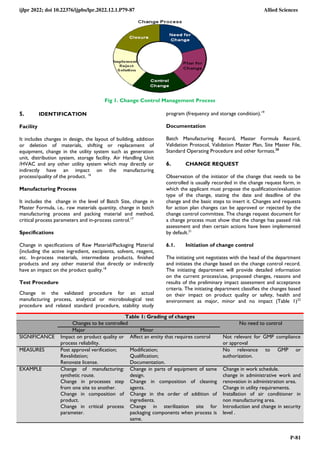
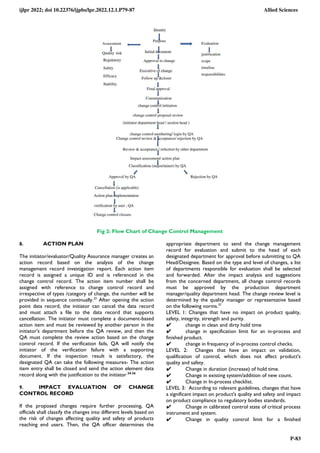
Change control change management is the protocol that
mainly concentrates on the following steps (Figure 1) to
implement the complete change control process in
pharmaceutical industry:
● Identification: This involves identifying a deviation,
OOS &OOT in any procedure, testing method (or) test
limits.
● Investigation: This involves different phases of
investigation to find the probable root cause for deviation,
OOS & OOT by using appropriate investigation tool14
.
● CAPA: once the probable root cause is identified,
the investigation is closed, by assigning a CAPA. This is
followed by login, implementation & closure of CAPA.
● Change control: as part, of implementing CAPA
change control is logged in. Followed by review, approval,
classification, implementation of action plan & closure of
change control. 15
ijlpr 2022; doi 10.22376/ijpbs/lpr.2022.12.1.P79-87 Allied Sciences
P-81
Fig 1. Change Control Management Process
5. IDENTIFICATION
Facility
It includes changes in design, the layout of building, addition
or deletion of materials, shifting or replacement of
equipment, change in the utility system such as generation
unit, distribution system, storage facility. Air Handling Unit
/HVAC and any other utility system which may directly or
indirectly have an impact on the manufacturing
process/quality of the product. 16
Manufacturing Process
It includes the change in the level of Batch Size, change in
Master Formula, i.e,. raw materials quantity, change in batch
manufacturing process and packing material and method,
critical process parameters and in-process control.17
Specifications
Change in specifications of Raw Material/Packaging Material
{including the active ingredient, excipients, solvent, reagent,
etc. In-process materials, intermediate products, finished
products and any other material that directly or indirectly
have an impact on the product quality.18
Test Procedure
Change in the validated procedure for an actual
manufacturing process, analytical or microbiological test
procedure and related standard procedure, stability study
program (frequency and storage condition).19
Documentation
Batch Manufacturing Record, Master Formula Record,
Validation Protocol, Validation Master Plan, Site Master File,
Standard Operating Procedure and other formats.20
6. CHANGE REQUEST
Observation of the initiator of the change that needs to be
controlled is usually recorded in the change request form, in
which the applicant must propose the qualification/evaluation
type of the change, stating the date and deadline of the
change and the basic steps to insert it. Changes and requests
for action plan changes can be approved or rejected by the
change control committee. The change request document for
a change process must show that the change has passed risk
assessment and then certain actions have been implemented
by default.21
6.1. Initiation of change control
The initiating unit negotiates with the head of the department
and initiates the change based on the change control record.
The initiating department will provide detailed information
on the current process/use, proposed changes, reasons and
results of the preliminary impact assessment and acceptance
criteria. The initiating department classifies the changes based
on their impact on product quality or safety, health and
environment as major, minor and no impact (Table 1)22
Table 1: Grading of changes
Changes to be controlled No need to control
Major Minor
SIGNIFICANCE Impact on product quality or
process reliability.
Affect an entity that requires control Not relevant for GMP compliance
or approval
MEASURES Post approval verification;
Revalidation;
Renovate license.
Modification;
Qualification;
Documentation.
No relevance to GMP or
authorization.
EXAMPLE Change of manufacturing:
synthetic route.
Change in processes step
from one site to another.
Change in composition of
product.
Change in critical process
parameter.
Change in parts of equipment of same
design.
Change in composition of cleaning
agents.
Change in the order of addition of
ingredients.
Change in sterilization site for
packaging components when process is
same.
Change in work schedule.
change in administrative work and
renovation in administration area.
Change in utility requirements.
Installation of air conditioner in
non manufacturing area.
Introduction and change in security
level .
ijlpr 2022; doi 10.22376/ijpbs/lpr.2022.12.1.P79-87 Allied Sciences
P-82
The QA personnel assigns the change control number on
the signed form with the respective date and then QA issues
the change control record to the corresponding department;
QA will complete change control logbook with an excepted
completion date as a reference to change records23
.
6.2. Change control number
QA assigns a unique alphanumeric character to each change
control record. Change control number can be represented
as CM/YY/XXX; CM stands for change management; YY
represents the last two digits of the current year; XXX
stands for serial number. Product details and their designated
change category (such as site, batch size, equipment,
composition change) are also included in the change control
record.24
6.3. Date of issuance
QA must specify the release date in a logbook on which
control number is assigned and justified. The timeline for
closure of the change control form provided by QA will be
reviewed by the relevant department, if the date is applicable,
then they will accept the updated date and complete the
change control within 90 days from the date of approval.25
6.4. Title of change
A suitable, appropriate and relevant title name for the
proposed change is provided with the acceptance of the
initiator. Then note the same in the logbook too. The
representative should ensure that there are no records for
the repetition of titles for similar changes. The title must be
self - explanatory without any complex words, which are
clear, concise and understandable. 26
6.5. Change details
The change control records should consist of the following
details such as product name, material name, document
name, standard operating procedure name detailed to the
deviations and changes related. The batch number/Analytical
Record number/document number assigned to the
representatives Process/method/procedure of the change
involved in the existing equipment or new equipment,
specifications and requirements to be met for the changes
implemented should also be specified in the change control
report and records.27
6.6. Reasons / justification for the change
A clear and accurate reasons must be provided for initiating
the change. The changes as well as reasons of change based
on applicable data, such as history, trends, stability data or
analysis/formula department documents, scientific reasons,
audit events/observations and experience, or other should be
in place to ensure regulatory compliance and to provide
evidence. There should be no negative impact on product
quality on the proposed changes 28
.
7. INVESTIGATION
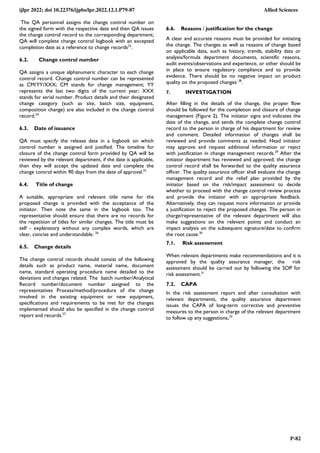
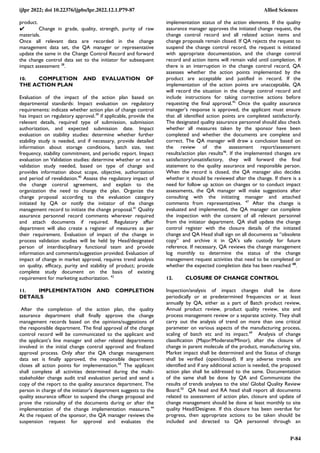
After filling in the details of the change, the proper flow
should be followed for the completion and closure of change
management (Figure 2). The initiator signs and indicates the
date of the change, and sends the complete change control
record to the person in charge of his department for review
and comment. Detailed information of changes shall be
reviewed and provide comments as needed. Head initiator
may approve and request additional information or reject
with justification in change management records.29
After the
initiator department has reviewed and approved; the change
control record shall be forwarded to the quality assurance
officer. The quality assurance officer shall evaluate the change
management record and the relief plan provided by the
initiator based on the risk/impact assessment to decide
whether to proceed with the change control review process
and provide the initiator with an appropriate feedback.
Alternatively, they can request more information or provide
a justification to reject the proposed changes. The person in
charge/representative of the relevant department will also
make suggestions on the relevant points and conduct an
impact analysis on the subsequent signature/date to confirm
the root cause.30
7.1. Risk assessment
When relevant departments make recommendations and it is
approved by the quality assurance manager, the risk
assessment should be carried out by following the SOP for
risk assessment.31
7.2. CAPA
In the risk assessment report and after consultation with
relevant departments, the quality assurance department
issues the CAPA of long-term corrective and preventive
measures to the person in charge of the relevant department
to follow up any suggestions.32
ijlpr 2022; doi 10.22376/ijpbs/lpr.2022.12.1.P79-87 Allied Sciences
P-83
Fig 2: Flow Chart of Change Control Management
8. ACTION PLAN
The initiator/evaluator/Quality Assurance manager creates an
action record based on the analysis of the change
management record investigation report. Each action item
record is assigned a unique ID and is referenced in the
change control record. The action item number shall be
assigned with reference to change control record and
irrespective of types /category of change, the number will be
provided in sequence continually.33
After opening the action
point data record, the initiator can cancel the data record
and must attach a file to the data record that supports
cancellation. The initiator must complete a document-based
action item and must be reviewed by another person in the
initiator's department before the QA review, and then the
QA must complete the review action based on the change
control record. If the verification fails, QA will notify the
initiator of the verification failure with a supporting
document. If the inspection result is satisfactory, the
designated QA can take the following measures- The action
item entry shall be closed and send the action element data
record along with the justification to the initiator 34-36
9. IMPACT EVALUATION OF CHANGE
CONTROL RECORD
If the proposed changes require further processing, QA
officials shall classify the changes into different levels based on
the risk of changes affecting quality and safety of products
reaching end users. Then, the QA officer determines the
appropriate department to send the change management
record for evaluation and submit to the head of each
designated department for approval before submitting to QA
Head/Designee. Based on the type and level of changes, a list
of departments responsible for evaluation shall be selected
and forwarded. After the impact analysis and suggestions
from the concerned department, all change control records
must be approved by the production department
manager/quality department head. The change review level is
determined by the quality manager or representative based
on the following norms.37
LEVEL 1: Changes that have no impact on product quality,
safety, integrity, strength and purity.
✔ change in clean and dirty hold time
✔ change in specification limit for an in-process and
finished product.
✔ change in frequency of in-process control checks.
LEVEL 2: Changes that have an impact on validation,
qualification of control, which does not affect product's
quality and safety.
✔ Change in duration (increase) of hold time.
✔ Change in existing system/addition of new count.
✔ Change in In-process checklist.
LEVEL 3: According to relevant guidelines, changes that have
a significant impact on product's quality and safety and impact
on product compliance to regulatory bodies standards.
✔ Change in calibrated control state of critical process
instrument and system.
✔ Change in quality control limit for a finished
ijlpr 2022; doi 10.22376/ijpbs/lpr.2022.12.1.P79-87 Allied Sciences
P-84
product.
✔ Change in grade, quality, strength, purity of raw
materials.
Once all relevant data are recorded in the change
management data set, the QA manager or representative
update the same in the Change Control Record and forward
the change control data set to the initiator for subsequent
impact assessment 38
.
10. COMPLETION AND EVALUATION OF
THE ACTION PLAN
Evaluation of the impact of the action plan based on
departmental standards: Impact evaluation on regulatory
requirements: indicate whether action plan of change control
has impact on regulatory approval.39
if applicable, provide the
relevant details, required type of submission, submission
authorization, and expected submission date. Impact
evaluation on stability studies: determine whether further
stability study is needed, and if necessary, provide detailed
information about storage conditions, batch size, test
frequency, stability commitment, and periodic report. Impact
evaluation on Validation studies: determine whether or not a
validation study needed, based on type of change and
provides information about scope, objective, authorization
and period of revalidation.40
Assess the regulatory impact of
the change control agreement, and explain to the
organization the need to change the plan. Organize the
change proposal according to the evaluation category
initiated by QA or notify the initiator of the change
management record to initiate the change proposal.41
Quality
assurance personnel record comments wherever required
and attach documents if required. Regulatory affair
department will also create a register of measures as per
their requirement. Evaluation of impact of the change in
process validation studies will be held by Head/designated
person of interdisciplinary functional team and provide
information and comments/suggestion provided. Evaluation of
impact of change in market approval, requires trend analysis
on quality, efficacy, purity and stability of product; provide
complete study document on the basis of existing
requirement for marketing authorization. 42
11. IMPLEMENTATION AND COMPLETION
DETAILS
After the completion of the action plan, the quality
assurance department shall finally approve the change
management records based on the opinions/suggestions of
the responsible department. The final approval of the change
control record will be communicated to the applicant and
the applicant’s line manager and other related departments
involved in the initial change control approval and finalized
approval process. Only after the QA change management
data set is finally approved, the responsible department
closes all action points for implementation.43
The applicant
shall complete all activities determined during the multi-
stakeholder change audit trail evaluation period and send a
copy of the report to the quality assurance department. The
person in charge of the initiator’s department suggests to the
quality assurance officer to suspend the change proposal and
prove the rationality of the documents during or after the
implementation of the change implementation measures.44
At the request of the sponsor, the QA manager reviews the
suspension request for approval and evaluates the
implementation status of the action elements. If the quality
assurance manager approves the initiated change request, the
change control record and all related action items and
change proposals remain closed. If QA rejects the request to
suspend the change control record, the request is initiated
with appropriate documentation, and the change control
record and action items will remain valid until completion. If
there is an interruption in the change control record, QA
assesses whether the action points implemented by the
product are acceptable and justified in record. If the
implementation of the action points are unacceptable, QA
will record the situation in the change control record and
include instructions for taking corrective actions before
requesting the final approval.45
Once the quality assurance
manager’s response is approved, the applicant must ensure
that all identified action points are completed satisfactorily.
The designated quality assurance personnel should also check
whether all measures taken by the sponsor have been
completed and whether the documents are complete and
correct. The QA manager will draw a conclusion based on
the review of the assessment report/assessment
results/action plan results46
. If the implemented changes are
satisfactory/unsatisfactory, they will forward the final
statement to the quality assurance and responsible person.
When the record is closed, the QA manager also decides
whether it should be reviewed after the change. If there is a
need for follow up action on changes or to conduct impact
assessments, the QA manager will make suggestions after
consulting with the initiating manager and attached
comments from representatives. 47
After the change is
evaluated and implemented, the QA manager can complete
the inspection with the consent of all relevant personnel
from the initiator department. QA shall update the change
control register with the closure details of the initiated
change and QA Head shall sign on all documents as ―obsolete
copy‖ and archive it in QA’s safe custody for future
reference. If necessary, QA reviews the change management
log monthly to determine the status of the change
management request activities that need to be completed or
whether the expected completion date has been reached 48
.
12. CLOSURE OF CHANGE CONTROL
Inspection/analysis of impact changes shall be done
periodically or at predetermined frequencies or at least
annually by QA, either as a part of Batch product review,
Annual product review, product quality review, site and
process management review or a separate activity. They shall
carry out the analysis of trend on more than one critical
parameter on various aspects of the manufacturing process,
scaling of batch etc and its impact.49
Analysis of change
classification (Major/Moderate/Minor), after the closure of
change in parent molecule of the product, manufacturing site,
Market impact shall be determined and the Status of change
shall be verified (open/closed). If any adverse trends are
identified and if any additional action is needed, the proposed
action plan shall be addressed to the same. Documentation
of the same shall be done by QA and Communicate the
results of trends analyses to the site/ Global Quality Review
Board.50
QA head and RA head shall report all documents
related to assessment of action plan, closure and update of
change management should be done at least monthly to site
quality Head/Designee. If this closure has been overdue for
progress, then appropriate actions to be taken should be
included and directed to QA personnel through an
ijlpr 2022; doi 10.22376/ijpbs/lpr.2022.12.1.P79-87 Allied Sciences
P-85
appropriate reporting system 51
.
13. CONCLUSION
The current study, provides an overview of the
pharmaceutical company’s change control change
management process in the Quality management system. This
review provides the need for a change control process,
different types of changes in a pharmaceutical company and
the protocol needed to implement change control. The
proposed change will likely have an impact on the quality of
production (or)GMP as there are done to be in line with ISO
requirements. Change management minimizes the risks that
may have an impact on the quality or critical attributes of the
process. This well-established Change control change
management protocol helps to find out deviations at the
earliest and make it comply with appropriate FDA regulation.
Future Recommendations
It is noted that post approval change control management is
a critical and brainstorming task and change control
committee must have advanced technology knowledge,
troubleshooting skill, and unique style, strategy for this
implementation. Post Approval Changes seriously influence
the market authorization and regulatory approval, so there
should be appropriate planning, scheduling and
implementation in compliance with GMP.
14. AUTHOR CONTRIBUTION STATEMENT
Both the authors have contributed equally in conceptualizing
the design and compiling the review and preparing the
manuscript.
15. CONFLICT OF INTEREST
Conflict of interest declared none.
16. REFERENCE
1. EU commission directorate-general; guidelines for
GMP for medical products for human and veterinary
use. [cited on may 01 2021]; 2015.
2. EudraLex. Good Manufacturing Practice (GMP)
guidelines.[cited on may 01 2021]. Vol. 4; 2015.
3. CFR. Code of federal regulations Title 21. Med
Devices. 2020.
4. Auterhoff Gert. Cantor verlag Aulendorf [internet];
2002. EC guide to good manufacturing practice for
medical products and active pharmaceutical
ingredients. (4). [cited on may 23 2021].
5. Panorama Consulting Group. What is change control
in project management? [internet]. [updated on Apr
26 2021]; cited on 22may 2021. Available from:
https://www.panorama-consulting.com/change-
control-in-project-management/.
6. Laszlo George. Change management. World
Conference on Quality and Improvement. Vol. 58
Issue pp; May 2004. p. 55-8.
7. Ordenes Pat. Change management strategy [internet].
Cascade. [updated on Jan 22, 2020; cited on 27 May
2021]. Available from:
https://www.cascade.app/blog/change-management-
strategy.
8. Good manufacturing practice for active
pharmaceutical ingredients [internet]. [updated on
2000; [cited on may 23 2021]]. International
Conference on Harmonization (ICH/4106).
9. Well spring manufacturing solution; Introduction to
Scale-Up and Post-Approval Changes (SUPAC);
October 12 2016. Available from:
http://aniglobalsource.com/blog/introduction-to-scale-
up-and-post-approval-changes-supac-part-2.
10. Asana. Project management [internet]. What is a
change control process and how do you use it?.
[updated on 09 June 2021; cited on 21 May 2021].
Available from: https://asana.com/resources/change-
control-process.
11. Pharma change control, FDA news; Strategies for
Successful Company-Wide Implementation; 2020
[cited may 01 2021]. Available from:
http://fdanews.com/ext/resources/files/The_Food_And
_Drug_Letter/2013/Pharm a-Change-Control-Peither-
ExecSeries.
12. Mccarty Becky. Soc, Royalty & Hipaa Audits, Fedramp
& Hitrust Assessments [Inernet]. Change control
management for service organizations. [Updated on 2
January; 2019; cited on 20may 2021Available from.
Available from: https://linfordco.com/blog/change-
control-management/.
13. Sarran Priya, Clark Delia, Mendonca Kathy [internet].
Change management toolkit [cited may 21 2021].
Available from:
https://hr.berkeley.edu/sites/default/files/change_manag
ement_toolkit.pdf.
14. Rational unified process: disciplines [internet].
Concepts: Change Request Management [updated on
02 November 2020; cited on 21 may 2021]. Available
from:
https://sceweb.uhcl.edu/helm/RationalUnifiedProcess/p
rocess/workflow/ovu_core.htm.
15. A comprehensive guide on change management in ITIL
[internet]. Management Engine Service. [updated on
June 19, 2020; cited on 23 may 2021]. Available from:
https://www.manageengine.com/products/service-
desk/itil-change-management/what-is-change-
management.html.
16. Mounica NVN, Sharmila R, Anusha S, Evangeline; scale
up and postapproval changes (supac) guidance for
industry: a regulatory note. Int J Drug Regul Aff.
March 2017;5(1):13-9.
17. Ali Huma, Gonjare Nitin. Menino D Souza; Change
Management in Pharmaceuticals: the most critical
element of Quality Management System. J Pharm Res.
2012;5(7):3706-8.
18. choudhary Ankur. SOP for change control [internet].
Pharmaceutical guidelines, July; 2012 [cited may 2
2021]. Available from:
http://www.pharmaguideline.com/2012/07/sop-for-
change-control.html.
19. Jamwal Umesh, Panchal D, Kumar A. Change
management in the Indian pharmaceutical industry: a
case study. Int J Logist Syst Manag. 2017;27(3):380.
doi: 10.1504/IJLSM.2017.084464.
20. Change Control, Nonconformance/Deviation and
CAPA Management in a Laboratory Environment;
Pilgrim, an IQVIA company. Available from:
http://pilgrimquality.com/knowledge/case-
ijlpr 2022; doi 10.22376/ijpbs/lpr.2022.12.1.P79-87 Allied Sciences
P-86
studies/pilgrim-capa-nc-and-change-control-
management-in-a-laboratory-environment-case-study.
21. McClintock Matt. Best practices for the IT change
request process [internet]. Process Maker. [updated
on 24 September 2021; cited on 26 may 2021].
Available from:
https://www.processmaker.com/blog/it-change-
request-process-best-practices/.
22. How to manage change requests effectively in IT
outsourcing [internet]. Edvantis. [updated on 24
November 2020; cited on 26 may 2021]. Available
from: https://www.edvantis.com/blog/change-requests-
management-in-outsourcing/.
23. ECA. Your GMP/GDP information source [internet].
Post-Approval Change Management - Does ICH Q12
offer a solution? [updated on 18 July 2018; cited on 26
May 2021]. Available from: https://www.gmp-
compliance.org/gmp-news/post-approval-change-
management-does-ich-q12-offer-a-solution.
24. Janki Singh; SOP for change control management
procedure; pharmabeginner; January 13 2020 [cited
may 2 2021]. Available from:
https://www.pharmabeginers.com/sop-for-
changecontrol-management.
25. Bosilj Vesna. Mario spermic; ERP system
implementation and business process change: case
study of a pharmaceutical company. J Comput Inf
Technol. 2005, 1;13:11-24.
26. Lokesh MSN, gupta Vishal. ;
Quality management
system in change control at industry level: an
overview. Int J Pharm Pharm Sci;7(5):2015.
27. Director of Marketing. Master control [internet].
Change Control—continuous Quality Improvement in
FDA and ISO Environments [updated on 16
September 2020; cited on 28 May 2021]. Available
from:
https://www.mastercontrol.com/gxplifeline/change_co
ntrol_continuous_quality_improvement_0510/.
28. Westland Jason. What is change control in project
management? [internet]. Project Manager. [updated on
Oct 14 2020] [cited may 20 2021]. Available from:
https://www.projectmanager.com/blog/what-is-change-
control-in-project-managemt.
29. Deviation handling and quality risk management
[internet]. Updated on sep 2013; [cited on may 23
2021]. Available from:
http://www.whoint/immunization_standards
/vaccine_quality/risk_july_2013.pdf.
30. Ali H, Hajela R. Risk assessment & management in
pharmaceutical industries: vital requirement to ensure
product quality. J Pharm Res. 2011;4(6):1909-10.
31. Harvard university. Risk management and audit service
[internet]. Change Control [cited may 20 2021].
Available from:
https://rmas.fad.harvard.edu/pages/change-control.
32. Gausepohl C. Deviations–Definition and
Requirements for deviation management.
2014;2013(10):1-3.
33. Smith Christopher. The change management action
plan guide [internet]. Journal of Change Management.
[updated on 24 march 2014; cited on 23 may 2021].
Available from: https://change.walkme.com/the-
change-management-action-plan-guide/.
34. Freifeld Lorri. How to create and execute a plan for
successful change [internet]. A change plan is an
explanation of the proposed changes and the steps
needed to achieve them. [updated on 4 February
2013; cited on 26 may 2021]. Available from:
https://trainingmag.com/how-to-create-and-execute-a-
plan-for-successful-change/.
35. APIC-guideline technical change control. Guideline for
the Establishment of a Control Procedure for
Technical Equipment, including related Utilities,
Computerised Systems and Facilities used in the
Manufacture of APIs and Intermediates [internet].
[Revised on Nov 2018] [cited may 25 2021]. Available
from: https://apic.cefic.org/pub/APIC-Guideline-
Technical-Change-Control-revised-Nov2018.pdf.
36. Doyle Bernadette. ICH Q10 and change management:
enabling quality improvement. GlaxoSmithKline
[internet]. Available from:
https://www.fda.gov/media/85281.
37. Lokesh MS, gupta Vishal. N ;
comparative study of
process of post approval change application
submission and approval for marketing authorization
variations in EU, US, India, Saudi Arabia and Singapore.
Int J Drug Dev Res. 2015; 7(1);9344:0975.
38. Pharmaceutical updates. Change Control Procedure
[internet]. change control vs deviation [updated on 16
may 2020;
39. Damini V, Kumar SH, Gangadharappa HV, Gowrav
MP. Handling of pharmaceutical deviations: A detailed
case study. Indian J Pharm Sci. 2020;82(6):928-44.
40. Freeman S Medina C, editor. Change management: a
far-reaching, comprehensive, and integrated system
compliance. Handbook for pharmaceuticals, Medical
Devices, and biologics; 2004. p. 315-46.
41. Pratt Mary K. Change management [internet]. Target
network [cited Jun 02 2021]. Available from:
https://searchcio.techtarget.com/definition/change-
management.
42. Varon Laura. Change management process: A
conclusive guide. Sweet process [internet]. Business
[cited Jun 06 2021]. Available from:
https://www.sweetprocess.com/change-management-
process/.
43. Customer experience and customer support
[internet]. Change Management Process [cited May 24
2021]. Available from:
https://www.getguru.com/reference/change-
management-process.
44. Sumitani Andrew. How to implement change
management: A step-by-step guide to successful
organizational change [internet]. Tinypulse. [updated
on 12 march 2020 ; cited on 23 may 2021]. Available
from: https://www.tinypulse.com/blog/how-to-
implement-change-management-a-step-by-step-guide-
to-successful-organizational-change.
45. John P, Leonard A. Change management [internet].
[updated on July–August 2008; [cited on May 28
2021]]. Choosing Strategies for Change. Available
from: https://hbr.org/2008/07/choosing-strategies-for-
change.
46. Process management. Change management [internet].
Project change management process: everything you
need to know. [updated on 09 January 2019; cited on
24 May 2021]. Available from:
https://pmtips.net/article/project-change-management-
process-everything-you-need-to-know.
ijlpr 2022; doi 10.22376/ijpbs/lpr.2022.12.1.P79-87 Allied Sciences
P-87
47. Business change readiness guide [internet]. The best
guide for conducting readiness assessments & getting
organizations Prepared for a Change [cited May 21
2021]. Available from:
https://www.airiodion.com/organizational-readiness-
assessment/.
48. Miller Kelsey. Management essentials [internet]. 5
Critical steps in the change management process.
[updated on 19 March 2020; cited on 23 may 2021].
Available from:
https://online.hbs.edu/blog/post/change-management-
process.
49. ProServeIT [internet]. Change management planning:
7 key steps to implementing change. [updated on 15
march 2021; ; cited on 23 may 2021]. Available from:
https://www.proserveit.com/blog/change-management-
planning-7-key-steps.
50. Asa Muhammad Nurul. Planning and executing change
effectively [internet]. Asa [journal]. [updated on 12
January 2021; cited on 26 may 2021]. Available from:
https://asajournal.site/planning-and-executing-change-
effectively/.
51. Watts Stephen. Muhammad Raza. BMC blogs
[internet]. Changes Types: Standard VS Normal VS
Emergency Change. [updated on 30 October 2019;
cited on 21 may 2021]. Available from:
https://www.bmc.com/blogs/changes-types-standard-
vs-normal-vs-emergency-change/.

b6d9292180b7acfb6cede93cf031347690ce.pdf

  • 1.
    10.22376/ijpbs/lpr.2022.12.1.P79-87 ijlpr 2022; doi RevisedOn 8 December, 2021 Accepted On 17 December, 2021 Published On 7 January, 2022 Funding This research did not receive any specific grant from any funding agencies in the public, commercial or not for profit sectors. Copyright @ International Journal of Life Science and Pharma Research, available at www.ijlpr.com Int J Life Sci Pharma Res., Volume12., No 1 (January) 2022, pp P79-87 This article is under the CC BY- NC-ND Licence (https://creativecommons.org/licenses/by-nc-nd/4.0) Citation Pavithra Bharathy, Shabna Roupal Morais , Change Control Management: An Overview.(2022).Int. J. Life Sci. Pharma Res.12(1), P79- 87 http://dx.doi.org/10.22376/ijpbs/lpr.2022.12.1.P79-87 Received On 22 September, 2021 Shabna Roupal Morais , Assistant Professor, Department of Pharmaceutical Chemistry, Sri Ramachandra Faculty of Pharmacy, Sri Ramachandra institute of higher Education and Research, Porur, Chennai-600116 *Corresponding Author Review Article Allied Sciences International Journal of Life science and Pharma Research Change Control Management: An Overview Pavithra Bharathy1 , Shabna Roupal Morais2 * 1 Student, Department of Pharmaceutical Chemistry, Sri Ramachandra College of Pharmacy, , Sri Ramachandra Institute of Higher Education and Research Porur, Chennai -600116. 2* Assistant Professor, Department of Pharmaceutical Chemistry, Sri Ramachandra Faculty of Pharmacy, Sri Ramachandra institute of higher Education and Research, Porur, Chennai-600116 Abstract: Change control is a basic element of the quality management system of a pharmaceutical company, that focuses on controlling change to provide a quality product by preventing non - compliance. Changes may occur at any time during the product life cycle, leading to changes in the manufacturing process, the number of materials, and the manufacturing location. All of these changes are post-approved changes. These changes can be controlled and not eliminated, through proper assessment and action plans. The change control committee consisting of the head of quality assurance, manufacturing, sales and other members of relevant disciplines, inspect the proposed changes that may alter the validated and qualified state of facilities, equipment or process. The proposed change will likely have an impact on the quality of production or Good Manufacturing Practice as there are done to be in line with the International Standard Organization requirements. These approved changes should not impact the quality, safety and potency of medicinal product. If ignored, it makes the patient life - critical which may even lead to death. This present review provides an overview of the industry’s Change Control change management protocol in Quality Management System in a company. The major objective is to identify, evaluate, measure, provide action and final authorization to ensure that the changes should not affect the product strength, integrity, purity, quality, or safety. There are many aspects of view on the change control management that take place in the pharmaceutical industry, where we can gain knowledge on concepts of change control. This article also delivers a flow of change management process starting from the request on change by an initiator to the closure of change with appropriate remedial action and follow up assigned by Quality Unit and other responsible authorities. Keywords: Quality management system, change control, post approval change, Quality assurance. ISSN 2250-0480 P-79
  • 2.
    ijlpr 2022; doi10.22376/ijpbs/lpr.2022.12.1.P79-87 Allied Sciences P-80 1. INTRODUCTION Change control management is the crucial aspect of a quality management system, that focuses on controlling change to provide a quality product by preventing non-compliance. It is a formal system to ensure that changes do not affect the validated state of facilities, equipment, processes or, systems and through which qualified representatives document that the system remains in an approved state. Any key changes in the manufacturing process, including equipment or material changes, require verification, that may affect product quality, safety and reproducibility of a quality product.1-3 There should be a written procedure to identify, analyze and control changes. It should cover all plans, protocols and requirements involved in change control management. If there is any deviation from the approved state, it should be formulated, reviewed and approved by the corresponding organizational unit, and reviewed and approved by the quality control department. Any deviations from written specifications, standards, sampling plans, test procedures, or other laboratory control mechanisms must be recorded and justified.4,5 There should be a written procedure describing the measures that should be taken when raw materials, product components, processing equipment, and processes change. The environment (or location), manufacturing or testing process, or any other changes that may affect product quality or process reproducibility must be taken into account. Change control procedures should ensure that there is sufficient evidence that the modified process meets the required quality of the product with approved specifications.6-8 2. SOURCES OF CHANGES ● Formulation - composition and percentage of active and inactive ingredient. ● API - change in grade, new manufacturer, process and physical characteristics. ● Equipment - change in scale (pilot batch, commercial batch, bio batch) change in principle and process optimization. ● Cleaning procedure - change in manual to automated, change in configuration, schedule of equipment9 . ● Manufacturing process- change in critical parameter, operating condition, scale up, technology transfer. ● Analytical method: change in qualification, validation state, modification of compendial method. ● Stability study: change in storage condition, container closure system, expiry period and shelf life. ● Facility and utility: change in cross contamination maintenance, validated classified area, HVAC system, compressed air and dust collection system. ● Packaging components: change in container, closure, change in labeling, inserts, change in packaging material. 10 3. RESPONSIBILITY Production managers, QC managers, sales managers and communications officers in their respective fields are responsible for the appropriate planning, implementation and approval of changes.11 They should ensure that the ranking status of rooms and places affected by the change or re- certification is maintained when the change occurs; the verification status of the process/procedure affected by the change or re-verification is retained.12 The changes in drug production, testing and labeling are based on valid approval documents required to update the changes. The Change Control Committee (CCC) is responsible for the organization and processing of the change control procedures and the preparation of documents. The members of the CCC are the regulatory affairs supervisor and the quality assurance officer. The committee is responsible for evaluating the risk of modification, approval or rejection of the request. The application implements the necessary measures through installation and programming. The QA officer the chairman of the CCC, is responsible for convening CCC meetings and minuting the meeting, filling in change requests, submitting change requests control, record distribution procedures, and maintaining the change database. Control procedures, control compliance deadlines. The QA representative is responsible for reviewing periodically and to ensure whether documents are revised and updated whenever necessary; and release a new version at least every two years.13 4. CHANGE CONTROL CHANGE MANAGEMENT Change control change management is the protocol that mainly concentrates on the following steps (Figure 1) to implement the complete change control process in pharmaceutical industry: ● Identification: This involves identifying a deviation, OOS &OOT in any procedure, testing method (or) test limits. ● Investigation: This involves different phases of investigation to find the probable root cause for deviation, OOS & OOT by using appropriate investigation tool14 . ● CAPA: once the probable root cause is identified, the investigation is closed, by assigning a CAPA. This is followed by login, implementation & closure of CAPA. ● Change control: as part, of implementing CAPA change control is logged in. Followed by review, approval, classification, implementation of action plan & closure of change control. 15
  • 3.
    ijlpr 2022; doi10.22376/ijpbs/lpr.2022.12.1.P79-87 Allied Sciences P-81 Fig 1. Change Control Management Process 5. IDENTIFICATION Facility It includes changes in design, the layout of building, addition or deletion of materials, shifting or replacement of equipment, change in the utility system such as generation unit, distribution system, storage facility. Air Handling Unit /HVAC and any other utility system which may directly or indirectly have an impact on the manufacturing process/quality of the product. 16 Manufacturing Process It includes the change in the level of Batch Size, change in Master Formula, i.e,. raw materials quantity, change in batch manufacturing process and packing material and method, critical process parameters and in-process control.17 Specifications Change in specifications of Raw Material/Packaging Material {including the active ingredient, excipients, solvent, reagent, etc. In-process materials, intermediate products, finished products and any other material that directly or indirectly have an impact on the product quality.18 Test Procedure Change in the validated procedure for an actual manufacturing process, analytical or microbiological test procedure and related standard procedure, stability study program (frequency and storage condition).19 Documentation Batch Manufacturing Record, Master Formula Record, Validation Protocol, Validation Master Plan, Site Master File, Standard Operating Procedure and other formats.20 6. CHANGE REQUEST Observation of the initiator of the change that needs to be controlled is usually recorded in the change request form, in which the applicant must propose the qualification/evaluation type of the change, stating the date and deadline of the change and the basic steps to insert it. Changes and requests for action plan changes can be approved or rejected by the change control committee. The change request document for a change process must show that the change has passed risk assessment and then certain actions have been implemented by default.21 6.1. Initiation of change control The initiating unit negotiates with the head of the department and initiates the change based on the change control record. The initiating department will provide detailed information on the current process/use, proposed changes, reasons and results of the preliminary impact assessment and acceptance criteria. The initiating department classifies the changes based on their impact on product quality or safety, health and environment as major, minor and no impact (Table 1)22 Table 1: Grading of changes Changes to be controlled No need to control Major Minor SIGNIFICANCE Impact on product quality or process reliability. Affect an entity that requires control Not relevant for GMP compliance or approval MEASURES Post approval verification; Revalidation; Renovate license. Modification; Qualification; Documentation. No relevance to GMP or authorization. EXAMPLE Change of manufacturing: synthetic route. Change in processes step from one site to another. Change in composition of product. Change in critical process parameter. Change in parts of equipment of same design. Change in composition of cleaning agents. Change in the order of addition of ingredients. Change in sterilization site for packaging components when process is same. Change in work schedule. change in administrative work and renovation in administration area. Change in utility requirements. Installation of air conditioner in non manufacturing area. Introduction and change in security level .
  • 4.
    ijlpr 2022; doi10.22376/ijpbs/lpr.2022.12.1.P79-87 Allied Sciences P-82 The QA personnel assigns the change control number on the signed form with the respective date and then QA issues the change control record to the corresponding department; QA will complete change control logbook with an excepted completion date as a reference to change records23 . 6.2. Change control number QA assigns a unique alphanumeric character to each change control record. Change control number can be represented as CM/YY/XXX; CM stands for change management; YY represents the last two digits of the current year; XXX stands for serial number. Product details and their designated change category (such as site, batch size, equipment, composition change) are also included in the change control record.24 6.3. Date of issuance QA must specify the release date in a logbook on which control number is assigned and justified. The timeline for closure of the change control form provided by QA will be reviewed by the relevant department, if the date is applicable, then they will accept the updated date and complete the change control within 90 days from the date of approval.25 6.4. Title of change A suitable, appropriate and relevant title name for the proposed change is provided with the acceptance of the initiator. Then note the same in the logbook too. The representative should ensure that there are no records for the repetition of titles for similar changes. The title must be self - explanatory without any complex words, which are clear, concise and understandable. 26 6.5. Change details The change control records should consist of the following details such as product name, material name, document name, standard operating procedure name detailed to the deviations and changes related. The batch number/Analytical Record number/document number assigned to the representatives Process/method/procedure of the change involved in the existing equipment or new equipment, specifications and requirements to be met for the changes implemented should also be specified in the change control report and records.27 6.6. Reasons / justification for the change A clear and accurate reasons must be provided for initiating the change. The changes as well as reasons of change based on applicable data, such as history, trends, stability data or analysis/formula department documents, scientific reasons, audit events/observations and experience, or other should be in place to ensure regulatory compliance and to provide evidence. There should be no negative impact on product quality on the proposed changes 28 . 7. INVESTIGATION After filling in the details of the change, the proper flow should be followed for the completion and closure of change management (Figure 2). The initiator signs and indicates the date of the change, and sends the complete change control record to the person in charge of his department for review and comment. Detailed information of changes shall be reviewed and provide comments as needed. Head initiator may approve and request additional information or reject with justification in change management records.29 After the initiator department has reviewed and approved; the change control record shall be forwarded to the quality assurance officer. The quality assurance officer shall evaluate the change management record and the relief plan provided by the initiator based on the risk/impact assessment to decide whether to proceed with the change control review process and provide the initiator with an appropriate feedback. Alternatively, they can request more information or provide a justification to reject the proposed changes. The person in charge/representative of the relevant department will also make suggestions on the relevant points and conduct an impact analysis on the subsequent signature/date to confirm the root cause.30 7.1. Risk assessment When relevant departments make recommendations and it is approved by the quality assurance manager, the risk assessment should be carried out by following the SOP for risk assessment.31 7.2. CAPA In the risk assessment report and after consultation with relevant departments, the quality assurance department issues the CAPA of long-term corrective and preventive measures to the person in charge of the relevant department to follow up any suggestions.32
  • 5.
    ijlpr 2022; doi10.22376/ijpbs/lpr.2022.12.1.P79-87 Allied Sciences P-83 Fig 2: Flow Chart of Change Control Management 8. ACTION PLAN The initiator/evaluator/Quality Assurance manager creates an action record based on the analysis of the change management record investigation report. Each action item record is assigned a unique ID and is referenced in the change control record. The action item number shall be assigned with reference to change control record and irrespective of types /category of change, the number will be provided in sequence continually.33 After opening the action point data record, the initiator can cancel the data record and must attach a file to the data record that supports cancellation. The initiator must complete a document-based action item and must be reviewed by another person in the initiator's department before the QA review, and then the QA must complete the review action based on the change control record. If the verification fails, QA will notify the initiator of the verification failure with a supporting document. If the inspection result is satisfactory, the designated QA can take the following measures- The action item entry shall be closed and send the action element data record along with the justification to the initiator 34-36 9. IMPACT EVALUATION OF CHANGE CONTROL RECORD If the proposed changes require further processing, QA officials shall classify the changes into different levels based on the risk of changes affecting quality and safety of products reaching end users. Then, the QA officer determines the appropriate department to send the change management record for evaluation and submit to the head of each designated department for approval before submitting to QA Head/Designee. Based on the type and level of changes, a list of departments responsible for evaluation shall be selected and forwarded. After the impact analysis and suggestions from the concerned department, all change control records must be approved by the production department manager/quality department head. The change review level is determined by the quality manager or representative based on the following norms.37 LEVEL 1: Changes that have no impact on product quality, safety, integrity, strength and purity. ✔ change in clean and dirty hold time ✔ change in specification limit for an in-process and finished product. ✔ change in frequency of in-process control checks. LEVEL 2: Changes that have an impact on validation, qualification of control, which does not affect product's quality and safety. ✔ Change in duration (increase) of hold time. ✔ Change in existing system/addition of new count. ✔ Change in In-process checklist. LEVEL 3: According to relevant guidelines, changes that have a significant impact on product's quality and safety and impact on product compliance to regulatory bodies standards. ✔ Change in calibrated control state of critical process instrument and system. ✔ Change in quality control limit for a finished
  • 6.
    ijlpr 2022; doi10.22376/ijpbs/lpr.2022.12.1.P79-87 Allied Sciences P-84 product. ✔ Change in grade, quality, strength, purity of raw materials. Once all relevant data are recorded in the change management data set, the QA manager or representative update the same in the Change Control Record and forward the change control data set to the initiator for subsequent impact assessment 38 . 10. COMPLETION AND EVALUATION OF THE ACTION PLAN Evaluation of the impact of the action plan based on departmental standards: Impact evaluation on regulatory requirements: indicate whether action plan of change control has impact on regulatory approval.39 if applicable, provide the relevant details, required type of submission, submission authorization, and expected submission date. Impact evaluation on stability studies: determine whether further stability study is needed, and if necessary, provide detailed information about storage conditions, batch size, test frequency, stability commitment, and periodic report. Impact evaluation on Validation studies: determine whether or not a validation study needed, based on type of change and provides information about scope, objective, authorization and period of revalidation.40 Assess the regulatory impact of the change control agreement, and explain to the organization the need to change the plan. Organize the change proposal according to the evaluation category initiated by QA or notify the initiator of the change management record to initiate the change proposal.41 Quality assurance personnel record comments wherever required and attach documents if required. Regulatory affair department will also create a register of measures as per their requirement. Evaluation of impact of the change in process validation studies will be held by Head/designated person of interdisciplinary functional team and provide information and comments/suggestion provided. Evaluation of impact of change in market approval, requires trend analysis on quality, efficacy, purity and stability of product; provide complete study document on the basis of existing requirement for marketing authorization. 42 11. IMPLEMENTATION AND COMPLETION DETAILS After the completion of the action plan, the quality assurance department shall finally approve the change management records based on the opinions/suggestions of the responsible department. The final approval of the change control record will be communicated to the applicant and the applicant’s line manager and other related departments involved in the initial change control approval and finalized approval process. Only after the QA change management data set is finally approved, the responsible department closes all action points for implementation.43 The applicant shall complete all activities determined during the multi- stakeholder change audit trail evaluation period and send a copy of the report to the quality assurance department. The person in charge of the initiator’s department suggests to the quality assurance officer to suspend the change proposal and prove the rationality of the documents during or after the implementation of the change implementation measures.44 At the request of the sponsor, the QA manager reviews the suspension request for approval and evaluates the implementation status of the action elements. If the quality assurance manager approves the initiated change request, the change control record and all related action items and change proposals remain closed. If QA rejects the request to suspend the change control record, the request is initiated with appropriate documentation, and the change control record and action items will remain valid until completion. If there is an interruption in the change control record, QA assesses whether the action points implemented by the product are acceptable and justified in record. If the implementation of the action points are unacceptable, QA will record the situation in the change control record and include instructions for taking corrective actions before requesting the final approval.45 Once the quality assurance manager’s response is approved, the applicant must ensure that all identified action points are completed satisfactorily. The designated quality assurance personnel should also check whether all measures taken by the sponsor have been completed and whether the documents are complete and correct. The QA manager will draw a conclusion based on the review of the assessment report/assessment results/action plan results46 . If the implemented changes are satisfactory/unsatisfactory, they will forward the final statement to the quality assurance and responsible person. When the record is closed, the QA manager also decides whether it should be reviewed after the change. If there is a need for follow up action on changes or to conduct impact assessments, the QA manager will make suggestions after consulting with the initiating manager and attached comments from representatives. 47 After the change is evaluated and implemented, the QA manager can complete the inspection with the consent of all relevant personnel from the initiator department. QA shall update the change control register with the closure details of the initiated change and QA Head shall sign on all documents as ―obsolete copy‖ and archive it in QA’s safe custody for future reference. If necessary, QA reviews the change management log monthly to determine the status of the change management request activities that need to be completed or whether the expected completion date has been reached 48 . 12. CLOSURE OF CHANGE CONTROL Inspection/analysis of impact changes shall be done periodically or at predetermined frequencies or at least annually by QA, either as a part of Batch product review, Annual product review, product quality review, site and process management review or a separate activity. They shall carry out the analysis of trend on more than one critical parameter on various aspects of the manufacturing process, scaling of batch etc and its impact.49 Analysis of change classification (Major/Moderate/Minor), after the closure of change in parent molecule of the product, manufacturing site, Market impact shall be determined and the Status of change shall be verified (open/closed). If any adverse trends are identified and if any additional action is needed, the proposed action plan shall be addressed to the same. Documentation of the same shall be done by QA and Communicate the results of trends analyses to the site/ Global Quality Review Board.50 QA head and RA head shall report all documents related to assessment of action plan, closure and update of change management should be done at least monthly to site quality Head/Designee. If this closure has been overdue for progress, then appropriate actions to be taken should be included and directed to QA personnel through an
  • 7.
    ijlpr 2022; doi10.22376/ijpbs/lpr.2022.12.1.P79-87 Allied Sciences P-85 appropriate reporting system 51 . 13. CONCLUSION The current study, provides an overview of the pharmaceutical company’s change control change management process in the Quality management system. This review provides the need for a change control process, different types of changes in a pharmaceutical company and the protocol needed to implement change control. The proposed change will likely have an impact on the quality of production (or)GMP as there are done to be in line with ISO requirements. Change management minimizes the risks that may have an impact on the quality or critical attributes of the process. This well-established Change control change management protocol helps to find out deviations at the earliest and make it comply with appropriate FDA regulation. Future Recommendations It is noted that post approval change control management is a critical and brainstorming task and change control committee must have advanced technology knowledge, troubleshooting skill, and unique style, strategy for this implementation. Post Approval Changes seriously influence the market authorization and regulatory approval, so there should be appropriate planning, scheduling and implementation in compliance with GMP. 14. AUTHOR CONTRIBUTION STATEMENT Both the authors have contributed equally in conceptualizing the design and compiling the review and preparing the manuscript. 15. CONFLICT OF INTEREST Conflict of interest declared none. 16. REFERENCE 1. EU commission directorate-general; guidelines for GMP for medical products for human and veterinary use. [cited on may 01 2021]; 2015. 2. EudraLex. Good Manufacturing Practice (GMP) guidelines.[cited on may 01 2021]. Vol. 4; 2015. 3. CFR. Code of federal regulations Title 21. Med Devices. 2020. 4. Auterhoff Gert. Cantor verlag Aulendorf [internet]; 2002. EC guide to good manufacturing practice for medical products and active pharmaceutical ingredients. (4). [cited on may 23 2021]. 5. Panorama Consulting Group. What is change control in project management? [internet]. [updated on Apr 26 2021]; cited on 22may 2021. Available from: https://www.panorama-consulting.com/change- control-in-project-management/. 6. Laszlo George. Change management. World Conference on Quality and Improvement. Vol. 58 Issue pp; May 2004. p. 55-8. 7. Ordenes Pat. Change management strategy [internet]. Cascade. [updated on Jan 22, 2020; cited on 27 May 2021]. Available from: https://www.cascade.app/blog/change-management- strategy. 8. Good manufacturing practice for active pharmaceutical ingredients [internet]. [updated on 2000; [cited on may 23 2021]]. International Conference on Harmonization (ICH/4106). 9. Well spring manufacturing solution; Introduction to Scale-Up and Post-Approval Changes (SUPAC); October 12 2016. Available from: http://aniglobalsource.com/blog/introduction-to-scale- up-and-post-approval-changes-supac-part-2. 10. Asana. Project management [internet]. What is a change control process and how do you use it?. [updated on 09 June 2021; cited on 21 May 2021]. Available from: https://asana.com/resources/change- control-process. 11. Pharma change control, FDA news; Strategies for Successful Company-Wide Implementation; 2020 [cited may 01 2021]. Available from: http://fdanews.com/ext/resources/files/The_Food_And _Drug_Letter/2013/Pharm a-Change-Control-Peither- ExecSeries. 12. Mccarty Becky. Soc, Royalty & Hipaa Audits, Fedramp & Hitrust Assessments [Inernet]. Change control management for service organizations. [Updated on 2 January; 2019; cited on 20may 2021Available from. Available from: https://linfordco.com/blog/change- control-management/. 13. Sarran Priya, Clark Delia, Mendonca Kathy [internet]. Change management toolkit [cited may 21 2021]. Available from: https://hr.berkeley.edu/sites/default/files/change_manag ement_toolkit.pdf. 14. Rational unified process: disciplines [internet]. Concepts: Change Request Management [updated on 02 November 2020; cited on 21 may 2021]. Available from: https://sceweb.uhcl.edu/helm/RationalUnifiedProcess/p rocess/workflow/ovu_core.htm. 15. A comprehensive guide on change management in ITIL [internet]. Management Engine Service. [updated on June 19, 2020; cited on 23 may 2021]. Available from: https://www.manageengine.com/products/service- desk/itil-change-management/what-is-change- management.html. 16. Mounica NVN, Sharmila R, Anusha S, Evangeline; scale up and postapproval changes (supac) guidance for industry: a regulatory note. Int J Drug Regul Aff. March 2017;5(1):13-9. 17. Ali Huma, Gonjare Nitin. Menino D Souza; Change Management in Pharmaceuticals: the most critical element of Quality Management System. J Pharm Res. 2012;5(7):3706-8. 18. choudhary Ankur. SOP for change control [internet]. Pharmaceutical guidelines, July; 2012 [cited may 2 2021]. Available from: http://www.pharmaguideline.com/2012/07/sop-for- change-control.html. 19. Jamwal Umesh, Panchal D, Kumar A. Change management in the Indian pharmaceutical industry: a case study. Int J Logist Syst Manag. 2017;27(3):380. doi: 10.1504/IJLSM.2017.084464. 20. Change Control, Nonconformance/Deviation and CAPA Management in a Laboratory Environment; Pilgrim, an IQVIA company. Available from: http://pilgrimquality.com/knowledge/case-
  • 8.
    ijlpr 2022; doi10.22376/ijpbs/lpr.2022.12.1.P79-87 Allied Sciences P-86 studies/pilgrim-capa-nc-and-change-control- management-in-a-laboratory-environment-case-study. 21. McClintock Matt. Best practices for the IT change request process [internet]. Process Maker. [updated on 24 September 2021; cited on 26 may 2021]. Available from: https://www.processmaker.com/blog/it-change- request-process-best-practices/. 22. How to manage change requests effectively in IT outsourcing [internet]. Edvantis. [updated on 24 November 2020; cited on 26 may 2021]. Available from: https://www.edvantis.com/blog/change-requests- management-in-outsourcing/. 23. ECA. Your GMP/GDP information source [internet]. Post-Approval Change Management - Does ICH Q12 offer a solution? [updated on 18 July 2018; cited on 26 May 2021]. Available from: https://www.gmp- compliance.org/gmp-news/post-approval-change- management-does-ich-q12-offer-a-solution. 24. Janki Singh; SOP for change control management procedure; pharmabeginner; January 13 2020 [cited may 2 2021]. Available from: https://www.pharmabeginers.com/sop-for- changecontrol-management. 25. Bosilj Vesna. Mario spermic; ERP system implementation and business process change: case study of a pharmaceutical company. J Comput Inf Technol. 2005, 1;13:11-24. 26. Lokesh MSN, gupta Vishal. ; Quality management system in change control at industry level: an overview. Int J Pharm Pharm Sci;7(5):2015. 27. Director of Marketing. Master control [internet]. Change Control—continuous Quality Improvement in FDA and ISO Environments [updated on 16 September 2020; cited on 28 May 2021]. Available from: https://www.mastercontrol.com/gxplifeline/change_co ntrol_continuous_quality_improvement_0510/. 28. Westland Jason. What is change control in project management? [internet]. Project Manager. [updated on Oct 14 2020] [cited may 20 2021]. Available from: https://www.projectmanager.com/blog/what-is-change- control-in-project-managemt. 29. Deviation handling and quality risk management [internet]. Updated on sep 2013; [cited on may 23 2021]. Available from: http://www.whoint/immunization_standards /vaccine_quality/risk_july_2013.pdf. 30. Ali H, Hajela R. Risk assessment & management in pharmaceutical industries: vital requirement to ensure product quality. J Pharm Res. 2011;4(6):1909-10. 31. Harvard university. Risk management and audit service [internet]. Change Control [cited may 20 2021]. Available from: https://rmas.fad.harvard.edu/pages/change-control. 32. Gausepohl C. Deviations–Definition and Requirements for deviation management. 2014;2013(10):1-3. 33. Smith Christopher. The change management action plan guide [internet]. Journal of Change Management. [updated on 24 march 2014; cited on 23 may 2021]. Available from: https://change.walkme.com/the- change-management-action-plan-guide/. 34. Freifeld Lorri. How to create and execute a plan for successful change [internet]. A change plan is an explanation of the proposed changes and the steps needed to achieve them. [updated on 4 February 2013; cited on 26 may 2021]. Available from: https://trainingmag.com/how-to-create-and-execute-a- plan-for-successful-change/. 35. APIC-guideline technical change control. Guideline for the Establishment of a Control Procedure for Technical Equipment, including related Utilities, Computerised Systems and Facilities used in the Manufacture of APIs and Intermediates [internet]. [Revised on Nov 2018] [cited may 25 2021]. Available from: https://apic.cefic.org/pub/APIC-Guideline- Technical-Change-Control-revised-Nov2018.pdf. 36. Doyle Bernadette. ICH Q10 and change management: enabling quality improvement. GlaxoSmithKline [internet]. Available from: https://www.fda.gov/media/85281. 37. Lokesh MS, gupta Vishal. N ; comparative study of process of post approval change application submission and approval for marketing authorization variations in EU, US, India, Saudi Arabia and Singapore. Int J Drug Dev Res. 2015; 7(1);9344:0975. 38. Pharmaceutical updates. Change Control Procedure [internet]. change control vs deviation [updated on 16 may 2020; 39. Damini V, Kumar SH, Gangadharappa HV, Gowrav MP. Handling of pharmaceutical deviations: A detailed case study. Indian J Pharm Sci. 2020;82(6):928-44. 40. Freeman S Medina C, editor. Change management: a far-reaching, comprehensive, and integrated system compliance. Handbook for pharmaceuticals, Medical Devices, and biologics; 2004. p. 315-46. 41. Pratt Mary K. Change management [internet]. Target network [cited Jun 02 2021]. Available from: https://searchcio.techtarget.com/definition/change- management. 42. Varon Laura. Change management process: A conclusive guide. Sweet process [internet]. Business [cited Jun 06 2021]. Available from: https://www.sweetprocess.com/change-management- process/. 43. Customer experience and customer support [internet]. Change Management Process [cited May 24 2021]. Available from: https://www.getguru.com/reference/change- management-process. 44. Sumitani Andrew. How to implement change management: A step-by-step guide to successful organizational change [internet]. Tinypulse. [updated on 12 march 2020 ; cited on 23 may 2021]. Available from: https://www.tinypulse.com/blog/how-to- implement-change-management-a-step-by-step-guide- to-successful-organizational-change. 45. John P, Leonard A. Change management [internet]. [updated on July–August 2008; [cited on May 28 2021]]. Choosing Strategies for Change. Available from: https://hbr.org/2008/07/choosing-strategies-for- change. 46. Process management. Change management [internet]. Project change management process: everything you need to know. [updated on 09 January 2019; cited on 24 May 2021]. Available from: https://pmtips.net/article/project-change-management- process-everything-you-need-to-know.
  • 9.
    ijlpr 2022; doi10.22376/ijpbs/lpr.2022.12.1.P79-87 Allied Sciences P-87 47. Business change readiness guide [internet]. The best guide for conducting readiness assessments & getting organizations Prepared for a Change [cited May 21 2021]. Available from: https://www.airiodion.com/organizational-readiness- assessment/. 48. Miller Kelsey. Management essentials [internet]. 5 Critical steps in the change management process. [updated on 19 March 2020; cited on 23 may 2021]. Available from: https://online.hbs.edu/blog/post/change-management- process. 49. ProServeIT [internet]. Change management planning: 7 key steps to implementing change. [updated on 15 march 2021; ; cited on 23 may 2021]. Available from: https://www.proserveit.com/blog/change-management- planning-7-key-steps. 50. Asa Muhammad Nurul. Planning and executing change effectively [internet]. Asa [journal]. [updated on 12 January 2021; cited on 26 may 2021]. Available from: https://asajournal.site/planning-and-executing-change- effectively/. 51. Watts Stephen. Muhammad Raza. BMC blogs [internet]. Changes Types: Standard VS Normal VS Emergency Change. [updated on 30 October 2019; cited on 21 may 2021]. Available from: https://www.bmc.com/blogs/changes-types-standard- vs-normal-vs-emergency-change/.