POTENTIOMETRY
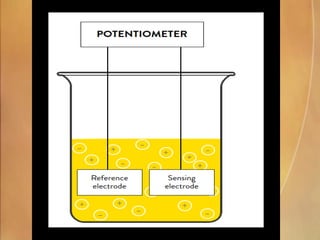
Potentiometry is based on
measurement of an electrical
potential between two electrodes.
One of the electrodes (the
measuring or sensing electrode) is
affected by contact with ions in
solution
The potential
between the measuring electrode
and a stable reference electrode is
altered as the concentration of ions
changes.
Potentiometric methods are best
suited for measurement of ions
(electrolytes) such as
sodium,
potassium
chlorid
The voltage change is a complex
function of the concentration of
each ion and is described in a
logarithmic relationship called the
Nernst equation
Potentiometry measures the activity
of the ion or effective concentration
of the ion in the solution.
Because
ions interact with each other and
with water in a real-world sample,
clinical specimens are not ideal.
Measuring the actual concentration
of an ion requires an infinitely
dilute solution where all of the ion
interactions disappear
The difference between effective
concentration that is measured by
electrodes in the
laboratory and the actual
concentration in an ideal dilute
solution is described by the activity
coefficient. The activity coefficient
is constant under specified
conditions
However, differences in heat, pH,
ionic strength, and sample mixtures
can alter the relationship between
the measured activity and resulted
concentration
So, many chemistry analyzers
dilute the specimen into a solution
of fixed ionic strength and perform
the analysis under controlled
conditions to minimize these
sources of bias.
This is termed an indirect method
because the sample is diluted
before the potentiometric
measurement. Direct methods, such
as blood gas analyzers, measure ion
activity in whole blood and control
conditions with a heat block.
ENDPOINT REACTIONS
Endpoint reactions are especially
suitable for chemical reactions that
are completed in a relatively short
time and are “stoichiometric,”
meaning that they produce one
product molecule or complex for
each molecule of analyte.
For example, a reaction of albumin
with the dye bromocresol purple
(BCP) produces a colored
complex. If the reaction is allowed
to continue until all the albumin
present in solution has reacted and
the maximum amount of colored
product has formed, the color at the
end of the reaction reflects the total
amount of albumin as the albumin-
dye complex.
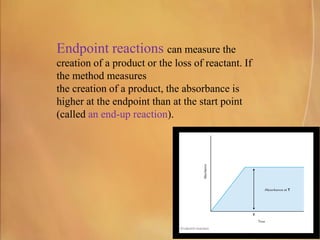
Endpoint reactions can measure the
creation of a product or the loss of reactant. If
the method measures
the creation of a product, the absorbance is
higher at the endpoint than at the start point
(called an end-up reaction).
If the method measures the
disappearance of a reactant, the
absorbance is lower at the endpoint
than at the start point (called an
end-down reaction).
RATE REACTIONS
If the analyte is an enzyme, a
molecule which can catalyze the
conversion of unlimited numbers of
reagent molecules (termed
substrates) to product, the amount
of product at the endpoint would
not reflect the
amount of enzyme. Instead, the
endpoint would reflect the amount
of substrate that was present
For this
reason, enzyme activity is
determined by a rate reaction rather
than an endpoint reaction. In such
cases determination of the enzyme
concentration is based on how fast
a fixed amount of substrate is
converted to product.
The more enzyme present, the
faster the conversion. Examples of
enzymes that are often measured
in the clinical laboratory include
lipase (a digestive enzyme
measured in pancreatic diseases)
and alanine
aminotransferase (an enzyme
responsible for interconversion of
amino acids measured in liver
diseases).
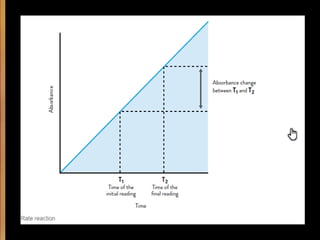
Rate reactions can measure the
appearance of a product or the
disappearance of a substrate
If measuring
the appearance of a product, the
absorbance increases with time
(called a rate-up reaction).
If measuring the disappearance of
a substrate, the absorbance
decreases with time (called a rate-
down reaction).
Rate reactions may also be used for
measurement of analytes that are
not enzymes. For example, if a
reaction is very slow to reach an
endpoint,
a rate method may be more
practical in order to obtain a result
in a shorter
timeframe. Some examples of
analytes other than enzymes that
are measured using rate reaction
include
ammonia (a waste product of
protein metabolism) and amikacin
(a therapeutic drug).
CALIBRATION
Calibration is the important process that links
the analytical signal with the concentration of
analyte.
Calibration uses a series of solutions containing
the analyte at known concentrations and
observes the signal produced at each
concentration.
These results can be expressed as a
calibration curve. The purpose of a
calibration curve is to establish a
relationship between the
concentration of the analyte and the
magnitude of the optical or
potentiometric signal given by the
measuring device. The relationship
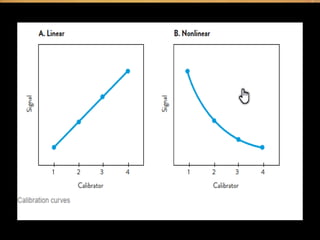
can be linear or nonlinear (such as
logarithmic or exponential).
The calibration curve in panel A shows the
signal rising linearly with increasing
concentration of analyte.
The curve in panel B shows the signal falling in
a nonlinear fashion with rising analyte
concentration.
Interpolation (connecting the points on the
calibration plot to form the best fit line or
curve) establishes an
expected signal for the range of concentrations
of analyte that fall between the lowest and
highest calibrator.
The signal from a sample can be compared to
the calibration curve and the concentration of
analyte that produces that signal can be
determined.
One of the challenges in the
calibration process is the
determination of the highest and
lowest signal that can be reliably
measured and related to a
concentration of analyte
These limits of measurement are
dictated in part by properties of the
method and in part by properties of
the instrument being used for the
test.
The
laboratory or manufacturer that
develops a test method typically
determines the analytic
measurement range (AMR, also
known as the dynamic range) that
defines the lowest to highest
measurable quantities.
Organizations such as the Clinical
and Laboratory Standards Institute
(CLSI; www.clsi.org) publish
guidelines for determination of
AMR and other characteristics of
clinical assays.
Ideally, all samples being analyzed
would give signals that are within
the AMR. However, for “real-life”
clinical assays, this is often not the
case. When a signal is outside the
AMR, the concentration of analyte
in the patient sample cannot be
determined with confidence.
If the signal is below the AMR, the
result is typically reported as less
than the lower end of the AMR or
less than the the lowest calibrator
used in the clinical laboratory. If
the signal is above the AMR, the
result may be reported as greater
than the upper limit
of the AMR or greater than the
highest calibrator used in the lab
Alternatively, the sample may be
diluted to bring the analyte
concentration within the AMR and
reanalyzed. The measured value on
the diluted sample
is then multiplied by the dilution
factor to determine the
concentration in the original
sample.

potentiometry.pdf

  • 1.
    POTENTIOMETRY Potentiometry is basedon measurement of an electrical potential between two electrodes. One of the electrodes (the measuring or sensing electrode) is affected by contact with ions in solution
  • 2.
    The potential between themeasuring electrode and a stable reference electrode is altered as the concentration of ions changes.
  • 3.
    Potentiometric methods arebest suited for measurement of ions (electrolytes) such as sodium, potassium chlorid
  • 4.
    The voltage changeis a complex function of the concentration of each ion and is described in a logarithmic relationship called the Nernst equation
  • 6.
    Potentiometry measures theactivity of the ion or effective concentration of the ion in the solution. Because ions interact with each other and with water in a real-world sample, clinical specimens are not ideal.
  • 7.
    Measuring the actualconcentration of an ion requires an infinitely dilute solution where all of the ion interactions disappear
  • 8.
    The difference betweeneffective concentration that is measured by electrodes in the laboratory and the actual concentration in an ideal dilute solution is described by the activity coefficient. The activity coefficient is constant under specified conditions
  • 9.
    However, differences inheat, pH, ionic strength, and sample mixtures can alter the relationship between the measured activity and resulted concentration
  • 10.
    So, many chemistryanalyzers dilute the specimen into a solution of fixed ionic strength and perform the analysis under controlled conditions to minimize these sources of bias.
  • 11.
    This is termedan indirect method because the sample is diluted before the potentiometric measurement. Direct methods, such as blood gas analyzers, measure ion activity in whole blood and control conditions with a heat block.
  • 12.
    ENDPOINT REACTIONS Endpoint reactionsare especially suitable for chemical reactions that are completed in a relatively short time and are “stoichiometric,” meaning that they produce one product molecule or complex for each molecule of analyte.
  • 13.
    For example, areaction of albumin with the dye bromocresol purple (BCP) produces a colored complex. If the reaction is allowed to continue until all the albumin present in solution has reacted and the maximum amount of colored product has formed, the color at the end of the reaction reflects the total amount of albumin as the albumin- dye complex.
  • 14.
    Endpoint reactions canmeasure the creation of a product or the loss of reactant. If the method measures the creation of a product, the absorbance is higher at the endpoint than at the start point (called an end-up reaction).
  • 15.
    If the methodmeasures the disappearance of a reactant, the absorbance is lower at the endpoint than at the start point (called an end-down reaction).
  • 16.
    RATE REACTIONS If theanalyte is an enzyme, a molecule which can catalyze the conversion of unlimited numbers of reagent molecules (termed substrates) to product, the amount of product at the endpoint would not reflect the amount of enzyme. Instead, the endpoint would reflect the amount of substrate that was present
  • 17.
    For this reason, enzymeactivity is determined by a rate reaction rather than an endpoint reaction. In such cases determination of the enzyme concentration is based on how fast a fixed amount of substrate is converted to product.
  • 18.
    The more enzymepresent, the faster the conversion. Examples of enzymes that are often measured in the clinical laboratory include lipase (a digestive enzyme measured in pancreatic diseases) and alanine aminotransferase (an enzyme responsible for interconversion of amino acids measured in liver diseases).
  • 19.
    Rate reactions canmeasure the appearance of a product or the disappearance of a substrate If measuring the appearance of a product, the absorbance increases with time (called a rate-up reaction). If measuring the disappearance of a substrate, the absorbance decreases with time (called a rate- down reaction).
  • 21.
    Rate reactions mayalso be used for measurement of analytes that are not enzymes. For example, if a reaction is very slow to reach an endpoint, a rate method may be more practical in order to obtain a result in a shorter timeframe. Some examples of analytes other than enzymes that are measured using rate reaction include ammonia (a waste product of protein metabolism) and amikacin (a therapeutic drug).
  • 22.
    CALIBRATION Calibration is theimportant process that links the analytical signal with the concentration of analyte. Calibration uses a series of solutions containing the analyte at known concentrations and observes the signal produced at each concentration.
  • 23.
    These results canbe expressed as a calibration curve. The purpose of a calibration curve is to establish a relationship between the concentration of the analyte and the magnitude of the optical or potentiometric signal given by the measuring device. The relationship can be linear or nonlinear (such as logarithmic or exponential).
  • 25.
    The calibration curvein panel A shows the signal rising linearly with increasing concentration of analyte. The curve in panel B shows the signal falling in a nonlinear fashion with rising analyte concentration. Interpolation (connecting the points on the calibration plot to form the best fit line or curve) establishes an expected signal for the range of concentrations of analyte that fall between the lowest and highest calibrator. The signal from a sample can be compared to the calibration curve and the concentration of analyte that produces that signal can be determined.
  • 26.
    One of thechallenges in the calibration process is the determination of the highest and lowest signal that can be reliably measured and related to a concentration of analyte These limits of measurement are dictated in part by properties of the method and in part by properties of the instrument being used for the test.
  • 27.
    The laboratory or manufacturerthat develops a test method typically determines the analytic measurement range (AMR, also known as the dynamic range) that defines the lowest to highest measurable quantities.
  • 28.
    Organizations such asthe Clinical and Laboratory Standards Institute (CLSI; www.clsi.org) publish guidelines for determination of AMR and other characteristics of clinical assays.
  • 29.
    Ideally, all samplesbeing analyzed would give signals that are within the AMR. However, for “real-life” clinical assays, this is often not the case. When a signal is outside the AMR, the concentration of analyte in the patient sample cannot be determined with confidence.
  • 30.
    If the signalis below the AMR, the result is typically reported as less than the lower end of the AMR or less than the the lowest calibrator used in the clinical laboratory. If the signal is above the AMR, the result may be reported as greater than the upper limit of the AMR or greater than the highest calibrator used in the lab
  • 31.
    Alternatively, the samplemay be diluted to bring the analyte concentration within the AMR and reanalyzed. The measured value on the diluted sample is then multiplied by the dilution factor to determine the concentration in the original sample.