Metal cutting Lab
Experiment Name: Calculating Chip Thickness Ratio.
Name : khogr Kamal Ibrahim
Stage : 3 rd
Expermanet No :2
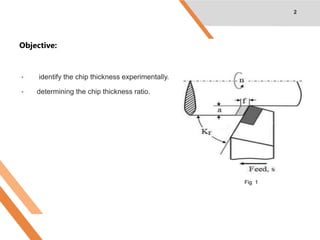
Objective:
• identify the chip thickness experimentally.
• determining the chip thickness ratio.
2
Fig 1
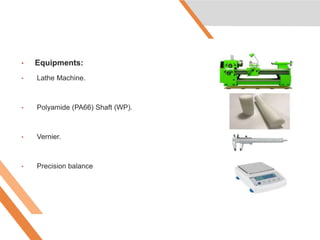
• Equipments:
• Lathe Machine.
• Polyamide (PA66) Shaft (WP).
• Vernier.
• Precision balance
Theory:
1-
• the Cutting edge angle
the angle between the cutting face of a cutting tool and the surface of the work back of the tool
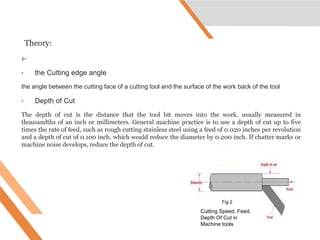
• Depth of Cut
The depth of cut is the distance that the tool bit moves into the work. usually measured in
thousandths of an inch or millimeters. General machine practice is to use a depth of cut up to five
times the rate of feed, such as rough cutting stainless steel using a feed of 0.020 inches per revolution
and a depth of cut of 0.100 inch. which would reduce the diameter by 0.200 inch. If chatter marks or
machine noise develops, reduce the depth of cut.
Fig 2
Cutting Speed, Feed,
Depth Of Cut in
Machine tools
2- the uncut chip
Uncut chip thickness is comparable to cutting edge radius in micromachining. If the uncut chip thickness is less than a
critical value, there will be no chip formation. This critical value is termed as minimum uncut chip thickness.
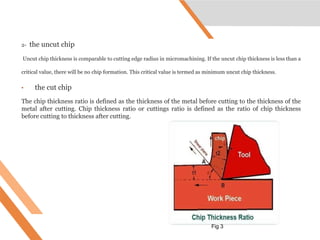
• the cut chip
The chip thickness ratio is defined as the thickness of the metal before cutting to the thickness of the
metal after cutting. Chip thickness ratio or cuttings ratio is defined as the ratio of chip thickness
before cutting to thickness after cutting.
Fig 3
Theory: cont.
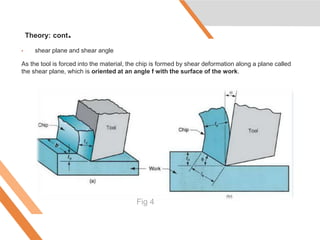
• shear plane and shear angle
As the tool is forced into the material, the chip is formed by shear deformation along a plane called
the shear plane, which is oriented at an angle f with the surface of the work.
Fig 4
Procedure:
• the density of WP material is 1.14 g/cm
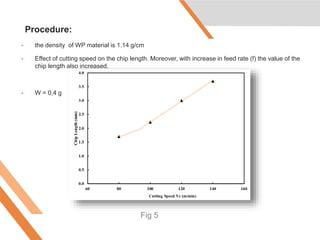
• Effect of cutting speed on the chip length. Moreover, with increase in feed rate (f) the value of the
chip length also increased.
• W = 0,4 g
Fig 5
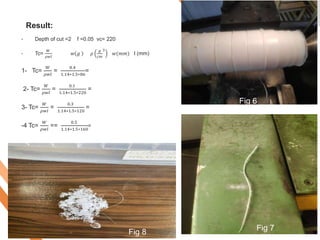
Result:
• Depth of cut =2 f =0.05 vc= 220
• Tc=
𝑊
𝜌𝑤𝑙
𝑤 𝑔 𝜌
𝑔
𝑐𝑚
3
𝑤(𝑚𝑚) l (mm)
1- Tc=
𝑊
𝜌𝑤𝑙
=
0.4
1.14∗1.5∗86
=
2- Tc=
𝑊
𝜌𝑤𝑙
=
0.1
1.14∗1.5∗220
=
3- Tc=
𝑊
𝜌𝑤𝑙
=
0.3
1.14∗1.5∗120
=
-4 Tc=
𝑊
𝜌𝑤𝑙
==
0.5
1.14∗1.5∗160
=
Fig 6
Fig 7
Fig 8
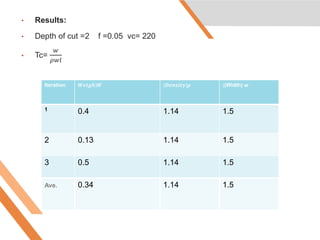
• Results:
• Depth of cut =2 f =0.05 vc= 220
• Tc=
𝑤
𝜌𝑤𝑙
Iteration 𝑾𝒆𝒊𝒈𝒉)𝑾 (𝑫𝒆𝒏𝒔𝒊𝒕𝒚)𝝆 ((Width) 𝒘
1 0.4 1.14 1.5
2 0.13 1.14 1.5
3 0.5 1.14 1.5
Ave. 0.34 1.14 1.5
Discussion:
-- In most cases the character of a machined surface depends upon the process used to produce it. For example,
there are several sources of roughness when machining with a single point tool: (1) feed marks left by the cutting tool;
(2) built-up edge fragments embedded in the surface during the process of chip formation; (3) chatter marks from
vibration of the tool, workpiece, or machine tool itself. When a surface is turned at high speed without chatter present..
--Uncut (undeformed) chip thickness (known also as the chip load) is one of the most important characteristics in any
metal cutting process as it defines many other important parameters, such as, for example, contact stresses on the
tool-chip interface, amount of plastic deformation of the layer being removed, tool life, ..

Calculating Chip Thickness Ratio.pptx

  • 1.
    Metal cutting Lab ExperimentName: Calculating Chip Thickness Ratio. Name : khogr Kamal Ibrahim Stage : 3 rd Expermanet No :2
  • 2.
    Objective: • identify thechip thickness experimentally. • determining the chip thickness ratio. 2 Fig 1
  • 3.
    • Equipments: • LatheMachine. • Polyamide (PA66) Shaft (WP). • Vernier. • Precision balance
  • 4.
    Theory: 1- • the Cuttingedge angle the angle between the cutting face of a cutting tool and the surface of the work back of the tool • Depth of Cut The depth of cut is the distance that the tool bit moves into the work. usually measured in thousandths of an inch or millimeters. General machine practice is to use a depth of cut up to five times the rate of feed, such as rough cutting stainless steel using a feed of 0.020 inches per revolution and a depth of cut of 0.100 inch. which would reduce the diameter by 0.200 inch. If chatter marks or machine noise develops, reduce the depth of cut. Fig 2 Cutting Speed, Feed, Depth Of Cut in Machine tools
  • 5.
    2- the uncutchip Uncut chip thickness is comparable to cutting edge radius in micromachining. If the uncut chip thickness is less than a critical value, there will be no chip formation. This critical value is termed as minimum uncut chip thickness. • the cut chip The chip thickness ratio is defined as the thickness of the metal before cutting to the thickness of the metal after cutting. Chip thickness ratio or cuttings ratio is defined as the ratio of chip thickness before cutting to thickness after cutting. Fig 3
  • 6.
    Theory: cont. • shearplane and shear angle As the tool is forced into the material, the chip is formed by shear deformation along a plane called the shear plane, which is oriented at an angle f with the surface of the work. Fig 4
  • 7.
    Procedure: • the densityof WP material is 1.14 g/cm • Effect of cutting speed on the chip length. Moreover, with increase in feed rate (f) the value of the chip length also increased. • W = 0,4 g Fig 5
  • 8.
    Result: • Depth ofcut =2 f =0.05 vc= 220 • Tc= 𝑊 𝜌𝑤𝑙 𝑤 𝑔 𝜌 𝑔 𝑐𝑚 3 𝑤(𝑚𝑚) l (mm) 1- Tc= 𝑊 𝜌𝑤𝑙 = 0.4 1.14∗1.5∗86 = 2- Tc= 𝑊 𝜌𝑤𝑙 = 0.1 1.14∗1.5∗220 = 3- Tc= 𝑊 𝜌𝑤𝑙 = 0.3 1.14∗1.5∗120 = -4 Tc= 𝑊 𝜌𝑤𝑙 == 0.5 1.14∗1.5∗160 = Fig 6 Fig 7 Fig 8
  • 9.
    • Results: • Depthof cut =2 f =0.05 vc= 220 • Tc= 𝑤 𝜌𝑤𝑙 Iteration 𝑾𝒆𝒊𝒈𝒉)𝑾 (𝑫𝒆𝒏𝒔𝒊𝒕𝒚)𝝆 ((Width) 𝒘 1 0.4 1.14 1.5 2 0.13 1.14 1.5 3 0.5 1.14 1.5 Ave. 0.34 1.14 1.5
  • 10.
    Discussion: -- In mostcases the character of a machined surface depends upon the process used to produce it. For example, there are several sources of roughness when machining with a single point tool: (1) feed marks left by the cutting tool; (2) built-up edge fragments embedded in the surface during the process of chip formation; (3) chatter marks from vibration of the tool, workpiece, or machine tool itself. When a surface is turned at high speed without chatter present.. --Uncut (undeformed) chip thickness (known also as the chip load) is one of the most important characteristics in any metal cutting process as it defines many other important parameters, such as, for example, contact stresses on the tool-chip interface, amount of plastic deformation of the layer being removed, tool life, ..