Downloaded 185 times


![“Markets
are changing across the board, and
the dental industry is no exception. The
catalyst for change in this industry have been
the digital platforms that have been
developed, working in concert with the
economic situation we find ourselves in
today”
JOHNSON
[1]
3](https://image.slidesharecdn.com/computeraideddesign-computeraidedmanufacturecad-cam-131112114827-phpapp02/75/Computer-aided-design-computer-aided-manufacture-cad-cam-3-2048.jpg)
![
1950s U.S Air Force
1971 Dr.Duret- Sopha System (crowns)
1985 Dr. Moermann- CEREC® system (inlay)
1980s Dr. Andersson- Procera® system
(titanium copings and composite veneered
restorations)
This system later developed as a processing center
networked with satellite digitizers around the world for
the fabrication of all-ceramic frameworks. [2]
4](https://image.slidesharecdn.com/computeraideddesign-computeraidedmanufacturecad-cam-131112114827-phpapp02/75/Computer-aided-design-computer-aided-manufacture-cad-cam-4-2048.jpg)


![Intra oral abutments
impression
Working
model
Wax
up
Casting
Porcelain works
CONVENTIONAL LAB WORK
Final restoration
[3]
Luting to abutment
9](https://image.slidesharecdn.com/computeraideddesign-computeraidedmanufacturecad-cam-131112114827-phpapp02/75/Computer-aided-design-computer-aided-manufacture-cad-cam-9-2048.jpg)

![[4]
11](https://image.slidesharecdn.com/computeraideddesign-computeraidedmanufacturecad-cam-131112114827-phpapp02/75/Computer-aided-design-computer-aided-manufacture-cad-cam-11-2048.jpg)
![[5]
12](https://image.slidesharecdn.com/computeraideddesign-computeraidedmanufacturecad-cam-131112114827-phpapp02/75/Computer-aided-design-computer-aided-manufacture-cad-cam-12-2048.jpg)
![[6]
13](https://image.slidesharecdn.com/computeraideddesign-computeraidedmanufacturecad-cam-131112114827-phpapp02/75/Computer-aided-design-computer-aided-manufacture-cad-cam-13-2048.jpg)
![[7]
14](https://image.slidesharecdn.com/computeraideddesign-computeraidedmanufacturecad-cam-131112114827-phpapp02/75/Computer-aided-design-computer-aided-manufacture-cad-cam-14-2048.jpg)

![[8]
16](https://image.slidesharecdn.com/computeraideddesign-computeraidedmanufacturecad-cam-131112114827-phpapp02/75/Computer-aided-design-computer-aided-manufacture-cad-cam-16-2048.jpg)

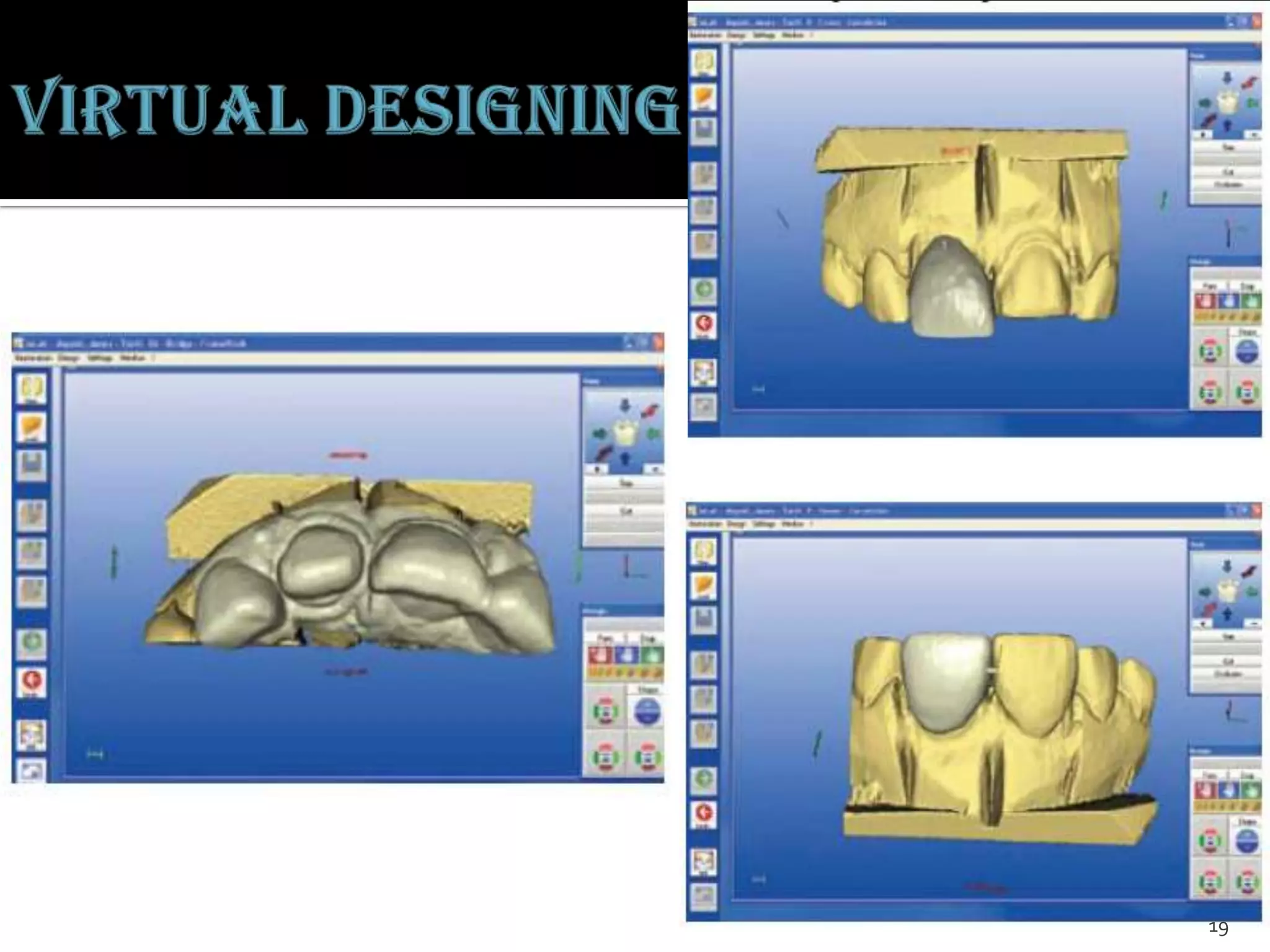
![[9
]
18](https://image.slidesharecdn.com/computeraideddesign-computeraidedmanufacturecad-cam-131112114827-phpapp02/75/Computer-aided-design-computer-aided-manufacture-cad-cam-18-2048.jpg)


![
Resin Adhesive Cements:
*light-cure
*self-cure
*dual-cure
[10]
23](https://image.slidesharecdn.com/computeraideddesign-computeraidedmanufacturecad-cam-131112114827-phpapp02/75/Computer-aided-design-computer-aided-manufacture-cad-cam-23-2048.jpg)


![[1] Johnosn P. As the World Turns. The changing global marketplace is revolutionizing
the way dental laboratories do business. Inside Dent Technol 2010;1(2),
http://www.dentalaegis.com/idt/2010/12/as-the-world-turns
[2, 4, 5,6,] Dental Materials Journal 2009; 28(1): 44-56
[3] Australian Dental Journal 2011; 56:(1 Suppl): 97–106
doi: 10.1111/j.1834-7819.2010.01300.x
[8,10] Innovation in Dentistry:CAD/CAM Restorative Procedures. A Peer-Reviewed
Publication, Written by James Klim, DDS, FAGD, FADFE and Edward B. Corrales
[7,9] CAD/CAM and Digital Impressions,Written by Paul Feuerstein, DMD and
Sameer Puri, DDS
Few Images from google
28](https://image.slidesharecdn.com/computeraideddesign-computeraidedmanufacturecad-cam-131112114827-phpapp02/75/Computer-aided-design-computer-aided-manufacture-cad-cam-28-2048.jpg)


This document summarizes the history and development of CAD/CAM technology in dentistry. It discusses early systems from the 1950s and key developments in the 1970s and 1980s. It then outlines the CAD/CAM process, including digital impression taking, design of restorations, milling, and cementing the final restoration. The document reviews materials used including ceramics, resins, and metals. It also discusses advantages like eliminating errors and the need for temporaries or second visits. Finally, it provides a brief overview of common contemporary CAD/CAM systems and their applications in dentistry.


