Memory unit in Computer organization and architecture.pptx
1.
Cache Memory
Cache memoryis an extremely fast memory
type that acts as a buffer between RAM and the
CPU. It holds frequently requested data and
instructions so that they are immediately
available to the CPU when needed. Cache
memory is used to reduce the average time to
access data from the Main memory.
2.
Cache memories
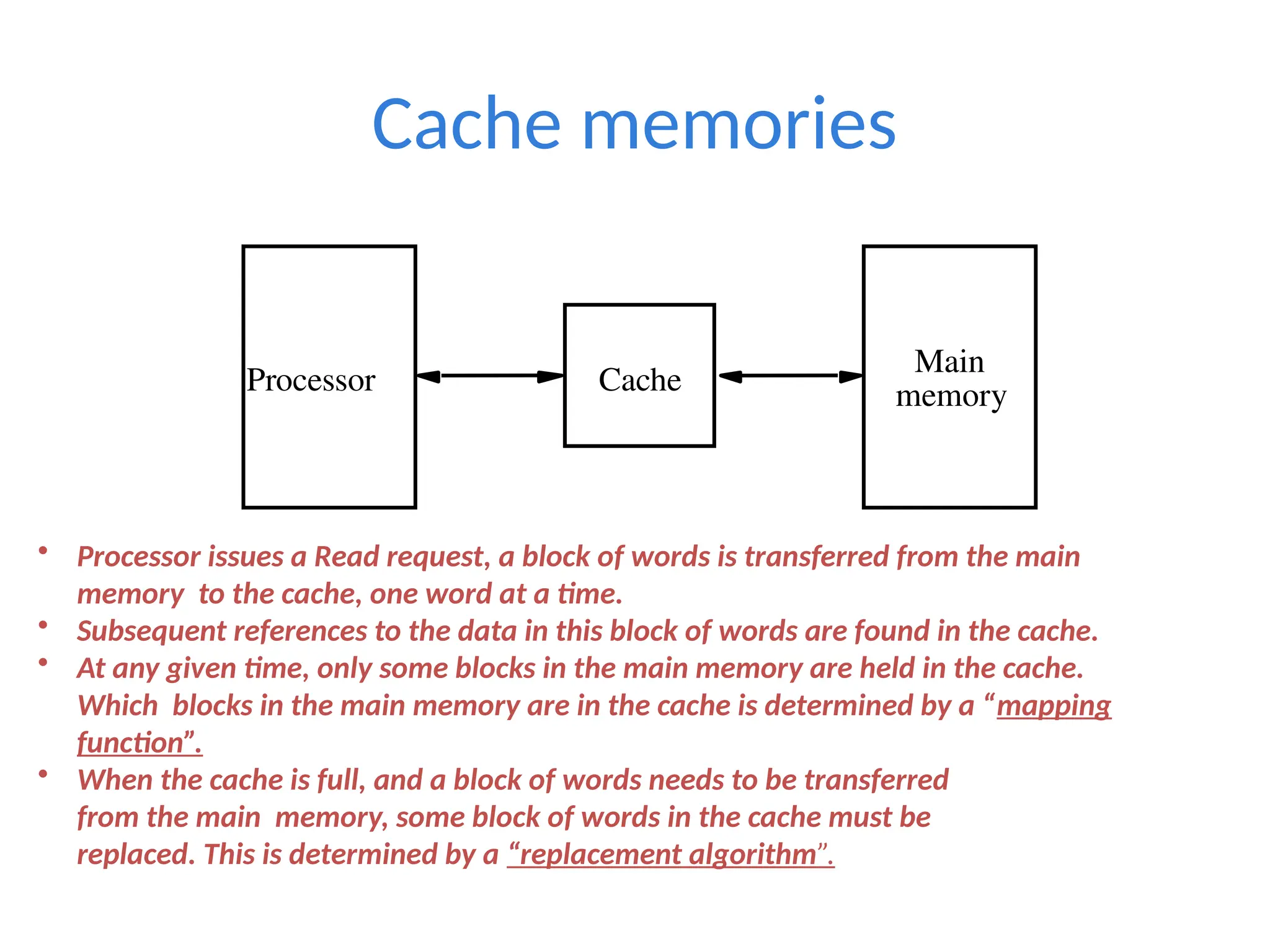
• Processorissues a Read request, a block of words is transferred from the main
memory to the cache, one word at a time.
• Subsequent references to the data in this block of words are found in the cache.
• At any given time, only some blocks in the main memory are held in the cache.
Which blocks in the main memory are in the cache is determined by a “mapping
function”.
• When the cache is full, and a block of words needs to be transferred
from the main memory, some block of words in the cache must be
replaced. This is determined by a “replacement algorithm”.
Cache
Main
memory
Processor
3.
Cache hit
• Theprocessor issues Read and Write requests in the same manner.
• If the data is in the cache it is called a Read or Write hit.
• Read hit:
The data is obtained from the cache.
• Write hit:
Cache has a replica of the contents of the main memory.
Contents of the cache and the main memory may be updated
simultaneously. This is the write-through protocol.
Update the contents of the cache, and mark it as updated by setting a bit
known as the dirty bit or modified bit. The contents of the main memory
are updated when this block is replaced. This is write-back or copy-back
protocol.
4.
Cache miss
• Ifthe data is not present in the cache, then a Read miss or Write miss occurs.
• Read miss:
Block of words containing this requested word is transferred from the memory.
After the block is transferred, the desired word is forwarded to the processor.
The desired word may also be forwarded to the processor as soon as it is
transferred without waiting for the entire block to be transferred. This is called
load-through or early-restart.
• Write-miss:
Write-through protocol is used, then the contents of the main memory are
updated directly.
If write-back protocol is used, the block containing the
addressed word is first brought into the cache. The desired word
is overwritten with new information.
5.
Mapping functions
Mappingfunctions determine how memory
blocks are placed in the cache.
Three mapping functions:
Direct mapping
Associative mapping
Set-associative mapping.
6.
Direct mapping
Main
memory Block0
Block 1
Block 127
Block 128
Block 129
Block 255
Block 256
Block 257
Block 4095
7 4
Main memory address
Tag Block Word
5
tag
tag
tag
Cache
Block 0
Block 1
Block 127
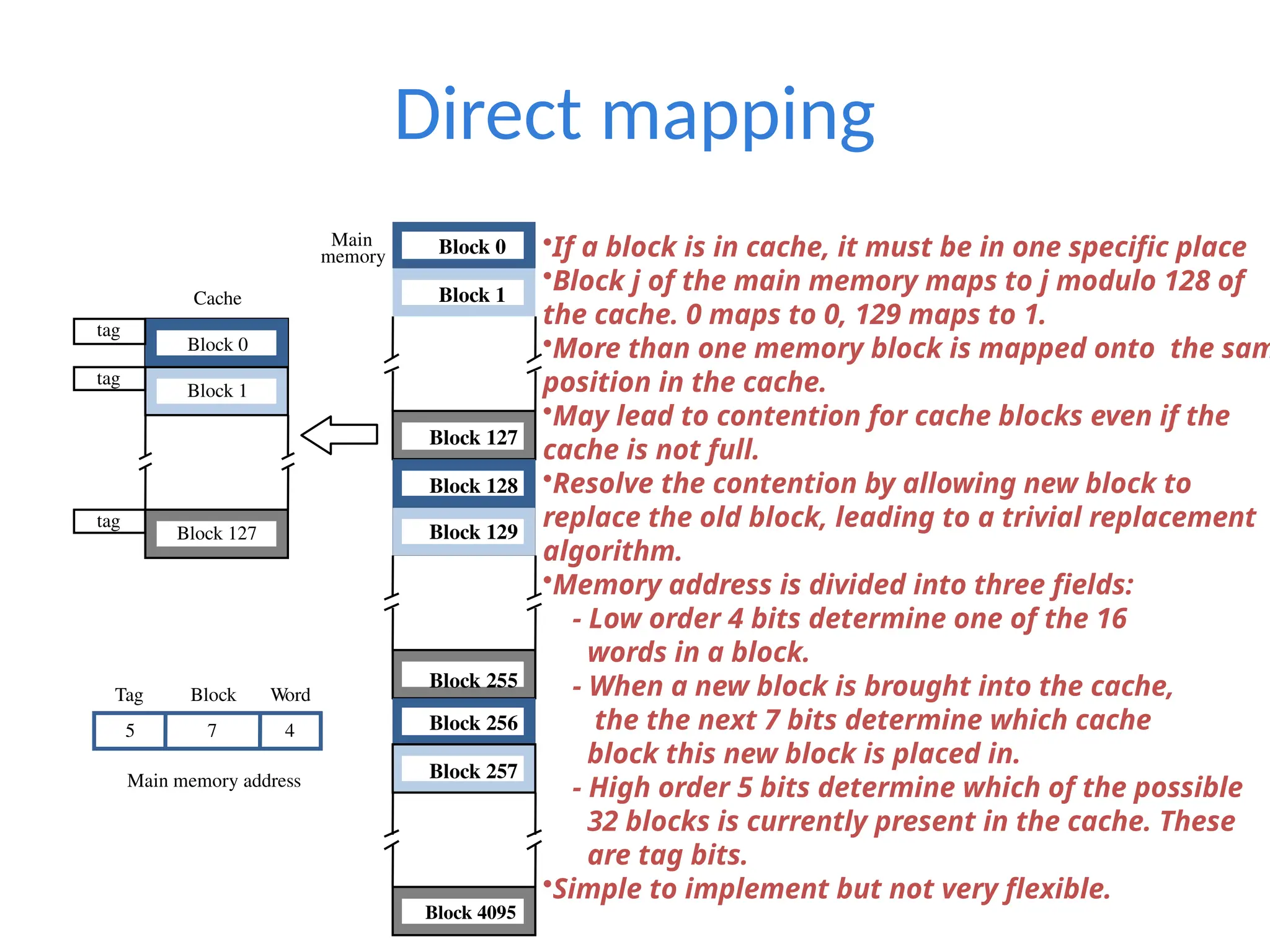
•If a block is in cache, it must be in one specific place
•Block j of the main memory maps to j modulo 128 of
the cache. 0 maps to 0, 129 maps to 1.
•More than one memory block is mapped onto the sam
position in the cache.
•May lead to contention for cache blocks even if the
cache is not full.
•Resolve the contention by allowing new block to
replace the old block, leading to a trivial replacement
algorithm.
•Memory address is divided into three fields:
- Low order 4 bits determine one of the 16
words in a block.
- When a new block is brought into the cache,
the the next 7 bits determine which cache
block this new block is placed in.
- High order 5 bits determine which of the possible
32 blocks is currently present in the cache. These
are tag bits.
•Simple to implement but not very flexible.
7.
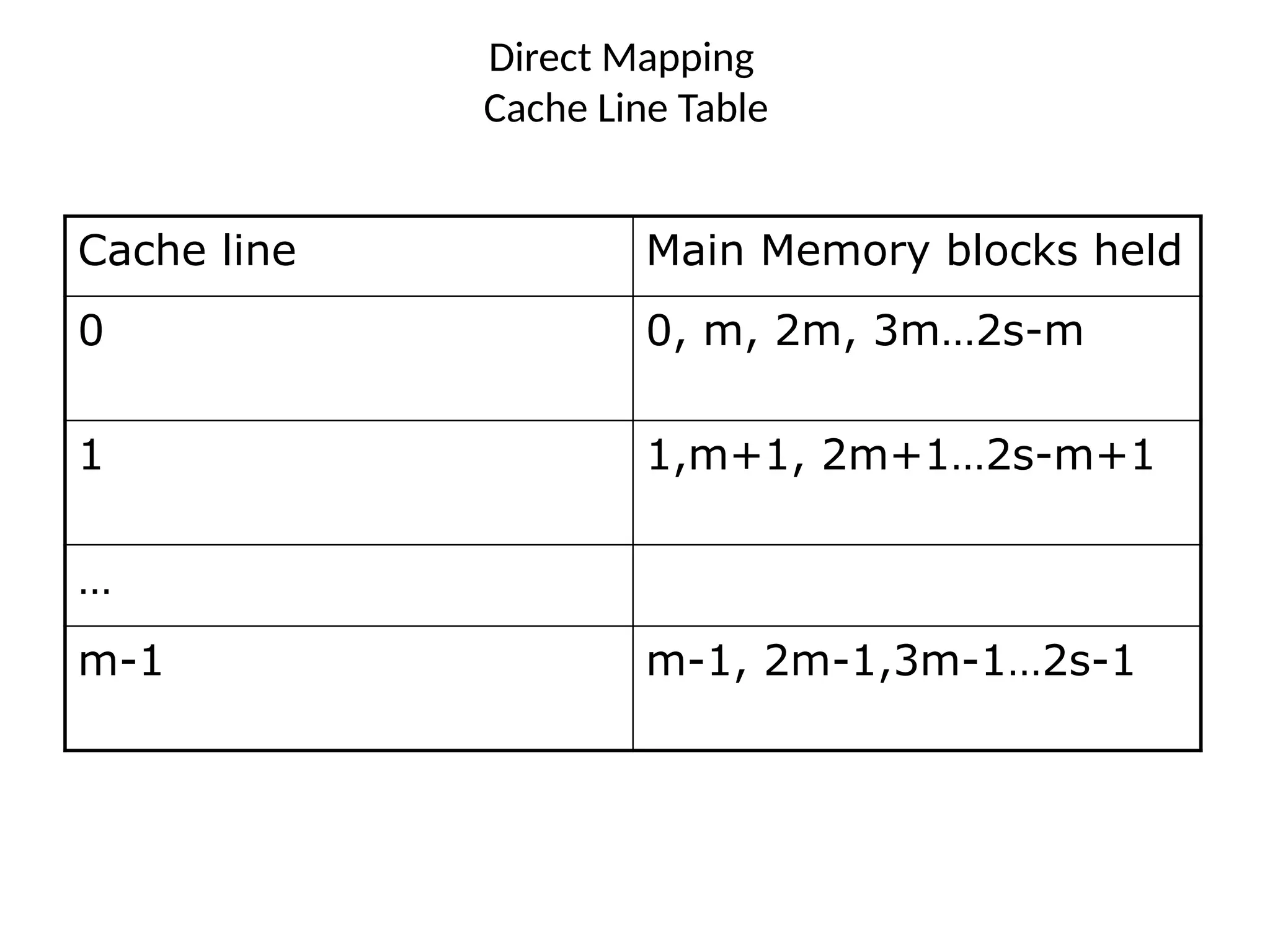
Direct Mapping
Cache LineTable
Cache line Main Memory blocks held
0 0, m, 2m, 3m…2s-m
1 1,m+1, 2m+1…2s-m+1
…
m-1 m-1, 2m-1,3m-1…2s-1
8.
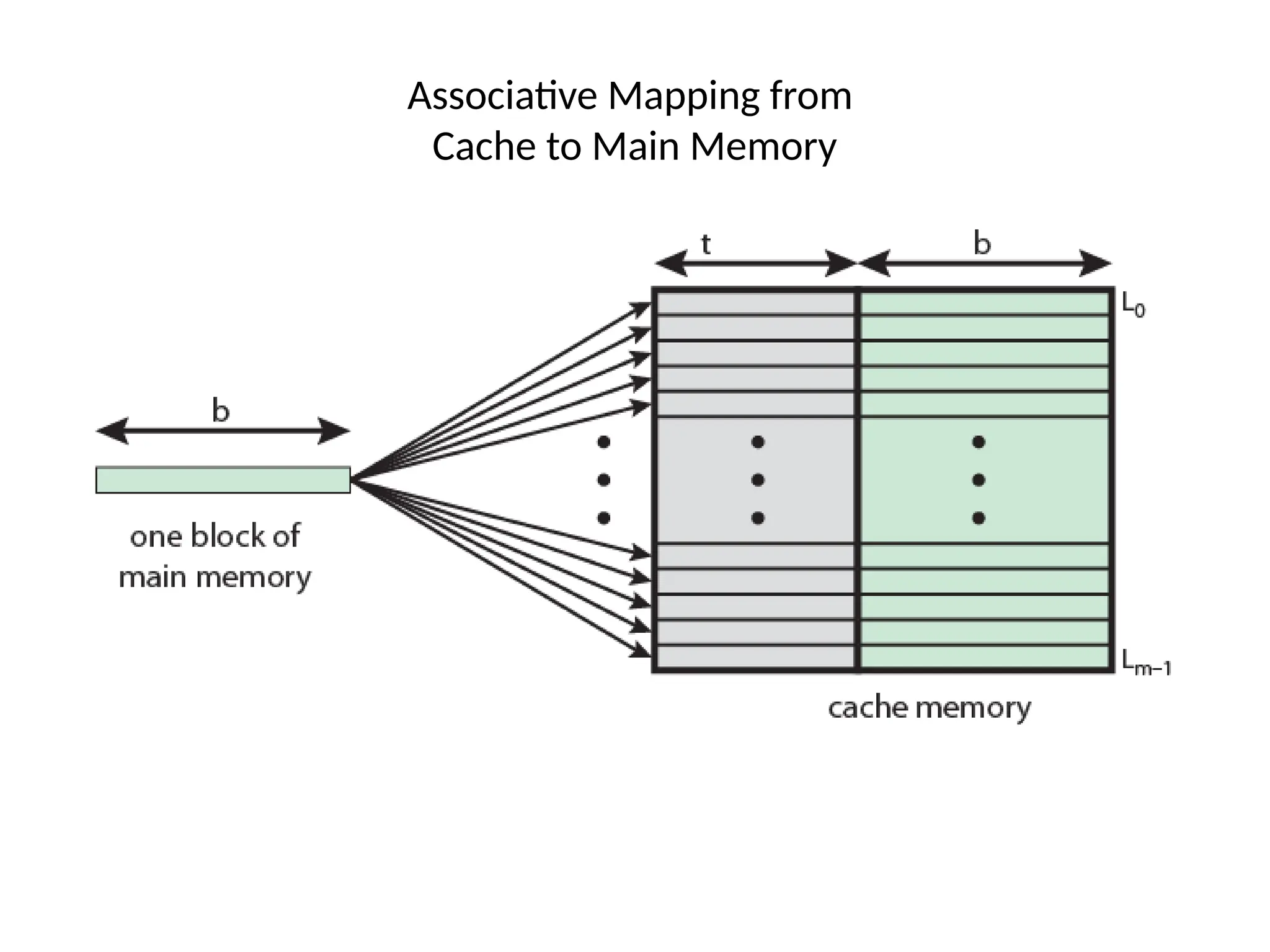
Associative mapping
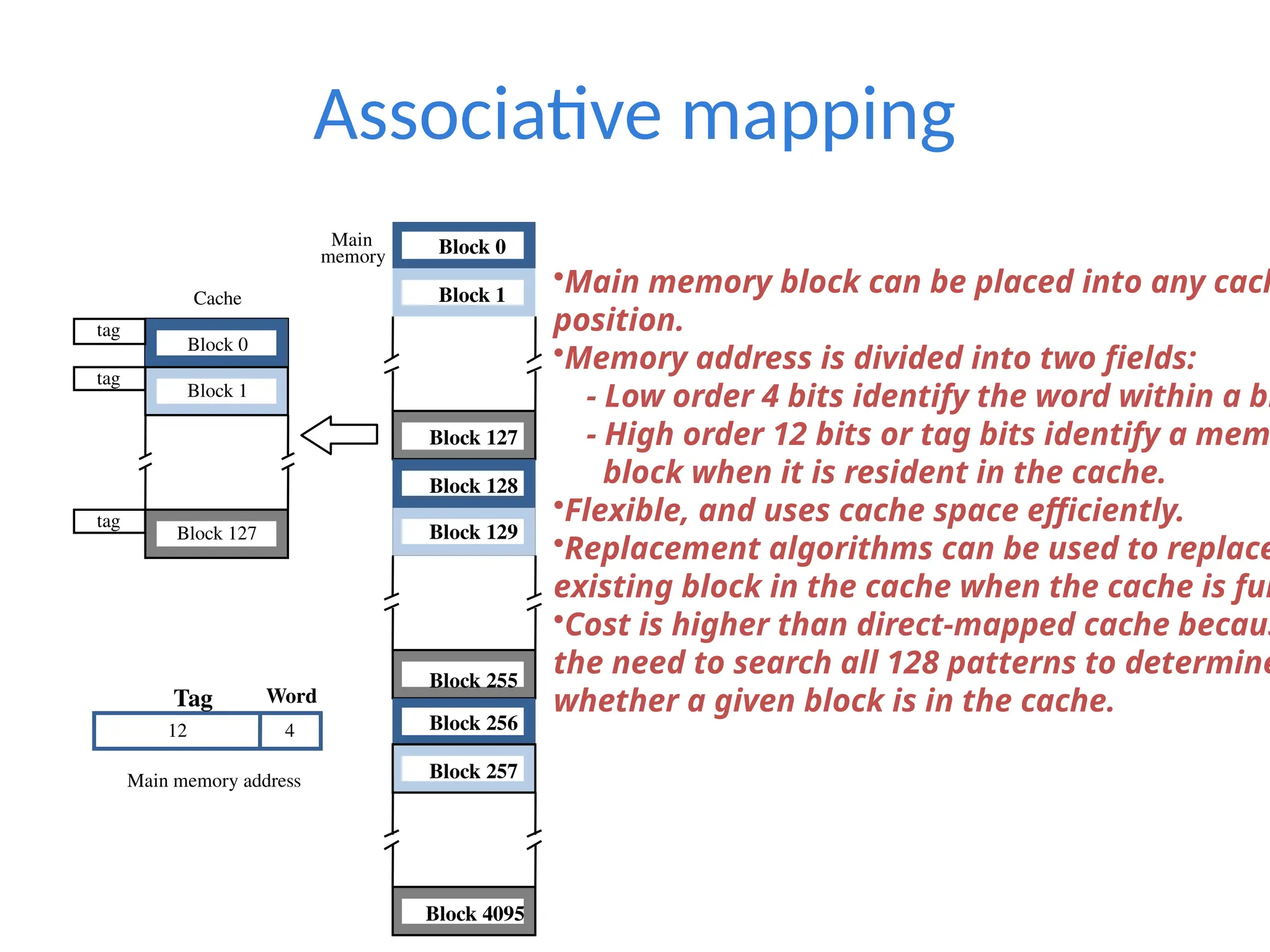
•Main memoryblock can be placed into any cach
position.
•Memory address is divided into two fields:
- Low order 4 bits identify the word within a bl
- High order 12 bits or tag bits identify a mem
block when it is resident in the cache.
•Flexible, and uses cache space efficiently.
•Replacement algorithms can be used to replace
existing block in the cache when the cache is ful
•Cost is higher than direct-mapped cache becaus
the need to search all 128 patterns to determine
whether a given block is in the cache.
Main
memory Block 0
Block 1
Block 127
Block 128
Block 129
Block 255
Block 256
Block 257
Block 4095
4
Main memory address
Tag Word
12
tag
tag
tag
Cache
Block 0
Block 1
Block 127
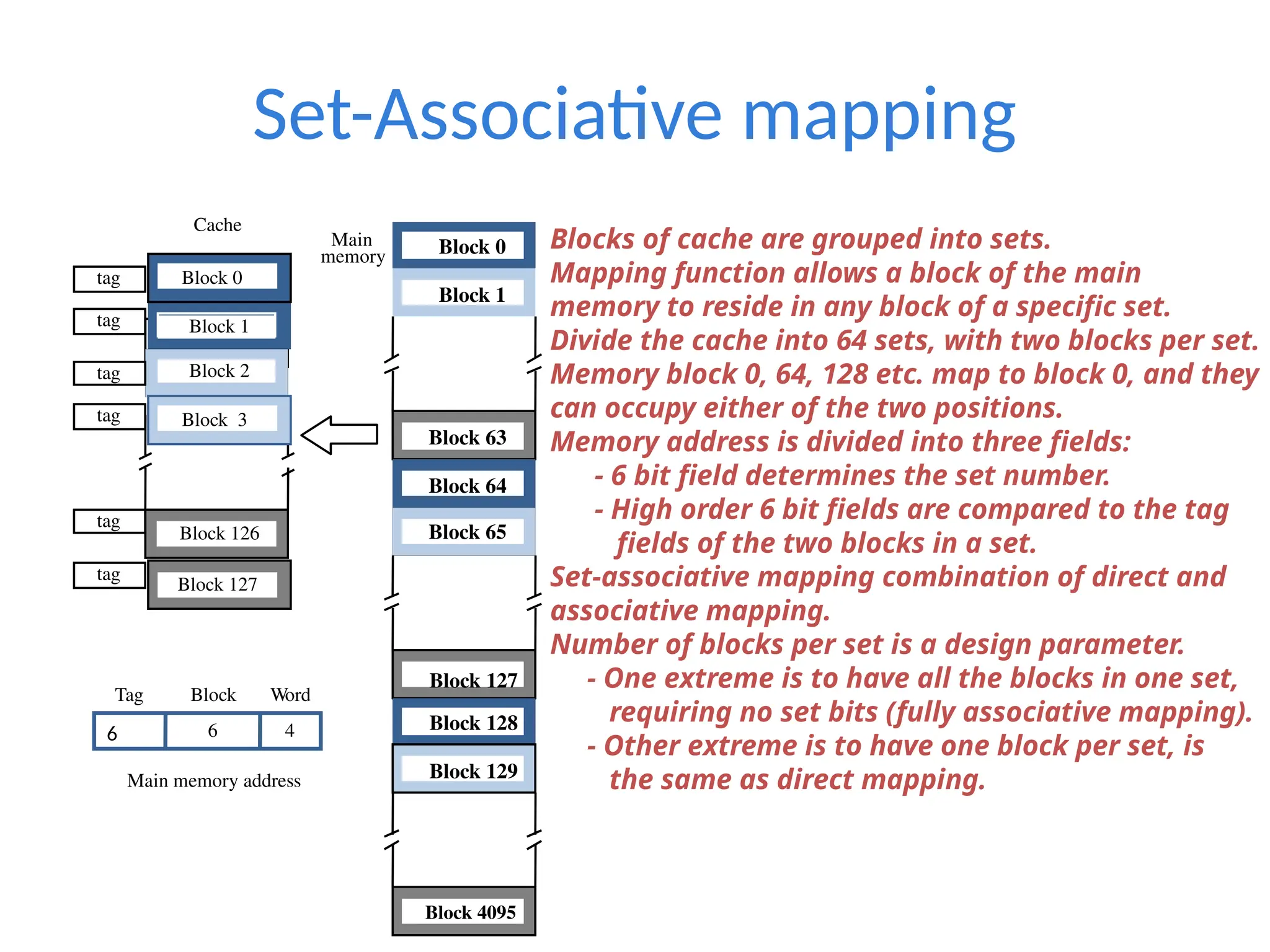
Set-Associative mapping
Blocks ofcache are grouped into sets.
Mapping function allows a block of the main
memory to reside in any block of a specific set.
Divide the cache into 64 sets, with two blocks per set.
Memory block 0, 64, 128 etc. map to block 0, and they
can occupy either of the two positions.
Memory address is divided into three fields:
- 6 bit field determines the set number.
- High order 6 bit fields are compared to the tag
fields of the two blocks in a set.
Set-associative mapping combination of direct and
associative mapping.
Number of blocks per set is a design parameter.
- One extreme is to have all the blocks in one set,
requiring no set bits (fully associative mapping).
- Other extreme is to have one block per set, is
the same as direct mapping.
Main
memory Block 0
Block 1
Block 63
Block 64
Block 65
Block 127
Block 128
Block 129
Block 4095
6 6 4
Main memory address
Tag Block Word
tag
tag
tag
Cache
Block 1
Block 2
Block 126
Block 127
Block 3
Block 0
tag
tag
tag
11.
Other Performance Enhancements
Writebuffer
Write-through:
• Each write operation involves writing to the main memory.
• If the processor has to wait for the write operation to be complete, it slows down the
processor.
• Processor does not depend on the results of the write operation.
• Write buffer can be included for temporary storage of write requests.
• Processor places each write request into the buffer and continues execution.
• If a subsequent Read request references data which is still in the write buffer, then this
data is referenced in the write buffer.
Write-back:
• Block is written back to the main memory when it is replaced.
• If the processor waits for this write to complete, before reading the new block, it is
slowed down.
• Fast write buffer can hold the block to be written, and the new
block can be read first.
12.
12
Virtual memories
Recallthat an important challenge in the design
of a computer system is to provide a large, fast
memory system at an affordable cost.
Architectural solutions to increase the effective
speed and size of the memory system.
Cache memories were developed to increase the
effective speed of the memory system.
Virtual memory is an architectural solution to
increase the effective size of the memory system.
13.
13
Virtual memories (contd..)
Recall that the addressable memory space depends
on the number of address bits in a computer.
Physical main memory in a computer is generally
not as large as the entire possible addressable
space.
Large programs that cannot fit completely into the
main memory have their parts stored on secondary
storage devices such as magnetic disks.
Pieces of programs must be transferred to the main memory from secondary storage
before they can be executed.
14.
14
Virtual memories (contd..)
When a new piece of a program is to be
transferred to the main memory, and the main
memory is full, then some other piece in the
main memory must be replaced.
Recall this is very similar to what we studied in case of cache memories.
Operating system automatically transfers data
between the main memory and secondary
storage.
Application programmer need not be concerned with this transfer.
Also, application programmer does not need to be aware of the limitations
imposed by the available physical memory.
15.
15
Virtual memories (contd..)
Techniques that automatically move program and data
between main memory and secondary storage when they are
required for execution are called virtual-memory techniques.
Programs and processors reference an instruction or data
independent of the size of the main memory.
Processor issues binary addresses for instructions and data.
These binary addresses are called logical or virtual addresses.
Virtual addresses are translated into physical addresses by a
combination of hardware and software subsystems.
If virtual address refers to a part of the program that is currently in the main memory, it is accessed
immediately.
If the address refers to a part of the program that is not currently in the main memory, it is first transferred
to the main memory before it can be used.
16.
16
Virtual memory organization
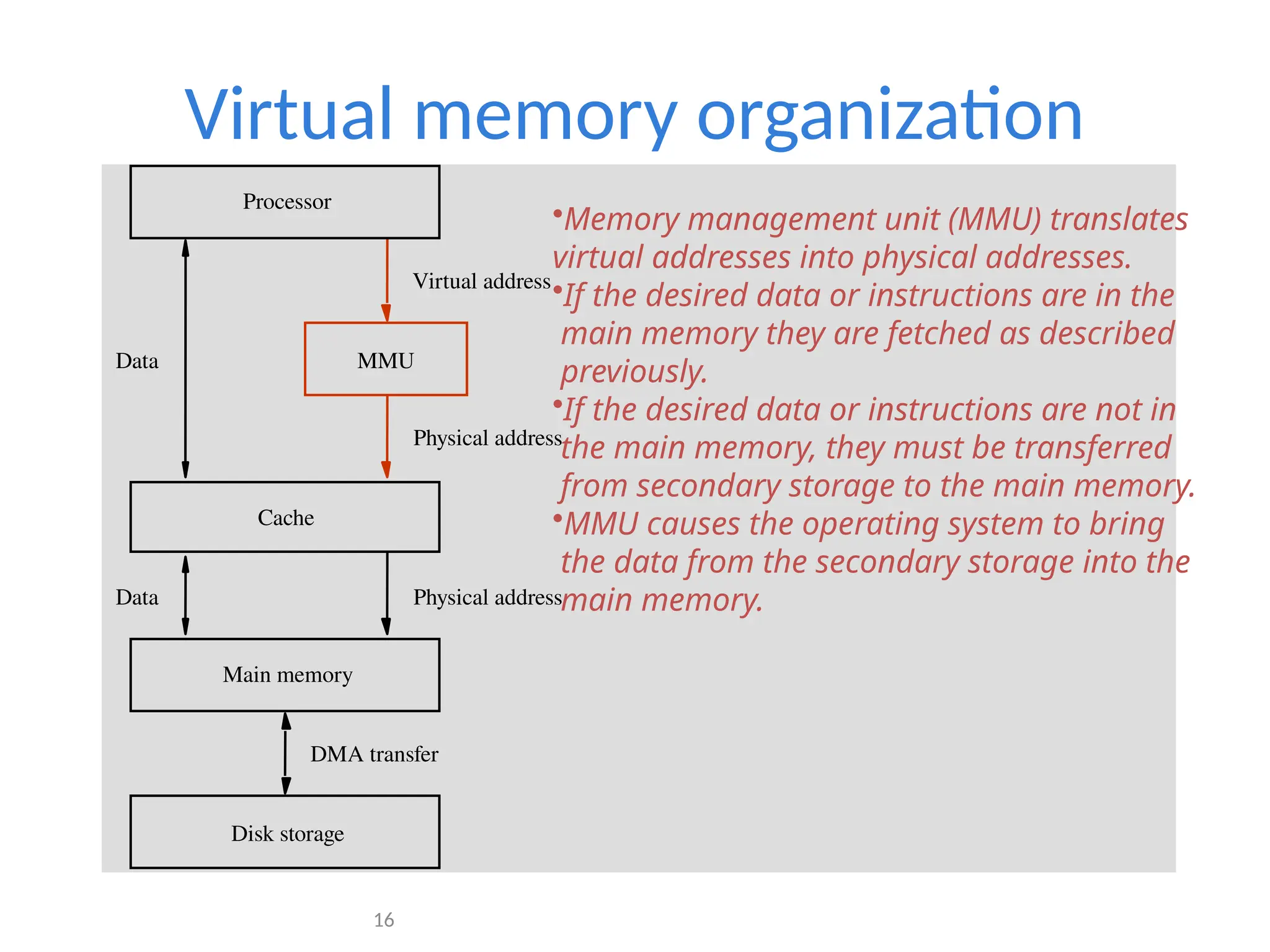
Data
Data
DMAtransfer
Physical address
Physical address
Virtual address
Disk storage
Main memory
Cache
MMU
Processor
•Memory management unit (MMU) translates
virtual addresses into physical addresses.
•If the desired data or instructions are in the
main memory they are fetched as described
previously.
•If the desired data or instructions are not in
the main memory, they must be transferred
from secondary storage to the main memory.
•MMU causes the operating system to bring
the data from the secondary storage into the
main memory.
17.
17
Address translation
Assumethat program and data are composed of
fixed-length units called pages.
A page consists of a block of words that occupy
contiguous locations in the main memory.
Page is a basic unit of information that is
transferred between secondary storage and
main memory.
Pages should not be too small, because the access time of a secondary storage
device is much larger than the main memory.
Pages should not be too large, else a large portion of the page may not be used,
and it will occupy valuable space in the main memory.
18.
18
Address translation (contd..)
•Concepts of virtual memory are similar to the
concepts of cache memory.
• Cache memory:
– Introduced to bridge the speed gap between the processor and the main
memory.
– Implemented in hardware.
• Virtual memory:
– Introduced to bridge the speed gap between the main memory and secondary
storage.
– Implemented in part by software.
19.
19
Address translation (contd..)
Each virtual or logical address generated by a processor is
interpreted as a virtual page number (high-order bits) plus
an offset (low-order bits) that specifies the location of a
particular byte within that page.
Information about the main memory location of each page
is kept in the page table.
Main memory address where the page is stored.
Current status of the page.
Area of the main memory that can hold a page is called as
page frame.
Starting address of the page table is kept in a page table
base register.
20.
20
Address translation (contd..)
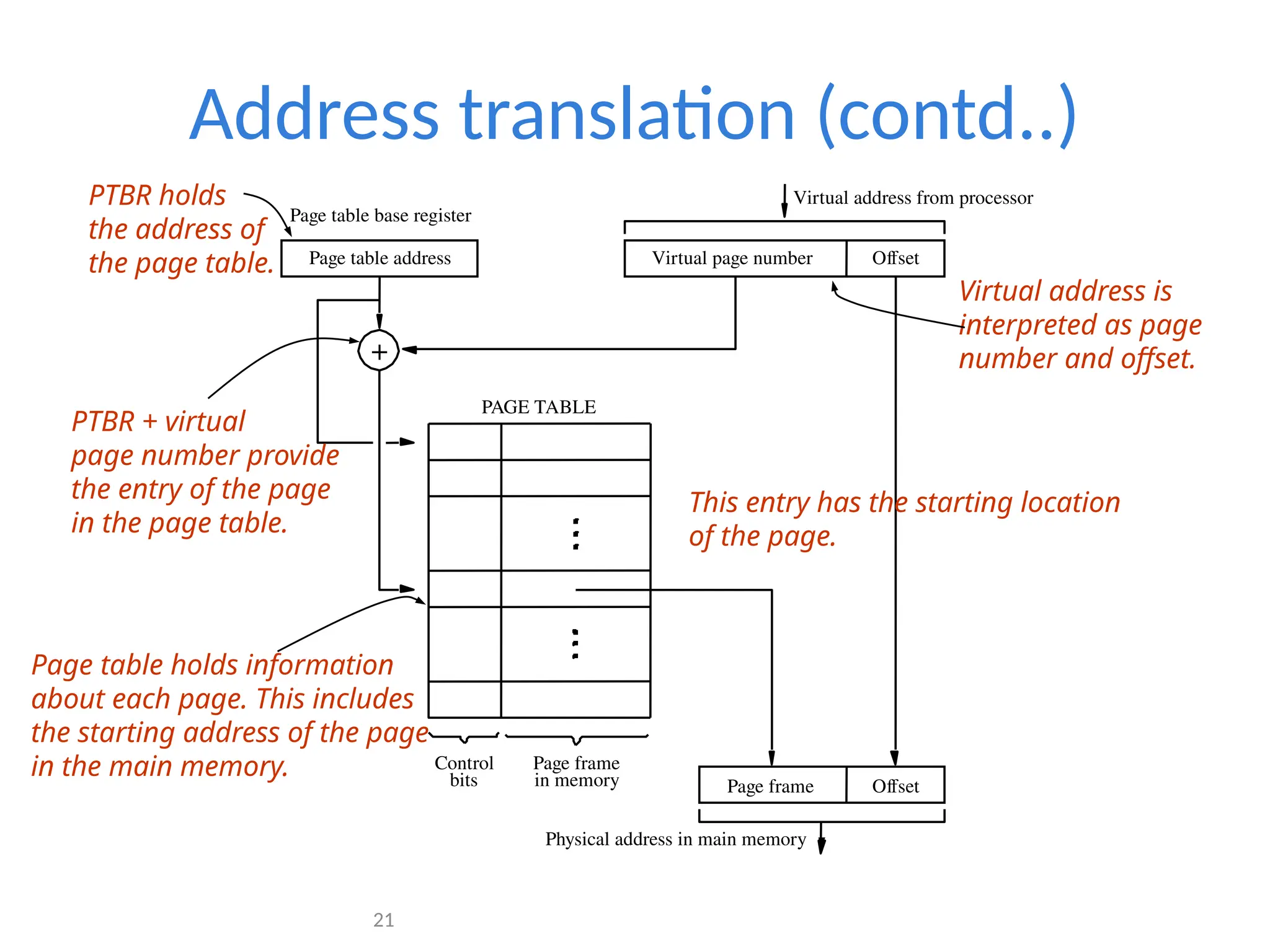
•Virtual page number generated by the
processor is added to the contents of the page
table base register.
– This provides the address of the corresponding entry in the page table.
• The contents of this location in the page table
give the starting address of the page if the
page is currently in the main memory.
21.
21
Address translation (contd..)
Pageframe
Virtual address from processor
in memory
Offset
Offset
Virtual page number
Page table address
Page table base register
Control
bits
Physical address in main memory
PAGE TABLE
Page frame
+
Virtual address is
interpreted as page
number and offset.
Page table holds information
about each page. This includes
the starting address of the page
in the main memory.
PTBR holds
the address of
the page table.
PTBR + virtual
page number provide
the entry of the page
in the page table.
This entry has the starting location
of the page.
22.
22
Address translation (contd..)
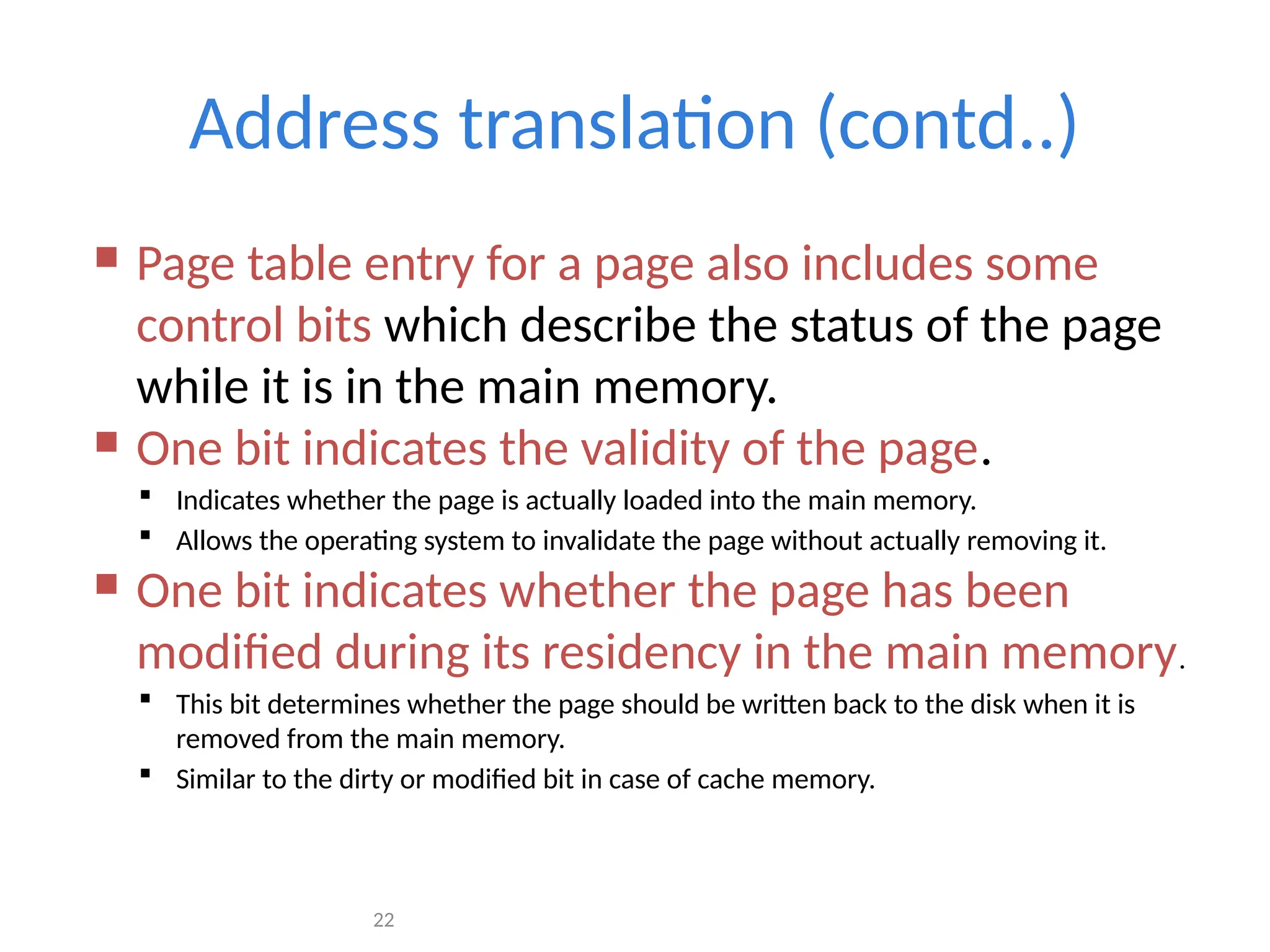
Page table entry for a page also includes some
control bits which describe the status of the page
while it is in the main memory.
One bit indicates the validity of the page.
Indicates whether the page is actually loaded into the main memory.
Allows the operating system to invalidate the page without actually removing it.
One bit indicates whether the page has been
modified during its residency in the main memory.
This bit determines whether the page should be written back to the disk when it is
removed from the main memory.
Similar to the dirty or modified bit in case of cache memory.
23.
23
Address translation (contd..)
Where should the page table be located?
Recall that the page table is used by the MMU for every
read and write access to the memory.
Ideal location for the page table is within the MMU.
Page table is quite large.
MMU is implemented as part of the processor chip.
Impossible to include a complete page table on the chip.
Page table is kept in the main memory.
A copy of a small portion of the page table can be
accommodated within the MMU.
Portion consists of page table entries that correspond to the most recently accessed pages.
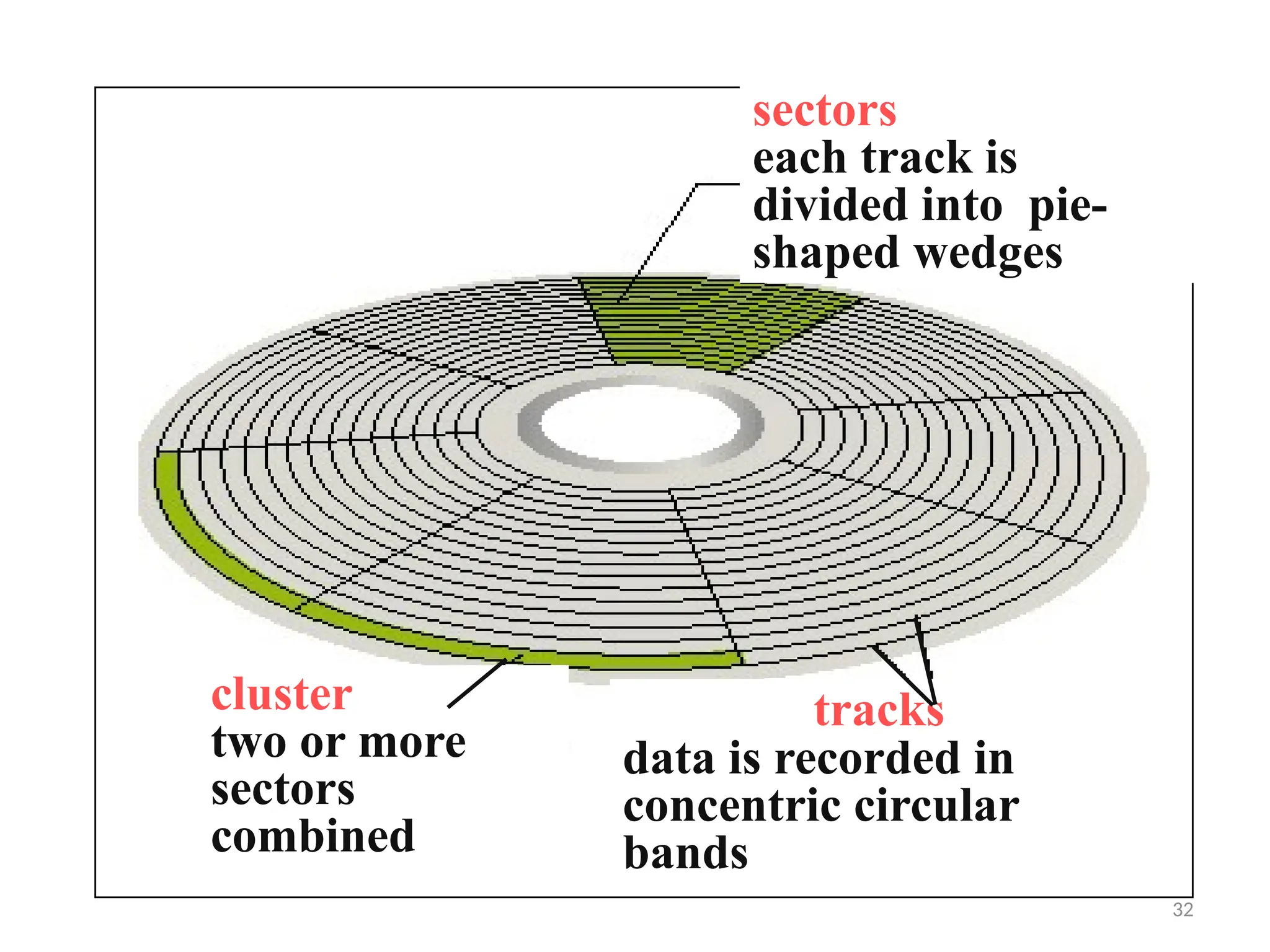
32
sectors
each track is
dividedinto pie-
shaped wedges
cluster
two or more
sectors
combined
tracks
data is recorded in
concentric circular
bands
41.
41
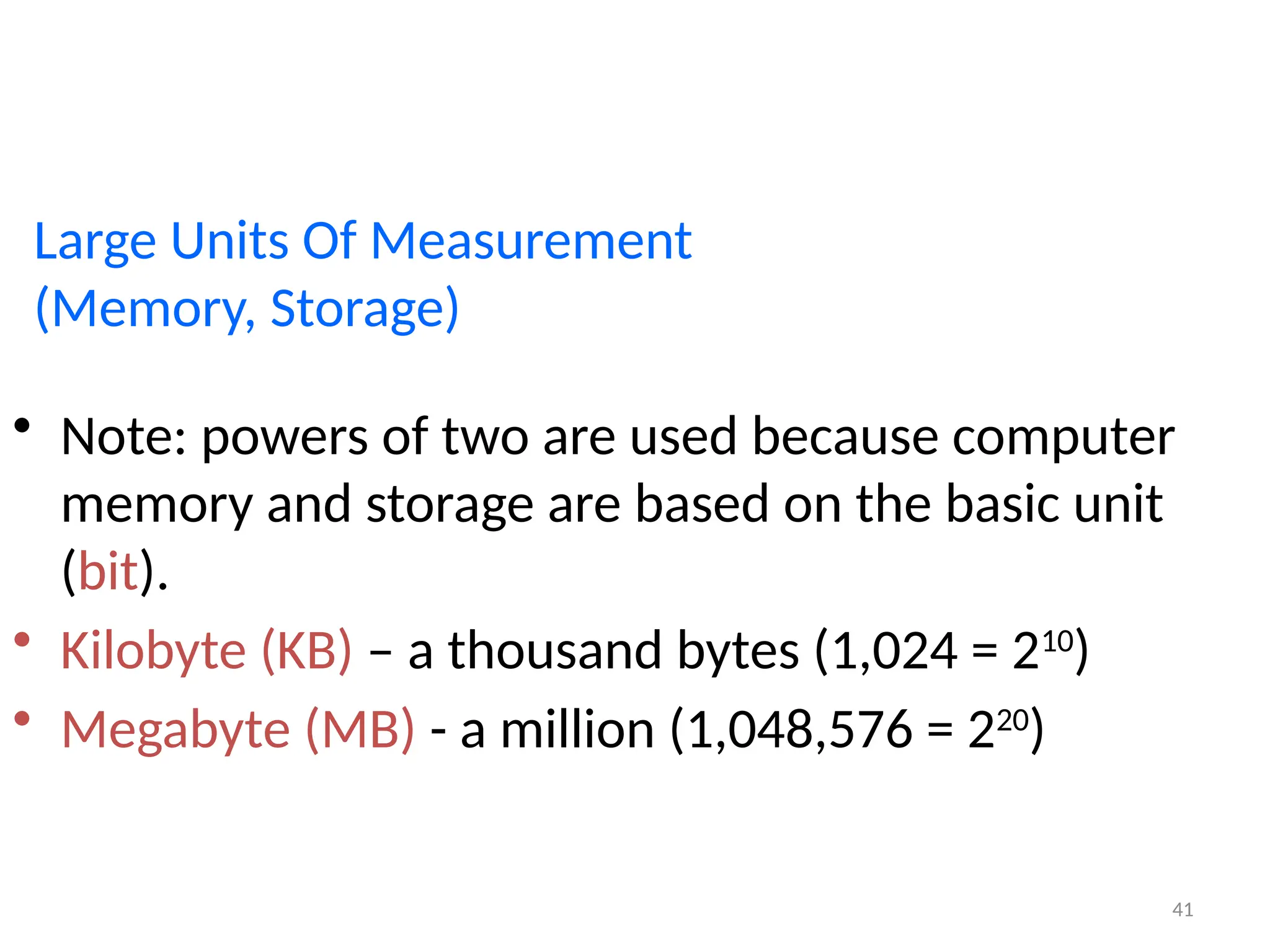
Large Units OfMeasurement
(Memory, Storage)
• Note: powers of two are used because computer
memory and storage are based on the basic unit
(bit).
• Kilobyte (KB) – a thousand bytes (1,024 = 210
)
• Megabyte (MB) - a million (1,048,576 = 220
)
42.
42
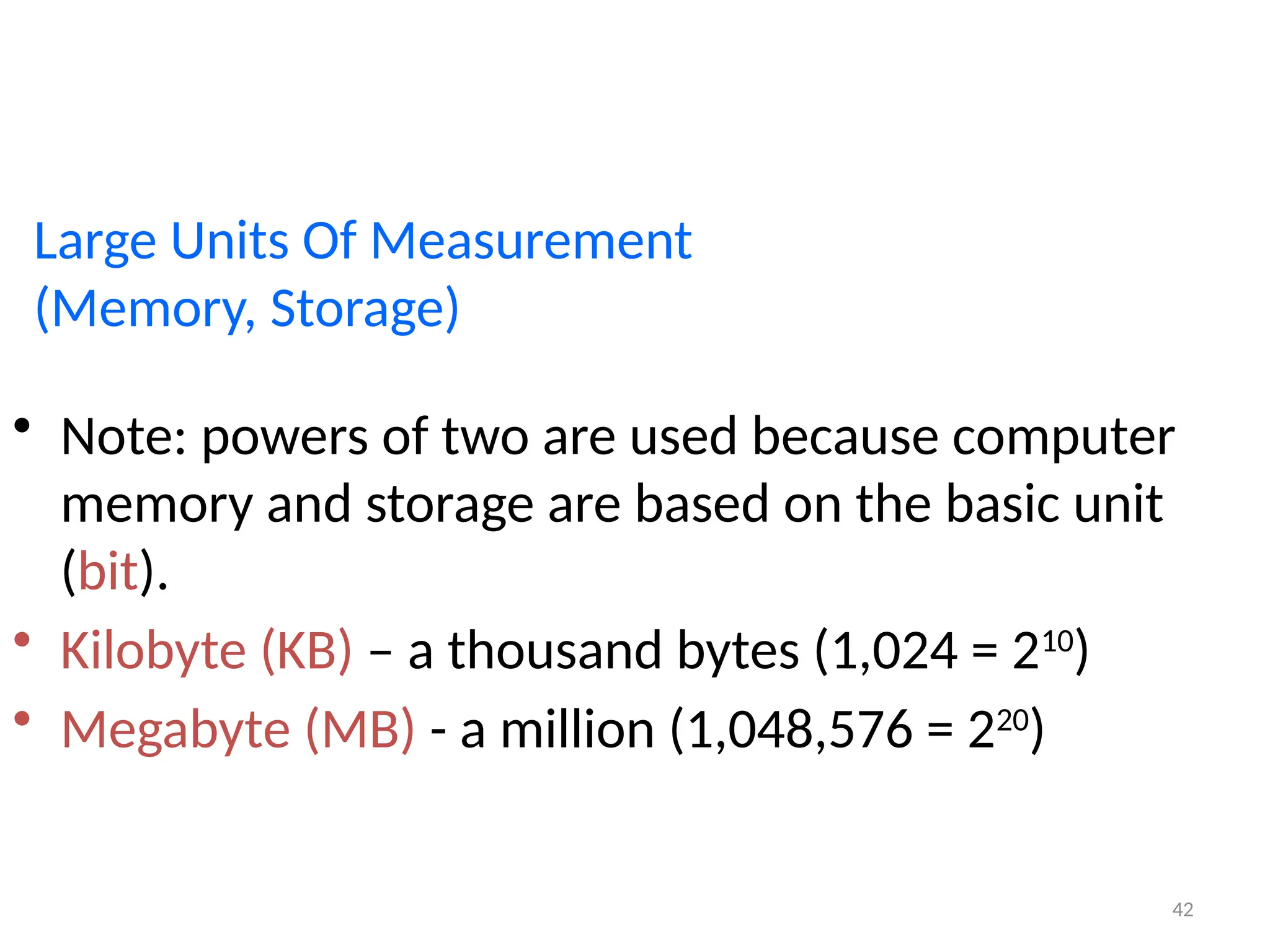
Large Units OfMeasurement
(Memory, Storage)
• Note: powers of two are used because computer
memory and storage are based on the basic unit
(bit).
• Kilobyte (KB) – a thousand bytes (1,024 = 210
)
• Megabyte (MB) - a million (1,048,576 = 220
)