Resolution(Decision)
V. Saranya
AP/CSE
Sri Vidya College of Engineering &
Technology, Virudhunagar
• Conjunctive normal form
• Resolution inference rule
• Dealing with Equality
• Resolution strategies
• Completeness of resolution
• Theorem provers
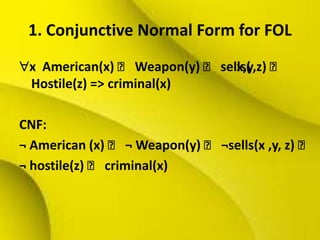
1. Conjunctive Normal Form for FOL
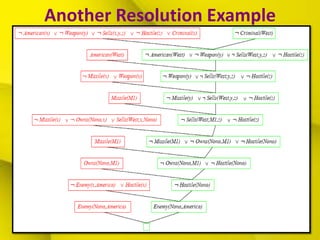
x American(x) ˄ Weapon(y) ˄ sells(x,y,z) ˄
Hostile(z) => criminal(x)
CNF:
¬ American (x) ˄ ¬ Weapon(y) ˄ ¬sells(x ,y, z) ˄
¬ hostile(z) ˄ criminal(x)
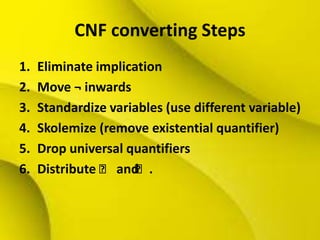
CNF converting Steps
1. Eliminate implication
2. Move ¬ inwards
3. Standardize variables (use different variable)
4. Skolemize (remove existential quantifier)
5. Drop universal quantifiers
6. Distribute ˄ and˄.
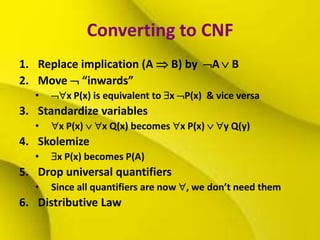
Converting to CNF
1. Replace implication (A  B) by A  B
2. Move  “inwards”
• x P(x) is equivalent to x P(x) & vice versa
3. Standardize variables
• x P(x)  x Q(x) becomes x P(x)  y Q(y)
4. Skolemize
• x P(x) becomes P(A)
5. Drop universal quantifiers
• Since all quantifiers are now , we don’t need them
6. Distributive Law
2. Resolution Inference rule
• Binary resolution Rule: resolves exactly 2 literals
• Factoring: removal of redundant literals.
• Combination of binary rule & factoring is
“Complete”
• Ex:
• [animal(F(x)) v loves(G(x),x)] and (¬ loves(u,v) v
¬kills(u,v)]
• loves(G(x),x) and ¬ loves(u,v)
• Ɵ = { u/G(x), v/x}  Unifier
Example
• Everyone who loves all animal is loved by
someone. Anyone who kills an animal is
loved by no one.
• Nikki loves all animals
• Either nikki or zooro killed the cat, who is
named teena.
• Did zooro kill the cat?
3. Dealing with Equality
Axiomatize Equality:
• Reflexive: x x=x
• Symmetric: x,y x=y, y=x
• Transitive: x,y,z x=y ˄ y=z => x=z
• Predicate name and function names are same
– x,y x=y => (P1(x) P1(y))
• Functional equality.
Additional inference rule
• Demodulation
• Para modulation
• Extended unification algorithm
4. Resolution strategies
• To tell proof in a efficient way
1. Unit Preference: ( prefer single literal)
• Evil v devil => ghost
• Devil => ghost
2. Set of support: (subset of sentences)
• Add relevant sentences.
3. Input resolution: combine one of the i/p sentences
with some other sentence.
4. Linear Resolution: complete
Ex: P and Q are 2 predicates. P should be in KB or P is an
ancestor of Q.
5. Subsumption: (elimination)
Resolution(decision)
• Convert everything to CNF
• Resolve, with unification
• If resolution is successful, proof succeeds
• If there was a variable in the item to prove, return
variable’s value from unification bindings
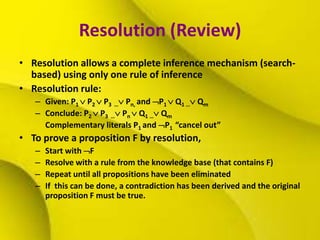
Resolution (Review)
• Resolution allows a complete inference mechanism (search-
based) using only one rule of inference
• Resolution rule:
– Given: P1  P2  P3 … Pn, and P1  Q1 … Qm
– Conclude: P2  P3 … Pn  Q1 … Qm
Complementary literals P1 and P1 “cancel out”
• To prove a proposition F by resolution,
– Start with F
– Resolve with a rule from the knowledge base (that contains F)
– Repeat until all propositions have been eliminated
– If this can be done, a contradiction has been derived and the original
proposition F must be true.
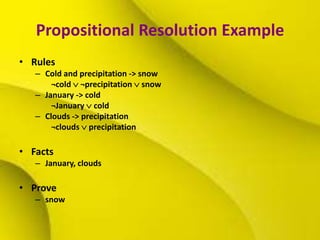
Propositional Resolution Example
• Rules
– Cold and precipitation -> snow
¬cold  ¬precipitation  snow
– January -> cold
¬January  cold
– Clouds -> precipitation
¬clouds  precipitation
• Facts
– January, clouds
• Prove
– snow
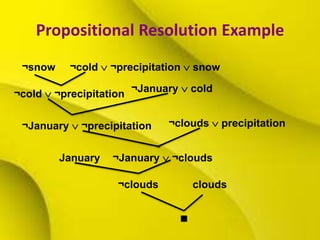
Propositional Resolution Example
¬snow ¬cold  ¬precipitation  snow
¬cold  ¬precipitation
¬January  cold
¬January  ¬precipitation ¬clouds  precipitation
¬January  ¬cloudsJanuary
¬clouds clouds
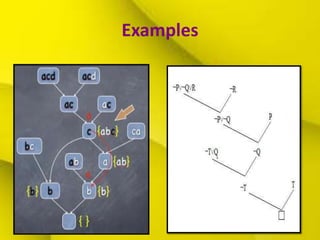
Examples
Another Resolution Example

Resolution(decision)

  • 1.
    Resolution(Decision) V. Saranya AP/CSE Sri VidyaCollege of Engineering & Technology, Virudhunagar
  • 2.
    • Conjunctive normalform • Resolution inference rule • Dealing with Equality • Resolution strategies • Completeness of resolution • Theorem provers
  • 3.
    1. Conjunctive NormalForm for FOL x American(x) ˄ Weapon(y) ˄ sells(x,y,z) ˄ Hostile(z) => criminal(x) CNF: ¬ American (x) ˄ ¬ Weapon(y) ˄ ¬sells(x ,y, z) ˄ ¬ hostile(z) ˄ criminal(x)
  • 4.
    CNF converting Steps 1.Eliminate implication 2. Move ¬ inwards 3. Standardize variables (use different variable) 4. Skolemize (remove existential quantifier) 5. Drop universal quantifiers 6. Distribute ˄ and˄.
  • 5.
    Converting to CNF 1.Replace implication (A  B) by A  B 2. Move  “inwards” • x P(x) is equivalent to x P(x) & vice versa 3. Standardize variables • x P(x)  x Q(x) becomes x P(x)  y Q(y) 4. Skolemize • x P(x) becomes P(A) 5. Drop universal quantifiers • Since all quantifiers are now , we don’t need them 6. Distributive Law
  • 6.
    2. Resolution Inferencerule • Binary resolution Rule: resolves exactly 2 literals • Factoring: removal of redundant literals. • Combination of binary rule & factoring is “Complete” • Ex: • [animal(F(x)) v loves(G(x),x)] and (¬ loves(u,v) v ¬kills(u,v)] • loves(G(x),x) and ¬ loves(u,v) • Ɵ = { u/G(x), v/x}  Unifier
  • 7.
    Example • Everyone wholoves all animal is loved by someone. Anyone who kills an animal is loved by no one. • Nikki loves all animals • Either nikki or zooro killed the cat, who is named teena. • Did zooro kill the cat?
  • 8.
    3. Dealing withEquality Axiomatize Equality: • Reflexive: x x=x • Symmetric: x,y x=y, y=x • Transitive: x,y,z x=y ˄ y=z => x=z • Predicate name and function names are same – x,y x=y => (P1(x) P1(y)) • Functional equality.
  • 9.
    Additional inference rule •Demodulation • Para modulation • Extended unification algorithm
  • 10.
    4. Resolution strategies •To tell proof in a efficient way 1. Unit Preference: ( prefer single literal) • Evil v devil => ghost • Devil => ghost 2. Set of support: (subset of sentences) • Add relevant sentences. 3. Input resolution: combine one of the i/p sentences with some other sentence. 4. Linear Resolution: complete Ex: P and Q are 2 predicates. P should be in KB or P is an ancestor of Q. 5. Subsumption: (elimination)
  • 11.
    Resolution(decision) • Convert everythingto CNF • Resolve, with unification • If resolution is successful, proof succeeds • If there was a variable in the item to prove, return variable’s value from unification bindings
  • 12.
    Resolution (Review) • Resolutionallows a complete inference mechanism (search- based) using only one rule of inference • Resolution rule: – Given: P1  P2  P3 … Pn, and P1  Q1 … Qm – Conclude: P2  P3 … Pn  Q1 … Qm Complementary literals P1 and P1 “cancel out” • To prove a proposition F by resolution, – Start with F – Resolve with a rule from the knowledge base (that contains F) – Repeat until all propositions have been eliminated – If this can be done, a contradiction has been derived and the original proposition F must be true.
  • 13.
    Propositional Resolution Example •Rules – Cold and precipitation -> snow ¬cold  ¬precipitation  snow – January -> cold ¬January  cold – Clouds -> precipitation ¬clouds  precipitation • Facts – January, clouds • Prove – snow
  • 14.
    Propositional Resolution Example ¬snow¬cold  ¬precipitation  snow ¬cold  ¬precipitation ¬January  cold ¬January  ¬precipitation ¬clouds  precipitation ¬January  ¬cloudsJanuary ¬clouds clouds
  • 15.
  • 16.