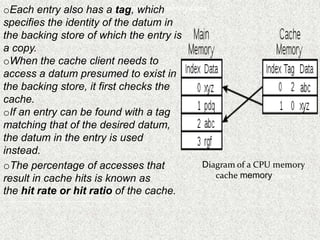


oEach entry also has a Diagramwhich memory cache
                           tag, of a CPU
specifies the identity of the datum in
the backing store of which the entry is
a copy.
oWhen the cache client needs to
access a datum presumed to exist in
the backing store, it first checks the
cache.
oIf an entry can be found with a tag
matching that of the desired datum,
the datum in the entry is used
instead.
  cache
oThe percentage of accesses that               Diagram of a CPU memory
result in cache hits is known as                  cache memory cache
the hit rate or hit ratio of the cache.
percentage of accesses that result in cache hits is known as the hit rate or hit ratio of the cache.
When a system writes a datum to cache, it must at some
  point write that datum to backing store as well. The
  timing of this write is controlled by what is known as
  the write policy.
There are two basic writing approaches:
 Write-through - Write is done synchronously both to
  the cache and to the backing store.
 Write-back- Writing is done only to the cache. A
  modified cache block is written back to the store, just
  before it is replaced.
More expensive
Consumes more power
    Low density
Cache memory

Cache memory

  • 3.
    oEach entry alsohas a Diagramwhich memory cache tag, of a CPU specifies the identity of the datum in the backing store of which the entry is a copy. oWhen the cache client needs to access a datum presumed to exist in the backing store, it first checks the cache. oIf an entry can be found with a tag matching that of the desired datum, the datum in the entry is used instead. cache oThe percentage of accesses that Diagram of a CPU memory result in cache hits is known as cache memory cache the hit rate or hit ratio of the cache. percentage of accesses that result in cache hits is known as the hit rate or hit ratio of the cache.
  • 4.
    When a systemwrites a datum to cache, it must at some point write that datum to backing store as well. The timing of this write is controlled by what is known as the write policy. There are two basic writing approaches:  Write-through - Write is done synchronously both to the cache and to the backing store.  Write-back- Writing is done only to the cache. A modified cache block is written back to the store, just before it is replaced.
  • 9.