AIR REGULATIONS
Submitted by:
M.NAMBI RAJAN
B.E AERONAUTICAL ENGG
Prof. FIGHTER WING AVIATION
UNIT – 1
AVIATION ORGANISATION & AGREEMENT
Introduction
The subject will outline the overall regulatory framework of civil aviation and
introduce delegates to the various regulatory bodies and the rules and laws made
by them.
Elementary knowledge for the organization and management of a scheduled or
charter flight in compliance with the international and EU regulations;
Who is who, from National Civil Aviation Authorities, ICAO, Joint Aviation
Authorities to EASA;
European Regulations;
The airline structure;
The airline licence and A.O.C.;
The European "Open Sky";
Aircraft leasing; and
Consumer protection.
Course Content
Air transport agreement
 An air transport agreement (also sometimes called an air service
agreement or ATA or ASA) is a bilateral agreement to allow international commercial
air transport services between signatories.
 The Chicago Convention was signed in December 1944 and has governed
international air services since then. the convention also has a range of annexes
covering issues such as aviation security, safety oversight, airworthiness, navigation,
environmental protection and facilitation (expediting and departure at airports).
 In 1913, in what was probably the earliest such agreement, a bilateral exchange of
notes was signed between Germany and France to provide for airship services.
 One of the first ATAs following World War II was the Bermuda Agreement, which was
signed in 1946 by the United Kingdom and the United States
Bilateral Agreement
 A bilateral agreement, also called a clearing trade or side deal, refers to an agreement
between parties or states that aims to keep trade deficits to a minimum.
 Bilateral agreements can take some time to finalize. For instance, it took three years for
the customer cooperation agreement between the European Union and New Zealand to
take effect.
Bilateral Agreements vs. Trade Deals
 Bilateral agreements are not the same as trade deals. The latter involves decreasing or
eliminating import quotas, export restrictions, tariffs, and other trade-related barriers
among states.
 Also, the rules governing trade deals are established by the World Trade Organization
(WTO).
 On the other hand, bilateral agreements are not bound by the rules set by the WTO and
do not solely focus on trade-related issues.
 Instead, the agreement usually targets individual policy areas, aiming to increase
cooperation and facilitate trade between countries in certain areas.
Scope of Bilateral Agreements
 With the elimination of tariffs and trade-related taxes, companies located in countries
with a bilateral agreement enjoy a price advantage, especially for nations that flourish in
different industries.
 Countries involved in the agreement will not offer products at a low cost only to gain
a bigger share in the market. They will not offer goods at prices that are even lower
than production costs, then increase prices when they’ve overcome the competition.
 The countries will not use unfair subsidies. For instance, when countries subsidize
energy or agriculture, producers will see lower costs, giving them an unfair
advantage when they export the goods.
 Because of standardized business operations such as labor standards and environmental
protection, exporters operate in a level playing field.
 The agreement involves not stealing the innovative goods of other exporters. Countries
adhere to existing copyright and intellectual property laws.
Advantages of Bilateral Agreements
 Since it involves only two countries, entering into a bilateral agreement is much easier
as compared to multilateral trade agreements.
 It gives companies access to new markets.
 When the parties involved see demand, they will open more job opportunities.
 Bilateral agreements also enable consumers to buy goods at lower prices. For instance,
some types of products may be more expensive without an agreement.
Multilateral agreement
 A multilateral agreement is a commerce treaty between three or more nations. It allows
for all of the countries that sign, called signatories, to be on an equal playing field.
 This agreement means that no signatories can give better or worse trade deals to one
country than it does another.
KEY POINTS
 Multilateral trade agreements strengthen the global economy by making developing
countries competitive.
 They standardize import and export procedures giving economic benefits to all member
nations.
 Their complexity helps those that can take advantage of globalization, while those who
cannot often face hardships.
Multilateral agreement
 Some regional trade agreements are multilateral. The largest had been the North American
Free Trade Agreement (NAFTA), which was ratified on January 1,
1994. NAFTA quadrupled trade between the United States, Canada, and Mexico from its
1993 level to 2018.
 
On July 1, 2020, the U.S.-Mexico-Canada Agreement (USMCA) went into effect. The
USMCA was a new trade agreement between the three countries that was negotiated
under President Donald Trump.
 On December 7, 2013, WTO representatives agreed to the so-called Bali package.9
All
countries agreed to streamline customs standards and reduce red tape to expedite trade flows.
Multilateral agreement
Open sky policy
Industry Overview
 India is World’s 9th largest market
 Comprises of Domestic Airline, Air Cargo and Airports
 Scheduled services available from to/fro 82 airports
 Bilateral with 104 countries
 Domestic air passenger - Worlds 4th Largest
 Enhanced connectivity – 87 foreign airlines of 49 countries
 07 scheduled & 01 regional airline operating exclusively in passenger sector
 Presently it contributes 0.5 % of GDP and it is expected that by 2030 it will contribute 5
% of GDP
Open sky policy
Open sky policy
International agreement between 2 or more countries allowing passenger and cargo to
flyover an area without restrictions
Aims to promote:
Free market competition
Cooperative marketing arrangements
Competitive pricing
Open sky policy
Some countries with Open Skies Policy
Open sky policy
Open sky policy
Open sky policy
Freedoms Of The Air
 First - the right to fly over a foreign country, without
 landing there Second - the right to refuel or carry out maintenance in a foreign country
on the way to another country
 Third - the right to fly from one's own country to another
 Fourth - the right to fly from another country to one's own
 Fifth - the right to fly between two foreign countries during flights while the flight
originates or ends in one's own country
Freedoms Of The Air
Economic Benefits
 Tourism
 Trade
 Employment
 Investments
Freedoms Of The Air
Freedoms Of The Air
Freedoms Of The Air
Investment
Freedoms Of The Air
Advantages & Disadvantages
ICAO
Introduction
In response to the invitation of the United States Government, representatives of 54
nations met at Chicago from November 1 to December 7, 1944, to "make
arrangements for the immediate establishment of provisional world air routes and
services" and "to set up an interim council to collect, record and study data
concerning international aviation and to make recommendations for its
improvement."
ICAO
Exploratory conversations with a number of governments had already been conducted
bilaterally by the United States Government, and the conference met with the texts of
four draft proposals already prepared for its consideration by the Governments of the
United States of America, the United Kingdom, and Canada, and by Australia and New
Zealand jointly.
What are ICAO objectives?
 Safety
 Air Navigation Capacity and Efficiency
 Facilitation
 Regional planning
 Economics
ICAO
Why ICAO is created?
 To promote the safety and efficient development of civil aviation
 The tremendous development of aviation during World War II demonstrated the need
for an international organization to assist and regulate international flight for peaceful
History
 The convention on International Civil Aviation (Chicago Convention) was signed on 7
Dec 1944 by 52 states
 The provisional ICAO was established from 6 June 1947 untill 4 Apr 1947 (cause of the
pending ratification by 26 states.
 ICAO came into being 4 Apr 1947 (as ratification was received.
 ICAO became a specialized agency of the United Nations
ICAO
What are ICAO purposes?
 Encourage the development of airways, airports, and air navigation facilities for
international civil aviation
 Meet the needs of the peoples of the world for safe, regular, efficient, and economical
air transport
 Prevent economic waste caused by unreasonable competition
 Ensure that the rights of contracting states are fully respected and that every
contracting state has a fair opportunity to operate international airlines
 Avoid discrimination between contracting states
 Promote safety of flight in international air navigation; and promote generally the
development of all aspects of international civil aeronautics.
ICAO
ICAO
Assembly
 All members’ assembly meets every 3 years
 They made the decision by a simple majority vote
 Makes policy recommendations, review of works, determine the budget
Council
 Permanent body, composed of 33 members states elected by the assembly
 In selecting process, the assembly is required by Chicago Convention to give adequate
representation regarding the nations of major importance in air transport
 Powers are unusually broad and adopt international standard and recommended practice
pertaining the Civil Air Navigation
ICAO
Functions of ICAO
1. Defines the protocols for air accident investigation followed by signatory agencies of
the Convention on International Civil Aviation in respective countries.
2. Supervises the standards and practices of air navigation, its infrastructure, Flight
inspection, prevention of unlawful interference, and facilitation of border- crossing
procedures for international civil aviation.
IATA
Introduction
Travel and Tourism have been recognized as the single largest item in world trade.
Perhaps, it is likely to become the largest global industry by the turn of this millennium.
Already accounting for more than 9.5% of total world trade, 30% of the service sector,
and about 13% of the global employment
In fact it, it has become a multi-facet industry that affects nearly all the sector of the
international and national economy. To develop and promote tourism at globally, there
are several international, national, and regional travel and tourism promotion
organizations such as WTO, PATA, ASTA, IATA, and ICAO.
IATA
International Air Transport Association (IATA)
 The International Air Transport Association was founded in 1945 by the airlines of
several countries to regulate the world’s civil air transport. It is the successor to the
International Air Transportation Association founded at Hague in 1919.
 As a non-governmental organization, it drew its legal existence from a special Act of
the Canadian Parliament in December 1945. It closely resembles the International Civil
Aviation Organization in terms of its activities and organizational structure.
 IATA is a voluntary, non-exclusive, non-political democratic organization and its
membership is open to any operating airline which has been licensed to provide
scheduled air services by the government.
IATA
Objectives of IATA
IATA is purely a non-political, commercial regulatory organization and has powers to
regulate every act of its constituents. The main objectives of IATA are:
 To ensure the safe, regular and economical air transport for the benefits of people
worldwide.
 To provides a means of collaboration.
 To prevent economic waste caused by unreasonable competition.
 To encourage the art of aircrafts design and operation for peaceful purposes.
 To promote and develop international tourism.
 To provide a common platform for travel agencies and tour operators.
 To provide training and education facilities for members.
 To cooperate with the International Civil Aviation Organisation and other international
and national organizations.
IATA
IATA
Active Members
Active membership is further divided into two types:
 Trade Associations and Traffic Co-Ordination
 Trade Associations
Any airline which has been licensed to operate scheduled air services by the appropriate
authority to transport passengers, mail, and cargo between the territories of two
countries, is eligible to become an active member of the association. The active
members have various rights, duties, and authority. Presently, there are more than 250
airlines as active members from 200 countries.
IATA
Associate Members
 This membership is open to any other organization/enterprise who is operating in
transport, hotels, resorts, travel trade and indirectly involved in tourism-related
activities.
 The application for the membership in the association is to be submitted in the writing
for the consideration and action of the executive committee and all such concerns can
become active or associate members, only after approval by the executive committee.
 However, any enterprise whose application is rejected by the committee can appear in
the next general meeting of the committee.
IATA
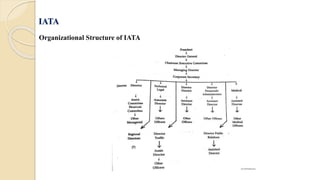
Organizational Structure of IATA
IATA
Roles and Contribution of IATA
 IATA provides a common platform to solve many travel trade problems.
 IATA helps travel agencies and tour operators to establish their professionalism and
integrity in the field of tourism.
 IATA helps to simplify the traveling process.
 IATA helps in the promotion and development of tourism.
 IATA helps the government to formulate civil aviation policy, paid tourism policy.
 It lays down rules and conditions for the approval of a travel trade organization.
Assignment – 1
CONVENTION OF CHICAGO, TOKYO,
MONTREAL, LA HAYE
DGCA {DIRECTORATE GENERAL OF CIVILAVIATION (INDIA)}
 The Directorate General of Civil Aviation (DGCA) is the statutory body formed under
the Aircraft (Amendment) Bill, 2020. This directorate investigates aviation accidents
and incidents, maintains all regulations related to aviation and is responsible for
issuance of licenses pertaining to aviation like PPL's, SPL's and CPL's in India. It is
headquartered along Sri Aurobindo Marg, opposite Safdarjung Airport, in New Delhi.
 The Government of India is planning to replace the organisation with a Civil Aviation
Authority (CAA), modelled on the lines of the American Federal Aviation
Administration (FAA).
DGCA
Functions
 Registration of civil aircraft
 Certification of airports
 Licensing of pilots, aircraft maintenance engineers, air traffic controllers and flight
engineers, and conducting examinations and checks for that purpose
 Carrying out amendments to the Aircraft Act, the Aircraft Rules and the Civil Aviation
Requirements for complying with the amendments to ICAO Annexes, and initiating
proposals for amendment to any other Act or for passing a new Act in order to give
effect to an international Convention or amendment to an existing convention.
 Formulation of standards of airworthiness for civil aircraft registered in India and
grant of certificates of airworthiness to such aircraft
DGCA
Functions
 Conducting investigation into incidents and serious incidents involving aircraft up to
2250 kg AUW and taking accident prevention measures, including formulation of
implementation of Safety Aviation Management Programmes
 Checks on the proficiency of flight crew and other operational personnel such as flight
dispatchers and cabin crew
 Coordination of ICAO matters with all agencies, sending replies to State letters, and
taking all necessary action arising out of the Universal Safety Oversight Audit
Programme (USOAP) of ICAO.
 Granting Air Operator's Certificates to Indian carriers and regulation of air transport
services operating to/from/within/over India by Indian and foreign operators,
including clearance of scheduled and non-scheduled flights of such operators
DGCA
 Approval of institutes engaged in flying training including simulator training, AME
training, air traffic services training or any other training related with aviation, with a
view to ensuring a high quality of training
 Approval to aircraft maintenance, repair, design and manufacturing organizations and
their continued oversight
 A nodal agency for implementing Annex 9 provisions in India and for coordinating
matters relating to facilitation at Indian airports, including holding meetings of the
National Facilitation Committee DGCA Organisation Manual
 Rendering advice to the Government on matters relating to air transport including
bilateral air services agreements, on ICAO matters and generally on all technical
matters relating to civil aviation, and to act as an overall regulatory and developmental
body for civil aviation in the country
DGCA
 Keeping a check on aircraft noise and engine emissions in accordance with ICAO
Annex 16 and collaborating with the environmental authorities in this matter, if required
 Regulation and oversight of matters related to Air Navigation Services. Coordination at
national level for flexi-use of air space by civil and military air traffic agencies and
interaction with ICAO for provision of more air routes for civil use through Indian
airspace
 Promoting indigenous design and manufacture of aircraft and aircraft components by
acting as a catalytic agent
 Approving training programmes of operators for carriage of dangerous goods, issuing
authorizations for carriage of dangerous goods, etc.
 Safety Oversight of all entities approved/ certified/ licensed under the Aircraft Rules
1937.
DGCA
Departments
These are classified and divided into the following:
 Administration Directorate
 Aerodrome Standards Directorate (AD)
 Air Safety Directorate (DAS)
 Air Transport Directorate (AT)
 Airworthiness Directorate (DAW) (which is also responsible for registering drones in India
 Flight Standards Directorate (FSD)
 Information & Regulation Directorate (DRI)
 Aircraft Engineering Directorate (AED)
 Directorate Of Flying Training (DFT)
 Medical Section
 Directorate of Training & Licensing (DTL)
 Directorate of Airspace and Air Navigation Services Standards (ANSS)
DGCA
DGCA
Civil Aviation Authority
The CAA has been envisaged as an autonomous regulatory body which will replace the
DGCA and will meet standards set by the UN's International Civil Aviation
Organization (ICAO). The CAA will have separate departments to deal with safety,
economic regulation and grievance resolution, as well as a full-fledged environment
department. It will also have an independent accident investigation bureau. The
Authority will also have the autonomy to recruit staff. Currently, the DGCA is
understaffed and does not have any recruitment powers. The CAA will have
administrative and financial powers similar to those of the American FAA. These
powers will redefine the regulator's role and better equip it to face the challenges of the
growing Aviation sector in the country. Employees working with DGCA will be
transferred to the CAA
DGCA
The estimated cost of establishing the new Authority would be around Rs 11.2 million.
The CAA would be self-financing and have a separate fund called the 'Civil Aviation
Authority of India Fund' that would finance its entire expenses. It would have a
Chairperson, a Director General and 7-9 members appointed by the Central
Government. These members will be qualified in the fields of aviation safety, aircraft
engineering, flight standard operations, aerodromes, air navigation systems and air
space management

Air regulation lecture notes

  • 1.
    AIR REGULATIONS Submitted by: M.NAMBIRAJAN B.E AERONAUTICAL ENGG Prof. FIGHTER WING AVIATION
  • 2.
    UNIT – 1 AVIATIONORGANISATION & AGREEMENT
  • 3.
    Introduction The subject willoutline the overall regulatory framework of civil aviation and introduce delegates to the various regulatory bodies and the rules and laws made by them. Elementary knowledge for the organization and management of a scheduled or charter flight in compliance with the international and EU regulations; Who is who, from National Civil Aviation Authorities, ICAO, Joint Aviation Authorities to EASA; European Regulations; The airline structure; The airline licence and A.O.C.; The European "Open Sky"; Aircraft leasing; and Consumer protection. Course Content
  • 4.
    Air transport agreement An air transport agreement (also sometimes called an air service agreement or ATA or ASA) is a bilateral agreement to allow international commercial air transport services between signatories.  The Chicago Convention was signed in December 1944 and has governed international air services since then. the convention also has a range of annexes covering issues such as aviation security, safety oversight, airworthiness, navigation, environmental protection and facilitation (expediting and departure at airports).  In 1913, in what was probably the earliest such agreement, a bilateral exchange of notes was signed between Germany and France to provide for airship services.  One of the first ATAs following World War II was the Bermuda Agreement, which was signed in 1946 by the United Kingdom and the United States
  • 5.
    Bilateral Agreement  Abilateral agreement, also called a clearing trade or side deal, refers to an agreement between parties or states that aims to keep trade deficits to a minimum.  Bilateral agreements can take some time to finalize. For instance, it took three years for the customer cooperation agreement between the European Union and New Zealand to take effect.
  • 6.
    Bilateral Agreements vs.Trade Deals  Bilateral agreements are not the same as trade deals. The latter involves decreasing or eliminating import quotas, export restrictions, tariffs, and other trade-related barriers among states.  Also, the rules governing trade deals are established by the World Trade Organization (WTO).  On the other hand, bilateral agreements are not bound by the rules set by the WTO and do not solely focus on trade-related issues.  Instead, the agreement usually targets individual policy areas, aiming to increase cooperation and facilitate trade between countries in certain areas.
  • 7.
    Scope of BilateralAgreements  With the elimination of tariffs and trade-related taxes, companies located in countries with a bilateral agreement enjoy a price advantage, especially for nations that flourish in different industries.  Countries involved in the agreement will not offer products at a low cost only to gain a bigger share in the market. They will not offer goods at prices that are even lower than production costs, then increase prices when they’ve overcome the competition.  The countries will not use unfair subsidies. For instance, when countries subsidize energy or agriculture, producers will see lower costs, giving them an unfair advantage when they export the goods.  Because of standardized business operations such as labor standards and environmental protection, exporters operate in a level playing field.  The agreement involves not stealing the innovative goods of other exporters. Countries adhere to existing copyright and intellectual property laws.
  • 8.
    Advantages of BilateralAgreements  Since it involves only two countries, entering into a bilateral agreement is much easier as compared to multilateral trade agreements.  It gives companies access to new markets.  When the parties involved see demand, they will open more job opportunities.  Bilateral agreements also enable consumers to buy goods at lower prices. For instance, some types of products may be more expensive without an agreement.
  • 9.
    Multilateral agreement  Amultilateral agreement is a commerce treaty between three or more nations. It allows for all of the countries that sign, called signatories, to be on an equal playing field.  This agreement means that no signatories can give better or worse trade deals to one country than it does another. KEY POINTS  Multilateral trade agreements strengthen the global economy by making developing countries competitive.  They standardize import and export procedures giving economic benefits to all member nations.  Their complexity helps those that can take advantage of globalization, while those who cannot often face hardships.
  • 10.
  • 11.
  • 12.
    Multilateral agreement  Someregional trade agreements are multilateral. The largest had been the North American Free Trade Agreement (NAFTA), which was ratified on January 1, 1994. NAFTA quadrupled trade between the United States, Canada, and Mexico from its 1993 level to 2018.   On July 1, 2020, the U.S.-Mexico-Canada Agreement (USMCA) went into effect. The USMCA was a new trade agreement between the three countries that was negotiated under President Donald Trump.  On December 7, 2013, WTO representatives agreed to the so-called Bali package.9 All countries agreed to streamline customs standards and reduce red tape to expedite trade flows.
  • 13.
  • 14.
    Open sky policy IndustryOverview  India is World’s 9th largest market  Comprises of Domestic Airline, Air Cargo and Airports  Scheduled services available from to/fro 82 airports  Bilateral with 104 countries  Domestic air passenger - Worlds 4th Largest  Enhanced connectivity – 87 foreign airlines of 49 countries  07 scheduled & 01 regional airline operating exclusively in passenger sector  Presently it contributes 0.5 % of GDP and it is expected that by 2030 it will contribute 5 % of GDP
  • 15.
  • 16.
    Open sky policy Internationalagreement between 2 or more countries allowing passenger and cargo to flyover an area without restrictions Aims to promote: Free market competition Cooperative marketing arrangements Competitive pricing
  • 17.
    Open sky policy Somecountries with Open Skies Policy
  • 18.
  • 19.
  • 20.
  • 21.
    Freedoms Of TheAir  First - the right to fly over a foreign country, without  landing there Second - the right to refuel or carry out maintenance in a foreign country on the way to another country  Third - the right to fly from one's own country to another  Fourth - the right to fly from another country to one's own  Fifth - the right to fly between two foreign countries during flights while the flight originates or ends in one's own country
  • 22.
    Freedoms Of TheAir Economic Benefits  Tourism  Trade  Employment  Investments
  • 23.
  • 24.
  • 25.
    Freedoms Of TheAir Investment
  • 26.
    Freedoms Of TheAir Advantages & Disadvantages
  • 27.
    ICAO Introduction In response tothe invitation of the United States Government, representatives of 54 nations met at Chicago from November 1 to December 7, 1944, to "make arrangements for the immediate establishment of provisional world air routes and services" and "to set up an interim council to collect, record and study data concerning international aviation and to make recommendations for its improvement."
  • 28.
    ICAO Exploratory conversations witha number of governments had already been conducted bilaterally by the United States Government, and the conference met with the texts of four draft proposals already prepared for its consideration by the Governments of the United States of America, the United Kingdom, and Canada, and by Australia and New Zealand jointly. What are ICAO objectives?  Safety  Air Navigation Capacity and Efficiency  Facilitation  Regional planning  Economics
  • 29.
    ICAO Why ICAO iscreated?  To promote the safety and efficient development of civil aviation  The tremendous development of aviation during World War II demonstrated the need for an international organization to assist and regulate international flight for peaceful History  The convention on International Civil Aviation (Chicago Convention) was signed on 7 Dec 1944 by 52 states  The provisional ICAO was established from 6 June 1947 untill 4 Apr 1947 (cause of the pending ratification by 26 states.  ICAO came into being 4 Apr 1947 (as ratification was received.  ICAO became a specialized agency of the United Nations
  • 30.
    ICAO What are ICAOpurposes?  Encourage the development of airways, airports, and air navigation facilities for international civil aviation  Meet the needs of the peoples of the world for safe, regular, efficient, and economical air transport  Prevent economic waste caused by unreasonable competition  Ensure that the rights of contracting states are fully respected and that every contracting state has a fair opportunity to operate international airlines  Avoid discrimination between contracting states  Promote safety of flight in international air navigation; and promote generally the development of all aspects of international civil aeronautics.
  • 31.
  • 32.
    ICAO Assembly  All members’assembly meets every 3 years  They made the decision by a simple majority vote  Makes policy recommendations, review of works, determine the budget Council  Permanent body, composed of 33 members states elected by the assembly  In selecting process, the assembly is required by Chicago Convention to give adequate representation regarding the nations of major importance in air transport  Powers are unusually broad and adopt international standard and recommended practice pertaining the Civil Air Navigation
  • 33.
    ICAO Functions of ICAO 1.Defines the protocols for air accident investigation followed by signatory agencies of the Convention on International Civil Aviation in respective countries. 2. Supervises the standards and practices of air navigation, its infrastructure, Flight inspection, prevention of unlawful interference, and facilitation of border- crossing procedures for international civil aviation.
  • 34.
    IATA Introduction Travel and Tourismhave been recognized as the single largest item in world trade. Perhaps, it is likely to become the largest global industry by the turn of this millennium. Already accounting for more than 9.5% of total world trade, 30% of the service sector, and about 13% of the global employment In fact it, it has become a multi-facet industry that affects nearly all the sector of the international and national economy. To develop and promote tourism at globally, there are several international, national, and regional travel and tourism promotion organizations such as WTO, PATA, ASTA, IATA, and ICAO.
  • 35.
    IATA International Air TransportAssociation (IATA)  The International Air Transport Association was founded in 1945 by the airlines of several countries to regulate the world’s civil air transport. It is the successor to the International Air Transportation Association founded at Hague in 1919.  As a non-governmental organization, it drew its legal existence from a special Act of the Canadian Parliament in December 1945. It closely resembles the International Civil Aviation Organization in terms of its activities and organizational structure.  IATA is a voluntary, non-exclusive, non-political democratic organization and its membership is open to any operating airline which has been licensed to provide scheduled air services by the government.
  • 36.
    IATA Objectives of IATA IATAis purely a non-political, commercial regulatory organization and has powers to regulate every act of its constituents. The main objectives of IATA are:  To ensure the safe, regular and economical air transport for the benefits of people worldwide.  To provides a means of collaboration.  To prevent economic waste caused by unreasonable competition.  To encourage the art of aircrafts design and operation for peaceful purposes.  To promote and develop international tourism.  To provide a common platform for travel agencies and tour operators.  To provide training and education facilities for members.  To cooperate with the International Civil Aviation Organisation and other international and national organizations.
  • 37.
  • 38.
    IATA Active Members Active membershipis further divided into two types:  Trade Associations and Traffic Co-Ordination  Trade Associations Any airline which has been licensed to operate scheduled air services by the appropriate authority to transport passengers, mail, and cargo between the territories of two countries, is eligible to become an active member of the association. The active members have various rights, duties, and authority. Presently, there are more than 250 airlines as active members from 200 countries.
  • 39.
    IATA Associate Members  Thismembership is open to any other organization/enterprise who is operating in transport, hotels, resorts, travel trade and indirectly involved in tourism-related activities.  The application for the membership in the association is to be submitted in the writing for the consideration and action of the executive committee and all such concerns can become active or associate members, only after approval by the executive committee.  However, any enterprise whose application is rejected by the committee can appear in the next general meeting of the committee.
  • 40.
  • 41.
    IATA Roles and Contributionof IATA  IATA provides a common platform to solve many travel trade problems.  IATA helps travel agencies and tour operators to establish their professionalism and integrity in the field of tourism.  IATA helps to simplify the traveling process.  IATA helps in the promotion and development of tourism.  IATA helps the government to formulate civil aviation policy, paid tourism policy.  It lays down rules and conditions for the approval of a travel trade organization.
  • 42.
    Assignment – 1 CONVENTIONOF CHICAGO, TOKYO, MONTREAL, LA HAYE
  • 43.
    DGCA {DIRECTORATE GENERALOF CIVILAVIATION (INDIA)}  The Directorate General of Civil Aviation (DGCA) is the statutory body formed under the Aircraft (Amendment) Bill, 2020. This directorate investigates aviation accidents and incidents, maintains all regulations related to aviation and is responsible for issuance of licenses pertaining to aviation like PPL's, SPL's and CPL's in India. It is headquartered along Sri Aurobindo Marg, opposite Safdarjung Airport, in New Delhi.  The Government of India is planning to replace the organisation with a Civil Aviation Authority (CAA), modelled on the lines of the American Federal Aviation Administration (FAA).
  • 44.
    DGCA Functions  Registration ofcivil aircraft  Certification of airports  Licensing of pilots, aircraft maintenance engineers, air traffic controllers and flight engineers, and conducting examinations and checks for that purpose  Carrying out amendments to the Aircraft Act, the Aircraft Rules and the Civil Aviation Requirements for complying with the amendments to ICAO Annexes, and initiating proposals for amendment to any other Act or for passing a new Act in order to give effect to an international Convention or amendment to an existing convention.  Formulation of standards of airworthiness for civil aircraft registered in India and grant of certificates of airworthiness to such aircraft
  • 45.
    DGCA Functions  Conducting investigationinto incidents and serious incidents involving aircraft up to 2250 kg AUW and taking accident prevention measures, including formulation of implementation of Safety Aviation Management Programmes  Checks on the proficiency of flight crew and other operational personnel such as flight dispatchers and cabin crew  Coordination of ICAO matters with all agencies, sending replies to State letters, and taking all necessary action arising out of the Universal Safety Oversight Audit Programme (USOAP) of ICAO.  Granting Air Operator's Certificates to Indian carriers and regulation of air transport services operating to/from/within/over India by Indian and foreign operators, including clearance of scheduled and non-scheduled flights of such operators
  • 46.
    DGCA  Approval ofinstitutes engaged in flying training including simulator training, AME training, air traffic services training or any other training related with aviation, with a view to ensuring a high quality of training  Approval to aircraft maintenance, repair, design and manufacturing organizations and their continued oversight  A nodal agency for implementing Annex 9 provisions in India and for coordinating matters relating to facilitation at Indian airports, including holding meetings of the National Facilitation Committee DGCA Organisation Manual  Rendering advice to the Government on matters relating to air transport including bilateral air services agreements, on ICAO matters and generally on all technical matters relating to civil aviation, and to act as an overall regulatory and developmental body for civil aviation in the country
  • 47.
    DGCA  Keeping acheck on aircraft noise and engine emissions in accordance with ICAO Annex 16 and collaborating with the environmental authorities in this matter, if required  Regulation and oversight of matters related to Air Navigation Services. Coordination at national level for flexi-use of air space by civil and military air traffic agencies and interaction with ICAO for provision of more air routes for civil use through Indian airspace  Promoting indigenous design and manufacture of aircraft and aircraft components by acting as a catalytic agent  Approving training programmes of operators for carriage of dangerous goods, issuing authorizations for carriage of dangerous goods, etc.  Safety Oversight of all entities approved/ certified/ licensed under the Aircraft Rules 1937.
  • 48.
    DGCA Departments These are classifiedand divided into the following:  Administration Directorate  Aerodrome Standards Directorate (AD)  Air Safety Directorate (DAS)  Air Transport Directorate (AT)  Airworthiness Directorate (DAW) (which is also responsible for registering drones in India  Flight Standards Directorate (FSD)  Information & Regulation Directorate (DRI)  Aircraft Engineering Directorate (AED)  Directorate Of Flying Training (DFT)  Medical Section  Directorate of Training & Licensing (DTL)  Directorate of Airspace and Air Navigation Services Standards (ANSS)
  • 49.
  • 50.
    DGCA Civil Aviation Authority TheCAA has been envisaged as an autonomous regulatory body which will replace the DGCA and will meet standards set by the UN's International Civil Aviation Organization (ICAO). The CAA will have separate departments to deal with safety, economic regulation and grievance resolution, as well as a full-fledged environment department. It will also have an independent accident investigation bureau. The Authority will also have the autonomy to recruit staff. Currently, the DGCA is understaffed and does not have any recruitment powers. The CAA will have administrative and financial powers similar to those of the American FAA. These powers will redefine the regulator's role and better equip it to face the challenges of the growing Aviation sector in the country. Employees working with DGCA will be transferred to the CAA
  • 51.
    DGCA The estimated costof establishing the new Authority would be around Rs 11.2 million. The CAA would be self-financing and have a separate fund called the 'Civil Aviation Authority of India Fund' that would finance its entire expenses. It would have a Chairperson, a Director General and 7-9 members appointed by the Central Government. These members will be qualified in the fields of aviation safety, aircraft engineering, flight standard operations, aerodromes, air navigation systems and air space management