Hand Hygiene
by Kimberly B. Merritt
MHA, BSN, RN, CNOR
Session Objective
 Discuss basic hand hygiene history and principles
 Examine CDC vs WHO guidelines
 Provide updates to AORN hand hygiene standards
www.courtemanche-assocs.com 2
 CDC: Center for Disease Control – Established
Guideline for Hand Hygiene in Health-Care Settings
in Oct 2002
 Current Campaign:
Clean Hands Count
 WHO: World Health Organization – Build upon the
who guidelines to make a more applicable model
for other regions and countries
 Current Campaign:
SAVE LIVES – Clean Your Hands
www.courtemanche-assocs.com 3
Glossary
 Hand Hygiene: Any activities related to hand
condition and cleansing. Includes handwashing,
antiseptic hand wash, antiseptic hand rub, or
surgical hand antisepsis. It is the primary step that
sets the foundation for patient safety in preventing
healthcare associated infections.
 Hand Washing: Using soap and water to perform
hand hygiene.
 Antiseptic Hand Wash: Use of an over-the-counter
alcohol-based hand cleanser.
 Surgical Hand Antisepsis: Hand wash or hand rub
using a surgical hand antiseptic, performed
preoperatively by the surgical team to remove
transient flora and reduce resident skin flora.
 Surgical Hand Antiseptic: A product that is a
broad-spectrum, fast-acting, and nonirritating
preparation containing an antimicrobial ingredient
designed to significantly reduce the number of
microorganisms on intact skin. Surgical hand
antiseptic agents demonstrate both persistent and
cumulative activity.
 AORN: Association of Peri-Operative Registered Nurses
 Artificial nails: Substances or devices applied to the natural nail to augment or enhance
the wear’s own nail. This includes, but is not limited to acrylic nails, gel nails, bonding,
tips, wrappings, and tapes.
 Direct Patient Care Providers: Any staff member performing a task that involves directly
touching the patient or their environment.
 Good Repair: Free from peeling, chips, or cracks.
 Suspected contamination: Hands may be contaminated after contact with a source of
microorganisms (such as body fluid and other potential infectious material).
www.courtemanche-assocs.com 4
Glossary continued
History
and
Basic Principles
www.courtemanche-assocs.com 5
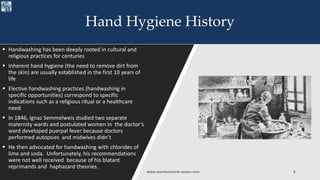
 Handwashing has been deeply rooted in cultural and
religious practices for centuries
 Inherent hand hygiene (the need to remove dirt from
the skin) are usually established in the first 10 years of
life
 Elective handwashing practices (handwashing in
specific opportunities) correspond to specific
indications such as a religious ritual or a healthcare
need
 In 1846, Ignaz Semmelweis studied two separate
maternity wards and postulated women in the doctor’s
ward developed puerpal fever because doctors
performed autopsies and midwives didn’t
 He then advocated for handwashing with chlorides of
lime and soda. Unfortunately, his recommendations
were not well received because of his blatant
reprimands and haphazard theories.
Hand Hygiene History
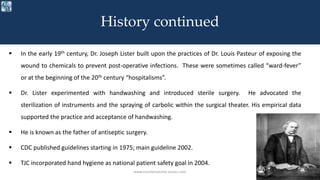
 In the early 19th century, Dr. Joseph Lister built upon the practices of Dr. Louis Pasteur of exposing the
wound to chemicals to prevent post-operative infections. These were sometimes called “ward-fever”
or at the beginning of the 20th century “hospitalisms”.
 Dr. Lister experimented with handwashing and introduced sterile surgery. He advocated the
sterilization of instruments and the spraying of carbolic within the surgical theater. His empirical data
supported the practice and acceptance of handwashing.
 He is known as the father of antiseptic surgery.
 CDC published guidelines starting in 1975; main guideline 2002.
 TJC incorporated hand hygiene as national patient safety goal in 2004.
www.courtemanche-assocs.com 7
History continued
 One in 25 hospital patients has at least one healthcare acquired illness (HAI). Estimated costs for care of HAIs in 2009
up to $33.8 billion.
 HAIs are the top priority for the Department of Health and Human Services.
 The most common mode of transmission for most organisms is by hand contact.
 The least costly and one of the fundamental basics of prevention is hand hygiene!
www.courtemanche-assocs.com 8
Why Hand Hygiene?
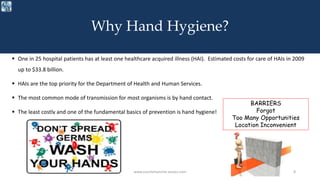
BARRIERS
Forgot
Too Many Opportunities
Location Inconvenient
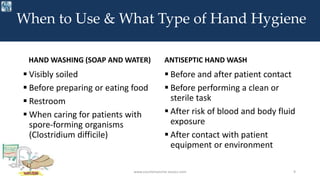
When to Use & What Type of Hand Hygiene
HAND WASHING (SOAP AND WATER)
 Visibly soiled
 Before preparing or eating food
 Restroom
 When caring for patients with
spore-forming organisms
(Clostridium difficile)
ANTISEPTIC HAND WASH
 Before and after patient contact
 Before performing a clean or
sterile task
 After risk of blood and body fluid
exposure
 After contact with patient
equipment or environment
www.courtemanche-assocs.com 9
How to Perform Hand Hygiene
 Hand washing with soap and water:
 Performed for a minimum of 15 seconds
 Water temp should be 70-80 degrees Fahrenheit
 Wet hands, Lather all sides, Rinse and Dry
 Open door with a paper towel to exit if needed
 Hand washing with antiseptic handwash:
 Fill the palm with product
 Rub together covering all surfaces
 Should take approximately 20 seconds to complete
and dry
 Surgical Hand Antisepsis:
 The first surgical hand scrub does
not have to be soap and water
before an alcohol-based hand
rub unless recommended by the
manufacturer.
 Follow manufacturer
recommendations for the FDA
approved alcohol-based hand
rub.
 Always remove all rings,
bracelets, and watches.
 Don’t use bristles of brushes on
skin if doing hand scrub
 Dry hands thoroughly before
donning gowns and gloves
www.courtemanche-assocs.com 10
CDC
vs
WHO
www.courtemanche-assocs.com 11
Required Protocol per
The Joint Commission
CDC
 Latest guideline published in
2002. Appended with updates
 Created in conjunction with
other organizations such as the
Association of Professionals in
Infection Control and
Epidemiology
WHO
 Built upon the CDC guidelines
 Expands to global infection
control concerns with regional
and country emphasis
www.courtemanche-assocs.com 12
or
AORN
Updates
www.courtemanche-assocs.com 13
AORN Update
 Evidence cited
 Fingernail tips < 6.4mm (0.25in)
 Nail polish acceptable unless chipped
 Hand wash upon arrival/before
leaving
 Hand wash before putting gloves on
 For surgical antisepsis, alcohol + CHG
product preferred
 Evidence RATED
 Fingernail tips < 2mm (0.08in)
 Healthcare organization should decide
if nail polish allowed (including gel &
Shellac)
 Great practice, but not included (no
citation/evidence)
 Conflicting evidence, perform hand
hygiene before clean or sterile task
 FDA approved surgical hand
antiseptics, conflicting evidence
www.courtemanche-assocs.com 14
What’s Next?
www.courtemanche-assocs.com 15
Sept 2, 2016 FDA issued
ban on antimicrobial
soap
Perceived barriers to
hand hygiene
Lack of resources (global
impacts)
Educate – families,
patients, all staff
Implement strategies to
sustain compliance
Monitor adherence
Summary
 Basic hand hygiene history and principles
 Reviewed CDC and WHO differences
 Examined AORN updates
www.courtemanche-assocs.com 16
References
 Guideline for hand hygiene. In: Guidelines for
Perioperative Practice. Denver, CO: AORN, Inc.
 https://www.aorn.org/guidelines/clinical-
resources/clinical-faqs/hand-antisepsis-hygiene>
www.courtemanche-assocs.com 17
Thank You for Participating!
www.courtemanche-assocs.com 18
For questions or more information,
please contact us at:
info@courtemanche-assocs.com
(704) 573-4535

C&A Presentation: Hand Hygiene

  • 1.
    Hand Hygiene by KimberlyB. Merritt MHA, BSN, RN, CNOR
  • 2.
    Session Objective  Discussbasic hand hygiene history and principles  Examine CDC vs WHO guidelines  Provide updates to AORN hand hygiene standards www.courtemanche-assocs.com 2
  • 3.
     CDC: Centerfor Disease Control – Established Guideline for Hand Hygiene in Health-Care Settings in Oct 2002  Current Campaign: Clean Hands Count  WHO: World Health Organization – Build upon the who guidelines to make a more applicable model for other regions and countries  Current Campaign: SAVE LIVES – Clean Your Hands www.courtemanche-assocs.com 3 Glossary  Hand Hygiene: Any activities related to hand condition and cleansing. Includes handwashing, antiseptic hand wash, antiseptic hand rub, or surgical hand antisepsis. It is the primary step that sets the foundation for patient safety in preventing healthcare associated infections.  Hand Washing: Using soap and water to perform hand hygiene.  Antiseptic Hand Wash: Use of an over-the-counter alcohol-based hand cleanser.  Surgical Hand Antisepsis: Hand wash or hand rub using a surgical hand antiseptic, performed preoperatively by the surgical team to remove transient flora and reduce resident skin flora.  Surgical Hand Antiseptic: A product that is a broad-spectrum, fast-acting, and nonirritating preparation containing an antimicrobial ingredient designed to significantly reduce the number of microorganisms on intact skin. Surgical hand antiseptic agents demonstrate both persistent and cumulative activity.
  • 4.
     AORN: Associationof Peri-Operative Registered Nurses  Artificial nails: Substances or devices applied to the natural nail to augment or enhance the wear’s own nail. This includes, but is not limited to acrylic nails, gel nails, bonding, tips, wrappings, and tapes.  Direct Patient Care Providers: Any staff member performing a task that involves directly touching the patient or their environment.  Good Repair: Free from peeling, chips, or cracks.  Suspected contamination: Hands may be contaminated after contact with a source of microorganisms (such as body fluid and other potential infectious material). www.courtemanche-assocs.com 4 Glossary continued
  • 5.
  • 6.
     Handwashing hasbeen deeply rooted in cultural and religious practices for centuries  Inherent hand hygiene (the need to remove dirt from the skin) are usually established in the first 10 years of life  Elective handwashing practices (handwashing in specific opportunities) correspond to specific indications such as a religious ritual or a healthcare need  In 1846, Ignaz Semmelweis studied two separate maternity wards and postulated women in the doctor’s ward developed puerpal fever because doctors performed autopsies and midwives didn’t  He then advocated for handwashing with chlorides of lime and soda. Unfortunately, his recommendations were not well received because of his blatant reprimands and haphazard theories. Hand Hygiene History
  • 7.
     In theearly 19th century, Dr. Joseph Lister built upon the practices of Dr. Louis Pasteur of exposing the wound to chemicals to prevent post-operative infections. These were sometimes called “ward-fever” or at the beginning of the 20th century “hospitalisms”.  Dr. Lister experimented with handwashing and introduced sterile surgery. He advocated the sterilization of instruments and the spraying of carbolic within the surgical theater. His empirical data supported the practice and acceptance of handwashing.  He is known as the father of antiseptic surgery.  CDC published guidelines starting in 1975; main guideline 2002.  TJC incorporated hand hygiene as national patient safety goal in 2004. www.courtemanche-assocs.com 7 History continued
  • 8.
     One in25 hospital patients has at least one healthcare acquired illness (HAI). Estimated costs for care of HAIs in 2009 up to $33.8 billion.  HAIs are the top priority for the Department of Health and Human Services.  The most common mode of transmission for most organisms is by hand contact.  The least costly and one of the fundamental basics of prevention is hand hygiene! www.courtemanche-assocs.com 8 Why Hand Hygiene? BARRIERS Forgot Too Many Opportunities Location Inconvenient
  • 9.
    When to Use& What Type of Hand Hygiene HAND WASHING (SOAP AND WATER)  Visibly soiled  Before preparing or eating food  Restroom  When caring for patients with spore-forming organisms (Clostridium difficile) ANTISEPTIC HAND WASH  Before and after patient contact  Before performing a clean or sterile task  After risk of blood and body fluid exposure  After contact with patient equipment or environment www.courtemanche-assocs.com 9
  • 10.
    How to PerformHand Hygiene  Hand washing with soap and water:  Performed for a minimum of 15 seconds  Water temp should be 70-80 degrees Fahrenheit  Wet hands, Lather all sides, Rinse and Dry  Open door with a paper towel to exit if needed  Hand washing with antiseptic handwash:  Fill the palm with product  Rub together covering all surfaces  Should take approximately 20 seconds to complete and dry  Surgical Hand Antisepsis:  The first surgical hand scrub does not have to be soap and water before an alcohol-based hand rub unless recommended by the manufacturer.  Follow manufacturer recommendations for the FDA approved alcohol-based hand rub.  Always remove all rings, bracelets, and watches.  Don’t use bristles of brushes on skin if doing hand scrub  Dry hands thoroughly before donning gowns and gloves www.courtemanche-assocs.com 10
  • 11.
  • 12.
    Required Protocol per TheJoint Commission CDC  Latest guideline published in 2002. Appended with updates  Created in conjunction with other organizations such as the Association of Professionals in Infection Control and Epidemiology WHO  Built upon the CDC guidelines  Expands to global infection control concerns with regional and country emphasis www.courtemanche-assocs.com 12 or
  • 13.
  • 14.
    AORN Update  Evidencecited  Fingernail tips < 6.4mm (0.25in)  Nail polish acceptable unless chipped  Hand wash upon arrival/before leaving  Hand wash before putting gloves on  For surgical antisepsis, alcohol + CHG product preferred  Evidence RATED  Fingernail tips < 2mm (0.08in)  Healthcare organization should decide if nail polish allowed (including gel & Shellac)  Great practice, but not included (no citation/evidence)  Conflicting evidence, perform hand hygiene before clean or sterile task  FDA approved surgical hand antiseptics, conflicting evidence www.courtemanche-assocs.com 14
  • 15.
    What’s Next? www.courtemanche-assocs.com 15 Sept2, 2016 FDA issued ban on antimicrobial soap Perceived barriers to hand hygiene Lack of resources (global impacts) Educate – families, patients, all staff Implement strategies to sustain compliance Monitor adherence
  • 16.
    Summary  Basic handhygiene history and principles  Reviewed CDC and WHO differences  Examined AORN updates www.courtemanche-assocs.com 16
  • 17.
    References  Guideline forhand hygiene. In: Guidelines for Perioperative Practice. Denver, CO: AORN, Inc.  https://www.aorn.org/guidelines/clinical- resources/clinical-faqs/hand-antisepsis-hygiene> www.courtemanche-assocs.com 17
  • 18.
    Thank You forParticipating! www.courtemanche-assocs.com 18 For questions or more information, please contact us at: info@courtemanche-assocs.com (704) 573-4535

Editor's Notes

  • #7 From the Babylonians to Romans soaking in baths for hours to Hindus washing in ash or dirt and rinsing with water, there has been some form of hand hygiene for centuries. If you are like me, you thought the tie to the medical community and handwashing was introduced by Lister and Pasteur. However, it was noted at first by Antoine-Germaine Labarraque, a chemist/pharmacist and followed by Ignaz Semmelweis. Semmelweis noted that women in maternity wards were dying from puerpal fever. However, the death rate women on the wards attended by doctors and residents were three times higher than those on the midwives wards. After going through several theories of women being on their backs vs their sides, the priest ringing a bell on the doctors clinic, and finally to doctors performing autopsies.
  • #9 A form of handwashing has been associated with healthcare since the 19th century, so it seems healthcare professionals would have it down pat. Unfortunately, we don’t. Hand hygiene is least expensive preventative measure for HAIs, and other illnesses such as diarrhea and respiratory infections. Many reasons have been sited for reasons of neglect for using hand hygiene. One study shows that a healthcare worker has on an average day at least 100 opportunities to wash his/her hands, yet fails to utilize almost 50% because of other reasons such as lack of soap, too far to walk, etc.
  • #10 Spore forming – C-diff or anthrax After risk of blood and body fluid exposure: Examples - Removing PPE •Having contact with blood, body fluids, non-intact skin, or wound dressings •Inserting or accessing an invasive device •Airway manipulation •Counting used sponges •Handling specimens •Draining urinary catheter bags, colostomy, or other drains •Removing surgical drapes After contact with patient equipment or environment: IV poles, bed, linen Re: ABHR {CHECK WITH MARTY} Alcohol-based hand hygiene product dispensers should •be at least 4 ftapart; •hold a maximum of 1.2 L in rooms, corridors, and areas open to corridors; •not be placed above an ignition source (eg, electrical outlet, switch) or within 1 inch of the ignition source; and •not total more than 10 gallons (37.8 L) outside of a storage cabinet in a single smoke compartment. Reference NFPA 101: Life Safety Code. Quincy, MA: National Fire Protection Association; 2015.
  • #11 When washing your hands with soap and water, it should take a minimum of 15 seconds. Go ahead and enjoy the warm water while singing the Happy birthday song twice if you like! FDA approved – fast acting (within one minute), broad spectrum, and persistent (doesn’t return flora at 6 hrs).