INTRODUCTION
Hand hygieneor hand washing is one of
the most important to prevent the
transmission of infections.
This is considered as the important step
in the infection control.
3.
DEFINITION
Hand hygienecan be defined as many
method of cleaning the hand that may
include, washing of the hands using either
antimicrobial or nonantimicrobial soap
solutation/water and soap, or using an
alcohol-based hand rub(liquid, gel or
foam) on the surface of the hands.
Accurate hand hygiene reduces the
quality of microbes on hands.
4.
INDICATIONS OF HANDWASING
Perform hand washing with soap and
water. It should be done when hands are:
1. Visible soiled or contaminated with
blood or body fluids.
2. After using washroom.
3. Before & after having foods.
5.
PURPOSES
HAI Reduction
Reduce microbes & its quality
Improve health care quality & efficiency
Reduce infection
Reduce anti microbial resistance
Prevent sepsis
6.
Common Agents Usedfor Hand
Washings
Plain soap or nonmedicated soap
Alcohols (60-95% ethanol, isopopanol or
n-propanol or combination of these)
Chlorhexidine
Chloroxylenol
Hexachlorophene
7.
SELECTION OF HANDHYGIENE
PRODUCT
The choice for hand hygiene product
depends upon the :
Transmission & patient risk factors
The degree of hand contamination.
The degree to which reduced bacterial
burden is required according to activity.
8.
MOMENTS OF HANDWASING
The moments of hand hygiene include the
5 moments in particular for the acute
setting & other health setting.
The ‘5 moments for hand hygiene’
approach is developed by the World
Health Organization(WHO, 2009)
9.
First moment :before touching a patient
To protect the patient against acquiring
infectious agent from the hands of the
healthcare worker.
10.
Second moment: beforeperforming clean
or aseptic procedure
To protect patients from infectious agent
(including their own) entering their
bodies during procedures.
11.
Third moment: aftera procedure
To protect the healthcare workers and
the healthcare surrounding from acquiring
patients’ infectious agents.
12.
Fourth moment: aftertouching a patient
To protect the healthcare workers and
the healthcare surroundings from
acquiring patients’ infectious agents.
13.
Fifth moment: aftertouching a patient
surrounding
To protect the healthcare workers and
the healthcare surroundings from
acquiring patient’s infectious agents.
14.
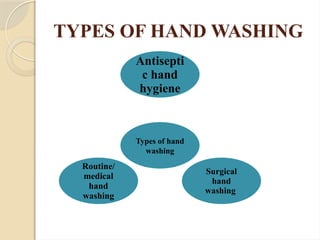
TYPES OF HANDWASHING
Types of hand
washing
Antisepti
c hand
hygiene
Surgical
hand
washing
Routine/
medical
hand
washing
15.
ANTISEPTIC HAND HYGIENE
This is done using an antimicrobial agent that is most
commonly used while performing certain procedures
on the patients in IPDs, OPDs or in the isolation wards.
This type of hand hygiene kills maximum transient
microbial flora of the hands.
THE ANTISEPTIC HAND HYGIENE is done during
outbreaks of infection especially when contact with
infected blood or body fluids or microbial
contamination is suspected, during high risk of
involvement work areas, some invasive procedure being
done and during wound care, catheterization, etc.
16.
The processof antiseptic hand hygiene can be
categorized into the following 2 types based upon
the usage of water during the hygiene process:
1. Antiseptic hand wash: this is the washing of
the hands done by using the antimicrobial soap/
solution & water. The antimicrobial soaps
include, for ex: chlorexidine, iodine etc.
2. Alcohol-based hand rub (ABHR): This
includes the use of alcohol based antiseptic hand
rub, ex: hydrex hand rub. The use of ABHR has
many advantages for the hand hygiene purpose.
17.
Steps of Alcohol-BasedHand Rub
(ABHR)
r
e
p
r
o
c
e
d
u
r
e
:
2
0
-
r
o
d
u
c
t
i
n
a
c
u
p
p
e
h
a
n
d
s
p
a
l
m
t
o
p
d
o
r
s
u
m
w
i
t
h
i
n
t
MEDICAL HAND WASHING
The hands when washed with soap and water
usually remove dirt, dead skin, organic matter
and most of the transient microbes on the hands.
The hand washing before general procedures is
called as the routine hand washing.
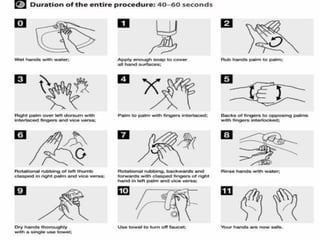
The hand washing should be done for at least
40-60 sec.
Wet the hands and apply soap, rub all surface,
rinse the hands and then dry thoroughly with a
single use towel or tissue paper.
20.
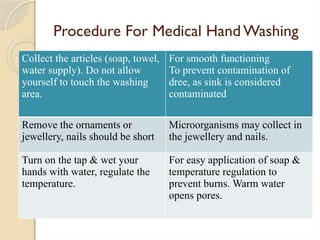
Procedure For MedicalHand Washing
Collect the articles (soap, towel,
water supply). Do not allow
yourself to touch the washing
area.
For smooth functioning
To prevent contamination of
dree, as sink is considered
contaminated
Remove the ornaments or
jewellery, nails should be short
Microorganisms may collect in
the jewellery and nails.
Turn on the tap & wet your
hands with water, regulate the
temperature.
For easy application of soap &
temperature regulation to
prevent burns. Warm water
opens pores.
21.
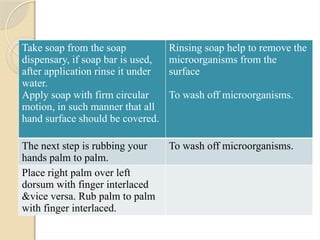
Take soap fromthe soap
dispensary, if soap bar is used,
after application rinse it under
water.
Apply soap with firm circular
motion, in such manner that all
hand surface should be covered.
Rinsing soap help to remove the
microorganisms from the
surface
To wash off microorganisms.
The next step is rubbing your
hands palm to palm.
To wash off microorganisms.
Place right palm over left
dorsum with finger interlaced
&vice versa. Rub palm to palm
with finger interlaced.
22.
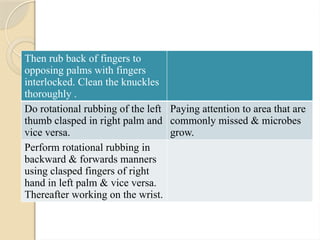
Then rub backof fingers to
opposing palms with fingers
interlocked. Clean the knuckles
thoroughly .
Do rotational rubbing of the left
thumb clasped in right palm and
vice versa.
Paying attention to area that are
commonly missed & microbes
grow.
Perform rotational rubbing in
backward & forwards manners
using clasped fingers of right
hand in left palm & vice versa.
Thereafter working on the wrist.
23.
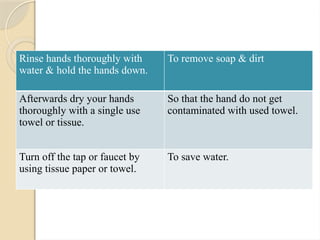
Rinse hands thoroughlywith
water & hold the hands down.
To remove soap & dirt
Afterwards dry your hands
thoroughly with a single use
towel or tissue.
So that the hand do not get
contaminated with used towel.
Turn off the tap or faucet by
using tissue paper or towel.
To save water.
25.
SURGICAL HAND WASHING
The hand scrubbing done before a surgical procedure is
called as the surgical hand scrub.
The purpose of surgical hand hygiene is to prevent the
transmission of microbes from the hands of the surgical
team personnel to the patient’s wounds.
The surgical hand scrub removes the soil, debris, dirt,
transient and resident microbes before and during the
surgery.
Recommended time for washing the hands in 2-6 minutes.
The surgical hand scrubbing with antiseptic agent before
beginning surgical procedures:
26.
Minimizes thenumber of microorganisms.
Helps prevent the growth of
microorganism on hand, under the gloves,
for a period of time.
It reduces the risk infections to the if the
gloves are torn during the procedure.
27.
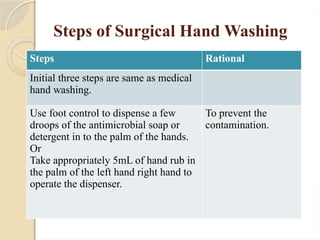
Steps of SurgicalHand Washing
Steps Rational
Initial three steps are same as medical
hand washing.
Use foot control to dispense a few
droops of the antimicrobial soap or
detergent in to the palm of the hands.
Or
Take appropriately 5mL of hand rub in
the palm of the left hand right hand to
operate the dispenser.
To prevent the
contamination.
28.
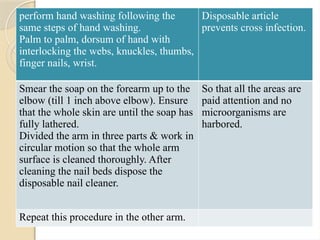
perform hand washingfollowing the
same steps of hand washing.
Palm to palm, dorsum of hand with
interlocking the webs, knuckles, thumbs,
finger nails, wrist.
Disposable article
prevents cross infection.
Smear the soap on the forearm up to the
elbow (till 1 inch above elbow). Ensure
that the whole skin are until the soap has
fully lathered.
Divided the arm in three parts & work in
circular motion so that the whole arm
surface is cleaned thoroughly. After
cleaning the nail beds dispose the
disposable nail cleaner.
So that all the areas are
paid attention and no
microorganisms are
harbored.
Repeat this procedure in the other arm.
29.
Rinse hands andarms under running
water starting at the fingertips and
working toward the elbows
Maintain aseptic technique during the
surgical scrub.
Keep hands upright and elbows down
when rinsing.
Allow water to drip off elbows down
when rinsing.
Dry hands thoroughly prior to donning
gloves, using a sterile towel.


 Most read