By: Laura Newberg
STRAIN THEORY
He proposed a general strain
theory that is no longer
structural or interpersonal, but
rather individual and emotional,
paying special attention to a
person's direct social
environment and negative
stimuli.
ROBERT AGNEW’S
GENERAL STRAIN
THEORY
Male Strain
•Concerned with material success – thus
higher rates of property and violent crime
•Face more conflict with peers and are likely
to be the victims of crime
•Failure to achieve goals may lead to property
and violent crime
•More likely to respond with anger, followed
by moral outrage
•Quick to blame others and are less
concerned about hurting others
Men tend to
be over-
represented
in arrests,
prisons, and
overall crime
statistics
Female Strain
•Concerned with creating and maintaining close
bonds and relationships with others
•Face negative treatment, such as
discrimination, high demands from family, and
restricted behavior
•Failure to achieve goals may lead to self-
destructive behavior
•More likely to respond with depression and
anger
•More likely to blame themselves and worry
about the effects of their anger
Strain can result from a person’s
failure to achieve one of three
positively valued goals.
The first of these is money. Money is
a cause of strain when it is not
available to the person through legal
means.
The second type of positive goal is
that of status and respect. This is an
especially important factor for males.
Autonomy, or the power over
oneself, is the third type of goal that
is valued in a society.
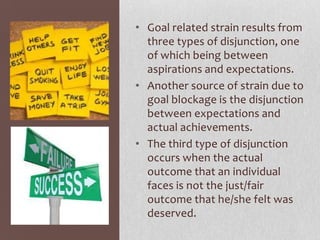
• Goal related strain results from
three types of disjunction, one
of which being between
aspirations and expectations.
• Another source of strain due to
goal blockage is the disjunction
between expectations and
actual achievements.
• The third type of disjunction
occurs when the actual
outcome that an individual
faces is not the just/fair
outcome that he/she felt was
deserved.
The removal of positive stimuli
can also cause strain. This loss
could manifest itself in the form
of a death, a broken relationship
with a friend or spouse, or the
theft of a valued object.
According to Agnew, the strain
that is felt by the individual due to
the loss could lead the individual
to delinquency as the individual
attempts to prevent its loss,
retrieve what was lost, or seek
revenge on those who caused the
loss (Agnew, 1992:57)
The presence of negative stimuli
• Some examples of negative stimuli that a young adult
might face are abuse, neglect, school difficulties such as
poor grades or bullying, neighborhood problems, and
homelessness (Agnew, 1992:58-59).
• Since its addition to Agnew’s general strain theory,
research has been done on this topic. A study by
Hoffmann and Miller (1998:106) found that negative life
events produce increasing delinquent behavior in
adolescents. Their findings include such factors as
parental unemployment, deaths in the family, and illness.
Anger and frustration may cause
the person to justify criminal acts.
Agnew stressed that individuals
who experience repetitive strain
may be more likely to commit
crime or delinquent acts.
This is due to the fact that other
coping strategies for the strain
are overloaded, the threshold for
negativity is pushed to the limit,
and the person may become
hostile or aggressive (Agnew,
1992:61)
References
• Agnew, Robert. (1992). Foundation for a general strain theory of
crime and delinquency. Criminology. 30(1), 47-87.
• Hoffmann, John and Alan Miller. (1998). A latent variable analysis of
general strain theory. Journal of quantitative criminology. 14(1), 83-
110.

Strain theory

  • 1.
  • 2.
    He proposed ageneral strain theory that is no longer structural or interpersonal, but rather individual and emotional, paying special attention to a person's direct social environment and negative stimuli. ROBERT AGNEW’S GENERAL STRAIN THEORY
  • 3.
    Male Strain •Concerned withmaterial success – thus higher rates of property and violent crime •Face more conflict with peers and are likely to be the victims of crime •Failure to achieve goals may lead to property and violent crime •More likely to respond with anger, followed by moral outrage •Quick to blame others and are less concerned about hurting others
  • 4.
    Men tend to beover- represented in arrests, prisons, and overall crime statistics
  • 5.
    Female Strain •Concerned withcreating and maintaining close bonds and relationships with others •Face negative treatment, such as discrimination, high demands from family, and restricted behavior •Failure to achieve goals may lead to self- destructive behavior •More likely to respond with depression and anger •More likely to blame themselves and worry about the effects of their anger
  • 6.
    Strain can resultfrom a person’s failure to achieve one of three positively valued goals. The first of these is money. Money is a cause of strain when it is not available to the person through legal means. The second type of positive goal is that of status and respect. This is an especially important factor for males. Autonomy, or the power over oneself, is the third type of goal that is valued in a society.
  • 7.
    • Goal relatedstrain results from three types of disjunction, one of which being between aspirations and expectations. • Another source of strain due to goal blockage is the disjunction between expectations and actual achievements. • The third type of disjunction occurs when the actual outcome that an individual faces is not the just/fair outcome that he/she felt was deserved.
  • 8.
    The removal ofpositive stimuli can also cause strain. This loss could manifest itself in the form of a death, a broken relationship with a friend or spouse, or the theft of a valued object. According to Agnew, the strain that is felt by the individual due to the loss could lead the individual to delinquency as the individual attempts to prevent its loss, retrieve what was lost, or seek revenge on those who caused the loss (Agnew, 1992:57)
  • 9.
    The presence ofnegative stimuli • Some examples of negative stimuli that a young adult might face are abuse, neglect, school difficulties such as poor grades or bullying, neighborhood problems, and homelessness (Agnew, 1992:58-59). • Since its addition to Agnew’s general strain theory, research has been done on this topic. A study by Hoffmann and Miller (1998:106) found that negative life events produce increasing delinquent behavior in adolescents. Their findings include such factors as parental unemployment, deaths in the family, and illness.
  • 10.
    Anger and frustrationmay cause the person to justify criminal acts. Agnew stressed that individuals who experience repetitive strain may be more likely to commit crime or delinquent acts. This is due to the fact that other coping strategies for the strain are overloaded, the threshold for negativity is pushed to the limit, and the person may become hostile or aggressive (Agnew, 1992:61)
  • 11.
    References • Agnew, Robert.(1992). Foundation for a general strain theory of crime and delinquency. Criminology. 30(1), 47-87. • Hoffmann, John and Alan Miller. (1998). A latent variable analysis of general strain theory. Journal of quantitative criminology. 14(1), 83- 110.