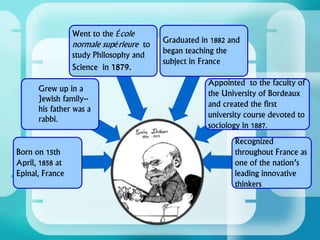















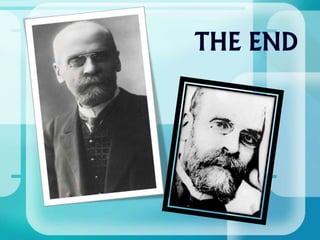
Born on 15th
April, 1858 at
Epinal, France
Grew up in a
Jewish family--
his father was a
rabbi.
Went to the École
normale supérieure to
study Philosophy and
Science in 1879.
Graduated in 1882 and
began teaching the
subject in France
Appointed to the faculty of
the University of Bordeaux
and created the first
university course devoted to
sociology in 1887.
Recognized
throughout France as
one of the nation’s
leading innovative
thinkers
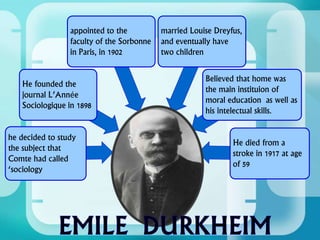
he decided to study
the subject that
Comte had called
‘sociology
He founded the
journal L’Année
Sociologique in 1898
appointed to the
faculty of the Sorbonne
in Paris, in 1902
married Louise Dreyfus,
and eventually have
two children
Believed that home was
the main instituion of
moral education as well as
his intelectual skills.
He died from a
stroke in 1917 at age
of 59
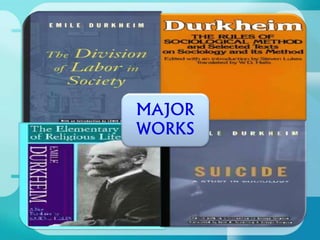
MAJOR
WORKS
How does society hold
itself together despite the
fact we all have different
interests?
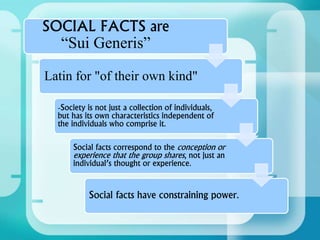
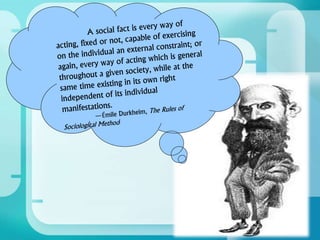
SOCIAL FACTS are
“Sui Generis”
Latin for "of their own kind"
-Society is not just a collection of individuals,
but has its own characteristics independent of
the individuals who comprise it.
Social facts correspond to the conception or
experience that the group shares, not just an
individual’s thought or experience.
Social facts have constraining power.
SOCIAL
FACTS
control over
the individual
External to
Individual
How does
society hold itself
together despite the
fact we all have
different interests?
• refers to the ties in a society
or social relations that bind
people to one another.
• a feeling of unity between
people who have the same
interests, goals, etc.
•Shared beliefs
•Sentiments
Mechanical
Solidarity
•Specialization
•Interdependence
Organic
Solidarity
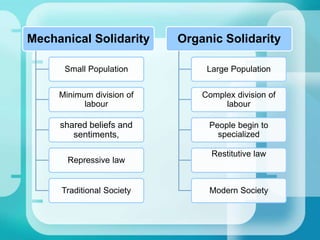
Mechanical Solidarity
Small Population
Minimum division of
labour
shared beliefs and
sentiments,
Repressive law
Traditional Society
Organic Solidarity
Large Population
Complex division of
labour
People begin to
specialized
Restitutive law
Modern Society
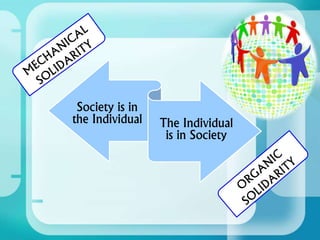
Society is in
the Individual The Individual
is in Society
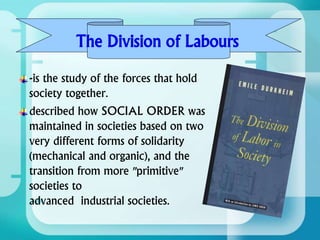
-is the study of the forces that hold
society together.
described how SOCIAL ORDER was
maintained in societies based on two
very different forms of solidarity
(mechanical and organic), and the
transition from more "primitive"
societies to
advanced industrial societies.
The Division of Labours
He focused on the shift
in societies from a simple
society to one that is more
complex.
The Division of Labours
MECHANICAL
SOLIDARITY
ORGANIC
SOLIDARITY
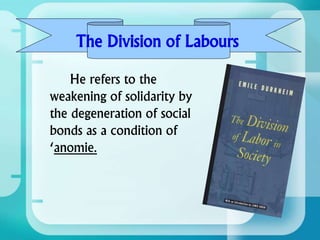
He refers to the
weakening of solidarity by
the degeneration of social
bonds as a condition of
‘anomie.
The Division of Labours
Anomie – is a condition of instability
resulting from a breakdown of standards
and values or from a lack of purpose or
ideals.
It is the breakdown of social bonds
between an individual and the community
. According to Durkheim , When a
social system is in a state of anomie,
common values and common meanings
are no longer understood or accepted, and
new values and meanings have not
developed
Sociology, 12th Edition
by John Macionis
• Warned that modern society creates
anomie–A condition in which society
provides little moral guidance to
individuals
• Change from mechanical solidarity–
Social bonds based on common
sentiment and shared moral values
that are common among members of
preindustrial societies
• Durkheim’s most important reason for
studying suicide was to prove the power of
the new science of Sociology. Suicide is
generally considered to be one of the most
private and personal acts. Durkheim
believed that if he could show that
Sociology had a role to play in explaining
such an individualistic act as suicide, it
would be relatively easy to extend
Sociology’s domain to phenomena.
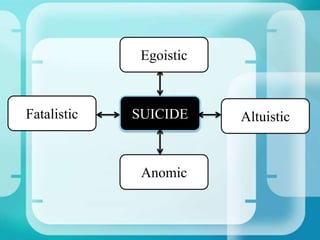
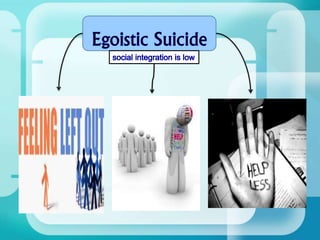
• In The Suicide, he identify four types of
suicide.
The Suicide
SUICIDE
Egoistic
Altuistic
Anomic
Fatalistic
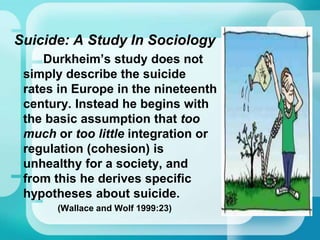
Suicide: A Study In Sociology
Durkheim’s study does not
simply describe the suicide
rates in Europe in the nineteenth
century. Instead he begins with
the basic assumption that too
much or too little integration or
regulation (cohesion) is
unhealthy for a society, and
from this he derives specific
hypotheses about suicide.
(Wallace and Wolf 1999:23)
The Elementary Forms
Of Religious Life
 How people relate to these beliefs and
practices, and the function they serve in
society?
 analyzes religion as a social
phenomenon. Durkheim attributes the
development of religion to the emotional
security attained through communal living.
The Elementary Forms
Of Religious Life
DURKHEIM’S PURPOSE
1. to identify the social origin and function
of religion as he felt that religion was a
source of camaraderie and solidarity.
2. to identify links between certain religions
in different cultures, finding a common
denominator.
He wanted to understand the
empirical, social aspect of religion that is
common to all religions and goes beyond
the concepts of spirituality and God.
The Elementary Forms
Of Religious Life
A religion is a unified system of beliefs
and practices relative to sacred things, that
is to say, things set apart and forbidden –
beliefs and practices which unite into one
single moral community called a Church,
all those who adhere to them.
(Elementary Forms, p. 62
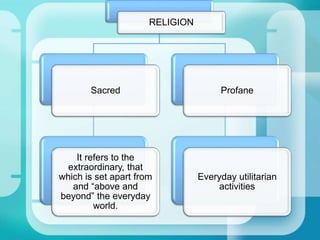
RELIGION
Sacred
It refers to the
extraordinary, that
which is set apart from
and “above and
beyond” the everyday
world.
Profane
Everyday utilitarian
activities
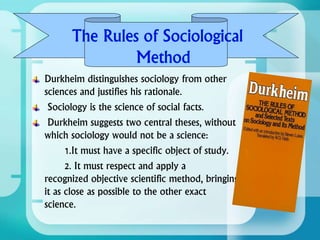
Durkheim distinguishes sociology from other
sciences and justifies his rationale.
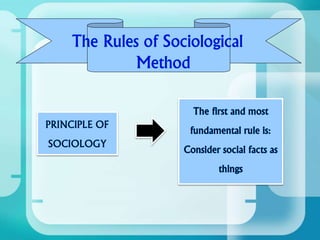
Sociology is the science of social facts.
Durkheim suggests two central theses, without
which sociology would not be a science:
1.It must have a specific object of study.
2. It must respect and apply a
recognized objective scientific method, bringing
it as close as possible to the other exact
science.
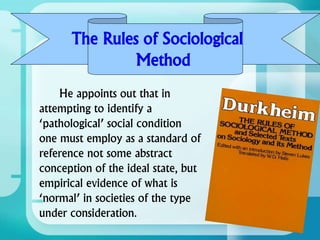
He appoints out that in
attempting to identify a
‘pathological’ social condition
one must employ as a standard of
reference not some abstract
conception of the ideal state, but
empirical evidence of what is
‘normal’ in societies of the type
under consideration.
The Rules of Sociological
Method
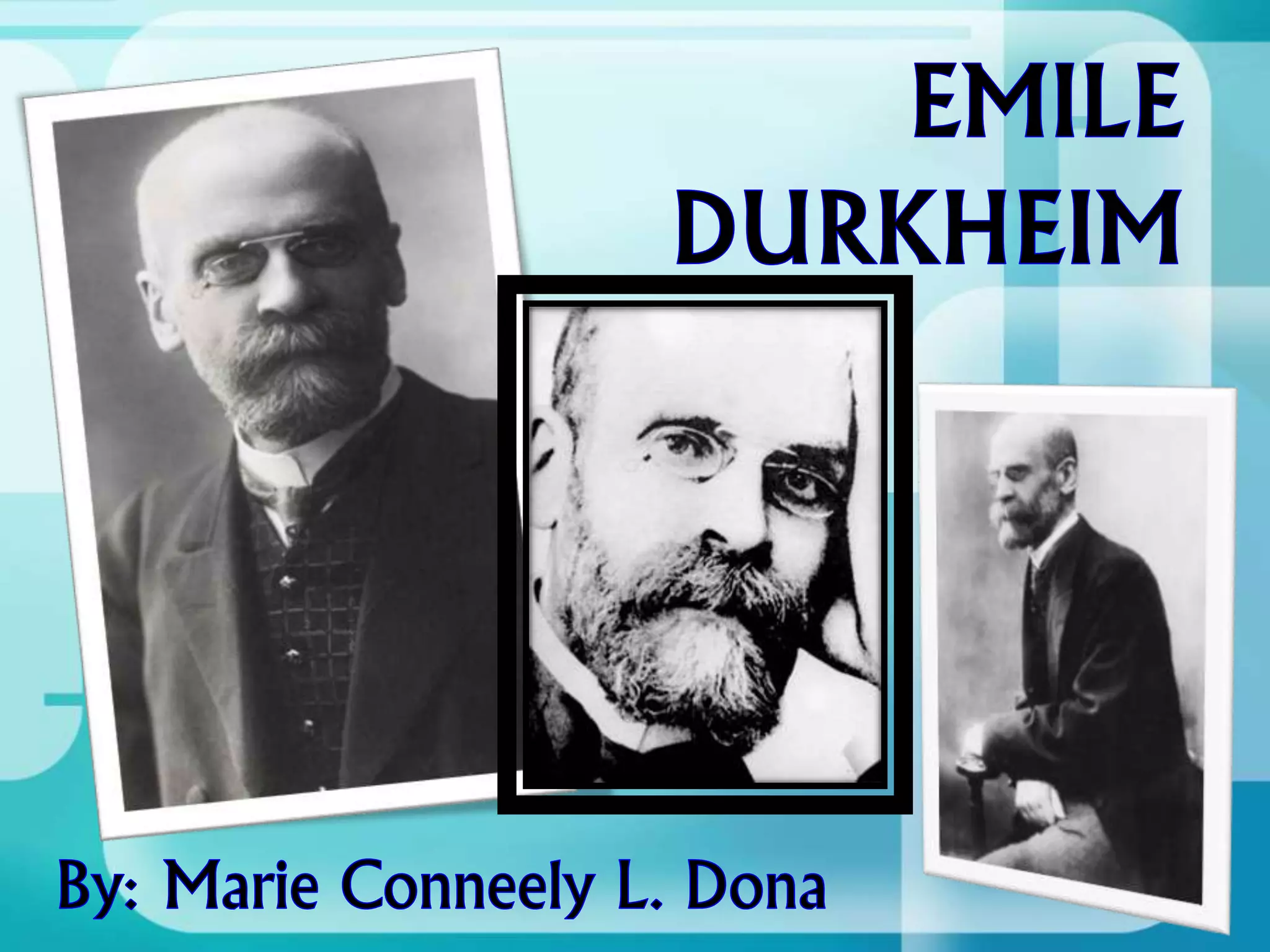
eMILE Durkheeim presentation

eMILE Durkheeim presentation

  • 2.
    Born on 15th April,1858 at Epinal, France Grew up in a Jewish family-- his father was a rabbi. Went to the École normale supérieure to study Philosophy and Science in 1879. Graduated in 1882 and began teaching the subject in France Appointed to the faculty of the University of Bordeaux and created the first university course devoted to sociology in 1887. Recognized throughout France as one of the nation’s leading innovative thinkers
  • 3.
    he decided tostudy the subject that Comte had called ‘sociology He founded the journal L’Année Sociologique in 1898 appointed to the faculty of the Sorbonne in Paris, in 1902 married Louise Dreyfus, and eventually have two children Believed that home was the main instituion of moral education as well as his intelectual skills. He died from a stroke in 1917 at age of 59
  • 5.
  • 7.
    How does societyhold itself together despite the fact we all have different interests?
  • 9.
    SOCIAL FACTS are “SuiGeneris” Latin for "of their own kind" -Society is not just a collection of individuals, but has its own characteristics independent of the individuals who comprise it. Social facts correspond to the conception or experience that the group shares, not just an individual’s thought or experience. Social facts have constraining power.
  • 11.
  • 13.
    How does society holditself together despite the fact we all have different interests?
  • 14.
    • refers tothe ties in a society or social relations that bind people to one another. • a feeling of unity between people who have the same interests, goals, etc.
  • 15.
  • 16.
    Mechanical Solidarity Small Population Minimumdivision of labour shared beliefs and sentiments, Repressive law Traditional Society Organic Solidarity Large Population Complex division of labour People begin to specialized Restitutive law Modern Society
  • 17.
    Society is in theIndividual The Individual is in Society
  • 19.
    -is the studyof the forces that hold society together. described how SOCIAL ORDER was maintained in societies based on two very different forms of solidarity (mechanical and organic), and the transition from more "primitive" societies to advanced industrial societies. The Division of Labours
  • 20.
    He focused onthe shift in societies from a simple society to one that is more complex. The Division of Labours MECHANICAL SOLIDARITY ORGANIC SOLIDARITY
  • 21.
    He refers tothe weakening of solidarity by the degeneration of social bonds as a condition of ‘anomie. The Division of Labours
  • 22.
    Anomie – isa condition of instability resulting from a breakdown of standards and values or from a lack of purpose or ideals. It is the breakdown of social bonds between an individual and the community . According to Durkheim , When a social system is in a state of anomie, common values and common meanings are no longer understood or accepted, and new values and meanings have not developed
  • 23.
    Sociology, 12th Edition byJohn Macionis • Warned that modern society creates anomie–A condition in which society provides little moral guidance to individuals • Change from mechanical solidarity– Social bonds based on common sentiment and shared moral values that are common among members of preindustrial societies
  • 24.
    • Durkheim’s mostimportant reason for studying suicide was to prove the power of the new science of Sociology. Suicide is generally considered to be one of the most private and personal acts. Durkheim believed that if he could show that Sociology had a role to play in explaining such an individualistic act as suicide, it would be relatively easy to extend Sociology’s domain to phenomena. • In The Suicide, he identify four types of suicide. The Suicide
  • 25.
  • 30.
    Suicide: A StudyIn Sociology Durkheim’s study does not simply describe the suicide rates in Europe in the nineteenth century. Instead he begins with the basic assumption that too much or too little integration or regulation (cohesion) is unhealthy for a society, and from this he derives specific hypotheses about suicide. (Wallace and Wolf 1999:23)
  • 31.
    The Elementary Forms OfReligious Life  How people relate to these beliefs and practices, and the function they serve in society?  analyzes religion as a social phenomenon. Durkheim attributes the development of religion to the emotional security attained through communal living.
  • 32.
    The Elementary Forms OfReligious Life DURKHEIM’S PURPOSE 1. to identify the social origin and function of religion as he felt that religion was a source of camaraderie and solidarity. 2. to identify links between certain religions in different cultures, finding a common denominator. He wanted to understand the empirical, social aspect of religion that is common to all religions and goes beyond the concepts of spirituality and God.
  • 33.
    The Elementary Forms OfReligious Life A religion is a unified system of beliefs and practices relative to sacred things, that is to say, things set apart and forbidden – beliefs and practices which unite into one single moral community called a Church, all those who adhere to them. (Elementary Forms, p. 62
  • 34.
    RELIGION Sacred It refers tothe extraordinary, that which is set apart from and “above and beyond” the everyday world. Profane Everyday utilitarian activities
  • 35.
    Durkheim distinguishes sociologyfrom other sciences and justifies his rationale. Sociology is the science of social facts. Durkheim suggests two central theses, without which sociology would not be a science: 1.It must have a specific object of study. 2. It must respect and apply a recognized objective scientific method, bringing it as close as possible to the other exact science.
  • 37.
    He appoints outthat in attempting to identify a ‘pathological’ social condition one must employ as a standard of reference not some abstract conception of the ideal state, but empirical evidence of what is ‘normal’ in societies of the type under consideration. The Rules of Sociological Method

Editor's Notes

  • #31 Thursday, October 9, 2014