1©Robere & Associates (Thailand) Ltd . Course: 20HRBW-D1
BUSINESS WRITING:BUSINESS WRITING:
ORGANIZING, WRITING, ANDORGANIZING, WRITING, AND
EDITING THEEDITING THE wRITEwRITE WAYWAY
Presented by:Presented by:
Robere & Associates (Thailand) Ltd.Robere & Associates (Thailand) Ltd.
2
©Robere & Associates (Thailand) Ltd
Training ObjectivesTraining Objectives
• Participants will have the following
opportunities:
– To learn methods to organize information effectively;
– To review and integrate the principles of readability;
– To evaluate and improve writing skills through
practice;
– To learn to match the appropriate format and style
with the intended reader; and
– To gain editorial skills to create professional
documents.
3
©Robere & Associates (Thailand) Ltd
I. Writing:I. Writing: a three-step processa three-step process
• OrganizingOrganizing
• WritingWriting
• EditingEditing
4
©Robere & Associates (Thailand) Ltd
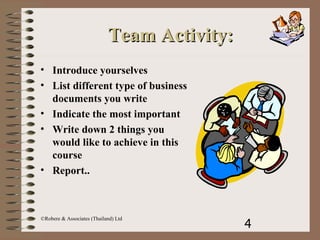
Team Activity:Team Activity:
• Introduce yourselves
• List different type of business
documents you write
• Indicate the most important
• Write down 2 things you
would like to achieve in this
course
• Report..
5
©Robere & Associates (Thailand) Ltd
Group Discussion:Group Discussion:
What are the “Myths” about Business Writing?What are the “Myths” about Business Writing?
• Always use short
sentences.
• Use only simple
vocabulary
• Eloquence is
unnecessary
• Business documents
are dull
6
©Robere & Associates (Thailand) Ltd
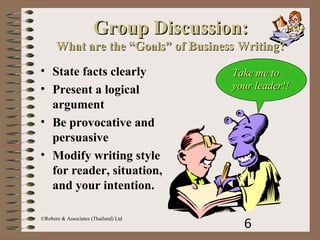
Group Discussion:Group Discussion:
What are the “Goals” of Business Writing?What are the “Goals” of Business Writing?
• State facts clearly
• Present a logical
argument
• Be provocative and
persuasive
• Modify writing style
for reader, situation,
and your intention.
Take me toTake me to
your leader!!your leader!!
7
©Robere & Associates (Thailand) Ltd
II.II. Organizing Before WritingOrganizing Before Writing
TEAM ACTIVITY: Read the case study on
Form AForm A and report:and report:
– Is the passage clear and easy to read, or is it
complicated requiring substantial rereading?
– What makes the writing easy or difficult to read?
– How would you describe this writing: impersonal,
boring, interesting? Why?
– Do ideas follow a logical sequence?
8
©Robere & Associates (Thailand) Ltd
Points to consider......Points to consider......
When you write a document make sure that:
– Understandable writing is clear and direct.
– Do not adopt the company’s “officialese”.
– Avoid repetitiveness and generalizations.
– Avoid jargon.
– Sequence ideas and thoughts logically. Organize a
plan before your write.
– Use more simple sentences and fewer complex
sentences.
– Be persuasive and give your writing “punch” to keep
it from being boring and impersonal.
9
©Robere & Associates (Thailand) Ltd
Team Exercise:Team Exercise:
Write for Your ReaderWrite for Your Reader (Writing Task)(Writing Task) – 15 minutes– 15 minutes
1. Write a letter of support as a recommendation for
an industry proposal to a government agency.
2. Write a press-release announcement of a new
product.
3. Write a memo to staff announcing a new vacation
policy.
4. Write an advertising slogan to encourage kids to stay
in school.
10
©Robere & Associates (Thailand) Ltd
Types of Business WritingTypes of Business Writing
(Group Inquiry)(Group Inquiry)
What type of documents do we have to write?
– Memo
– Report
– Letter
– Proposal
– Resume
– News release
– Technical writing
11
©Robere & Associates (Thailand) Ltd
Outlines from the OutsetOutlines from the Outset
(Form B)(Form B)
• In pairs, think of a business document you
have to write.
• Decide which “outline” format you will use.
• Create the outline.
• Join with other pairs and your outlines.
• Discuss
12
©Robere & Associates (Thailand) Ltd
III. Writing EffectivelyIII. Writing Effectively
Which of these terms are “abstract”“abstract” oror
“concrete”?“concrete”?
• quality • garden
• personality • personality
• maintenance • experience
• jeep
13
©Robere & Associates (Thailand) Ltd
– People usually think and speak using concrete words
and examples.
– Abstract words usually decrease readers’ ease of
comprehension.
– People often write abstractly to impress others and be
precise.
– People use abstract words to protect their writing from
criticism or attack.
– Effective business writing balances abstract words,
concrete words, and specific examples to inform the
reader clearly and completely.
Using words EffectivelyUsing words Effectively
14
©Robere & Associates (Thailand) Ltd
Jargon?Jargon?
• Give an example of
“jargon” used in
your business field.
• Does “jargon” get in
the way of proper
communication?
15
©Robere & Associates (Thailand) Ltd
– is usually associated with a particular profession or
specialty.
– is appropriate : when two professionals who understand
the jargon are communicating.
– An inappropriate use of jargon occurs when the writer
knows that the reader will not understand the technical
language.
– Buzzwords are usually some jargon that has become
trendy.
– To ensure effective business writing, one should
eliminate excessive or unclear jargon and delete, add,
or change parts of the sentence to improve clarity.
Jargon....Jargon....
16
©Robere & Associates (Thailand) Ltd
Can you rewrite this sentence?Can you rewrite this sentence?
• Treck Ltd., although it has an nonoperating
segment, has a policy of allocating common
costs and expenses of an operating nature in
proportion to sales.
• Treck Ltd., allocates common operating costs
and expenses in proportion to sales.
Nonoperating expenses are presented
separately.
17
©Robere & Associates (Thailand) Ltd
Is this better?Is this better?
• Treck Ltd., allocates common operating
costs and expenses in proportion to
sales. Nonoperating expenses are
presented separately.
18
©Robere & Associates (Thailand) Ltd
How about this one?How about this one?
• In order to accomplish recurring currency
translation overrides in the DONTON System,
the consolidation accountant now enters fixed
U.S. dollar amounts in an adjustment file, to
be applied against specific unit and row
number combinations.
• Recurring currency-translation overrides in
the DONTON System are achieved by
applying fixed U.S. dollar amounts against
specific unit and row number combinations in
an adjustment file.
19
©Robere & Associates (Thailand) Ltd
Is this better?Is this better?
• Recurring currency-translation
overrides in the DONTON System are
achieved by applying fixed U.S. dollar
amounts against specific unit and row
number combinations in an adjustment
file.
20
©Robere & Associates (Thailand) Ltd
Active vs. Passive VoiceActive vs. Passive Voice
(Form C)(Form C)
• In trios, read the sentences in
section I. Anything different?
– Which are “active” and which are
“passive”?
– Mark you answers in the space
provided.
• Change teams and complete
section II.
• Change teams and complete
section III.
21
©Robere & Associates (Thailand) Ltd
– Organization of business writing depends on the
readers’ needs. Initially decide what information
they need or want.
– Order your information in a way that helps the
reader understand the message.
– The building-block approach orders information
from specific to general conclusion.
– Paragraphs should follow the same pattern of
opening with a lead or topic sentence.
– Limit paragraphs to statements related to a single
topic.
Organization and LogicOrganization and Logic
22
©Robere & Associates (Thailand) Ltd
Five Paragraph organizingFive Paragraph organizing
strategies:strategies:
1. Classification
2. Cause-and-effect
analysis
3. Process analysis
4. Comparison and
contrast
5. Illustration
23
©Robere & Associates (Thailand) Ltd
Team Exercise:Team Exercise:
• Using your original outline, create a short
document considering
– reader’s needs
– type of document
– active voice
– creating opening leads and hooks
– using topic sentences in paragraphs and
– organizing paragraphs using the five strategies.
24
©Robere & Associates (Thailand) Ltd
Editing your writingEditing your writing
• Do you know
about editing
marks?
• Do you know how
to indicate a
change in yourr
document?
25
©Robere & Associates (Thailand) Ltd
Editing ProcessEditing Process
(Form D)(Form D)
– Initially read document and check for completeness.
– Next read for substance. This includes content, format,Next read for substance. This includes content, format,
and policy.and policy.
– Next read for mechanics. This includes the more
detailed items like punctuation, capitalization,
parallelism, verb-noun agreement, verb-tense
consistency, deletion, and repetitions.
– The goal of editing is to retain the meaning and style ofThe goal of editing is to retain the meaning and style of
the writing while shortening it wherever possible andthe writing while shortening it wherever possible and
improving clarity.improving clarity.
26
©Robere & Associates (Thailand) Ltd
FORMAT TECHNIQUESFORMAT TECHNIQUES
(Six teams discuss and present)(Six teams discuss and present)
1. Instructive and topical subheadings
2. Bullet points or lists
3. Indenting, underlining, italicizing, and
capitalizing
4. White space
5. Appendices
6. T-form or parallel columns
27
©Robere & Associates (Thailand) Ltd
Closing Activities:Closing Activities:
Mental ImageryMental Imagery
•Share your thoughts with your neighbor
•Use Form E and complete it.
28©Robere & Associates (Thailand) Ltd . Course: 20HRBW-D1
ANY QUESTIONS?ANY QUESTIONS?

Business writing

  • 1.
    1©Robere & Associates(Thailand) Ltd . Course: 20HRBW-D1 BUSINESS WRITING:BUSINESS WRITING: ORGANIZING, WRITING, ANDORGANIZING, WRITING, AND EDITING THEEDITING THE wRITEwRITE WAYWAY Presented by:Presented by: Robere & Associates (Thailand) Ltd.Robere & Associates (Thailand) Ltd.
  • 2.
    2 ©Robere & Associates(Thailand) Ltd Training ObjectivesTraining Objectives • Participants will have the following opportunities: – To learn methods to organize information effectively; – To review and integrate the principles of readability; – To evaluate and improve writing skills through practice; – To learn to match the appropriate format and style with the intended reader; and – To gain editorial skills to create professional documents.
  • 3.
    3 ©Robere & Associates(Thailand) Ltd I. Writing:I. Writing: a three-step processa three-step process • OrganizingOrganizing • WritingWriting • EditingEditing
  • 4.
    4 ©Robere & Associates(Thailand) Ltd Team Activity:Team Activity: • Introduce yourselves • List different type of business documents you write • Indicate the most important • Write down 2 things you would like to achieve in this course • Report..
  • 5.
    5 ©Robere & Associates(Thailand) Ltd Group Discussion:Group Discussion: What are the “Myths” about Business Writing?What are the “Myths” about Business Writing? • Always use short sentences. • Use only simple vocabulary • Eloquence is unnecessary • Business documents are dull
  • 6.
    6 ©Robere & Associates(Thailand) Ltd Group Discussion:Group Discussion: What are the “Goals” of Business Writing?What are the “Goals” of Business Writing? • State facts clearly • Present a logical argument • Be provocative and persuasive • Modify writing style for reader, situation, and your intention. Take me toTake me to your leader!!your leader!!
  • 7.
    7 ©Robere & Associates(Thailand) Ltd II.II. Organizing Before WritingOrganizing Before Writing TEAM ACTIVITY: Read the case study on Form AForm A and report:and report: – Is the passage clear and easy to read, or is it complicated requiring substantial rereading? – What makes the writing easy or difficult to read? – How would you describe this writing: impersonal, boring, interesting? Why? – Do ideas follow a logical sequence?
  • 8.
    8 ©Robere & Associates(Thailand) Ltd Points to consider......Points to consider...... When you write a document make sure that: – Understandable writing is clear and direct. – Do not adopt the company’s “officialese”. – Avoid repetitiveness and generalizations. – Avoid jargon. – Sequence ideas and thoughts logically. Organize a plan before your write. – Use more simple sentences and fewer complex sentences. – Be persuasive and give your writing “punch” to keep it from being boring and impersonal.
  • 9.
    9 ©Robere & Associates(Thailand) Ltd Team Exercise:Team Exercise: Write for Your ReaderWrite for Your Reader (Writing Task)(Writing Task) – 15 minutes– 15 minutes 1. Write a letter of support as a recommendation for an industry proposal to a government agency. 2. Write a press-release announcement of a new product. 3. Write a memo to staff announcing a new vacation policy. 4. Write an advertising slogan to encourage kids to stay in school.
  • 10.
    10 ©Robere & Associates(Thailand) Ltd Types of Business WritingTypes of Business Writing (Group Inquiry)(Group Inquiry) What type of documents do we have to write? – Memo – Report – Letter – Proposal – Resume – News release – Technical writing
  • 11.
    11 ©Robere & Associates(Thailand) Ltd Outlines from the OutsetOutlines from the Outset (Form B)(Form B) • In pairs, think of a business document you have to write. • Decide which “outline” format you will use. • Create the outline. • Join with other pairs and your outlines. • Discuss
  • 12.
    12 ©Robere & Associates(Thailand) Ltd III. Writing EffectivelyIII. Writing Effectively Which of these terms are “abstract”“abstract” oror “concrete”?“concrete”? • quality • garden • personality • personality • maintenance • experience • jeep
  • 13.
    13 ©Robere & Associates(Thailand) Ltd – People usually think and speak using concrete words and examples. – Abstract words usually decrease readers’ ease of comprehension. – People often write abstractly to impress others and be precise. – People use abstract words to protect their writing from criticism or attack. – Effective business writing balances abstract words, concrete words, and specific examples to inform the reader clearly and completely. Using words EffectivelyUsing words Effectively
  • 14.
    14 ©Robere & Associates(Thailand) Ltd Jargon?Jargon? • Give an example of “jargon” used in your business field. • Does “jargon” get in the way of proper communication?
  • 15.
    15 ©Robere & Associates(Thailand) Ltd – is usually associated with a particular profession or specialty. – is appropriate : when two professionals who understand the jargon are communicating. – An inappropriate use of jargon occurs when the writer knows that the reader will not understand the technical language. – Buzzwords are usually some jargon that has become trendy. – To ensure effective business writing, one should eliminate excessive or unclear jargon and delete, add, or change parts of the sentence to improve clarity. Jargon....Jargon....
  • 16.
    16 ©Robere & Associates(Thailand) Ltd Can you rewrite this sentence?Can you rewrite this sentence? • Treck Ltd., although it has an nonoperating segment, has a policy of allocating common costs and expenses of an operating nature in proportion to sales. • Treck Ltd., allocates common operating costs and expenses in proportion to sales. Nonoperating expenses are presented separately.
  • 17.
    17 ©Robere & Associates(Thailand) Ltd Is this better?Is this better? • Treck Ltd., allocates common operating costs and expenses in proportion to sales. Nonoperating expenses are presented separately.
  • 18.
    18 ©Robere & Associates(Thailand) Ltd How about this one?How about this one? • In order to accomplish recurring currency translation overrides in the DONTON System, the consolidation accountant now enters fixed U.S. dollar amounts in an adjustment file, to be applied against specific unit and row number combinations. • Recurring currency-translation overrides in the DONTON System are achieved by applying fixed U.S. dollar amounts against specific unit and row number combinations in an adjustment file.
  • 19.
    19 ©Robere & Associates(Thailand) Ltd Is this better?Is this better? • Recurring currency-translation overrides in the DONTON System are achieved by applying fixed U.S. dollar amounts against specific unit and row number combinations in an adjustment file.
  • 20.
    20 ©Robere & Associates(Thailand) Ltd Active vs. Passive VoiceActive vs. Passive Voice (Form C)(Form C) • In trios, read the sentences in section I. Anything different? – Which are “active” and which are “passive”? – Mark you answers in the space provided. • Change teams and complete section II. • Change teams and complete section III.
  • 21.
    21 ©Robere & Associates(Thailand) Ltd – Organization of business writing depends on the readers’ needs. Initially decide what information they need or want. – Order your information in a way that helps the reader understand the message. – The building-block approach orders information from specific to general conclusion. – Paragraphs should follow the same pattern of opening with a lead or topic sentence. – Limit paragraphs to statements related to a single topic. Organization and LogicOrganization and Logic
  • 22.
    22 ©Robere & Associates(Thailand) Ltd Five Paragraph organizingFive Paragraph organizing strategies:strategies: 1. Classification 2. Cause-and-effect analysis 3. Process analysis 4. Comparison and contrast 5. Illustration
  • 23.
    23 ©Robere & Associates(Thailand) Ltd Team Exercise:Team Exercise: • Using your original outline, create a short document considering – reader’s needs – type of document – active voice – creating opening leads and hooks – using topic sentences in paragraphs and – organizing paragraphs using the five strategies.
  • 24.
    24 ©Robere & Associates(Thailand) Ltd Editing your writingEditing your writing • Do you know about editing marks? • Do you know how to indicate a change in yourr document?
  • 25.
    25 ©Robere & Associates(Thailand) Ltd Editing ProcessEditing Process (Form D)(Form D) – Initially read document and check for completeness. – Next read for substance. This includes content, format,Next read for substance. This includes content, format, and policy.and policy. – Next read for mechanics. This includes the more detailed items like punctuation, capitalization, parallelism, verb-noun agreement, verb-tense consistency, deletion, and repetitions. – The goal of editing is to retain the meaning and style ofThe goal of editing is to retain the meaning and style of the writing while shortening it wherever possible andthe writing while shortening it wherever possible and improving clarity.improving clarity.
  • 26.
    26 ©Robere & Associates(Thailand) Ltd FORMAT TECHNIQUESFORMAT TECHNIQUES (Six teams discuss and present)(Six teams discuss and present) 1. Instructive and topical subheadings 2. Bullet points or lists 3. Indenting, underlining, italicizing, and capitalizing 4. White space 5. Appendices 6. T-form or parallel columns
  • 27.
    27 ©Robere & Associates(Thailand) Ltd Closing Activities:Closing Activities: Mental ImageryMental Imagery •Share your thoughts with your neighbor •Use Form E and complete it.
  • 28.
    28©Robere & Associates(Thailand) Ltd . Course: 20HRBW-D1 ANY QUESTIONS?ANY QUESTIONS?