Business Research Methods Dr. Ning DING Sept 10, 2010
Overview 09/09/10 Course Structure Schedule What is research?
Course Structure 09/09/10 Lecturer STATISTICS: BRM: Jan Roelf Scholtens (SCJR) Room: I007 Lecturer METHODS : Ning Ding (DINI); Room: I007 Blackboard BUSINESS RESEARCH METHODS BRM1
Course Structure 09/09/10 3++ hours per week 1 hour with lecturer (MAAC) Research fundamentals Assignment: applying research methods Statistics: 2 hours with lecturer (SCJR) statistics SPSS ++ hours on assignments
Course Structure 09/09/10 Written exam  IBVH4BRM1A two sections A and B A: research methods and qualitative aspects: Saunders 5 th  Ed., chapters 1, 2, 3, 4.3 (sub chapter ‘research approaches’), 5, 7, 10, 11  B: the quantitative part 2 ECTS Group assignment   IBVH4BRM1C research project 3 ECTS
Course Structure 09/09/10 Assignment week 1 Form a team Identify a research topic,  indicate direction , expert Email (before Friday 12 hours): full names (first + last names), student numbers and class; Name contact person; Research topic ,  research population +  general direction ;  Description and role of expert Further info on BB (Business research methods BRM1):  ‘Team Assignment Business research Methods’ (Group Project button)
Course Structure 09/09/10 Group formation group size:  minimum  4 - maximum 5 team members cultural diversity ; international Preferably from same class
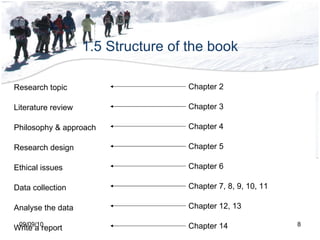
1.5 Structure of the book 09/09/10 Chapter 2 Chapter 3 Chapter 4 Chapter 5 Chapter 6 Chapter 7, 8, 9, 10, 11 Research topic Literature review Philosophy & approach Research design Ethical issues Data collection Analyse the data Write a report Chapter 12, 13 Chapter 14
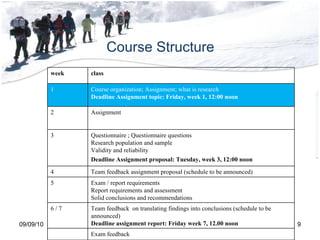
Course Structure 09/09/10 week class 1 Course organization; Assignment; what is research Deadline Assignment topic: Friday, week 1, 12:00 noon 2 Assignment 3 Questionnaire ; Questionnaire questions Research population and sample Validity and reliability Deadline Assignment proposal: Tuesday, week 3, 12:00 noon   4 Team feedback assignment proposal (schedule to be announced) 5 Exam / report requirements Report requirements and assessment Solid conclusions and recommendations 6 / 7 Team feedback  on translating findings into conclusions (schedule to be announced) Deadline assignment report: Friday week 7, 12.00 noon Exam feedback
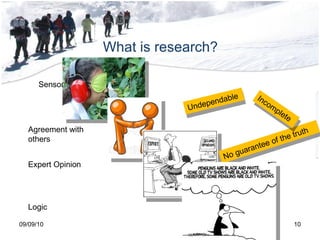
What is research? 09/09/10 No guarantee of the truth Incomplete  Undependable  Sensory  Agreement with others Expert Opinion Logic
What is research?
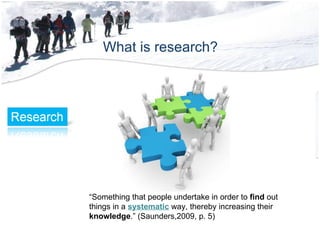
What is research? “ Something that people undertake in order to  find  out things in a  systematic  way, thereby increasing their  knowledge .” (Saunders,2009, p. 5)
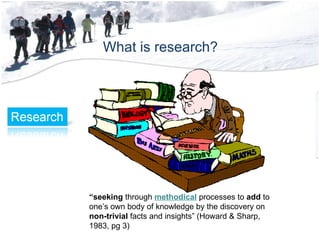
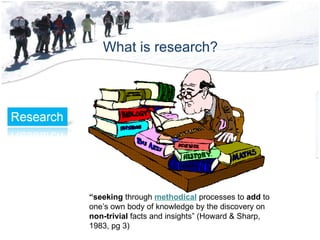
What is research? “ seeking  through  methodical  processes to  add  to one’s own body of knowledge by the discovery on  non-trivial  facts and insights” (Howard & Sharp, 1983, pg 3)
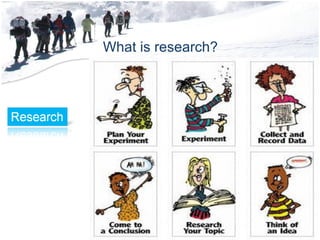
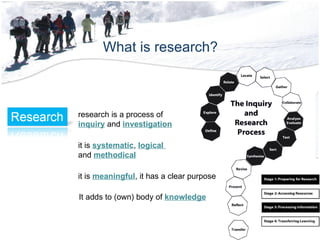
What is research? research is a process of  inquiry  and  investigation it is  systematic ,  logical  and  methodical it is  meaningful , it has a clear purpose  It adds to (own) body of  knowledge
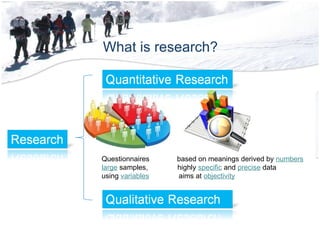
What is research? Questionnaires  based on meanings derived by  numbers large  samples,  highly  specific  and  precise  data using  variables   aims at  objectivity
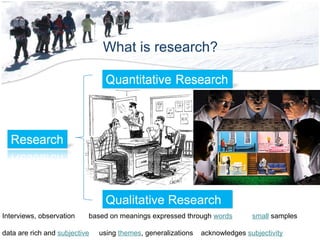
What is research? Qualitative Research Interviews, observation  based on meanings expressed through  words   small  samples data are rich and  subjective   using  themes , generalizations  acknowledges  subjectivity
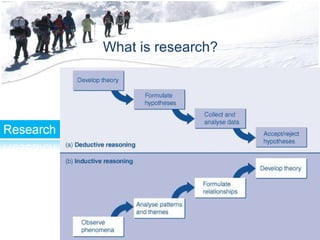
What is research?
What is research 09/09/10
What is research 09/09/10 topics for research: lifestyle behavior impulse buying fashion consciousness personal appearance health consciousness  brand consciousness money management / spending patterns life satisfaction financial satisfaction and optimism environmental consciousness opinion leadership
Summary Why research? Provide information for solving problems, guiding business decisions Good research? Purposeful,  with clearly defined focus With plausible goals With ethical and repeatable procedures With objective evidence With complete and honest report 09/09/10
Summary 09/09/10 Topic week 2: Assignment: research objectives, theoretical framework Prepare for next week Study ‘team assignment business research methods’ (BB) Study Saunders (ch 2.4, 3, 10.4, 10.5) Email (before Friday 12 hours noon): full names (first + last names), student numbers and class; contact person; Research topic / population + indication of direction; Description and role of expert
Discussion Questions A research study was carried out to see whether people notice web addresses on television adverts. This is an example of: Pure research Applied research Neither Both  09/09/10 A research study was carried out to see how many people bought a product using the freephone number and how many using a paid-for phone call. This is an example of:  Pure research Applied research Neither Both
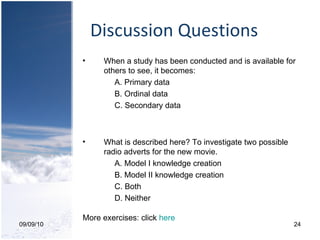
Discussion Questions 09/09/10 When a study has been conducted and is available for others to see, it becomes:  A. Primary data B. Ordinal data C. Secondary data What is described here? To investigate two possible radio adverts for the new movie. A. Model I knowledge creation B. Model II knowledge creation C. Both D. Neither More exercises: click  here

Chapter1 What is research

  • 1.
    Business Research MethodsDr. Ning DING Sept 10, 2010
  • 2.
    Overview 09/09/10 CourseStructure Schedule What is research?
  • 3.
    Course Structure 09/09/10Lecturer STATISTICS: BRM: Jan Roelf Scholtens (SCJR) Room: I007 Lecturer METHODS : Ning Ding (DINI); Room: I007 Blackboard BUSINESS RESEARCH METHODS BRM1
  • 4.
    Course Structure 09/09/103++ hours per week 1 hour with lecturer (MAAC) Research fundamentals Assignment: applying research methods Statistics: 2 hours with lecturer (SCJR) statistics SPSS ++ hours on assignments
  • 5.
    Course Structure 09/09/10Written exam IBVH4BRM1A two sections A and B A: research methods and qualitative aspects: Saunders 5 th Ed., chapters 1, 2, 3, 4.3 (sub chapter ‘research approaches’), 5, 7, 10, 11 B: the quantitative part 2 ECTS Group assignment IBVH4BRM1C research project 3 ECTS
  • 6.
    Course Structure 09/09/10Assignment week 1 Form a team Identify a research topic, indicate direction , expert Email (before Friday 12 hours): full names (first + last names), student numbers and class; Name contact person; Research topic , research population + general direction ; Description and role of expert Further info on BB (Business research methods BRM1): ‘Team Assignment Business research Methods’ (Group Project button)
  • 7.
    Course Structure 09/09/10Group formation group size: minimum 4 - maximum 5 team members cultural diversity ; international Preferably from same class
  • 8.
    1.5 Structure ofthe book 09/09/10 Chapter 2 Chapter 3 Chapter 4 Chapter 5 Chapter 6 Chapter 7, 8, 9, 10, 11 Research topic Literature review Philosophy & approach Research design Ethical issues Data collection Analyse the data Write a report Chapter 12, 13 Chapter 14
  • 9.
    Course Structure 09/09/10week class 1 Course organization; Assignment; what is research Deadline Assignment topic: Friday, week 1, 12:00 noon 2 Assignment 3 Questionnaire ; Questionnaire questions Research population and sample Validity and reliability Deadline Assignment proposal: Tuesday, week 3, 12:00 noon 4 Team feedback assignment proposal (schedule to be announced) 5 Exam / report requirements Report requirements and assessment Solid conclusions and recommendations 6 / 7 Team feedback on translating findings into conclusions (schedule to be announced) Deadline assignment report: Friday week 7, 12.00 noon Exam feedback
  • 10.
    What is research?09/09/10 No guarantee of the truth Incomplete Undependable Sensory Agreement with others Expert Opinion Logic
  • 11.
  • 12.
    What is research?“ Something that people undertake in order to find out things in a systematic way, thereby increasing their knowledge .” (Saunders,2009, p. 5)
  • 13.
    What is research?“ seeking through methodical processes to add to one’s own body of knowledge by the discovery on non-trivial facts and insights” (Howard & Sharp, 1983, pg 3)
  • 14.
    What is research?“ seeking through methodical processes to add to one’s own body of knowledge by the discovery on non-trivial facts and insights” (Howard & Sharp, 1983, pg 3)
  • 15.
    What is research?research is a process of inquiry and investigation it is systematic , logical and methodical it is meaningful , it has a clear purpose It adds to (own) body of knowledge
  • 16.
    What is research?Questionnaires based on meanings derived by numbers large samples, highly specific and precise data using variables aims at objectivity
  • 17.
    What is research?Qualitative Research Interviews, observation based on meanings expressed through words small samples data are rich and subjective using themes , generalizations acknowledges subjectivity
  • 18.
  • 19.
  • 20.
    What is research09/09/10 topics for research: lifestyle behavior impulse buying fashion consciousness personal appearance health consciousness brand consciousness money management / spending patterns life satisfaction financial satisfaction and optimism environmental consciousness opinion leadership
  • 21.
    Summary Why research?Provide information for solving problems, guiding business decisions Good research? Purposeful, with clearly defined focus With plausible goals With ethical and repeatable procedures With objective evidence With complete and honest report 09/09/10
  • 22.
    Summary 09/09/10 Topicweek 2: Assignment: research objectives, theoretical framework Prepare for next week Study ‘team assignment business research methods’ (BB) Study Saunders (ch 2.4, 3, 10.4, 10.5) Email (before Friday 12 hours noon): full names (first + last names), student numbers and class; contact person; Research topic / population + indication of direction; Description and role of expert
  • 23.
    Discussion Questions Aresearch study was carried out to see whether people notice web addresses on television adverts. This is an example of: Pure research Applied research Neither Both 09/09/10 A research study was carried out to see how many people bought a product using the freephone number and how many using a paid-for phone call. This is an example of: Pure research Applied research Neither Both
  • 24.
    Discussion Questions 09/09/10When a study has been conducted and is available for others to see, it becomes: A. Primary data B. Ordinal data C. Secondary data What is described here? To investigate two possible radio adverts for the new movie. A. Model I knowledge creation B. Model II knowledge creation C. Both D. Neither More exercises: click here

Editor's Notes

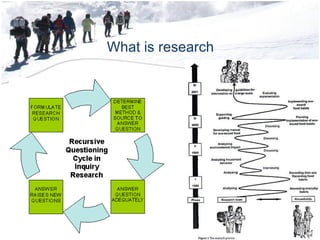
  • #20 The explorative and longitudinal project, Foods and the Environment : A Household Ecological Approach, was started in 1998 to study food management in households related to environmental impact. The project's approach is action and participatory research. Figure 1 describes four evolving phases. The overall aim of the first phase was to describe management processes covering the whole chain of events from shopping, transporting, preparing, serving, cleaning up, and waste handling. In the second phase the environmental impact of the households’ food habits was analysed. The analysis was made in terms of life cycle energy inputs for food consumed. In the third phase feedback was given to the households about the life cycle energy inputs related to food habits. Moreover, a manual for low energy foods habits was developed as a guideline for the households. Based on this information, the households planned and implemented food habits demanding less energy. The effect of the participation in this experiment was evaluated in phase four.
  • #21 The explorative and longitudinal project, Foods and the Environment : A Household Ecological Approach, was started in 1998 to study food management in households related to environmental impact. The project's approach is action and participatory research. Figure 1 describes four evolving phases. The overall aim of the first phase was to describe management processes covering the whole chain of events from shopping, transporting, preparing, serving, cleaning up, and waste handling. In the second phase the environmental impact of the households’ food habits was analysed. The analysis was made in terms of life cycle energy inputs for food consumed. In the third phase feedback was given to the households about the life cycle energy inputs related to food habits. Moreover, a manual for low energy foods habits was developed as a guideline for the households. Based on this information, the households planned and implemented food habits demanding less energy. The effect of the participation in this experiment was evaluated in phase four.