Defination [1].Research is define as systematic and scientific process
to answer the question about fact and relationship .
[2]. Meaning of Research Research is defined as the scientific
investigation of phenomena which includes collection, presentation,
analysis and interpretation of facts that lines an individual’s
speculation with reality.

Nursing research
Nursing research develops knowledge to:
Build the scientific foundation for clinical practice
Prevent disease and disability
Manage and eliminate symptom caused by illness
Enhance end-of-life and palliative care

Need of nursing research
Development a good standered of nursing care
Developed a scientific knowledge
Provide evidance based nursing care
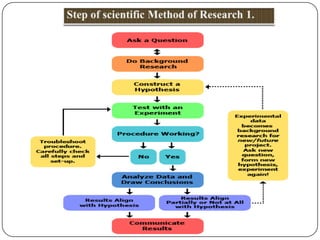
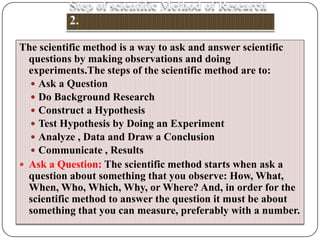
The scientific method is a way to ask and answer scientific
questions by making observations and doing
experiments.The steps of the scientific method are to:
 Ask a Question
 Do Background Research
 Construct a Hypothesis
 Test Hypothesis by Doing an Experiment
 Analyze , Data and Draw a Conclusion
 Communicate , Results
 Ask a Question: The scientific method starts when ask a
question about something that you observe: How, What,
When, Who, Which, Why, or Where? And, in order for the
scientific method to answer the question it must be about
something that you can measure, preferably with a number.
Do Background Research: Rather than starting from scratch
in putting together a plan for answering question,want to
be a sarvy scientist using library and Internet research to
help find the best way to do things and insure that don't
repeat mistakes from the past.
Construct a Hypothesis: A hypothesis is an educated guess
about how things work:
"If _____[I do this] _____, then _____[this]_____ will
happen." must state hypothesis in a way that can easily
measure, and of course, hypothesis should be constructed in
a way to help answer , original question.
Test Hypothesis by Doing an Experiment: experiment tests
whether hypothesis is supported or not. It is important for
experiment to be a fair test.conduct a fair test by making
sure that change only one factor at a time while keeping all
other conditions the same.repeat experiments several times
to make sure that the first results weren't just an accident.
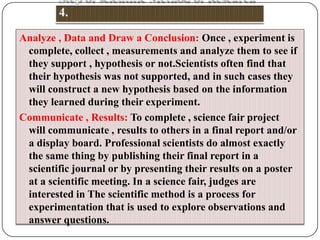
Analyze , Data and Draw a Conclusion: Once , experiment is
complete, collect , measurements and analyze them to see if
they support , hypothesis or not.Scientists often find that
their hypothesis was not supported, and in such cases they
will construct a new hypothesis based on the information
they learned during their experiment.
Communicate , Results: To complete , science fair project
will communicate , results to others in a final report and/or
a display board. Professional scientists do almost exactly
the same thing by publishing their final report in a
scientific journal or by presenting their results on a poster
at a scientific meeting. In a science fair, judges are
interested in The scientific method is a process for
experimentation that is used to explore observations and
answer questions.
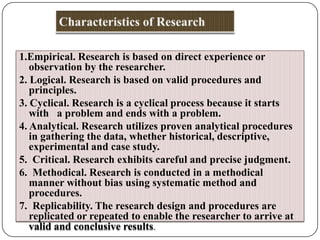
1.Empirical. Research is based on direct experience or
observation by the researcher.
2. Logical. Research is based on valid procedures and
principles.
3. Cyclical. Research is a cyclical process because it starts
with a problem and ends with a problem.
4. Analytical. Research utilizes proven analytical procedures
in gathering the data, whether historical, descriptive,
experimental and case study.
5. Critical. Research exhibits careful and precise judgment.
6. Methodical. Research is conducted in a methodical
manner without bias using systematic method and
procedures.
7. Replicability. The research design and procedures are
replicated or repeated to enable the researcher to arrive at
valid and conclusive results.
1.
2.
3.
4.
5.
6.
7.
8.
9.
10.

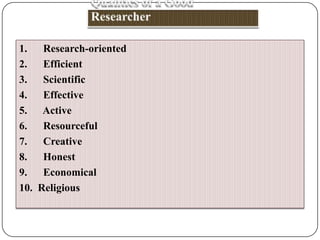
Research-oriented
Efficient
Scientific
Effective
Active
Resourceful
Creative
Honest
Economical
Religious
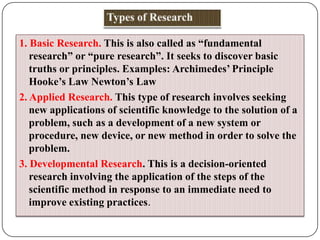
1. Basic Research. This is also called as “fundamental
research” or “pure research”. It seeks to discover basic
truths or principles. Examples: Archimedes’ Principle
Hooke’s Law Newton’s Law
2. Applied Research. This type of research involves seeking
new applications of scientific knowledge to the solution of a
problem, such as a development of a new system or
procedure, new device, or new method in order to solve the
problem.
3. Developmental Research. This is a decision-oriented
research involving the application of the steps of the
scientific method in response to an immediate need to
improve existing practices.
1.
2.
3.
4.
5.
6.
7.
8.
9.
10.

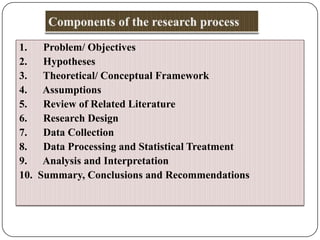
Problem/ Objectives
Hypotheses
Theoretical/ Conceptual Framework
Assumptions
Review of Related Literature
Research Design
Data Collection
Data Processing and Statistical Treatment
Analysis and Interpretation
Summary, Conclusions and Recommendations
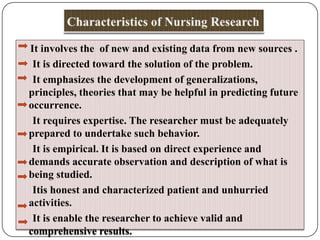
It involves the of new and existing data from new sources .
It is directed toward the solution of the problem.
It emphasizes the development of generalizations,
principles, theories that may be helpful in predicting future
occurrence.
It requires expertise. The researcher must be adequately
prepared to undertake such behavior.
It is empirical. It is based on direct experience and
demands accurate observation and description of what is
being studied.
Itis honest and characterized patient and unhurried
activities.
It is enable the researcher to achieve valid and
comprehensive results.
The Research Problem and objectives
The Research Problem .5 factors to consider to determine that a problem
is researchable or not.
1. The problem existing in the locality or country but no known solution to
the problem.
2. The solution can be answered by using statistical methods and
techniques.
3. There are probable solutions but they are not yet tested.
4. The occurrence of phenomena requires scientific investigation to arrive
at precise solution.
5. Serious needs/problems of the people where it demands research.

Research objectives
Research objectives are a specification of the ultimate reason for carrying
out research in the first place. They help in developing a specific list of
information needs. Only when the researcher knows the problem that
management wants to solve can the research project be designed to
Specific. The problem should be specificallytested
Measurable. It is easy to measure by using research instruments,
apparatus or
equipment.
Achievable. The data are achievable using correct statistical tools to arrive
at
precise results.
Realistic. Real results are attained because they are gathered scientifically
and
not manipulated or maneuvered.
Time-bound. Time frame is required in every activity because the shorter
completion of the activity, the better.
Sources of Research Problem
1. Specialization of the researcher.
2. Current and past researches.
Identification of research problem is the first step in a scientific method
for
conducting a research. To initiate a research, there should be preoccurred
ideas that generated the necessity for the research to be carried out. The
ideas are developed while going though literatures, discourses with
experts
and continuation of activities related to the subject matter. These ideas
develop into some specific topics that will be interesting or rewarding if
investigated. These topics generally called problems.
Some guidelines for selecting problems: The problem should be such in
which the researcher may be deeply interested.
The problem should be related with the chain of thinking. Stray
problems can mislead the whole research project.
The problem selected should not necessarily be new one. It may be old
problem or one on which work has already been done i.e., verification
of old problem may be equally useful.

Research notes B.sc nursing 4rth year +919887888167

  • 1.
    Defination [1].Research isdefine as systematic and scientific process to answer the question about fact and relationship . [2]. Meaning of Research Research is defined as the scientific investigation of phenomena which includes collection, presentation, analysis and interpretation of facts that lines an individual’s speculation with reality. Nursing research Nursing research develops knowledge to: Build the scientific foundation for clinical practice Prevent disease and disability Manage and eliminate symptom caused by illness Enhance end-of-life and palliative care Need of nursing research Development a good standered of nursing care Developed a scientific knowledge Provide evidance based nursing care
  • 3.
    The scientific methodis a way to ask and answer scientific questions by making observations and doing experiments.The steps of the scientific method are to:  Ask a Question  Do Background Research  Construct a Hypothesis  Test Hypothesis by Doing an Experiment  Analyze , Data and Draw a Conclusion  Communicate , Results  Ask a Question: The scientific method starts when ask a question about something that you observe: How, What, When, Who, Which, Why, or Where? And, in order for the scientific method to answer the question it must be about something that you can measure, preferably with a number.
  • 4.
    Do Background Research:Rather than starting from scratch in putting together a plan for answering question,want to be a sarvy scientist using library and Internet research to help find the best way to do things and insure that don't repeat mistakes from the past. Construct a Hypothesis: A hypothesis is an educated guess about how things work: "If _____[I do this] _____, then _____[this]_____ will happen." must state hypothesis in a way that can easily measure, and of course, hypothesis should be constructed in a way to help answer , original question. Test Hypothesis by Doing an Experiment: experiment tests whether hypothesis is supported or not. It is important for experiment to be a fair test.conduct a fair test by making sure that change only one factor at a time while keeping all other conditions the same.repeat experiments several times to make sure that the first results weren't just an accident.
  • 5.
    Analyze , Dataand Draw a Conclusion: Once , experiment is complete, collect , measurements and analyze them to see if they support , hypothesis or not.Scientists often find that their hypothesis was not supported, and in such cases they will construct a new hypothesis based on the information they learned during their experiment. Communicate , Results: To complete , science fair project will communicate , results to others in a final report and/or a display board. Professional scientists do almost exactly the same thing by publishing their final report in a scientific journal or by presenting their results on a poster at a scientific meeting. In a science fair, judges are interested in The scientific method is a process for experimentation that is used to explore observations and answer questions.
  • 6.
    1.Empirical. Research isbased on direct experience or observation by the researcher. 2. Logical. Research is based on valid procedures and principles. 3. Cyclical. Research is a cyclical process because it starts with a problem and ends with a problem. 4. Analytical. Research utilizes proven analytical procedures in gathering the data, whether historical, descriptive, experimental and case study. 5. Critical. Research exhibits careful and precise judgment. 6. Methodical. Research is conducted in a methodical manner without bias using systematic method and procedures. 7. Replicability. The research design and procedures are replicated or repeated to enable the researcher to arrive at valid and conclusive results.
  • 7.
  • 8.
    1. Basic Research.This is also called as “fundamental research” or “pure research”. It seeks to discover basic truths or principles. Examples: Archimedes’ Principle Hooke’s Law Newton’s Law 2. Applied Research. This type of research involves seeking new applications of scientific knowledge to the solution of a problem, such as a development of a new system or procedure, new device, or new method in order to solve the problem. 3. Developmental Research. This is a decision-oriented research involving the application of the steps of the scientific method in response to an immediate need to improve existing practices.
  • 9.
    1. 2. 3. 4. 5. 6. 7. 8. 9. 10. Problem/ Objectives Hypotheses Theoretical/ ConceptualFramework Assumptions Review of Related Literature Research Design Data Collection Data Processing and Statistical Treatment Analysis and Interpretation Summary, Conclusions and Recommendations
  • 10.
    It involves theof new and existing data from new sources . It is directed toward the solution of the problem. It emphasizes the development of generalizations, principles, theories that may be helpful in predicting future occurrence. It requires expertise. The researcher must be adequately prepared to undertake such behavior. It is empirical. It is based on direct experience and demands accurate observation and description of what is being studied. Itis honest and characterized patient and unhurried activities. It is enable the researcher to achieve valid and comprehensive results.
  • 11.
    The Research Problemand objectives The Research Problem .5 factors to consider to determine that a problem is researchable or not. 1. The problem existing in the locality or country but no known solution to the problem. 2. The solution can be answered by using statistical methods and techniques. 3. There are probable solutions but they are not yet tested. 4. The occurrence of phenomena requires scientific investigation to arrive at precise solution. 5. Serious needs/problems of the people where it demands research. Research objectives Research objectives are a specification of the ultimate reason for carrying out research in the first place. They help in developing a specific list of information needs. Only when the researcher knows the problem that management wants to solve can the research project be designed to
  • 12.
    Specific. The problemshould be specificallytested Measurable. It is easy to measure by using research instruments, apparatus or equipment. Achievable. The data are achievable using correct statistical tools to arrive at precise results. Realistic. Real results are attained because they are gathered scientifically and not manipulated or maneuvered. Time-bound. Time frame is required in every activity because the shorter completion of the activity, the better. Sources of Research Problem 1. Specialization of the researcher. 2. Current and past researches.
  • 13.
    Identification of researchproblem is the first step in a scientific method for conducting a research. To initiate a research, there should be preoccurred ideas that generated the necessity for the research to be carried out. The ideas are developed while going though literatures, discourses with experts and continuation of activities related to the subject matter. These ideas develop into some specific topics that will be interesting or rewarding if investigated. These topics generally called problems. Some guidelines for selecting problems: The problem should be such in which the researcher may be deeply interested. The problem should be related with the chain of thinking. Stray problems can mislead the whole research project. The problem selected should not necessarily be new one. It may be old problem or one on which work has already been done i.e., verification of old problem may be equally useful.