Business Ethics
 Definition
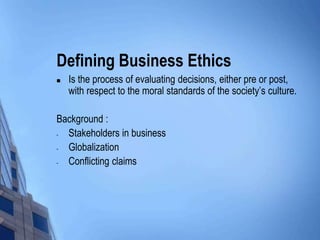
Defining Business Ethics
   Is the process of evaluating decisions, either pre or post,
    with respect to the moral standards of the society’s culture.

Background :
- Stakeholders in business
- Globalization
- Conflicting claims
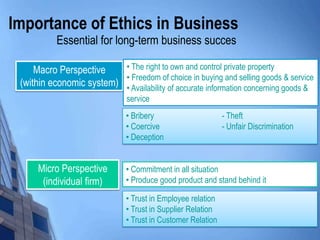
Importance of Ethics in Business
           Essential for long-term business succes

     Macro Perspective    • The right to own and control private property
                          • Freedom of choice in buying and selling goods & service
 (within economic system) • Availability of accurate information concerning goods &
                              service
                              • Bribery                      - Theft
                              • Coercive                     - Unfair Discrimination
                              • Deception


     Micro Perspective        • Commitment in all situation
      (individual firm)       • Produce good product and stand behind it

                              • Trust in Employee relation
                              • Trust in Supplier Relation
                              • Trust in Customer Relation
Moral Standards
     Business ethics use moral standards when
      making business decisions; not the determination
      of standards.
     Applied ethics not a normative ethics
     Moral standards consist of moral norms & moral
      principles.
     Moral norms prohibit certain types of behavior
      such as lying, stealing, and killing.
     Moral principles provide more general guidelines
      for behavior
Moral Principles of Business Ethics
                                                                           Non-
              Consequentialist                                        Consequentialist
                                                                       (deontologism)
           Focus on outcome or end result                                   Based on rules


     Egoism                    Utilitarianism                     Right                      Justice

                                                        Human right                     1. Distributive
Standard that focuses        Greater net utility than   Not to violate other’s right    2. Retributive
on self-interests            other decision             1. Life & Safety                (punishment for
Short term & long term       alternatives.              2. Truthfulness                     wrongdoing)
Can benefit or harm          Single act                 3. Privacy                      3. Compensatory
the society                  Series of act              4. Freedom of Conscience        (compensating the
                                                        5. Free Speech                      party injured by
                                                        6. Private property                 the wrongful
                                                                                            act)
Question from the ethical theories
   Egoism: will the action lead to other people behaving toward
    me in a way I would like?
   Utilitarianism: does the action yield the greatest net benefits?
   Rights: does the action negatively affect someone’s moral
    rights?
   Justice: does the action give a fair distribution of costs and
    benefits among those affected?
Ethical Check Questions
   Is it legal ?
    Will I be violating either civil law or company policy?
   Is it balanced ?
    Is it fair to all concerned in the short term as well as the
    long term? Does it promote win-win relationship?
   How it will make me feel about myself?
    Will it make me proud? Would I feel good if my decision
    was published in the newspaper? Would I feel good if my
    family knew about it?

Business ethics definition

  • 1.
  • 2.
    Defining Business Ethics  Is the process of evaluating decisions, either pre or post, with respect to the moral standards of the society’s culture. Background : - Stakeholders in business - Globalization - Conflicting claims
  • 3.
    Importance of Ethicsin Business Essential for long-term business succes Macro Perspective • The right to own and control private property • Freedom of choice in buying and selling goods & service (within economic system) • Availability of accurate information concerning goods & service • Bribery - Theft • Coercive - Unfair Discrimination • Deception Micro Perspective • Commitment in all situation (individual firm) • Produce good product and stand behind it • Trust in Employee relation • Trust in Supplier Relation • Trust in Customer Relation
  • 4.
    Moral Standards  Business ethics use moral standards when making business decisions; not the determination of standards.  Applied ethics not a normative ethics  Moral standards consist of moral norms & moral principles.  Moral norms prohibit certain types of behavior such as lying, stealing, and killing.  Moral principles provide more general guidelines for behavior
  • 5.
    Moral Principles ofBusiness Ethics Non- Consequentialist Consequentialist (deontologism) Focus on outcome or end result Based on rules Egoism Utilitarianism Right Justice Human right 1. Distributive Standard that focuses Greater net utility than Not to violate other’s right 2. Retributive on self-interests other decision 1. Life & Safety (punishment for Short term & long term alternatives. 2. Truthfulness wrongdoing) Can benefit or harm Single act 3. Privacy 3. Compensatory the society Series of act 4. Freedom of Conscience (compensating the 5. Free Speech party injured by 6. Private property the wrongful act)
  • 6.
    Question from theethical theories  Egoism: will the action lead to other people behaving toward me in a way I would like?  Utilitarianism: does the action yield the greatest net benefits?  Rights: does the action negatively affect someone’s moral rights?  Justice: does the action give a fair distribution of costs and benefits among those affected?
  • 7.
    Ethical Check Questions  Is it legal ? Will I be violating either civil law or company policy?  Is it balanced ? Is it fair to all concerned in the short term as well as the long term? Does it promote win-win relationship?  How it will make me feel about myself? Will it make me proud? Would I feel good if my decision was published in the newspaper? Would I feel good if my family knew about it?