The newest revolution would break down national barriers,
expose the most closeted societies to notions from others,
and create opportunities for trade, travel, and ideas.
M anagement thought is both a process in and a product
of its changing environment
Lenny M artini - 29006014

Part IV The M odern Era- Ch. 22

Introduction

this chapter examines the evolving expectations and obligations concerning
business ethics and the relationship between business and society
also examines opportunities in the global marketplace and how
competing cross-culturally has influenced business decisions

obligations to behave in a legally, ethically, and socially responsible manner
and opportunities to c ompete globally across different cultures

the moral oughts that sustain a civilized soc iety

Ethics, codes of moral conduct, have long been of conc ern in history, but people still
struggle to make the right decisions as individuals and this struggle is confounded as
they come under the influence of others in organizations
Social responsibility, the moral conduct of business in its environment, has
also undergone changes over time

business transaction embedded in trust and confidence
search for guidelines to moral conduct beyond the
question of legal boundaries
Summary

Joseph Wharton

The world is now a closer community because of advancements in transportation and communication
Global markets bring new opportunities, yet jingoism threatens the prospects of more open markets

Robert W. Johnson
trade among nations has been initiated and carried out as a political strategy
free trade provided the best of all possible worlds because all nations
would concentrate on what they could best produce

Ethics

David Ricardo

a market exchange system needed to allowed each nation to find its
comparative advantage among other trading nations

transportation and communication revolutions pushed back the
frontier for trade, enabling the loc al markets of yesteryears to
become the electronic commerce and global markets of today

cheaper labor, better way to produce, lower costs

align the interests of management with others as well
as serving as a guide to moral conduct

John Stad

believed that business schools had a responsibility to teach ethics to the
future business owners
Sherman Anti-Trust Act
Clayton Anti-Trust Act (1914)

Legislation

The globalization of business

Securities Act (1933)
Securities Exchange Act (1934)

the new-global competition is an extension of the past

Sarbanes-Oxley Act (2002)

outsourcing jobs

social responsibility addresses the expectations that
soc iety has about a business firm

free trade vs protectionism
opening product and factor markets or protecting indigenous special interest groups

business must meet the needs and desires of human
beings, whether they work for it, purchase its products,
or live in the same community

separation of owners and manages led to more ethical dilemmas as
principal and agents interests come into conflict

the notion of multinational enterprise has undergone an evolution
with changing technologies and market opportunities
growth of international finance and securities market

set a high moral and ethical standards of curriculum of business schools
need for service capitalism by rendering good service in
return for its right to operate

Although people may have gained knowledge of those of other nations, it is
often without a greater understanding of them

problems

obligations of business firms appear to be more variable and changing
as a soc ial values and legal obligations change

answered by national policy

merchant provided the means for artists, sculptors, and writers in Renaissance

NAFTA
the European Union

person in business preserve the cultural heritage

trade alliances

business leaders provided a view of the obligations of firms
Andrew Carnegie believed that the acquisition of wealth imposed a duty

APEC

19th century court placed management as trustee of the shareholders
and could do nothing with corporate assets

as firms become more global in their outlook and operations, they
find themselves working with diverse cultures
a set of beliefs held in common by group of people about economic,
social, and political form of behavior

legal notions of business obligations

term of culture

management theories face their serious challenge as cross-cultural studies are made
found a clustering of values that had an impact on leader-follower relations
traditionalism vs modernity

Donna Wood
Bernard Bass

Obligations and
Opportunities

collectivism vs individualism
determine which leadership attributes and behaviors are endorsed
widely and which appear to be culturally contingent

Howard Bowen

project GLOBE

social responsibility

the obligations of businessmen to pursue those policies, to make those
decisions, or to follow those lines of action which are desirable in
terms of the objectives and values of our soc iety
synonymous with public responsibility, social obligations, business morality

if you mess it up, you c lean it up

Individuals & Organizations : Relating to Evolving Expectations

organizational behavior

since business influenced society, it had to accept the social
obligations that followed

studies of cross culture management
M anagement Opportunities in a
Global Arena

strategic management
business-government relations

social responsibility served the long-run interest of business
social responsibility improved the public
image of business

how much do cultures vary?
how does this variance influence management practices ?
is this variance converging, diverging, or stable when a country
become more industrialized ?

enduring questions

with social responsibility, government
regulation could be avoided

Keith Davis

power distance

business had the resources and expertise
to apply to social problems

Business and Society

individualism versus collectivism
characterized cultural differences in these dimensions

masculinity versus femininity

increased its legitimacy in society

argument in favor of soc ial responsibility

are management theories culture bound ?
the degree of inequality among individuals considered by that culture as normal

5% clause, permitted corporations to deduct up from net income for
contributions to society

business alone could not solve the problems of economic life

human resource management
information and technology transfer

revision of the Federal Revenue Act (1935)

business leaders were proactive, desirous of laws to protect themselves
as well as consumers

that as a trustee of the stockholders, management
should optimize their return

M anaging across cultures
Geert Hofstede

argument against social responsibility

uncertainty avoidance

social involvement was costly and diluted the primary
economic purpose of the firm
business should not be given responsibilities for which it was
neither equipped to perform nor could be held accountable

and long-term versus short-term orientation

On balance, Davis favored social involvement on the part of business, but acknowledged Bowen's caveat that certain things
should not be expected of business but should be left to others who were better able to carry out those responsibilities

Ethics, corporate soc ial responsibility, and laws further complicate the issue of competing across national borders
a continuum from "cultural relativism" (do whatever local customs, traditions, and
ethics permit) to "ethical imperialism" (one set of standards everywhere)
good business and good ethics go hand in hand but different
nations and regions faced particular types of problems
misuse of power for private benefits

Donaldson

(a) "economic" objectives aimed at optimizing the efficiency of its total resource conversion process
Igor Ansoff

the social objectives exert a modifying and con straining influence on management behavior

making more companies accountable
Peter Drucker

Firms must ask if their core competencies/strengths are appropriate to
the opportunities in a particular market
wiil foreign investment be welcomed
does the political system provide safeguards for employees and
intellectual and physical property

Choosing to enter the global market
involves more than an understanding of
cultural and ethical issues

will competing abroad serve the long-run best interests of our stakeholders?

management must put economic considerations first and could justify its existence
only through the economic results it produced
there could be noneconomic consequences of managerial decisions, such as improved community well-being, but that
these were by-products made possible only by an emphasis on economic performance
describing four categories of
responsibilities

economic
legal
ethical
discretionary/ philanthropic

is the economic system conducive to private market-driven enterprise
is the rivalry in the intended market currently too formidable

(b) "social" or noneconomic objectives
In most firms the economic objectives exert the primary influence on the firm's behavior and form the
main body of explicit goals used by management for guidance and control of the firm

global management issues

greater corporate responsiveness to stakeholders

can a transfer of technology benefit all

those groups without whose support the organization would cease to exist
distinguished between "objectives" and "responsibilities

corruption

the need for integrity in business and political leadership

stakeholders

Enderle

Archie Carroll

Economic responsibilities were primary
Legal responsibilities were those regulations and rules created by political
institutions to legitimize and govern business activities
Ethical responsibilities were expectations of how a firm should conduct its
business beyond what the law required
Philanthropic responsibilities were voluntary choices

Unanswered is the question about who defines what is ethical or socially responsible behavior

22- Obligations and Opportunities - Lenny 29006014.mmap - 10/12/2006 -

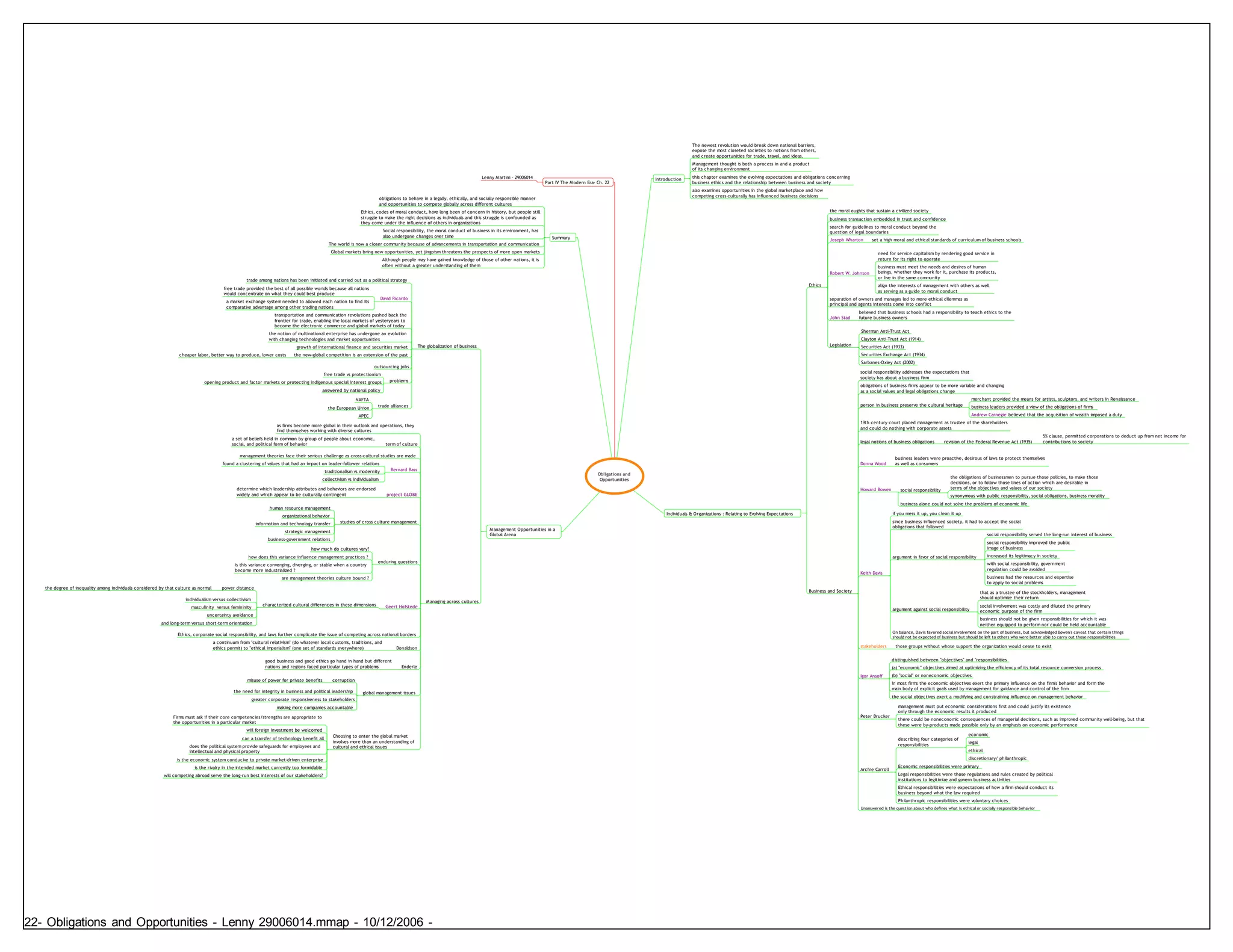
Obligations and Opportunities

  • 1.
    The newest revolutionwould break down national barriers, expose the most closeted societies to notions from others, and create opportunities for trade, travel, and ideas. M anagement thought is both a process in and a product of its changing environment Lenny M artini - 29006014 Part IV The M odern Era- Ch. 22 Introduction this chapter examines the evolving expectations and obligations concerning business ethics and the relationship between business and society also examines opportunities in the global marketplace and how competing cross-culturally has influenced business decisions obligations to behave in a legally, ethically, and socially responsible manner and opportunities to c ompete globally across different cultures the moral oughts that sustain a civilized soc iety Ethics, codes of moral conduct, have long been of conc ern in history, but people still struggle to make the right decisions as individuals and this struggle is confounded as they come under the influence of others in organizations Social responsibility, the moral conduct of business in its environment, has also undergone changes over time business transaction embedded in trust and confidence search for guidelines to moral conduct beyond the question of legal boundaries Summary Joseph Wharton The world is now a closer community because of advancements in transportation and communication Global markets bring new opportunities, yet jingoism threatens the prospects of more open markets Robert W. Johnson trade among nations has been initiated and carried out as a political strategy free trade provided the best of all possible worlds because all nations would concentrate on what they could best produce Ethics David Ricardo a market exchange system needed to allowed each nation to find its comparative advantage among other trading nations transportation and communication revolutions pushed back the frontier for trade, enabling the loc al markets of yesteryears to become the electronic commerce and global markets of today cheaper labor, better way to produce, lower costs align the interests of management with others as well as serving as a guide to moral conduct John Stad believed that business schools had a responsibility to teach ethics to the future business owners Sherman Anti-Trust Act Clayton Anti-Trust Act (1914) Legislation The globalization of business Securities Act (1933) Securities Exchange Act (1934) the new-global competition is an extension of the past Sarbanes-Oxley Act (2002) outsourcing jobs social responsibility addresses the expectations that soc iety has about a business firm free trade vs protectionism opening product and factor markets or protecting indigenous special interest groups business must meet the needs and desires of human beings, whether they work for it, purchase its products, or live in the same community separation of owners and manages led to more ethical dilemmas as principal and agents interests come into conflict the notion of multinational enterprise has undergone an evolution with changing technologies and market opportunities growth of international finance and securities market set a high moral and ethical standards of curriculum of business schools need for service capitalism by rendering good service in return for its right to operate Although people may have gained knowledge of those of other nations, it is often without a greater understanding of them problems obligations of business firms appear to be more variable and changing as a soc ial values and legal obligations change answered by national policy merchant provided the means for artists, sculptors, and writers in Renaissance NAFTA the European Union person in business preserve the cultural heritage trade alliances business leaders provided a view of the obligations of firms Andrew Carnegie believed that the acquisition of wealth imposed a duty APEC 19th century court placed management as trustee of the shareholders and could do nothing with corporate assets as firms become more global in their outlook and operations, they find themselves working with diverse cultures a set of beliefs held in common by group of people about economic, social, and political form of behavior legal notions of business obligations term of culture management theories face their serious challenge as cross-cultural studies are made found a clustering of values that had an impact on leader-follower relations traditionalism vs modernity Donna Wood Bernard Bass Obligations and Opportunities collectivism vs individualism determine which leadership attributes and behaviors are endorsed widely and which appear to be culturally contingent Howard Bowen project GLOBE social responsibility the obligations of businessmen to pursue those policies, to make those decisions, or to follow those lines of action which are desirable in terms of the objectives and values of our soc iety synonymous with public responsibility, social obligations, business morality if you mess it up, you c lean it up Individuals & Organizations : Relating to Evolving Expectations organizational behavior since business influenced society, it had to accept the social obligations that followed studies of cross culture management M anagement Opportunities in a Global Arena strategic management business-government relations social responsibility served the long-run interest of business social responsibility improved the public image of business how much do cultures vary? how does this variance influence management practices ? is this variance converging, diverging, or stable when a country become more industrialized ? enduring questions with social responsibility, government regulation could be avoided Keith Davis power distance business had the resources and expertise to apply to social problems Business and Society individualism versus collectivism characterized cultural differences in these dimensions masculinity versus femininity increased its legitimacy in society argument in favor of soc ial responsibility are management theories culture bound ? the degree of inequality among individuals considered by that culture as normal 5% clause, permitted corporations to deduct up from net income for contributions to society business alone could not solve the problems of economic life human resource management information and technology transfer revision of the Federal Revenue Act (1935) business leaders were proactive, desirous of laws to protect themselves as well as consumers that as a trustee of the stockholders, management should optimize their return M anaging across cultures Geert Hofstede argument against social responsibility uncertainty avoidance social involvement was costly and diluted the primary economic purpose of the firm business should not be given responsibilities for which it was neither equipped to perform nor could be held accountable and long-term versus short-term orientation On balance, Davis favored social involvement on the part of business, but acknowledged Bowen's caveat that certain things should not be expected of business but should be left to others who were better able to carry out those responsibilities Ethics, corporate soc ial responsibility, and laws further complicate the issue of competing across national borders a continuum from "cultural relativism" (do whatever local customs, traditions, and ethics permit) to "ethical imperialism" (one set of standards everywhere) good business and good ethics go hand in hand but different nations and regions faced particular types of problems misuse of power for private benefits Donaldson (a) "economic" objectives aimed at optimizing the efficiency of its total resource conversion process Igor Ansoff the social objectives exert a modifying and con straining influence on management behavior making more companies accountable Peter Drucker Firms must ask if their core competencies/strengths are appropriate to the opportunities in a particular market wiil foreign investment be welcomed does the political system provide safeguards for employees and intellectual and physical property Choosing to enter the global market involves more than an understanding of cultural and ethical issues will competing abroad serve the long-run best interests of our stakeholders? management must put economic considerations first and could justify its existence only through the economic results it produced there could be noneconomic consequences of managerial decisions, such as improved community well-being, but that these were by-products made possible only by an emphasis on economic performance describing four categories of responsibilities economic legal ethical discretionary/ philanthropic is the economic system conducive to private market-driven enterprise is the rivalry in the intended market currently too formidable (b) "social" or noneconomic objectives In most firms the economic objectives exert the primary influence on the firm's behavior and form the main body of explicit goals used by management for guidance and control of the firm global management issues greater corporate responsiveness to stakeholders can a transfer of technology benefit all those groups without whose support the organization would cease to exist distinguished between "objectives" and "responsibilities corruption the need for integrity in business and political leadership stakeholders Enderle Archie Carroll Economic responsibilities were primary Legal responsibilities were those regulations and rules created by political institutions to legitimize and govern business activities Ethical responsibilities were expectations of how a firm should conduct its business beyond what the law required Philanthropic responsibilities were voluntary choices Unanswered is the question about who defines what is ethical or socially responsible behavior 22- Obligations and Opportunities - Lenny 29006014.mmap - 10/12/2006 -