
TRIPLE HELIX
COLLABORATION TO
DEVELOP ECONOMIC
CORRIDORS AS KNOWLEDGE
HUB IN INDONESIA
Lenny Martini, Jann Hidajat Tjakraatmadja, Yudo Anggoro,
Adita Pritasari, and Libertha Hutapea
Center of Knowledge for Business Competitiveness, SBM, ITB
Research Purposes
 To analyze the capabilities of triple helix actor
(academician, local business and local
government)
 To propose model of collaboration to develop
Indonesia economic corridors in MP3EI
(Masterplan for Acceleration and Expansion of
Indonesia Economic Development) as
knowledge hub
Research Results
 a useful foundation conceptual model for the
future research of knowledge hub
development in a knowledge based-economy
 It can be used by each triple helix model’s
actors as a guidance to develop knowledge
hubs in each economic corridor in Indonesia.
MP3EI
 the Masterplan for Acceleration and Expansion of Indonesia
Economic Development (Masterplan Percepatan dan
Perluasan Pembangunan Ekonomi Indonesia)
 launched by the Indonesian government on May 27, 2011 to
drive high, fair, and sustainable economic growth
 to place Indonesia at the top ten advanced economies in the
world by 2025, and world’s top six by the year 2050
 6 economic corridors and 22 main economic activities
 12 main economic activities focus on natural resources to
support Indonesia’s prime industries
the world’s major producer (palm oil, cocoa, rubber, timber)
main exporter for mining materials (coal, steel, nickel, copper,
bauxite)
huge reserves for energy (oil and gas, coal, geothermal)
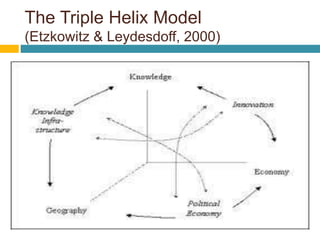
The Triple Helix Model
(Etzkowitz & Leydesdoff, 2000)
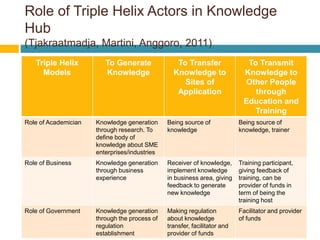
Role of Triple Helix Actors in Knowledge
Hub
(Tjakraatmadja, Martini, Anggoro, 2011)
Triple Helix
Models
To Generate
Knowledge
To Transfer
Knowledge to
Sites of
Application
To Transmit
Knowledge to
Other People
through
Education and
Training
Role of Academician Knowledge generation
through research. To
define body of
knowledge about SME
enterprises/industries
Being source of
knowledge
Being source of
knowledge, trainer
Role of Business Knowledge generation
through business
experience
Receiver of knowledge,
implement knowledge
in business area, giving
feedback to generate
new knowledge
Training participant,
giving feedback of
training, can be
provider of funds in
term of being the
training host
Role of Government Knowledge generation
through the process of
regulation
establishment
Making regulation
about knowledge
transfer, facilitator and
provider of funds
Facilitator and provider
of funds
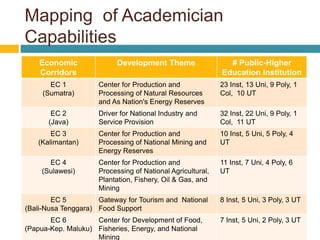
Mapping of Academician
Capabilities
Economic
Corridors
Development Theme # Public-Higher
Education Institution
EC 1
(Sumatra)
Center for Production and
Processing of Natural Resources
and As Nation's Energy Reserves
23 Inst, 13 Uni, 9 Poly, 1
Col, 10 UT
EC 2
(Java)
Driver for National Industry and
Service Provision
32 Inst, 22 Uni, 9 Poly, 1
Col, 11 UT
EC 3
(Kalimantan)
Center for Production and
Processing of National Mining and
Energy Reserves
10 Inst, 5 Uni, 5 Poly, 4
UT
EC 4
(Sulawesi)
Center for Production and
Processing of National Agricultural,
Plantation, Fishery, Oil & Gas, and
Mining
11 Inst, 7 Uni, 4 Poly, 6
UT
EC 5
(Bali-Nusa Tenggara)
Gateway for Tourism and National
Food Support
8 Inst, 5 Uni, 3 Poly, 3 UT
EC 6
(Papua-Kep. Maluku)
Center for Development of Food,
Fisheries, Energy, and National
Mining
7 Inst, 5 Uni, 2 Poly, 3 UT
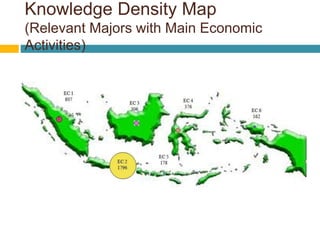
Knowledge Density Map
(Relevant Majors with Main Economic
Activities)
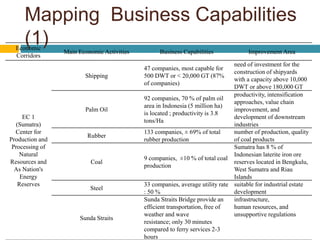
Mapping Business Capabilities
(1)Economic
Corridors
Main Economic Activities Business Capabilities Improvement Area
EC 1
(Sumatra)
Center for
Production and
Processing of
Natural
Resources and
As Nation's
Energy
Reserves
Shipping
47 companies, most capable for
500 DWT or < 20,000 GT (87%
of companies)
need of investment for the
construction of shipyards
with a capacity above 10,000
DWT or above 180,000 GT
Palm Oil
92 companies, 70 % of palm oil
area in Indonesia (5 million ha)
is located ; productivity is 3.8
tons/Ha
productivity, intensification
approaches, value chain
improvement, and
development of downstream
industries
Rubber
133 companies, ± 69% of total
rubber production
number of production, quality
of coal products
Coal
9 companies, ±10 % of total coal
production
Sumatra has 8 % of
Indonesian laterite iron ore
reserves located in Bengkulu,
West Sumatra and Riau
Islands
Steel
33 companies, average utility rate
: 50 %
suitable for industrial estate
development
Sunda Straits
Sunda Straits Bridge provide an
efficient transportation, free of
weather and wave
resistance; only 30 minutes
compared to ferry services 2-3
hours
infrastructure,
human resources, and
unsupportive regulations
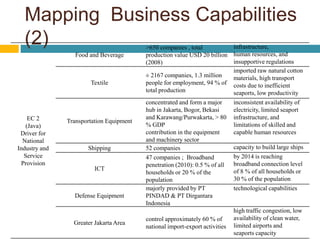
Mapping Business Capabilities
(2)
EC 2
(Java)
Driver for
National
Industry and
Service
Provision
Food and Beverage
>650 companies , total
production value USD 20 billion
(2008)
infrastructure,
human resources, and
insupportive regulations
Textile
± 2167 companies, 1.3 million
people for employment, 94 % of
total production
imported raw natural cotton
materials, high transport
costs due to inefficient
seaports, low productivity
Transportation Equipment
concentrated and form a major
hub in Jakarta, Bogor, Bekasi
and Karawang/Purwakarta, > 80
% GDP
contribution in the equipment
and machinery sector
inconsistent availability of
electricity, limited seaport
infrastructure, and
limitations of skilled and
capable human resources
Shipping 52 companies capacity to build large ships
ICT
47 companies ; Broadband
penetration (2010): 0.5 % of all
households or 20 % of the
population
by 2014 is reaching
broadband connection level
of 8 % of all households or
30 % of the population
Defense Equipment
majorly provided by PT
PINDAD & PT Dirgantara
Indonesia
technological capabilities
Greater Jakarta Area
control approximately 60 % of
national import-export activities
high traffic congestion, low
availability of clean water,
limited airports and
seaports capacity
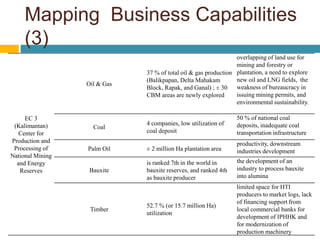
Mapping Business Capabilities
(3)
EC 3
(Kalimantan)
Center for
Production and
Processing of
National Mining
and Energy
Reserves
Oil & Gas
37 % of total oil & gas production
(Balikpapan, Delta Mahakam
Block, Rapak, and Ganal) ; ± 30
CBM areas are newly explored
overlapping of land use for
mining and forestry or
plantation, a need to explore
new oil and LNG fields, the
weakness of bureaucracy in
issuing mining permits, and
environmental sustainability.
Coal
4 companies, low utilization of
coal deposit
50 % of national coal
deposits, inadequate coal
transportation infrastructure
Palm Oil ± 2 million Ha plantation area
productivity, downstream
industries development
Bauxite
is ranked 7th in the world in
bauxite reserves, and ranked 4th
as bauxite producer
the development of an
industry to process bauxite
into alumina
Timber
52.7 % (or 15.7 million Ha)
utilization
limited space for HTI
producers to market logs, lack
of financing support from
local commercial banks for
development of IPHHK and
for modernization of
production machinery
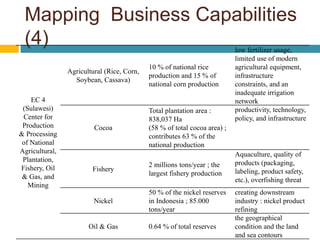
Mapping Business Capabilities
(4)
EC 4
(Sulawesi)
Center for
Production
& Processing
of National
Agricultural,
Plantation,
Fishery, Oil
& Gas, and
Mining
Agricultural (Rice, Corn,
Soybean, Cassava)
10 % of national rice
production and 15 % of
national corn production
low fertilizer usage,
limited use of modern
agricultural equipment,
infrastructure
constraints, and an
inadequate irrigation
network
Cocoa
Total plantation area :
838,037 Ha
(58 % of total cocoa area) ;
contributes 63 % of the
national production
productivity, technology,
policy, and infrastructure
Fishery
2 millions tons/year ; the
largest fishery production
Aquaculture, quality of
products (packaging,
labeling, product safety,
etc.), overfishing threat
Nickel
50 % of the nickel reserves
in Indonesia ; 85.000
tons/year
creating downstream
industry : nickel product
refining
Oil & Gas 0.64 % of total reserves
the geographical
condition and the land
and sea contours
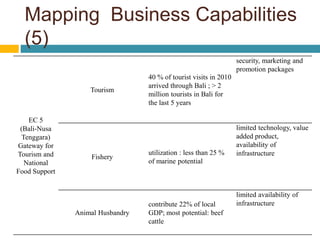
Mapping Business Capabilities
(5)
EC 5
(Bali-Nusa
Tenggara)
Gateway for
Tourism and
National
Food Support
Tourism
40 % of tourist visits in 2010
arrived through Bali ; > 2
million tourists in Bali for
the last 5 years
security, marketing and
promotion packages
Fishery
utilization : less than 25 %
of marine potential
limited technology, value
added product,
availability of
infrastructure
Animal Husbandry
contribute 22% of local
GDP; most potential: beef
cattle
limited availability of
infrastructure
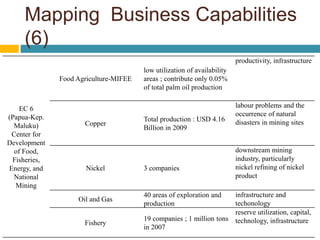
Mapping Business Capabilities
(6)
EC 6
(Papua-Kep.
Maluku)
Center for
Development
of Food,
Fisheries,
Energy, and
National
Mining
Food Agriculture-MIFEE
low utilization of availability
areas ; contribute only 0.05%
of total palm oil production
productivity, infrastructure
Copper
Total production : USD 4.16
Billion in 2009
labour problems and the
occurrence of natural
disasters in mining sites
Nickel 3 companies
downstream mining
industry, particularly
nickel refining of nickel
product
Oil and Gas
40 areas of exploration and
production
infrastructure and
techonology
Fishery
19 companies ; 1 million tons
in 2007
reserve utilization, capital,
technology, infrastructure
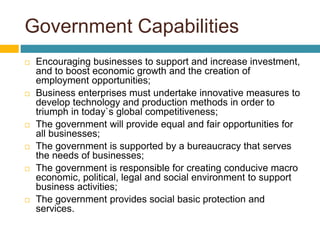
Government Capabilities
 Encouraging businesses to support and increase investment,
and to boost economic growth and the creation of
employment opportunities;
 Business enterprises must undertake innovative measures to
develop technology and production methods in order to
triumph in today`s global competitiveness;
 The government will provide equal and fair opportunities for
all businesses;
 The government is supported by a bureaucracy that serves
the needs of businesses;
 The government is responsible for creating conducive macro
economic, political, legal and social environment to support
business activities;
 The government provides social basic protection and
services.
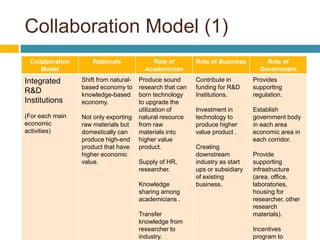
Collaboration Model (1)
Collaboration
Model
Rationale Role of
Academician
Role of Business Role of
Government
Integrated
R&D
Institutions
(For each main
economic
activities)
Shift from natural-
based economy to
knowledge-based
economy.
Not only exporting
raw materials but
domestically can
produce high-end
product that have
higher economic
value.
Produce sound
research that can
born technology
to upgrade the
utilization of
natural resource
from raw
materials into
higher value
product.
Supply of HR,
researcher.
Knowledge
sharing among
academicians .
Transfer
knowledge from
researcher to
industry.
Contribute in
funding for R&D
Institutions.
Investment in
technology to
produce higher
value product .
Creating
downstream
industry as start
ups or subsidiary
of existing
business.
Provides
supporting
regulation.
Establish
government body
in each area
economic area in
each corridor.
Provide
supporting
infrastructure
(area, office,
laboratories,
housing for
researcher, other
research
materials).
Incentives
program to
Collaboration Model (2)
Collaboration
Model
Rationale Role of
Academician
Role of Business Role of
Government
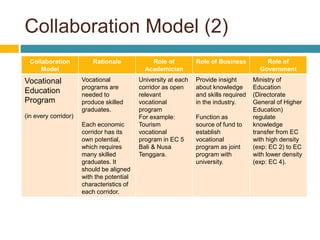
Vocational
Education
Program
(in every corridor)
Vocational
programs are
needed to
produce skilled
graduates.
Each economic
corridor has its
own potential,
which requires
many skilled
graduates. It
should be aligned
with the potential
characteristics of
each corridor.
University at each
corridor as open
relevant
vocational
program
For example:
Tourism
vocational
program in EC 5
Bali & Nusa
Tenggara.
Provide insight
about knowledge
and skills required
in the industry.
Function as
source of fund to
establish
vocational
program as joint
program with
university.
Ministry of
Education
(Directorate
General of Higher
Education)
regulate
knowledge
transfer from EC
with high density
(exp: EC 2) to EC
with lower density
(exp: EC 4).
Collaboration Model (3)
Collaboration
Model
Rationale Role of
Academician
Role of Business Role of
Government
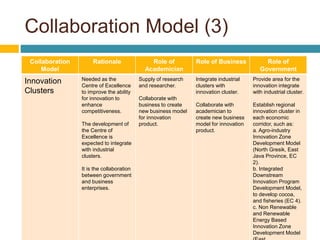
Innovation
Clusters
Needed as the
Centre of Excellence
to improve the ability
for innovation to
enhance
competitiveness.
The development of
the Centre of
Excellence is
expected to integrate
with industrial
clusters.
It is the collaboration
between government
and business
enterprises.
Supply of research
and researcher.
Collaborate with
business to create
new business model
for innovation
product.
Integrate industrial
clusters with
innovation cluster.
Collaborate with
academician to
create new business
model for innovation
product.
Provide area for the
innovation integrate
with industrial cluster.
Establish regional
innovation cluster in
each economic
corridor, such as:
a. Agro-industry
Innovation Zone
Development Model
(North Gresik, East
Java Province, EC
2).
b. Integrated
Downstream
Innovation Program
Development Model,
to develop cocoa,
and fisheries (EC 4).
c. Non Renewable
and Renewable
Energy Based
Innovation Zone
Development Model
Conclusion (1)
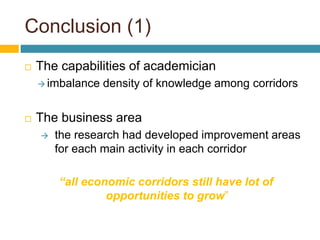
 The capabilities of academician
 imbalance density of knowledge among corridors
 The business area
 the research had developed improvement areas
for each main activity in each corridor
“all economic corridors still have lot of
opportunities to grow”
Conclusion (2)
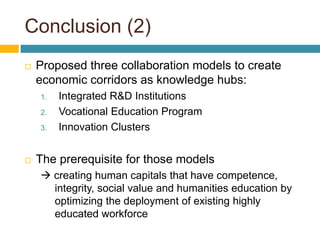
 Proposed three collaboration models to create
economic corridors as knowledge hubs:
1. Integrated R&D Institutions
2. Vocational Education Program
3. Innovation Clusters
 The prerequisite for those models
 creating human capitals that have competence,
integrity, social value and humanities education by
optimizing the deployment of existing highly
educated workforce
References
 Coordinating Ministry For Economic Affairs, Republic of Indonesia (2011). Masterplan for Acceleration and
Expansion of Indonesia Economic Development. Published by Coordinating Ministry for Economic Affairs,
Republic of Indonesia.
 World Bank Institute (2007). Building Knowledge Economies: Advanced Strategies for Development. Washington:
World Bank.
 Etzkowitz, H. and Leydesdorff, L. (2000). The dynamics of innovation: from National Systems and “Mode 2” to a
Triple Helix of university-industry-government relations”, Research Policy, 29, 109-123.
 Tjakraatmadja, J.H., Martini, L., & Pritasari A. (2011). Role of ITB in Developing Knowledge Hub in Bandung, The
International Conference on Political Economy of Trade Liberalization in Developing East Asia: Sustainability,
Governance, and the Role of Small Business, University of Brawijaya, Malang-Indonesia, November 24-25, 2011.
 Menkhoff, T., Evers, H.D., Chay, Y.W., & Pang E.F., eds (2011) Beyond the Knowledge Trap: Developing Asia's
Knowledge-Based Economies, New Jersey, London, Singapore, Beijing: World Scientific.
 Tjakraatmadja, J.H., Martini, L., & Anggoro, Y. (2011). Knowledge Sharing in Small and Medium Enterprises: A
case study of creative clothing industry in West Java, Indonesia, Asia Pacific Tech Monitor, Special Edition Jul-
Aug 2011, 29-35.
THANK YOU

Triple helix collaboration to develop economic corridors

  • 1.
    TRIPLE HELIX COLLABORATION TO DEVELOPECONOMIC CORRIDORS AS KNOWLEDGE HUB IN INDONESIA Lenny Martini, Jann Hidajat Tjakraatmadja, Yudo Anggoro, Adita Pritasari, and Libertha Hutapea Center of Knowledge for Business Competitiveness, SBM, ITB
  • 2.
    Research Purposes  Toanalyze the capabilities of triple helix actor (academician, local business and local government)  To propose model of collaboration to develop Indonesia economic corridors in MP3EI (Masterplan for Acceleration and Expansion of Indonesia Economic Development) as knowledge hub
  • 3.
    Research Results  auseful foundation conceptual model for the future research of knowledge hub development in a knowledge based-economy  It can be used by each triple helix model’s actors as a guidance to develop knowledge hubs in each economic corridor in Indonesia.
  • 4.
    MP3EI  the Masterplanfor Acceleration and Expansion of Indonesia Economic Development (Masterplan Percepatan dan Perluasan Pembangunan Ekonomi Indonesia)  launched by the Indonesian government on May 27, 2011 to drive high, fair, and sustainable economic growth  to place Indonesia at the top ten advanced economies in the world by 2025, and world’s top six by the year 2050  6 economic corridors and 22 main economic activities  12 main economic activities focus on natural resources to support Indonesia’s prime industries the world’s major producer (palm oil, cocoa, rubber, timber) main exporter for mining materials (coal, steel, nickel, copper, bauxite) huge reserves for energy (oil and gas, coal, geothermal)
  • 5.
    The Triple HelixModel (Etzkowitz & Leydesdoff, 2000)
  • 6.
    Role of TripleHelix Actors in Knowledge Hub (Tjakraatmadja, Martini, Anggoro, 2011) Triple Helix Models To Generate Knowledge To Transfer Knowledge to Sites of Application To Transmit Knowledge to Other People through Education and Training Role of Academician Knowledge generation through research. To define body of knowledge about SME enterprises/industries Being source of knowledge Being source of knowledge, trainer Role of Business Knowledge generation through business experience Receiver of knowledge, implement knowledge in business area, giving feedback to generate new knowledge Training participant, giving feedback of training, can be provider of funds in term of being the training host Role of Government Knowledge generation through the process of regulation establishment Making regulation about knowledge transfer, facilitator and provider of funds Facilitator and provider of funds
  • 7.
    Mapping of Academician Capabilities Economic Corridors DevelopmentTheme # Public-Higher Education Institution EC 1 (Sumatra) Center for Production and Processing of Natural Resources and As Nation's Energy Reserves 23 Inst, 13 Uni, 9 Poly, 1 Col, 10 UT EC 2 (Java) Driver for National Industry and Service Provision 32 Inst, 22 Uni, 9 Poly, 1 Col, 11 UT EC 3 (Kalimantan) Center for Production and Processing of National Mining and Energy Reserves 10 Inst, 5 Uni, 5 Poly, 4 UT EC 4 (Sulawesi) Center for Production and Processing of National Agricultural, Plantation, Fishery, Oil & Gas, and Mining 11 Inst, 7 Uni, 4 Poly, 6 UT EC 5 (Bali-Nusa Tenggara) Gateway for Tourism and National Food Support 8 Inst, 5 Uni, 3 Poly, 3 UT EC 6 (Papua-Kep. Maluku) Center for Development of Food, Fisheries, Energy, and National Mining 7 Inst, 5 Uni, 2 Poly, 3 UT
  • 8.
    Knowledge Density Map (RelevantMajors with Main Economic Activities)
  • 9.
    Mapping Business Capabilities (1)Economic Corridors MainEconomic Activities Business Capabilities Improvement Area EC 1 (Sumatra) Center for Production and Processing of Natural Resources and As Nation's Energy Reserves Shipping 47 companies, most capable for 500 DWT or < 20,000 GT (87% of companies) need of investment for the construction of shipyards with a capacity above 10,000 DWT or above 180,000 GT Palm Oil 92 companies, 70 % of palm oil area in Indonesia (5 million ha) is located ; productivity is 3.8 tons/Ha productivity, intensification approaches, value chain improvement, and development of downstream industries Rubber 133 companies, ± 69% of total rubber production number of production, quality of coal products Coal 9 companies, ±10 % of total coal production Sumatra has 8 % of Indonesian laterite iron ore reserves located in Bengkulu, West Sumatra and Riau Islands Steel 33 companies, average utility rate : 50 % suitable for industrial estate development Sunda Straits Sunda Straits Bridge provide an efficient transportation, free of weather and wave resistance; only 30 minutes compared to ferry services 2-3 hours infrastructure, human resources, and unsupportive regulations
  • 10.
    Mapping Business Capabilities (2) EC2 (Java) Driver for National Industry and Service Provision Food and Beverage >650 companies , total production value USD 20 billion (2008) infrastructure, human resources, and insupportive regulations Textile ± 2167 companies, 1.3 million people for employment, 94 % of total production imported raw natural cotton materials, high transport costs due to inefficient seaports, low productivity Transportation Equipment concentrated and form a major hub in Jakarta, Bogor, Bekasi and Karawang/Purwakarta, > 80 % GDP contribution in the equipment and machinery sector inconsistent availability of electricity, limited seaport infrastructure, and limitations of skilled and capable human resources Shipping 52 companies capacity to build large ships ICT 47 companies ; Broadband penetration (2010): 0.5 % of all households or 20 % of the population by 2014 is reaching broadband connection level of 8 % of all households or 30 % of the population Defense Equipment majorly provided by PT PINDAD & PT Dirgantara Indonesia technological capabilities Greater Jakarta Area control approximately 60 % of national import-export activities high traffic congestion, low availability of clean water, limited airports and seaports capacity
  • 11.
    Mapping Business Capabilities (3) EC3 (Kalimantan) Center for Production and Processing of National Mining and Energy Reserves Oil & Gas 37 % of total oil & gas production (Balikpapan, Delta Mahakam Block, Rapak, and Ganal) ; ± 30 CBM areas are newly explored overlapping of land use for mining and forestry or plantation, a need to explore new oil and LNG fields, the weakness of bureaucracy in issuing mining permits, and environmental sustainability. Coal 4 companies, low utilization of coal deposit 50 % of national coal deposits, inadequate coal transportation infrastructure Palm Oil ± 2 million Ha plantation area productivity, downstream industries development Bauxite is ranked 7th in the world in bauxite reserves, and ranked 4th as bauxite producer the development of an industry to process bauxite into alumina Timber 52.7 % (or 15.7 million Ha) utilization limited space for HTI producers to market logs, lack of financing support from local commercial banks for development of IPHHK and for modernization of production machinery
  • 12.
    Mapping Business Capabilities (4) EC4 (Sulawesi) Center for Production & Processing of National Agricultural, Plantation, Fishery, Oil & Gas, and Mining Agricultural (Rice, Corn, Soybean, Cassava) 10 % of national rice production and 15 % of national corn production low fertilizer usage, limited use of modern agricultural equipment, infrastructure constraints, and an inadequate irrigation network Cocoa Total plantation area : 838,037 Ha (58 % of total cocoa area) ; contributes 63 % of the national production productivity, technology, policy, and infrastructure Fishery 2 millions tons/year ; the largest fishery production Aquaculture, quality of products (packaging, labeling, product safety, etc.), overfishing threat Nickel 50 % of the nickel reserves in Indonesia ; 85.000 tons/year creating downstream industry : nickel product refining Oil & Gas 0.64 % of total reserves the geographical condition and the land and sea contours
  • 13.
    Mapping Business Capabilities (5) EC5 (Bali-Nusa Tenggara) Gateway for Tourism and National Food Support Tourism 40 % of tourist visits in 2010 arrived through Bali ; > 2 million tourists in Bali for the last 5 years security, marketing and promotion packages Fishery utilization : less than 25 % of marine potential limited technology, value added product, availability of infrastructure Animal Husbandry contribute 22% of local GDP; most potential: beef cattle limited availability of infrastructure
  • 14.
    Mapping Business Capabilities (6) EC6 (Papua-Kep. Maluku) Center for Development of Food, Fisheries, Energy, and National Mining Food Agriculture-MIFEE low utilization of availability areas ; contribute only 0.05% of total palm oil production productivity, infrastructure Copper Total production : USD 4.16 Billion in 2009 labour problems and the occurrence of natural disasters in mining sites Nickel 3 companies downstream mining industry, particularly nickel refining of nickel product Oil and Gas 40 areas of exploration and production infrastructure and techonology Fishery 19 companies ; 1 million tons in 2007 reserve utilization, capital, technology, infrastructure
  • 15.
    Government Capabilities  Encouragingbusinesses to support and increase investment, and to boost economic growth and the creation of employment opportunities;  Business enterprises must undertake innovative measures to develop technology and production methods in order to triumph in today`s global competitiveness;  The government will provide equal and fair opportunities for all businesses;  The government is supported by a bureaucracy that serves the needs of businesses;  The government is responsible for creating conducive macro economic, political, legal and social environment to support business activities;  The government provides social basic protection and services.
  • 16.
    Collaboration Model (1) Collaboration Model RationaleRole of Academician Role of Business Role of Government Integrated R&D Institutions (For each main economic activities) Shift from natural- based economy to knowledge-based economy. Not only exporting raw materials but domestically can produce high-end product that have higher economic value. Produce sound research that can born technology to upgrade the utilization of natural resource from raw materials into higher value product. Supply of HR, researcher. Knowledge sharing among academicians . Transfer knowledge from researcher to industry. Contribute in funding for R&D Institutions. Investment in technology to produce higher value product . Creating downstream industry as start ups or subsidiary of existing business. Provides supporting regulation. Establish government body in each area economic area in each corridor. Provide supporting infrastructure (area, office, laboratories, housing for researcher, other research materials). Incentives program to
  • 17.
    Collaboration Model (2) Collaboration Model RationaleRole of Academician Role of Business Role of Government Vocational Education Program (in every corridor) Vocational programs are needed to produce skilled graduates. Each economic corridor has its own potential, which requires many skilled graduates. It should be aligned with the potential characteristics of each corridor. University at each corridor as open relevant vocational program For example: Tourism vocational program in EC 5 Bali & Nusa Tenggara. Provide insight about knowledge and skills required in the industry. Function as source of fund to establish vocational program as joint program with university. Ministry of Education (Directorate General of Higher Education) regulate knowledge transfer from EC with high density (exp: EC 2) to EC with lower density (exp: EC 4).
  • 18.
    Collaboration Model (3) Collaboration Model RationaleRole of Academician Role of Business Role of Government Innovation Clusters Needed as the Centre of Excellence to improve the ability for innovation to enhance competitiveness. The development of the Centre of Excellence is expected to integrate with industrial clusters. It is the collaboration between government and business enterprises. Supply of research and researcher. Collaborate with business to create new business model for innovation product. Integrate industrial clusters with innovation cluster. Collaborate with academician to create new business model for innovation product. Provide area for the innovation integrate with industrial cluster. Establish regional innovation cluster in each economic corridor, such as: a. Agro-industry Innovation Zone Development Model (North Gresik, East Java Province, EC 2). b. Integrated Downstream Innovation Program Development Model, to develop cocoa, and fisheries (EC 4). c. Non Renewable and Renewable Energy Based Innovation Zone Development Model
  • 19.
    Conclusion (1)  Thecapabilities of academician  imbalance density of knowledge among corridors  The business area  the research had developed improvement areas for each main activity in each corridor “all economic corridors still have lot of opportunities to grow”
  • 20.
    Conclusion (2)  Proposedthree collaboration models to create economic corridors as knowledge hubs: 1. Integrated R&D Institutions 2. Vocational Education Program 3. Innovation Clusters  The prerequisite for those models  creating human capitals that have competence, integrity, social value and humanities education by optimizing the deployment of existing highly educated workforce
  • 21.
    References  Coordinating MinistryFor Economic Affairs, Republic of Indonesia (2011). Masterplan for Acceleration and Expansion of Indonesia Economic Development. Published by Coordinating Ministry for Economic Affairs, Republic of Indonesia.  World Bank Institute (2007). Building Knowledge Economies: Advanced Strategies for Development. Washington: World Bank.  Etzkowitz, H. and Leydesdorff, L. (2000). The dynamics of innovation: from National Systems and “Mode 2” to a Triple Helix of university-industry-government relations”, Research Policy, 29, 109-123.  Tjakraatmadja, J.H., Martini, L., & Pritasari A. (2011). Role of ITB in Developing Knowledge Hub in Bandung, The International Conference on Political Economy of Trade Liberalization in Developing East Asia: Sustainability, Governance, and the Role of Small Business, University of Brawijaya, Malang-Indonesia, November 24-25, 2011.  Menkhoff, T., Evers, H.D., Chay, Y.W., & Pang E.F., eds (2011) Beyond the Knowledge Trap: Developing Asia's Knowledge-Based Economies, New Jersey, London, Singapore, Beijing: World Scientific.  Tjakraatmadja, J.H., Martini, L., & Anggoro, Y. (2011). Knowledge Sharing in Small and Medium Enterprises: A case study of creative clothing industry in West Java, Indonesia, Asia Pacific Tech Monitor, Special Edition Jul- Aug 2011, 29-35.
  • 22.