
Module I
Communication defined…
 An exchange of facts, ideas, opinions or
emotions, by two or more persons
 A process by which we understand others
and in turn ,endeavour to be understood by
them. It is dynamic, constantly changing in
response to the total situation
Managerial communication
 Business is any economic activity which is
undertaken with a view to earn profit
 The achievement of organisational
objectives largely depends on proper co-
ordination and integration of human effort
 The more effective the system of
communication, the better is the
relationship between workers and
management
Objectives of communication
 To inform
 To persuade
 To educate
 To train
 To integrate
 To motivate
 To entertain
 To facilitate decision making
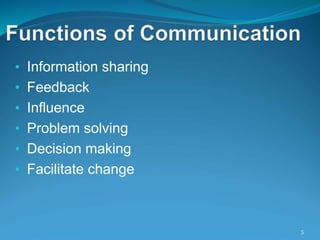
• Information sharing
• Feedback
• Influence
• Problem solving
• Decision making
• Facilitate change
5
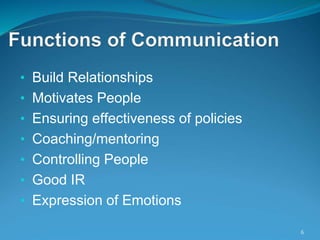
• Build Relationships
• Motivates People
• Ensuring effectiveness of policies
• Coaching/mentoring
• Controlling People
• Good IR
• Expression of Emotions
6
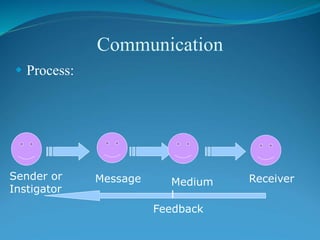
Communication
 Process:
Sender or
Instigator
Message Receiver
Feedback
Medium
l
Receiver
Decode
message
Encode
feedback
Form
feedback
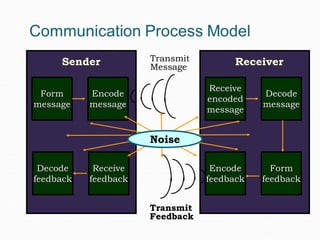
Sender
Form
message
Encode
message
Decode
feedback
Transmit
Message
Transmit
Feedback
Receive
encoded
message
Receive
feedback
Noise
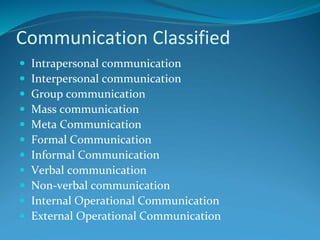
Communication Classified
 Intrapersonal communication
 Interpersonal communication
 Group communication
 Mass communication
 Meta Communication
 Formal Communication
 Informal Communication
 Verbal communication
 Non-verbal communication
 Internal Operational Communication
 External Operational Communication
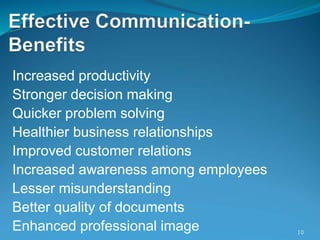
Increased productivity
Stronger decision making
Quicker problem solving
Healthier business relationships
Improved customer relations
Increased awareness among employees
Lesser misunderstanding
Better quality of documents
Enhanced professional image 10
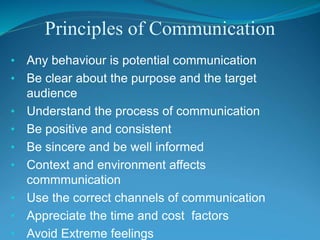
Principles of Communication
• Any behaviour is potential communication
• Be clear about the purpose and the target
audience
• Understand the process of communication
• Be positive and consistent
• Be sincere and be well informed
• Context and environment affects
commmunication
• Use the correct channels of communication
• Appreciate the time and cost factors
• Avoid Extreme feelings
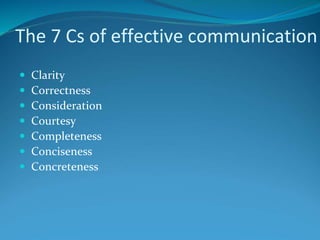
The 7 Cs of effective communication
 Clarity
 Correctness
 Consideration
 Courtesy
 Completeness
 Conciseness
 Concreteness
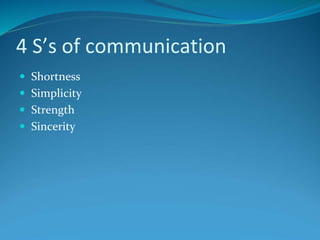
4 S’s of communication
 Shortness
 Simplicity
 Strength
 Sincerity
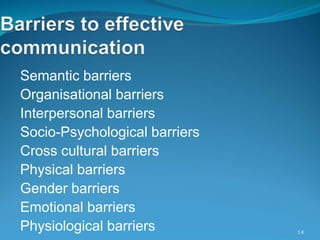
Semantic barriers
Organisational barriers
Interpersonal barriers
Socio-Psychological barriers
Cross cultural barriers
Physical barriers
Gender barriers
Emotional barriers
Physiological barriers 14
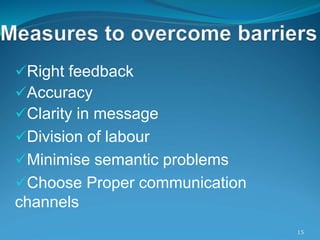
Right feedback
Accuracy
Clarity in message
Division of labour
Minimise semantic problems
Choose Proper communication
channels
15
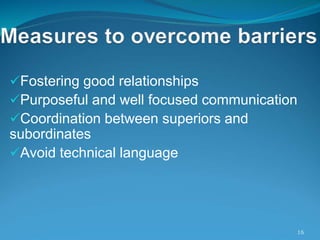
Fostering good relationships
Purposeful and well focused communication
Coordination between superiors and
subordinates
Avoid technical language
16
Formal Communication
 The process of sharing official information
with others who need to know it, to the
prescribed patterns depicted in an
organization chart
Directions in which communication flows
 Downward
 Upward
 Horizontal or lateral
 Diagonal or crosswise
 Inward
 Outward
 Downward communication involves messages
from senders relatively high in the organizational
structure to receivers in lower positions.
 Downward communication may be used:
 to give instructions
 to provide information about policies and
procedures
 to give feedback about performance
 for indoctrinating or motivating
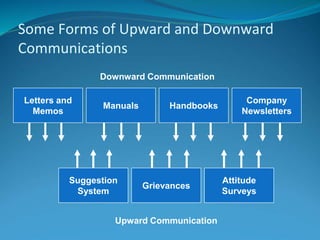
Downward Communication
Upward Communication
 Upward communication involves
communication from sources in lower-level
positions to receivers in higher positions.
 Participative in nature
 Upward communication is often used:
 to give information on progress/feedback
 Complaints and grievances
 to pass on ideas for improvement of activities
 to express their sentiments on the different
issues
 Release of tension
Formal Media
 Company Newsletters
 Employee Handbooks
 Company Magazines
 Formal Meetings
 Letters
 Flyers and Bulletins
 Memos
 Faxes
Letters and
Memos
Manuals Handbooks
Company
Newsletters
Downward Communication
Upward Communication
Suggestion
System
Grievances
Attitude
Surveys
Some Forms of Upward and Downward
Communications
Informal Communication
Grapevine Communication-Information
shared without any formally imposed
obligations or restrictions
if an organization’s formal communication represents its
skeleton, its informal communication constitutes its
central nervous system
 An organization’s informal channels of communication,
based mainly on friendship or acquaintance
Feeling of uncertainty or lack of a sense of
direction when the organisation is passing through
a difficult period
Feeling of inadequacy or lack of self confidence
on the part of the employees, leading to the
formation of groups
Formation of a favoured group by the manager,
giving other employees a feeling of insecurity or
isolation
Personal problems of the employees
24
Employees rely on the grapevine when:
 they feel threatened,
 insecure,
 under stress
 when there is pending change
 when communication from management is
limited
Informal Media
 Face-to-face communication
 Telephone
 Voice mail
 E-mail
 Instant messaging
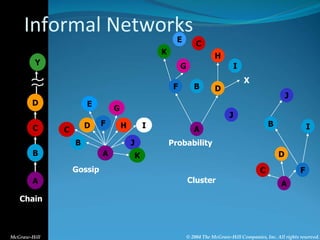
Informal Networks
Y
D
C
B
A
Chain
A
JB
D H I
K
F
G
E
C
Gossip
A
F B D
J
H
C
E
K
G I
X
Probability
A
C
D
F
J
IB
Cluster
McGraw-Hill © 2004 The McGraw-Hill Companies, Inc. All rights reserved.
Grapevine Characteristics
 oral  mostly undocumented
 open to change
 fast
 crossing organizational boundaries
Grapevine Characteristics
 inaccuracy:
 Levelling- Deletion of crucial details
 Sharpening - Exaggeration of the most
dramatic details
While the grapevine generally carries the
truth, it seldom carries the whole truth
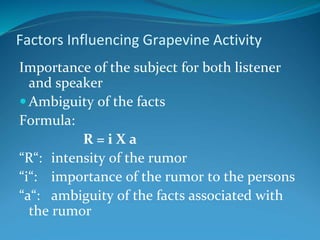
Factors Influencing Grapevine Activity
Importance of the subject for both listener
and speaker
 Ambiguity of the facts
Formula:
R = i X a
“R“: intensity of the rumor
“i“: importance of the rumor to the persons
“a“: ambiguity of the facts associated with
the rumor
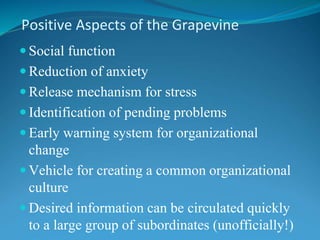
Positive Aspects of the Grapevine
 Social function
 Reduction of anxiety
 Release mechanism for stress
 Identification of pending problems
 Early warning system for organizational
change
 Vehicle for creating a common organizational
culture
 Desired information can be circulated quickly
to a large group of subordinates (unofficially!)
Coping or Managing the Grapevine
“the grapevine cannot be abolished, rubbed
out, hidden under a basket, chopped down,
tied up, or stopped“
(Managing the Grapevine, p.222)
“Tapping“ the Grapevine
 identify and make use of key
communicators ( bridgers)
 monitor what is happening in the
organization
 use the grapevine to give new ideas a “trial
run“
 don‘t try to control or restrict it
 use it to supplement formal channels
Preventing Rumors
 provide information through the formal
system of communication on the issues
important to the employees
 supply employees with a steady flow of
clear, accurate and timely information
 present full facts
 keep formal communication lines open and
the process as short as possible

Managerial Communication

  • 1.
  • 2.
    Communication defined…  Anexchange of facts, ideas, opinions or emotions, by two or more persons  A process by which we understand others and in turn ,endeavour to be understood by them. It is dynamic, constantly changing in response to the total situation
  • 3.
    Managerial communication  Businessis any economic activity which is undertaken with a view to earn profit  The achievement of organisational objectives largely depends on proper co- ordination and integration of human effort  The more effective the system of communication, the better is the relationship between workers and management
  • 4.
    Objectives of communication To inform  To persuade  To educate  To train  To integrate  To motivate  To entertain  To facilitate decision making
  • 5.
    • Information sharing •Feedback • Influence • Problem solving • Decision making • Facilitate change 5
  • 6.
    • Build Relationships •Motivates People • Ensuring effectiveness of policies • Coaching/mentoring • Controlling People • Good IR • Expression of Emotions 6
  • 7.
  • 8.
  • 9.
    Communication Classified  Intrapersonalcommunication  Interpersonal communication  Group communication  Mass communication  Meta Communication  Formal Communication  Informal Communication  Verbal communication  Non-verbal communication  Internal Operational Communication  External Operational Communication
  • 10.
    Increased productivity Stronger decisionmaking Quicker problem solving Healthier business relationships Improved customer relations Increased awareness among employees Lesser misunderstanding Better quality of documents Enhanced professional image 10
  • 11.
    Principles of Communication •Any behaviour is potential communication • Be clear about the purpose and the target audience • Understand the process of communication • Be positive and consistent • Be sincere and be well informed • Context and environment affects commmunication • Use the correct channels of communication • Appreciate the time and cost factors • Avoid Extreme feelings
  • 12.
    The 7 Csof effective communication  Clarity  Correctness  Consideration  Courtesy  Completeness  Conciseness  Concreteness
  • 13.
    4 S’s ofcommunication  Shortness  Simplicity  Strength  Sincerity
  • 14.
    Semantic barriers Organisational barriers Interpersonalbarriers Socio-Psychological barriers Cross cultural barriers Physical barriers Gender barriers Emotional barriers Physiological barriers 14
  • 15.
    Right feedback Accuracy Clarity inmessage Division of labour Minimise semantic problems Choose Proper communication channels 15
  • 16.
    Fostering good relationships Purposefuland well focused communication Coordination between superiors and subordinates Avoid technical language 16
  • 17.
    Formal Communication  Theprocess of sharing official information with others who need to know it, to the prescribed patterns depicted in an organization chart
  • 18.
    Directions in whichcommunication flows  Downward  Upward  Horizontal or lateral  Diagonal or crosswise  Inward  Outward
  • 19.
     Downward communicationinvolves messages from senders relatively high in the organizational structure to receivers in lower positions.  Downward communication may be used:  to give instructions  to provide information about policies and procedures  to give feedback about performance  for indoctrinating or motivating Downward Communication
  • 20.
    Upward Communication  Upwardcommunication involves communication from sources in lower-level positions to receivers in higher positions.  Participative in nature  Upward communication is often used:  to give information on progress/feedback  Complaints and grievances  to pass on ideas for improvement of activities  to express their sentiments on the different issues  Release of tension
  • 21.
    Formal Media  CompanyNewsletters  Employee Handbooks  Company Magazines  Formal Meetings  Letters  Flyers and Bulletins  Memos  Faxes
  • 22.
    Letters and Memos Manuals Handbooks Company Newsletters DownwardCommunication Upward Communication Suggestion System Grievances Attitude Surveys Some Forms of Upward and Downward Communications
  • 23.
    Informal Communication Grapevine Communication-Information sharedwithout any formally imposed obligations or restrictions if an organization’s formal communication represents its skeleton, its informal communication constitutes its central nervous system  An organization’s informal channels of communication, based mainly on friendship or acquaintance
  • 24.
    Feeling of uncertaintyor lack of a sense of direction when the organisation is passing through a difficult period Feeling of inadequacy or lack of self confidence on the part of the employees, leading to the formation of groups Formation of a favoured group by the manager, giving other employees a feeling of insecurity or isolation Personal problems of the employees 24
  • 25.
    Employees rely onthe grapevine when:  they feel threatened,  insecure,  under stress  when there is pending change  when communication from management is limited
  • 26.
    Informal Media  Face-to-facecommunication  Telephone  Voice mail  E-mail  Instant messaging
  • 27.
    Informal Networks Y D C B A Chain A JB D HI K F G E C Gossip A F B D J H C E K G I X Probability A C D F J IB Cluster McGraw-Hill © 2004 The McGraw-Hill Companies, Inc. All rights reserved.
  • 28.
    Grapevine Characteristics  oral mostly undocumented  open to change  fast  crossing organizational boundaries
  • 29.
    Grapevine Characteristics  inaccuracy: Levelling- Deletion of crucial details  Sharpening - Exaggeration of the most dramatic details While the grapevine generally carries the truth, it seldom carries the whole truth
  • 30.
    Factors Influencing GrapevineActivity Importance of the subject for both listener and speaker  Ambiguity of the facts Formula: R = i X a “R“: intensity of the rumor “i“: importance of the rumor to the persons “a“: ambiguity of the facts associated with the rumor
  • 31.
    Positive Aspects ofthe Grapevine  Social function  Reduction of anxiety  Release mechanism for stress  Identification of pending problems  Early warning system for organizational change  Vehicle for creating a common organizational culture  Desired information can be circulated quickly to a large group of subordinates (unofficially!)
  • 32.
    Coping or Managingthe Grapevine “the grapevine cannot be abolished, rubbed out, hidden under a basket, chopped down, tied up, or stopped“ (Managing the Grapevine, p.222)
  • 33.
    “Tapping“ the Grapevine identify and make use of key communicators ( bridgers)  monitor what is happening in the organization  use the grapevine to give new ideas a “trial run“  don‘t try to control or restrict it  use it to supplement formal channels
  • 34.
    Preventing Rumors  provideinformation through the formal system of communication on the issues important to the employees  supply employees with a steady flow of clear, accurate and timely information  present full facts  keep formal communication lines open and the process as short as possible

Editor's Notes

  • #22 company newsletters: formal - impersonal - aimed at a general audience - regularly published internal documents - describe information of interest to employees regarding an array of business and nonbusiness issues affecting them - effective devices in improving employees’ attitudes because the mere act of publishing a newsletter sends a message that the company cares enough about its employees to communicate with them employee handbooks: formal - major formal means of communicating pertinent company information to employees - internally published - a document describing to employees basic information about the company - general reference regarding the company’s background, the nature of its business, and its rules - explains key aspects of the company’s policies - clarifies the expectations of the company and employees toward each other - clarifies company policies -> prevents lawsuits - useful means of effectively socializing new employees and promoting the company’s values company magazines: formal - sometimes published by a group of employees who spend part of their work time on the magazine - open dialogue between management and employees – e.g. critics and suggestions for improvement - account on organizational activities - readership includes pensioners - small ads - formal meetings - long interactions on pre-planned topics - often with multiple people - scheduled: planned in advance by both parties - frequently in a room designed for meetings [4] - arranged participants - participants in role - preset agenda - formal language and speech register Conclusion: formal communication channels: - mostly produce written messages - frequently one-way and take long for a response - one-way written communications tend to be reserved for formal, official messages that need to be referred to in the future at the receiver’s convenience (e.g. official announcements about position openings)
  • #28 - Informal Networks: - consist of interaction patterns that are not designed by management can be based on physical proximity, shared career interests or personal friendships article about the exchange of email in an organization (E-mail reveals real leaders) used e-mail exchanges to build a map of the structure of an organization The map shows the teams in which people actually work, as opposed to those they are assigned to unofficial de facto leaders can also emerge big institutions tend to divide organically into informal collaborative networks, called communities of practice -> companies‘ informal structure the communities often crossed the formal departmental boundaries defined by the company - chain: every member passes on information, but to just one person - gossip one person passes on information to all the others that he encounters - probability chain no structure A is very talkative and outgoing type, passes on information to random contacts - cluster information is passed on to selected persons most common pattern selectivity: pass on information to people with whom you are in close contact