BIODIVERSITY & IT'S
CONSERVATION IN SIKKIM
BY JYOTI CHAUHAN
BIODIVERSITY
• Sikkim covering just 0.2 % of the
geographical area of the country has
tremendous biodiversity and has been
identified as one of the HOT-SPOT in the
Eastern Himalayas. India is recognized as
one of the 12 mega diversity centers of the
world. Out of the 18 Biodiversity hot-spots
in the world, India owns 2, namely the
Western Ghats and the Eastern
Himalayas. There are 10 bio-geographic
zones & 25 biotic provinces which have 16
major forests types & > 200 sub types as
per (Champion & Seth 1968). Sikkim falls
under Himalayan (2) Bio-geographic zone
& Central Himalaya (2c) biotic province
having about 9 types of forests types
(Champion & Seth).
BIODIVERSITY
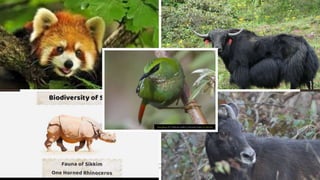
• The State is endowed with rich floral and faunal
diversity. Species wise, the State harbors over 4500
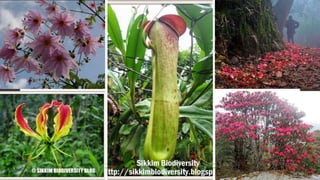
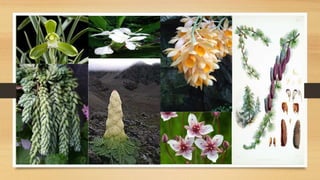
flowering plants, 550 Orchids, 36 Rhododendrons,
16 Conifers, 28 Bamboos, 362 Ferns and its allies, 9
Tree Ferns, 30 Primulas, 11 Oaks, over 424
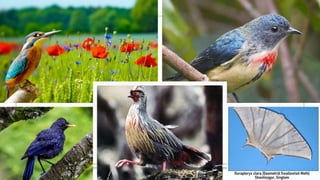
Medicinal plants, 144+ mammals, 550 Birds, 48
Fishes and over 600 Butterflies. While these figures
are still not absolute, it may be kept in mind that
this is only the mega-fauna and flora. The
tremendous diversity of insects like beetles and
moths as well as a host of other life forms is yet to
be enumerated. Most of the high altitude
medicinal plants are rare and endangered species.
Sikkim also has 28 Mountains/Peaks, more than
80 Glaciers, 227 high altitude lakes/wetlands and
over 104 rivers and streams
This Photo by Unknown author is licensed under CC BY-SA.
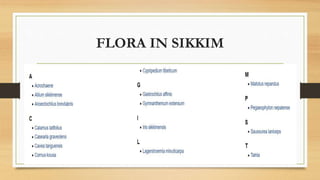
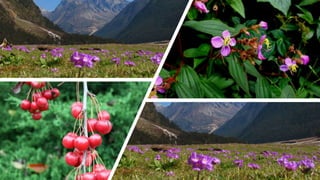
FLORA IN SIKKIM
MEDICINAL
PLANTS IN
SIKKIM
BIODIVERSITY
• Nature has been particularly generous in her gift of sylvan treasures to the state
of Sikkim. Luxuriant forest, abound in all part of state and variety of medicinal
plants, herbs, shrubs, bamboos and trees growing in state is truly rich. In the
forest, there are number of plants whose medicinal values have been well
recognized by local people as well as by different pharmaceutical, insecticidal and
perfumery sectors. Medicinal plants ought to be given the status of a “National
Resources” because their sustained availability is essential to sustain one of the
world’s oldest medicinal traditions, a priceless legacy of the Indian people. The
local inhabitants for treatment of various ailments use numerous herbal remedies.
Furthermore, modern medicines owes to the flora of these mountains. Many
inhabitants for treatment of various ailments use numerous herbal remedies.
Many species of Himalayan origin have revolutionized the allopathic systems of
medicine.
CONSERVATION
OF
BIODIVERSITY IN
SIKKIM
Since April 2010, through an innovative ten-year project which
is supported by the Japan International Cooperation Agency
(JICA), the Government of Sikkim is developing eco-tourism
as a tool to achieve the twin objectives of biodiversity
conservation and economic development. This is the first
project of its kind in India. More than half of the Project’s
budget is earmarked for forest and biodiversity conservation
activities. These include:
• Establishment and implementation of sound
management plans for a number of important reserved
forests and protected areas. This includes the
Khanchendzonga National Park (and support for its
inscription as a UNESCO World Heritage Site); The
project will also help to create two new Protected Areas
(Nimphu Wildlife Sanctuary and Fairrieanum
Conservation Reserve), and to rationalize the boundaries
of existing protected area boundaries;
• • Supporting various ex situconservation measures,
including the creation of a Butterfly park in North Sikkim;
CONSERVATION
OF BIODIVERSIT
Y IN SIKKIM
•
Improving the infrastructure of the Himalayan
Zoological Park at Bulbulay, Gangtok. This will also
include the establishment of a Sikkim Biodiversity
Centre which will generate and disseminate
information on biodiversity and best practice;
• • Undertaking inventory and monitoring of
biodiversity throughout the State;
• • Undertake studies on the impacts of climate
change and grazing in the Himalayan Ecosystem,
as well as on a number of ‘flagship’ species (such as
the Snow Leopard and Red Panda) to better
understand the nature and effects of human-nature
interactions;
• • Enhancement of the spatial and resource
information base through the establishment of a
modern laboratory for GIS and Remote Sensing.
other
initiatives of
the
Government
of Sikkim
Over the past two decades, the Government of Sikkim has implemented a
number of important initiatives which are also aimed at conserving biodiversity
and protecting the environment. These include:
• • Banning grazing in reserved forests (1995);
• • Banning felling of green trees in forests;
• • Use of non-biodegradable materials like plastic and poly bags banned
(1998);
• • Sikkim declared an “Organic State” (2002): Use of all chemical fertilisers
and pesticides banned;
• • Strengthening the Protected Area Network which today covers 31% of the
land area of the State (and 42.5 % if the Khanchendzonga Biosphere
Reserve area is also included (the highest of any State in India);
• • Eco-clubs, green funds have been created in a number of schools &
colleges.
• • Ban on killing of wildlife has been imposed by the Government.
• • Our forest cover has increased by 2% growth in the total forest cover in
the State.
• • Government of Sikkim has decided to make all the road sides full of
greenery and aesthetically appreciable. The Rabongla-Namchi Road has
been declared as the ECo- HIGHWAY.
•
other initiatives of the Government of Sikkim
• All Panchayats have been provided with “Classified Panchayats Bio-diversity register” to register every
species in their area- as to the kind and the usage especially of the medicinal variety
• • State Government under the direction of Hon’ble Chief Minister initiated “Ten Minutes to Earth”
programme supporting the United Nation Environment Programme (UNEP) worldwide Tree Planting
Campaign “Plant for Planet: Billion Tree Campaign”.
• • More than 215 Joint Forest Management Committees (JFMCs) and Eco-Development Committees
(EDCs) have been created to implement the government’s Participatory Forest Management policy.
Forest protection and management by local communities living in forest fringe areas offers the best way
to ensure the conservation of our biodiversity;
• • Designation of Himal Rakshaks (Honorary Mountain Guardians);
• • Introduction of the “Smriti Van” (Memorial Forests) programme in all districts and every Gram
Panchayat;
Other initiatives of the Government of Sikkim
• • Preparation of the State Biodiversity Strategy and Action Plan (SBSAP);
• • State Biodiversity Park created at Tendong in South District;
• • 11 Important Bird Areas notified (2003);
• • State Green Mission launched to make Sikkim a clean, green and garden state;
• • As per the State Industrial Policy (1996), only eco-friendly, pollution-free and green
industries are encouraged;
All these measures taken by the present Government over recent years are helping to protect
and maintain Sikkim’s remarkable biodiversity heritage, for the benefit of present and future
generations.
Biodiversity and It's conservation in Sikkim

Biodiversity and It's conservation in Sikkim

  • 1.
    BIODIVERSITY & IT'S CONSERVATIONIN SIKKIM BY JYOTI CHAUHAN
  • 3.
    BIODIVERSITY • Sikkim coveringjust 0.2 % of the geographical area of the country has tremendous biodiversity and has been identified as one of the HOT-SPOT in the Eastern Himalayas. India is recognized as one of the 12 mega diversity centers of the world. Out of the 18 Biodiversity hot-spots in the world, India owns 2, namely the Western Ghats and the Eastern Himalayas. There are 10 bio-geographic zones & 25 biotic provinces which have 16 major forests types & > 200 sub types as per (Champion & Seth 1968). Sikkim falls under Himalayan (2) Bio-geographic zone & Central Himalaya (2c) biotic province having about 9 types of forests types (Champion & Seth).
  • 5.
    BIODIVERSITY • The Stateis endowed with rich floral and faunal diversity. Species wise, the State harbors over 4500 flowering plants, 550 Orchids, 36 Rhododendrons, 16 Conifers, 28 Bamboos, 362 Ferns and its allies, 9 Tree Ferns, 30 Primulas, 11 Oaks, over 424 Medicinal plants, 144+ mammals, 550 Birds, 48 Fishes and over 600 Butterflies. While these figures are still not absolute, it may be kept in mind that this is only the mega-fauna and flora. The tremendous diversity of insects like beetles and moths as well as a host of other life forms is yet to be enumerated. Most of the high altitude medicinal plants are rare and endangered species. Sikkim also has 28 Mountains/Peaks, more than 80 Glaciers, 227 high altitude lakes/wetlands and over 104 rivers and streams
  • 8.
    This Photo byUnknown author is licensed under CC BY-SA.
  • 9.
  • 10.
  • 13.
    BIODIVERSITY • Nature hasbeen particularly generous in her gift of sylvan treasures to the state of Sikkim. Luxuriant forest, abound in all part of state and variety of medicinal plants, herbs, shrubs, bamboos and trees growing in state is truly rich. In the forest, there are number of plants whose medicinal values have been well recognized by local people as well as by different pharmaceutical, insecticidal and perfumery sectors. Medicinal plants ought to be given the status of a “National Resources” because their sustained availability is essential to sustain one of the world’s oldest medicinal traditions, a priceless legacy of the Indian people. The local inhabitants for treatment of various ailments use numerous herbal remedies. Furthermore, modern medicines owes to the flora of these mountains. Many inhabitants for treatment of various ailments use numerous herbal remedies. Many species of Himalayan origin have revolutionized the allopathic systems of medicine.
  • 15.
    CONSERVATION OF BIODIVERSITY IN SIKKIM Since April2010, through an innovative ten-year project which is supported by the Japan International Cooperation Agency (JICA), the Government of Sikkim is developing eco-tourism as a tool to achieve the twin objectives of biodiversity conservation and economic development. This is the first project of its kind in India. More than half of the Project’s budget is earmarked for forest and biodiversity conservation activities. These include: • Establishment and implementation of sound management plans for a number of important reserved forests and protected areas. This includes the Khanchendzonga National Park (and support for its inscription as a UNESCO World Heritage Site); The project will also help to create two new Protected Areas (Nimphu Wildlife Sanctuary and Fairrieanum Conservation Reserve), and to rationalize the boundaries of existing protected area boundaries; • • Supporting various ex situconservation measures, including the creation of a Butterfly park in North Sikkim;
  • 17.
    CONSERVATION OF BIODIVERSIT Y INSIKKIM • Improving the infrastructure of the Himalayan Zoological Park at Bulbulay, Gangtok. This will also include the establishment of a Sikkim Biodiversity Centre which will generate and disseminate information on biodiversity and best practice; • • Undertaking inventory and monitoring of biodiversity throughout the State; • • Undertake studies on the impacts of climate change and grazing in the Himalayan Ecosystem, as well as on a number of ‘flagship’ species (such as the Snow Leopard and Red Panda) to better understand the nature and effects of human-nature interactions; • • Enhancement of the spatial and resource information base through the establishment of a modern laboratory for GIS and Remote Sensing.
  • 18.
    other initiatives of the Government of Sikkim Overthe past two decades, the Government of Sikkim has implemented a number of important initiatives which are also aimed at conserving biodiversity and protecting the environment. These include: • • Banning grazing in reserved forests (1995); • • Banning felling of green trees in forests; • • Use of non-biodegradable materials like plastic and poly bags banned (1998); • • Sikkim declared an “Organic State” (2002): Use of all chemical fertilisers and pesticides banned; • • Strengthening the Protected Area Network which today covers 31% of the land area of the State (and 42.5 % if the Khanchendzonga Biosphere Reserve area is also included (the highest of any State in India); • • Eco-clubs, green funds have been created in a number of schools & colleges. • • Ban on killing of wildlife has been imposed by the Government. • • Our forest cover has increased by 2% growth in the total forest cover in the State. • • Government of Sikkim has decided to make all the road sides full of greenery and aesthetically appreciable. The Rabongla-Namchi Road has been declared as the ECo- HIGHWAY. •
  • 20.
    other initiatives ofthe Government of Sikkim • All Panchayats have been provided with “Classified Panchayats Bio-diversity register” to register every species in their area- as to the kind and the usage especially of the medicinal variety • • State Government under the direction of Hon’ble Chief Minister initiated “Ten Minutes to Earth” programme supporting the United Nation Environment Programme (UNEP) worldwide Tree Planting Campaign “Plant for Planet: Billion Tree Campaign”. • • More than 215 Joint Forest Management Committees (JFMCs) and Eco-Development Committees (EDCs) have been created to implement the government’s Participatory Forest Management policy. Forest protection and management by local communities living in forest fringe areas offers the best way to ensure the conservation of our biodiversity; • • Designation of Himal Rakshaks (Honorary Mountain Guardians); • • Introduction of the “Smriti Van” (Memorial Forests) programme in all districts and every Gram Panchayat;
  • 21.
    Other initiatives ofthe Government of Sikkim • • Preparation of the State Biodiversity Strategy and Action Plan (SBSAP); • • State Biodiversity Park created at Tendong in South District; • • 11 Important Bird Areas notified (2003); • • State Green Mission launched to make Sikkim a clean, green and garden state; • • As per the State Industrial Policy (1996), only eco-friendly, pollution-free and green industries are encouraged; All these measures taken by the present Government over recent years are helping to protect and maintain Sikkim’s remarkable biodiversity heritage, for the benefit of present and future generations.