Principles of Effective Work
 PLANING
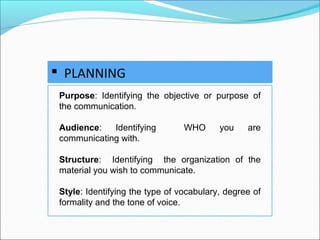
 PLANNING
Purpose: Identifying the objective or purpose of
the communication.
Audience: Identifying WHO you are
communicating with.
Structure: Identifying the organization of the
material you wish to communicate.
Style: Identifying the type of vocabulary, degree of
formality and the tone of voice.

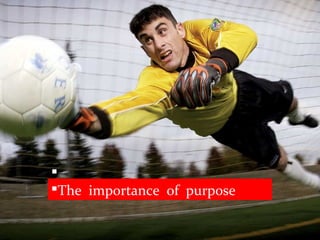
The importance of purpose
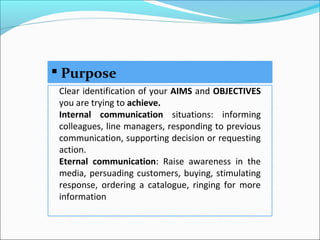
 Purpose
Clear identification of your AIMS and OBJECTIVES
you are trying to achieve.
Internal communication situations: informing
colleagues, line managers, responding to previous
communication, supporting decision or requesting
action.
Eternal communication: Raise awareness in the
media, persuading customers, buying, stimulating
response, ordering a catalogue, ringing for more
information
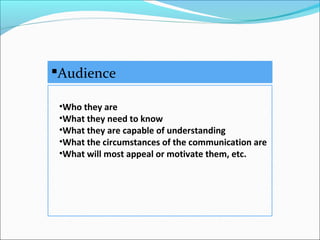
The importance of Audience
Audience
•Who they are
•What they need to know
•What they are capable of understanding
•What the circumstances of the communication are
•What will most appeal or motivate them, etc.
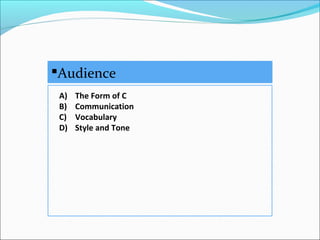
Audience
A) The Form of C
B) Communication
C) Vocabulary
D) Style and Tone
 Preparation
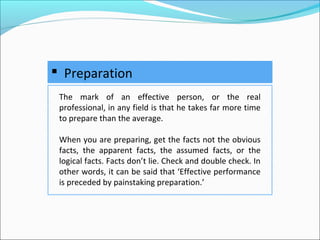
 Preparation
The mark of an effective person, or the real
professional, in any field is that he takes far more time
to prepare than the average.
When you are preparing, get the facts not the obvious
facts, the apparent facts, the assumed facts, or the
logical facts. Facts don’t lie. Check and double check. In
other words, it can be said that ‘Effective performance
is preceded by painstaking preparation.’
 Priority
 Priority
To achieve great results, you must always be
concentrating on the small number of activities that
contribute the greatest value in terms of work.
Always decide what is the most valuable use of your
time? And whatever it is, work on that.
Your ability to discipline yourself to work on those few
tasks can make the greatest difference between
effective or ineffective team member at work.
 Decision
 Decision
Every great leap forward in life is preceded by a clear
decision and a commitment to action.
The people who have achieved great feats are not
necessarily those who make the right decisions, but
they are those who make their decisions right.
They accept feed back and self-correct. They are always
decisive, always moving forward, never wishy-washy or
vacillating in their attitudes.
 Efforts
 Efforts
Nothing will bring you to the attention of your
superiors faster than your developing a reputation for
being a hard worker.
Your commitment to hard work creates a force field of
positive energy around you that attracts positive
people and greater opportunities into your life.
You must be working on high value tasks and activities
aimed toward the accomplishment of meaningful and
important goals.
 Efficiency
 Efficiency
Always ask these questions to yourself. Why am I on
the payroll? What specific, tangible, measurable results
are expected of me?
There will never be enough time to do everything that
you have to do. Only by stretching yourself can you
discover how much you are truly capable of. It is
therefore the efficiency in which you complete the job
that matters.
 Persistence
 Persistence
Your ability to persist in the face of setbacks and
disappointments is your measure of your belief in
yourself and your ability to succeed in your
professional life.
When you demonstrate to yourself and to the people
around you that you have the quality of self-discipline
and self-mastery you will become absolutely
indispensable and your effectiveness in the
organization shall sky rocket.
 Excellence
 Excellence
Commit to excellence in your work, especially in your
key result areas and core competencies.
Resolve today to commit to top performance and you
will see that you move into the fast lane in your career
than any other decision you can make.
 Superb Execution
 Superb Execution
Set standards of excellence for yourself and for
everyone who report to you. You also need to be
ruthless about weeding out incompetence and poor
performance.
Identify your core competencies and continuously look
for ways to upgrade them to see that you and your
organization are the best in the business.
 Relationships
People don’t buy products or services. They “buy” the
people who are selling the products or services.
First, you sell yourself as a likeable and creditable
person, and then you sell what you represent.
Maintain and strengthen high quality relationships with
internal customers (subordinates, colleagues, bosses,
vendors) and external customers to see the company
forging ahead.
 Service
 Service
If you wish to increase the quantity of your rewards,
you must first increase the quality and quantity of your
service.
Your rewards in life will be in direct proportion to the
value of your service to company.
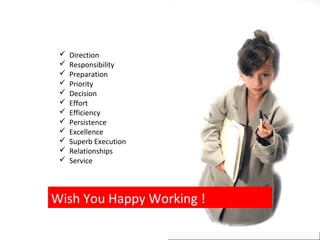
Wish You Happy Working !
 Direction
 Responsibility
 Preparation
 Priority
 Decision
 Effort
 Efficiency
 Persistence
 Excellence
 Superb Execution
 Relationships
 Service

Business communication 2

  • 1.
  • 2.
  • 3.
     PLANNING Purpose: Identifyingthe objective or purpose of the communication. Audience: Identifying WHO you are communicating with. Structure: Identifying the organization of the material you wish to communicate. Style: Identifying the type of vocabulary, degree of formality and the tone of voice.
  • 4.
  • 5.
     Purpose Clear identificationof your AIMS and OBJECTIVES you are trying to achieve. Internal communication situations: informing colleagues, line managers, responding to previous communication, supporting decision or requesting action. Eternal communication: Raise awareness in the media, persuading customers, buying, stimulating response, ordering a catalogue, ringing for more information
  • 6.
  • 7.
    Audience •Who they are •Whatthey need to know •What they are capable of understanding •What the circumstances of the communication are •What will most appeal or motivate them, etc.
  • 8.
    Audience A) The Formof C B) Communication C) Vocabulary D) Style and Tone
  • 9.
  • 10.
     Preparation The markof an effective person, or the real professional, in any field is that he takes far more time to prepare than the average. When you are preparing, get the facts not the obvious facts, the apparent facts, the assumed facts, or the logical facts. Facts don’t lie. Check and double check. In other words, it can be said that ‘Effective performance is preceded by painstaking preparation.’
  • 11.
  • 12.
     Priority To achievegreat results, you must always be concentrating on the small number of activities that contribute the greatest value in terms of work. Always decide what is the most valuable use of your time? And whatever it is, work on that. Your ability to discipline yourself to work on those few tasks can make the greatest difference between effective or ineffective team member at work.
  • 13.
  • 14.
     Decision Every greatleap forward in life is preceded by a clear decision and a commitment to action. The people who have achieved great feats are not necessarily those who make the right decisions, but they are those who make their decisions right. They accept feed back and self-correct. They are always decisive, always moving forward, never wishy-washy or vacillating in their attitudes.
  • 15.
  • 16.
     Efforts Nothing willbring you to the attention of your superiors faster than your developing a reputation for being a hard worker. Your commitment to hard work creates a force field of positive energy around you that attracts positive people and greater opportunities into your life. You must be working on high value tasks and activities aimed toward the accomplishment of meaningful and important goals.
  • 17.
  • 18.
     Efficiency Always askthese questions to yourself. Why am I on the payroll? What specific, tangible, measurable results are expected of me? There will never be enough time to do everything that you have to do. Only by stretching yourself can you discover how much you are truly capable of. It is therefore the efficiency in which you complete the job that matters.
  • 19.
  • 20.
     Persistence Your abilityto persist in the face of setbacks and disappointments is your measure of your belief in yourself and your ability to succeed in your professional life. When you demonstrate to yourself and to the people around you that you have the quality of self-discipline and self-mastery you will become absolutely indispensable and your effectiveness in the organization shall sky rocket.
  • 21.
  • 22.
     Excellence Commit toexcellence in your work, especially in your key result areas and core competencies. Resolve today to commit to top performance and you will see that you move into the fast lane in your career than any other decision you can make.
  • 23.
  • 24.
     Superb Execution Setstandards of excellence for yourself and for everyone who report to you. You also need to be ruthless about weeding out incompetence and poor performance. Identify your core competencies and continuously look for ways to upgrade them to see that you and your organization are the best in the business.
  • 25.
     Relationships People don’tbuy products or services. They “buy” the people who are selling the products or services. First, you sell yourself as a likeable and creditable person, and then you sell what you represent. Maintain and strengthen high quality relationships with internal customers (subordinates, colleagues, bosses, vendors) and external customers to see the company forging ahead.
  • 26.
  • 27.
     Service If youwish to increase the quantity of your rewards, you must first increase the quality and quantity of your service. Your rewards in life will be in direct proportion to the value of your service to company.
  • 28.
    Wish You HappyWorking !  Direction  Responsibility  Preparation  Priority  Decision  Effort  Efficiency  Persistence  Excellence  Superb Execution  Relationships  Service