




HIRE FOR ATTITUDE,
TRAIN FOR SKILL
Why Passion and Spirit Should
Supersede a Resume
Hiring For Attitude
• Determining what the right Characteristics are for your specific Brand
• Evaluating current interview questions and techniques
• Creating interview questions that screen for these characteristics
The right formula
Determining Fit for your brand
Before you can even start the process of Hiring for Attitude, you need to determine
what Attitude you want in your brand.
• Top 3 Employees
• Bottom 3 Employees
• Come up with characteristics that make them the Top or Bottom
Determining Fit for your brand
Top 3:
• Runs their business like an owner -
takes pride in ownership
• Communicates collaboratively with
staff members
• Ensures guests service standards
are exceeded in every situation
• Knows how to prioritize multiple
priorities and respond and react
accordingly to balance the needs of
the business as well as the needs of
team members
Bottom 3:
• Constantly blames others or makes
excuses for their lack of
performance and execution
• Receives multiple guest complaints
and is unable to resolve issues
• Consistently has high turnover and
a revolving door with staff members
• Has poor financial performance on a
consist basis
Learning what to ask…
• The 3 most common questions and why they shouldn’t be asked
• The Behavioral questions and how to frame them
• The Hypothetical questions
Learning what to ask…
1. Tell me about yourself….
2. What are your strengths….
3. What are your weaknesses….
What’s wrong with these questions – I ask these all the time…..
The 3 most common questions
Learning what to ask…
1. Tell me when you had to adapt to a difficult situation. What did you do do?
2. Tell me about a time when you had to balance competing priorities and did so
successfully.
3. Tell me about a conflict with a coworker and how you resolved it.
How to frame behavioral questions
Learning what to ask…
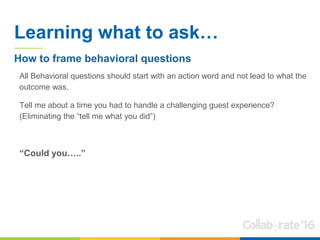
All Behavioral questions should start with an action word and not lead to what the
outcome was.
Tell me about a time you had to handle a challenging guest experience?
(Eliminating the “tell me what you did”)
“Could you…..”
How to frame behavioral questions
Learning what to ask…
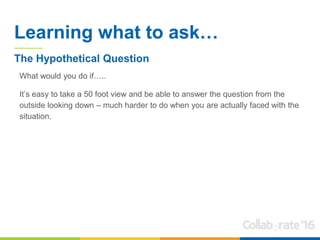
What would you do if…..
It’s easy to take a 50 foot view and be able to answer the question from the
outside looking down – much harder to do when you are actually faced with the
situation.
The Hypothetical Question
Creating your Interview
Questions
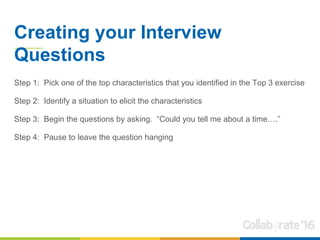
Step 1: Pick one of the top characteristics that you identified in the Top 3 exercise
Step 2: Identify a situation to elicit the characteristics
Step 3: Begin the questions by asking. “Could you tell me about a time….”
Step 4: Pause to leave the question hanging
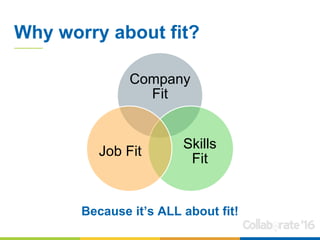
Why worry about fit?
Because it’s ALL about fit!
Company
Fit
Skills
Fit
Job Fit
Why worry about fit?
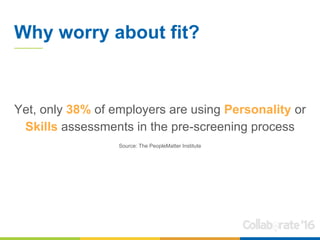
Yet, only 38% of employers are using Personality or
Skills assessments in the pre-screening process
Source: The PeopleMatter Institute
What are we left to do?
What to do instead
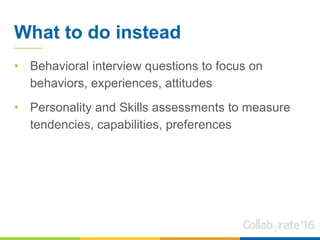
• Behavioral interview questions to focus on
behaviors, experiences, attitudes
• Personality and Skills assessments to measure
tendencies, capabilities, preferences
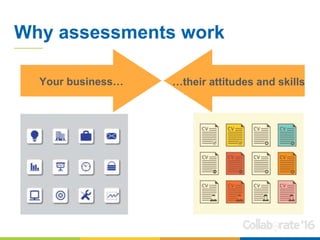
Why assessments work
…their attitudes and skillsYour business…
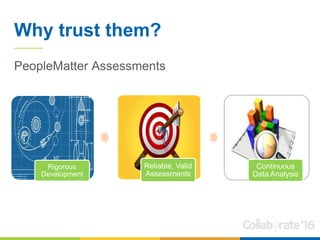
Why trust them?
PeopleMatter Assessments
Rigorous
Development
Reliable, Valid
Assessments
Continuous
Data Analysis
Summary: Hire for Attitude!
• Determine the attitudes that match your brand
• Attitude can’t be trained, so find applicants who fit
your brand!
• Use behavioral questions to get at someone’s
attitude and approach to work
• Use PeopleMatter Assessments to measure
tendencies, personality, attitudes

Hire for Attitude, Train for Skill

  • 1.
    HIRE FOR ATTITUDE, TRAINFOR SKILL Why Passion and Spirit Should Supersede a Resume
  • 3.
    Hiring For Attitude •Determining what the right Characteristics are for your specific Brand • Evaluating current interview questions and techniques • Creating interview questions that screen for these characteristics The right formula
  • 7.
    Determining Fit foryour brand Before you can even start the process of Hiring for Attitude, you need to determine what Attitude you want in your brand. • Top 3 Employees • Bottom 3 Employees • Come up with characteristics that make them the Top or Bottom
  • 8.
    Determining Fit foryour brand Top 3: • Runs their business like an owner - takes pride in ownership • Communicates collaboratively with staff members • Ensures guests service standards are exceeded in every situation • Knows how to prioritize multiple priorities and respond and react accordingly to balance the needs of the business as well as the needs of team members Bottom 3: • Constantly blames others or makes excuses for their lack of performance and execution • Receives multiple guest complaints and is unable to resolve issues • Consistently has high turnover and a revolving door with staff members • Has poor financial performance on a consist basis
  • 10.
    Learning what toask… • The 3 most common questions and why they shouldn’t be asked • The Behavioral questions and how to frame them • The Hypothetical questions
  • 11.
    Learning what toask… 1. Tell me about yourself…. 2. What are your strengths…. 3. What are your weaknesses…. What’s wrong with these questions – I ask these all the time….. The 3 most common questions
  • 12.
    Learning what toask… 1. Tell me when you had to adapt to a difficult situation. What did you do do? 2. Tell me about a time when you had to balance competing priorities and did so successfully. 3. Tell me about a conflict with a coworker and how you resolved it. How to frame behavioral questions
  • 13.
    Learning what toask… All Behavioral questions should start with an action word and not lead to what the outcome was. Tell me about a time you had to handle a challenging guest experience? (Eliminating the “tell me what you did”) “Could you…..” How to frame behavioral questions
  • 14.
    Learning what toask… What would you do if….. It’s easy to take a 50 foot view and be able to answer the question from the outside looking down – much harder to do when you are actually faced with the situation. The Hypothetical Question
  • 15.
    Creating your Interview Questions Step1: Pick one of the top characteristics that you identified in the Top 3 exercise Step 2: Identify a situation to elicit the characteristics Step 3: Begin the questions by asking. “Could you tell me about a time….” Step 4: Pause to leave the question hanging
  • 16.
    Why worry aboutfit? Because it’s ALL about fit! Company Fit Skills Fit Job Fit
  • 17.
  • 18.
    Why worry aboutfit? Yet, only 38% of employers are using Personality or Skills assessments in the pre-screening process Source: The PeopleMatter Institute
  • 19.
    What are weleft to do?
  • 20.
    What to doinstead • Behavioral interview questions to focus on behaviors, experiences, attitudes • Personality and Skills assessments to measure tendencies, capabilities, preferences
  • 21.
    Why assessments work …theirattitudes and skillsYour business…
  • 22.
    Why trust them? PeopleMatterAssessments Rigorous Development Reliable, Valid Assessments Continuous Data Analysis
  • 23.
    Summary: Hire forAttitude! • Determine the attitudes that match your brand • Attitude can’t be trained, so find applicants who fit your brand! • Use behavioral questions to get at someone’s attitude and approach to work • Use PeopleMatter Assessments to measure tendencies, personality, attitudes

Editor's Notes

  • #9 Once explained, have them write their top 3/bottom 3 and think about the characteristics that make them such. This is an exercise that you should do with your top leaders
  • #12 Will discuss what is wrong with these questions.
  • #13 Will discuss how these are leading questions and lead the candidate to answer ones that have a positive outcome. These are leading questions.
  • #14 Starting with “Could you…..(Elicits a physiological response that puts the interviewer in charge and breaks down barriers) Use this instead of Tell me about.
  • #15 Hypothetical questions are a waste of time – they are not indicative of the action someone would take when faced with the situation.
  • #17 Use to transition to how to measure fit
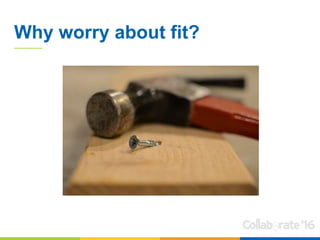
  • #18 Consequences of a lack of fit
  • #19 Use statistics to discuss what is being done
  • #20 Without assessing fit, we are left to guess or read minds, or try to predict the future on our own
  • #21 Demonstrate the options for measuring fit: --Interviewing as Carrie discussed --PeopleMatter assessments
  • #22 Interviews and assessments work (that is, they help us find people with the attitude/skills to do the job) when the content is job-related. Match between job requirements and applicant background, experience, attitude/skills.
  • #23 Why trust PM assessments? --Rigorous development --Reliable, valid --Continuous data analysis
  • #24 Summary of points from both