Work Ethics
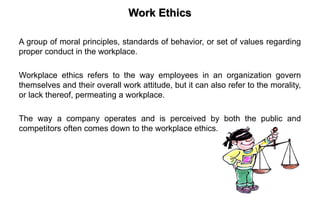
A group of moral principles, standards of behavior, or set of values regarding
proper conduct in the workplace.
Workplace ethics refers to the way employees in an organization govern
themselves and their overall work attitude, but it can also refer to the morality,
or lack thereof, permeating a workplace.
The way a company operates and is perceived by both the public and
competitors often comes down to the workplace ethics.
Why Employees are Fired?
(Common Reasons)
Objectives
• Develop your ability to recognize and promote ethical decisions in
the workplace.
• Identify ethical and unethical decisions and behaviors.
• Ethics represent a set of standards and values that define how
a business will manage itself and how it will promote the greater good.
• Work ethic traits: appearance, attendance, attitude, character,
communication, cooperation, organizational skills, productivity, respect
and teamwork.
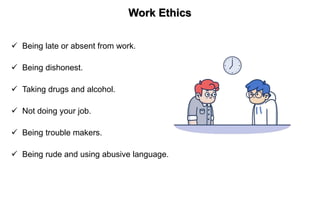
 Being late or absent from work.
 Being dishonest.
 Taking drugs and alcohol.
 Not doing your job.
 Being trouble makers.
 Being rude and using abusive language.
Work Ethics
 Being lazy and careless.
 Lost company assets.
 Lack of Time Management.
 Not getting along with others ( No Teamwork).
 Failing to follow company policies.
 Harassing.
Work Ethics
Work Ethics
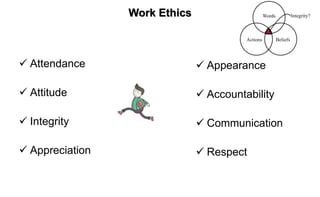
 Attendance
 Attitude
 Integrity
 Appreciation
 Appearance
 Accountability
 Communication
 Respect
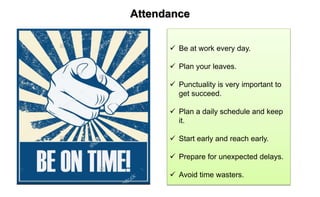
Attendance
Attendance
 Be at work every day.
 Plan your leaves.
 Punctuality is very important to
get succeed.
 Plan a daily schedule and keep
it.
 Start early and reach early.
 Prepare for unexpected delays.
 Avoid time wasters.
Attendance
× ×
DON’T BE HURRY.
 Dressing have an impact on self, colleagues and customers.
 Clothes convey the message that you are confident and presentable.
 You can impress the people. Your appearance speaks first.
 Wear company uniform or formals.
 Wear Shoes.
 Grooming also plays an important role in appearance.
Appearance
 Be positive at workplace.
 If you think You Can…………… You are right.
 If you think You Can’t…….You are right again.
 Positive thinkers achieve the impossible.
 Negative thoughts have no power unless you empower them.
Attitude
Accountability
 Responsible to complete assigned tasks.
 Responsible for company assets.
 Work towards to achieve common goal.
 Focus on tasks during working hours.
 Give honest feedback ( If you are assessing your team members).
 Use perks as per policy.
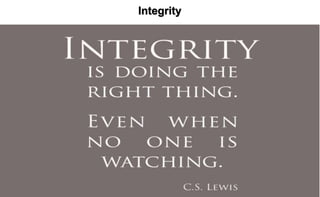
Integrity
Integrity
 Doing right things at all time and all circumstances either someone watching or
not.
 Choosing thoughts and actions not for personal gain
 Building a reputation of integrity takes years, but it takes only second to lose.
 Integrity is one of the fundamental values that employers seek in the
employees.
Integrity
Examples:
 Show up on time, every time.
 Keep all promises or explain the difficulty.
 Focus on performance.
 Be disciplined.
 Admit mistakes. Use mistakes as an opportunity for improvement.
 Maintain confidentiality.
Communication
Communication is simply the act of transferring information from one place,
person or group to another. Every communication involves (at least) one
sender, a message and a recipient.
These include our emotions, the cultural situation, the medium used to
communicate, and even our location.
Open and Clear Communication:
 Open and clear communication is the most important attribute for high
performance teams.
 Most of the problems can be solved through excellent communication such as
listening well and providing constructive feedback.
 Communication is main ingredient for a successful teamwork.
 Open communication encourages team members to express their views.
 Be a good listener to become great speaker and leader.
Communication
Appreciation
 Give credit wherever credit is due.
 Appreciate people for their ideas and achievements.
 Appreciation increases happiness and satisfaction.
 Appreciation improves company culture.
Appreciation
Treat Others With Respect
 Treat others as you wish to be treated.
 Pay attention to colleagues when they speak.
 Don’t treat based on position, appearance, religion and country.
 Treat everyone equally.
Wish You All The Best

Workplace_Ethics.pptx

  • 1.
    Work Ethics A groupof moral principles, standards of behavior, or set of values regarding proper conduct in the workplace. Workplace ethics refers to the way employees in an organization govern themselves and their overall work attitude, but it can also refer to the morality, or lack thereof, permeating a workplace. The way a company operates and is perceived by both the public and competitors often comes down to the workplace ethics.
  • 2.
    Why Employees areFired? (Common Reasons)
  • 3.
    Objectives • Develop yourability to recognize and promote ethical decisions in the workplace. • Identify ethical and unethical decisions and behaviors. • Ethics represent a set of standards and values that define how a business will manage itself and how it will promote the greater good. • Work ethic traits: appearance, attendance, attitude, character, communication, cooperation, organizational skills, productivity, respect and teamwork.
  • 4.
     Being lateor absent from work.  Being dishonest.  Taking drugs and alcohol.  Not doing your job.  Being trouble makers.  Being rude and using abusive language. Work Ethics
  • 5.
     Being lazyand careless.  Lost company assets.  Lack of Time Management.  Not getting along with others ( No Teamwork).  Failing to follow company policies.  Harassing. Work Ethics
  • 6.
    Work Ethics  Attendance Attitude  Integrity  Appreciation  Appearance  Accountability  Communication  Respect
  • 8.
  • 9.
    Attendance  Be atwork every day.  Plan your leaves.  Punctuality is very important to get succeed.  Plan a daily schedule and keep it.  Start early and reach early.  Prepare for unexpected delays.  Avoid time wasters.
  • 10.
  • 11.
     Dressing havean impact on self, colleagues and customers.  Clothes convey the message that you are confident and presentable.  You can impress the people. Your appearance speaks first.  Wear company uniform or formals.  Wear Shoes.  Grooming also plays an important role in appearance. Appearance
  • 12.
     Be positiveat workplace.  If you think You Can…………… You are right.  If you think You Can’t…….You are right again.  Positive thinkers achieve the impossible.  Negative thoughts have no power unless you empower them. Attitude
  • 13.
    Accountability  Responsible tocomplete assigned tasks.  Responsible for company assets.  Work towards to achieve common goal.  Focus on tasks during working hours.  Give honest feedback ( If you are assessing your team members).  Use perks as per policy.
  • 14.
  • 15.
    Integrity  Doing rightthings at all time and all circumstances either someone watching or not.  Choosing thoughts and actions not for personal gain  Building a reputation of integrity takes years, but it takes only second to lose.  Integrity is one of the fundamental values that employers seek in the employees.
  • 16.
    Integrity Examples:  Show upon time, every time.  Keep all promises or explain the difficulty.  Focus on performance.  Be disciplined.  Admit mistakes. Use mistakes as an opportunity for improvement.  Maintain confidentiality.
  • 17.
    Communication Communication is simplythe act of transferring information from one place, person or group to another. Every communication involves (at least) one sender, a message and a recipient. These include our emotions, the cultural situation, the medium used to communicate, and even our location.
  • 18.
    Open and ClearCommunication:  Open and clear communication is the most important attribute for high performance teams.  Most of the problems can be solved through excellent communication such as listening well and providing constructive feedback.  Communication is main ingredient for a successful teamwork.  Open communication encourages team members to express their views.  Be a good listener to become great speaker and leader. Communication
  • 19.
  • 20.
     Give creditwherever credit is due.  Appreciate people for their ideas and achievements.  Appreciation increases happiness and satisfaction.  Appreciation improves company culture. Appreciation
  • 21.
    Treat Others WithRespect  Treat others as you wish to be treated.  Pay attention to colleagues when they speak.  Don’t treat based on position, appearance, religion and country.  Treat everyone equally.
  • 22.
    Wish You AllThe Best