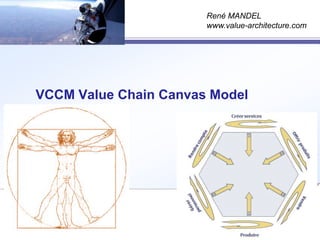
VCCM Value Chain Canvas Model
12/04/2013
René MANDEL
www.value-architecture.com
2
AGENDA
 1-The top-down approach Overview
 2-About the Author
 3-Main principles
 4-Example 1 : an Airport
 5 Example 2 : Offer creation in Retail
 6 Example 3 : Service Support ITIL
 7 Example 4 : Call for Proposal European Commission
 8 The EDA kit tool
 9 A panel of applications
EDA-kit
3
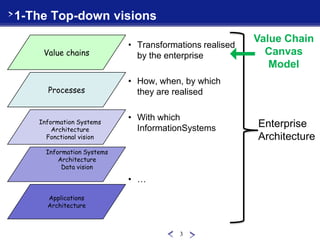
1-The Top-down visions
• Transformations realised
by the enterprise
• How, when, by which
they are realised
• With which
InformationSystems
• …
Value chains
Processes
Applications
Architecture
Information Systems
Architecture
Fonctional vision
Information Systems
Architecture
Data vision
Enterprise
Architecture
Value Chain
Canvas
Model
4
1-The Top-down visions
Enterprise
Architecture
Value Chain
Canvas Model
5
Rene MANDEL, after responsibilities with data processing for the French
statistical Institute, carried out many studies of projects of process and
information systems.
René is one of the founders of ORESYS, in 1981,and also one of the initiators
of the “Club des urbanistes et architectes d’entreprise” (www.urba-ea.org ).
He has published several articles on IS “urbanisme”, strategic alignment, IS
projects return on investment, and a book about IT and business strategies:
“De la stratégie business aux systèmes d’information, l’entreprise et son
écosystème” Hermès 2006 Paris.
Rene is graduate of the Polytechnic School and the Statistics and Economic
Administration National School.
KEY COMPETENCES
 Creator of method PREMYS ®: design of the planning and the architecture
of the information systems
 Creator of the model of Enterprise Architecture BUSINESS CANVAS®:
passage from the business strategy to processes, to IS planning
 Strategic foresight on Enterprise Architecture, BPM, SOA and new
architectures
 Generic functional fields: statistics, decisional-strategy, finance-
accountancy, human resources, documentation, data processing-IS real
estate, CRM-development of consumer loyalty, supply-chain,
communication
EDUCATION
 Polytechnic school - Paris (1961)
 National school of the Statistics and
the Economic Administration - Paris
(1966)
LANGUAGES
 English
PUBLICATIONS-CONFERENCES
 Strategy business with the
information systems (Hermes)
 Articles, white papers
 Conferences: Planning, EA, BPM
MAIN CLIENTS
 SNCF, AEROPORTS DE PARIS,
 Gaz de France,
 INSEE, UNEDIC, ANPE
 French and european ministries
and administrations
 Banks, insurances, distribution
2-René Mandel Founder of ORESYS
Club Urba-EA Vice President
6
René Mandel Founder of ORESYS
Club Urba-EA Vice President
ROFESSIONNAL PUBLICATIONS
« Practices of the planning of the information systems in enterprise » : Publibook 2003 (Participation in the work)
« Planning of IS governorship with the projects» : Dunod 2006 (Participation in the work)
« From the Strategy Business to the Information systems » Hermès 2006 (author)
7
3-VCCM : Main principles
 An ecosystem field
• The enterprise cooperate with partners to realize all sorts of
transformations
» Material operations
» Transport (supply chain,…)
» Immaterial value chains (financial, insurance, product design,
advertising,…)
• The ecosystem boundaries (virtual borders) are fixed by
invariable facts
» Cycles of events (product life cycle, project cycle, life events as
birth,…) in the real world or a virtual world ( concept changes,
regulation evolutions )
» Succession of events in an journey (traveler, consumer, user, freight,
road traffic,…)
 Value chains begin and end with events
• Events initiate the transformations
• And the result is delivered by event
8
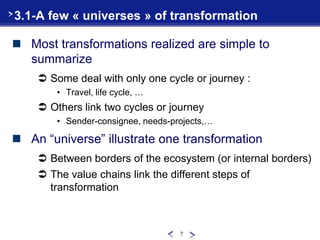
3.1-A few « universes » of transformation
 Most transformations realized are simple to
summarize
 Some deal with only one cycle or journey :
• Travel, life cycle, …
 Others link two cycles or journey
• Sender-consignee, needs-projects,…
 An “universe” illustrate one transformation
 Between borders of the ecosystem (or internal borders)
 The value chains link the different steps of
transformation
9
3.2-Case of a mono-boarder universe
 Please abstract now organization structures and
boundaries, processes, information systems,…
10
3.3 Three levels of value chain
 A few steps of transformation, symbolized by « levels » of
the value chain, a minima 3 levels :
» Proximity level
» Integration level
» Resource provider level
Proximity level
Integrator level
Ressource
Provider level
Event EventEvent Event Event Event EventEvent
11
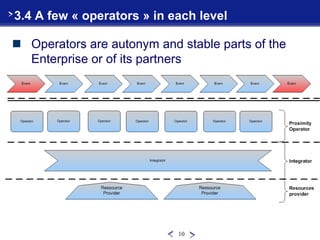
3.4 A few « operators » in each level
 Operators are autonym and stable parts of the Enterprise or
of its partners
12
3.5 The Polygon of facts
 At a macro level the enterprise ecosystem realize
few transformations, connected with a few external
facts and events
The « MANDEL Polygon »
Real or virtual cycle
synergies between
cycles
13
4.1 Example 1 : An Airport
 The passenger journey
14
4.2 Example 1 : An Airport ecosystem
 The plane course
15
5 Example 2 : Offer creation in Retail
 An immaterial universe with 2 boarders
16
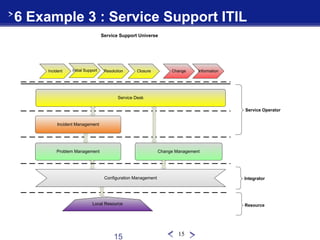
6 Example 3 : Service Support ITIL
16
Service Operator
Integrator
Incident Resolution ChangeClosure Information
Service Desk
Configuration Management
Incident Management
Problem Management Change Management
Service Support Universe
Local Resource Resource
Initial Support
17
IT
Financial
Scientific
Logistics
Research
area 2
7 Example 4 Call for Proposal
Logistics
Sub-contractors
(experts)
Integrator
DIGIT (Portal
operator)? Sub-
contractors
(REA? EPSS)?
Operational integration
Customer Relationship
Proposal
submission
Eligibility
Redress
request
Research
area 1
Sub-contractors
(REA, ESS?)
Call for
proposals
Budget – PFM integration
Scientific
evaluation
Ethical review
Operator?
Operators ?
Integrator
Multi-canal exchanges?
Elements for
negotiation
Elements for
hearings
REA ?
RDGs?
RDGs?
Security scrutiny
18
Conclusion This model addresses the Business
 Based on invariants
 Facts initiate transformations and value chains
 Describe the “battlefield” not the battle
 A multidimensional LEGO
 Easy to build and to imagine scenario
 Change the boundaries of the enterprise
 Extend the transformation to the beginning or the end of
the cycle
 Jump to the news borders
19
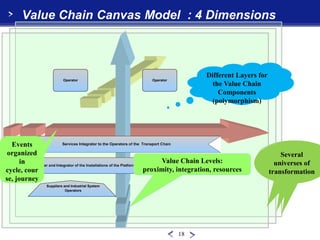
Value Chain Canvas Model : 4 Dimensions
Several
universes of
transformation
Different Layers for
the Value Chain
Components
(polymorphism)
Value Chain Levels: proximity,
integration, resources
Suppliers and Industrial System
Operators
OperatorOperator
Events
organized
in cycle,
course,
journey
20
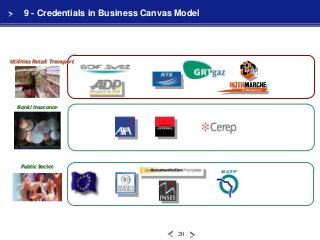
9 - Credentials in Business Canvas Model
Utilities Retail Transport
Public Sector
Bank/ Insurance
21
9 - Contact
About VCCM
http://www.value-architecture.com/p/vccm-value-chain-canvas-model.html
Contact rene.mandel@oresys.fr
http://www.linkedin.com/in/renemandel

Value Chain Canvas Model an Enterprise Architecture Framework

  • 1.
    VCCM Value ChainCanvas Model 12/04/2013 René MANDEL www.value-architecture.com
  • 2.
    2 AGENDA  1-The top-downapproach Overview  2-About the Author  3-Main principles  4-Example 1 : an Airport  5 Example 2 : Offer creation in Retail  6 Example 3 : Service Support ITIL  7 Example 4 : Call for Proposal European Commission  8 The EDA kit tool  9 A panel of applications EDA-kit
  • 3.
    3 1-The Top-down visions •Transformations realised by the enterprise • How, when, by which they are realised • With which InformationSystems • … Value chains Processes Applications Architecture Information Systems Architecture Fonctional vision Information Systems Architecture Data vision Enterprise Architecture Value Chain Canvas Model
  • 4.
  • 5.
    5 Rene MANDEL, afterresponsibilities with data processing for the French statistical Institute, carried out many studies of projects of process and information systems. René is one of the founders of ORESYS, in 1981,and also one of the initiators of the “Club des urbanistes et architectes d’entreprise” (www.urba-ea.org ). He has published several articles on IS “urbanisme”, strategic alignment, IS projects return on investment, and a book about IT and business strategies: “De la stratégie business aux systèmes d’information, l’entreprise et son écosystème” Hermès 2006 Paris. Rene is graduate of the Polytechnic School and the Statistics and Economic Administration National School. KEY COMPETENCES  Creator of method PREMYS ®: design of the planning and the architecture of the information systems  Creator of the model of Enterprise Architecture BUSINESS CANVAS®: passage from the business strategy to processes, to IS planning  Strategic foresight on Enterprise Architecture, BPM, SOA and new architectures  Generic functional fields: statistics, decisional-strategy, finance- accountancy, human resources, documentation, data processing-IS real estate, CRM-development of consumer loyalty, supply-chain, communication EDUCATION  Polytechnic school - Paris (1961)  National school of the Statistics and the Economic Administration - Paris (1966) LANGUAGES  English PUBLICATIONS-CONFERENCES  Strategy business with the information systems (Hermes)  Articles, white papers  Conferences: Planning, EA, BPM MAIN CLIENTS  SNCF, AEROPORTS DE PARIS,  Gaz de France,  INSEE, UNEDIC, ANPE  French and european ministries and administrations  Banks, insurances, distribution 2-René Mandel Founder of ORESYS Club Urba-EA Vice President
  • 6.
    6 René Mandel Founderof ORESYS Club Urba-EA Vice President ROFESSIONNAL PUBLICATIONS « Practices of the planning of the information systems in enterprise » : Publibook 2003 (Participation in the work) « Planning of IS governorship with the projects» : Dunod 2006 (Participation in the work) « From the Strategy Business to the Information systems » Hermès 2006 (author)
  • 7.
    7 3-VCCM : Mainprinciples  An ecosystem field • The enterprise cooperate with partners to realize all sorts of transformations » Material operations » Transport (supply chain,…) » Immaterial value chains (financial, insurance, product design, advertising,…) • The ecosystem boundaries (virtual borders) are fixed by invariable facts » Cycles of events (product life cycle, project cycle, life events as birth,…) in the real world or a virtual world ( concept changes, regulation evolutions ) » Succession of events in an journey (traveler, consumer, user, freight, road traffic,…)  Value chains begin and end with events • Events initiate the transformations • And the result is delivered by event
  • 8.
    8 3.1-A few «universes » of transformation  Most transformations realized are simple to summarize  Some deal with only one cycle or journey : • Travel, life cycle, …  Others link two cycles or journey • Sender-consignee, needs-projects,…  An “universe” illustrate one transformation  Between borders of the ecosystem (or internal borders)  The value chains link the different steps of transformation
  • 9.
    9 3.2-Case of amono-boarder universe  Please abstract now organization structures and boundaries, processes, information systems,…
  • 10.
    10 3.3 Three levelsof value chain  A few steps of transformation, symbolized by « levels » of the value chain, a minima 3 levels : » Proximity level » Integration level » Resource provider level Proximity level Integrator level Ressource Provider level Event EventEvent Event Event Event EventEvent
  • 11.
    11 3.4 A few« operators » in each level  Operators are autonym and stable parts of the Enterprise or of its partners
  • 12.
    12 3.5 The Polygonof facts  At a macro level the enterprise ecosystem realize few transformations, connected with a few external facts and events The « MANDEL Polygon » Real or virtual cycle synergies between cycles
  • 13.
    13 4.1 Example 1: An Airport  The passenger journey
  • 14.
    14 4.2 Example 1: An Airport ecosystem  The plane course
  • 15.
    15 5 Example 2: Offer creation in Retail  An immaterial universe with 2 boarders
  • 16.
    16 6 Example 3: Service Support ITIL 16 Service Operator Integrator Incident Resolution ChangeClosure Information Service Desk Configuration Management Incident Management Problem Management Change Management Service Support Universe Local Resource Resource Initial Support
  • 17.
    17 IT Financial Scientific Logistics Research area 2 7 Example4 Call for Proposal Logistics Sub-contractors (experts) Integrator DIGIT (Portal operator)? Sub- contractors (REA? EPSS)? Operational integration Customer Relationship Proposal submission Eligibility Redress request Research area 1 Sub-contractors (REA, ESS?) Call for proposals Budget – PFM integration Scientific evaluation Ethical review Operator? Operators ? Integrator Multi-canal exchanges? Elements for negotiation Elements for hearings REA ? RDGs? RDGs? Security scrutiny
  • 18.
    18 Conclusion This modeladdresses the Business  Based on invariants  Facts initiate transformations and value chains  Describe the “battlefield” not the battle  A multidimensional LEGO  Easy to build and to imagine scenario  Change the boundaries of the enterprise  Extend the transformation to the beginning or the end of the cycle  Jump to the news borders
  • 19.
    19 Value Chain CanvasModel : 4 Dimensions Several universes of transformation Different Layers for the Value Chain Components (polymorphism) Value Chain Levels: proximity, integration, resources Suppliers and Industrial System Operators OperatorOperator Events organized in cycle, course, journey
  • 20.
    20 9 - Credentialsin Business Canvas Model Utilities Retail Transport Public Sector Bank/ Insurance
  • 21.
    21 9 - Contact AboutVCCM http://www.value-architecture.com/p/vccm-value-chain-canvas-model.html Contact rene.mandel@oresys.fr http://www.linkedin.com/in/renemandel