Value delivered – is it the same or
different?
Ilia Bider, Erik Perjons
DSV, Stockholm University
Presentation at: VMBO 2019
Value Modeling and Business Ontologies
Stockholm, March 2019
Links to the video and article text on Slide 3
Background
● In the mid 1990s, many enterprises start to focus on customer
values, and the way this could be created - in business processes
● For example, the BPR guru Michael Hammer (1996) stated: ”The
purpose of the company is to create customer value”
(Hammer (1996) Beyond Reengineering)
Background
● Therefore, many industry leaders had the following picture in their
heads around mid 1990s (Bengtsson &Skärvad, 2011):
Processes Customer values
(Bengtsson &Skärvad (2011) Company strategic perspectives (in Swedish)
External links
● Link to the video presentation
https://youtu.be/eewTbSAxnc8
● Link to the text of the paper
http://bit.ly/2GJHfgs
Background
● Today, customer value is still in focus, for example, when
developing service management and marketing strategies
(Grönroos, 2016)
(Grönroos (2016) Service Management and Marketing)
Background
The concept of customer value triggers a number of
questions:
● What is customer value?
● What different customer values exists?
● Are customer values generic or bransch specific?
● How can customer value be categorized - given a certain branch?
● …
Question in focus
● How can values among enterprises in the same branch be
categorized?
Delimitation
● We focus on one branch – the consultant branch
● We focus on two different approaches to answer/discuss the
question in focus
Two approaches
● Two approaches to understand the differences of value in the consultant
branch - and build a categorization:
– Patterns of Strategy (Hoverstadt, Loh, 2017)
– Fractal Enterprise Modelling (Bider et al, 2016)
Patterns of Strategy
● Pattern of strategy – define an enterprise strategy in terms of
the way an enterprise is connected to elements/actors in the
environment – that is, the enterprise’s structural coupling
Consulting
company
Customer
Local
government
Supplier
Branch
….
(Hoverstadt & Loh (2017) Patterns of Strategy)
Patterns of Strategy
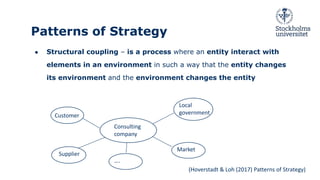
● Structural coupling – is a process where an entity interact with
elements in an environment in such a way that the entity changes
its environment and the environment changes the entity
Consulting
company
Customer
Local
government
Supplier
Market
….
(Hoverstadt & Loh (2017) Patterns of Strategy)
Patterns of Strategy
● The book ”Patterns of Strategy” presents 80 different patterns of
strategies arranged in groups based on the concept of structural
coupling
● We focus on a subset of these patterns, the patterns that are related
to the notion of herd
(Hoverstadt & Loh (2017) Patterns of Strategy)
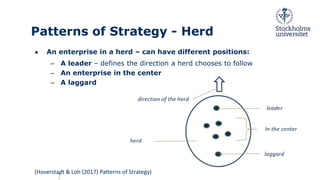
Patterns of Strategy - Herd
● Herd – is a group of enterprises in the same segment of a market
producing the same kind of products and services, that is, they
provide the same kind of value proposition
(Hoverstadt & Loh (2017) Patterns of Strategy)
Patterns of Strategy - Herd
● An enterprise in a herd – can have different positions:
– A leader – defines the direction a herd chooses to follow
– An enterprise in the center
– A laggard
(Hoverstadt & Loh (2017) Patterns of Strategy)
Patterns of Strategy – Individuals
outside the herd
● Individual enterprises
are not part of the herd
● They provide value to
the customers in a market
segment
● They provide value in
different ways than the
enterprises in the herd
(Hoverstadt & Loh (2017) Patterns of Strategy)
Patterns of Strategy – Management
Consulting Bransch
● Different values to be delivered among consultant companies:
Properties of methods
Leader Latest versions. Risky. Expensive.
In the center Tested. Less risky. Less expensive.
Laggard Less valuable. Cheap.
Individual Non-mainstream methods.
Fractal Enterprise Model (FEM)
● FEM – is a model that focuses on 1) enterprise processes and
2) assets and 3) relationships between them, and helps to
visualize these relationships
Process
Asset (resource)
(Bider, Perjons, Elias & Johannesson (2017) A fractal
enterprise model and its application for business
development, Software & Systems Modeling 16 (3))
FEM – step by step
● To build a FEM, one starts with a process (in most cases a
primary one)
Providing solutions
for customers
FEM – step by step
● … then assets that are needed to run process instances are
identified
Providing solutions
for customers
FEM – step by step
● … then assets that are needed to run process instances are
identified
Providing solutions
for customers
Providing solutions
for customers
Enterprise that
need help in
solving problem
Management
consultant
Method
Tool, including
software
Beneficiary
Workforce EXT
Tech & Info
Infrastructure
FEM – step by step
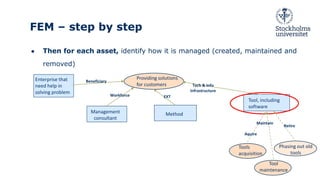
● Then for each asset, identify how it is managed (created, maintained and
removed)
Providing solutions
for customers
Providing solutions
for customers
Enterprise that
need help in
solving problem
Management
consultant
Method
Tool, including
software
Beneficiary
Workforce EXT
Tech & Info
Infrastructure
FEM – step by step
● Then for each asset, identify how it is managed (created, maintained and
removed)
Providing solutions
for customers
Providing solutions
for customers
Enterprise that
need help in
solving problem
Management
consultant
Method
Tool, including
software
Beneficiary
Workforce EXT
Tech & Info
Infrastructure
Tools
acquisition
Tool
maintenance
Phasing out old
tools
Aquire
Maintain
Retire
FEM – step by step
● Then for each asset, identify how it is managed (created, maintained and
removed)
Providing solutions
for customers
Providing solutions
for customers
Enterprise that
need help in
solving problem
Management
consultant
Method
Tool, including
software
Beneficiary
Workforce EXT
Tech & Info
Infrastructure
Tools
acquisition
Tool
maintenance
Phasing out old
tools
Aquire
Maintain
Retire
Methods
acquisition
Methods
maintenance
Phasing out old
methods
Aquire
Maintain
Retire
Recruiting
Education and
training
Aquire Maintain Retire
Sales and
marketing
Aquire Maintain
Cancelling the
relationship
FEM – step by step
● Then for each newly added process, once again, identify the assets that
are needed for running its instances
Providing solutions
for customers
Providing solutions
for customers
Enterprise that
need help in
solving problem
Management
consultant
Method
Tool, including
software
Beneficiary
Workforce EXT
Tech & Info
Infrastructure
Tools
acquisition
Tool
maintenance
Phasing out old
tools
Aquire
Maintain
Retire
Methods
acquisition
Methods
maintenance
Phasing out old
methods
Aquire
Maintain
Retire
Recruiting
Education and
training
Aquire Maintain Retire
Sales and
marketing
Aquire Maintain
Cancelling the
relationship
FEM – step by step
● Then for each newly added process, once again, identify the assets that
are needed for running its instances
Providing solutions
for customers
Enterprise that
need help in
solving problem
Management
consultant
Method
Tool, including
software
Tools
acquisition
Tool
maintenance
Phasing out old
tools
Beneficiary
Workforce EXT
Tech & Info
Infrastructure
Aquire
Maintain
Retire
Methods
acquisition
Methods
maintenance
Phasing out old
methods
Aquire
Maintain
Retire
Recruiting
Education and
training
Cancelling the
relationship
Aquire Maintain Retire
Sales and
marketing
Aquire Maintain
Value
proposition
Attraction
FEM – Management Consulting
Bransch
● When an the consulting company is forming its value proposition, the
consulting company needs to focus on one of the three main assets:
– Workforce
– Method (EXT)
– Tools
FEM – Management Consulting
Bransch
● These assets can be used to classify the values based on means for
producing values as well as impacts on internal structure
Means for producing values Effects on internal structure
Workforce ”World class” experts Focus on processes for
recruiting and training
Methods (EXT) Well-tested or unique
methods
Focus on processes for
finding and adopting or
developing methods
Tools Excellent tools Focus on processes for
finding or developing tools
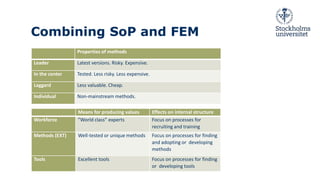
Combining SoP and FEM
Means for producing values Effects on internal structure
Workforce ”World class” experts Focus on processes for
recruiting and training
Methods (EXT) Well-tested or unique methods Focus on processes for finding
and adopting or developing
methods
Tools Excellent tools Focus on processes for finding
or developing tools
Properties of methods
Leader Latest versions. Risky. Expensive.
In the center Tested. Less risky. Less expensive.
Laggard Less valuable. Cheap.
Individual Non-mainstream methods.
Conclusion
● Future research:
– Compare to other existing value categorizations
– Create method for selecting an appropriate value
categorizations
– Categorising existing SME consultant companies
● How to use the result:
– Support customers to select appropriate consultant
companies given the customer’s issues
– Support consultant companies to select appropriate
stategies

Value delivered - is it the same or different?

  • 1.
    Value delivered –is it the same or different? Ilia Bider, Erik Perjons DSV, Stockholm University Presentation at: VMBO 2019 Value Modeling and Business Ontologies Stockholm, March 2019 Links to the video and article text on Slide 3
  • 2.
    Background ● In themid 1990s, many enterprises start to focus on customer values, and the way this could be created - in business processes ● For example, the BPR guru Michael Hammer (1996) stated: ”The purpose of the company is to create customer value” (Hammer (1996) Beyond Reengineering)
  • 3.
    Background ● Therefore, manyindustry leaders had the following picture in their heads around mid 1990s (Bengtsson &Skärvad, 2011): Processes Customer values (Bengtsson &Skärvad (2011) Company strategic perspectives (in Swedish)
  • 4.
    External links ● Linkto the video presentation https://youtu.be/eewTbSAxnc8 ● Link to the text of the paper http://bit.ly/2GJHfgs
  • 5.
    Background ● Today, customervalue is still in focus, for example, when developing service management and marketing strategies (Grönroos, 2016) (Grönroos (2016) Service Management and Marketing)
  • 6.
    Background The concept ofcustomer value triggers a number of questions: ● What is customer value? ● What different customer values exists? ● Are customer values generic or bransch specific? ● How can customer value be categorized - given a certain branch? ● …
  • 7.
    Question in focus ●How can values among enterprises in the same branch be categorized?
  • 8.
    Delimitation ● We focuson one branch – the consultant branch ● We focus on two different approaches to answer/discuss the question in focus
  • 9.
    Two approaches ● Twoapproaches to understand the differences of value in the consultant branch - and build a categorization: – Patterns of Strategy (Hoverstadt, Loh, 2017) – Fractal Enterprise Modelling (Bider et al, 2016)
  • 10.
    Patterns of Strategy ●Pattern of strategy – define an enterprise strategy in terms of the way an enterprise is connected to elements/actors in the environment – that is, the enterprise’s structural coupling Consulting company Customer Local government Supplier Branch …. (Hoverstadt & Loh (2017) Patterns of Strategy)
  • 11.
    Patterns of Strategy ●Structural coupling – is a process where an entity interact with elements in an environment in such a way that the entity changes its environment and the environment changes the entity Consulting company Customer Local government Supplier Market …. (Hoverstadt & Loh (2017) Patterns of Strategy)
  • 12.
    Patterns of Strategy ●The book ”Patterns of Strategy” presents 80 different patterns of strategies arranged in groups based on the concept of structural coupling ● We focus on a subset of these patterns, the patterns that are related to the notion of herd (Hoverstadt & Loh (2017) Patterns of Strategy)
  • 13.
    Patterns of Strategy- Herd ● Herd – is a group of enterprises in the same segment of a market producing the same kind of products and services, that is, they provide the same kind of value proposition (Hoverstadt & Loh (2017) Patterns of Strategy)
  • 14.
    Patterns of Strategy- Herd ● An enterprise in a herd – can have different positions: – A leader – defines the direction a herd chooses to follow – An enterprise in the center – A laggard (Hoverstadt & Loh (2017) Patterns of Strategy)
  • 15.
    Patterns of Strategy– Individuals outside the herd ● Individual enterprises are not part of the herd ● They provide value to the customers in a market segment ● They provide value in different ways than the enterprises in the herd (Hoverstadt & Loh (2017) Patterns of Strategy)
  • 16.
    Patterns of Strategy– Management Consulting Bransch ● Different values to be delivered among consultant companies: Properties of methods Leader Latest versions. Risky. Expensive. In the center Tested. Less risky. Less expensive. Laggard Less valuable. Cheap. Individual Non-mainstream methods.
  • 17.
    Fractal Enterprise Model(FEM) ● FEM – is a model that focuses on 1) enterprise processes and 2) assets and 3) relationships between them, and helps to visualize these relationships Process Asset (resource) (Bider, Perjons, Elias & Johannesson (2017) A fractal enterprise model and its application for business development, Software & Systems Modeling 16 (3))
  • 18.
    FEM – stepby step ● To build a FEM, one starts with a process (in most cases a primary one) Providing solutions for customers
  • 19.
    FEM – stepby step ● … then assets that are needed to run process instances are identified Providing solutions for customers
  • 20.
    FEM – stepby step ● … then assets that are needed to run process instances are identified Providing solutions for customers Providing solutions for customers Enterprise that need help in solving problem Management consultant Method Tool, including software Beneficiary Workforce EXT Tech & Info Infrastructure
  • 21.
    FEM – stepby step ● Then for each asset, identify how it is managed (created, maintained and removed) Providing solutions for customers Providing solutions for customers Enterprise that need help in solving problem Management consultant Method Tool, including software Beneficiary Workforce EXT Tech & Info Infrastructure
  • 22.
    FEM – stepby step ● Then for each asset, identify how it is managed (created, maintained and removed) Providing solutions for customers Providing solutions for customers Enterprise that need help in solving problem Management consultant Method Tool, including software Beneficiary Workforce EXT Tech & Info Infrastructure Tools acquisition Tool maintenance Phasing out old tools Aquire Maintain Retire
  • 23.
    FEM – stepby step ● Then for each asset, identify how it is managed (created, maintained and removed) Providing solutions for customers Providing solutions for customers Enterprise that need help in solving problem Management consultant Method Tool, including software Beneficiary Workforce EXT Tech & Info Infrastructure Tools acquisition Tool maintenance Phasing out old tools Aquire Maintain Retire Methods acquisition Methods maintenance Phasing out old methods Aquire Maintain Retire Recruiting Education and training Aquire Maintain Retire Sales and marketing Aquire Maintain Cancelling the relationship
  • 24.
    FEM – stepby step ● Then for each newly added process, once again, identify the assets that are needed for running its instances Providing solutions for customers Providing solutions for customers Enterprise that need help in solving problem Management consultant Method Tool, including software Beneficiary Workforce EXT Tech & Info Infrastructure Tools acquisition Tool maintenance Phasing out old tools Aquire Maintain Retire Methods acquisition Methods maintenance Phasing out old methods Aquire Maintain Retire Recruiting Education and training Aquire Maintain Retire Sales and marketing Aquire Maintain Cancelling the relationship
  • 25.
    FEM – stepby step ● Then for each newly added process, once again, identify the assets that are needed for running its instances Providing solutions for customers Enterprise that need help in solving problem Management consultant Method Tool, including software Tools acquisition Tool maintenance Phasing out old tools Beneficiary Workforce EXT Tech & Info Infrastructure Aquire Maintain Retire Methods acquisition Methods maintenance Phasing out old methods Aquire Maintain Retire Recruiting Education and training Cancelling the relationship Aquire Maintain Retire Sales and marketing Aquire Maintain Value proposition Attraction
  • 26.
    FEM – ManagementConsulting Bransch ● When an the consulting company is forming its value proposition, the consulting company needs to focus on one of the three main assets: – Workforce – Method (EXT) – Tools
  • 27.
    FEM – ManagementConsulting Bransch ● These assets can be used to classify the values based on means for producing values as well as impacts on internal structure Means for producing values Effects on internal structure Workforce ”World class” experts Focus on processes for recruiting and training Methods (EXT) Well-tested or unique methods Focus on processes for finding and adopting or developing methods Tools Excellent tools Focus on processes for finding or developing tools
  • 28.
    Combining SoP andFEM Means for producing values Effects on internal structure Workforce ”World class” experts Focus on processes for recruiting and training Methods (EXT) Well-tested or unique methods Focus on processes for finding and adopting or developing methods Tools Excellent tools Focus on processes for finding or developing tools Properties of methods Leader Latest versions. Risky. Expensive. In the center Tested. Less risky. Less expensive. Laggard Less valuable. Cheap. Individual Non-mainstream methods.
  • 29.
    Conclusion ● Future research: –Compare to other existing value categorizations – Create method for selecting an appropriate value categorizations – Categorising existing SME consultant companies ● How to use the result: – Support customers to select appropriate consultant companies given the customer’s issues – Support consultant companies to select appropriate stategies