UNDERSTAND THE INCREASE IN THE
COMPLEXITY OF INFORMATION SYSTEMS:
PROJECT “FOCUS COMPONENTS”
René MANDEL
www.value-architecture.com
Version 0
May 2015
Focus-composants-english-V0 21/06/2015
SOMMARY
Table of content
1. PREAMBLE.................................................................................................................... 1
1.1 COMPLEXIFICATION OF INFORMATION SYSTEMS....................................... 1
1.2 MOBILIZABLE DATA............................................................................................. 1
2. WAYS OF RESEARCH................................................................................................. 2
2.1 CHARACTERIZE THE DISORGANIZATION OF A SET OF COMPONENTS .. 2
2.2 CONSIDER THE CASE OF ACTUAL BASES OF COMPONENTS..................... 2
2.3 STUDY THE STACKING OF THE GENERATIONS OF COMPONENTS .......... 3
2.4 ASSESS THE IMPACTS ON RESPONSIVENESS AND COSTS.......................... 4
3. CONCLUSIONS............................................................................................................. 5
3.1 MASTER NATURAL DRIFTS OF IS ...................................................................... 5
3.2 INVOLVE RELEVANT STAKEHOLDERS............................................................ 5
Understand the natural increase in IS complexity PAGE N° 1
René MANDEL May 2015
1. PREAMBLE
1.1 COMPLEXIFICATION OF INFORMATION SYSTEMS
In is a previous note “Is the increase in the entropy of information systems a fate?” two
principal assumptions were posed:
• There exists a “natural” increase in complexity, due to a drift of architecture.
Indeed, as the integration of components, the “optimal” role of reference
components “is usurped”. The probable causes of this drift can be the lack of
information, the absence of flexibility of the existing reference components, the
short-term vision which privileges fast development to the detriment of simplicity,
• Another assumption is that the use of technologies of data integration, largely
available at a moderate cost, would make it possible to thwart natural propensity to
complexification.
This phenomenon occurs in extremely varied contexts: business computing, but also
technical computing: systems of systems, and it will also occur “fatally” in the current
extensive fields: Big Data, connected objects. Technological and methodological changes
(agile approaches, micro-services…) will not mitigate these difficulties, consubstantial
with the activity of systems development and integration.
The economic issue of the control of this race to complexity is paramount, and should
mobilize energies of the IT experts.
1.2 MOBILIZABLE DATA
It is paradoxical to note that, vis-a-vis this challenge, with this IT’s complexity wall which
can handicap investments in IS:
• The specialists in software engineering, and Enterprise Architects, were interested
especially in modeling, in creation of an architecture, in “systems of systems”. And
few with the phenomenon of stacking of these architectures, ageing by successive
generations.
• More and more of data on “Information System of IS” are available, because the
management of application heritage, the management of configuration, spread, for
example through methods like ITIL.
Understand the natural increase in IS complexity PAGE N° 2
René MANDEL May 2015
2. WAYS OF RESEARCH
2.1 CHARACTERIZE THE DISORGANIZATION OF A SET OF COMPONENTS
From the study of a population of components connected by recursive graph one can
characterize each component by his implication in the graph of architecture. For example:
• Number of direct ascendants,
• Number of direct descendants,
• Complexity of these relations
One can also be interested in 2 classes of components:
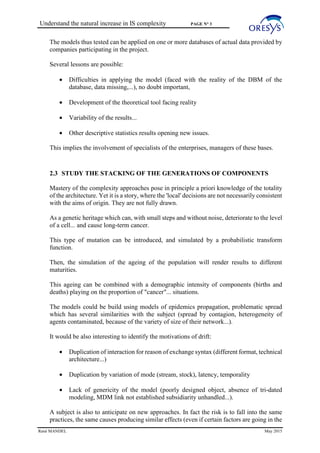
• Reference components, which are in general useful for a large number of
components,
• Ordinary components, which are in general in local integration relations
From these characteristics one can:
• Summarize the population (dispersion for the various classes of components)
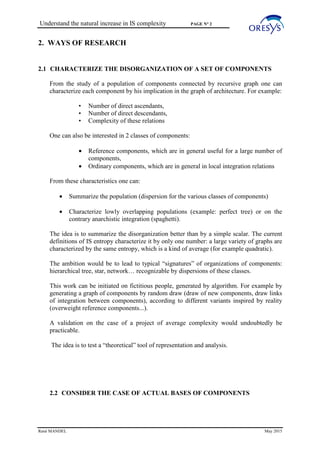
• Characterize lowly overlapping populations (example: perfect tree) or on the
contrary anarchistic integration (spaghetti).
The idea is to summarize the disorganization better than by a simple scalar. The current
definitions of IS entropy characterize it by only one number: a large variety of graphs are
characterized by the same entropy, which is a kind of average (for example quadratic).
The ambition would be to lead to typical “signatures” of organizations of components:
hierarchical tree, star, network… recognizable by dispersions of these classes.
This work can be initiated on fictitious people, generated by algorithm. For example by
generating a graph of components by random draw (draw of new components, draw links
of integration between components), according to different variants inspired by reality
(overweight reference components...).
A validation on the case of a project of average complexity would undoubtedly be
practicable.
The idea is to test a “theoretical” tool of representation and analysis.
2.2 CONSIDER THE CASE OF ACTUAL BASES OF COMPONENTS
Understand the natural increase in IS complexity PAGE N° 3
René MANDEL May 2015
The models thus tested can be applied on one or more databases of actual data provided by
companies participating in the project.
Several lessons are possible:
• Difficulties in applying the model (faced with the reality of the DBM of the
database, data missing,...), no doubt important,
• Development of the theoretical tool facing reality
• Variability of the results...
• Other descriptive statistics results opening new issues.
This implies the involvement of specialists of the enterprises, managers of these bases.
2.3 STUDY THE STACKING OF THE GENERATIONS OF COMPONENTS
Mastery of the complexity approaches pose in principle a priori knowledge of the totality
of the architecture. Yet it is a story, where the 'local' decisions are not necessarily consistent
with the aims of origin. They are not fully drawn.
As a genetic heritage which can, with small steps and without noise, deteriorate to the level
of a cell... and cause long-term cancer.
This type of mutation can be introduced, and simulated by a probabilistic transform
function.
Then, the simulation of the ageing of the population will render results to different
maturities.
This ageing can be combined with a demographic intensity of components (births and
deaths) playing on the proportion of "cancer"... situations.
The models could be build using models of epidemics propagation, problematic spread
which has several similarities with the subject (spread by contagion, heterogeneity of
agents contaminated, because of the variety of size of their network...).
It would be also interesting to identify the motivations of drift:
• Duplication of interaction for reason of exchange syntax (different format, technical
architecture...)
• Duplication by variation of mode (stream, stock), latency, temporality
• Lack of genericity of the model (poorly designed object, absence of tri-dated
modeling, MDM link not established subsidiarity unhandled...).
A subject is also to anticipate on new approaches. In fact the risk is to fall into the same
practices, the same causes producing similar effects (even if certain factors are going in the
Understand the natural increase in IS complexity PAGE N° 4
René MANDEL May 2015
right direction): DevOps, micro-services. The objective is to advance in the explanation
of this natural complexity. And, by implication, to find preventive parades ("Janus
components" are typically agents limiting the perverse effects of stacking).
2.4 ASSESS THE IMPACTS ON RESPONSIVENESS AND COSTS
The final objective of the research is to master the drift of the costs induced by natural
ageing of IS heritage. On the basis of previous work, it is possible to assess these financial
impacts in terms of additional costs of investment and maintenance.
A direct application is the evaluation of "Janus" type approaches for reference components
(MDM, data wells). More generally, the capitalization on IS would be better made, even
through new concepts very fashionable (Big Data, Data Lake).
In short, answer to the question: how to keep an IS still 'young', and what the financial
stakes are.
A link with the APM is also a practical spin-off which would be very beneficial.
Understand the natural increase in IS complexity PAGE N° 5
René MANDEL May 2015
3. CONCLUSIONS
3.1 MASTER NATURAL DRIFTS OF IS
This project tackles a phenomenon known and found both by the owners, the contractors,
the planners of IT projects.
It aims to exceed this stage of the finding, apprehending natural drifts that occur within the
overall framework, beyond the project cycle. Because the classic architecture approaches
lie on :
• In the context of a project, the analogy with the creation of a building (software
architecture, MDA,...)
• In the context of a set of projects, typically in an Enterprise Architecture approach
(e.g. Open Group with Togaf and its cycle ADM), the analogy with the creation of
a new town.
The "demographic model" approach would be adapted to the current phase of IS creation,
increasingly large and technologically diverse and innovative.
3.2 INVOLVE RELEVANT STAKEHOLDERS
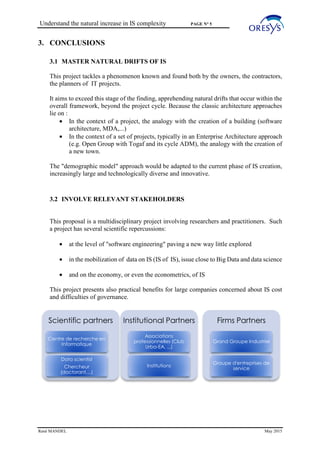
This proposal is a multidisciplinary project involving researchers and practitioners. Such
a project has several scientific repercussions:
• at the level of "software engineering" paving a new way little explored
• in the mobilization of data on IS (IS of IS), issue close to Big Data and data science
• and on the economy, or even the econometrics, of IS
This project presents also practical benefits for large companies concerned about IS cost
and difficulties of governance.
Scientific partners
Centre de recherche en
Informatique
Data scientist
Chercheur
(doctorant,...)
Institutional Partners
Associations
professionnelles (Club
Urba-EA, ...)
Institutions
Firms Partners
Grand Groupe Industriel
Groupe d'entreprises de
service

Focus composants-english-v0

  • 1.
    UNDERSTAND THE INCREASEIN THE COMPLEXITY OF INFORMATION SYSTEMS: PROJECT “FOCUS COMPONENTS” René MANDEL www.value-architecture.com Version 0 May 2015
  • 2.
    Focus-composants-english-V0 21/06/2015 SOMMARY Table ofcontent 1. PREAMBLE.................................................................................................................... 1 1.1 COMPLEXIFICATION OF INFORMATION SYSTEMS....................................... 1 1.2 MOBILIZABLE DATA............................................................................................. 1 2. WAYS OF RESEARCH................................................................................................. 2 2.1 CHARACTERIZE THE DISORGANIZATION OF A SET OF COMPONENTS .. 2 2.2 CONSIDER THE CASE OF ACTUAL BASES OF COMPONENTS..................... 2 2.3 STUDY THE STACKING OF THE GENERATIONS OF COMPONENTS .......... 3 2.4 ASSESS THE IMPACTS ON RESPONSIVENESS AND COSTS.......................... 4 3. CONCLUSIONS............................................................................................................. 5 3.1 MASTER NATURAL DRIFTS OF IS ...................................................................... 5 3.2 INVOLVE RELEVANT STAKEHOLDERS............................................................ 5
  • 3.
    Understand the naturalincrease in IS complexity PAGE N° 1 René MANDEL May 2015 1. PREAMBLE 1.1 COMPLEXIFICATION OF INFORMATION SYSTEMS In is a previous note “Is the increase in the entropy of information systems a fate?” two principal assumptions were posed: • There exists a “natural” increase in complexity, due to a drift of architecture. Indeed, as the integration of components, the “optimal” role of reference components “is usurped”. The probable causes of this drift can be the lack of information, the absence of flexibility of the existing reference components, the short-term vision which privileges fast development to the detriment of simplicity, • Another assumption is that the use of technologies of data integration, largely available at a moderate cost, would make it possible to thwart natural propensity to complexification. This phenomenon occurs in extremely varied contexts: business computing, but also technical computing: systems of systems, and it will also occur “fatally” in the current extensive fields: Big Data, connected objects. Technological and methodological changes (agile approaches, micro-services…) will not mitigate these difficulties, consubstantial with the activity of systems development and integration. The economic issue of the control of this race to complexity is paramount, and should mobilize energies of the IT experts. 1.2 MOBILIZABLE DATA It is paradoxical to note that, vis-a-vis this challenge, with this IT’s complexity wall which can handicap investments in IS: • The specialists in software engineering, and Enterprise Architects, were interested especially in modeling, in creation of an architecture, in “systems of systems”. And few with the phenomenon of stacking of these architectures, ageing by successive generations. • More and more of data on “Information System of IS” are available, because the management of application heritage, the management of configuration, spread, for example through methods like ITIL.
  • 4.
    Understand the naturalincrease in IS complexity PAGE N° 2 René MANDEL May 2015 2. WAYS OF RESEARCH 2.1 CHARACTERIZE THE DISORGANIZATION OF A SET OF COMPONENTS From the study of a population of components connected by recursive graph one can characterize each component by his implication in the graph of architecture. For example: • Number of direct ascendants, • Number of direct descendants, • Complexity of these relations One can also be interested in 2 classes of components: • Reference components, which are in general useful for a large number of components, • Ordinary components, which are in general in local integration relations From these characteristics one can: • Summarize the population (dispersion for the various classes of components) • Characterize lowly overlapping populations (example: perfect tree) or on the contrary anarchistic integration (spaghetti). The idea is to summarize the disorganization better than by a simple scalar. The current definitions of IS entropy characterize it by only one number: a large variety of graphs are characterized by the same entropy, which is a kind of average (for example quadratic). The ambition would be to lead to typical “signatures” of organizations of components: hierarchical tree, star, network… recognizable by dispersions of these classes. This work can be initiated on fictitious people, generated by algorithm. For example by generating a graph of components by random draw (draw of new components, draw links of integration between components), according to different variants inspired by reality (overweight reference components...). A validation on the case of a project of average complexity would undoubtedly be practicable. The idea is to test a “theoretical” tool of representation and analysis. 2.2 CONSIDER THE CASE OF ACTUAL BASES OF COMPONENTS
  • 5.
    Understand the naturalincrease in IS complexity PAGE N° 3 René MANDEL May 2015 The models thus tested can be applied on one or more databases of actual data provided by companies participating in the project. Several lessons are possible: • Difficulties in applying the model (faced with the reality of the DBM of the database, data missing,...), no doubt important, • Development of the theoretical tool facing reality • Variability of the results... • Other descriptive statistics results opening new issues. This implies the involvement of specialists of the enterprises, managers of these bases. 2.3 STUDY THE STACKING OF THE GENERATIONS OF COMPONENTS Mastery of the complexity approaches pose in principle a priori knowledge of the totality of the architecture. Yet it is a story, where the 'local' decisions are not necessarily consistent with the aims of origin. They are not fully drawn. As a genetic heritage which can, with small steps and without noise, deteriorate to the level of a cell... and cause long-term cancer. This type of mutation can be introduced, and simulated by a probabilistic transform function. Then, the simulation of the ageing of the population will render results to different maturities. This ageing can be combined with a demographic intensity of components (births and deaths) playing on the proportion of "cancer"... situations. The models could be build using models of epidemics propagation, problematic spread which has several similarities with the subject (spread by contagion, heterogeneity of agents contaminated, because of the variety of size of their network...). It would be also interesting to identify the motivations of drift: • Duplication of interaction for reason of exchange syntax (different format, technical architecture...) • Duplication by variation of mode (stream, stock), latency, temporality • Lack of genericity of the model (poorly designed object, absence of tri-dated modeling, MDM link not established subsidiarity unhandled...). A subject is also to anticipate on new approaches. In fact the risk is to fall into the same practices, the same causes producing similar effects (even if certain factors are going in the
  • 6.
    Understand the naturalincrease in IS complexity PAGE N° 4 René MANDEL May 2015 right direction): DevOps, micro-services. The objective is to advance in the explanation of this natural complexity. And, by implication, to find preventive parades ("Janus components" are typically agents limiting the perverse effects of stacking). 2.4 ASSESS THE IMPACTS ON RESPONSIVENESS AND COSTS The final objective of the research is to master the drift of the costs induced by natural ageing of IS heritage. On the basis of previous work, it is possible to assess these financial impacts in terms of additional costs of investment and maintenance. A direct application is the evaluation of "Janus" type approaches for reference components (MDM, data wells). More generally, the capitalization on IS would be better made, even through new concepts very fashionable (Big Data, Data Lake). In short, answer to the question: how to keep an IS still 'young', and what the financial stakes are. A link with the APM is also a practical spin-off which would be very beneficial.
  • 7.
    Understand the naturalincrease in IS complexity PAGE N° 5 René MANDEL May 2015 3. CONCLUSIONS 3.1 MASTER NATURAL DRIFTS OF IS This project tackles a phenomenon known and found both by the owners, the contractors, the planners of IT projects. It aims to exceed this stage of the finding, apprehending natural drifts that occur within the overall framework, beyond the project cycle. Because the classic architecture approaches lie on : • In the context of a project, the analogy with the creation of a building (software architecture, MDA,...) • In the context of a set of projects, typically in an Enterprise Architecture approach (e.g. Open Group with Togaf and its cycle ADM), the analogy with the creation of a new town. The "demographic model" approach would be adapted to the current phase of IS creation, increasingly large and technologically diverse and innovative. 3.2 INVOLVE RELEVANT STAKEHOLDERS This proposal is a multidisciplinary project involving researchers and practitioners. Such a project has several scientific repercussions: • at the level of "software engineering" paving a new way little explored • in the mobilization of data on IS (IS of IS), issue close to Big Data and data science • and on the economy, or even the econometrics, of IS This project presents also practical benefits for large companies concerned about IS cost and difficulties of governance. Scientific partners Centre de recherche en Informatique Data scientist Chercheur (doctorant,...) Institutional Partners Associations professionnelles (Club Urba-EA, ...) Institutions Firms Partners Grand Groupe Industriel Groupe d'entreprises de service