BUSINESS ANALYSIS &
PROJECT MANAGEMENT
Do BAs make good PMs?
Ranjan Kumar Jha, CBAP
Email: ranjanjha@gmail.com
4th April, BA Open, Pune
Agenda
1. Difference between Business Analyst and Project
Manager
2. What I learned as a BA
3. What I didn’t know as BA
4. What I Learned as a PM
5. How to transition from BA to PM?
Difference between Business Analyst and
Project Manager
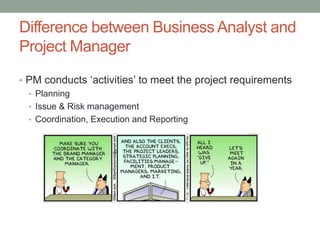
• PM conducts ‘activities’ to meet the project requirements
• Planning
• Issue & Risk management
• Coordination, Execution and Reporting
Difference between Business Analyst and
Project Manager
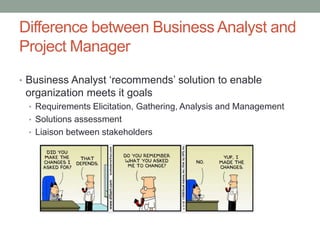
• Business Analyst ‘recommends’ solution to enable
organization meets it goals
• Requirements Elicitation, Gathering, Analysis and Management
• Solutions assessment
• Liaison between stakeholders
What I learnt as BA
1. Success is in defining what the business need vs what they
want
2. Technology and business are now married – you have to
understand both
3. For the delivery team you’re the ‘client’ and for the client you
are the ‘vendor’
4. PM is your partner – help him to help you
5. One skill that can always be improved is the listening skill
What I didn’t know as BA
1. Conducting status meeting is equally boring for the PM - but
is a necessity
2. The PM has more stakeholders to manage – Leadership
teams, Steering committees, Internal Bosses, HR and
Finance
3. Project planning is not an easy task, resource planning is
even more difficult, financial planning is boring
4. Sometime it is more important to get things done and on time
– then to have it done perfectly
What I learned as PM
1. A stupid BA can ruin the project
2. Communication is the key, you cannot communicate enough
3. The trick is in managing the Issues and Risk – and
communicating them
4. No one likes the bad news – however it should travel faster
5. Project planning is not an one time activity – it should be
done every day
Transitioning From BA to PM
1. Get a coach – who can guide you through things
2. Get a good understanding of the scope, SOW
3. Know your team, they know the details, involve them in
planning and estimation
4. Avoid the temptation of getting in the details
1. Keep a macro view but be ready to get in details when required
5. Issues and Risk are your friends
1. Learn to identify, prioritize and manage them

Business analysis & project management

  • 1.
    BUSINESS ANALYSIS & PROJECTMANAGEMENT Do BAs make good PMs? Ranjan Kumar Jha, CBAP Email: ranjanjha@gmail.com 4th April, BA Open, Pune
  • 2.
    Agenda 1. Difference betweenBusiness Analyst and Project Manager 2. What I learned as a BA 3. What I didn’t know as BA 4. What I Learned as a PM 5. How to transition from BA to PM?
  • 3.
    Difference between BusinessAnalyst and Project Manager • PM conducts ‘activities’ to meet the project requirements • Planning • Issue & Risk management • Coordination, Execution and Reporting
  • 4.
    Difference between BusinessAnalyst and Project Manager • Business Analyst ‘recommends’ solution to enable organization meets it goals • Requirements Elicitation, Gathering, Analysis and Management • Solutions assessment • Liaison between stakeholders
  • 5.
    What I learntas BA 1. Success is in defining what the business need vs what they want 2. Technology and business are now married – you have to understand both 3. For the delivery team you’re the ‘client’ and for the client you are the ‘vendor’ 4. PM is your partner – help him to help you 5. One skill that can always be improved is the listening skill
  • 6.
    What I didn’tknow as BA 1. Conducting status meeting is equally boring for the PM - but is a necessity 2. The PM has more stakeholders to manage – Leadership teams, Steering committees, Internal Bosses, HR and Finance 3. Project planning is not an easy task, resource planning is even more difficult, financial planning is boring 4. Sometime it is more important to get things done and on time – then to have it done perfectly
  • 7.
    What I learnedas PM 1. A stupid BA can ruin the project 2. Communication is the key, you cannot communicate enough 3. The trick is in managing the Issues and Risk – and communicating them 4. No one likes the bad news – however it should travel faster 5. Project planning is not an one time activity – it should be done every day
  • 8.
    Transitioning From BAto PM 1. Get a coach – who can guide you through things 2. Get a good understanding of the scope, SOW 3. Know your team, they know the details, involve them in planning and estimation 4. Avoid the temptation of getting in the details 1. Keep a macro view but be ready to get in details when required 5. Issues and Risk are your friends 1. Learn to identify, prioritize and manage them