Technical Briefing Speech #1 Advanced Communications Manual – Technical Presentations Karen A. Threlkeld, PMP, CC, CL Toastmasters Power Speakers Club
What is Project Management and why do we need it?
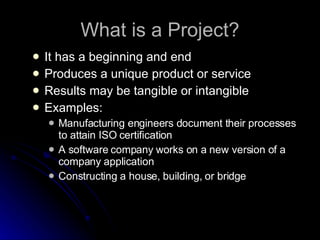
What is a Project? It has a beginning and end Produces a unique product or service Results may be tangible or intangible Examples:  Manufacturing engineers document their processes to attain ISO certification A software company works on a new version of a company application Constructing a house, building, or bridge From  A Guide to the Project Management Body of Knowledge (PMBOK ®  Guide)  – 2000 Edition
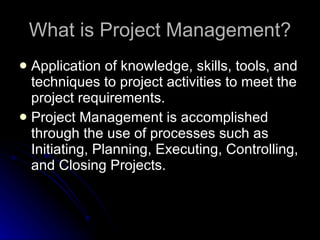
What is Project Management? Application of knowledge, skills, tools, and techniques to project activities to meet the project requirements. Project Management is accomplished through the use of processes such as Initiating, Planning, Executing, Controlling, and Closing Projects. From  A Guide to the Project Management Body of Knowledge (PMBOK ®  Guide)  – 2000 Edition
Lots of people are PMs! (or at least perform some Project Management) Event Planner Wedding City Stages Golf Tournament Staff Meeting Construction Contractor Manager / Secretary / Analyst
Why Use Project Management? Disciplined project management provides: Focal point for effective communications, coordination and control A plan to assess progress Emphasis on time and cost performance Project management provides the framework for methods, processes, monitoring and change control.
How Project Management Benefits the Organization Improves monitoring and control (providing consistent method for tracking tasks and milestones) Expands communication among participants Refines projections of resource requirements Provides a mechanism for performance measurement Increases stakeholder trust and confidence Continuously improves projects Control  Change management Improved project success
More Ways Project Management Benefits the Organization Identifies problem areas early Clarifies project goals and project scope Quantifies project risk Identifies resource requirements
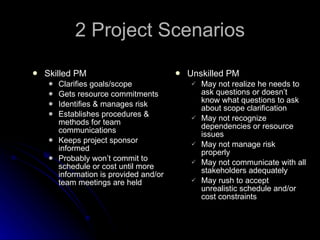
2 Project Scenarios Skilled PM Clarifies goals/scope Gets resource commitments Identifies & manages risk Establishes procedures & methods for team communications Keeps project sponsor informed Probably won’t commit to schedule or cost until more information is provided and/or team meetings are held Unskilled PM May not realize he needs to ask questions or doesn’t know what questions to ask about scope clarification May not recognize dependencies or resource issues May not manage risk properly May not communicate with all stakeholders adequately May rush to accept unrealistic schedule and/or cost constraints
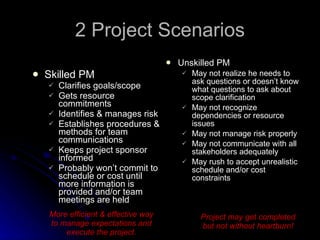
2 Project Scenarios Skilled PM Clarifies goals/scope Gets resource commitments Identifies & manages risk Establishes procedures & methods for team communications Keeps project sponsor informed Probably won’t commit to schedule or cost until more information is provided and/or team meetings are held Unskilled PM May not realize he needs to ask questions or doesn’t know what questions to ask about scope clarification May not recognize dependencies or resource issues May not manage risk properly May not communicate with all stakeholders adequately May rush to accept unrealistic schedule and/or cost constraints More efficient & effective way to manage expectations and execute the project. Project may get completed but not without heartburn!
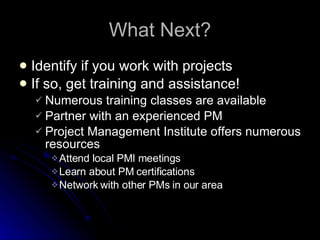
What Next? Identify if you work with projects If so, get training and assistance! Numerous training classes are available Partner with an experienced PM Project Management Institute offers numerous resources Attend local PMI meetings Learn about PM certifications Network with other PMs in our area

Technical Presentations #1 Techical Briefing

  • 1.
    Technical Briefing Speech#1 Advanced Communications Manual – Technical Presentations Karen A. Threlkeld, PMP, CC, CL Toastmasters Power Speakers Club
  • 2.
    What is ProjectManagement and why do we need it?
  • 3.
    What is aProject? It has a beginning and end Produces a unique product or service Results may be tangible or intangible Examples: Manufacturing engineers document their processes to attain ISO certification A software company works on a new version of a company application Constructing a house, building, or bridge From A Guide to the Project Management Body of Knowledge (PMBOK ® Guide) – 2000 Edition
  • 4.
    What is ProjectManagement? Application of knowledge, skills, tools, and techniques to project activities to meet the project requirements. Project Management is accomplished through the use of processes such as Initiating, Planning, Executing, Controlling, and Closing Projects. From A Guide to the Project Management Body of Knowledge (PMBOK ® Guide) – 2000 Edition
  • 5.
    Lots of peopleare PMs! (or at least perform some Project Management) Event Planner Wedding City Stages Golf Tournament Staff Meeting Construction Contractor Manager / Secretary / Analyst
  • 6.
    Why Use ProjectManagement? Disciplined project management provides: Focal point for effective communications, coordination and control A plan to assess progress Emphasis on time and cost performance Project management provides the framework for methods, processes, monitoring and change control.
  • 7.
    How Project ManagementBenefits the Organization Improves monitoring and control (providing consistent method for tracking tasks and milestones) Expands communication among participants Refines projections of resource requirements Provides a mechanism for performance measurement Increases stakeholder trust and confidence Continuously improves projects Control Change management Improved project success
  • 8.
    More Ways ProjectManagement Benefits the Organization Identifies problem areas early Clarifies project goals and project scope Quantifies project risk Identifies resource requirements
  • 9.
    2 Project ScenariosSkilled PM Clarifies goals/scope Gets resource commitments Identifies & manages risk Establishes procedures & methods for team communications Keeps project sponsor informed Probably won’t commit to schedule or cost until more information is provided and/or team meetings are held Unskilled PM May not realize he needs to ask questions or doesn’t know what questions to ask about scope clarification May not recognize dependencies or resource issues May not manage risk properly May not communicate with all stakeholders adequately May rush to accept unrealistic schedule and/or cost constraints
  • 10.
    2 Project ScenariosSkilled PM Clarifies goals/scope Gets resource commitments Identifies & manages risk Establishes procedures & methods for team communications Keeps project sponsor informed Probably won’t commit to schedule or cost until more information is provided and/or team meetings are held Unskilled PM May not realize he needs to ask questions or doesn’t know what questions to ask about scope clarification May not recognize dependencies or resource issues May not manage risk properly May not communicate with all stakeholders adequately May rush to accept unrealistic schedule and/or cost constraints More efficient & effective way to manage expectations and execute the project. Project may get completed but not without heartburn!
  • 11.
    What Next? Identifyif you work with projects If so, get training and assistance! Numerous training classes are available Partner with an experienced PM Project Management Institute offers numerous resources Attend local PMI meetings Learn about PM certifications Network with other PMs in our area