Best practices for
streaming
applications
O’Reilly Webcast
June 21st
/22nd
, 2016
Mark Grover | @mark_grover | Software Engineer
Ted Malaska | @TedMalaska | Principal Solutions Architect
2
About the presenters
• Principal Solutions Architect at
Cloudera
• Done Hadoop for 6 years
– Worked with > 70 companies in 8
countries
• Previously, lead architect at FINRA
• Contributor to Apache Hadoop,
HBase, Flume, Avro, Pig and Spark
• Contributor to Apache Hadoop,
HBase, Flume, Avro, Pig and Spark
• Marvel fan boy, runner
• Software Engineer at Cloudera,
working on Spark
• Committer on Apache Bigtop, PMC
member on Apache Sentry
(incubating)
• Contributor to Apache Hadoop,
Spark, Hive, Sqoop, Pig and Flume
Ted Malaska Mark Grover
3
About the book
• @hadooparchbook
• hadooparchitecturebook.com
• github.com/hadooparchitecturebook
• slideshare.com/hadooparchbook
4
Goal
5
Understand common use-
cases for streaming and
their architectures
6
What is streaming?
7
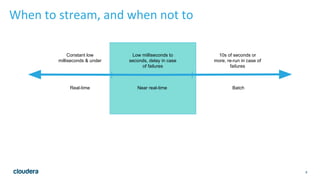
When to stream, and when not to
Constant low
milliseconds & under
Low milliseconds to
seconds, delay in case
of failures
10s of seconds or
more, re-run in case of
failures
Real-time Near real-time Batch
8
When to stream, and when not to
Constant low
milliseconds & under
Low milliseconds to
seconds, delay in case
of failures
10s of seconds or
more, re-run in case of
failures
Real-time Near real-time Batch
9
No free lunch
Constant low
milliseconds & under
Low milliseconds to
seconds, delay in case
of failures
10s of seconds or
more, re-run in case of
failures
Real-time Near real-time Batch
“Difficult” architectures, lower latency “Easier” architectures, higher latency
10
Use-cases for
streaming
11
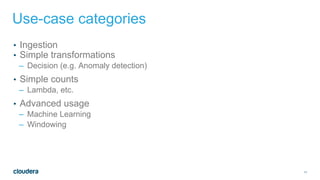
Use-case categories
• Ingestion
• Simple transformations
– Decision (e.g. Anomaly detection)
• Simple counts
– Lambda, etc.
• Advanced usage
– Machine Learning
– Windowing
12
Ingestion &
Transformations
13
What is ingestion?
Source Systems
Destination system
Streaming
engine
14
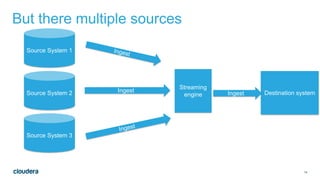
But there multiple sources
Ingest
Source System 1
Destination systemSource System 2
Source System 3
Ingest
Ingest
Streaming
engine Ingest
15
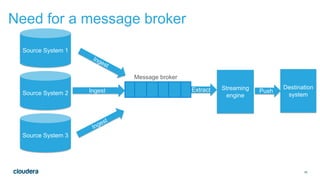
But..
• Sources, sinks, ingestion channels may go down
• Sources, sinks producing/consuming at different rates (buffering)
• Regular maintenance windows may need to be scheduled
• You need a resilient message broker (pub/sub)
16
Need for a message broker
Source System 1
Destination
systemSource System 2
Source System 3
Ingest
Ingest
Ingest Extract Streaming
engine
Push
Message broker
17
Kafka
Source System 1
Destination
systemSource System 2
Source System 3
Ingest
Ingest
Ingest Extract Streaming
engine
Push
Message broker
18
Destination systems
Source System 1
Destination
systemSource System 2
Source System 3
Ingest
Ingest
Ingest Extract Streaming
engine
Push
Message broker
Most common
“destination” is a
storage system
19
Architecture diagram with a broker
Source System 1
Storage
systemSource System 2
Source System 3
Ingest
Ingest
Ingest Extract Streaming
engine
Push
Message broker
20
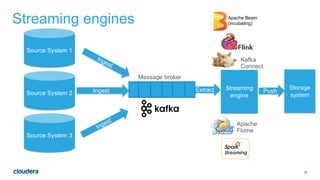
Streaming engines
Source System 1
Storage
systemSource System 2
Source System 3
Ingest
Ingest
Ingest Extract Streaming
engine
Push
Kafka
Connect
Apache
Flume
Message broker
Apache Beam
(incubating)
21
Storage options
Source System 1
Storage
systemSource System 2
Source System 3
Ingest
Ingest
Ingest Extract Streaming
engine
Push
Kafka
Connect
Apache
Flume
Message broker
Apache Beam
(incubating)
22
Semantics
At most once, Exactly once, At least once
23
Semantic types
• At most once
– Not good for many cases
– Only where performance/SLA is more important than accuracy
• Exactly once
– Expensive to achieve but desirable
• At least once
– Easiest to achieve
24
Review
Source System 1
Destination
systemSource System 2
Source System 3
Ingest
Ingest
Ingest Extract Streaming
engine
Push
Message broker
25
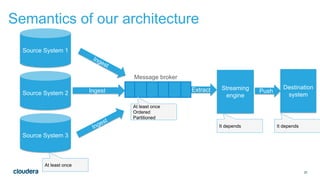
Semantics of our architecture
Source System 1
Destination
systemSource System 2
Source System 3
Ingest
Ingest
Ingest Extract Streaming
engine
Push
Message broker
At least once
At least once
Ordered
Partitioned
It depends It depends
26
Transforming data
in flight
27
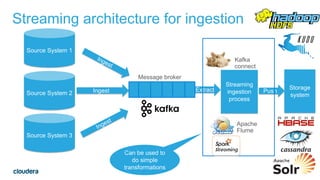
Streaming architecture for ingestion
Source System 1
Storage
systemSource System 2
Source System 3
Ingest
Ingest
Ingest Extract
Streaming
ingestion
process
Push
Kafka
connect
Apache
Flume
Message broker
Can be used to
do simple
transformations
28
Ingestion and/or Transformation
1. Zero Transformation
– No transformation, plain ingest, no schema validation
– Keep the original format - SequenceFiles, Text, etc.
– Allows to store data that may have errors in the schema
2. Format Transformation
– Simply change the format of field, for example
– Structured Format e.g. Avro
– Which does schema validation
3. Enrichment Transformation
– Atomic
– Contextual
29
#3 - Enrichment transformations
Atomic
• Need to work with one event at a
time
• Mask a credit card number
• Add processing time or offset to the
record
Contextual
• Need to refer to external context
• Example - convert zip code to state,
by looking up a cache
30
Atomic transformations
• Require no context
• All streaming engines support it
31
Contextual transformations
• Well supported by many streaming engines
• Need to store the context somewhere.
32
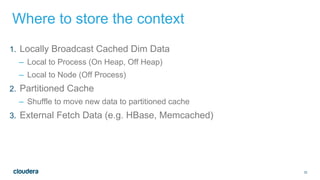
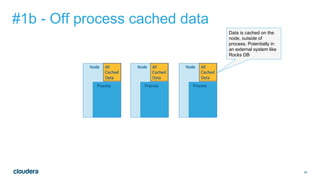
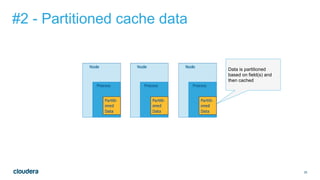
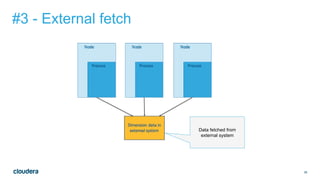
Where to store the context
1. Locally Broadcast Cached Dim Data
– Local to Process (On Heap, Off Heap)
– Local to Node (Off Process)
2. Partitioned Cache
– Shuffle to move new data to partitioned cache
3. External Fetch Data (e.g. HBase, Memcached)
33
#1a - Locally broadcast cached data
Could be
On heap or Off heap
34
#1b - Off process cached data
Data is cached on the
node, outside of
process. Potentially in
an external system like
Rocks DB
35
#2 - Partitioned cache data
Data is partitioned
based on field(s) and
then cached
36
#3 - External fetch
Data fetched from
external system
37
A combination (partitioned cache + external)
38
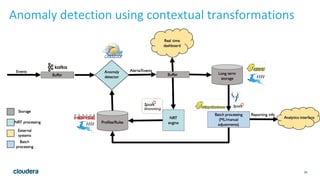
Anomaly detection using contextual transformations
39
Storage systems
When to use which one?
40
Storage Considerations
• Throughput
• Access Patterns
– Scanning
– Indexed
– Reversed Indexed
• Transaction Level
– Record/Document
– File
41
File Level
• HDFS
• S3
42
NoSql
• HBase
• Cassandra
• MongoDB
43
Search
• SolR
• Elastic Search
44
NoSql-Sql
• Kudu
45
Streaming engines
Comparison
46© Cloudera, Inc. All rights reserved.
Tricks With Producers
•Send Source ID (requires Partitioning In Kafka)
•Seq
•UUID
•UUID plus time
•Partition on SourceID
•Watch out for repartitions and partition fail overs
47© Cloudera, Inc. All rights reserved.
Streaming Engines
•Consumer
•Flume, KafkaConnect, Streaming Engine
•Storm
•Spark Streaming
•Flink
•Kafka Streams
48© Cloudera, Inc. All rights reserved.
Consumer: Flume, KafkaConnect
•Simple and Works
•Low latency
•High throughput
•Interceptors
•Transformations
•Alerting
•Ingestions
49© Cloudera, Inc. All rights reserved.
Consumer: Streaming Engines
•Not so great at HDFS Ingestion
•But great for record storage systems
•HBase
•Cassandra
•Kudu
•SolR
•Elastic Search
50© Cloudera, Inc. All rights reserved.
Storm
•Old Gen
•Low latency
•Low throughput
•At least once
•Around for ever
•Topology Based
51© Cloudera, Inc. All rights reserved.
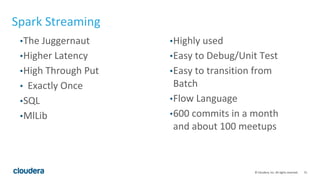
Spark Streaming
•The Juggernaut
•Higher Latency
•High Through Put
• Exactly Once
•SQL
•MlLib
•Highly used
•Easy to Debug/Unit Test
•Easy to transition from
Batch
•Flow Language
•600 commits in a month
and about 100 meetups
52© Cloudera, Inc. All rights reserved.
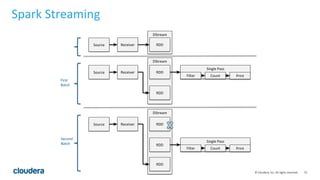
Spark Streaming
DStream
DStream
DStream
Single Pass
Source Receiver RDD
Source Receiver RDD
RDD
Filter Count Print
Source Receiver RDD
RDD
RDD
Single Pass
Filter Count Print
First
Batch
Second
Batch
53© Cloudera, Inc. All rights reserved.
DStream
DStream
DStream
Single Pass
Source Receiver RDD
Source Receiver RDD
RDD
Filter Count
Print
Source Receiver
RDD
partitions
RDD
Parition
RDD
Single Pass
Filter Count
Pre-first
Batch
First
Batch
Second
Batch
Stateful
RDD 1
Print
Stateful
RDD 2
Stateful
RDD 1
Spark Streaming
54© Cloudera, Inc. All rights reserved.
Flink
•I’m Better Than Spark Why Doesn’t Anyone use me
•Very much like Spark but not as feature rich
•Lower Latency
•Micro Batch -> ABS
•Asynchronous Barrier Snapshotting
•Flow Language
•~1/6th
the comments and meetups
•But Slim loves it ☺
55© Cloudera, Inc. All rights reserved.
Flink - ABS
Operator
Buffer
56© Cloudera, Inc. All rights reserved.
Operator
Buffer
Operator
Buffer
Flink - ABS
Barrier 1A
Hit
Barrier 1B
Still Behind
57© Cloudera, Inc. All rights reserved.
Operator
Buffer
Flink - ABS
Both
Barriers Hit
Operator
Buffer
Barrier 1A
Hit
Barrier 1B
Still Behind
Check Point
58© Cloudera, Inc. All rights reserved.
Operator
Buffer
Flink - ABS
Both
Barriers Hit
Check Point
Operator
Buffer
Barrier is
combined
and can
move on
Buffer can
be flushed
out
59© Cloudera, Inc. All rights reserved.
Kafka Streams
• The new Kid on the Block
• When you only have Kafka
• Low Latency
• High Throughput
• Not exactly once
• Very Young
• Flow Language
• Very different hardware profile then others
• Not widely supported
• Not widely used
• Worries about separation of concern
60© Cloudera, Inc. All rights reserved.
Summary about Engines
• Ingestion
• Flume and KafkaConnect
• Super Real Time and Special
• Consumer
• Counting, MlLib, SQL
• Spark
• Maybe future and cool
• Flink and KafkaStreams
• Odd man out
• Storm
61© Cloudera, Inc. All rights reserved.
Abstractions
Code Abstractions
Beam
SQL Abstraction
SQL
UI Abstraction
StreamSets
Streaming Engines
62
Counting
63
Streaming and Counting
• Counting is easy right?
• Back to Only once
64
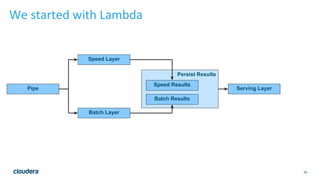
We started with Lambda
Pipe
Speed Layer
Batch Layer
Persist Results
Speed Results
Batch Results
Serving Layer
65
Why did Streaming Suck
• Increments with Cassandra
• Double increment
• No strong consistency
• Storm without Kafka
• Not only once
• Not at least once
• Batch would have to re-process EVERY record to remove
dups
66
We have come a long way
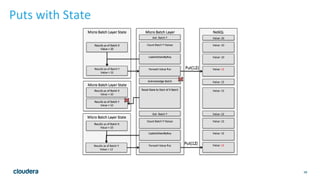
• We don’t have to use Increments any more and we can
have consistency
• HBase
• We can have state in our streaming platform
• Spark Streaming
• We don’t lose data
• Spark Streaming
• Kafka
• Other options
• Full universe of Deduping
• Again HBase with versions
67
Increments
68
Puts with State
69
Advanced
streaming
When to use which one?
70
Advanced Streaming
• Ad-hoc will produce Identify Value
• Ad-hoc will become batch
• The value will demand less latency on batch
• Batch will become Streaming
71
Advanced Streaming
• Requirements for Ideal Batch to Streaming frameworks
• Something that can snap both paradigms
• Something that can use the tools of Ad-hoc
• SQL
• MlLib
• R
• Scala
• Java
• Development through a common IDE
• Debugging
• Unit Testing
• Common deployment model
72
Advanced Streaming
• In Spark Streaming
• A DStream is a collection of RDD with respect to micro batch
intervals
• If we can access RDDs in Spark Streaming
• We can convert to Vectors
• KMeans
• Principal component analysis
• We can convert to LabeledPoint
• NaiveBayes
• Random Forest
• Linear Support Vector Machines
• We can convert to a DataFrames
• SQL
• R
73
Wrap-up
74
Understand common
use-cases for streaming and
their architecturesOur original goal
75
Common streaming use-cases
• Ingestion
– Transformation
• Counting
– Lambda, etc.
• Advanced streaming
76
Thank you!Mark Grover | @mark_grover
Ted Malaska | @TedMalaska
@hadooparchbook
hadooparchitecturebook.com
77
Transformations with context

Streaming architecture patterns

  • 1.
    Best practices for streaming applications O’ReillyWebcast June 21st /22nd , 2016 Mark Grover | @mark_grover | Software Engineer Ted Malaska | @TedMalaska | Principal Solutions Architect
  • 2.
    2 About the presenters •Principal Solutions Architect at Cloudera • Done Hadoop for 6 years – Worked with > 70 companies in 8 countries • Previously, lead architect at FINRA • Contributor to Apache Hadoop, HBase, Flume, Avro, Pig and Spark • Contributor to Apache Hadoop, HBase, Flume, Avro, Pig and Spark • Marvel fan boy, runner • Software Engineer at Cloudera, working on Spark • Committer on Apache Bigtop, PMC member on Apache Sentry (incubating) • Contributor to Apache Hadoop, Spark, Hive, Sqoop, Pig and Flume Ted Malaska Mark Grover
  • 3.
    3 About the book •@hadooparchbook • hadooparchitecturebook.com • github.com/hadooparchitecturebook • slideshare.com/hadooparchbook
  • 4.
  • 5.
    5 Understand common use- casesfor streaming and their architectures
  • 6.
  • 7.
    7 When to stream,and when not to Constant low milliseconds & under Low milliseconds to seconds, delay in case of failures 10s of seconds or more, re-run in case of failures Real-time Near real-time Batch
  • 8.
    8 When to stream,and when not to Constant low milliseconds & under Low milliseconds to seconds, delay in case of failures 10s of seconds or more, re-run in case of failures Real-time Near real-time Batch
  • 9.
    9 No free lunch Constantlow milliseconds & under Low milliseconds to seconds, delay in case of failures 10s of seconds or more, re-run in case of failures Real-time Near real-time Batch “Difficult” architectures, lower latency “Easier” architectures, higher latency
  • 10.
  • 11.
    11 Use-case categories • Ingestion •Simple transformations – Decision (e.g. Anomaly detection) • Simple counts – Lambda, etc. • Advanced usage – Machine Learning – Windowing
  • 12.
  • 13.
    13 What is ingestion? SourceSystems Destination system Streaming engine
  • 14.
    14 But there multiplesources Ingest Source System 1 Destination systemSource System 2 Source System 3 Ingest Ingest Streaming engine Ingest
  • 15.
    15 But.. • Sources, sinks,ingestion channels may go down • Sources, sinks producing/consuming at different rates (buffering) • Regular maintenance windows may need to be scheduled • You need a resilient message broker (pub/sub)
  • 16.
    16 Need for amessage broker Source System 1 Destination systemSource System 2 Source System 3 Ingest Ingest Ingest Extract Streaming engine Push Message broker
  • 17.
    17 Kafka Source System 1 Destination systemSourceSystem 2 Source System 3 Ingest Ingest Ingest Extract Streaming engine Push Message broker
  • 18.
    18 Destination systems Source System1 Destination systemSource System 2 Source System 3 Ingest Ingest Ingest Extract Streaming engine Push Message broker Most common “destination” is a storage system
  • 19.
    19 Architecture diagram witha broker Source System 1 Storage systemSource System 2 Source System 3 Ingest Ingest Ingest Extract Streaming engine Push Message broker
  • 20.
    20 Streaming engines Source System1 Storage systemSource System 2 Source System 3 Ingest Ingest Ingest Extract Streaming engine Push Kafka Connect Apache Flume Message broker Apache Beam (incubating)
  • 21.
    21 Storage options Source System1 Storage systemSource System 2 Source System 3 Ingest Ingest Ingest Extract Streaming engine Push Kafka Connect Apache Flume Message broker Apache Beam (incubating)
  • 22.
    22 Semantics At most once,Exactly once, At least once
  • 23.
    23 Semantic types • Atmost once – Not good for many cases – Only where performance/SLA is more important than accuracy • Exactly once – Expensive to achieve but desirable • At least once – Easiest to achieve
  • 24.
    24 Review Source System 1 Destination systemSourceSystem 2 Source System 3 Ingest Ingest Ingest Extract Streaming engine Push Message broker
  • 25.
    25 Semantics of ourarchitecture Source System 1 Destination systemSource System 2 Source System 3 Ingest Ingest Ingest Extract Streaming engine Push Message broker At least once At least once Ordered Partitioned It depends It depends
  • 26.
  • 27.
    27 Streaming architecture foringestion Source System 1 Storage systemSource System 2 Source System 3 Ingest Ingest Ingest Extract Streaming ingestion process Push Kafka connect Apache Flume Message broker Can be used to do simple transformations
  • 28.
    28 Ingestion and/or Transformation 1.Zero Transformation – No transformation, plain ingest, no schema validation – Keep the original format - SequenceFiles, Text, etc. – Allows to store data that may have errors in the schema 2. Format Transformation – Simply change the format of field, for example – Structured Format e.g. Avro – Which does schema validation 3. Enrichment Transformation – Atomic – Contextual
  • 29.
    29 #3 - Enrichmenttransformations Atomic • Need to work with one event at a time • Mask a credit card number • Add processing time or offset to the record Contextual • Need to refer to external context • Example - convert zip code to state, by looking up a cache
  • 30.
    30 Atomic transformations • Requireno context • All streaming engines support it
  • 31.
    31 Contextual transformations • Wellsupported by many streaming engines • Need to store the context somewhere.
  • 32.
    32 Where to storethe context 1. Locally Broadcast Cached Dim Data – Local to Process (On Heap, Off Heap) – Local to Node (Off Process) 2. Partitioned Cache – Shuffle to move new data to partitioned cache 3. External Fetch Data (e.g. HBase, Memcached)
  • 33.
    33 #1a - Locallybroadcast cached data Could be On heap or Off heap
  • 34.
    34 #1b - Offprocess cached data Data is cached on the node, outside of process. Potentially in an external system like Rocks DB
  • 35.
    35 #2 - Partitionedcache data Data is partitioned based on field(s) and then cached
  • 36.
    36 #3 - Externalfetch Data fetched from external system
  • 37.
  • 38.
    38 Anomaly detection usingcontextual transformations
  • 39.
  • 40.
    40 Storage Considerations • Throughput •Access Patterns – Scanning – Indexed – Reversed Indexed • Transaction Level – Record/Document – File
  • 41.
  • 42.
  • 43.
  • 44.
  • 45.
  • 46.
    46© Cloudera, Inc.All rights reserved. Tricks With Producers •Send Source ID (requires Partitioning In Kafka) •Seq •UUID •UUID plus time •Partition on SourceID •Watch out for repartitions and partition fail overs
  • 47.
    47© Cloudera, Inc.All rights reserved. Streaming Engines •Consumer •Flume, KafkaConnect, Streaming Engine •Storm •Spark Streaming •Flink •Kafka Streams
  • 48.
    48© Cloudera, Inc.All rights reserved. Consumer: Flume, KafkaConnect •Simple and Works •Low latency •High throughput •Interceptors •Transformations •Alerting •Ingestions
  • 49.
    49© Cloudera, Inc.All rights reserved. Consumer: Streaming Engines •Not so great at HDFS Ingestion •But great for record storage systems •HBase •Cassandra •Kudu •SolR •Elastic Search
  • 50.
    50© Cloudera, Inc.All rights reserved. Storm •Old Gen •Low latency •Low throughput •At least once •Around for ever •Topology Based
  • 51.
    51© Cloudera, Inc.All rights reserved. Spark Streaming •The Juggernaut •Higher Latency •High Through Put • Exactly Once •SQL •MlLib •Highly used •Easy to Debug/Unit Test •Easy to transition from Batch •Flow Language •600 commits in a month and about 100 meetups
  • 52.
    52© Cloudera, Inc.All rights reserved. Spark Streaming DStream DStream DStream Single Pass Source Receiver RDD Source Receiver RDD RDD Filter Count Print Source Receiver RDD RDD RDD Single Pass Filter Count Print First Batch Second Batch
  • 53.
    53© Cloudera, Inc.All rights reserved. DStream DStream DStream Single Pass Source Receiver RDD Source Receiver RDD RDD Filter Count Print Source Receiver RDD partitions RDD Parition RDD Single Pass Filter Count Pre-first Batch First Batch Second Batch Stateful RDD 1 Print Stateful RDD 2 Stateful RDD 1 Spark Streaming
  • 54.
    54© Cloudera, Inc.All rights reserved. Flink •I’m Better Than Spark Why Doesn’t Anyone use me •Very much like Spark but not as feature rich •Lower Latency •Micro Batch -> ABS •Asynchronous Barrier Snapshotting •Flow Language •~1/6th the comments and meetups •But Slim loves it ☺
  • 55.
    55© Cloudera, Inc.All rights reserved. Flink - ABS Operator Buffer
  • 56.
    56© Cloudera, Inc.All rights reserved. Operator Buffer Operator Buffer Flink - ABS Barrier 1A Hit Barrier 1B Still Behind
  • 57.
    57© Cloudera, Inc.All rights reserved. Operator Buffer Flink - ABS Both Barriers Hit Operator Buffer Barrier 1A Hit Barrier 1B Still Behind Check Point
  • 58.
    58© Cloudera, Inc.All rights reserved. Operator Buffer Flink - ABS Both Barriers Hit Check Point Operator Buffer Barrier is combined and can move on Buffer can be flushed out
  • 59.
    59© Cloudera, Inc.All rights reserved. Kafka Streams • The new Kid on the Block • When you only have Kafka • Low Latency • High Throughput • Not exactly once • Very Young • Flow Language • Very different hardware profile then others • Not widely supported • Not widely used • Worries about separation of concern
  • 60.
    60© Cloudera, Inc.All rights reserved. Summary about Engines • Ingestion • Flume and KafkaConnect • Super Real Time and Special • Consumer • Counting, MlLib, SQL • Spark • Maybe future and cool • Flink and KafkaStreams • Odd man out • Storm
  • 61.
    61© Cloudera, Inc.All rights reserved. Abstractions Code Abstractions Beam SQL Abstraction SQL UI Abstraction StreamSets Streaming Engines
  • 62.
  • 63.
    63 Streaming and Counting •Counting is easy right? • Back to Only once
  • 64.
    64 We started withLambda Pipe Speed Layer Batch Layer Persist Results Speed Results Batch Results Serving Layer
  • 65.
    65 Why did StreamingSuck • Increments with Cassandra • Double increment • No strong consistency • Storm without Kafka • Not only once • Not at least once • Batch would have to re-process EVERY record to remove dups
  • 66.
    66 We have comea long way • We don’t have to use Increments any more and we can have consistency • HBase • We can have state in our streaming platform • Spark Streaming • We don’t lose data • Spark Streaming • Kafka • Other options • Full universe of Deduping • Again HBase with versions
  • 67.
  • 68.
  • 69.
  • 70.
    70 Advanced Streaming • Ad-hocwill produce Identify Value • Ad-hoc will become batch • The value will demand less latency on batch • Batch will become Streaming
  • 71.
    71 Advanced Streaming • Requirementsfor Ideal Batch to Streaming frameworks • Something that can snap both paradigms • Something that can use the tools of Ad-hoc • SQL • MlLib • R • Scala • Java • Development through a common IDE • Debugging • Unit Testing • Common deployment model
  • 72.
    72 Advanced Streaming • InSpark Streaming • A DStream is a collection of RDD with respect to micro batch intervals • If we can access RDDs in Spark Streaming • We can convert to Vectors • KMeans • Principal component analysis • We can convert to LabeledPoint • NaiveBayes • Random Forest • Linear Support Vector Machines • We can convert to a DataFrames • SQL • R
  • 73.
  • 74.
    74 Understand common use-cases forstreaming and their architecturesOur original goal
  • 75.
    75 Common streaming use-cases •Ingestion – Transformation • Counting – Lambda, etc. • Advanced streaming
  • 76.
    76 Thank you!Mark Grover| @mark_grover Ted Malaska | @TedMalaska @hadooparchbook hadooparchitecturebook.com
  • 77.