Presenting by
KVN Pavan Kumar
IT Project Vs BA Practice
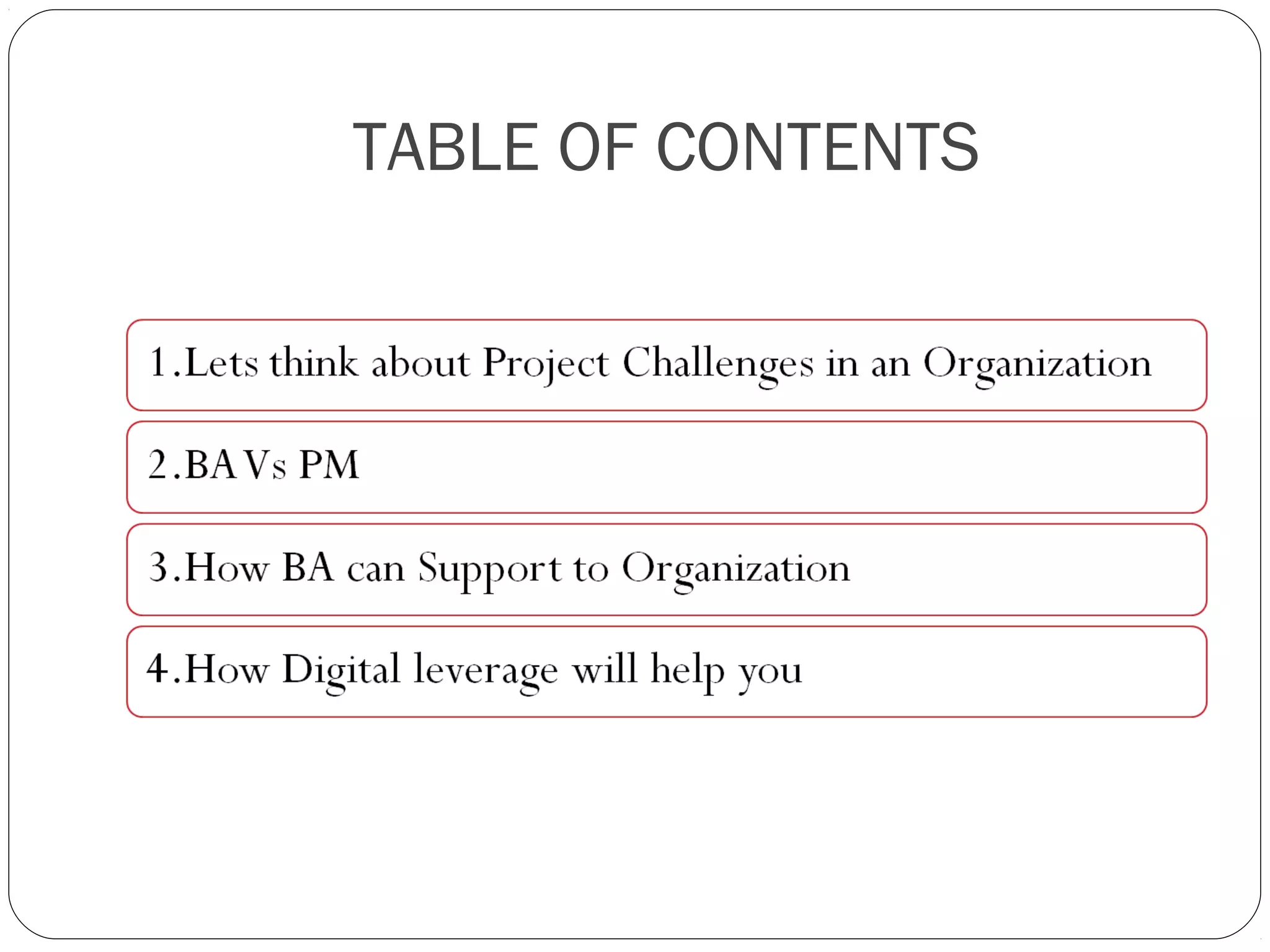
TABLE OF CONTENTS
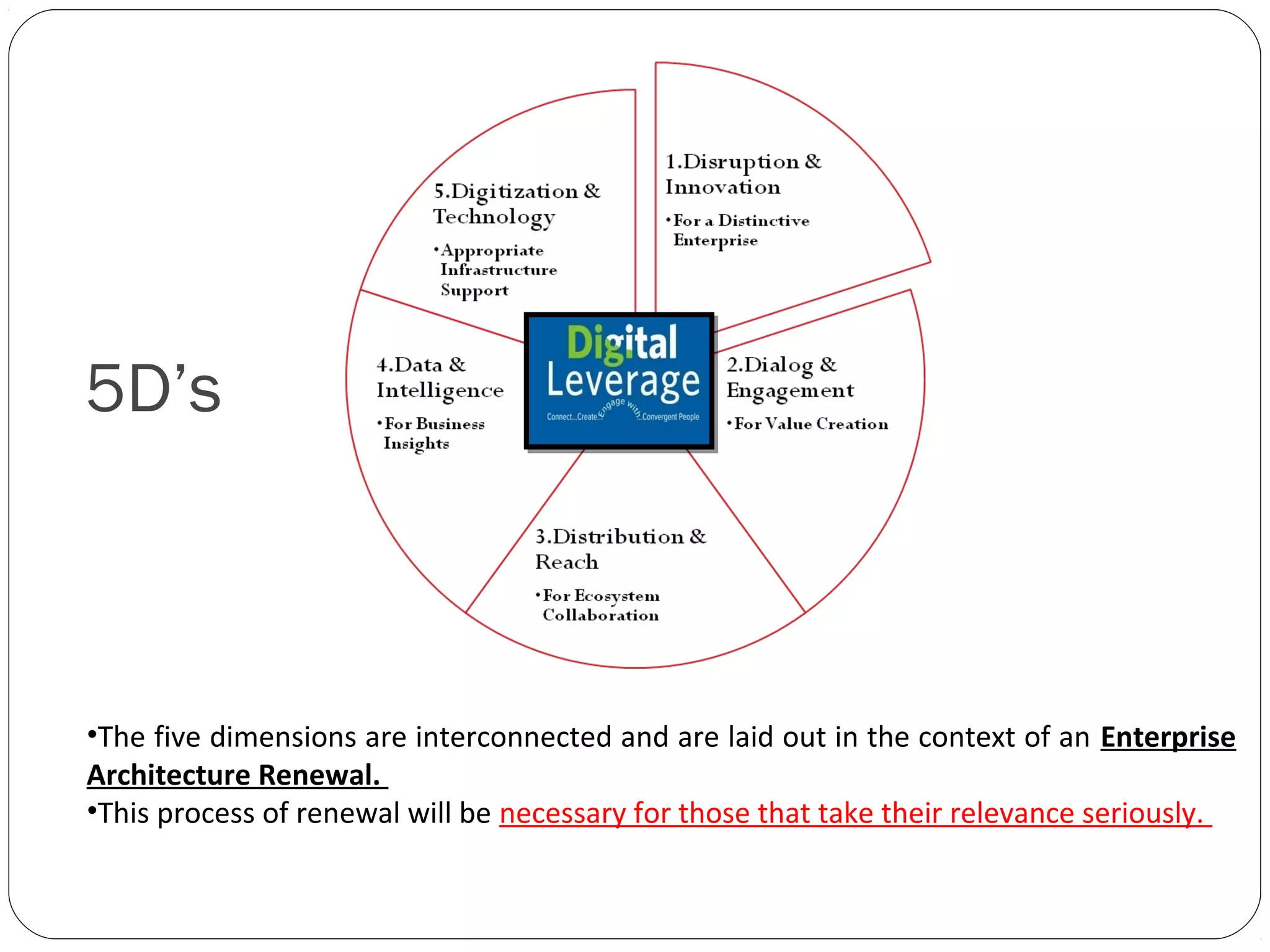
•The five dimensions are interconnected and are laid out in the context of an Enterprise
Architecture Renewal.
•This process of renewal will be necessary for those that take their relevance seriously.
5D’s
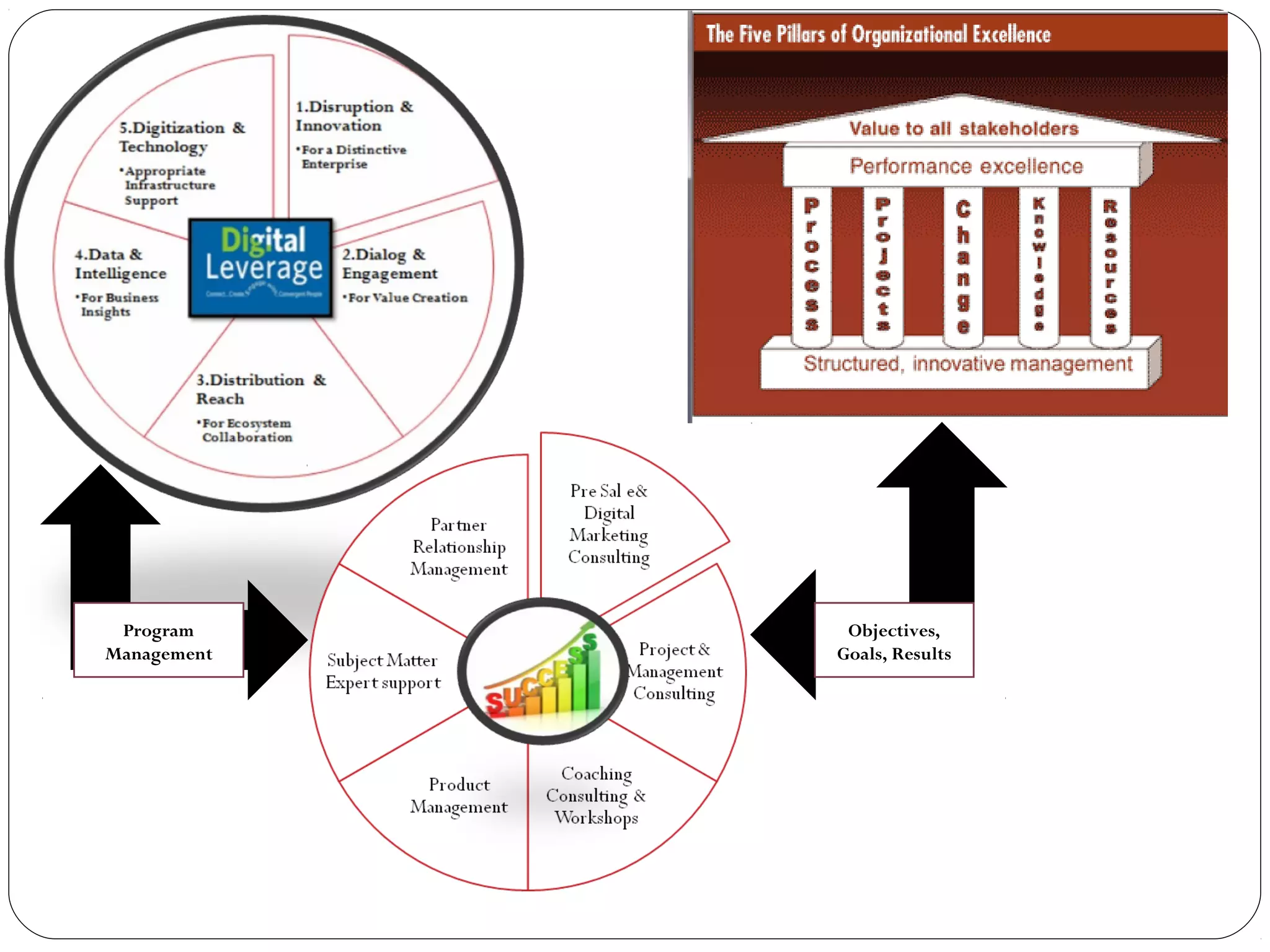
Program
Management
Objectives,
Goals, Results
1.Understand about Project failures
Challenges in Organization in the case of less
involvement of BA for an IT Project
Lack of advance planning for projects and initiatives
Lack of formal training for business analysts
Inconsistent approach to business analysis
Outsourcing and relying on external contractors to perform
major roles in system development
Impatience with the analysis/design/planning process
Gap between what business analysts are assigned to do and
what they should be assigned to do
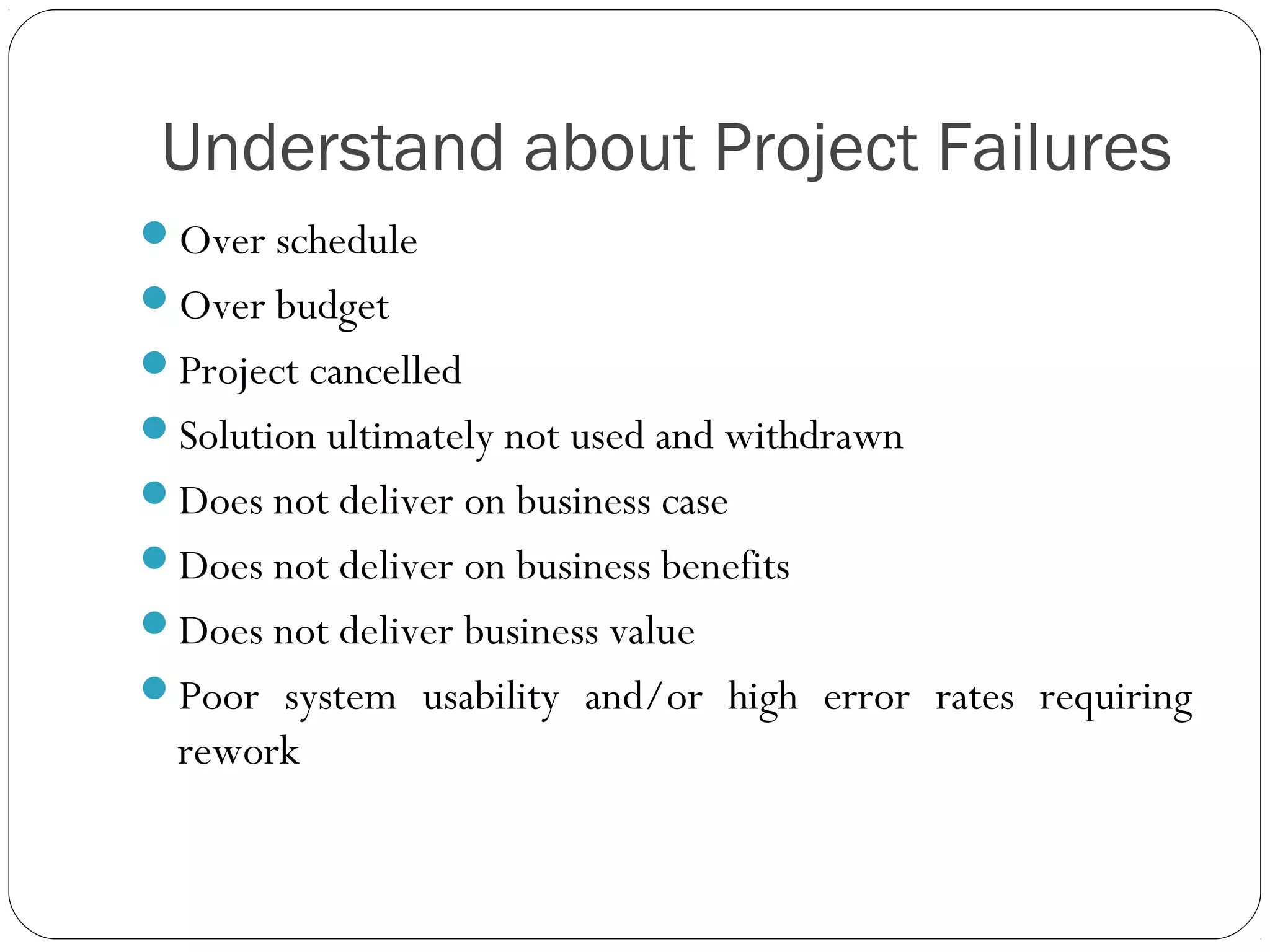
Understand about Project Failures
Over schedule
Over budget
Project cancelled
Solution ultimately not used and withdrawn
Does not deliver on business case
Does not deliver on business benefits
Does not deliver business value
Poor system usability and/or high error rates requiring
rework
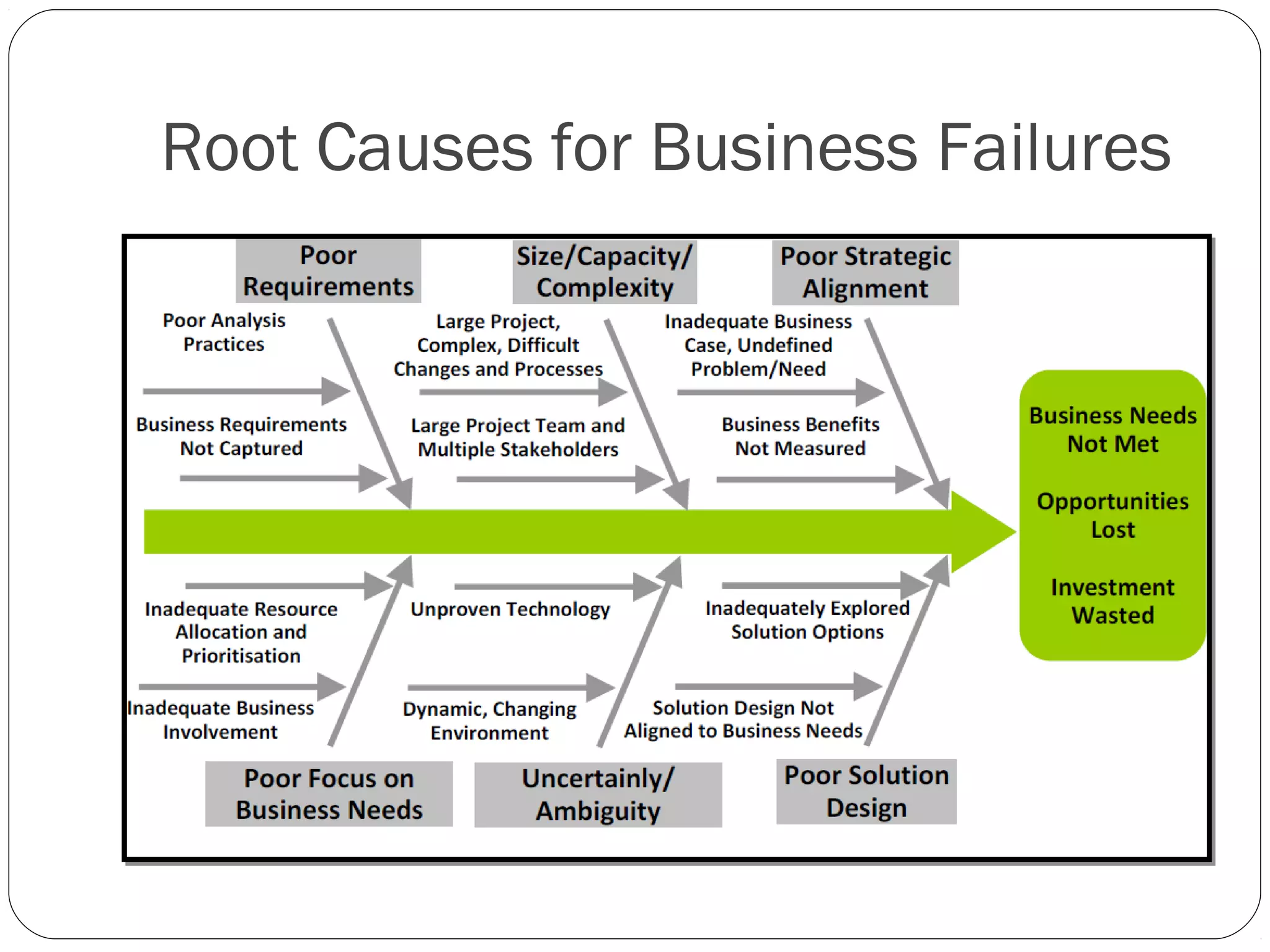
Root Causes for Business Failures
2. BA Vs PM
Business Analysis Vs Project Management
"Business Analysis is the task of understanding business
change needs, assessing the business impact of those
changes, capturing, analyzing and documenting
requirements and supporting the communication and
delivery of requirements with relevant stakeholders.“
 “Project Management is that project managers take
responsibility to ensure activities for collecting
requirements are covered in the project management
plan and monitored along with the project”.
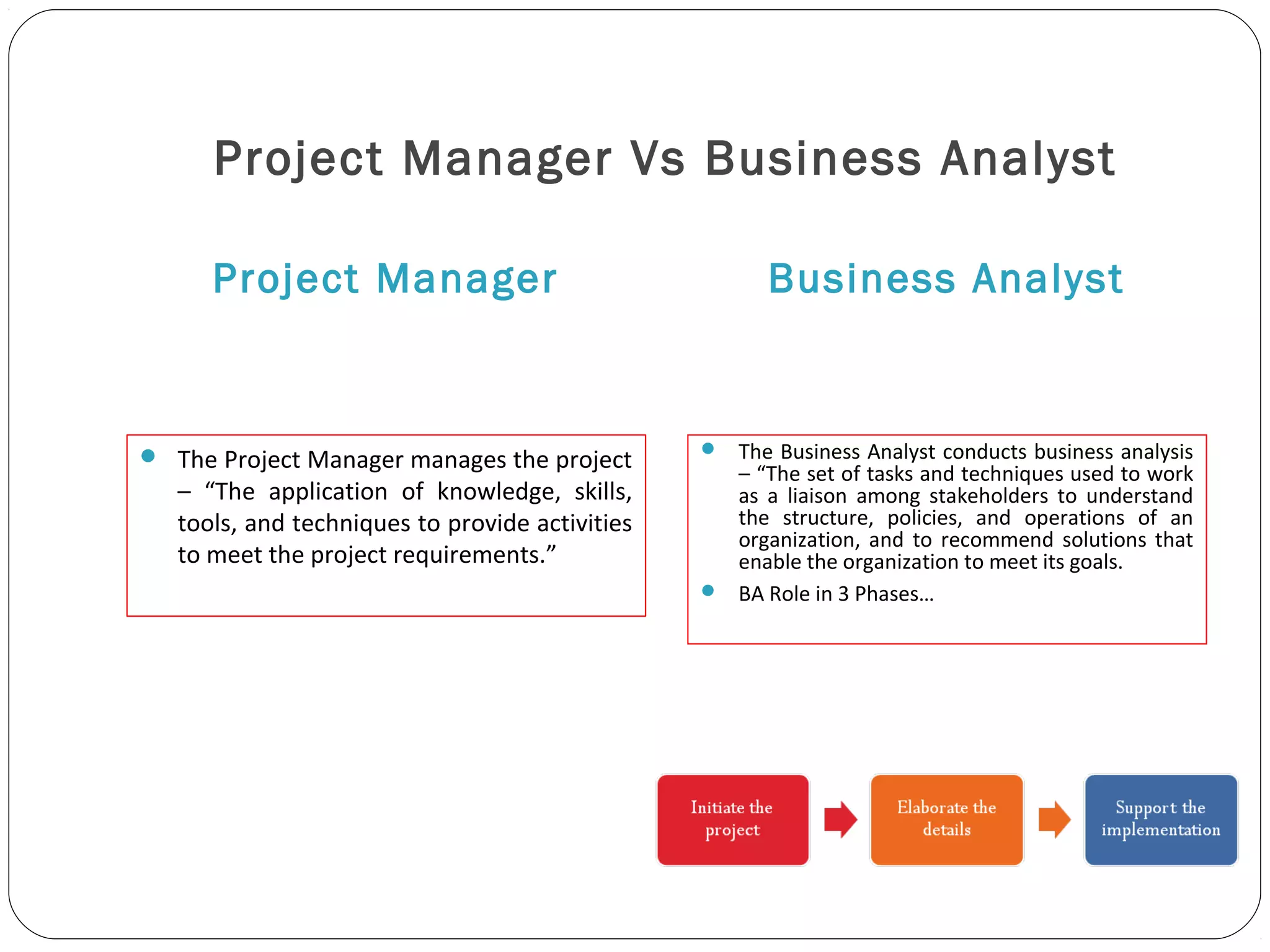
Project Manager Vs Business Analyst
Project Manager Business Analyst
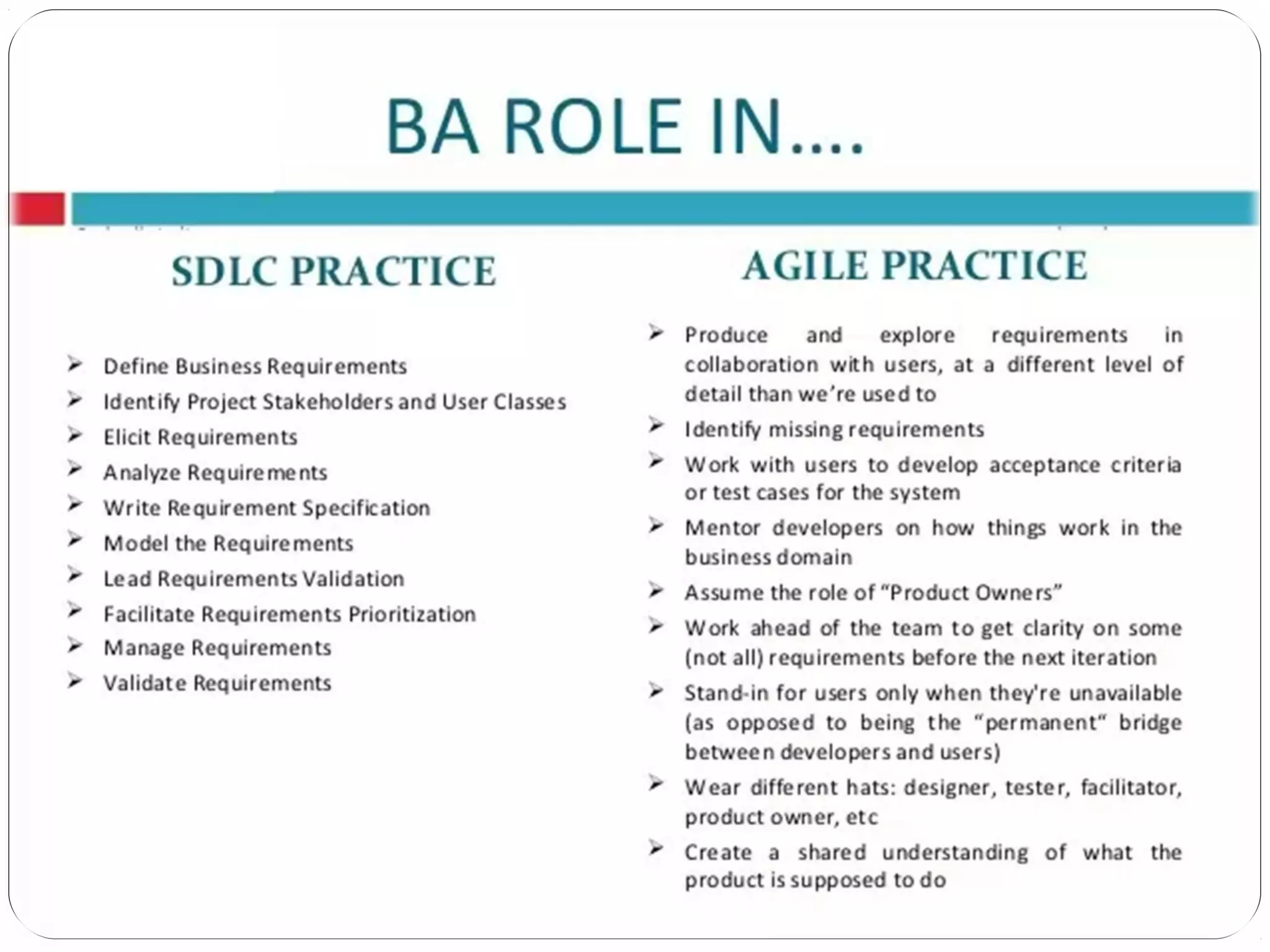
 The Business Analyst conducts business analysis
– “The set of tasks and techniques used to work
as a liaison among stakeholders to understand
the structure, policies, and operations of an
organization, and to recommend solutions that
enable the organization to meet its goals.
 BA Role in 3 Phases…
 The Project Manager manages the project
– “The application of knowledge, skills,
tools, and techniques to provide activities
to meet the project requirements.”
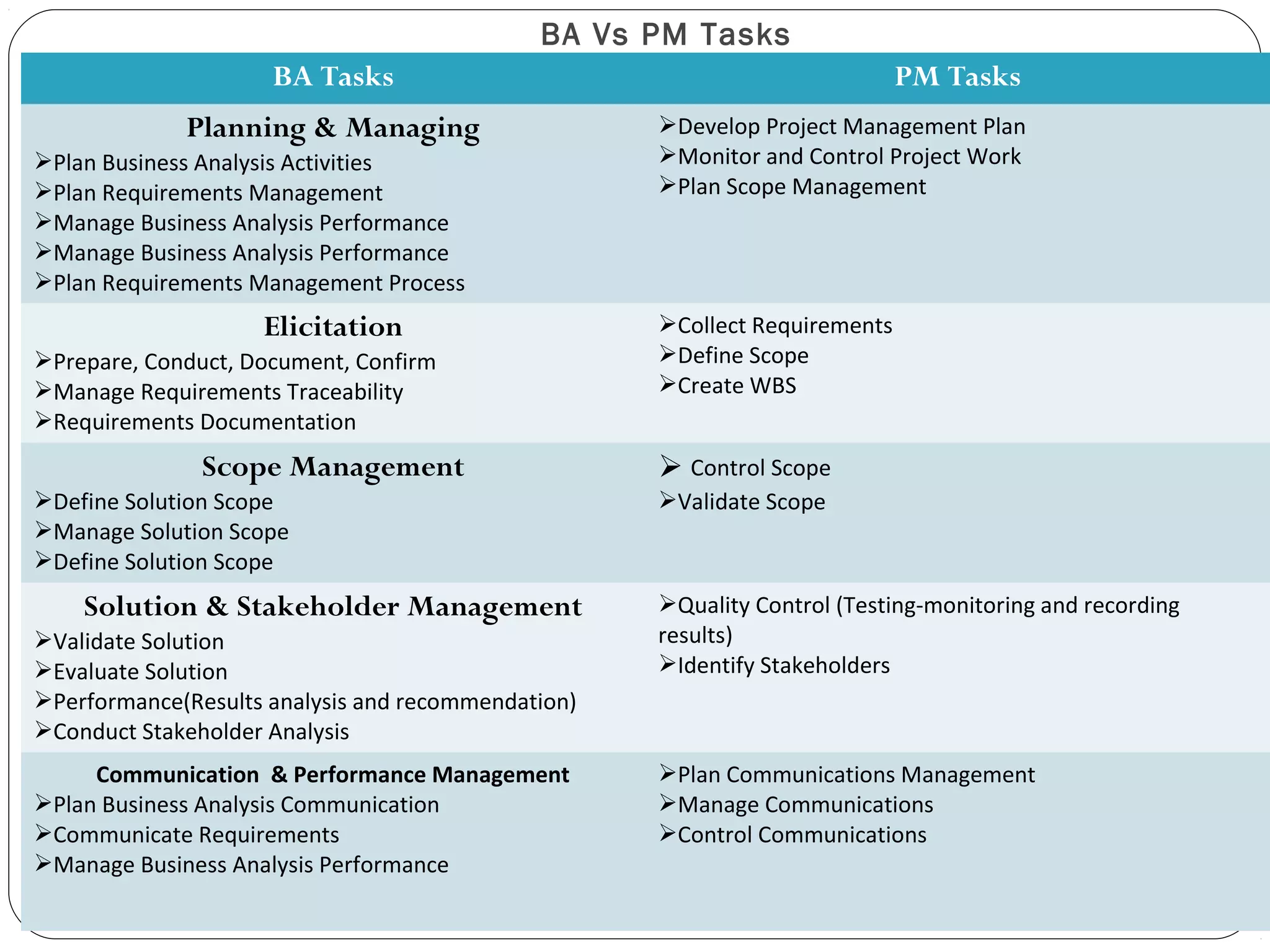
BA Vs PM Tasks
BA Tasks PM Tasks
Planning & Managing
Plan Business Analysis Activities
Plan Requirements Management
Manage Business Analysis Performance
Plan Requirements Management Process
Develop Project Management Plan
Monitor and Control Project Work
Plan Scope Management
Elicitation
Prepare, Conduct, Document, Confirm
Manage Requirements Traceability
Requirements Documentation
Collect Requirements
Define Scope
Create WBS
Scope Management
Define Solution Scope
Manage Solution Scope
Define Solution Scope
 Control Scope
Validate Scope
Solution & Stakeholder Management
Validate Solution
Evaluate Solution
Performance(Results analysis and recommendation)
Conduct Stakeholder Analysis
Quality Control (Testing-monitoring and recording
results)
Identify Stakeholders
Communication & Performance Management
Plan Business Analysis Communication
Communicate Requirements
Manage Business Analysis Performance
Plan Communications Management
Manage Communications
Control Communications
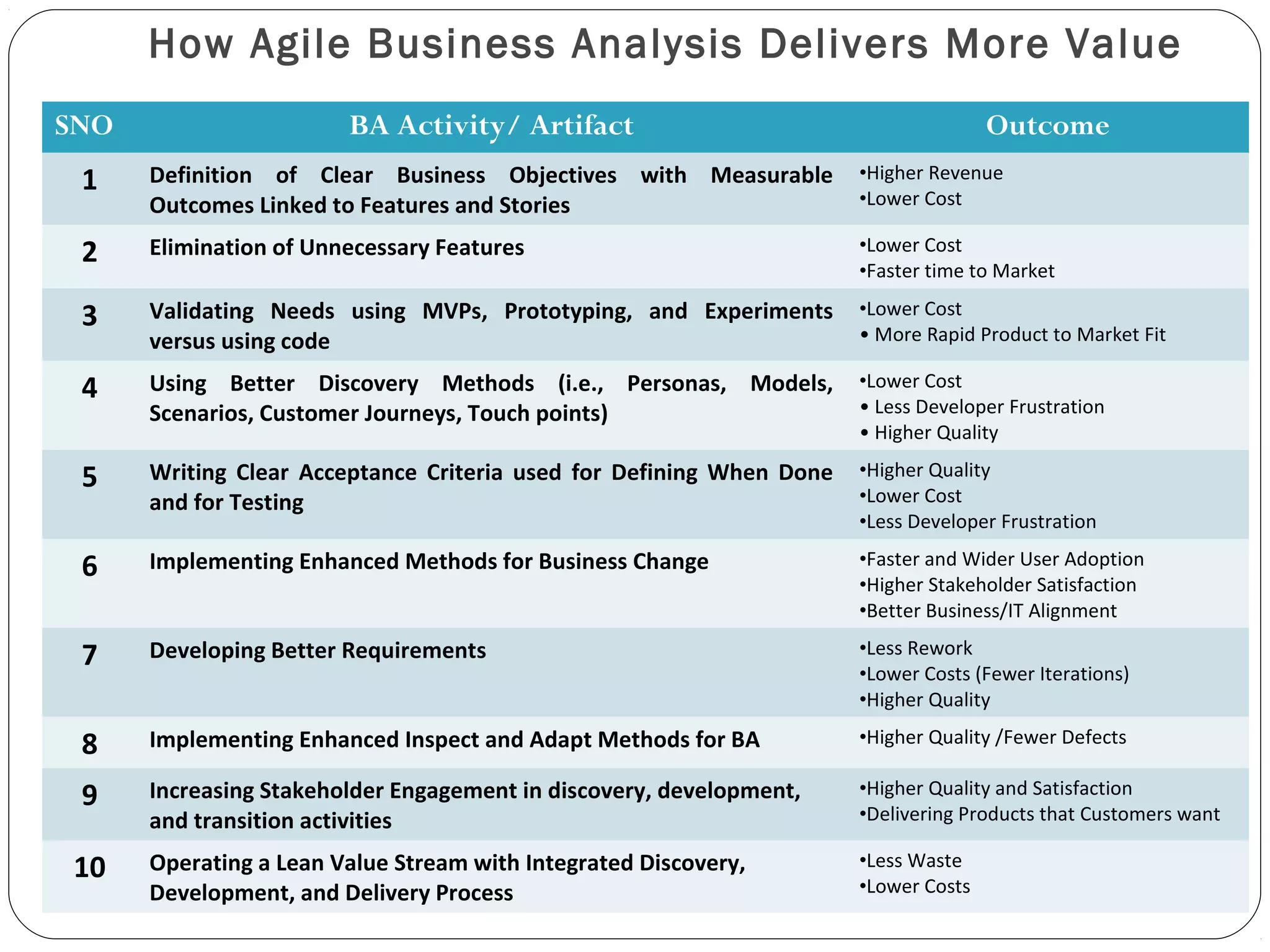
How Agile Business Analysis Delivers More Value
SNO BA Activity/ Artifact Outcome
1 Definition of Clear Business Objectives with Measurable
Outcomes Linked to Features and Stories
•Higher Revenue
•Lower Cost
2 Elimination of Unnecessary Features •Lower Cost
•Faster time to Market
3 Validating Needs using MVPs, Prototyping, and Experiments
versus using code
•Lower Cost
• More Rapid Product to Market Fit
4 Using Better Discovery Methods (i.e., Personas, Models,
Scenarios, Customer Journeys, Touch points)
•Lower Cost
• Less Developer Frustration
• Higher Quality
5 Writing Clear Acceptance Criteria used for Defining When Done
and for Testing
•Higher Quality
•Lower Cost
•Less Developer Frustration
6 Implementing Enhanced Methods for Business Change •Faster and Wider User Adoption
•Higher Stakeholder Satisfaction
•Better Business/IT Alignment
7 Developing Better Requirements •Less Rework
•Lower Costs (Fewer Iterations)
•Higher Quality
8 Implementing Enhanced Inspect and Adapt Methods for BA •Higher Quality /Fewer Defects
9 Increasing Stakeholder Engagement in discovery, development,
and transition activities
•Higher Quality and Satisfaction
•Delivering Products that Customers want
10 Operating a Lean Value Stream with Integrated Discovery,
Development, and Delivery Process
•Less Waste
•Lower Costs
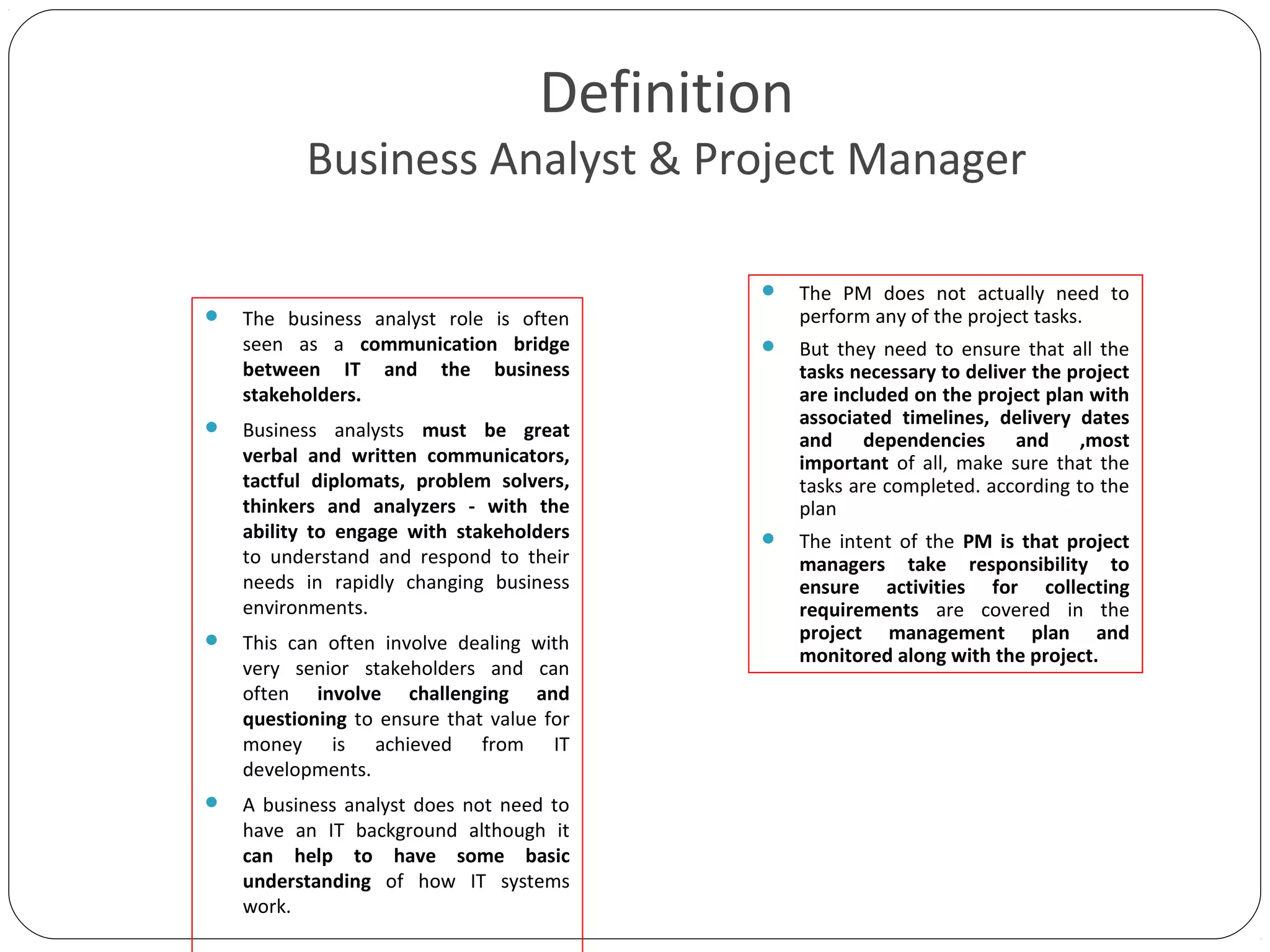
Definition
Business Analyst & Project Manager
 The business analyst role is often
seen as a communication bridge
between IT and the business
stakeholders.
 Business analysts must be great
verbal and written communicators,
tactful diplomats, problem solvers,
thinkers and analyzers - with the
ability to engage with stakeholders
to understand and respond to their
needs in rapidly changing business
environments.
 This can often involve dealing with
very senior stakeholders and can
often involve challenging and
questioning to ensure that value for
money is achieved from IT
developments.
 A business analyst does not need to
have an IT background although it
can help to have some basic
understanding of how IT systems
work.
 The PM does not actually need to
perform any of the project tasks.
 But they need to ensure that all the
tasks necessary to deliver the project
are included on the project plan with
associated timelines, delivery dates
and dependencies and ,most
important of all, make sure that the
tasks are completed. according to the
plan
 The intent of the PM is that project
managers take responsibility to
ensure activities for collecting
requirements are covered in the
project management plan and
monitored along with the project.
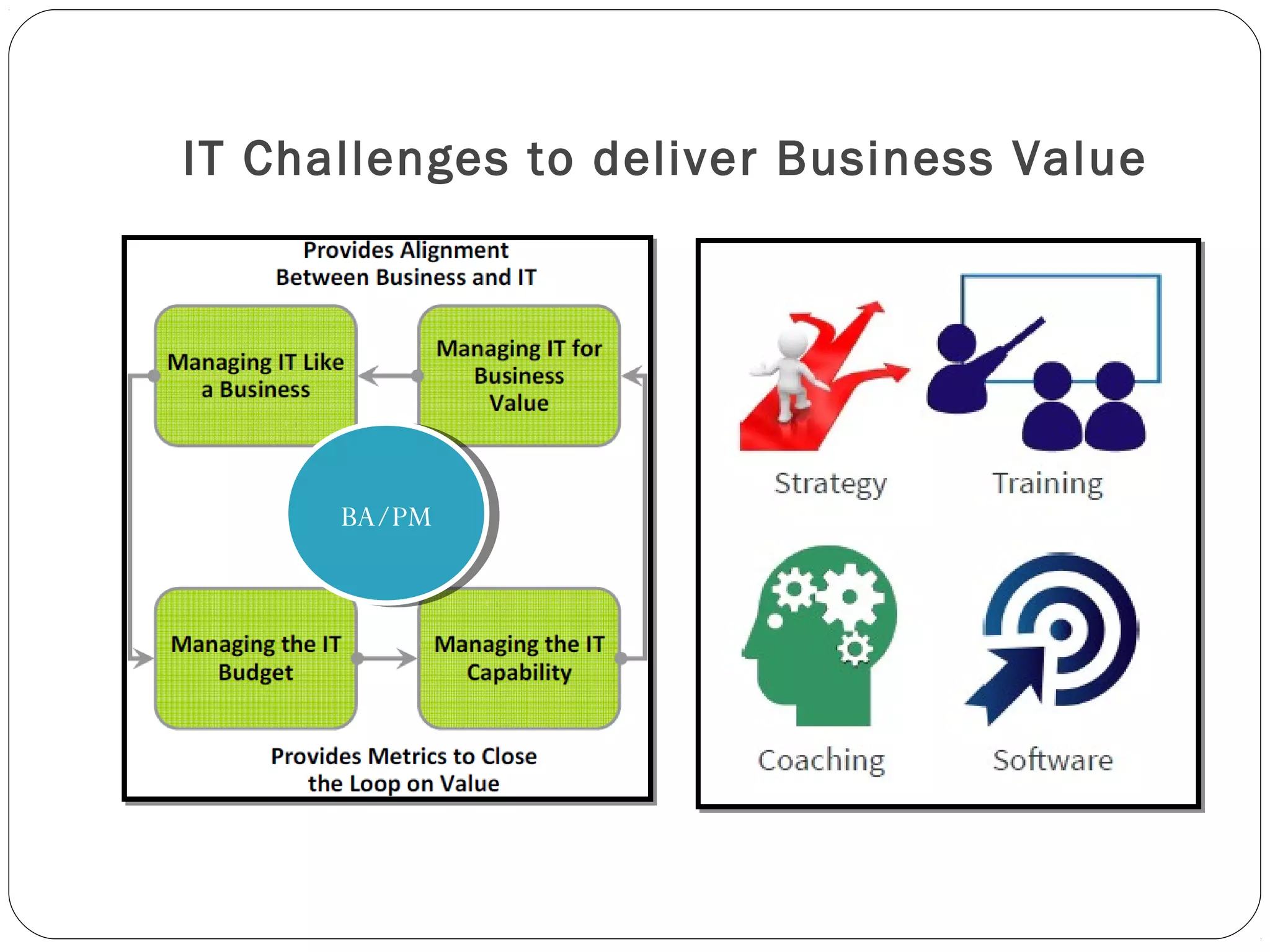
IT Challenges to deliver Business Value
BA/PMBA/PM
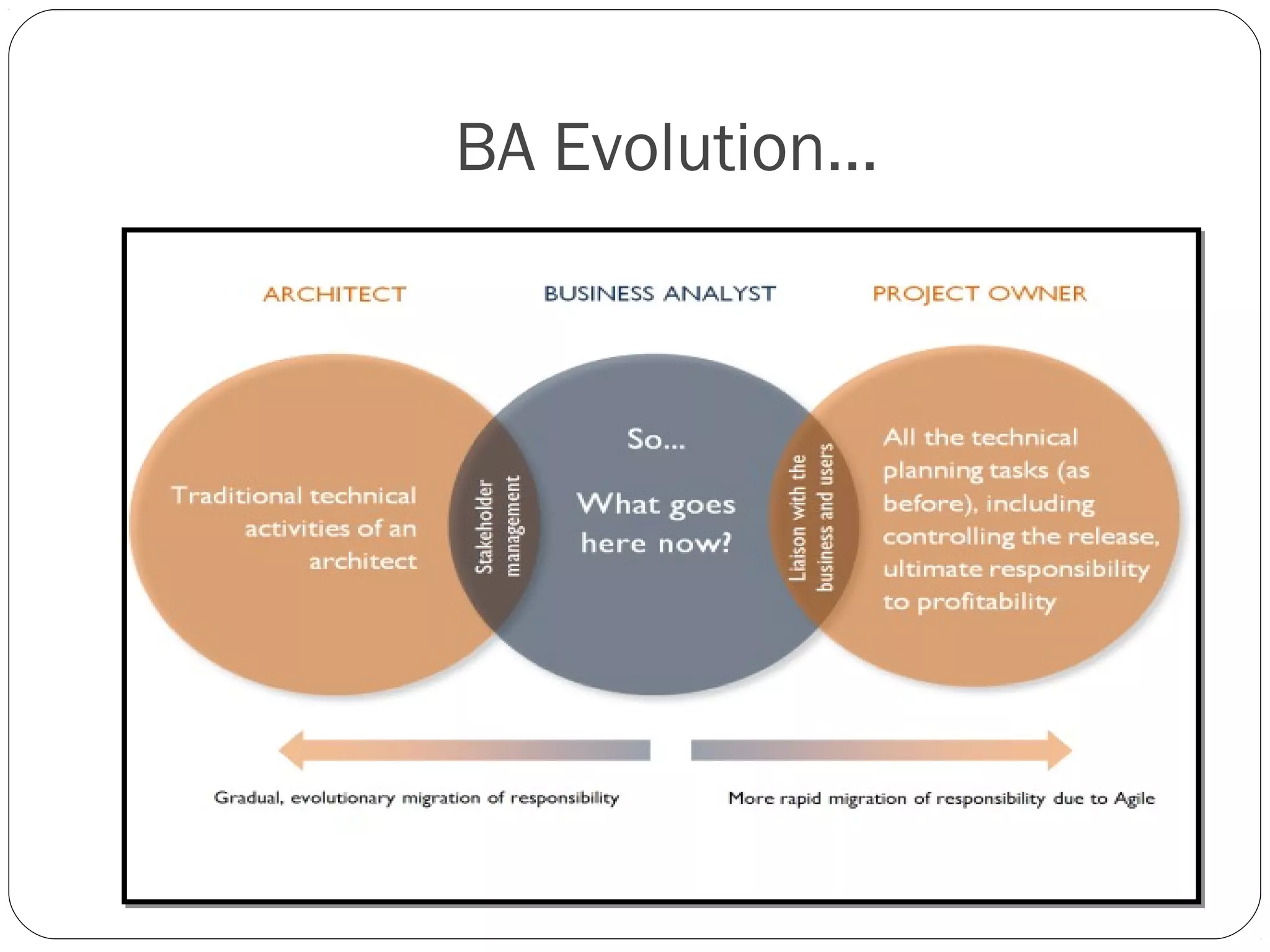
BA Evolution…
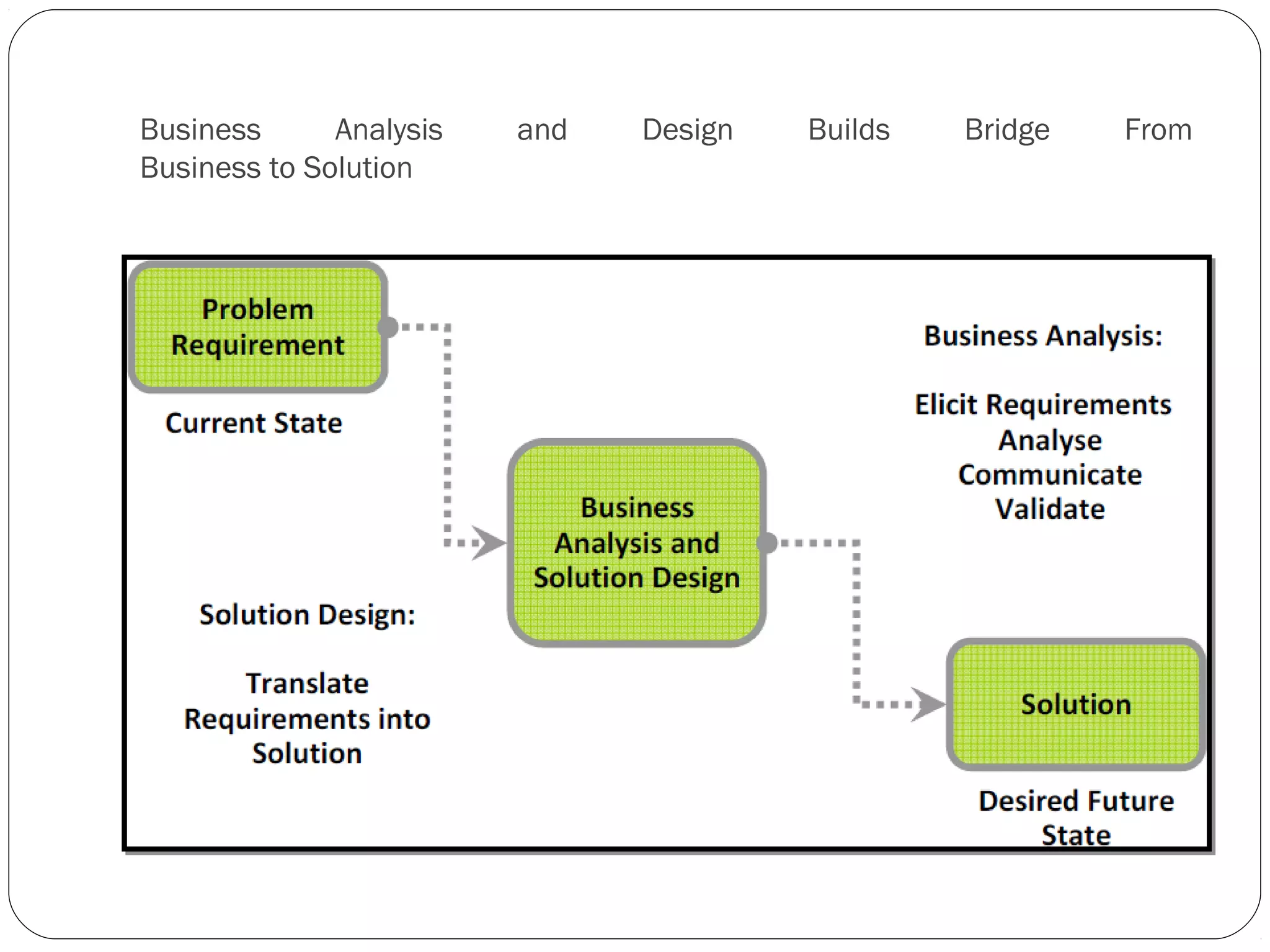
Business Analysis and Design Builds Bridge From
Business to Solution
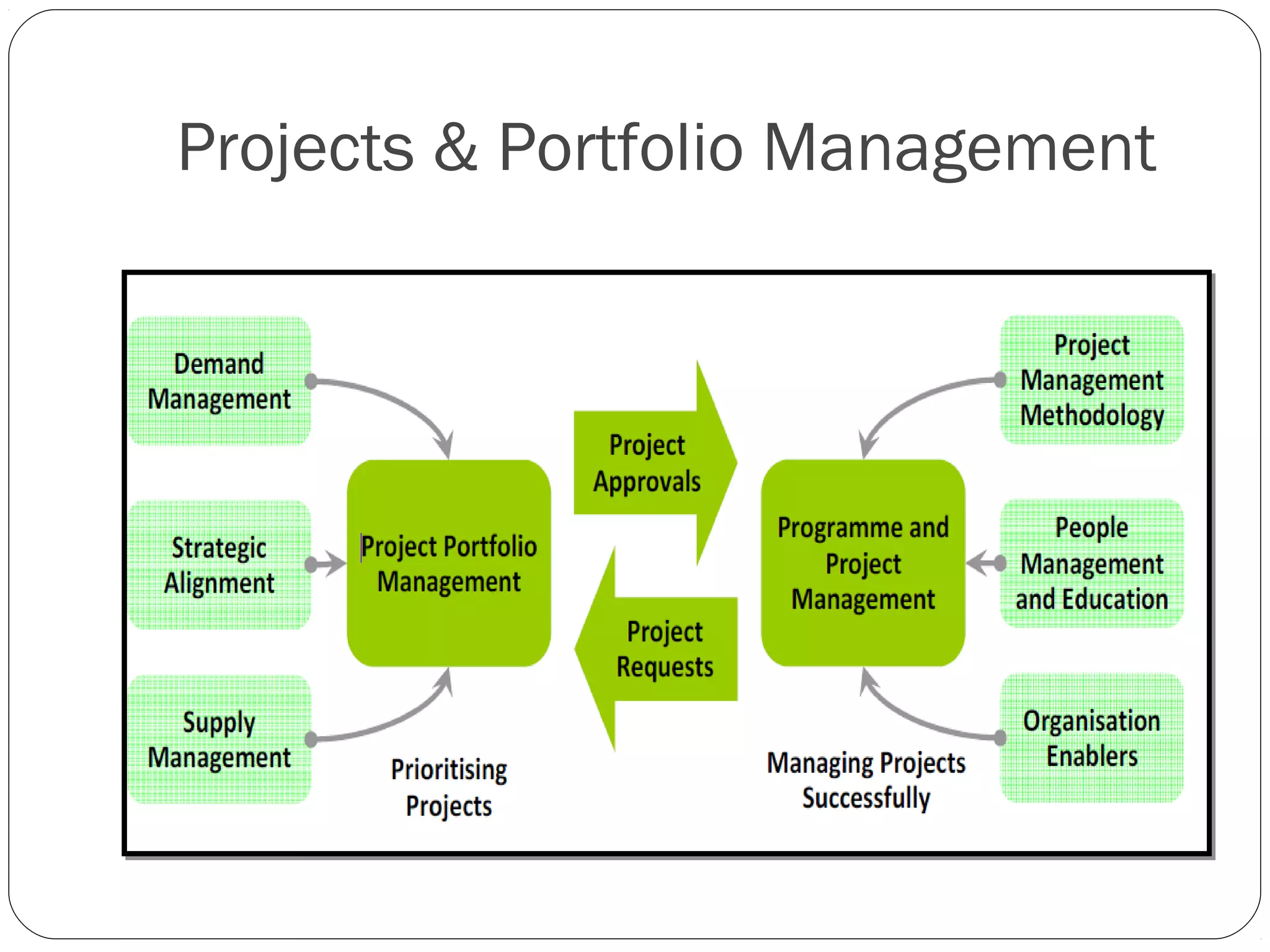
Projects & Portfolio Management
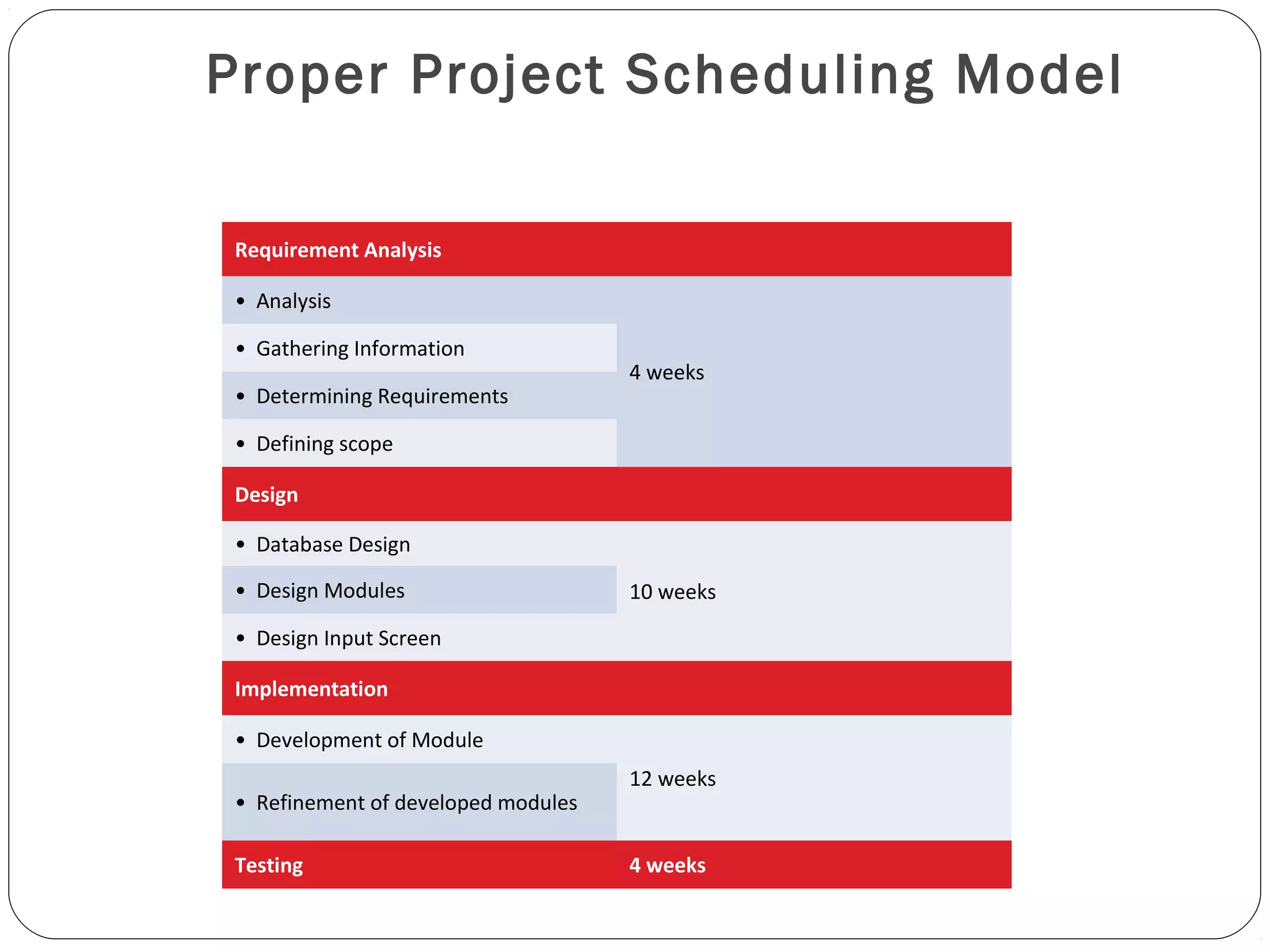
Proper Project Scheduling Model
Requirement Analysis
• Analysis
4 weeks
• Gathering Information
• Determining Requirements
• Defining scope
Design
• Database Design
10 weeks• Design Modules
• Design Input Screen
Implementation
• Development of Module
12 weeks
• Refinement of developed modules
Testing 4 weeks
3. How BA can support you….
Need for BA for an Organization
 Business analysis function manages the
entire solution requirements lifecycle from
understanding the business need to ensuring
that the delivered solution meets business
needs and adds business value
 Projects all too frequently experience
difficulties not from lack of technical
expertise but from an a failure to gather,
understand,analyse and manage business
requirements, and convert them into realistic
achievable solution specifications
 Projects are all too frequently initiated and
solution design and implementation started
before there is a clear understanding of the
business need
 High tolerance and acceptance of inadequate
and ever-changing requirements leading to
requirements and scope creep
 Business analysis focuses on adding value to
the business
 Business analysis provides
 Detailed project objectives
 Business needs analysis
 Well defined and structured
requirements
 Requirements trade-off analysis and
requirements feasibility and
 risk analysis; and cost-benefit analysis
 Without business analysis poor
requirements definition happens,
resulting in a disconnect between what
the business needs and what solution is
delivered
 Effective business analysis is a
combination of technical, analytical,
business and leadership skills
BA Key Roles
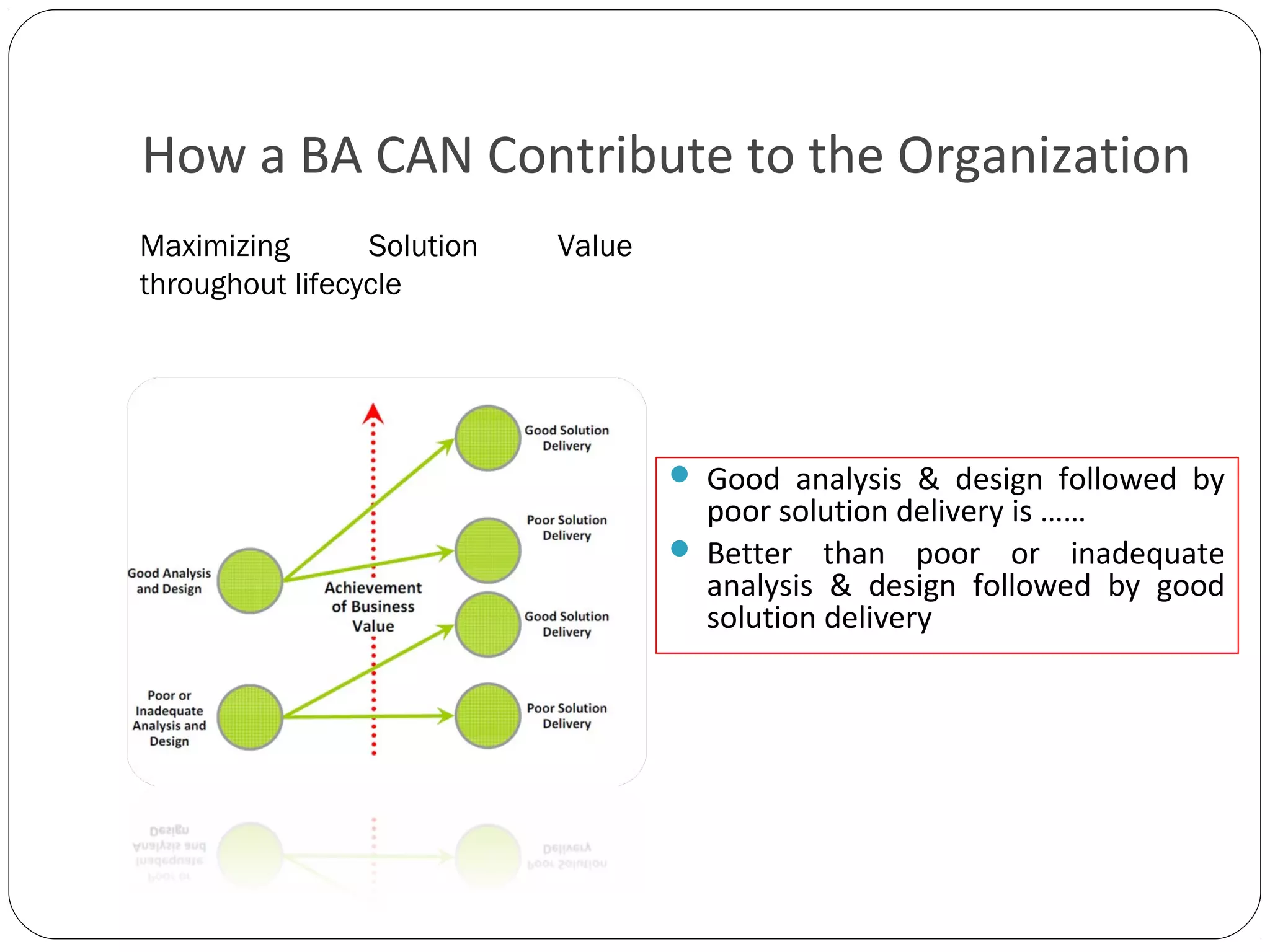
How a BA CAN Contribute to the Organization
Maximizing Solution Value
throughout lifecycle
 Good analysis & design followed by
poor solution delivery is ……
 Better than poor or inadequate
analysis & design followed by good
solution delivery
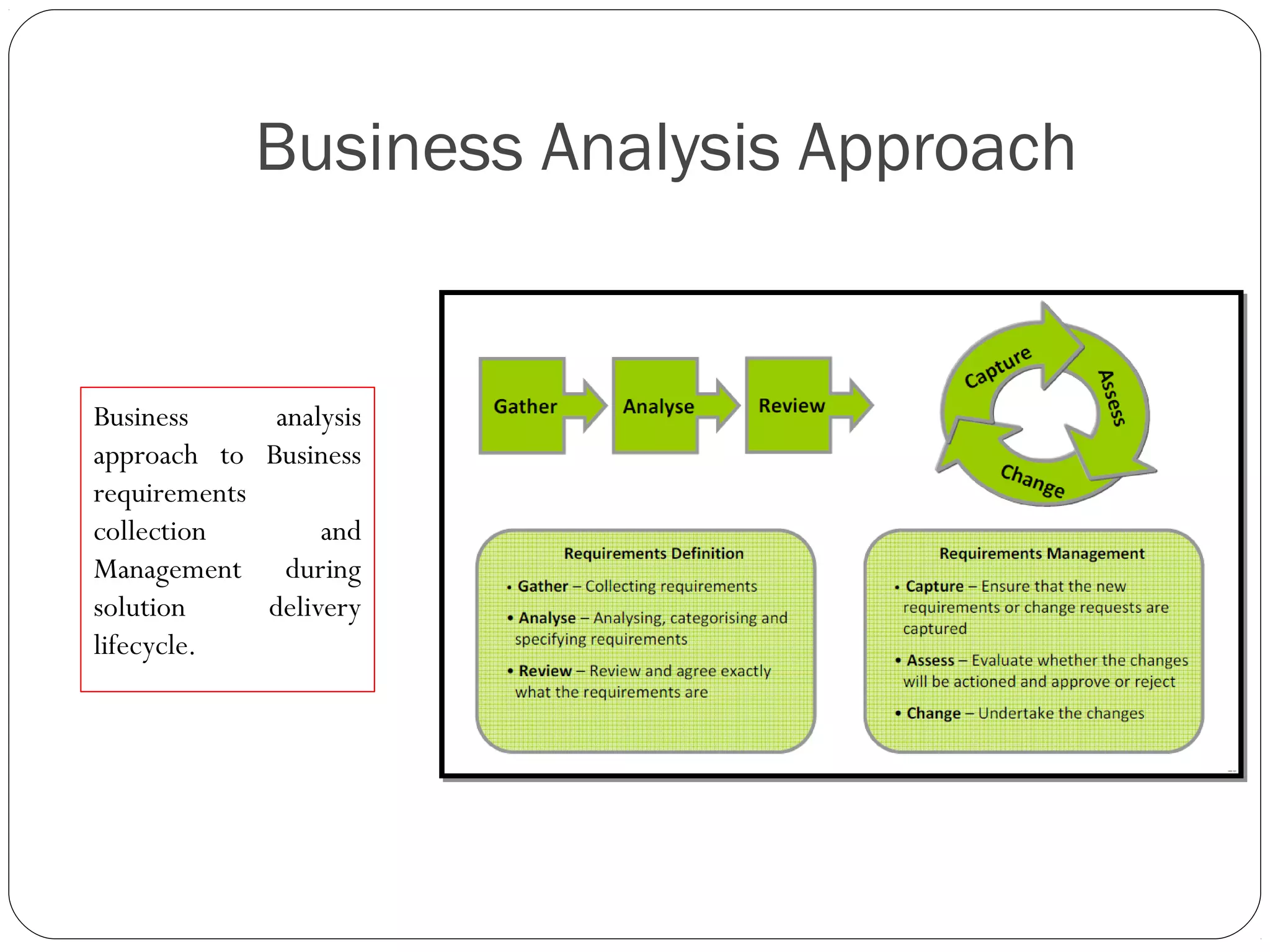
Business Analysis Approach
Business analysis
approach to Business
requirements
collection and
Management during
solution delivery
lifecycle.
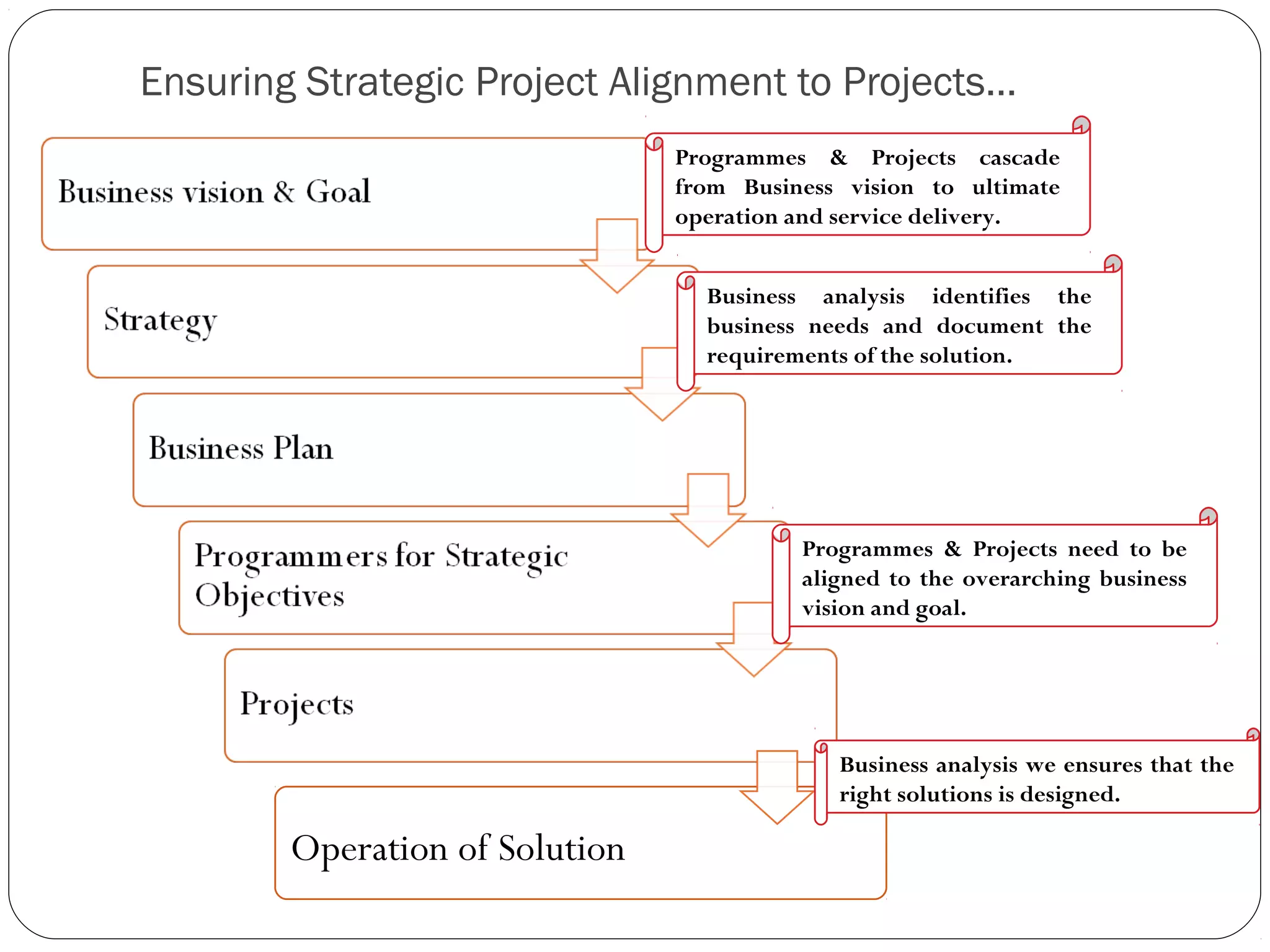
Ensuring Strategic Project Alignment to Projects…
Operation of Solution
Programmes & Projects cascade
from Business vision to ultimate
operation and service delivery.
Business analysis identifies the
business needs and document the
requirements of the solution.
Programmes & Projects need to be
aligned to the overarching business
vision and goal.
Business analysis we ensures that the
right solutions is designed.
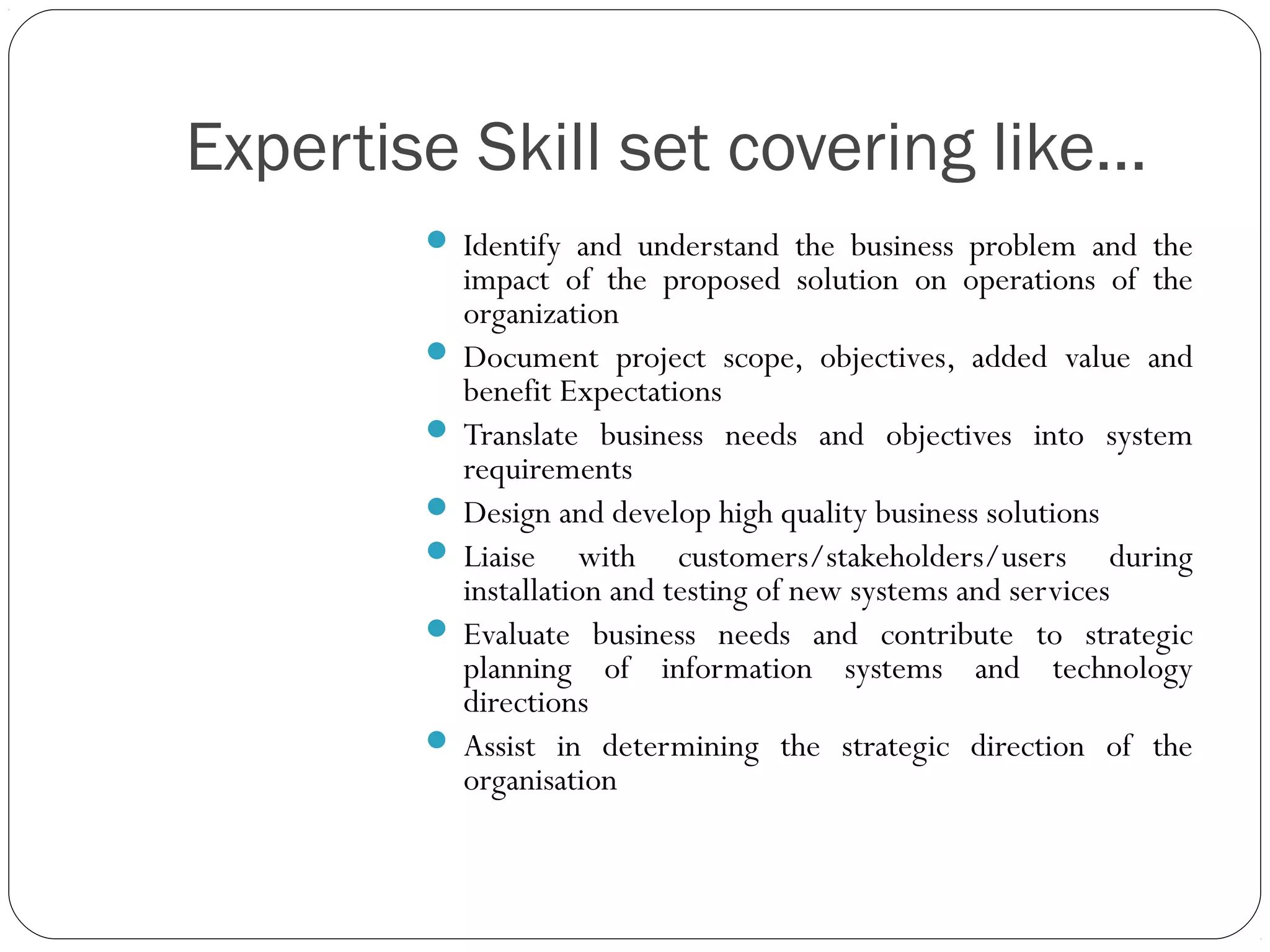
Expertise Skill set covering like…
 Identify and understand the business problem and the
impact of the proposed solution on operations of the
organization
 Document project scope, objectives, added value and
benefit Expectations
 Translate business needs and objectives into system
requirements
 Design and develop high quality business solutions
 Liaise with customers/stakeholders/users during
installation and testing of new systems and services
 Evaluate business needs and contribute to strategic
planning of information systems and technology
directions
 Assist in determining the strategic direction of the
organisation
4. How Digitalleverage Support you..
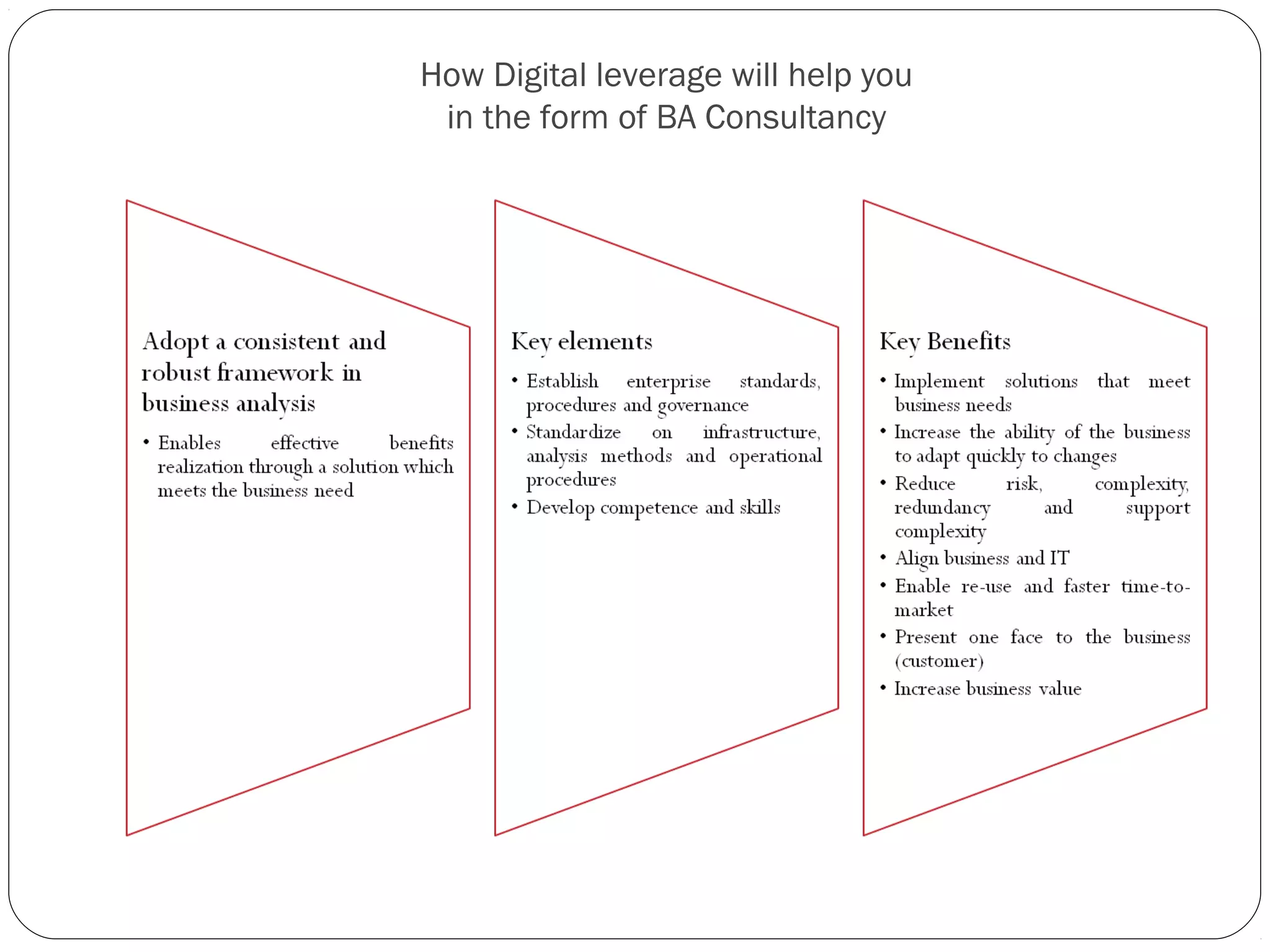
How Digital leverage will help you
in the form of BA Consultancy
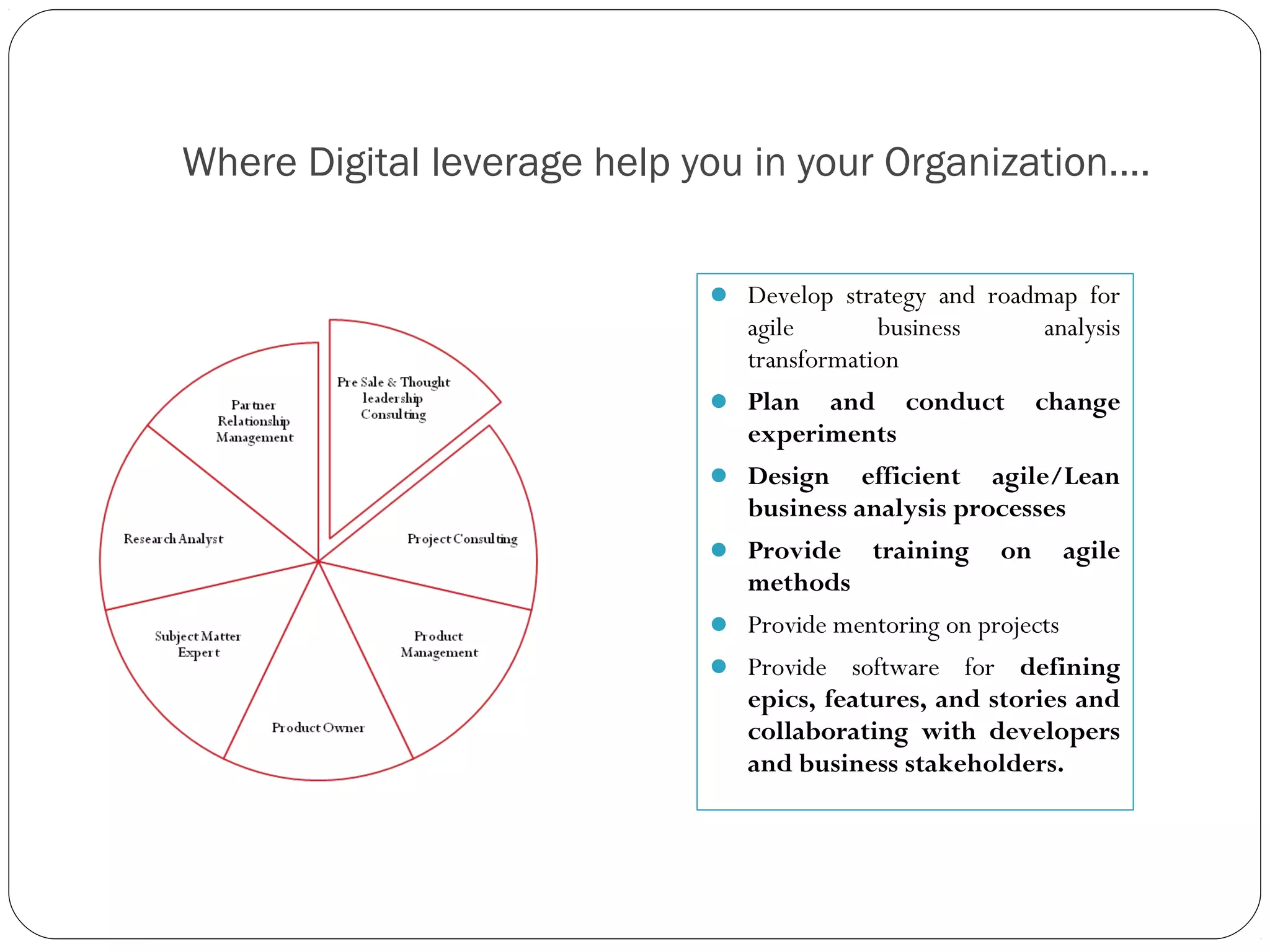
Where Digital leverage help you in your Organization….
 Develop strategy and roadmap for
agile business analysis
transformation
 Plan and conduct change
experiments
 Design efficient agile/Lean
business analysis processes
 Provide training on agile
methods
 Provide mentoring on projects
 Provide software for defining
epics, features, and stories and
collaborating with developers
and business stakeholders.
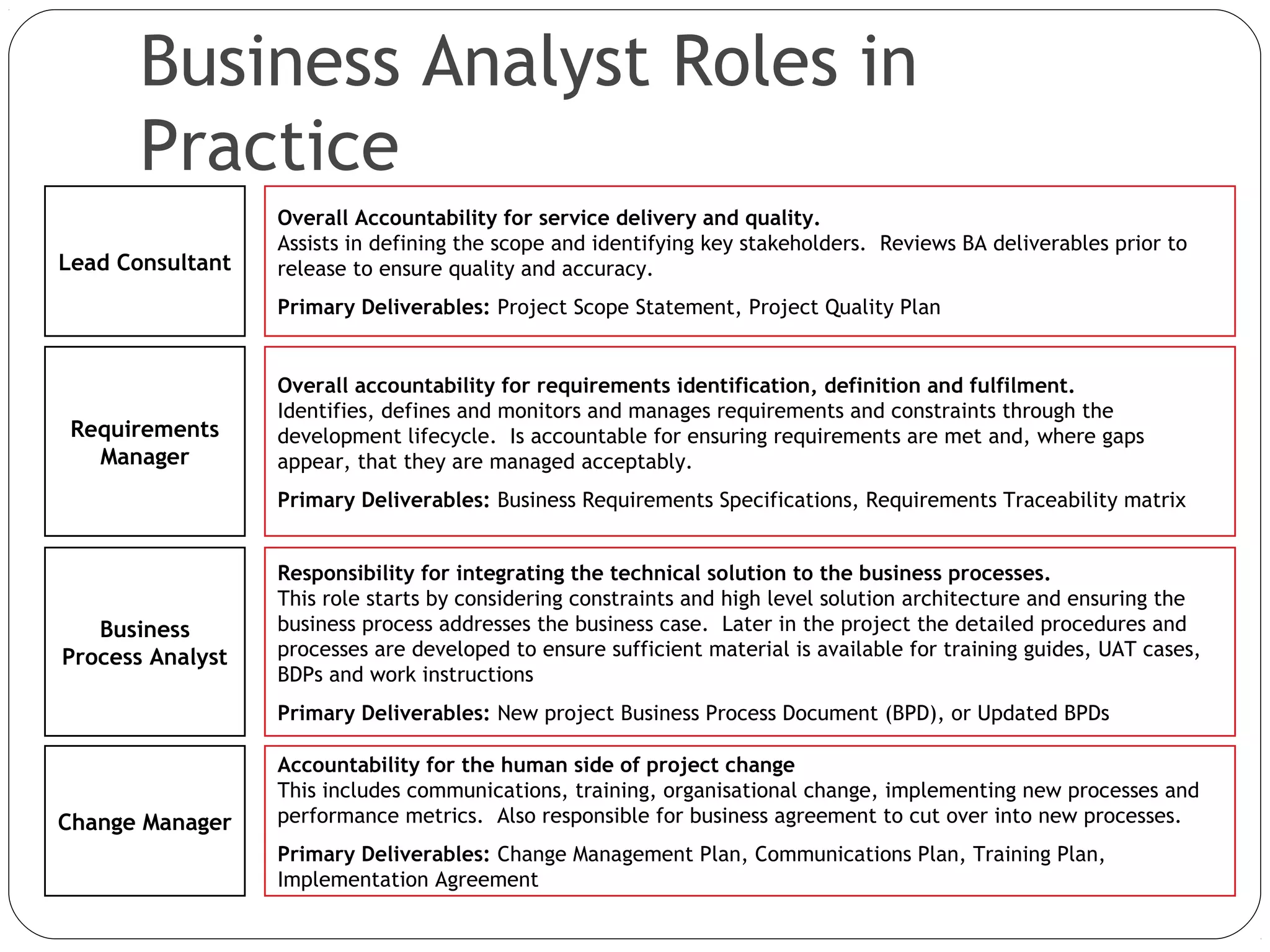
Lead Consultant
Requirements
Manager
Change Manager
Business
Process Analyst
Business Analyst Roles in
Practice
Overall Accountability for service delivery and quality.
Assists in defining the scope and identifying key stakeholders. Reviews BA deliverables prior to
release to ensure quality and accuracy.
Primary Deliverables: Project Scope Statement, Project Quality Plan
Overall accountability for requirements identification, definition and fulfilment.
Identifies, defines and monitors and manages requirements and constraints through the
development lifecycle. Is accountable for ensuring requirements are met and, where gaps
appear, that they are managed acceptably.
Primary Deliverables: Business Requirements Specifications, Requirements Traceability matrix
Accountability for the human side of project change
This includes communications, training, organisational change, implementing new processes and
performance metrics. Also responsible for business agreement to cut over into new processes.
Primary Deliverables: Change Management Plan, Communications Plan, Training Plan,
Implementation Agreement
Responsibility for integrating the technical solution to the business processes.
This role starts by considering constraints and high level solution architecture and ensuring the
business process addresses the business case. Later in the project the detailed procedures and
processes are developed to ensure sufficient material is available for training guides, UAT cases,
BDPs and work instructions
Primary Deliverables: New project Business Process Document (BPD), or Updated BPDs
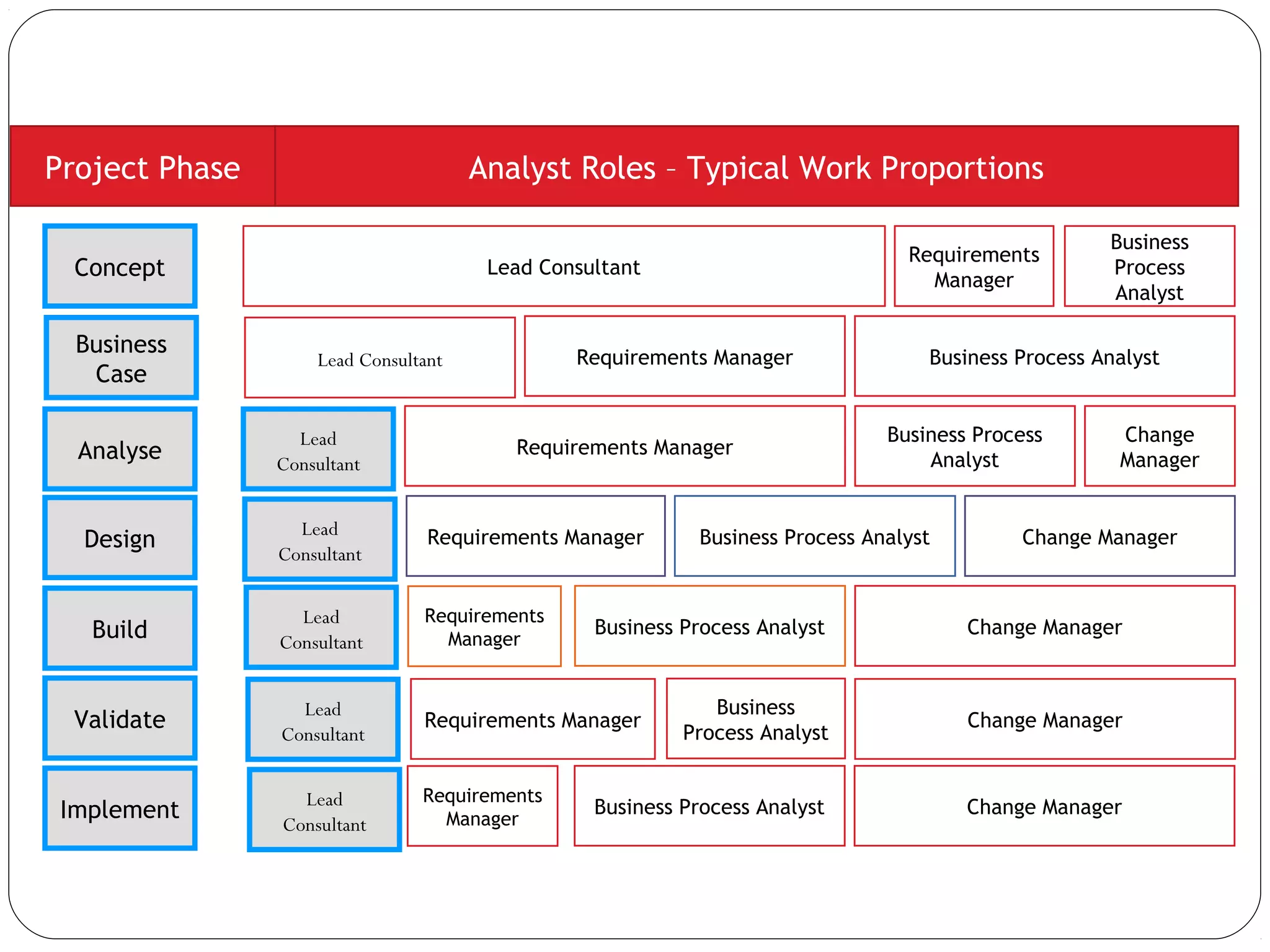
Concept
Business
Case
Analyse
Design
Build
Validate
Implement
Project Phase
Lead Consultant
Lead Consultant
Lead
Consultant
Analyst Roles – Typical Work Proportions
Requirements
Manager
Requirements Manager
Change
Manager
Lead
Consultant
Requirements Manager Change Manager
Requirements
Manager
Change Manager
Lead
Consultant
Requirements Manager Change Manager
Lead
Consultant
Business Process Analyst
Business Process
Analyst
Lead
Consultant
Business
Process Analyst
Requirements
Manager
Change ManagerBusiness Process Analyst
Business
Process
Analyst
Requirements Manager
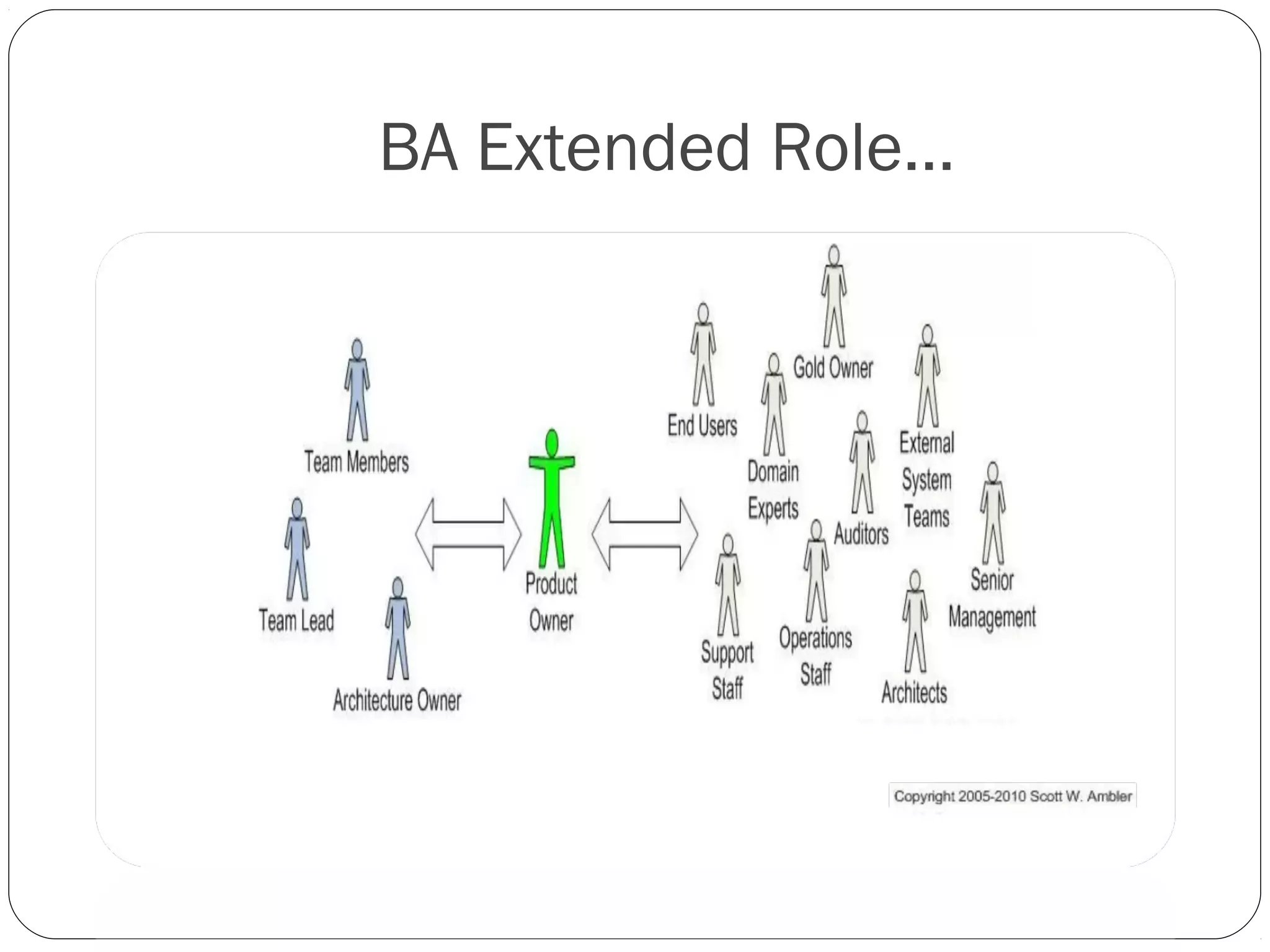
BA Extended Role…
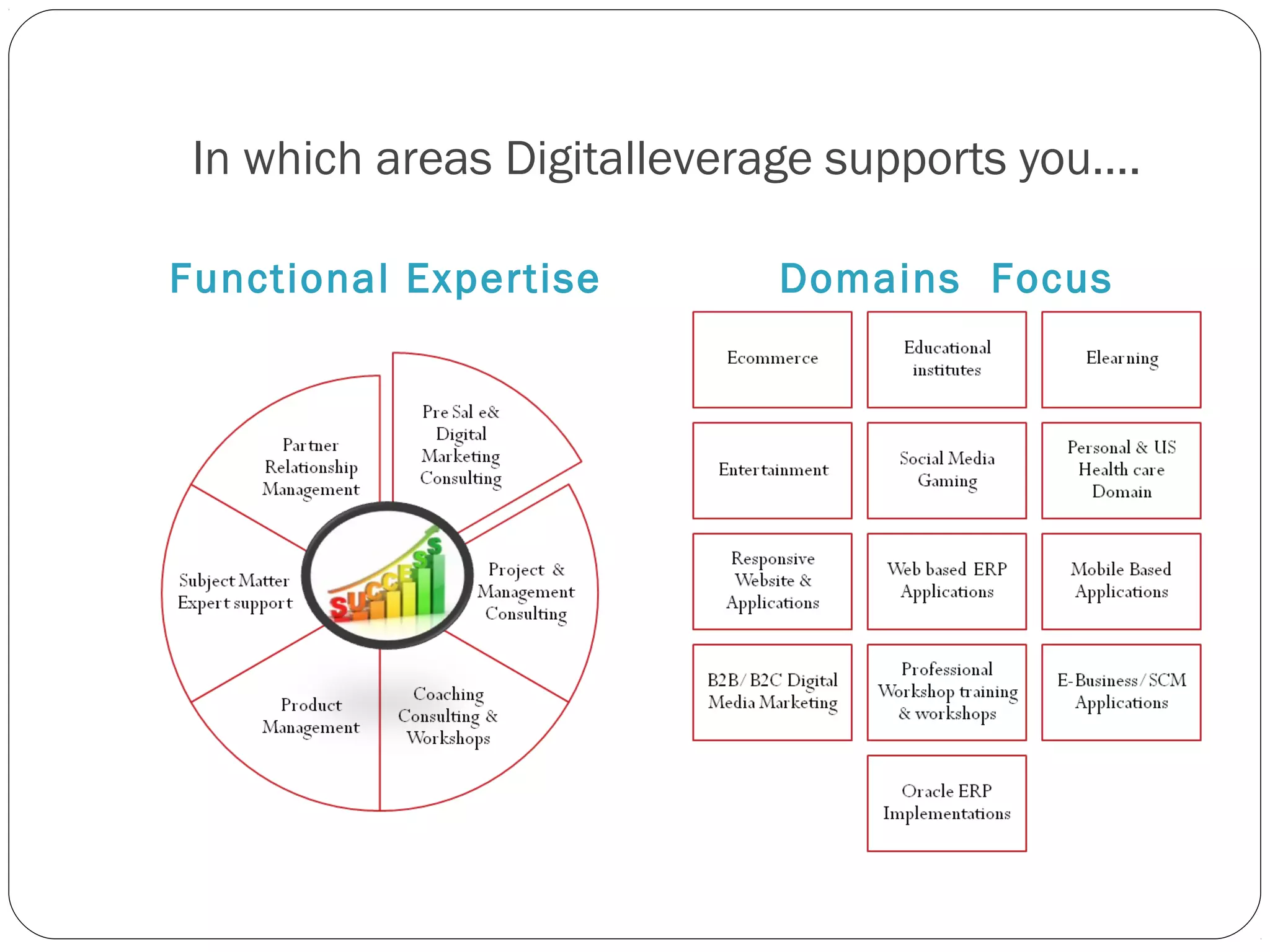
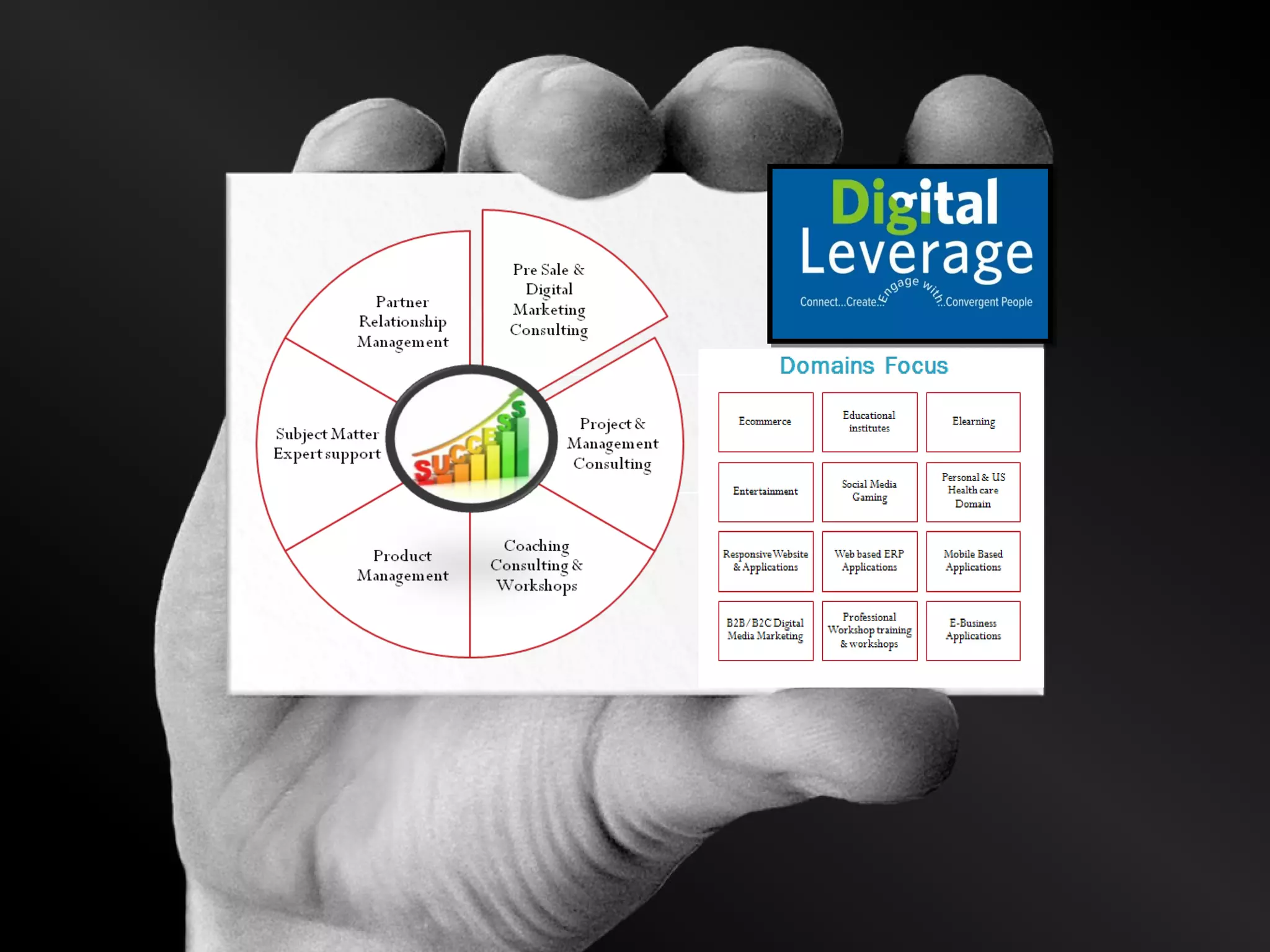
In which areas Digitalleverage supports you….
Functional Expertise Domains Focus
Thank YouKVN Pavan Kumar
SAFE PM/PO Certified Consultant
Founder of Digitalleverage & Sr.BA,Digital Marketing Analyst
https://in.linkedin.com/in/pavankumarsrba
https://www.facebook.com/Digitalleverageconsulting/?ref=hl
https://twitter.com/Thoughtleverage
IT Project and Digital Media Marketing Consulting

IT Project and Digital Media Marketing Consulting

  • 1.
    Presenting by KVN PavanKumar IT Project Vs BA Practice
  • 2.
  • 3.
    •The five dimensionsare interconnected and are laid out in the context of an Enterprise Architecture Renewal. •This process of renewal will be necessary for those that take their relevance seriously. 5D’s
  • 4.
  • 5.
  • 6.
    Challenges in Organizationin the case of less involvement of BA for an IT Project Lack of advance planning for projects and initiatives Lack of formal training for business analysts Inconsistent approach to business analysis Outsourcing and relying on external contractors to perform major roles in system development Impatience with the analysis/design/planning process Gap between what business analysts are assigned to do and what they should be assigned to do
  • 7.
    Understand about ProjectFailures Over schedule Over budget Project cancelled Solution ultimately not used and withdrawn Does not deliver on business case Does not deliver on business benefits Does not deliver business value Poor system usability and/or high error rates requiring rework
  • 8.
    Root Causes forBusiness Failures
  • 9.
  • 10.
    Business Analysis VsProject Management "Business Analysis is the task of understanding business change needs, assessing the business impact of those changes, capturing, analyzing and documenting requirements and supporting the communication and delivery of requirements with relevant stakeholders.“  “Project Management is that project managers take responsibility to ensure activities for collecting requirements are covered in the project management plan and monitored along with the project”.
  • 11.
    Project Manager VsBusiness Analyst Project Manager Business Analyst  The Business Analyst conducts business analysis – “The set of tasks and techniques used to work as a liaison among stakeholders to understand the structure, policies, and operations of an organization, and to recommend solutions that enable the organization to meet its goals.  BA Role in 3 Phases…  The Project Manager manages the project – “The application of knowledge, skills, tools, and techniques to provide activities to meet the project requirements.”
  • 12.
    BA Vs PMTasks BA Tasks PM Tasks Planning & Managing Plan Business Analysis Activities Plan Requirements Management Manage Business Analysis Performance Manage Business Analysis Performance Plan Requirements Management Process Develop Project Management Plan Monitor and Control Project Work Plan Scope Management Elicitation Prepare, Conduct, Document, Confirm Manage Requirements Traceability Requirements Documentation Collect Requirements Define Scope Create WBS Scope Management Define Solution Scope Manage Solution Scope Define Solution Scope  Control Scope Validate Scope Solution & Stakeholder Management Validate Solution Evaluate Solution Performance(Results analysis and recommendation) Conduct Stakeholder Analysis Quality Control (Testing-monitoring and recording results) Identify Stakeholders Communication & Performance Management Plan Business Analysis Communication Communicate Requirements Manage Business Analysis Performance Plan Communications Management Manage Communications Control Communications
  • 16.
    How Agile BusinessAnalysis Delivers More Value SNO BA Activity/ Artifact Outcome 1 Definition of Clear Business Objectives with Measurable Outcomes Linked to Features and Stories •Higher Revenue •Lower Cost 2 Elimination of Unnecessary Features •Lower Cost •Faster time to Market 3 Validating Needs using MVPs, Prototyping, and Experiments versus using code •Lower Cost • More Rapid Product to Market Fit 4 Using Better Discovery Methods (i.e., Personas, Models, Scenarios, Customer Journeys, Touch points) •Lower Cost • Less Developer Frustration • Higher Quality 5 Writing Clear Acceptance Criteria used for Defining When Done and for Testing •Higher Quality •Lower Cost •Less Developer Frustration 6 Implementing Enhanced Methods for Business Change •Faster and Wider User Adoption •Higher Stakeholder Satisfaction •Better Business/IT Alignment 7 Developing Better Requirements •Less Rework •Lower Costs (Fewer Iterations) •Higher Quality 8 Implementing Enhanced Inspect and Adapt Methods for BA •Higher Quality /Fewer Defects 9 Increasing Stakeholder Engagement in discovery, development, and transition activities •Higher Quality and Satisfaction •Delivering Products that Customers want 10 Operating a Lean Value Stream with Integrated Discovery, Development, and Delivery Process •Less Waste •Lower Costs
  • 17.
    Definition Business Analyst &Project Manager  The business analyst role is often seen as a communication bridge between IT and the business stakeholders.  Business analysts must be great verbal and written communicators, tactful diplomats, problem solvers, thinkers and analyzers - with the ability to engage with stakeholders to understand and respond to their needs in rapidly changing business environments.  This can often involve dealing with very senior stakeholders and can often involve challenging and questioning to ensure that value for money is achieved from IT developments.  A business analyst does not need to have an IT background although it can help to have some basic understanding of how IT systems work.  The PM does not actually need to perform any of the project tasks.  But they need to ensure that all the tasks necessary to deliver the project are included on the project plan with associated timelines, delivery dates and dependencies and ,most important of all, make sure that the tasks are completed. according to the plan  The intent of the PM is that project managers take responsibility to ensure activities for collecting requirements are covered in the project management plan and monitored along with the project.
  • 18.
    IT Challenges todeliver Business Value BA/PMBA/PM
  • 19.
  • 20.
    Business Analysis andDesign Builds Bridge From Business to Solution
  • 22.
  • 23.
    Proper Project SchedulingModel Requirement Analysis • Analysis 4 weeks • Gathering Information • Determining Requirements • Defining scope Design • Database Design 10 weeks• Design Modules • Design Input Screen Implementation • Development of Module 12 weeks • Refinement of developed modules Testing 4 weeks
  • 24.
    3. How BAcan support you….
  • 26.
    Need for BAfor an Organization  Business analysis function manages the entire solution requirements lifecycle from understanding the business need to ensuring that the delivered solution meets business needs and adds business value  Projects all too frequently experience difficulties not from lack of technical expertise but from an a failure to gather, understand,analyse and manage business requirements, and convert them into realistic achievable solution specifications  Projects are all too frequently initiated and solution design and implementation started before there is a clear understanding of the business need  High tolerance and acceptance of inadequate and ever-changing requirements leading to requirements and scope creep  Business analysis focuses on adding value to the business  Business analysis provides  Detailed project objectives  Business needs analysis  Well defined and structured requirements  Requirements trade-off analysis and requirements feasibility and  risk analysis; and cost-benefit analysis  Without business analysis poor requirements definition happens, resulting in a disconnect between what the business needs and what solution is delivered  Effective business analysis is a combination of technical, analytical, business and leadership skills
  • 27.
  • 28.
    How a BACAN Contribute to the Organization Maximizing Solution Value throughout lifecycle  Good analysis & design followed by poor solution delivery is ……  Better than poor or inadequate analysis & design followed by good solution delivery
  • 29.
    Business Analysis Approach Businessanalysis approach to Business requirements collection and Management during solution delivery lifecycle.
  • 30.
    Ensuring Strategic ProjectAlignment to Projects… Operation of Solution Programmes & Projects cascade from Business vision to ultimate operation and service delivery. Business analysis identifies the business needs and document the requirements of the solution. Programmes & Projects need to be aligned to the overarching business vision and goal. Business analysis we ensures that the right solutions is designed.
  • 31.
    Expertise Skill setcovering like…  Identify and understand the business problem and the impact of the proposed solution on operations of the organization  Document project scope, objectives, added value and benefit Expectations  Translate business needs and objectives into system requirements  Design and develop high quality business solutions  Liaise with customers/stakeholders/users during installation and testing of new systems and services  Evaluate business needs and contribute to strategic planning of information systems and technology directions  Assist in determining the strategic direction of the organisation
  • 32.
  • 33.
    How Digital leveragewill help you in the form of BA Consultancy
  • 34.
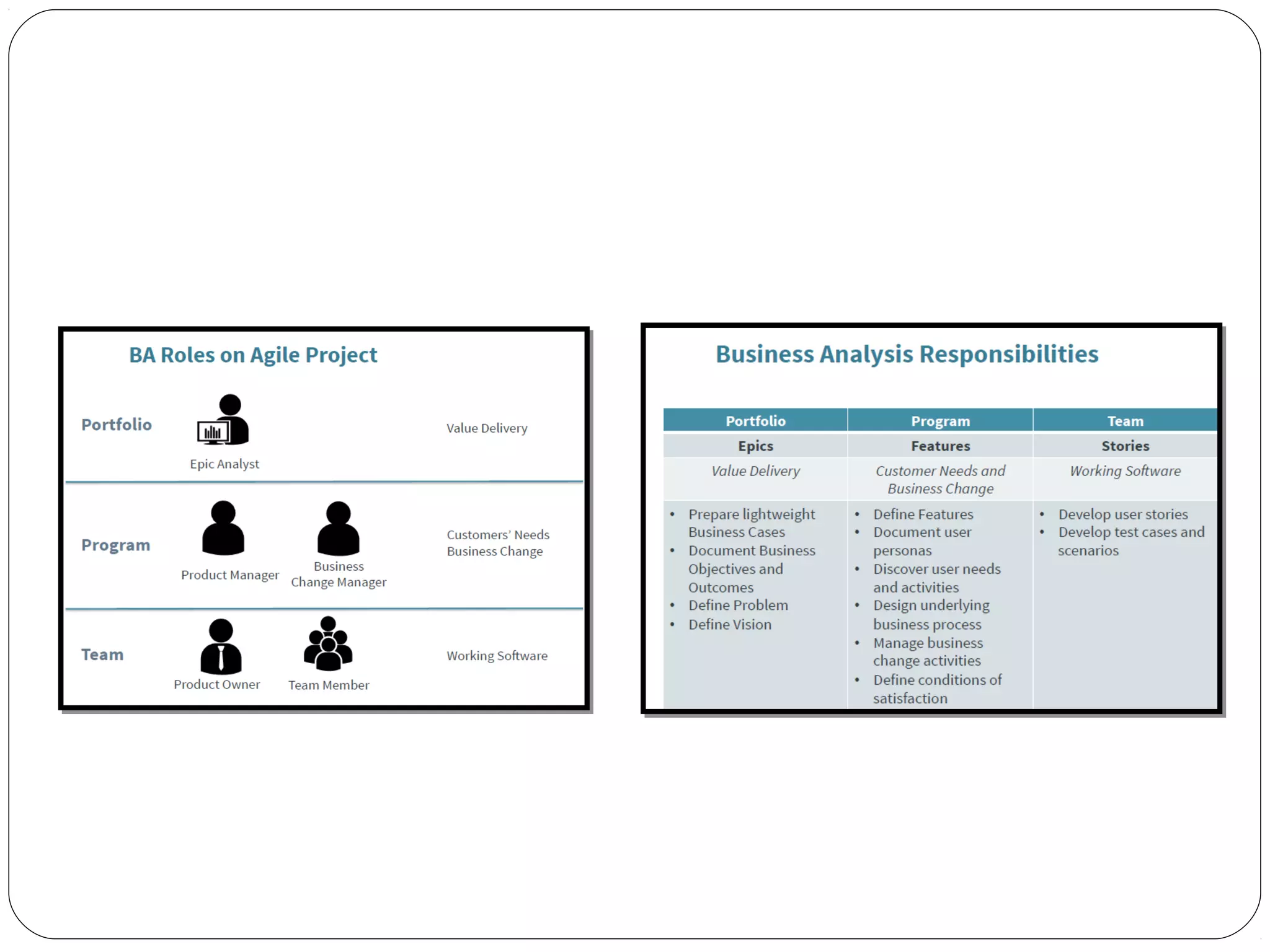
    Where Digital leveragehelp you in your Organization….  Develop strategy and roadmap for agile business analysis transformation  Plan and conduct change experiments  Design efficient agile/Lean business analysis processes  Provide training on agile methods  Provide mentoring on projects  Provide software for defining epics, features, and stories and collaborating with developers and business stakeholders.
  • 35.
    Lead Consultant Requirements Manager Change Manager Business ProcessAnalyst Business Analyst Roles in Practice Overall Accountability for service delivery and quality. Assists in defining the scope and identifying key stakeholders. Reviews BA deliverables prior to release to ensure quality and accuracy. Primary Deliverables: Project Scope Statement, Project Quality Plan Overall accountability for requirements identification, definition and fulfilment. Identifies, defines and monitors and manages requirements and constraints through the development lifecycle. Is accountable for ensuring requirements are met and, where gaps appear, that they are managed acceptably. Primary Deliverables: Business Requirements Specifications, Requirements Traceability matrix Accountability for the human side of project change This includes communications, training, organisational change, implementing new processes and performance metrics. Also responsible for business agreement to cut over into new processes. Primary Deliverables: Change Management Plan, Communications Plan, Training Plan, Implementation Agreement Responsibility for integrating the technical solution to the business processes. This role starts by considering constraints and high level solution architecture and ensuring the business process addresses the business case. Later in the project the detailed procedures and processes are developed to ensure sufficient material is available for training guides, UAT cases, BDPs and work instructions Primary Deliverables: New project Business Process Document (BPD), or Updated BPDs
  • 36.
    Concept Business Case Analyse Design Build Validate Implement Project Phase Lead Consultant LeadConsultant Lead Consultant Analyst Roles – Typical Work Proportions Requirements Manager Requirements Manager Change Manager Lead Consultant Requirements Manager Change Manager Requirements Manager Change Manager Lead Consultant Requirements Manager Change Manager Lead Consultant Business Process Analyst Business Process Analyst Business Process Analyst Business Process Analyst Lead Consultant Business Process Analyst Requirements Manager Change ManagerBusiness Process Analyst Business Process Analyst Requirements Manager
  • 37.
  • 38.
    In which areasDigitalleverage supports you…. Functional Expertise Domains Focus
  • 39.
    Thank YouKVN PavanKumar SAFE PM/PO Certified Consultant Founder of Digitalleverage & Sr.BA,Digital Marketing Analyst https://in.linkedin.com/in/pavankumarsrba https://www.facebook.com/Digitalleverageconsulting/?ref=hl https://twitter.com/Thoughtleverage