Project Management Session 8 Project Termination
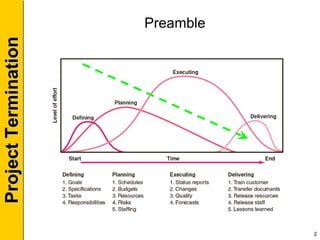
Preamble
The Ways of Terminating a Project A project can be said to be terminated  when work on the substance of the project has ceased  or slowed to the point that further progress is no longer possible; There are four fundamentally  different ways  to close out a project: extinction, addition, integration, and starvation
Termination by Extinction The project may end because it has been successful and achieved its goals; The project may also be stopped because it is unsuccessful or has been superseded; A special case of termination by extinction is “termination by murder” which can range from political assassination to accidental projecticide.
Termination by Extinction Two important characteristics of termination by murder are the  suddenness  of project demise and the lack of obvious signals that death is imminent; When a decision is made to terminate a project by extinction, the most noticeable event is that all activity on the  substance  of the project ceases.
Termination by Addition If a project is a major success, it may be terminated by  institutionalizing it as a formal part of the parent organization; Project personnel, property, and equipment are often simply transferred  from the dying project to the newly born division; The transition from project to division demands a superior level of political sensitivity for successful accomplishment.
Termination by Integration This method of terminating projects is the most common way of dealing with successful projects, and the most complex; The property, equipment, material, personnel, and functions of the project are distributed among the existing elements of the parent organization.
Termination by Integration In general, the problems of integration are inversely related to the  level of experience that the parent or client has had with : the technology being integrated; the successful integration of other projects, regardless of technology.
Termination by Integration A few of the more important aspects of the transition from project to integrated operation that must be considered: Personnel  - where will the team go?; Manufacturing  - is the training complete?; Accounting/Finance  - have the project’s account been closed and audited?; Engineering  - are all drawings complete and on file?; Information Systems/Software  - has the new system been thoroughly tested?; Marketing  - is the sales department aware of the change?
Termination by Starvation This type of project termination is a “slow starvation by  budget decrement ”; There are many reasons why senior management does not wish to terminate an unsuccessful or obsolete project: Politically dangerous to admit that one has championed a failure; Terminating a project that has not accomplished its goals is an admission of failure.
When to Terminate a Project Some questions to ask when considering termination: Has the project been obviated by  technical advances ? Is the output of the project still  cost-effective ? Is it time to  integrate or add  the project as a part of regular operations? Are there  better alternative  uses for the funds, time and personnel devoted to the project? Has a  change in the environment  altered the need for the project’s output?
When to Terminate a Project Fundamental reasons why some projects fail to produce satisfactory answers to termination questions: A project organization is not required; Insufficient support from senior management; Naming the wrong person as project manager; Poor planning. These and a few other reasons, are the base cause of most project failures; The specific causes derive from these fundamental issues.
The Termination Process The termination process has two distinct parts; First is the decision whether or not to terminate; Second, if the decision is to terminate the project, the decision must be carried out.
The Decision Process Decision-aiding models for the termination decision fall into two generic categories: Models that base the decision on the degree to which the project qualifies against a set of factors generally held to be  associated with successful projects; Models that base the decision on the degree to which the  project meets the goals and objectives set for it ; Just as the decision criteria, constraints, weights, and environmental data are unique to each organization, so are the specifics of using any decision model.
The Implementation Process The actual termination can be planned and orderly, or a simple hatchet job; Special termination managers  are sometimes useful in completing the long and involved process of shutting down a project; The primary duties of the manager in charge of termination can be encompassed in nine general tasks.
The Implementation Process Duties of the termination manager: Ensure  completion of the work,  including tasks performed by subcontractors; Notify the client of project completion and ensure that  delivery  is accomplished; Ensure that  documentation  is complete including a terminal evaluation of the project deliverables and preparation of the project’s  Final Report; Clear for  final billings  and oversee preparation of the final invoices sent to the client.
The Implementation Process Duties of the termination manager (cont.): Redistribute  personnel, materials equipment, and any other resources to the appropriate places; Clear project with  legal  counsel or consultant; Determine what  records  to keep; Ascertain any  product support  requirements, decide how each support will be delivered, and assign responsibility; Oversee the closing of the  project’s books .
The Final Report The final report is the  history  of the project; It is a  chronicle  of the life and times of the project, a compendium of what went right and what went wrong; The required information is contained in the master plan, all project audits, and evaluations; The precise organization of the report is not of great concern; the content is.
The Final Report Several subjects should be addressed in the final report: Project performance; Administrative performance; Organizational structure; Project and administrative teams; Techniques of project management.
A life worth living is a life worth recording
 

PM Session 8

  • 1.
    Project Management Session8 Project Termination
  • 2.
  • 3.
    The Ways ofTerminating a Project A project can be said to be terminated when work on the substance of the project has ceased or slowed to the point that further progress is no longer possible; There are four fundamentally different ways to close out a project: extinction, addition, integration, and starvation
  • 4.
    Termination by ExtinctionThe project may end because it has been successful and achieved its goals; The project may also be stopped because it is unsuccessful or has been superseded; A special case of termination by extinction is “termination by murder” which can range from political assassination to accidental projecticide.
  • 5.
    Termination by ExtinctionTwo important characteristics of termination by murder are the suddenness of project demise and the lack of obvious signals that death is imminent; When a decision is made to terminate a project by extinction, the most noticeable event is that all activity on the substance of the project ceases.
  • 6.
    Termination by AdditionIf a project is a major success, it may be terminated by institutionalizing it as a formal part of the parent organization; Project personnel, property, and equipment are often simply transferred from the dying project to the newly born division; The transition from project to division demands a superior level of political sensitivity for successful accomplishment.
  • 7.
    Termination by IntegrationThis method of terminating projects is the most common way of dealing with successful projects, and the most complex; The property, equipment, material, personnel, and functions of the project are distributed among the existing elements of the parent organization.
  • 8.
    Termination by IntegrationIn general, the problems of integration are inversely related to the level of experience that the parent or client has had with : the technology being integrated; the successful integration of other projects, regardless of technology.
  • 9.
    Termination by IntegrationA few of the more important aspects of the transition from project to integrated operation that must be considered: Personnel - where will the team go?; Manufacturing - is the training complete?; Accounting/Finance - have the project’s account been closed and audited?; Engineering - are all drawings complete and on file?; Information Systems/Software - has the new system been thoroughly tested?; Marketing - is the sales department aware of the change?
  • 10.
    Termination by StarvationThis type of project termination is a “slow starvation by budget decrement ”; There are many reasons why senior management does not wish to terminate an unsuccessful or obsolete project: Politically dangerous to admit that one has championed a failure; Terminating a project that has not accomplished its goals is an admission of failure.
  • 11.
    When to Terminatea Project Some questions to ask when considering termination: Has the project been obviated by technical advances ? Is the output of the project still cost-effective ? Is it time to integrate or add the project as a part of regular operations? Are there better alternative uses for the funds, time and personnel devoted to the project? Has a change in the environment altered the need for the project’s output?
  • 12.
    When to Terminatea Project Fundamental reasons why some projects fail to produce satisfactory answers to termination questions: A project organization is not required; Insufficient support from senior management; Naming the wrong person as project manager; Poor planning. These and a few other reasons, are the base cause of most project failures; The specific causes derive from these fundamental issues.
  • 13.
    The Termination ProcessThe termination process has two distinct parts; First is the decision whether or not to terminate; Second, if the decision is to terminate the project, the decision must be carried out.
  • 14.
    The Decision ProcessDecision-aiding models for the termination decision fall into two generic categories: Models that base the decision on the degree to which the project qualifies against a set of factors generally held to be associated with successful projects; Models that base the decision on the degree to which the project meets the goals and objectives set for it ; Just as the decision criteria, constraints, weights, and environmental data are unique to each organization, so are the specifics of using any decision model.
  • 15.
    The Implementation ProcessThe actual termination can be planned and orderly, or a simple hatchet job; Special termination managers are sometimes useful in completing the long and involved process of shutting down a project; The primary duties of the manager in charge of termination can be encompassed in nine general tasks.
  • 16.
    The Implementation ProcessDuties of the termination manager: Ensure completion of the work, including tasks performed by subcontractors; Notify the client of project completion and ensure that delivery is accomplished; Ensure that documentation is complete including a terminal evaluation of the project deliverables and preparation of the project’s Final Report; Clear for final billings and oversee preparation of the final invoices sent to the client.
  • 17.
    The Implementation ProcessDuties of the termination manager (cont.): Redistribute personnel, materials equipment, and any other resources to the appropriate places; Clear project with legal counsel or consultant; Determine what records to keep; Ascertain any product support requirements, decide how each support will be delivered, and assign responsibility; Oversee the closing of the project’s books .
  • 18.
    The Final ReportThe final report is the history of the project; It is a chronicle of the life and times of the project, a compendium of what went right and what went wrong; The required information is contained in the master plan, all project audits, and evaluations; The precise organization of the report is not of great concern; the content is.
  • 19.
    The Final ReportSeveral subjects should be addressed in the final report: Project performance; Administrative performance; Organizational structure; Project and administrative teams; Techniques of project management.
  • 20.
    A life worthliving is a life worth recording
  • 21.