2
CONTENT
• Introduction
• Generalprinciples of reconstructive surgery
• Reconstructive surgery of hand
• The skin
• Burns
• Maxillofacial Trauma
• References
3.
• PLASTIC SURGERY:
The word ‘plastic’ comes from the Greek word ‘plastikos’ meaning to mould or to
sculpt: therefore, plastic surgery refers to procedures which involve moulding or
sculpting tissues to achieve reconstruction or cosmetic effect.
It consist of two aspects: reconstructive and cosmetic surgery.
INTRODUCTION:
4.
• Reconstructive Surgery:
Performed on abnormal structures of the body to improve function or
approximate normal appearance. Abnormalities may stem from
1. Congenital defects/ Developmental abnormalities
2. Trauma/ Disease/ Infection/ Tumors
• Cosmetic Surgery:
Performed on normal structures of the body to improve appearance.
6.
6
General principlesof reconstructive surgery:
• 1.) Pre-op Requirements:
Range of motion
Muscle strength
Mobility status
Respiratory assessment
Pre-op exercise programme
Sensory component
• 2.) What structures are being repaired?:
Contractile v. Non-contractile tissues
Healing times for various tissues
The level of damage to be repaired should be noted pre-op as this will potentially alter
the surgical and rehabilitation protocols.
7.
7
3.) Does therepair need to be immobilized?
Duration of daily immobilization
Mode of immobilization: cast or removable splint
Elevation to minimise swelling
Positioning to encourage full ROM
4.)What stage of rehabilitation is this patient at?
The stages of rehabilitation are largely dependent on the healing process and the
structure being repaired.
• What the clinician needs to be aware of:
The healing process of the repaired structure
The goals of the rehabilitation process
Safety precautions
8.
8
5.) What doesthe patient need to be educated about?
Safety precautions to consider
Pain relief
Wound care and hygiene
Advice regarding return to normal activities, such as work and driving
Return to sport
Possible complications following repair, and what, if anything, needs to be
monitored
9.
9
Reconstructive surgeryof the hand:
Hand surgery consist of those conducted on the hand, wrist or nerves of the upper
limb. Examples includes
• Congenital abnormalities
• Flexor/ extensor tendon rupture
• Peripheral nerve damage
• Carpal tunnel syndrome
• Trigger finger, boutonnieres deformity
• De Quervains Tenosynovities
• Amputations
• Arthritis
10.
10
FLEXOR TENDONREPAIR:
Flexor tendon injuries are one of the most common and complex injuries which
occur in the hand.
Flexor tendon repairs pose more of a challenge than extensor tendon repairs
because of higher risk of adhesions and complications and the higher demands
placed on the flexor tendons by ADLs.
EXTENSOR TENDON REPAIR:
Extensor tendon injury may occur to the extensor digitorum, the extensor digiti
minimi, or extensor pollicis longus.
The zones of injury vary slightly, and the tendon sheath is less complex than that
of the flexor tendons.
11.
11
REHABILITATION POSTFLEXOR TENDON REPAIR:
Flexor tendon injuries of hand divided into three groups on the basis of the
exercise instituted during the first 3 to 4 weeks after tendon repair
1) Immobilization
2) Early passive mobilization
3) Early active mobilization
• Cifaldi Collins and Associates
Immobilization
• 1. Duran and Houser
• 2. Kleinert and colleagues
Early passive
mobilization
• Belfast and Sheffield
Early active
mobilization
12.
12
Treating theimmobilized tendon repair:
0
to
3-4
weeks
• Cast or dorsal
protective splint
in wrist and MCP
joint flexion and
IP joint full
extension
3-4
weeks
• Dorsal protective
splint replaces
cast
• Splint modified
to bring wrist to
neutral
• Hourly: 10 rep.
of passive digital
flexion & ext.
with wrist at 10
extension
4-6
weeks
• Dorsal blocking
splint
discontinued
• Gentle blocking
exercise initiated
10 rep., 4-6 times
daily added to
passive flexion
and tendon
gliding
6-8
weeks
• Gentle
resistive
exercise
begins
and
progress
gradually
13.
13
Early PassiveMobilization
• Duran program:
0-3
days
• Dorsal
protective
splint
applied with
wrist in 20
flexion MCP
50, IP full
extension
0-4.5
weeks
• Hourly
exercise
within the
splints
• 10 rep.
passive DIP
extension
with PIP and
MCP flexion
4.5-5.5
weeks
• Splint
replaced
by wrist
cuff
• Continue
active/pass
ive flexion
5.5
weeks
Wrist cuff
discontinued.
Blocking and
fisting
exercise
initiated
7.5
weeks
Light resistive
exercise
14.
14
• Kleinert Protocol:
0-3
Days
•Dorsal
protective
splint applied
• Velcro strap
0-4
weeks
• Hourly active
extension to
limits of
splint
• Wound and
scar
management
4-6
weeks
• Splint
discontinued
• Active wrist
and fisting
initiated
• Progressi
ve
resisted
exercise
begin
6-8
weeks
16
THE SKIN:
Theskin is the most common tissue a plastic surgeon endeavors to replace as most
of the conditions requiring plastic surgery involve skin, which envelopes the
entire surface of the body and it is an indispensible organ: its total destruction is
incompatible with survival.
It consist of
• An outer layer- the epidermis
• An inner layer – the dermis
17.
17
BURNS:
Aburn is damage to the tissue that is caused by heat, sunlight, electricity,
chemicals or nuclear radiation.
Hot liquid or steam, inflammable liquids and gases, and building fires are the
most frequent causes of burns.
Burns can be thought of the tissue damage that occurs due to heat or other acute
exposure involving the aforementioned factors.
MECHANISM OF INJURY:
May be thermal or non thermal
Flame burns-50%
Scalds from hot liquids, e.g. boiling water, cooling oil-40%
Contact burn e.g. stoves, heaters, irons
Electrical burn e.g. electrocution
Radiation burn
18.
18
Skin Grafts:
3types-
Split grafts( epidermis and superficial layers of dermis)
Full thickness grafts( full dermis thickness)
Free flaps( skin along with blood vessels)
The following are the methods available for grafting onto a debrided wound to
obtain closure:
1. Autograft (‘split skin graft’) (own skin)
2. Allograft (donor skin)
3. Xenografts (animal skin)
4. Skin substitutes
19.
19
ROLE OFPHYSIOTHERAPY IN BURN INJURY:
• Prevent deformities
• Maintenance of ROM
• Promote healing
• Protection
Acute Stage
• Maintenance of ROM
• Regain ROM
Sub acute stage
20.
20
• Immobilisation postskin reconstruction surgery :
Surgical Procedure Immobilisation Time
Biological Dressings <24hours
Autograft (superficial to
intermediate)
24-48hours
STSG 3-5 days
FTSG 5-7 days
21.
21
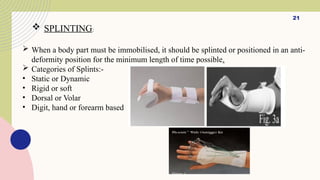
When abody part must be immobilised, it should be splinted or positioned in an anti-
deformity position for the minimum length of time possible.
Categories of Splints:-
• Static or Dynamic
• Rigid or soft
• Dorsal or Volar
• Digit, hand or forearm based
SPLINTING:
22.
22
MANAGEMENT OF OEDEMA:
1.Elevation
Elevation of the extremities above heart level is the most simple and effective
ways to prevent and decrease oedema.
A Bradford sling can be used to facilitate elevation.
This type of sling facilitates both elevation and protection of wound area while
still allowing movement.
Its foam design also reduces the risk of the development of pressure points or
friction.
23.
23
Role of thePhysiotherapist in the Rehabilitation of the Sub Acute Burn
Patient:
• MOBILIZATION:
Active ROM- for affected as well as for non affected parts.
Passive ROM- for affected parts.
• FREQUENCY, DURATION, RECOMMENDATION:
Physiotherapy intervention should be twice daily with patients prescribed frequent
active exercises in between sessions.
For the sedated patient gentle passive range of motion exercises should be done 3
times a day once indicated.
Dependent on the severity of the burn active and very gentle passive range of motion
exercises for the hand and fingers are begun from day one of injury.
24.
24
CONTRAINDICATION:
Activeor Passive range of motion exercises should not be carried out if there is
suspected damage to extensor tendons (common occurrence with deep dermal
and full thickness burns).
Flexion of the PIP joints should be avoided at all costs to prevent extensor
tendon rupture.
The hand should be splinted in the position of safe immobilization or
alternatively a volar PIP extension splint until surgical intervention is discussed.
Range of motion exercises are also contraindicated post skin grafting as a period
of 3- 5 days immobilization is required to enable graft healing.
26
• SCAR MASSAGETECHNIQUES:
Retrograde massage to aid venous return, increase lymphatic drainage,
mobilise fluid
Effleurage to increase circulation
Static pressure to reduce swelling
Finger and thumb kneading to mobilise the scar and surrounding tissue
Skin rolling to restore mobility to tissue interfaces
Wringing the scar to stretch and promote collagenous remodelling .
Frictions to loosen adhesions
27.
27
PT FOLLOWINGSKIN GRAFT:
Aim is to soften and mobilize grafted tissue to enable freedom of movements and
improve nutrition and to restore function.
Donor area of split skin graft may be treated with UVR to promote healing 3-4 days
after operation.
E1 dose is given for 3-4 days/week.
Joints and muscles near grafts should be exercised through full ROM as possible and
all other joints and muscles should be put through general full ROM movement
program.
Muscles near the grafts over immobilized joints should be moved isometrically, e.g. 5
contractions per muscle every hour.
This eases some of discomfort and maintain fluid flow through tissues.
These exercises usually start 5-7 days after grafting.
Active ROM- for affected as well as for non affected parts.
Passive ROM- for affected parts.
28.
28
MAXILLOFACIAL TRAUMA:
Fracturesof the facial bone can be encountered in isolation with other injuries.
Facial fractures include mandible, maxilla, nasal bone and zygoma.
PHYSIOTHERAPY FOR PATIENTS WITH FACIAL BONE FRACTURES:
Chest Physiotherapy
Mouth opening exercise
Low voltage short wave diathermy
Early Amputation
29.
29
REFERENCES:
Baskies,M.A., Tuckman, D.V. and Paksima, N. (2008) ‘Management of flexor
tendon injuries following surgical repair’, Bulletin of the NYU hospital for joint
diseases, 66(1), available: SPORTDiscus (accessed 26th Jan 2013).
Aoife Hale Rhona O’Donovan Sarah Diskin Sarah McEvoy Claire Keohane
Geraldine Gormley PY4017/4019 Module Leader: Norelee Kennedy.
Thien, T.B. Becker, J.H. and Theis, J.C. (2009) ‘Rehabilitation for flexor tendon
injuries in the hand (review)’ Cochrane Database of Systematic Reviews, Issue 1.
Megha Sandeep Sheth, Priya Singh Rangey, Neeta Jayprakash Vyas, Srishti Sanat
Sharma “ Physiotherapy in General Medical and Surgical Conditions.”