MEng / PG Diploma in Manufacturing Systems Engineering 2007/2008

                  Department of Mechanical Engineering

                           University of Moratuwa


                          ME5141 - Special Studies


                    GREEN ENGINEERING


                                   March 2008

Name           V. G. Saman Priyantha

Index No.      05/8645

Supervisor/s   Dr. M.A.R.V. Fernando, Mr. H.K.G. Punchihewa
Green Engineering1


Abstract
Green building is the practice of increasing the efficiency with which buildings use
resources, energy, water, and materials while reducing building impacts on human health
and the environment, through better sitting, design, construction, operation, maintenance,
and removal the complete building life cycle.

A similar concept is natural building, which is usually on a smaller scale and tends to
focus on the use of natural materials that are available locally. Other commonly used
terms include sustainable design and green architecture.

The related concepts of sustainable development and sustainability are integral to green
building. Effective green building can lead to

1) Reduced operating costs by increasing productivity and using less energy and water,

2) Improved public and occupant health due to improved indoor air quality, and

 3) Reduced environmental impacts by, for example, lessening storm water runoff and the
heat island effect.

Practitioners of green building often seek to achieve not only ecological but aesthetic
harmony between a structure and its surrounding natural and built environment, although
the appearance and style of sustainable buildings is not necessarily distinguishable from
their less sustainable counterparts.
Green Engineering2


Acknowledgements
I wish to express my sincere gratitude to the Mechanical Engineering Department of the
University of Moratuwa, Sri Lanka for giving me the opportunity to participate in the
Master in Manufacturing Systems Engineering Course. During this course I was able to
expand my knowledge and practical skills in manufacturing engineering while improving
other aspects such as presentation skills, academic writing abilities etc. I enjoyed my
return to the university as a post-graduate student.

I am also grateful to all the lecturers and mentors of the course for all the guidance given
to at all times. I am very thankful to all but especially to the course coordinator Dr. Udaya
Kahangamage & Dr. Watugala & all academic & technical staff for the tremendous
support extended at all times.

I like to thank all my fellow mates for the great support extended to me throughout the
course. I wish them all good luck. Finally I also thank all my friends who helped me in
many ways to complete this project report.
Green Engineering3


Content
 1. Introduction

           1.1.    What Makes a Building Green?

           1.2.    What Are the Economic Benefits of Green Buildings?

           1.3.    What Are the Elements of Green Buildings?

                   1.3.1. Sitting

                   1.3.2. Energy Efficiency

                   1.3.3. Materials Efficiency

                   1.3.4. Water Efficiency

                     1.3.5. Occupant Health and Safety

                   1.3.6. Building Operation and Maintenance

 2. Why GREEN Engineering

            2.1.   The environmental impact of buildings

            2.2.   Green building practices

 3. History of GREEN

 4. World ratings for GREEN

           4.1.    Australia

                   4.1.1. What is Green Star?

                   4.1.2. Green Star certified ratings

                   4.1.3. Development of Green Star Rating Tools

                   4.1.4. Green Star Rating Tools

                   4.1.5. Background

           4.2.    Canada

                   4.2.1. The World Business Council for Sustainable

                   4.2.2. A Brief History of R-2000

                   4.2.3. The R-2000 Standard
Green Engineering4


                   4.2.4. The ten most important things to know about R-2000

           4.3.    Germany

           4.4.     India

           4.5.     Israel

           4.6.      Malaysia

           4.7.      New Zealand

           4.8.     United Kingdom

                   4.8.1     AECB history

                   4.8.2. Ten points about AECB

                   4.8.3. Extra ten miles

           4.9.    United States


5. LEEDs

           5.1.   LEED’s history

           5.2.   LEED’s objectives:

           5.3.   The Rating system

           5.4.   Benefits and Disadvantages

           5.5.   LEEDs GREEN Certification

                  5.5.1.     What is LEED®?

                  5.5.2.     Who Uses LEED?

                  5.5.3.     How is LEED Developed?

                  5.5.4.     Project Certification

           5.6.    Project Check list

           5.7.    LEED-certified buildings:

           5.8.    LEED versions

           5.9.    Eligibility
Green Engineering5


          5.10.LEED Professional Accreditation

6. Path to GREEN

          6.1.   Sustainable sites

          6.2.   Water efficiency

          6.3.   Energy & Atmosphere

          6.4.   Materials & recourses

          6.5.   Indoor Environmental quality

          6.6.   Innovation & Design


7. Legal aspects of GREEN

8. Costs & Financial benefits of GREEN certification

9. Global & local trends

10. Conclusion
Green Engineering6


List of Figures


List of Tables


List of Appendices
Green Engineering7


1.0.   Introduction
What is a Green Building?

“Green” or “sustainable” buildings are sensitive to:

• Environment.

• Resource & energy consumption.

• Impact on people (quality and healthiness of work environment).

• Financial impact (cost-effectiveness from a full financial cost-return perspective).

• The world at large (a broader set of issues, such as ground water recharge and global
warming, that a government is typically concerned about).

California’s Executive Order D-16-00 establishes a solid set of sustainable building
objectives: “to site, design, deconstruct, construct, renovate, operate, and maintain
state buildings that are models of energy, water and materials efficiency; while
providing healthy, productive and comfortable indoor environments and long-term
benefits to Californians.”

1.1.   What Makes a Building Green?

A green building, also known as a sustainable building, is a structure that is designed,
built, renovated, operated, or reused in an ecological and resource-efficient manner.
Green buildings are designed to meet certain objectives such as protecting occupant
health; improving employee productivity; using energy, water, and other resources more
efficiently; and reducing the overall impact to the environment.

1.2.   What Are the Economic Benefits of Green Buildings?

        A green building may cost more up front, but saves through lower operating costs
over the life of the building. The green building approach applies a project life cycle cost
analysis for determining the appropriate up-front expenditure. This analytical method
calculates costs over the useful life of the asset.

These and other cost savings can only be fully realized when they are incorporated at the
project's conceptual design phase with the assistance of an integrated team of
professionals. The integrated systems approach ensures that the building is designed as
one system rather than a collection of stand-alone systems.

Some benefits, such as improving occupant health, comfort, productivity, reducing
pollution and landfill waste are not easily quantified. Consequently, they are not
adequately considered in cost analysis. For this reason, consider setting aside a small
portion of the building budget to cover differential costs associated with less tangible
Green Engineering8


green building benefits or to cover the cost of researching and analyzing green building
options.

Even with a tight budget, many green building measures can be incorporated with
minimal or zero increased up-front costs and they can yield enormous savings.

1.3.     What Are the Elements of Green Buildings?

Below is a sampling of green building practices.

     1.3.1.     Sitting

   i.    Start by selecting a site well suited to take advantage of mass transit.

  ii.    Protect and retain existing landscaping and natural features. Select plants that have
         low water and pesticide needs, and generate minimum plant trimmings. Use
         compost and mulches. This will save water and time.

 iii.    Recycled content paving materials, furnishings, and mulches help close the
         recycling loop.

     1.3.2.     Energy Efficiency

    Most buildings can reach energy efficiency levels far beyond California Title 24
standards, yet most only strive to meet the standard. It is reasonable to strive for 40
percent less energy than Title 24 standards. The following strategies contribute to this
goal.

   i.    Passive design strategies can dramatically affect building energy performance.
         These measures include building shape and orientation, passive solar design, and
         the use of natural lighting.

  ii.    Develop strategies to provide natural lighting. Studies have shown that it has a
         positive impact on productivity and well being.

 iii.    Install high-efficiency lighting systems with advanced lighting controls. Include
         motion sensors tied to dimmable lighting controls. Task lighting reduces general
         overhead light levels.

 iv.     Use a properly sized and energy-efficient heat/cooling system in conjunction with
         a thermally efficient building shell. Maximize light colors for roofing and wall
         finish materials; install high R-value wall and ceiling insulation; and use minimal
         glass on east and west exposures.

  v.     Minimize the electric loads from lighting, equipment, and appliances.

 vi.     Consider alternative energy sources such as photovoltaic’s and fuel cells that are
         now available in new products and applications. Renewable energy sources
         provide a great symbol of emerging technologies for the future.
Green Engineering9


    vii.    Computer modeling is an extremely useful tool in optimizing design of electrical
            and mechanical systems and the building shell.

        1.3.3.     Materials Efficiency

•       Select sustainable construction materials and products by evaluating several
        characteristics such as reused and recycled content, zero or low off gassing of harmful
        air emissions, zero or low toxicity, sustainably harvested materials, high recyclability,
        durability, longevity, and local production. Such products promote resource
        conservation and efficiency. Using recycled-content products also helps develop
        markets for recycled materials that are being diverted from California's landfills, as
        mandated by the Integrated Waste Management Act.

•       Use dimensional planning and other material efficiency strategies. These strategies
        reduce the amount of building materials needed and cut construction costs. For
        example, design rooms on 4-foot multiples to conform to standard-sized wallboard
        and plywood sheets.

•       Reuse and recycle construction and demolition materials. For example, using inert
        demolition materials as a base course for a parking lot keeps materials out of landfills
        and costs less.

•       Require plans for managing materials through deconstruction, demolition, and
        construction.

•       Design with adequate space to facilitate recycling collection and to incorporate a solid
        waste management program that prevents waste generation.

        1.3.4.     Water Efficiency

•       Design for dual plumbing to use recycled water for toilet flushing or a gray water
        system that recovers rainwater or other no potable water for site irrigation.

•       Minimize wastewater by using ultra low-flush toilets, low-flow shower heads, and
        other water conserving fixtures.

•       Use recalculating systems for centralized hot water distribution.

•       Install point-of-use hot water heating systems for more distant locations.

•       Use a water budget approach that schedules irrigation using the California Irrigation
        Management Information System data for landscaping.

•       Meter the landscape separately from buildings. Use micro-irrigation (which excludes
        sprinklers and high-pressure sprayers) to supply water in non turf areas.

•       Use state-of-the-art irrigation controllers and self-closing nozzles on hoses.
Green Engineering10


  1.3.5. Occupant Health and Safety

   Recent studies reveal that buildings with good overall environmental quality can
reduce the rate of respiratory disease, allergy, asthma, sick building symptoms, and
enhance worker performance. .

Choose construction materials and interior finish products with zero or low emissions to
improve indoor air quality. Many building materials and cleaning/maintenance products
emit toxic gases, such as volatile organic compounds (VOC) and formaldehyde. These
gases can have a detrimental impact on occupants' health and productivity.

Provide adequate ventilation and a high-efficiency, in-duct filtration system. Heating and
cooling systems that ensure adequate ventilation and proper filtration can have a dramatic
and positive impact on indoor air quality.

Prevent indoor microbial contamination through selection of materials resistant to
microbial growth, provide effective drainage from the roof and surrounding landscape,
install adequate ventilation in bathrooms, allow proper drainage of air-conditioning coils,
and design other building systems to control humidity.

       1.3.6. Building Operation and Maintenance

        Green building measures cannot achieve their goals unless they work as intended.
Building commissioning includes testing and adjusting the mechanical, electrical, and
plumbing systems to ensure that all equipment meets design criteria. It also includes
instructing the staff on the operation and maintenance of equipment.

Over time, building performance can be assured through measurement, adjustment, and
upgrading. Proper maintenance ensures that a building continues to perform as designed
and commissioned.
Green Engineering11


2.0.    Why GREEN Engineering
2.1.    The environmental impact of buildings

Buildings have a profound effect on the environment, which is why green building
practices are so important to reduce and perhaps one day eliminate those impacts.

In the United States, buildings account for:

       between 40 and 49% of total energy use

       25% of total water consumption

       70% of total electricity consumption

       38% of total carbon dioxide emissions

However, the environmental impact of buildings is often underestimated, while the
perceived costs of building green are overestimated. A recent survey by the World
Business Council for Sustainable Development finds that green costs are overestimated
by 300%, as key players in real estate and construction estimate the additional cost at
17% above conventional construction, more than triple the true average cost difference of
about 5%.

        2.2.   Green building practices

        Green building brings together a vast array of practices and techniques to reduce
and ultimately eliminate the impacts of buildings on the environment and human health.
But effective green buildings are more than just a random collection of environmental
friendly technologies. They require careful, systemic attention to the full life cycle
impacts of the resources embodied in the building and to the resource consumption and
pollution emissions over the building's complete life cycle.

       On the aesthetic side of green architecture or sustainable design is the philosophy
of designing a building that is in harmony with the natural features and resources
surrounding the site. There are several key steps in designing sustainable buildings:
specify 'green' building materials from local sources, reduce loads, optimize systems, and
generate on-site renewable energy.

       Building materials typically considered to be 'green' include rapidly renewable
plant materials like bamboo and straw, lumber from forests certified to be sustainably
managed, dimension stone, recycled stone, recycled metal, and other products that are
non-toxic, reusable, renewable, and/or recyclable. Building materials should be extracted
and manufactured locally to the building site to minimize the energy embedded in their
transportation.
Green Engineering12


        Low-impact building materials are used wherever feasible: for example, insulation
may be made from low VOC (volatile organic compound)-emitting materials such as
recycled denim or cellulose insulation, rather than the building insulation materials that
may contain carcinogenic or toxic materials such as formaldehyde. To discourage insect
damage, these alternate insulation materials may be treated with boric acid. Organic or
milk-based paints may be used. However, a common fallacy is that "green" materials are
always better for the health of occupants or the environment. Many harmful substances
(including formaldehyde, arsenic, and asbestos) are naturally occurring and are not
without their histories of use with the best of intentions. A study of emissions from
materials by the State of California has shown that there are some green materials that
have substantial emissions whereas some more "traditional" materials actually were lower
emitters. Thus, the subject of emissions must be carefully investigated before concluding
that natural materials are always the healthiest alternatives for occupants and for the
Earth.

        Architectural salvage and reclaimed materials are used when appropriate as well.
When older buildings are demolished, frequently any good wood is reclaimed, renewed,
and sold as flooring. Any good dimension stone is similarly reclaimed. Many other parts
are reused as well, such as doors, windows, mantels, and hardware, thus reducing the
consumption of new goods. When new materials are employed, green designers look for
materials that are rapidly replenished, such as bamboo, which can be harvested for
commercial use after only 6 years of growth, or cork oak, in which only the outer bark is
removed for use, thus preserving the tree. When possible, building materials may be
gleaned from the site itself; for example, if a new structure is being constructed in a
wooded area, wood from the trees which were cut to make room for the building would
be re-used as part of the building itself.

       To minimize the energy loads within and on the structure, it is critical to orient the
building to take advantage of cooling breezes and sunlight. Day lighting with ample
windows will eliminate the need to turn on electric lights during the day (and provide
great views outside too). Passive Solar can warm a building in the winter — but care
needs to be taken to provide shade in the summer time to prevent overheating. Prevailing
breezes and convection currents can passively cool the building in the summer. Thermal
mass stores heat gained during the day and releases it at night minimizing the swings in
temperature. Thermal mass can both heat the building in winter and cool it during the
summer. Insulation is the final step to optimizing the structure. Well-insulated windows,
doors, and ceilings and walls help reduce energy loss, thereby reducing energy usage.
These design features don't cost much money to construct and significantly reduce the
energy needed to make the building comfortable.

       Optimizing the heating and cooling systems through installing energy efficient
machinery, commissioning, and heat recovery is the next step. Compared to optimizing
the passive heating and cooling features through design, the gains made by engineering
are relatively expensive and can add significantly to the projects cost. However,
thoughtful integrated design can reduce costs — for example, once a building has been
Green Engineering13


designed to be more energy-efficient, it may be possible to downsize heating, ventilation
and air-conditioning (HVAC) equipment, leading to substantial savings. To further
address energy loss hot water heat recycling is used to reduce energy usage for domestic
water heating. Ground source heat pumps are more energy efficient then other forms of
heating and cooling.

       Finally, onsite generation of renewable energy through solar power, wind power,
hydro power, or biomass can significantly reduce the environmental impact of the
building. Power generation is the most expensive feature to add to a building.

       Good green architecture also reduces waste, of energy, water and materials.
During the construction phase, one goal should be to reduce the amount of material going
to landfills. Well-designed buildings also help reduce the amount of waste generated by
the occupants as well, by providing onsite solutions such as compost bins to reduce
matter going to landfills.

       To reduce the impact on wells or water treatment plants, several options exist.
"Grey water", wastewater from sources such as dishwashing or washing machines, can be
used for subsurface irrigation, or if treated, for non-potable purposes, e.g., to flush toilets
and wash cars. Rainwater collectors are used for similar purposes.

        Green building often emphasizes taking advantage of renewable resources, e.g.,
using sunlight through passive solar, active solar, and photovoltaic techniques and using
plants and trees through green roofs, rain gardens, and for reduction of rainwater run-off.
[7]
    Many other techniques, such as using packed gravel for parking lots instead of concrete
or asphalt to enhance replenishment of ground water, are used as well.
Green Engineering14


3.0.   History of Green
   •   Pre-20th Century – structures were designed and built by builder-architects who
       had an ability to understand the entire building from design through construction
       and lifetime operations. They incorporated enduring passive design and simple
       mechanical systems to heat, cool and light buildings. Architects in the 21st
       Century will look back upon these ideas to relearn the basics of climatic design.

   •   1930s – New building technologies began to transform urban landscape. Advent
       of air conditioning, low-wattage fluorescent lighting, structural steel, and
       reflective glass made possible enclosed glass and steel structures that could be
       heated and cooled with massive HVAC systems, thanks to availability of cheap
       fossil fuels. These technologies began a sadly regressive movement in architecture
       in which architects began to ignore climate issues and their effect on buildings and
       occupants. Increasing complexity in the industry also brought about specialization
       in professionals, leading to the loss of the generalists, the builder-architects. This
       specialization led to an increasing lack of communication between the
       professionals and therefore of lack of whole systems thinking in designing the
       various parts of the building. This problem will only begin to be addressed by the
       start of the 21st Century through the integrated design process.

   •   1970s, a small group of forward-thinking architects, environmentalists, and
       ecologists inspired by work of Victor Olgyay (Design with Climate), Ralph
       Knowles (Form and Stability), and Rachel Carson (Silent Spring), began to
       question the advisability of building in this manner.

   •   1973 – in response to energy crisis, American Institute of Architects (AIA)
       formed an energy task force, later the AIA Committee on Energy

   •   1977 – The Department of Energy was created to address energy usage and
       conservation

   •   1977 – Solar Energy Research Institute was founded (later National Renewable
       Energy Laboratory) in Golden, CO

   •   1980 - The Sustainable Buildings Industry Council (SBIC) was founded by the
       major building trade associations as the Passive Solar Industries Council.

   •   1987 – UN World Commission on the Environment and Development provided
       the first definition of the term “sustainable development,” as that which “meets
       the needs of the present without compromising the ability of future generations to
       meet their own needs.”

   •   1989 – The AIA Energy Committee formed into the AIA Committee on the
       Environment (COTE)
Green Engineering15


•   1990 – Austin Green Building Program launched (Austin, TX)

•   1992 – AIA Environmental Resource Guide – the first assessment of building
    products based on life cycle analysis. Credited with encouraging numerous
    building product manufacturers to make their products more ecologically
    sensitive.

•   1992 –UN Conference on Environment and Development in Rio de Janeiro, or
    “Earth Summit.” Passage of Agenda 21, a blueprint for achieving global
    sustainability, the Rio declaration on Environment and Development, and
    statements on forest principles, climate change, and biodiversity.

•   1992 – Rio Earth Summit awards Austin Green Building Program on of only ten
    awards for most innovative government environmental programs in the world, the
    only one awarded to a US program.

•   1993 – Inspired at Earth Summit, AIA president-elect chose sustainability as
    theme for International Union of Architects (UIA)/AIA World Congress of
    Architects. Signed a declaration of Interdependence for a Sustainable Future by
    AIA president Susan Maxman and UIA president Olufemi Majekodunmi. Today,
    the “Architecture at the Crossroads” convention is recognized as a turning point in
    the history of the green building movement.

•   1993 – Greening of the White House: President Clinton announced plans to make
    the Presidential mansion “a model for efficiency and waste reduction.” This
    encouraged participants to green other properties: the Pentagon, the Presidio, and
    the US Department of Energy Headquarters, Grand Canyon, Yellowstone,
    Alaska’s Denali

•   1993 – US Green Building Council Founded

•   1994 – City of Boulder, CO, GreenPoints Program launched (Boulder, CO)

•   1995 – The Built Green Colorado Program launched (Denver, CO)

•   1997 - Build a Better Kitsap Program launched (Kitsap County, WA)

•   1997 – The Navy initiated the development of the Whole Building Design Guide,
    an online resource that incorporates sustainability requirements into mainstream
    specifications and guidelines. They incorporate sustainable design into the
    majority of their new projects.

•   1998 – Green Building Challenge – Reps from 14 nations met to create an
    international assessment tool that takes into account regional and national
    environmental, economic, and social equity conditions

•   1998 – Build a Better Clark Program launched (Clark County, WA)
Green Engineering16


•   1998 – City of Scottsdale, AZ Sustainable Building Program launched
    (Scottsdale, AZ)

•   1998 – AIA/COTE Top 10 Green Projects to call attention to successful
    sustainable design

•   1998 – President Clinton issued first of 3 “greening buildings” executive orders

•   1999 – Earth Craft House Program launched (Atlanta, GA)

•   1999 – Executive Order 12852 established President Council on Sustainable
    Development final report, recommending 140 actions to improve the nation’s
    environment, many related to building sustainability.

•   2000 – Increasing number of municipalities and corporations begin to demand and
    set internal standards for green buildings within their organizations. Growth in
    green building organizations, attendance at professional conferences, and
    consumer awareness grows exponentially.
Green Engineering17


4.0       World ratings for GREEN
World wide standards and ratings

Many countries have developed their own standards of energy efficiency for buildings.

         Code for Sustainable Homes, United Kingdom

         BREEAM, United Kingdom

         EnerGuide for Houses, Canada (energy retrofits & up-grades)

         EnerGuide for New Houses, Canada (new construction)

         Gold & Silver Energy Standards, United Kingdom

         Green Building Council of Australia's Green Star

         Effinergie, France

         House Energy Rating, Australia

         Leadership in Energy and Environmental Design (LEED), USA, Canada &
          INDIA

         Green Globes, USA, Canada and United Kingdom

         Minergie, Switzerland

         National Association of Home Builders Green Building Guidelines, USA

         New Zealand Green Building Council Green Star

         Passivhaus, Germany, Austria, United Kingdom

         EEWH, Taiwan


4.1.      Australia

There is a system in place in Australia called First Rate designed to increase energy
efficiency of residential buildings. The Green Building Council of Australia (GBCA) has
developed a green building standard known as Green Star.

Launched in 2002, the GBCA is a national, not-for-profit organization that is committed
to developing a sustainable property industry for Australia by encouraging the adoption of
green building practices. It is uniquely supported by both industry and governments
across the country.
Green Engineering18


Mission The Green Building Council's mission is to develop a sustainable property
industry for Australia and drive the adoption of green building practices through market-
based solutions.

Objectives Its key objectives are to drive the transition of the Australian property
industry towards sustainability by promoting green building programs, technologies,
design practices and operations as well as the integration of green building initiatives into
mainstream design, construction and operation of buildings.

4.1.1.What is Green Star?

Green Star is a comprehensive, national, voluntary environmental rating scheme that
evaluates the environmental design and achievements of buildings.

Green Star was developed for the property industry in order to:
- Establish a common language;
- Set a standard of measurement for green buildings;
- Promote integrated, whole-building design;
- Recognise environmental leadership;
- Identify building life-cycle impacts; and
- Raise awareness of green building benefits.

Green Star covers a number of categories that assess the environmental impact that is a
direct consequence of a projects site selection, design, construction and maintenance. The
nine categories included within all Green Star rating tools are:
- Management
- Indoor Environment Quality
- Energy
- Transport
- Water
- Materials
- Land Use & Ecology
- Emissions
- Innovation

These categories are divided into credits, each of which addresses an initiative that
improves or has the potential to improve environmental performance. Points are awarded
in each credit for actions that demonstrate that the project has met the overall objectives
of Green Star.

Once all claimed credits in each category are assessed, a percentage score is calculated
and Green Star environmental weighting factors are then applied. Green Star
environmental weighting factors vary across states and territories to reflect diverse
environmental concerns across Australia.
Green Engineering19


4.1.2. Green Star certified ratings

4 Star Green Star Certified Rating (score 45-59) signifies 'Best Practice'
5 Star Green Star Certified Rating (score 60-74) signifies 'Australian Excellence'
6 Star Green Star Certified Rating (score 75-100) signifies 'World Leadership'

Although Green Star certification requires a formal process, any project can freely
download and use the Green Star tools as guides to track and improve their environmental
performance.

4.1.3. Development of Green Star Rating Tools

Green Star rating tools are the result of the work of GBCA staff and the GBCA Technical
Working Group (TWG), a voluntary collaboration of environmental and industry experts.
All Green Star tools are initially launched as PILOT tools with a 90-day public feedback
period. A limited number of project ranging in size and locations undergo assessment
using the PILOT rating tool. The Pilot Assessment Process and stakeholder feedback the
GBCA receives is used to refine the tool, which is then officially released as a v1 (version
1).

4.1.4. Green Star Rating Tools

Currently, there is a suite of Green Star rating tools for commercial office design and
construction.

Green Star - Office Design v2
Green Star - Office As Built v2
Green Star - Office Interiors v1.1

4.1.5. Background

Buildings have a significant impact on the environment, consuming 32% of the world's
resources, including 12% of its water and up to 40% of its energy. Buildings also produce
40% of waste going to landfill and 40% of air emissions. In Australia, commercial
buildings produce 8.8% of the national greenhouse emissions and have a major part to
play in meeting Australia's international greenhouse obligations. A commercial building
sector baseline study found that office buildings and hospitals were the two largest
emitters by building type, causing around 40% of total sectoral emissions.

The property industry is well placed to deliver significant long-term environmental
improvements using a broad range of measures. More importantly, it is unique in that it
can directly influence and create behavioral changes at all stages of the supply chain.
Although a strong business case can be made for their implementation, there are barriers
within the property industry that often preventing efficiency measures from being
adopted?

The Green Building Council of Australia was created to in order to address some of these
Green Engineering20


barriers. The Council's objective is to promote sustainable development and the transition
of the property industry by promoting green building programs, technologies, design
practices and operations.

After an industry survey conducted by the GBCA, Green Star was developed to be a
comprehensive, national, voluntary environmental rating scheme that evaluates the
environmental design and achievements of buildings.

Green Star has built on existing systems and tools in overseas markets including the
British BREEAM (Building Research Establishment Environmental Assessment Method)
system and the North American LEED (Leadership in Energy and Environmental Design)
system. In addition, Vic Urban, in its work with the Melbourne Docklands' ESD Guide,
provided the intellectual property to assist in the development of a local system.

Green Star has established individual environmental measurement criteria with particular
relevance to the Australian marketplace and environmental context.

In Adelaide, South Australia, there are at least two different projects that incorporate the
principles of Green building. The Eco-City development is located in Adelaide's city
centre and the Aldinga Arts Eco Village is located in Aldinga. Guidelines for building
developments in each project are outlined in the bylaws. The bylaws include grey water
reuse, reuse of stormwater, capture of rainwater, use of solar panels for electricity and
hotwater, solar passive building design and community gardens and landscaping.

Melbourne has a rapidly growing environmental consciousness, many government
subsidies and rebates are available for water tanks, water efficient products (such as
shower heads) and solar hot water systems. The city is home to many examples of green
buildings and sustainable development such as the CERES Environmental Park. Another
one is EcoLinc in Bacchus Marsh. Two of the most prominent examples of green
commercial buildings in Australia are located in Melbourne — 60L and Council House 2
(also known as CH2).

The most recent building to receive the 6 Green Star award was in Canberra, where
Australian Ethical Investment Ltd refurbished an existing office space in Trevor Pearcey
House. The total cost of the renovation was $1.7 million, and produced an estimated 75%
reductions in carbon dioxide emissions, 75% reduction in water usage, and used over
80% recycled materials. The architects were Collard Clarke Jackson Canberra,
architectual work done by Kevin Miller, interior design by Katy Mutton.
Green Engineering21


4.2.   Canada

Canada has implemented "R-2000" guidelines for new buildings built after the year 2000.
Incentives are offered to builders to meet the R-2000 standard in an effort to increase
energy efficiency and promote sustainability.

In December 2002, Canada formed the Canada Green Building Council and in July 2003
obtained an exclusive licence from the US Green Building Council to adapt the LEED
rating system to Canadian circumstances. The path for LEED's entry to Canada had
already been prepared by BREEAM-Canada, an environmental performance assessment
standard released by the Canadian Standards Association in June 1996. The American
authors of LEED-NC 1.0 had borrowed heavily from BREEAM-Canada in the outline of
their rating system; and in the assignment of credits for performance criteria.

   Beamish-Munro Hall at Queen's University features sustainable construction methods
    such as high fly-ash concrete, triple-glazed windows, dimmable fluorescent lights and
    a grid-tied photovoltaic array.

   Gene H. Kruger Pavilion at Laval University uses largely non polluting, non toxic,
    recycled and renewable materials as well as advanced bioclimatic concepts that
    reduce energy consumption by 25% compared with a concrete building of the same
    dimensions. The structure of the building is made entirely out of wood products, thus
    further reducing the environmental impact of the building.

4.2.5. The World Business Council for Sustainable

DAs thousands of homeowners have discovered, R-2000 is the smart new home choice.

R-2000 is made-in-Canada home building technology with a worldwide reputation for
energy efficiency and environmental responsibility. The R-2000 Standard is a series of
technical requirements for new home performance that go way beyond building codes.
Every R-2000 home is built and certified to this standard.

The Canadian Home Builders' Association works with Natural Resources Canada's
(NRCan's) Office of Energy Efficiency which manages R-2000 on behalf of the federal
government in support of R-2000 technology, builders and consumers.

The R-2000 mission is:
“ To promote the energy efficiency and reduction of greenhouse gas emissions of
Canada’s new housing stock through an industry-led, market-driven, leading edge
housing standard presented as a co-operative partnership of the private and public
sectors. ”

4.2.6. A Brief History of R-2000
Green Engineering22


When the first “R-2000 homes” were built, it was difficult, even for the visionaries in the
industry, to imagine the impact of the technology, and how it would revolutionize the
industry.

• It began in the mid-1970s with a research project in
the Prairies to develop ways of building homes that
were comfortable and healthy to live in during the
frigid winters, but used much less energy than
conventional homes. These forerunners of R-2000
were modest-looking homes, with thick walls and
small windows—a far cry from today's bright and
sunny homes.

• The research resulted in the "house as a system" concept—a major evolution in building
science. "House as a system" thinking recognizes that the flow of air, heat and moisture
within a home is affected by the interaction of all the components, i.e., everything works
together. If you make changes in one area, it will affect other areas—a simple concept
that has profoundly changed the way all homes today are built.

• The R-2000 Program was created in 1981 as a partnership between the Canadian Home
Builders' Association and Natural Resources Canada to begin moving this exciting new
technology into the marketplace. The R-2000 Standard was formalized, home builders
were trained in the new design and construction techniques, and consumers began to learn
about these "better-built" homes.

• Since then, thousands of R-2000 homes have been built, and thousands of building
professionals trained.

• Indirectly, R-2000 has influenced the way every home is built today, spawning a new
generation of better builders, better materials and products and better homes.

• Periodic upgrading of the R-2000 Standard has ensured that R-2000 remains at the
forefront of construction technology. Over the years, requirements for indoor air quality
and resource conservation have been added, along with stricter energy targets.

• R-2000 technology has enjoyed tremendous international success. Early on in the
Program, R-2000 was “exported” to Japan as well as the US where it had a great
influence on the evolution of energy-efficient construction. R-2000 homes have also been
built in Poland, Russia, Germany, and most recently, England, as a collaboration between
Canadian builders and British developers.
Green Engineering23


4.2.7. The R-2000 Standard

        The R-2000 Standard sets out the criteria that a new home must meet in order to
be eligible for R-2000 certification. The technical requirements involve three main areas
of construction: energy performance, indoor air quality and environmental responsibility.

• The R-2000 Standard is a voluntary national standard that is in addition to and beyond
building code requirements.

• The R-2000 Standard is a performance-based standard. It sets criteria for how a house
must perform rather than specify exactly how it must be constructed. The builder is free
to choose the best and most-cost effective approach for each home—construction
techniques, building products, mechanical equipment, lighting and appliances.

• One of the most important aspects of the Standard is the energy target for space and
water heating. The target is calculated for each house, taking into consideration size, fuel
type, lot orientation and location (to account for climate variations across Canada).
Typically R-2000 homes will use approximately 30% less energy than a comparable non-
R-2000 home.

• In order to achieve these energy savings, every R-2000 home is designed and built to
reduce heat loss and air leakage. Extra insulation, energy-efficient windows and doors,
and careful air-sealing are standard features. A blower door is used to measure the
airtightness of the building envelope to ensure that air leakage does not exceed the rate set
out in the R-2000 Standard. This test is part of the mandatory R-2000 quality assurance
process for every R-2000 home.

• The mechanical systems for heating, cooling and ventilation are chosen for efficiency
and performance. Natural gas, propane, oil or electrical systems are all permitted under
the Standard which also allows for advanced systems such as integrated space and hot
water heating systems, heat pumps or solar-assisted systems.

• R-2000 construction always includes controlled ventilation to maintain good indoor air
quality. Every R-2000 home must have a mechanical ventilation system to bring fresh air
in from the outside and exhaust stale air to the outside. Most R-2000 builders use a heat
recovery ventilator, or HRV, to provide continuous balanced ventilation. In winter, HRVs
use the heat from the outgoing air to preheat the incoming air; in summer, this process is
reversed.

• To further protect the indoor air quality, R-2000 builders use building products
specifically aimed at reducing chemicals, dust and other indoor air pollutants. This
includes products such as EcoLogo-approved paints, varnishes and floor finishes, low-
emission cabinetry or the use of hardwood floors.

• The R-2000 Standard recognizes the importance of resource conservation both during
the construction of the home and later during the ongoing operation of the home. R-2000
Green Engineering24


homes use only water-saving toilets, showers and faucets. Builders are also required to
use materials with recycled content.

The R-2000 Standard is updated periodically to reflect the ongoing evolution of the
construction technology and development of new materials, products and systems. This
ensures that R-2000 continues to represent the leading edge of housing technology, and
that homebuyers will continue to benefit from the latest advances in new home
construction.

4.2.8. The ten most important things to know about R-2000

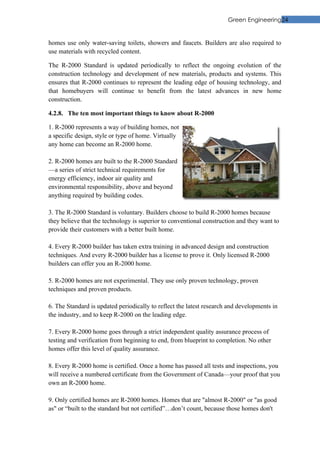
1. R-2000 represents a way of building homes, not
a specific design, style or type of home. Virtually
any home can become an R-2000 home.

2. R-2000 homes are built to the R-2000 Standard
—a series of strict technical requirements for
energy efficiency, indoor air quality and
environmental responsibility, above and beyond
anything required by building codes.

3. The R-2000 Standard is voluntary. Builders choose to build R-2000 homes because
they believe that the technology is superior to conventional construction and they want to
provide their customers with a better built home.

4. Every R-2000 builder has taken extra training in advanced design and construction
techniques. And every R-2000 builder has a license to prove it. Only licensed R-2000
builders can offer you an R-2000 home.

5. R-2000 homes are not experimental. They use only proven technology, proven
techniques and proven products.

6. The Standard is updated periodically to reflect the latest research and developments in
the industry, and to keep R-2000 on the leading edge.

7. Every R-2000 home goes through a strict independent quality assurance process of
testing and verification from beginning to end, from blueprint to completion. No other
homes offer this level of quality assurance.

8. Every R-2000 home is certified. Once a home has passed all tests and inspections, you
will receive a numbered certificate from the Government of Canada—your proof that you
own an R-2000 home.

9. Only certified homes are R-2000 homes. Homes that are "almost R-2000" or "as good
as" or “built to the standard but not certified”…don’t count, because those homes don't
Green Engineering25


have quality assured performance.

10. Amid growing concerns over greenhouse gasses and global warming,
R-2000 provides a model for environmentally responsible housing, both in Canada and
around the world.

4.3.    Germany

German developments that employ green building techniques include:

   The Solarsiedlung (Solar Village) in Freiburg, Germany, which features energy-plus
    houses.

   The Vauban development, also in Freiburg.

   Houses designed by Baufritz, incorporating passive solar design, heavily insulated
    walls, triple-glaze doors and windows, non-toxic paints and finishes, summer shading,
    heat recovery ventilation, and greywater treatment systems.

   The new Reichstag building in Berlin, which produces its own energy.

4.10.     India

The Confederation of Indian Industry (CII) plays an active role in promoting
sustainability in the Indian construction sector. The CII is the central pillar of the Indian
Green Building Council or IGBC. The IGBC has licesensed the LEED Green Building
Standard from the U.S. Green Building Council and currently is responsible for certifying
LEED-New Construction and LEED-Core and Shell buildings in India. All other projects
are certified through the U.S. Green Building Council. There are many energy efficient
buildings in India, situated in a variety of climatic zones.

4.11.     Israel

Israel has recently implemented a voluntary standard for "Buildings with Reduced
Environmental Impact" 5281, this standard is based on a point rating system (55=
certified 75=excellence) and together with complementary standards 5282-1 5282-2 for
energy analysis and 1738 for sustainable products provides a system for evaluating
environmental sustainability of buildings. United States Green Building Council LEED
rating system has been implemented on several building in Israel including the recent
Intel Development Center in Haifa and there is strong industry drive to introduce an
Israeli version of LEED in the very near future.

4.12.     Malaysia

The Standards and Industrial Research Institute of Malaysia (SIRIM) promotes green
building techniques. Malaysian architect Ken Yeang is a prominent voice in the area of
ecological design.
Green Engineering26


4.13.      New Zealand

The New Zealand Green Building Council has been in formation since July 2005. An
establishment board was formed later in 2005 and with formal organizational status
granted on 1st February 2006. That month Jane Henley was appointed as the CEO and
activity to gain membership of the World GBC began. In July 2006 the first full board
was appointed with 12 members reflecting wide industry involvement. The several major
milestones were achieved in 2006/2007; becoming a member of the World GBC, the
launch of the Green Star NZ — Office Design Tool, and welcoming our member
companies.

4.14.     United Kingdom

The Association for Environment Conscious Building (AECB) has promoted sustainable
building in the UK since 1989.

The UK Building Regulations set requirements for insulation levels and other aspects of
sustainability in building construction.

4.8.1   AECB history

1989:

   •    The Association of Environment Conscious Builders founded by Keith and Sally
        Hall

   •    A quarterly newsletter is sent to members

1990:

   •    The name is changed to The Association for Environment Conscious Building to
        reflect more accurately the diverse membership

   •    The first issue of the AECB's Products and Services Directory is published
        Subscription rates introduced

1991:

   •    The first issue of 'Building for a Future' in magazine format is produced

1992:

   •    Greener Building products and services directory is launched by Professor Chris
        Baines

1993:

   •    The first General Meeting, attended by 67 members, is held at the Earth Centre,
        next door to Winson Green Prison, Birmingham
Green Engineering27


   •    Professor Chris Baines becomes President; the first Steering Committee is
        appointed, chaired by Peter Warm

1994:

   •    Andy Simmonds wins the design competition for the AECB's logo,

1995:

   •    The Web site goes online

   •    The second AGM is held at the Bishopswood Centre, Worcestershire

   •    GreenPro is launched as a CD ROM - based product and services directory

1996:

   •    The AECB Charter is adopted at the AGM held at the Pit Hill Community Centre,
        Bradford [the year before the Centre was destroyed by fire]

   •    This year the two-day AGM format is adopted to include workshops, talks and a
        social event

   •    The AECB contribute to the Greenpeace publication"Building the Future; a guide
        to building without PVC"

1997:

   •    The fourth AGM is held at the Centre for Alternative Technology, Machynlleth

   •    The first AECB Year Book / Directory of Members is published

   •    Unit One, Dyfi Eco Parc is the first recipient of SPEC (Sustainable Projects
        Endorsement Certificate)

   •    Keith and Sally Hall receive the 1997 Schumacher Award for their work in
        establishing the Association and for "working to transform society in the
        Schumacher tradition"

1998:

   •    The AGM at Construction Resources, London attracts a record attendance of 100
        members

   •    The AECB join a body to advise on greening of the Heathrow Terminal 5 building

   •    The Members' Directory is re-named 'The Real Green Building Book'

1999:
Green Engineering28


   •    AECB and RICS conference 'Sustaining our Heritage - the way forward for
        energy efficient historic buildings' is held in London

   •    The sixth AGM takes place at the Earth Balance Centre, Northumberland

   •    The Associations registers its own domain name"aecb.net"

2000:

   •    Membership exceeds 1000

   •    The seventh AGM is held at The Wildfowl and Wetlands Trust, Slimbridge

   •    Distribution of The Real Green Building Book tops 5000 copies

   •    The association join SETCO, later to become The Phone Co-op

2001:

   •    The Association collaborates with BRE on their web-based project"Sustainability
        - getting the SME's questions answered"

   •    The Pestalozzi Children's Village trust near Hastings is chosen as the venue for
        this year's AGM

2002:

   •    Work is put in hand to change the legal status of the Association to a Company
        Limited by Guarantee, replacing the steering committee with a board of trustees

   •    The AGM is held at the National Botanic Garden, Wales, shortly before the
        Garden's closure is announced

   •    The Real Green Building Book title is changed to The Green Building Bible by
        the publisher.

2003:

   •    The tenth AGM is held at The Earth Centre, Doncaster

   •    Green Building Press publishes Building for a Future and the Green Building
        Bible independently

   •    The AECB Training Initiative is established

2004:

   •    The eleventh AGM is held at The Weald and Downland Museum

   •    The new website is launched
Green Engineering29


   •    The AECB Training Initiative is formalised as SussEd - Sustainable Skills and
        Education

2005:

   •    The AECB's new legal status is finalised

   •    The twelfth AGM is held at the Somerset College of Arts and Technology where
        the Genesis Project is under construction

   •    The AECB's first Executive Officer is appointed as a paid post

   •    The Association becomes a Company Limited by Guarantee and the steering
        committee members are appointed as directors

2006

   •    The AECB officially transferred to AECB Ltd.

4.8.2. Ten points about AECB

Food

   •    Create space to grow food.

   •    Develop links with local food suppliers.

Transport

   •    Think carefully about your personal transport patterns.

   •    If public transport links are not good, car share schemes or solar-powered electric
        vehicles could be a more effective way of reducing your personal CO2 burden
        than improved building performance.

Water

   •    Low water-use appliances should be used.

   •    WC Less than 6 litres per flush

   •    Shower No more than 9 litres per minute, preferably 6

   •    Washing machine 50 litres per wash or less

   •    Dishwasher 16 litres per cycle or less

   •    Restrict excessivedead legs' on hot water outlets to less than 5 meters.
Green Engineering30


4.8.3. Extra ten miles

   1. Insulation This is the starting point. Think thickuse about 300 mm of insulation
      all round in the roof, walls and floor. Make sure the insulation material has a zero
      ozone depletion potential (ZODP)

   2. Insulation Make sure the windows are not a weak link in the fabric insulation.
      Consider double or triple glazing with low emissivity coatings and gas filling.
      Avoid PVC frames.

   3. Insulation Take care to eliminate thermal bridges in the insulation. This is
      particularly important at the junctions between walls, roofs and floors and around
      openings. Also bridging in the structure needs attention: timber studs, metal wall
      ties, blockwork returns can all reduce the effectiveness of the insulation.

   4. Airtightness There is no point in having lots of insulation if air can leak through
      the structure. Take a strategic view of how air leakage is to be avoided. Design
      airtight details. Use a pressure test to ensure the strategy has been carried through
      on site.

   5. Ventilation In an airtight construction it is important to supply air where it is
      needed when it is needed. Use a system that supplies and extracts air such as
      Passive Stack Ventilation (PSV), assisted PSV (both using humidity controlled
      inlet and exhaust grilles) or heat recovery ventilation (HRV). HRV is the most
      efficient but to be a net benefit the heat exchanger needs to be over 70% efficient
      and the fan power needs to be less than 2 W per litre/sec of extract air (you can do
      better than this). Also the unit and all the ductwork should be kept within the
      insulated / airtight shell.

   6. Lighting Take great care to provide good daylight conditions in all habitable
      rooms. Use energy efficient lighting throughout. Usededicated' compact
      fluorescent lamps which cannot be swapped for inefficient tungsten lamps.

   7. Electrical AppliancesConsider ways of eliminating the need for electrical
      appliances. Provide a clothes' drying space, provide a cold room for food storage.
      Use only A-rated appliances (or A++ for fridges and freezers). Look carefully at
      the stand-by losses of all appliances especially TVs, videos, computers, cookers.

   8. Healthy living Choose appropriate paints and finishes (considernatural' ormineral'
      paints; otherwise low-VOCsynthetic'), coupled with a good ventilation system, to
      ensure a fresh environment. Use floorboards in preference to carpets.

   9. Embodied energy Don't get too hung up on the energy used to produce the
      building materials. Usually it is not significant in terms of the energy used to run
      the building. But keep an eye on transport energy particularly when dealing with
      heavy materials such as masonry.
Green Engineering31


   10. Renewables If the load reduction measures have been addressed, then it makes
       sense to consider renewable energy systems. Biomass (logs, wood chips, wood
       pellets) can be used for heating and hot water. A small wind turbine is likely to be
       more cost effective for providing electricity than photovoltaic (PV) panels. Solar
       panels can be used to provide about half the hot water needs. All the systems need
       good controls.

4.15.    United States

The United States Green Building Council (USGBC) has developed The Leadership in
Energy and Environmental Design (LEED) green building rating system, which is the
nationally accepted benchmark for the design, construction and operation of high
performance green buildings.

The Green Building Initiative is a non-profit network of building industry leaders
working to mainstream building approaches that are environmentally progressive, but
also practical and affordable for builders to implement. The GBI has developed a web-
based rating tool called Green Globes, which is being upgraded in accordance with ANSI
procedures.

The United States Environmental Protection Agency's EnergyStar program rates
commercial buildings for energy efficiency and provides EnergyStar qualifications for
new homes that meet its standards for energy efficient building design.

In 2005, Washington became the first state in the United States to enact green building
legislation. According to the law, all major public agency facilities with a floor area
exceeding 5,000 square feet (465 m²), including state funded school buildings, are
required to meet or exceed LEED standards in construction or renovation. The projected
benefits from this law are 20% annual savings in energy and water costs, 38% reduction
in waste water production and 22% reduction in construction waste.

Charlottesville, Virginia became one of the first small towns in the United States to enact
green building legislation. This presents a significant shift in construction and architecture
as LEED regulations have formerly been focused on commercial construction. If US
homeowner interest grows in "green" residential construction, the companies involved in
the production and manufacturing of LEED building materials will become likely
candidates for tomorrow's round of private equity and IPO investing.
Green Engineering32


5.0.     LEEDS
The Leadership in Energy and Environmental Design (LEED) Green Building Rating
System, developed by the U.S. Green Building Council, provides a suite of standards for
environmentally sustainable construction. Since its inception in 1998, LEED has grown to
encompass over 14,000 projects in 50 US States and 30 countries covering 1.062 billion
square feet (99 km²) of development area. The hallmark of LEED is that it is an open and
transparent process where the technical criteria proposed by the LEED committees are
publicly reviewed for approval by the more than 10,000 membership organizations that
currently constitute the USGBC.

Individuals recognized for their knowledge of the LEED rating system are permitted to
use the LEED Accredited Professional (AP) acronym after their name, indicating they
have passed the accreditation exam given by the USGBC.

5.1.    LEED’s history

LEED began its development in 1994 spearheaded by Natural Resources Defense Council
(NRDC) senior scientist Robert K. Watson who, as founding chairman of the LEED
Steering Committee until 2006, led a broad-based consensus process which included non-
profit organizations, government agencies, architects, engineers, developers, builders,
product manufacturers and other industry leaders. Early LEED committee members also
included USGBC co-founder Mike Italiano, architects Bill Reed and Sandy Mendler,
builder Gerard Heiber and engineer Richard Bourne. As interest in LEED grew, in 1996,
engineers Tom Paladino and Lynn Barker co-chaired the newly formed LEED technical
committee.

From 1994 to 2006, LEED grew from one standard for new construction to a
comprehensive system of six interrelated standards covering all aspects of the
development and construction process. LEED also has grown from six volunteers on one
committee to over 200 volunteers on nearly 20 committees and three dozen professional
staff.

5.2.    LEED’s objectives:

       Define "green building" by establishing a common standard of measurement

       Promote integrated, whole-building design practices

       Recognize environmental leadership in the building industry

       Stimulate green competition

       Raise consumer awareness of green building benefits

       Transform the building market
Green Engineering33


Green Building Council members, representing every sector of the building industry,
developed and continue to refine LEED.

5.3.    The Rating system

The rating system addresses six major areas:

       Sustainable sites

       Water efficiency

       Energy and atmosphere

       Materials and resources

       Indoor environmental quality

       Innovation and design process

5.4.    Benefits and Disadvantages

The move towards LEED and green building practices has been driven greatly by the
tremendous benefits which are a direct result of implementing a green approach. Green
buildings use key resources more efficiently when compared to conventional buildings
which are simply built to code. LEED creates healthier work and living environments,
contributes to higher productivity and improved employee health and comfort. The
USGBC has also compiled a long list of benefits of implementing a LEED strategy which
ranges from improving air and water quality to reducing solid waste. The fundamental
reduction in relative environmental impacts in addition to all of the economic and
occupant benefits goes a long way for making a case for green building. It is also
important to note that these benefits are reaped by anyone who comes into contact with
the project which includes owners, designers, occupants and society as a whole.

These benefits do not come without a cost however. Currently within the industry, green
buildings cost more to both design and construct when compared to conventional
buildings. These increased costs typically represent initial up front costs which are
incurred at the start of the project. However, these initial costs increases are greatly
overshadowed by the economic gains associated with constructing a LEED certified
green building. These economic gains can take the form of anything from productivity
gains to decreased life cycle operating costs. Studies have suggested that an initial up
front investment of 2% will yield over ten times the initial investment over the life cycle
of the building. From this perspective, there is no initial cost. In fact the initial cost is
actually an investment.

Although the deployment of the LEED Standard has raised awareness of Green Building
practices, its scoring system is skewed toward the ongoing use of fossil fuels. More than
half of the available points in the Standard support efficient use of fossil fuels, while only
a handful are awarded for the use of sustainable energy sources. Further the USGBC has
Green Engineering34


stated support for the 2030 Challenge, an effort that has set a goal of efficient fossil fuel
use by 2030. Despite it's broad acceptance, mounting scientific evidence suggests that a
more aggressive program of sustainable energy deployment is required to protect the
climate, than that promoted by the LEED Standard and the USGBC.

5.6.   LEEDs GREEN Certification

5.6.1. What is LEED®?

The Leadership in Energy and Environmental Design (LEED) Green Building Rating
System™ encourages and accelerates global adoption of sustainable green building and
development practices through the creation and implementation of universally understood
and accepted tools and performance criteria.


LEED is the nationally accepted benchmark for the design, construction and operation of
high performance green buildings. LEED gives building owners and operators the tools
they need to have an immediate and measurable impact on their buildings’ performance.
LEED promotes a whole-building approach to sustainability by recognizing performance
in five key areas of human and environmental health: sustainable site development, water
savings, energy efficiency, materials selection and indoor environmental quality.

5.6.2. Who Uses LEED?

Architects, real estate professionals, facility managers, engineers, interior designers,
landscape architects, construction managers, lenders and government officials all use
LEED to help transform the built environment to sustainability. State and local
governments across the country are adopting LEED for public-owned and public-funded
buildings; there are LEED initiatives in federal agencies, including the Departments of
Defense, Agriculture, Energy, and State; and LEED projects are in progress in 41
different countries, including Canada, Brazil, Mexico and India.
Green Engineering35


5.6.3. How is LEED Developed?

LEED Rating Systems are developed through an open, consensus-based process led
by LEED committees. Each volunteer committee is composed of a diverse group of
practitioners and experts representing a cross-section of the building and construction
industry. The key elements of USGBC's consensus process include a balanced and
transparent committee structure, technical advisory groups that ensure scientific
consistency and rigor, opportunities for stakeholder comment and review, member ballot
of new rating systems, and a fair and open appeals process.

5.6.4. Project Check list

Sustainable Sites
       Prerequisite 1 Erosion & Sedimentation Control
       Credit 1       Site Selection
       Credit 2       Urban Redevelopment
       Credit 3        Brownfield Redevelopment
       Credit 4       Alternative Transportation
       Credit 5       Reduced Site Disturbances
       Credit 6       Storm water Management
       Credit 7       Landscape & Exterior Design to Reduce Heat Islands
       Credit 8        Light Pollution Reduction
Water Efficiency
       Credit 1       Water Efficient Landscaping
       Credit 2       Innovative Wastewater Technologies
       Credit 3       Water Use Reduction
Energy & Atmosphere
       Prerequisite 1 Fundamental Building Systems Commissioning
       Prerequisite 2 Minimum Energy Performances
       Prerequisite 3 CFC Reductions in HVAC&R Equipment
       Credit 1       Optimize Energy Performance
       Credit 2       Renewable Energy
       Credit 3       Additional Commissioning
       Credit 4       Ozone Depletion
       Credit 5       Measurement & Verification
       Credit 6       Green Power
Materials & Resource
       Prerequisite 1 Storage & Collection of Recyclables
       Credit 1       Building Reuse
       Credit 2       Construction Waste Management
       Credit 3       Resource Reuse
       Credit 4       Recycled Content
       Credit 5        Local/Regional Materials
       Credit 6       Rapidly Renewable Materials
       Credit 7       Certified Wood
Indoor Environmental Quality
       Prerequisite 1 Minimum IAQ Performance
       Prerequisite 2 Environmental Tobacco Smoke (ETS) Control
       Credit 1       Carbon Dioxide (CO2 ) Monitoring
       Credit 2       Increase Ventilation Effectiveness
Green Engineering36


      Credit 3     Construction IAQ Management Plan
      Credit 4     Low-Emitting Materials
      Credit 5     Indoor Chemical & Pollutant Source Control
      Credit 6     Controllability of Systems
      Credit 7     Thermal Comfort
      Credit 8     Daylight & Views
Innovation & Design Process
      Credit 1     Innovation in Design
      Credit 2     LEEDTM Accredited Professional

5.6.5. Project Certification

Different LEED versions have varied scoring systems based on a set of required
"prerequisites" and a variety of "credits" in the six major categories listed above. In
LEED v2.2 for new construction and major renovations for commercial buildings there
are 69 possible points and buildings can qualify for four levels of certification:

       Certified - 26-32 points

       Silver - 33-38 points

       Gold - 39-51 points

       Platinum - 52-69 points

LEED certification is obtained after submitting an application documenting compliance
with the requirements of the rating system as well as paying registration and certification
fees. Certification is granted solely by the Green Building Council responsible for issuing
the LEED system used on the project.

Recently the application process for new construction certification has been streamlined
electronically, via a set of active PDFs that automates the process of filing the
documentation.

LEED certification provides independent, third-party verification that a building project
meets the highest green building and performance measures. All certified projects receive
a LEED plaque, which is the nationally recognized symbol demonstrating
that a building is environmentally responsible, profitable and a healthy place to live and
work.

There are both environmental and financial benefits to earning LEED certification.

5.7.    LEED-certified buildings:

    •   Lower operating costs and increased asset value.

    •   Reduce waste sent to landfills.

    •   Conserve energy and water.
Green Engineering37


    •   Healthier and safer for occupants.

    •   Reduce harmful greenhouse gas emissions.

    •   Qualify for tax rebates, zoning allowances and other incentives in hundreds of
        cities.

    •   Demonstrate an owner's commitment to environmental stewardship and social
        responsibility.

5.8.    LEED versions

Different versions of the rating system are available for specific project types:

       LEED for New Construction: New construction and major renovations (the most
        commonly applied-for LEED certification)

       LEED for Existing Buildings: Existing buildings seeking LEED certification

       LEED for Commercial Interiors: Commercial interior fitouts by tenants

       LEED for Core and Shell: Core-and-shell projects (total building minus tenant
        fitouts)

       LEED for Homes: Homes

       LEED for Neighborhood Development: Neighborhood development

       LEED for Schools: Recognizes the unique nature of the design and construction of
        K-12 schools

       LEED for Retail: Consists of two rating systems. One is based on New
        Construction and Major Renovations version 2.2. The other track is based on
        LEED for Commercial Interiors version 2.0.

LEED has evolved since its original inception in 1998 to more accurately represent and
incorporate emerging green building technologies. LEED-NC 1.0 was a pilot version.
These projects helped inform the USGBC of the requirements for such a rating system,
and this knowledge was incorporated into LEED-NC 2.0. The present version of LEED
for new construction is LEED-NC v2.2. LEED also forms the basis for other
sustainability rating systems such as the Environmental Protection Agency's Labs21.

5.9.    Eligibility

Commercial buildings as defined by standard building codes are eligible for certification
under the LEED for New Construction, LEED for Existing Buildings, LEED for
Commercial Interiors, LEED for Retail, LEED for Schools and LEED for Core & Shell
rating systems. Building types include – but are not limited to – offices, retail and service
establishments, institutional buildings (e.g., libraries, schools, museums and religious
institutions), hotels and residential buildings of four or more habitable stories.
Green Engineering38


If you are unsure whether your building project is a candidate for LEED certification,
review the LEED Rating System Checklist that applies to your project to tally a potential
point total. Your project is a viable candidate for certification if it meets all prerequisites
and can achieve the minimum number of points necessary to earn the Certified level.

5.10.   LEED Professional Accreditation

The LEED Professional Accreditation program is now managed by the Green Building
Certification Institute.

LEED Professional Accreditation distinguishes building professionals with the
knowledge and skills to successfully steward the LEED certification process. LEED
Accredited Professionals (LEED APs) have demonstrated a thorough understanding of
green building practices and principles and the LEED Rating System. More than 43,000
people have earned the credential since the Professional Accreditation program was
launched                                     in                                2001.

In 2008, administration of the Professional Accreditation program transitioned to the
Green Building Certification Institute (GBCI). The Green Building Certification Institute,
established with the support of the U.S. Green Building Council, handles exam
development and delivery to allow for objective, balanced management of the
credentialing Program.

The Green Building Certification Institute (GBCI) is a newly incorporated entity
established with the support of the U.S. Green Building Council to administer
credentialing programs related to green building practice and standards. GBCI was
created to develop and administer credentialing programs aimed at improving green
building practice. GBCI will ensure that the LEED Accredited Professional (LEED AP)
program will continue to be developed in accordance with best practices for credentialing
programs. To underscore this commitment, GBCI will undergo the ANSI accreditation
process for personnel certification agencies complying with ISO Standard 17024.

GBCI, launched on 11/20/2007, was formed to allow for balanced, objective management
of the LEED Professional Accreditation program, including exam development,
registration and delivery. Those who attain the LEED AP credential have knowledge of
the LEED Rating Systems that allows them to facilitate the integrated design process and
streamline LEED certification for their projects.
Green Engineering39


6.0.   Path to GREEN
6.1. Sustainable sites

Building development is often destructive to local ecological systems from the onset of
construction activity, through occupancy and beyond.

LEED Sustainable Sites credits encourage best practice measures through strategies such
as alternative transportation, effective site lighting design, development of high-density
and Brownfield sites, and storm water management.

Prerequisite 1: Erosion & Sedimentation Control. Control erosion to reduce negative
impacts on water and air quality.

Credit 1: Site Selection. Avoid development of inappropriate sites and reduce the
environmental impact from the location of a building on a site.

Credit 2: Development Density. Channel development to urban areas with existing
infrastructure, protect green fields and preserve habitat and natural resources.

Credit 3: Brownfield Redevelopment. Rehabilitate damaged sites where development is
complicated by real or perceived environmental contamination, reducing pressure on
undeveloped land.

Credit 4: Alternative Transportation. Reduce pollution and land development impacts
from automobile use. Credits are awarded for selecting a site near transit, providing
bicycle storage, alternative fuel vehicles, alternative refueling stations, the minimum
parking capacity necessary, and providing preferred parking for alternative fuel vehicles
and carpool vehicles.

Credit 5: Reduced Site Disturbance. Conserve existing natural areas and restore damaged
areas to provide habitat and promote biodiversity.

Credit 6: Storm water Management. Limit disruption and pollution of natural water flows
by managing storm water runoff. Credits are awarded for limiting, reducing, or treating
storm water runoff.

Credit 7: Heat Island Effect. Reduce heat islands (thermal gradient differences between
developed and undeveloped areas) to minimize impact on microclimate and human and
wildlife habitat. Credits are awarded for roof and non-roof solutions related to landscape
and exterior design.

Credit 8: Light Pollution Reduction. Eliminate light trespass from the building and site,
improve night sky access and reduce development impact on nocturnal environments.
Green Engineering40


6.2. Water efficiency

Many water conservation strategies involve either no additional costs or rapid paybacks.
LEED Water Efficiency credits describe these strategies.

6.2.1. Credit 1.1:Water Efficient Landscaping, Reduce by 50%

The intent of this credit is to reduce potable water consumption for irrigation to minimize the
demand on limited supplies and reduce water costs.

Requirements for Certification:

Reduce potable water consumption for irrigation by 50% over a theoretical baseline design for
the specific region.

Successful Strategies:

       Drought tolerant plants

       Drip irrigation, moisture-sensing irrigation technologies

       Recycled rainwater system

       Municipally-provided non-potable water source use
Helpful Hints:

   1. Look to similar existing building types or typical practices used by developers
      implementing water intensive landscaping to establish a reasonable baseline.

   2. Campus applications may require revisions to campus standards to allow the
      native/adaptive plantings. Xeriscaping may not be applicable in all high-usage areas.

   3. Some native plants may not be appropriate for facilities where allergies or compromised
      immune systems are of primary concern.

   4. Non-potable water systems (untreated irrigation water) may be prone to problems with
      mineral deposits in irrigation piping and nozzles.

   5. Over 400 water recycling plants are currently built or under construction throughout
      California . Projects should check with the local city water department for municipally
      provided non-potable water.
Green Engineering41


6.2.2. Credit 1.2: No Potable Water Use or No Irrigation

The intent of this credit is to eliminate potable water consumption for site irrigation to
minimize the demand on limited water supplies.

Requirements for Certification:

Option 1 - Use only captured rainwater, recycled wastewater, recycled gray water, or
municipally provided gray water for irrigation.

Option 2 – Do not use irrigation.

Successful Strategies:

       Captured rainwater systems

       Recycled wastewater

       Municipally provided recycled gray water

       Indigenous plants
Helpful Hints:

    1. Research the potential health issues associated with using gray water for irrigation.
       Gray water may contain bacteria and other potential pathogens. Some plants are not
       suited well for gray water irrigation.

    2. The USGBC does not consider hard-piped underground irrigation lines to be
       acceptable as a temporary irrigation system; however, hose connections and above
       ground drip systems can be used for up to one year to get plants established.

    3. When designing a site, consider the addition of a detention pond or the use of an
       existing pond to provide a source of untreated, non-potable water for landscape
       irrigation. This credit may be complimentary to a detention pond used for storm
       water management.

    4. Spray irrigation is not permitted for gray water irrigation due to possible health
       issues.
Green Engineering42


6.2.1. Credits 3.1 and 3.2: Water Use Reduction, 20% and 30% Reduction

The intent of this credit is to choose water-conserving fixtures and/or incorporate rainwater or
gray water systems to minimize the demand on potable water sources.

    •     Requirements for Certification:

Reduce potable water consumption by 20% or 30%.

Successful Strategies:

    •     Dual flush water closets

    •     Ultra low-flow water closets and urinals

    •     Waterless Urinals

    •     Sensor-operated, Low-flow lavatories

    •     Rainwater collection reuse systems

    •     Gray water reuse systems


    •     Helpful Hints:

       1. The water use reduction percentage in addresses all flow and flush fixtures in the
          building (Exclude irrigation and building process loads such as dishwashers, lab
          sinks, washing machines, etc.).

       2. Simple strategies include, but are not limited to, aerators, flow restrictors, low-flow
          showerheads, 0.5 gallon per flush urinals or low-flow water closets. More aggressive
          strategies may include pressure assisted water closets, waterless fixtures and dual
          flush water closets.

       3. Complete water use calculation comparison between design and baseline case to
          determine water reduction and to revise design specifications to achieve desired
          water reduction.


6.3.      LEED Energy and Atmosphere

Buildings consume more than 2/3rds of all electricity produced in the United States
annually. Improving the energy performance of buildings lowers operational costs,
reduces pollution generated by power plants, and enhances comfort.
Green Engineering43


LEED Energy and Atmosphere credits encourage energy efficiency through improved
glazing, better insulation, improved daylighting design / lighting power density reduction,
high-efficiency HVAC&R equipment selection, renewable energy production, and
building commissioning.


               EA Prerequisite 1 – Fundamental Commissioning of the Building Energy
               Systems

The intent of this prerequisite is to ensure building's energy related systems are installed,
calibrated and perform according to the owner's project requirements, basis of design, and
construction documents.

                             Requirements for Certification:

Designate an individual as the Commissioning Authority (CxA) to lead, review and oversee
the completion of the commissioning process activities.

The Owner shall document the Owner's Project Requirements. The design team shall
develop the Basis of Design. The CxA shall review these documents for clarity and
completeness. The Owner and design team shall be responsible for updates to their
respective documents.

Develop and incorporate commissioning requirements into the construction documents.
Develop and implement a commissioning plan.

Verify the installation and performance of the systems to be commissioned. Complete a
summary commissioning report.

                             Successful Strategies:

   •   Commissioning agent should coordinate and organize regularly scheduled meetings
       with the contractors and subcontractors on-site.

   •   Incorporate the commissioning agent's milestones into the project schedule.
Green Engineering44


                             Helpful Hints:

                             EA Prerequisite 2: Minimum Energy Performance

The intent of this prerequisite is to establish the minimum level of energy efficiency for the
proposed building and systems.

                             Requirements for Certification:

Design the building project to comply with both of the following:

The mandatory provisions (Sections 5.4, 6.4, 7.4, 8.4, 9.4 and 10.4) of ASHRAE/IESNA
Standard 90.1-2004 (without amendments); and

The prescriptive requirements (Sections 5.5, 6.5, 7.5 and 9.5) or performance requirements
(Section 11) of ASHRAE/IESNA Standard 90.1-2004 (without amendments).

Note that the USGBC deems Title 24-2005 to be directly equivalent to ASHRAE 90.1-2004 for
purposes of certification. California LEED-NC v2.2 projects do not need to provide
justification or support of Title-24 2005 equivalence when applying for LEED-NC v2.2
certification, but doing so can satisfy the requirements.

                             Successful Strategies:

   •   Ensure this prerequisite early: Confirm with the Mechanical Engineer that the design
       will meet all ASHRAE/Title24 minimum and mandatory compliances for this credit.
   •   The documentation for the Minimum Energy Performance Prerequisite can either be
       produced by the Mechanical Engineer (typically using prescriptive methods) or by the
       Energy Modeler who produces the documentation for EAc1 (based on performance
       calculations).

                             Helpful Hints:

   1. If the Mechanical Engineer's standard practice does not meet or exceed this
      prerequisite, he or she may not be the right engineer for a LEED job.
   2. The 2005 Federal Energy Bill contains revisions to energy codes and incentives to
      exceeding energy codes. Refer to the energy bill and resulting policies that may impact
      your building.

   3. This credit has synergy and cost savings with measurement and verification activities
      in credit EAc5, so be aware of both credits when scoping and bidding this work.
Green Engineering45


                             EA Prerequisite 3: Fundamental Refrigerant Management

The intent of this prerequisite is to reduce ozone depletion by reducing or eliminating the use
of Chlorofluorocarbons (CFCs).

                             Requirements for Certification:

Do not use CFC-based refrigerants in new base building HVAC&R systems.

For existing base building HVAC equipment, complete a CFC “phase-out” prior to project
completion.

                             Successful Strategies:

   •   Replace CFC-based refrigerant.
   •   Consider non-refrigerant based cooling such as evaporative cooling in dryer climates.


                           Helpful Hints:
   1. This credit has relevance to EAc4, Ozone Protection, so be aware of both when
      specifying HVAC equipment.
Green Engineering46


                            EA Credit 1: Optimize Energy Performance

The intent of this credit is to improve energy performance above the baseline (EAp2) by
employing energy efficient strategies and equipment selections.

                            Requirements for Certification:

Option 1 – Whole Building Energy Simulation (1-10 points). Demonstrate a percentage
improvement over the baseline building performance rating per ASHRAE/IESNA Standard
90.1-2004 or Title24-2005 by using the Building Performance Rating Method in Appendix G
of the Standard.

Option 2 – Prescriptive Compliance Path (office buildings under 20,000 SF, 4 points). Comply
with the prescriptive measures of the ASHRAE Advanced Energy Design Guide for Small
Office Buildings 2004.

Option 3 – Prescriptive Compliance Path (1 point). Comply with the Basic Criteria and
Prescriptive Measures of the Advanced Buildings Benchmark Version 1.1.


                            Successful Strategies:

   •   Reduce demand
   •   Harvest free energy
   •   Increase efficiency
   •   Recover waste energy
Green Engineering47


                              Helpful Hints:
   1.   EAc1 example documentation is available on the USGBC website. It is best to
        follow the USGBC format precisely and not use custom tables or graphs.
   2.   Separate guidelines (e.g. LEED for Labs) are being developed specifically to
        address perceived shortcomings in the current energy performance evaluation
        system. In general, it is best to work with an energy modeler who is versed in
        LEED Energy Cost Budget requirements to best estimate the percentage of
        energy cost savings that will be approved by the USGBC for a given project or
        building type.
   3.   To maximize the points in this credit, consider renewable energy-based HVAC
        systems or systems that use waste heat recovery.
   4.   Consider incorporating energy performance contracting as a way of financing
        additional energy efficiency in new buildings.
   5.   The 2005 Federal Energy Bill offers tax incentives of $1.80 per square foot for
        new commercial buildings designed to exceed the ASHRAE 90.1 standard by 50
        percent or more.
   6.   Check with local utility for demand-side, energy efficiency, and market
        transformation programs, such as Savings by Design.


                             EA Credit 2: On-Site Renewable Energy

The intent of this credit is to decrease dependence on fossil fuel energy use by employing
on-site renewable energy self-supply systems.

                             Requirements for Certification:

Implement on-site renewable energy systems such that 2.5% (1 pt.), 7.5% (2 pts.), or 12.5%
(3 pts.) of the total annual energy costs are generated by on-site renewable energy systems.

                             Successful Strategies:

   •    Contact local utilities or electric service providers to determine if net metering is
        available.
   •    Consider photovoltaic, solar thermal, geothermal, wind, biomass, and bio-gas energy
        technologies.
Green Engineering48


                           Helpful Hints:
1.   The installation of renewable energy generation systems (wind, PV, biomass etc.)
     may be incorporated into an education and outreach program for an Innovation and
     Design point (IDc1).
2.   This credit has synergies with EAc1 energy saving calculations. In a certain sense,
     renewable energy generation is rewarded twice by the LEED rating system.
3.   Passive solar design, day lighting strategies, and ground-source heat pumps are not
     eligible for EAc2.
4.   Project teams should pursue the many energy incentives and rebates offered by
     California for renewable energy generation systems.
5.   Consider use of on-site distributed energy such as fuel cells and waste heat
     recovery.
6.   Useful references:
     www.energy.ca.gov/distgen/index.html www.energy.ca.gov/renewables/index.html
     www.consumerenergycenter.org/erprebate/index.html
Green Engineering49


                            EA Credit 3: Enhanced Commissioning

The intent of this credit is to begin the commissioning process early during the design process
and execute additional activities after systems performance verification is completed.

                            Requirements for Certification:

Prior to the start of the construction documents phase, designate an independent
Commissioning Authority (CxA) to lead, review, and oversee the completion of all
commissioning process activities. The CxA shall conduct, at a minimum, one commissioning
design review of the Owner's Project Requirements (OPR), Basis of Design (BOD), and design
documents prior to mid-construction documents phase and back-check the review comments in
the subsequent design submission.

The CxA shall review contractor submittals applicable to systems being commissioned for
compliance with the OPR and BOD. This review shall be concurrent with A/E reviews and
submitted to the design team and the Owner.

Develop a systems manual that provides future operating staff the information needed to
understand and optimally operate the commissioned systems. Verify that the requirements for
training operating personnel and building occupants are completed.

Assure the involvement by the CxA in reviewing building operation within 10 months after
substantial completion with O&M staff and occupants. Include a plan for resolution of
outstanding commissioning-related issues.

                            Successful Strategies:

   •   Commissioning agent should coordinate and organize regularly scheduled meetings
       with the contractors and subcontractors on-site.
   •   Incorporate the commissioning agent's milestones into the project schedule.
Green Engineering50


                           Helpful Hints:
1.   The commissioning MUST be contracted prior to 50% CDs.
2.   Some requirements for this credit occur just prior to substantial completion.
     Note that LEED requires that documentation is “readily available” prior to
     submittal.
3.   When a Commissioning Authority reviews key submittals for compliance
     with the specifications and design intent, the whole project team benefits by
     getting an extra set of eyes to look at the details of equipment and control
     integration at a very early phase of the project. These reviews can help to
     integrate the equipment suppliers and control vendors prior to equipment
     being ordered, which facilitates on-site integration and keeps "head-
     scratching" to a minimum.
4.   Project teams should be aware of the credit synergies with EAp1 when
     scoping and bidding this credit.
5.   Check for more favorable terms of professional liability insurance.
6.   Consider including an ongoing training component to strengthen the training
     beyond the commissioning prerequisite. This should be integrated in the IAQ
     Management Plan.
7.   Include an IAQ Management Plan as part of the Facility Maintenance and
     Commissioning Plans.
Green Engineering51


                            EA Credit 4: Enhanced Refrigerant Management

The intent of this credit is reducing ozone depletion and support early compliance with the
Montreal Protocol while minimizing direct contributions to global warming.

                            Requirements for Certification:

Option 1 – Do not use refrigerants.

Option 2 – Select refrigerants and HVAC&R that minimize or eliminate the emission of
compounds that contribute to ozone depletion and global warming. The base building
HVAC&R equipment shall comply with the formula provided for this credit, which sets a
maximum threshold for the combined contributions to ozone depletion and global warming
potential.

AND – Do not install fire suppression systems that contain ozone-depleting substances (CFCs,
HCFCs or Halons).

                            Successful Strategies:

   •   Complete the Template calculations early in design if considering more than one
       refrigerant.
   •   Consider non-refrigerant based cooling such as evaporative cooling in dry climates.


                          Helpful Hints:
   1. Small HVAC units that are used to cool equipment support rooms, such as
      computer, telephone and data rooms, are not considered part of the base building
      system and are not subject to the requirements of this credit.
   2. Evaporative cooling is a solution for dry climates that eliminates the need for
      refrigeration equipment.
Green Engineering52


                             EA Credit 5: Measurement and Verification

The intent of this credit is to provide for the ongoing accountability of building energy
consumption over time.

                             Requirements for Certification:

Develop and implement a Measurement & Verification (M&V) Plan consistent with Option D:
Calibrated Simulation (Savings Estimation Method 2), or Option B: Energy Conservation
Measure Isolation, as specified in the International Performance Measurement & Verification
Protocol (IPMVP) Volume III: Concepts and Options for Determining Energy Savings in New
Construction, April, 2003.

The M&V period shall cover a period of no less than one year of post-construction occupancy.

                             Successful Strategies:

   •   This credit has synergies with the Fundamental commissioning of the Building Energy
       Systems prerequisite (EAp1) and the Enhanced Commissioning credit (EAc3).
   •   Sophisticated Electrical Management Systems, Building Automation Systems or Direct
       Digital Control systems inherently include most of the required monitoring points.


                             Helpful Hints:
    1. Target this LEED credit early and inform both the mechanical and electrical
       engineer to allow them to design their systems for easy monitoring (i.e.
       consolidating all the electric lighting circuits on one panel to allow for easy
       breakout of data.) Most of these design requirements are zero cost items if
       specified as part of the original design.
    2. Some requirements for this credit occur just prior to substantial completion.
       Note that LEED requires that documentation is “readily available” prior to
       submittal.


                             EA Credit 6: Green Power

The intent of this credit is to encourage the development and use of grid-source,
renewable energy technologies on a net zero pollution basis.

                             Requirements for Certification:

Provide at least 35% of the building's electricity from renewable sources by engaging in
at least a two-year renewable energy contract. Renewable sources are as defined by the
Center for Resource Solutions (CRS) Green-e products certification requirements.
Green Engineering53


Determine the baseline electricity use. Use the annual electricity consumption from the
results of EA Credit 1 or Use the Department of Energy (DOE) Commercial Buildings
Energy Consumption Survey (CBECS) database to determine the estimated electricity
use.

                            Successful Strategies:

    •   Purchase Green-Tags from any Green Broker.
    •   Contact local energy providers for $/kWh premium for Green-e certified or
        equivalent power


6.4.    LEED Materials and Resources

The effect a building has on the environment can be substantially minimized with the
efficient use and disposal of building materials. LEED

Materials and Resources credits looks at the products and materials used in building
construction and requires that they be used efficiently, conservatively and pragmatically,
from the design and specification of recycled material content to the effective management
of the project waste stream throughout construction.


    •   Prereq 1 - Storage and Collection of Recyclables
    •   Credit 1 - Building Reuse: Maintain 75% of Existing Walls, Floors and Roof
    •   Credit 1.2 - Building Reuse: Maintain 95% of Existing Walls, Floors and Roof
    •   Credit 1.3 - Building Reuse: Maintain 50% of Interior Non-Structural Elements
    •   Credit 2 - Construction Waste Management: Divert from Disposal
    •   Credit 3 - Materials Reuse
    •   Credit 4 - Recycled Content: (post-consumer + 1/2 pre-consumer)
    •   Credit 5 - Regional Materials: Extracted, Processed & Manufactured Regionally
    •   Credit 6 - Rapidly Renewable Materials
    •   Credit 7 - Certified Wood
Green Engineering54


                             General information related to all Materials and Resources
                             credits:

The intent of this category is that the use, specification, and disposal of building materials will
minimize the effect a building has on the environment.

                             Requirements for Certification:

MRp1 - Designated accessible end-user recycling area for paper, corrugated cardboard, glass,
plastics, and metals.

MRc1 - Maintain 75% (MRc1.1), or 95% (MRc1.2) of existing building structure and
envelope. Maintain 50% of interior non-structural elements for MRc1.3.

MRc2 - Recycle and/or salvage 50% (MRc2.1), or 75% (MRc2.2) of non-hazardous
construction and demolition waste and debris.

MRc3 - Use salvaged, refurbished, or reused materials for at least 5% (MRc3.1), or 10%
(MRc3.2) of total materials, by cost.

MRc4 - Use 10% (MRc4.1) or 20% (MRc4.2) of total materials, by value, with recycled
content (recycled content = post-consumer + ½ pre-consumer).

MRc5 - Use 10% (MRc5.1) or 20% (MRc5.2) of total materials by value that have been
extracted, harvested or recovered, as well as manufactured, within 500 miles of the project site.

MRc6 - Use rapidly renewable building materials for 2.5% of the total materials by value.

MRc7 - Use Forest Stewardship Council (FSC) certified wood materials and products for 50%
of all wood-based materials and products used in the project.

                             Successful Strategies:

   •   Tie contractor retainage to complete submission of LEED product/material submittals
       and document everything.
   •   Education of subcontractors on recycling practices and established penalties (such as
       fees) for not following these practices help achieve the highest percentage of
       construction waste diverted from the landfill.

   •   Incentives, given by the general contractor or owner, to subcontractors for meeting
       targeted MR goals can both motivate and benefit all involved.
Green Engineering55


                               Helpful Hints:
    1.   Renovation and/or expansion projects are most applicable to MRc1 credits.
    2.   Help contractors develop a waste management plan early to ensure best practices
         from the initial phases of the project.
    3.   Identify local waste recycling /salvaging resources before demolition begins.
    4.   Target high-dollar items early in the project to include recycled content or local
         manufacturer/harvesting in the specifications.
    5.   Ensure application of renewable materials is appropriate.
    6.   Confirm lead time for any and all FSC materials.


6.5. LEED Indoor Environmental Quality
The goal of the Indoor Environmental Quality (IEQ) category is to provide a healthy,
comfortable and productive indoor environment for building occupants.

Issues affecting this goal include ventilation system deficiencies, adequate ventilation for
occupants, off-gassing from finish materials and mechanical equipment, tobacco smoke,
microbiological contamination and outside air pollutants.

   •     Prereq 1 - Minimum IAQ Performance
   •     Prereq 2 - Environmental Tobacco Smoke (ETS) Control
   •     Credit 1 - Outdoor Air Delivery Monitoring
   •     Credit 2 - Increased Ventilation
   •     Credit 3.1 - Construction IAQ Management Plan: During Construction
   •     Credit 3.2 - Construction IAQ Management Plan: Before Occupancy
   •     Credit 4 - Low-Emitting Materials
   •     Credit 5 - Indoor Chemical & Pollutant Source Control
   •     Credit 6.1 - Controllability of Systems: Lighting
   •     Credit 6.2 - Controllability of Systems: Thermal Comfort
   •     Credit 7.1 - Thermal Comfort: Design
   •     Credit 7.2 - Thermal Comfort: Verification
   •     Credit 8.1 - Daylight & Views: Daylight 75% of Spaces
   •     Credit 8.2 - Daylight & Views: Views for 90% of Spaces
Green Engineering56


                            EQ Prerequisite 1: Minimum IAQ Performance

The intent of this credit is designing the building's ventilation system to meet the minimum
requirements of ASHRAE 62.1-2004, which improves occupant comfort and enhances indoor
air quality.

                            Requirements for Certification:

Design the mechanical ventilation system such that the minimum requirements of Sections 4
through 7 of ASHRAE 62.1-2004 are met.

If no mechanical ventilation systems will be provided, the building must comply with
paragraph 5.1 in ASHRAE 62.1-2004.

                            Successful Strategies:

   •    Mechanical Engineers or responsible party should confirm the project can meet the
        ASHRAE 62.1-2004 requirements as early as possible in the design phase.


                              Helpful Hints:
   1.   Ventilation systems may be mechanical or natural. If natural ventilation and
        infiltration are being used, compliance can be demonstrated using a tracer gas test
        (described in ASHRAE 55-1999). Otherwise, perform calculations of natural
        ventilation based on wind pressure and thermal buoyancy (stack-effect) driven
        ventilation as described in the ASHRAE Handbook of Fundamentals, Chapter 22 or
        the ASHRAE Standard 62-2001.
   2.   ASHRAE 62.1-2004 combines Standard 62-2001 and published addenda, thereby
        providing an easy-to-use consolidated standard. Standard 62.1-2004 specifies
        minimum ventilation rates and indoor air quality that will be acceptable to human
        occupants and are intended to minimize the potential for adverse health effects.
        Locate outside air intakes at least 25 feet from sources of contamination
   3.   Provide proper drainage for the HVAC condensate pans (prevent the accumulation
        of water under, in, or near buildings)
   4.   Recommended to use high efficiency filters at main HVAC intakes
   5.   Recommended to meet operational, maintenance, and record-keeping requirements
        of Cal/OSHA
Green Engineering57


                             EQ Credit 1: Outdoor Air Delivery Monitoring

The intent of this credit is to encourage project teams to employ carbon dioxide monitoring to
provide feedback on space ventilation performance. Carbon dioxide monitoring, when paired
with demand based ventilation systems, improve energy efficiency.

                             Requirements for Certification:

For mechanically ventilated spaces:

Install carbon dioxide monitors between 3 feet and 6 feet above the floor within all spaces
occupied by 25 or more people per 1000 sq. ft.

Install outdoor airflow measurement devices (+/- 15% accuracy of design minimum outdoor air
rate) for each HVAC system serving non-densely occupied spaces.

For naturally ventilated spaces:

Install carbon dioxide monitors between 3 feet and 6 feet above the floor. One carbon dioxide
sensor may be used to represent multiple spaces if the design meets requirements.

                             Successful Strategies:

   •     Combine carbon dioxide monitors with demand based ventilation.
   •     Include carbon dioxide sensor points in BAS/DDC for system design automation.


                               Helpful Hints:
    1.   Operational adjustment of building systems due to CO 2 monitor feedback can be
         interpreted as either automatic adjustment or manual adjustment.
    2.   A carbon dioxide monitoring system can provide substantial energy cost savings in
         limiting the amount of unnecessary outside air for ventilation purposes.
    3.   Specify carbon dioxide controlled ventilation in those areas with highly variable
         occupancy
    4.   Provide a separate minimum outdoor airflow measuring station for each HVAC
         system
Green Engineering58


                              EQ Credit 2: Increased Ventilation

The intent of this credit is to achieve maximum effectiveness of the ventilation provided by
optimizing proper air mixing and flow.

                              Requirements for Certification:

For mechanically ventilated spaces:

Increase outdoor air ventilation rates by 30% above minimum rates required by ASHRAE
62.1-2004.

For naturally ventilated spaces:

Follow the recommendations in the Carbon Trust Good Practice Guide 237 [1998] for occupied
spaces. Determine that natural ventilation is an effective strategy for the project.

AND use diagrams and calculations to show that the design of the natural ventilation systems
meets the recommendations set forth in the CIBSE Applications Manual 10: 2005, Natural
ventilation in non-domestic buildings.

OR use a macroscopic, multi-zone, analytic model to predict that room-by-room airflows will
effectively naturally ventilate for at least 90% of occupied spaces.

                              Successful Strategies:

   •     This credit may require extensive documentation.
   •     This credit is frequently achievable with proper application of underfloor air distribution
         systems.


                              Helpful Hints:
    1.   Combine heat recovery to minimize additional energy consumption.
    2.   Consider potential energy savings lost due to increased ventilation rates.
    3.   Primarily applicable to specific building types, including: healthcare facilities, high-
         level containment laboratory spaces, micro-electron manufacturing plants, etc.
    4.   Displacement ventilation systems are effective systems to earn this credit. However,
         they require closely monitored construction detailing.
Green Engineering59


                            EQ Credit 3.1: Construction IAQ Management Plan, During
                            Construction

The intent of this credit is to implement an Indoor Air Quality (IAQ) Management Plan during
construction that reduces indoor air quality problems and reduces health issues with construction
workers and building occupants.

                            Requirements for Certification:

Implement an IAQ Management Plan during construction and pre-occupancy as follows:

Meet or exceed the recommended Control Measures of the Sheet Metal and Air Conditioning
Contractors National Association (SMACNA) IAQ Guidelines for Occupied Buildings under
Construction.

Protect stored or installed absorptive materials from moisture.

Install filtration media with a Minimum Efficiency Reporting Value (MERV) of 8 at all return air
grilles on permanently installed air handlers used during construction.

Replace all filtration media immediately prior to occupancy

                            Successful Strategies:

   •   Include construction IAQ requirements in all relevant specifications, including front-end
       project requirements, to the specific MEP divisions.
   •   Include construction IAQ quality control related items in the projects weekly progress
       meetings with the team.
   •   Specify the sequence of installation of finishing materials according to the Reference
       Specifications for Energy and Resource Efficiency, section 1350.


                             Helpful Hints:
   1. Assign a responsible party for documenting how the project is following the five
      SMACNA approaches early in construction. Photos from three different occasions in
      the project are required, and it is not possible to take all of them at the end of the
      project.
   2. Create the IAQ Plan before construction begins. This ensures all SMACNA
      approaches are addressed.
   3. The required control measures are generally standard construction practices in such
      facilities as hospitals or laboratories where indoor environmental air quality is
      important.
Green Engineering60


                               EQ Credit 3.2: Construction IAQ Management Plan: Before
                               Occupancy

The intent of this credit is to implement a building flushout or Indoor Air Quality (IAQ) test to
demonstrate air quality problems will be reduced from the construction/renovation process.

                               Requirements for Certification:

OPTION 1 – Flushout

Supply a total air volume of 14,000 cu. ft. of outdoor air per sq. ft. of floor area maintaining a
temperature of at least 60F and relative humidity less than 60% prior to occupancy. All interior
finishes must be installed prior to flushout.

If occupancy is desired prior to completion of flushout, space may be occupied after 3,500 cu.ft.
of outdoor air per sq. ft. of floor area has been delivered. Consequently, the space must be
ventilated with at least 0.30 cfm / sq. ft. of outside air until 14,000 cu. ft. of outdoor air per sq. ft.
of floor area has been delivered.

OPTION 2 – Air Quality Testing

Conduct baseline IAQ testing after construction and prior to occupancy following the testing
protocols determined by the United States Environmental Protection Agency Compendium of
Methods for the Determination of Air Pollutants in Indoor Air.

Maximum concentration limits for contaminants defined by LEED must not be exceeded for
credit compliance.

                               Successful Strategies:

    •   If flushout option, incorporate 2-week period in construction schedule early in design.
    •   If IAQ test option, determine if the associated cost will be a contractor's or owner's
        contingency.
Green Engineering61


                               Helpful Hints:
   1.   Consider including both flush-out and testing options in the specifications to allow the
        construction schedule to dictate whether the two-week building flush-out is feasible.
        Alternatively, if the schedule does not permit, IAQ testing is already in the project
        budget.
   2.   It is possible to stage the flushing of a building if areas are separated physically and
        the mechanical systems can operate separately. Once the area has been flushed out,
        however, it is necessary to maintain separation from areas under construction per
        SMACNA Guidelines for Occupied Buildings.
   3.   If IAQ testing is chosen, quality control in the field will be more stringent due to strict
        LEED requirements about what can and cannot be present during testing (furniture,
        etc.).
   4.   Commissioning activities may occur during the building flush-out period.


                             EQ Credits 4.1 through 4.4: Low-Emitting Materials, Adhesives
                             & Sealants, Paints & Coatings, Carpet Systems, Composite
                             Wood & Agrifiber Products

The intent of this credit is to reduce the use of high Volatile Organic Compound (VOC)
producing materials enhances indoor air quality and to provide an environment free of odorous,
irritating, and/or harmful indoor air contaminants.

                             Requirements for Certification:

CREDIT 4.1 – Use low-VOC adhesives and sealants that comply with the South Coast Air
Quality Management District (SCAQMD) Rule #1168.

CREDIT 4.2 – Use low-VOC paints, finishes, sealers, stains, and coatings on the interior of the
building that comply with the Green Seal Standard GS-11 & SCAQMD VOC limits.

CREDIT 4.3 - Use carpets and carpet cushions that comply with the Carpet and Rug Institute's
Green Label Plus program. All carpet adhesives must have no more than 50 g/L of VOCs.

CREDIT 4.4 – Use composite wood and agrifiber products on the interior of the building that
contain no added urea-formaldehyde resins.

                             Successful Strategies:

   •    Include credit compliance language in each applicable specification section.
   •    The general contractor should review all relevant product submittals to confirm VOC
        level & added urea-formaldehyde free compliance before approving any submittals.
   •    Track, document, and maintain all product submittals throughout construction.
Green Engineering62


                               Helpful Hints:
    1.   In general, these credits require 100 percent compliance, this requires diligent
         monitoring during construction. However, an alternative compliance path is available,
         if necessary. A project can complete a “VOC Budget”, if use of a minimal amount of a
         high-VOC product is unavoidable. This calculation procedure demonstrates the
         project's actual overall VOC level for paints and/or adhesives is less than the
         permissible total threshold for low-VOC products on the project. This may be
         necessary if the USGBC rules a paint or adhesive non-compliant during their
         preliminary review.
    2.   All scopes within the building must comply with low-VOC requirements.
    3.   Reference the Chronic Reference Exposure Levels as adopted by OEHHA for organic
         compounds.
    4.   Consider potential Innovation & Design (I&D) credits relating to low-emitting
         materials such as low-VOC interior furnishings (Green Guard Furniture) and exterior
         low-VOC paints and stains .


                             EQ Credit 5: Indoor Chemical and Pollutant Source Control

The intent of this credit is to implement entryway systems, properly exhaust chemical use areas,
and employ high efficiency filters on mechanical ventilation systems to minimize occupant
exposure to hazardous particulates and chemical pollutants.

                             Requirements for Certification:

Install permanent grates, grills, or slotted systems at building entryways regularly used by
building occupants.

Exhaust chemical use areas (garages, laundry, copy rooms, janitor's closets, pool chemical
storage rooms, etc.) and provide self-closing doors and deck-to-deck partitions.

Install minimum MERV 13 rated filters on all mechanical ventilation systems.

                             Successful Strategies:

   •     Identify possible pollution sources related to this credit early in design.
   •     Confirm early in the mechanical design that the ventilation system is specified with a
         minimum MERV 13 filters. Some fan-coil unit designs cannot accept the pressure-drop
         and/or filter size.
Green Engineering63


                               Helpful Hints:
    1.   Credit requirements are readily included in the project design and most codes include
         requirements for plumbing where chemical use occurs.
    2.   Residential or dormitory units with separate, exterior entrances must have permanent
         entry mats. However, if the units share one exterior entrance, only central entry walk-
         off mats will be required.
    3.   Small, low-volume copiers are not considered pollutant sources and do not require full
         height partition walls.
    4.   Copy rooms generating more than 40,000 copies (20,000 double-sided) per month
         must to be exhausted.


                              EQ Credit 6.1: Controllability of Systems, Lighting

The intent of this credit is to provide a high percentage of lighting controls for building
occupants to improve occupant productivity and comfort.

                              Requirements for Certification:

Provide individual lighting controls for at least 90% of all building occupants.

Provide lighting controls for all shared multi-occupant spaces to meet the group needs.

                              Successful Strategies:

   •     Perform preliminary lighting control calculations early in design to determine if more or
         less lighting controls are required to meet the credit.
   •     Review drawings carefully as the design develops to ensure the required number of
         operable windows and lighting controls are provided and documented.


                              Helpful Hints:

                   1. Specific types or number of controls are not defined by LEED for shared multi-
                      occupant spaces.
                   2. Task lights need not be permanently wired.


               1.0.1.1.
Green Engineering64


                             EQ Credit 6.2: Controllability of Systems, Thermal Comfort

The intent of this credit is to provide a high level of thermal comfort controls for building
occupants to improve occupant productivity and comfort.

                             Requirements for Certification:

Provide individual comfort controls for at least 50% of the building occupants.

Provide comfort controls for multi-occupant spaces to meet group needs.

                             Successful Strategies:

   •     Consider adjustable under floor air diffusers, or thermostat controlled VAV boxes.
   •     Operable windows can be used in lieu of comfort controls for occupants of areas that are
         20 feet inside of and 10 feet to either side of the operable part of the window.
   •     Perform preliminary temperature/airflow control calculations early in design to determine
         if more or less thermal comfort controls are required to meet the credit.


                              Helpful Hints:
    1.   Comfort controls are defined as the provision of control over at least one of the
         primary factors in the occupant's local environment: thermostats, diffusers, radiant
         panels, operable windows.
    2.   Specific types or numbers of controls are not defined by LEED for shared multi-
         occupant spaces.
    3.   The control strategies cannot rely on average temperature inputs, individual
         temperature control must be provided.
    4.   Provide sensors at each operable window so that maintenance staff gets notified when
         windows are left open after hours.
Green Engineering65


                            EQ Credit 7.1: Thermal Comfort, Design

The intent of this credit is to provide a comfortable thermal environment to improve occupant
productivity and comfort.

                            Requirements for Certification:

Design HVAC systems and building envelope such that the requirements of ASHRAE 55-2004
are met.

                            Successful Strategies:

   •   Consider active, passive, and mixed-mode conditioning for ventilation design.


                            Helpful Hints:
   1. Psychrometric analysis or output from a building energy model can be used to
      demonstrate that a building meets ASHRAE Standard 55 for 98% of the time the
      building is occupied.
   2. Demonstrate credit compliance through the documentation of the following: outdoor
      ambient design conditions, indoor design conditions, assumptions for thermal comfort
      (climate, activity level, clothing, etc.), and air movement ranges for each air handler.
Green Engineering66


                            EQ Credit 7.2: Thermal Comfort, Verification

The intent of this credit is to implement a thermal comfort survey to confirm occupant comfort
has been provided.

                            Requirements for Certification:

Agree to implement a thermal comfort survey within six to 18 months after occupancy.

Agree to develop a plan for corrective action if the survey indicates more than 20% of the
occupants are dissatisified with thermal comfort in the building.

                            Successful Strategies:

   •   Thermal comfort survey may be administered in person, over the phone, emailed, or on
       paper.
   •   Corrective actions may include: control adjustments, diffuser airflow adjustments, and
       solar control.
   •   Sample surveys can be found at the Center for the Built Environment and Usable
       Buildings Trust.


                            Helpful Hints:
   1. Ventilation systems may be mechanical or natural. If natural ventilation and
      infiltration are being used, compliance with ASHRAE 62-1999 can be demonstrated
      using a tracer gas test (described in ASHRAE 55-1999). Otherwise, perform
      calculations of natural ventilation based on wind pressure and thermal buoyancy
      (stack-effect) driven ventilation as described in the ASHRAE Handbook of
      Fundamentals, Chapter 22 or the ASHRAE Standard 62-2001.
   2. ASHRAE 62.1-2004 combines Standard 62-2001 and published addenda, thereby
      providing an easy-to-use consolidated standard. Standard 62.1-2004 specifies
      minimum ventilation rates and indoor air quality that will be acceptable to human
      occupants and are intended to minimize the potential for adverse health effects.
Green Engineering67


                             EQ Credit 8.1: Daylight and Views, Daylight 75% of Spaces

The intent of this credit is for implementation of proper daylighting design that reduces energy
usage for electric lighting by 50 to 80%, provides occupants a connection between indoor spaces
and the outdoors, and increases occupant productivity with reduced illness and absenteeism.

                             Requirements for Certification:

OPTION 1 – Glazing Factor Calculation: Complete the Glazing factor calculation specified in
the LEED reference guide to prove a minimum 2% glazing factor is achieved in 75% of all
regularly occupied areas.

OPTION 2 – Daylight Simulation Model: Create a computer simulation demonstrating a
minimum daylight illumination level of 25 footcandles in at least 75% of all regularly occupied
areas.

OPTION 3 – Daylight Measurement: Record indoor light measurements that prove a minimum
daylight illumination level of 25 footcandles in at least 75% of regularly occupied areas.

                             Successful Strategies:

   •    Use of effective solar control strategies (overhangs) and high performance glazings limit
        associated solar gains.
   •    Achieving this daylight credit will likely increase energy savings in the Energy and
        Atmosphere credits. This is largely due to savings in the electric lighting that results from
        well daylit spaces.
   •    Daylighting strategies can have synergies with other energy efficiency strategies such as
        displacement ventilation.


                              Helpful Hints:
   1.   The USGBC calculation methods (requiring a two percent daylight factor) can require
        prohibitively high interior illuminance levels in climates with high exterior
        illuminance levels.
   2.   Exclude spaces where tasks would be hindered by the use of daylight, e.g.,
        photography dark rooms and x-ray viewing rooms.
   3.   Daylight glazing (above 7'-6”) offers the most benefit for harvesting daylight deeper
        into the space (although they do not count towards IEQc8.2).
   4.   This credit may have synergies with the lighting control strategies required in IEQc6.1
        and IEQc6.2.
   5.   Consider non-tangible benefits of increased daylighting design, including increased
        productivity, decreased absenteeism and errors, reduced salaries for appealing work
        environments, etc.
Green Engineering68


                              EQ Credit 8.2: Views for 90% of Spaces

The intent of this credit is to provide access to views of the outdoors to increase occupant
productivity and comfort. Although glazing will increase costs, maintenance, and decrease
envelope insulation over standard walls, energy savings in lighting power density has been
shown by up to 30% in some office buildings.

                              Requirements for Certification:

Provide a direct line of sight to the outdoors for building occupants in 90% of all regularly
occupied areas.

                              Successful Strategies:

   •     Consider vision glazing (glass between 2'6” and 7'6”) only when applying lines of sight
         to interior spaces.
   •     Consider footprint shape and space layout early in design to maximize views to glazing.
   •     Open office floor plans with centralized building core designs more readily achieve this
         point.


                               Helpful Hints:
    1.   Design the building floorplate so that as many regularly occupied spaces as possible are
         located near the perimeter, with access to glazing. Open offices should be located at the
         perimeter with enclosed spaces and support areas near the building core.
    2.   Glazing should be shaded appropriately to control solar heat gains.
    3.   Include interior transom glazing to add views to enclosed spaces away from the
         perimeter of the building.
    4.   Perform preliminary space area calculations early in design to determine if design
         approach will easily achieve the appropriate level of views for the building occupants.


6.6. LEED Innovation and Design
The Innovation and Design Process credits reward projects that exemplify sustainable
strategies and building practices that are not fully embodied in existing LEED credit
requirements.

Exemplary performance can be demonstrated in two different ways: by reaching a new
credit threshold or through the implementation of sustainable design approaches outside
those defined by the LEED-NC scope.
Green Engineering69


   •   Credit 1 - Innovation in Design
   •   Credit 2 - LEED Accredited Professional


                            ID Credits 1.1 through 1.4: Innovation in Design

Up to four Innovation and Design credits can be achieved through exceptional performance
above the requirements defined in the LEED-NC Green Building Rating System.

                            Requirements for Certification:

Identify the intent of the proposed innovation credit, requirement for compliance, design
approach, and compliance documentation.

                            Successful Strategies:

   •   Energy Star Equipment
   •   Community Neighborhood Outreach
   •   Greenguard Furniture
   •   Green Housekeeping
   •   Waste stream diversion of unique materials
   •   Owner/Employer transportation exceedance
   •   Natural Pesticide / Landscape architect program
   •   Process H20 savings
   •   Fumehoods
   •   Long term Commissioning


                            Helpful Hints:
   1. Innovation and Design credits are designed for applications of innovative
      technologies, market place transformation, education, as well as credit exceedance.
   2. Project owners are usually the driving factor behind innovation and design credits in
      regards to audits, policies, actions, equipment, and education.
Green Engineering70


7.0. Legal aspects of GREEN

#1: Negotiate and draft contracts that reflect each project stakeholder’s role in
earning the desired level of LEED or Green Globes certification and allocate that
responsibility accordingly.

Strong contract language is critical for a number of reasons. First, with respect to
obtaining certification pursuant to any green building rating system, which party will be
responsible for tracking, collecting, assembling, and submitting the supporting
documentation? Second, design professionals must be careful that, by signing credit
submittal templates, they do not trigger an exclusion in their professional liability policy
(the standard exclusion in such policies states that the policy “does not apply to
warranties and guarantees and any claim(s) based upon or arising out of express
warranties and guarantees.”) Architects and engineers should thus insist on contract
language that clearly indicates their signing of credit submittal templates is solely for the
Green Engineering71


purpose of satisfying the given rating system credit and does not constitute any type of
warranty or guarantee.

#2: Select design professionals and consultants that have participated on other green
projects and are familiar with sustainable design, green building rating systems, and
the corresponding certification process.

Obviously the best way to avoid legal problems down the road is to head them off at the
pass up front. Sophisticated designers, contractors, and consultants that have extensive
green experience are limited in number, but their ranks continue to grow as more owners
are demanding sustainability. Due diligence by those owners in order to engage a green-
savvy project team is critical to executing a successful project that achieves the desired
sustainable result- whether that’s certification under LEED or Green Globes or some
other quantifiable measure of building performance- both on time and on budget.

#3: Contract for a design that requires specific green materials, systems, and
products whose ability to deliver the necessary level of green performance can be
verified.

For example, we wrote previously about a scenario where an architect was “impressed”
with promotional materials from a green product manufacturer and the owner agreed to
use it on the project. However, the product was not readily in stock and project delays
ensued. The owner sued the architect on the grounds that the delays stemmed from its
failure to inform the owner that delayed delivery was possibility. This scenario becomes
increasingly nefarious where such delays impact any financial incentives for a project that
are keyed to it achieving a certain certification level.

#4: Accurately survey existing state and local legislation, applying to both public and
private sector construction, either mandating green building standards or offering
incentives for compliant projects.

We’ve written extensively here at gbNYC about state and local legislation that mandates
compliance with LEED or Green Globes in both the public and private sectors.
Understanding what your project needs to do in order to receive a certificate of occupancy
or earn tax credits, expedited permitting, or a density bonus is obviously a critical
consideration.

#5: Green design implicates new and non-traditional challenges for construction
project stakeholders.

It goes without saying that the construction process on even the most benign of traditional
projects is fraught with the potential for complications and litigation. Green project
stakeholders should obviously be mindful of this, and treat the project’s sustainable
elements as adding an extra layer of complexity to the process. Accordingly, budgeting
extra time and dollars, where possible, makes sense, and stakeholders should be even
Green Engineering72


more scrupulous when evaluating proposed schedules and budgets and negotiating the
terms of their contracts.


8.0    Costs & Financial Benefits of Green certification
There has been a widespread perception in the real-estate industry that building green is
significantly more expensive than traditional methods of development. A half dozen
California developers interviewed in 2001 estimated that green buildings cost 10% to
15% more than conventional buildings. The Sustainable Building Task Force Blueprint
identifies several obstacles to sustainable buildings, including:

• Incomplete integration within and between projects.

• Lack of life cycle costing.

• Insufficient technical information.

 “Many sustainable building applications are prematurely labeled as ‘unproven’ or ‘too
costly.’”

“The perception that green design is more expensive is pervasive among developers and
will take time to overcome” and
Green Engineering73


“Inhibiting green design is the perception that ‘green’ costs more and does not have an
economically attractive payback.”

There is a growing body of performance documentation and online resources related to
green building. For example, a new online source developed through a partnership of the
US Department of Energy, Environmental Building News, the US Green Building
Council, Rocky Mountain Institute, and the AIA Committee on the Environment includes
42 green building case studies, 13 of which are located in California. Despite these
advances, there is still little published data about actual cost premiums for green
buildings. This information gap is compounded by the fact that the USGBC does not
require that cost information be included with submissions for LEED certification.

Many developers keep cost information proprietary. In addition, even if developers are
willing to share their cost data, determining a precise “green premium” for a given project
is often very difficult for several reasons:

• Developers typically only issue specifications and costs for the designed building, not
for other green options. Individual green items are sometimes priced out in comparison to
non-green ones, but this is not the norm and does not provide a basis for cost comparison
between green and conventional whole building design.

Some green buildings being built today are showcase projects that may include additional
and sometimes costly “finish” upgrades that are unrelated to greenness but that
nonetheless are counted toward the green building cost increase.

• The design and construction process for the first green building of a client or
design/architectural firm is often characterized by significant learning curve costs, and
design schedule problems such as late and costly change orders.

•The relative newness of green technologies and systems can make designers, architects
and clients conservative when using them. They may oversize green building systems and
not fully integrate them into the building, thereby reducing cost savings and other
benefits. Similarly, cost estimators may add uncertainty factors for new green
technologies they are not familiar with, and these can compound, further inflating cost
estimates.

Detailed cost data from these projects has not yet been released, but according to a draft
report, LEED Silver certification should not add cost to a project provided the following:

LEED Silver is made a requirement in the Request for Qualification for the Design Team
and embedded within the construction documents, building construction, and
commissioning.


The selected Design Team has sustainable design embedded within the firm’s design
culture.
Green Engineering74


Contractors, Property Managers, Real Estate Analysts, Budget Analysts, Crew Chiefs and
Custodians are included on the Design Team.

Selected sustainable design strategies are “whole system” in nature and integrated design
solutions are pursued that cannot be peeled off from the base project as “add alternates.”

A Cost Analysis of 33 LEED Projects

Cost data was gathered on 33 individual LEED registered projects (25 office buildings
and 8 school buildings) with actual or projected dates of completion between 1995 and
2004. These 33 projects were chosen because relatively solid cost data for both actual
green design and conventional design was available for the same building.

Virtually no data has been collected on conventional buildings to determine what the
building would cost as a green building. And, surprisingly, most green buildings do not
have data on what the building would have cost as a conventional building. To be useful
for this analysis, cost data must include both green building and conventional design costs
for the same building. Typically this data is based on modeling and detailed cost
estimates. (As indicated elsewhere, LEED does not currently require that cost data for
both conventional and green design be submitted. This report recommends that the
USGBC consider making this a prerequisite or offer part of a credit for providing this
data).

Attempts to compare the cost of a specific green building – such as a school – with other
buildings of similar size and function in a different locality provide little help in
understanding the cost of green design. The added cost impact of designing green may be
very small compared with other building costs such as the cost of land and infrastructure.
Therefore, a meaningful assessment of the cost of building green requires a comparison of
conventional and green designs for the same building only.

Consequently, there is very little solid data on the additional costs associated with green
design. Information for this report was collected primarily through a broad literature
review; from several dozen interviews with architects and other senior building
personnel; written and verbal communications with California’s Sustainable Building
Task Force members, USGBC staff, attendees at the Austin green building conference,
and members of the Green Building Valuation Advisory Group; through a query posted in
the Environmental Building News; and from others.

A resulting table containing each project name, location, building type, date of
completion, green premium and certification level or equivalent can be found in
Appendix C. Note that many of these buildings have not yet been certified by the
USGBC. In these cases, the LEED level indicated is an assessment by the architect and/or
client team reflecting very detailed analysis and modeling – this is viewed as a relatively
accurate prediction of final LEED certification level.

While the size of the data set is not large, analysis provides meaningful insights into the
cost premium for green buildings. Below figures show that, on average, the premium for
Green Engineering75


green buildings is about 2%. The eight rated Bronze level buildings had an average cost
premium of less than 1%. Eighteen Silver-level buildings averaged a 2.1% cost premium.
The six Gold buildings had an average premium of 1.8%, and the one Platinum building
was at 6.5%. The average reported cost premium for all 33 buildings is somewhat less
than 2%.


                                                               Average Green Cost
 Level of Green Standard
                                                                    Premium
 Level 1 – Certified                                                  0.66%
 Level 2 – Silver                                                     2.11%
 Level 3 – Gold                                                       1.82%
 Level 4 – Platinum                                                   6.50%
 Average of 33 Buildings                                              1.84%
Green Engineering76


There is evidence that building green gets less expensive over time, with experience.
However, an expected downward cost trend of the green cost premium is not clear in this
data. The green premium is lowest for the most recently completed buildings (2001-02)
and higher for buildings projected to be completed in 2003 and 2004. This data reflects
two things. First, 2003-2004 buildings costs are projections and these tend to be slightly
high (conservative). It can be expected that as these buildings are completed, the actual
cost premium will, on average, be lower than projected in this data. Second and perhaps
more importantly, the reported data includes both first time green buildings and buildings
that may be the third or fourth green building by the same owner/designer builder team.
Thus the data includes both relatively higher cost first timers and the efforts of
experienced teams that generally achieve lower cost premiums.

The trend of declining costs associated with increased experience in green building
construction has been experienced in Pennsylvania, as well as in Portland and Seattle.
Portland’s three reported completed LEED Silver buildings were finished in 1995, 1997,
and of LEED Silver buildings drop from 3-4% several years ago to 1-2% today.

A second data anomaly is that reported cost levels for LEED Gold buildings are slightly
lower than for Silver buildings, whereas the higher performance level requirements to
achieve Gold would be expected to cost more than Silver levels. In part, this anomaly
reflects the small data set – the Gold premium is an average across only six buildings. As
additional green building data is assembled, costs are likely to more closely follow the
rising cost levels associated with more rigorous levels of LEED. Nonetheless, the data
indicates that it is possible to build Gold level buildings for little additional cost. The
higher performance levels associated with Gold buildings (described below in Health and
Productivity and other sections), combined with their potentially low cost premiums – as
Green Engineering77


indicated in this small data set – suggest that, based on available data, LEED Gold may be
the most cost effective design objective for green buildings.

The conclusions above indicate that while green buildings generally cost more than
conventional buildings, the “green premium” is lower than is commonly perceived. As
expected, the cost of green buildings generally rises as the level of greenness increases,
while the premium to build green is coming down over time. Importantly, the cost of
green buildings tends to decline with experience in design and development, as clients
and their design and architecture teams move beyond their first green building. This trend
suggests that California develop policies and procedures to favor the hiring of more
experienced green building teams, and that this experience be embedded throughout the
design team. Additionally, development of multiple green buildings within a particular
California state agency or university can be expected to result in declining costs per
building to that organization.

Assuming conservative, relatively high commercial construction costs of $150/ft2 to 250/
ft2,91 a 2% green building premium is equivalent to $3-5/ft2. Use of lower construction
costs in these calculations would tend to increase the reported cost effectiveness of green
construction.

The rest of this report will attempt to quantify the size of financial benefits as compared
with the costs of building green buildings.


9.0. Global & Local Trends

9.1. Global Trend

In the last few years, the trend towards sustainable design in the United States has proven
that it is, in fact, much more than a trend. Green building is transforming the building
market, and it is revolutionizing the way we think about, design, inhabit, and operate
buildings. In order for green building to fulfill its promise of a healthy present and a
sustainable future, however, the transformation must extend far beyond the U.S. borders:
green building must be a global movement. In countries as diverse as Australia, China,
and India, to name just a few examples, that movement is well underway. The U.S. Green
Building Council is committed to fostering and furthering green building efforts
worldwide-and to enabling our members to be a part of those efforts.

The LEED Green Building Rating System has quickly become the national standard for
green building in the United States, but it is also recognized worldwide as an invaluable
tool for the design and construction of high performance, sustainable buildings. LEED
buildings can be found in every corner of the globe-in addition to the U.S., there are
currently LEED certified and registered buildings in Australia, Canada, China,
Guatemala, India, Japan, Mexico, Puerto Rico, and Sri Lanka. The international interest
Green Engineering78


in the USGBC and LEED is in evidence each year at Greenbuild, the USGBC's
International Conference and Expo. Greenbuild is an important forum for international
leaders in green building to exchange ideas and information. More than 20 different
countries were represented at both the Pittsburgh conference in 2003 and in Portland in
2004, and even greater participation is expected at Greenbuild 2005 in Atlanta, GA. In
fact, this year the USGBC will be participating in the U.S. Department of Commerce's
International Buyer Program (IBP), working with the DOC's overseas posts to market
Greenbuild abroad and encourage the attendance of trade delegations.
Although many project teams are successfully using LEED as developed in the United
States, the USGBC recognizes that certain criteria, processes or technologies may not be
appropriate for other countries. The USGBC therefore permits other countries to license
LEED, allowing them to adapt the rating system to their specific needs while maintaining
the high standards that are the LEED hallmark. To date, two countries-Canada and India-
have licensed LEED, and many other countries have expressed an interest in doing so.
Likewise, the Council recognizes that successful methods for encouraging and practicing
green building will vary from country to country, depending on local custom, practice,
and language. The USGBC works internationally through the World Green Building
Council (WorldGBC) to assist other countries with establishing their own Councils and
effective buy-in to local industry and policy.
The WorldGBC, a federation of nine national green building councils devoted to
transforming the global property industry to sustainability, was officially launched at
Greenbuild 2002 in Austin, TX. Its mission is to support and promote individual Green
Building Councils; to serve as a forum for knowledge transfer between Green Building
Councils; to encourage the development of market based environmental rating systems;
and to recognize global green building leadership. As one of the founding members of the
WorldGBC, the USGBC is firmly committed to this mission. The international
importance of green building was highlighted at Greenbuild 2004 in Portland, OR.
Among the many international delegations was a high-level delegation from China that
included the Vice Minister of the Ministry of Construction, Mr. Qiu Baoxing. Over the
last decade, China has experienced explosive economic growth, and is on pace to become
the largest economy in the world in just a few years. With that growth, however, has
come severe environmental problems, including a looming energy crisis. China has made
an impressive commitment to reversing these environmental trends, however, and Vice
Minister Qiu chose Greenbuild as the forum to announce China's new energy efficiency
strategy, of which green building is a primary component. Representatives of the Ministry
of Construction and of the USGBC also signed a Memorandum of Understanding
identifying avenues for collaboration in the promotion of environmentally responsible
buildings in China and in the U.S.; and pledging their commitment to those
collaborative efforts. In addition, Vice Minister Qiu issued an open invitation to
USGBC's members to assist the nation in developing and implementing green building
technologies, products, and processes.
The combination of China's booming construction industry and its critical need for green
buildings makes it a very exciting international opportunity for the USGBC and its
members. In response to the Vice Minister's invitation, the USGBC, in conjunction with
the U.S. Department of Commerce, is leading a green building trade mission to China.
Nine USGBC member companies-Advanced Building Performance, CALMAC, GBBN
Architects, Honeywell, Interface Engineering, Parsons Brinckerhoff, Sebesta Blomberg &
Green Engineering79


Associates, Trane, and York International Corporation-and several USGBC
representatives, including Nigel Howard, Vice President for LEED, departed for
China on March 26, 2005 and will return to the U.S. on April 3. The mission was
scheduled to overlap with the International Intelligent and Green Building Technologies
Conference & Expo in Beijing March 28-30, 2005. In addition to attending the
conference, the USGBC trade delegation will meet with the U.S. Department of
Commerce posts in Beijing and Shanghai, the Chinese Ministry of Construction, the
China Real Estate Development Group, the Shanghai Green Building Council, and will
participate in educational seminars on doing business in China. Attendees also
have the opportunity to participate in an Olympic Village Planning Meeting in Beijing on
March 26 with the U.S. Department of Energy and Chinese Ministry.
These exciting international developments represent only some of the ways the U.S.
Green Building Council and its members are contributing to the international green
building movement. And they represent only a few of the opportunities that will exist in
the future. Despite the tremendous progress that has been made, there is still much work
to be done to transform the built environment, both at home and aboard. But it is
USGBC's members who will make that transformation occur.


9.2.   MAS Holdings, Sri Lanka.


MAS announced the commencement of construction on its model eco manufacturing
plant to produce lingerie exclusively for Marks & Spencer (M&S) at MAS Fabric Park,
Thulhiriya. Mr. Dian Gomes, CEO of MAS Intimates, accompanied by Mr. Paschal
Green Engineering80


Little, Head of Technology, Lingerie at M&S, laid the foundation stone on 16th August
2007 in a ground breaking ceremony to mark start of construction on the new facility.

Earlier this year, MAS announced its commitment to support UK retailer M&S in the
implementation of its Plan-A initiative, which will set new standards in ethical trading
and help its customers and employees choose a healthier lifestyle.

Speaking on the initiative MAS Chairman Deshamanya Mahesh Amalean expressed his
views on the project being “an excellent way to kick-off MAS’ environmental
initiatives.”

The Group is working on improving energy efficiency of all facilities and will focus on
the environmental impact of operations in the next few years.

Mr. Paschal Little, Head of Technology, Lingerie, Marks & Spencer commented, saying:
“Just as we are aiming to reduce the carbon footprint and waste from our operations in the
UK and the Republic of Ireland, we are also keen to work with our suppliers to reduce our
impact in the countries in which we source our goods. The MAS factory is an exciting
development as it will set a new benchmark for sustainable garment manufacturing,
whilst delivering stylish quality products our customers want. We look forward to
working with the MAS team on the development of the factory over the coming months.”

 The factory will be a 110,000 square foot state-of-the-art facility that will manufacture
 bras exclusively for M&S.

 M&S will support the development of the factory by providing advice on sustainable
 construction through its experience in store development and the creation of its ‘green’
 stores in the UK. It will also provide sponsorship for the architects design costs. The
 project design philosophy is based on respect for the site, the user and the environment,


 while the building draws inspiration from traditional Sri Lankan architecture, building
 on stilts, with inner courtyards and extensive greenery around the structures giving
 thermal comfort, minimizing disturbance of land contours and drainage patterns.

 The facility will be surrounded by green-belts with introduction of native or adapted
 flora and endemic plants, as part of a comprehensive bio-diversity plan. Incentives will
 also be offered to management and employees to promote the use of bicycles and
 reduce fuel consumption.

 Solar-electric, solar-thermal, wind and methane through sewerage treatment will be
 used as renewable energy sources on site, while energy saving equipment including
 LED based task lights will be used to minimize energy consumption. Rainwater
 harvesting is also planned for the full roof area.
Green Engineering81


Ecologically friendly construction material including Forest Stewardship Council
(FSC) certified wood and cement-stabilized-earth bricks will be used for construction.

Training and awareness initiatives on environmental sustainability will be provided for
employees and the community. It will include aspects such as educating employees on
the need to live in harmony with the environment and make economically sustainable
decisions.

The factory is the first to be specifically designed for MAS Operating System (MOS),
the lean manufacturing methodology developed by MAS for the apparel industry based
on the principles of the Toyota Production System, making it the first lean and green
apparel manufacturing facility.

It will be operational by March 2008 with a combined workforce of 550, and is
expected to operate at full capacity with 1300 people in employment by 2010.

It is also expected to deliver more than 50% and 40% savings on water and electricity
respectively in comparison to a standard factory.

The project will be independently certified by the U.S. Green Building Council’s
(USGBC) Leadership in Energy and Environmental Design (LEED) Green Building
Rating System.

A team from the University of Moratuwa was engaged in the conceptualization and
design of the project.

MAS Intimates Managing Director, Dian Gomes, said: “We are proud to associate
ourselves with M&S’ Plan A, which is one of the most far-sighted and bold corporate
initiatives in the present age.”

“With MAS’ alignment to Plan A, we will bring in our skills and innovation to address
the environmental challenges facing Sri Lanka and the world.”

“This initiative is proof of the shared values and outlook, where interests of both parties
are closely aligned.”

In 2003 MAS piloted the Marks & Start Programme for the Asian region with M&S,
giving disabled people (mostly women) the opportunity to be integrated into a
mainstream working environment, and help them contribute towards the economic
stability of their families.

The MAS Team looks forward to play a similar leadership role in M&S’ Plan A
initiative through this iconic eco manufacturing plant.

MAS Founders – Mahesh, Sharad and Ajay Amalean - were ranked 14th among the
Top 20 Asian Progressives (World Business Magazine May 2007) for progressive
leadership and actively raising the bar on traditionally accepted standards of ethical
practices in an industry long plagued by the sweatshop stigma, while the continuing
work done through the programme underscores MAS’ commitment to place Sri Lanka
Green Engineering82


 on the world’s map as the preferred sourcing destination for ethically manufactured
 lingerie and sportswear.


SRI LANKA: M&S inks eco-friendly supply deals

UK retailer Marks & Spencer (M&S) has linked up with the Brandix group,
MAS_Holdings and the_Hirdaramani_group in Sri Lanka for the supply of eco-friendly
garments for its retail outlets.

M&S is looking to increase its purchases of environmentally friendly clothing from Sri
Lanka in line with its plan to be carbon neutral by 2012.

"We have made tremendous progress in Sri Lanka. Three of our suppliers are now
involved in the project to be more green," said Neil Hackett, country manager for M&S
Sri Lanka.

Hirdaramani and MAS are building new 'green' factories following their deals.

The Hirdaramani green factory is to be located in Agalawatte and will be ready for
commercial operations by June this year. The factory will produce casual knitted tops and
bottoms.

MAS is building its green factory at the MAS Fabric Park in Thulhiriya. This factory will
be dedicated to manufacturing bras for M&S and is expected to be ready for commercial
operations this year.

Meanwhile, Brandix is converting an existing factory into green standards. The Brandix
Casualwear plant in Seeduwa is being upgraded into a green building as a pilot project
that will be replicated across the group once it is completed.
Green Engineering83


All three green factories are to be independently certified by the US Green Building
Council's (USGBC) Leadership in Energy and Environmental Design (LEED) Green
Building Rating System.

The factories will invest in many green techniques such as rain water harvesting,
renewable energy sources, the use of natural light to reduce energy consumption and will
also recycle garment waste.

"Around 75 tonnes of waste from these three suppliers have been recycled and re-knitted
in India, and turned into garments again," said Hackett.

M&S is also sourcing Fairtrade clothing from Sri Lanka and last year sold 3m Fairtrade
T-shirts at its retail outlets.


   10.0. Conclusion


"The concept of sustainability has broader applicability than the environmental arena. In
fact, like good governance, sustainability is fast becoming a cornerstone of public sector
management." i
Green Engineering84


--J. W. Cameron, Auditor-General, State of Victoria, Australia

As many public architects already know, LEEDTM in the public sector is here to stay. The
U.S. Green Building Council’s (USGBC) Leadership in Energy and Environmental
Design (LEEDTM) Green Building Rating System® has been adopted as a standard or
guideline by dozens of state, local, and federal agencies. Today, these groups alone have
registered almost 750 new construction projects; totaling over 83 million square feet.

The reasons for LEED’s success are many. As a design template, it systematically guides
designers through many of the environmental requirements that most of us already have.
And through its certification and commissioning requirements, LEED includes useful
quality-control tools for design and construction. Certification requirements also help us
to establish a design baseline when dealing with the private sector. As commercial
owners begin to understand that we are serious about these requirements in both
government-owned and -leased spaces, they will begin to plan ahead, building greener
facilities that provide the kinds of spaces that meet our needs.

GSA’s Facilities Standards for the Public Buildings Service (P100) requires all new
construction and major modernization projects to be certified through the LEED
program, with an emphasis on obtaining Silver ratings. There has been some concern
about the premium associated with green design. However, a recent study by the GSA
Public Buildings Service found that, in some scenarios (depending on the design solution,
market conditions, and other contingency factors), “a LEED rating could potentially be
achieved within a standard GSA project budget (without a green building budget
allowance).”

Creating Long-Term Value
There are economic, environmental, and social issues associated with every business
decision we make. Getting the best value for the American people means doing more
than getting the lowest first cost for a project. It means understanding, acknowledging,
and even celebrating the choices that public agencies make across the broad spectrum of
programs and responsibilities.

Getting the greatest long-term benefit and creating value in our facilities means making
the most economical long-term choices. While LEED can help us achieve our
environmental and business goals, social strategies are absent. Where achieving the
government’s business goals (like those of GSA) includes the commitment to “carry out
social, environmental, and other responsibilities,” iv this absence can be problematic.

According to the USGBC, LEED “provides a complete framework for assessing building
performance and meeting sustainability goals.” But, while LEED is intended to be a
“complete framework,” the details within that framework are not complete. Generally,
LEED is successful in addressing issues of the environment, health, and safety; however,
one key part of sustainable development—social equity—is only briefly addressed.

Considering Social Equity
Part of the difficulty in incorporating social equity has been defining it. Social equity is a
broad topic that includes both individual and corporate responsibility. Common in the
longstanding discussion of social equity is the ideas of “respect” for people, including”
their “well-being” and “quality of life.” This means remembering the people and
Green Engineering85


communities affected by the products and services we use.

Frederick Douglass wrote in 1881 for North American Review, “Neither we, nor any
other people, will ever be respected till we respect ourselves and we will never respect
ourselves till we have the means to live respectfully.” The connection to sustainable
development is clear. As Stephanie Luce, at the University of Massachusetts-Amherst,
writes:

When policymakers talk about sustainable development, the emphasis is often on factors
such as the impact of new building on the environment, the use of recyclable and
renewable resources, and designing communities in order to minimize excessive
transportation requirements and other sources of pollution. Often, the piece that gets
ignored in the conversation is labor: the labor that is required in the actual building or
production, as well as the working conditions of people who inhabit the community in
question.

The World Business Council for Sustainable Development repeats similar themes:

As an engine for social progress, Corporate Social Responsibility (CSR) helps companies
live up to their responsibilities as global citizens and local neighbors in a fast-changing
world. We define CSR as business’ commitment to contribute to sustainable economic
development, working with employees, their families, the local community, and society
at large to improve their quality of life. We are convinced that a coherent CSR strategy,
based on integrity, sound values, and a long-term approach offers clear business benefits
to companies and contributes to the well-being of society.vii

Generally, societal issues such as respect, quality of life, and well-being have not been
addressed in the sustainable development equation. Considering the complexity of the
subject, this is not unexpected. But as our understanding of sustainability develops,
opportunities exist for building more effective tools and strategies.

Tools and Strategies
One useful tool is the McDonough Braungart Design Protocol™ Fractal, which facilitates
modeling of sustainable design’s basic elements—economy, ecology, and equity—as
well as the more complex interactions.

The basic questions posed at the corners of the fractal are:
• Ecology. Does the product return to a reusable or biodegradable state?
• Economy. Can we make it and sell it at a profit?
• Equity. Are employees treating one another with respect?

The secondary questions posed by this fractal model are the most useful for identifying
equity needs:
• Economy–Equity. Are our employees earning a living wage?
• Equity–Economy. Are men and women paid the same for the same work?
• Equity–Ecology. Are employees and customers safe making and using our products?
• Ecology–Equity. Is our production safe for the local and global communities?
• Ecology–Economy. Are we making effective use of our resources?
• Economy–Ecology. Are we being efficient with our use of resources?
Green Engineering86


Currently, the LEED certification template exemplifies an economic and environmental
approach to sustainable development, with prerequisites and credits principally
addressing those areas. By focusing on these two core values, the USGBC was able to
bring together diverse segments of the building industry to create a national standard for
high-performance buildings. But the third core value, equity, is only peripherally
addressed, with few incentives for investments in that area.

As a result, LEED, in its current version, does not adequately consider the government’s
(or any other owner’s) investments in equity. Without such consideration, it is unlikely
that we are making the most sustainable—or economical—decisions.

Designers now get points for strategies such as energy conservation and building on
brownfields. If social equity were a consideration, they would also get points for using
building products made in a way that doesn’t harm the workers and their community, the
fabricators and the installers.

A Starting Point

• Are employees and customers safe in making and using the products we specify? And
are our tenants safe?
• Are the production and use of those products safe for the local and global communities?

The publication will help to answer these questions by explaining two underlying
concepts of sustainable development:

(1) present-value, life-cycle cost analysis and assessment, and

(2) toxics. It will present tools to assist in making informed choices as well as strategies
and case studies for their application.

We hope to discuss other equity issues of particular interest to public architects in future
publications and forums.

Going For the Gold
As mentioned above, GSA has found that, when compared with our standard
requirements, construction costs associated with attaining LEED certification (and in
some cases, a Silver or Gold rating) are negligible. Other public agencies will likely find
this to be true in their own programs as well because our basic environmental and energy
conservation mandates coincide with those of LEED.

But not all of our mandates, particularly those associated with our social goals, are
recognized in the current LEED credits system. Perhaps consideration should be given to
credits where the government is investing in communities by

(1) paying wages that support local economies, increase skills, and reduce reliance on
social welfare, and

(2) minimizing the use of materials that generate toxics that threaten the environment and
Green Engineering87


threaten existing communities.

Sometimes it is hard to invest in all of the design features and strategies that lead to a
particular rating level while meeting all of our mandates. Perhaps a more complete
definition of sustainability is needed. Why not pursue equity credits as well as the
economic and environmental ones? We would expect future versions of LEED to more
fully recognize and incorporate equity. In the meantime, where might these be pursued
using the current version of LEED?

Innovation in Design
LEED grants “innovation credits” to recognize and reward exemplary performance
“where the outcome provides substantial benefits.” Under the present version of LEED,
this appears to be the logical place to introduce equity. LEED’s “Innovation in Design,
Green Building Concerns” could be enhanced as described below.

Environmental Issues. With all sustainable design strategies and products, it is important
to consider related impacts on the environment and occupant well-being and to ensure
that other building aspects are not adversely affected.

Economic Issues. Innovative strategies and measures have variable first costs and
operating costs, depending on the degree of complexity, materials incorporated, and the
novelty of the technology. Initial costs can range from free to prohibitive. To understand
the implications of design features, a life-cycle analysis can determine whether the
strategy or product is cost-effective over the lifetime of the building.

Community Issues. Community issues are those that affect others in close proximity to
the project as well as members of regional and world communities. Local actions can
have dramatic effects on the world when considered in aggregate.

Green and Fair Means Best Value

The good news is that LEED is still evolving as the USGBC responds to users’ concerns
and ideas. With the success of LEED, we should be comfortable re-examining its goals
and expanding the discussion. While significant improvements to LEED 2.1 appear to be
problematic, a great opportunity still exists to incorporate the concept of social
responsibility into the new LEED products now being developed.

Sustainable development only works when all three pillars of sustainable development—
economic prosperity, environmental quality, and social equity—are considered. A full
understanding of them will help us build and operate our facilities more responsibly and
economically and lead us towards getting the best value for the people.

Green

  • 1.
    MEng / PGDiploma in Manufacturing Systems Engineering 2007/2008 Department of Mechanical Engineering University of Moratuwa ME5141 - Special Studies GREEN ENGINEERING March 2008 Name V. G. Saman Priyantha Index No. 05/8645 Supervisor/s Dr. M.A.R.V. Fernando, Mr. H.K.G. Punchihewa
  • 3.
    Green Engineering1 Abstract Green buildingis the practice of increasing the efficiency with which buildings use resources, energy, water, and materials while reducing building impacts on human health and the environment, through better sitting, design, construction, operation, maintenance, and removal the complete building life cycle. A similar concept is natural building, which is usually on a smaller scale and tends to focus on the use of natural materials that are available locally. Other commonly used terms include sustainable design and green architecture. The related concepts of sustainable development and sustainability are integral to green building. Effective green building can lead to 1) Reduced operating costs by increasing productivity and using less energy and water, 2) Improved public and occupant health due to improved indoor air quality, and 3) Reduced environmental impacts by, for example, lessening storm water runoff and the heat island effect. Practitioners of green building often seek to achieve not only ecological but aesthetic harmony between a structure and its surrounding natural and built environment, although the appearance and style of sustainable buildings is not necessarily distinguishable from their less sustainable counterparts.
  • 4.
    Green Engineering2 Acknowledgements I wishto express my sincere gratitude to the Mechanical Engineering Department of the University of Moratuwa, Sri Lanka for giving me the opportunity to participate in the Master in Manufacturing Systems Engineering Course. During this course I was able to expand my knowledge and practical skills in manufacturing engineering while improving other aspects such as presentation skills, academic writing abilities etc. I enjoyed my return to the university as a post-graduate student. I am also grateful to all the lecturers and mentors of the course for all the guidance given to at all times. I am very thankful to all but especially to the course coordinator Dr. Udaya Kahangamage & Dr. Watugala & all academic & technical staff for the tremendous support extended at all times. I like to thank all my fellow mates for the great support extended to me throughout the course. I wish them all good luck. Finally I also thank all my friends who helped me in many ways to complete this project report.
  • 5.
    Green Engineering3 Content 1.Introduction 1.1. What Makes a Building Green? 1.2. What Are the Economic Benefits of Green Buildings? 1.3. What Are the Elements of Green Buildings? 1.3.1. Sitting 1.3.2. Energy Efficiency 1.3.3. Materials Efficiency 1.3.4. Water Efficiency 1.3.5. Occupant Health and Safety 1.3.6. Building Operation and Maintenance 2. Why GREEN Engineering 2.1. The environmental impact of buildings 2.2. Green building practices 3. History of GREEN 4. World ratings for GREEN 4.1. Australia 4.1.1. What is Green Star? 4.1.2. Green Star certified ratings 4.1.3. Development of Green Star Rating Tools 4.1.4. Green Star Rating Tools 4.1.5. Background 4.2. Canada 4.2.1. The World Business Council for Sustainable 4.2.2. A Brief History of R-2000 4.2.3. The R-2000 Standard
  • 6.
    Green Engineering4 4.2.4. The ten most important things to know about R-2000 4.3. Germany 4.4. India 4.5. Israel 4.6. Malaysia 4.7. New Zealand 4.8. United Kingdom 4.8.1 AECB history 4.8.2. Ten points about AECB 4.8.3. Extra ten miles 4.9. United States 5. LEEDs 5.1. LEED’s history 5.2. LEED’s objectives: 5.3. The Rating system 5.4. Benefits and Disadvantages 5.5. LEEDs GREEN Certification 5.5.1. What is LEED®? 5.5.2. Who Uses LEED? 5.5.3. How is LEED Developed? 5.5.4. Project Certification 5.6. Project Check list 5.7. LEED-certified buildings: 5.8. LEED versions 5.9. Eligibility
  • 7.
    Green Engineering5 5.10.LEED Professional Accreditation 6. Path to GREEN 6.1. Sustainable sites 6.2. Water efficiency 6.3. Energy & Atmosphere 6.4. Materials & recourses 6.5. Indoor Environmental quality 6.6. Innovation & Design 7. Legal aspects of GREEN 8. Costs & Financial benefits of GREEN certification 9. Global & local trends 10. Conclusion
  • 8.
    Green Engineering6 List ofFigures List of Tables List of Appendices
  • 9.
    Green Engineering7 1.0. Introduction What is a Green Building? “Green” or “sustainable” buildings are sensitive to: • Environment. • Resource & energy consumption. • Impact on people (quality and healthiness of work environment). • Financial impact (cost-effectiveness from a full financial cost-return perspective). • The world at large (a broader set of issues, such as ground water recharge and global warming, that a government is typically concerned about). California’s Executive Order D-16-00 establishes a solid set of sustainable building objectives: “to site, design, deconstruct, construct, renovate, operate, and maintain state buildings that are models of energy, water and materials efficiency; while providing healthy, productive and comfortable indoor environments and long-term benefits to Californians.” 1.1. What Makes a Building Green? A green building, also known as a sustainable building, is a structure that is designed, built, renovated, operated, or reused in an ecological and resource-efficient manner. Green buildings are designed to meet certain objectives such as protecting occupant health; improving employee productivity; using energy, water, and other resources more efficiently; and reducing the overall impact to the environment. 1.2. What Are the Economic Benefits of Green Buildings? A green building may cost more up front, but saves through lower operating costs over the life of the building. The green building approach applies a project life cycle cost analysis for determining the appropriate up-front expenditure. This analytical method calculates costs over the useful life of the asset. These and other cost savings can only be fully realized when they are incorporated at the project's conceptual design phase with the assistance of an integrated team of professionals. The integrated systems approach ensures that the building is designed as one system rather than a collection of stand-alone systems. Some benefits, such as improving occupant health, comfort, productivity, reducing pollution and landfill waste are not easily quantified. Consequently, they are not adequately considered in cost analysis. For this reason, consider setting aside a small portion of the building budget to cover differential costs associated with less tangible
  • 10.
    Green Engineering8 green buildingbenefits or to cover the cost of researching and analyzing green building options. Even with a tight budget, many green building measures can be incorporated with minimal or zero increased up-front costs and they can yield enormous savings. 1.3. What Are the Elements of Green Buildings? Below is a sampling of green building practices. 1.3.1. Sitting i. Start by selecting a site well suited to take advantage of mass transit. ii. Protect and retain existing landscaping and natural features. Select plants that have low water and pesticide needs, and generate minimum plant trimmings. Use compost and mulches. This will save water and time. iii. Recycled content paving materials, furnishings, and mulches help close the recycling loop. 1.3.2. Energy Efficiency Most buildings can reach energy efficiency levels far beyond California Title 24 standards, yet most only strive to meet the standard. It is reasonable to strive for 40 percent less energy than Title 24 standards. The following strategies contribute to this goal. i. Passive design strategies can dramatically affect building energy performance. These measures include building shape and orientation, passive solar design, and the use of natural lighting. ii. Develop strategies to provide natural lighting. Studies have shown that it has a positive impact on productivity and well being. iii. Install high-efficiency lighting systems with advanced lighting controls. Include motion sensors tied to dimmable lighting controls. Task lighting reduces general overhead light levels. iv. Use a properly sized and energy-efficient heat/cooling system in conjunction with a thermally efficient building shell. Maximize light colors for roofing and wall finish materials; install high R-value wall and ceiling insulation; and use minimal glass on east and west exposures. v. Minimize the electric loads from lighting, equipment, and appliances. vi. Consider alternative energy sources such as photovoltaic’s and fuel cells that are now available in new products and applications. Renewable energy sources provide a great symbol of emerging technologies for the future.
  • 11.
    Green Engineering9 vii. Computer modeling is an extremely useful tool in optimizing design of electrical and mechanical systems and the building shell. 1.3.3. Materials Efficiency • Select sustainable construction materials and products by evaluating several characteristics such as reused and recycled content, zero or low off gassing of harmful air emissions, zero or low toxicity, sustainably harvested materials, high recyclability, durability, longevity, and local production. Such products promote resource conservation and efficiency. Using recycled-content products also helps develop markets for recycled materials that are being diverted from California's landfills, as mandated by the Integrated Waste Management Act. • Use dimensional planning and other material efficiency strategies. These strategies reduce the amount of building materials needed and cut construction costs. For example, design rooms on 4-foot multiples to conform to standard-sized wallboard and plywood sheets. • Reuse and recycle construction and demolition materials. For example, using inert demolition materials as a base course for a parking lot keeps materials out of landfills and costs less. • Require plans for managing materials through deconstruction, demolition, and construction. • Design with adequate space to facilitate recycling collection and to incorporate a solid waste management program that prevents waste generation. 1.3.4. Water Efficiency • Design for dual plumbing to use recycled water for toilet flushing or a gray water system that recovers rainwater or other no potable water for site irrigation. • Minimize wastewater by using ultra low-flush toilets, low-flow shower heads, and other water conserving fixtures. • Use recalculating systems for centralized hot water distribution. • Install point-of-use hot water heating systems for more distant locations. • Use a water budget approach that schedules irrigation using the California Irrigation Management Information System data for landscaping. • Meter the landscape separately from buildings. Use micro-irrigation (which excludes sprinklers and high-pressure sprayers) to supply water in non turf areas. • Use state-of-the-art irrigation controllers and self-closing nozzles on hoses.
  • 12.
    Green Engineering10 1.3.5. Occupant Health and Safety Recent studies reveal that buildings with good overall environmental quality can reduce the rate of respiratory disease, allergy, asthma, sick building symptoms, and enhance worker performance. . Choose construction materials and interior finish products with zero or low emissions to improve indoor air quality. Many building materials and cleaning/maintenance products emit toxic gases, such as volatile organic compounds (VOC) and formaldehyde. These gases can have a detrimental impact on occupants' health and productivity. Provide adequate ventilation and a high-efficiency, in-duct filtration system. Heating and cooling systems that ensure adequate ventilation and proper filtration can have a dramatic and positive impact on indoor air quality. Prevent indoor microbial contamination through selection of materials resistant to microbial growth, provide effective drainage from the roof and surrounding landscape, install adequate ventilation in bathrooms, allow proper drainage of air-conditioning coils, and design other building systems to control humidity. 1.3.6. Building Operation and Maintenance Green building measures cannot achieve their goals unless they work as intended. Building commissioning includes testing and adjusting the mechanical, electrical, and plumbing systems to ensure that all equipment meets design criteria. It also includes instructing the staff on the operation and maintenance of equipment. Over time, building performance can be assured through measurement, adjustment, and upgrading. Proper maintenance ensures that a building continues to perform as designed and commissioned.
  • 13.
    Green Engineering11 2.0. Why GREEN Engineering 2.1. The environmental impact of buildings Buildings have a profound effect on the environment, which is why green building practices are so important to reduce and perhaps one day eliminate those impacts. In the United States, buildings account for:  between 40 and 49% of total energy use  25% of total water consumption  70% of total electricity consumption  38% of total carbon dioxide emissions However, the environmental impact of buildings is often underestimated, while the perceived costs of building green are overestimated. A recent survey by the World Business Council for Sustainable Development finds that green costs are overestimated by 300%, as key players in real estate and construction estimate the additional cost at 17% above conventional construction, more than triple the true average cost difference of about 5%. 2.2. Green building practices Green building brings together a vast array of practices and techniques to reduce and ultimately eliminate the impacts of buildings on the environment and human health. But effective green buildings are more than just a random collection of environmental friendly technologies. They require careful, systemic attention to the full life cycle impacts of the resources embodied in the building and to the resource consumption and pollution emissions over the building's complete life cycle. On the aesthetic side of green architecture or sustainable design is the philosophy of designing a building that is in harmony with the natural features and resources surrounding the site. There are several key steps in designing sustainable buildings: specify 'green' building materials from local sources, reduce loads, optimize systems, and generate on-site renewable energy. Building materials typically considered to be 'green' include rapidly renewable plant materials like bamboo and straw, lumber from forests certified to be sustainably managed, dimension stone, recycled stone, recycled metal, and other products that are non-toxic, reusable, renewable, and/or recyclable. Building materials should be extracted and manufactured locally to the building site to minimize the energy embedded in their transportation.
  • 14.
    Green Engineering12 Low-impact building materials are used wherever feasible: for example, insulation may be made from low VOC (volatile organic compound)-emitting materials such as recycled denim or cellulose insulation, rather than the building insulation materials that may contain carcinogenic or toxic materials such as formaldehyde. To discourage insect damage, these alternate insulation materials may be treated with boric acid. Organic or milk-based paints may be used. However, a common fallacy is that "green" materials are always better for the health of occupants or the environment. Many harmful substances (including formaldehyde, arsenic, and asbestos) are naturally occurring and are not without their histories of use with the best of intentions. A study of emissions from materials by the State of California has shown that there are some green materials that have substantial emissions whereas some more "traditional" materials actually were lower emitters. Thus, the subject of emissions must be carefully investigated before concluding that natural materials are always the healthiest alternatives for occupants and for the Earth. Architectural salvage and reclaimed materials are used when appropriate as well. When older buildings are demolished, frequently any good wood is reclaimed, renewed, and sold as flooring. Any good dimension stone is similarly reclaimed. Many other parts are reused as well, such as doors, windows, mantels, and hardware, thus reducing the consumption of new goods. When new materials are employed, green designers look for materials that are rapidly replenished, such as bamboo, which can be harvested for commercial use after only 6 years of growth, or cork oak, in which only the outer bark is removed for use, thus preserving the tree. When possible, building materials may be gleaned from the site itself; for example, if a new structure is being constructed in a wooded area, wood from the trees which were cut to make room for the building would be re-used as part of the building itself. To minimize the energy loads within and on the structure, it is critical to orient the building to take advantage of cooling breezes and sunlight. Day lighting with ample windows will eliminate the need to turn on electric lights during the day (and provide great views outside too). Passive Solar can warm a building in the winter — but care needs to be taken to provide shade in the summer time to prevent overheating. Prevailing breezes and convection currents can passively cool the building in the summer. Thermal mass stores heat gained during the day and releases it at night minimizing the swings in temperature. Thermal mass can both heat the building in winter and cool it during the summer. Insulation is the final step to optimizing the structure. Well-insulated windows, doors, and ceilings and walls help reduce energy loss, thereby reducing energy usage. These design features don't cost much money to construct and significantly reduce the energy needed to make the building comfortable. Optimizing the heating and cooling systems through installing energy efficient machinery, commissioning, and heat recovery is the next step. Compared to optimizing the passive heating and cooling features through design, the gains made by engineering are relatively expensive and can add significantly to the projects cost. However, thoughtful integrated design can reduce costs — for example, once a building has been
  • 15.
    Green Engineering13 designed tobe more energy-efficient, it may be possible to downsize heating, ventilation and air-conditioning (HVAC) equipment, leading to substantial savings. To further address energy loss hot water heat recycling is used to reduce energy usage for domestic water heating. Ground source heat pumps are more energy efficient then other forms of heating and cooling. Finally, onsite generation of renewable energy through solar power, wind power, hydro power, or biomass can significantly reduce the environmental impact of the building. Power generation is the most expensive feature to add to a building. Good green architecture also reduces waste, of energy, water and materials. During the construction phase, one goal should be to reduce the amount of material going to landfills. Well-designed buildings also help reduce the amount of waste generated by the occupants as well, by providing onsite solutions such as compost bins to reduce matter going to landfills. To reduce the impact on wells or water treatment plants, several options exist. "Grey water", wastewater from sources such as dishwashing or washing machines, can be used for subsurface irrigation, or if treated, for non-potable purposes, e.g., to flush toilets and wash cars. Rainwater collectors are used for similar purposes. Green building often emphasizes taking advantage of renewable resources, e.g., using sunlight through passive solar, active solar, and photovoltaic techniques and using plants and trees through green roofs, rain gardens, and for reduction of rainwater run-off. [7] Many other techniques, such as using packed gravel for parking lots instead of concrete or asphalt to enhance replenishment of ground water, are used as well.
  • 16.
    Green Engineering14 3.0. History of Green • Pre-20th Century – structures were designed and built by builder-architects who had an ability to understand the entire building from design through construction and lifetime operations. They incorporated enduring passive design and simple mechanical systems to heat, cool and light buildings. Architects in the 21st Century will look back upon these ideas to relearn the basics of climatic design. • 1930s – New building technologies began to transform urban landscape. Advent of air conditioning, low-wattage fluorescent lighting, structural steel, and reflective glass made possible enclosed glass and steel structures that could be heated and cooled with massive HVAC systems, thanks to availability of cheap fossil fuels. These technologies began a sadly regressive movement in architecture in which architects began to ignore climate issues and their effect on buildings and occupants. Increasing complexity in the industry also brought about specialization in professionals, leading to the loss of the generalists, the builder-architects. This specialization led to an increasing lack of communication between the professionals and therefore of lack of whole systems thinking in designing the various parts of the building. This problem will only begin to be addressed by the start of the 21st Century through the integrated design process. • 1970s, a small group of forward-thinking architects, environmentalists, and ecologists inspired by work of Victor Olgyay (Design with Climate), Ralph Knowles (Form and Stability), and Rachel Carson (Silent Spring), began to question the advisability of building in this manner. • 1973 – in response to energy crisis, American Institute of Architects (AIA) formed an energy task force, later the AIA Committee on Energy • 1977 – The Department of Energy was created to address energy usage and conservation • 1977 – Solar Energy Research Institute was founded (later National Renewable Energy Laboratory) in Golden, CO • 1980 - The Sustainable Buildings Industry Council (SBIC) was founded by the major building trade associations as the Passive Solar Industries Council. • 1987 – UN World Commission on the Environment and Development provided the first definition of the term “sustainable development,” as that which “meets the needs of the present without compromising the ability of future generations to meet their own needs.” • 1989 – The AIA Energy Committee formed into the AIA Committee on the Environment (COTE)
  • 17.
    Green Engineering15 • 1990 – Austin Green Building Program launched (Austin, TX) • 1992 – AIA Environmental Resource Guide – the first assessment of building products based on life cycle analysis. Credited with encouraging numerous building product manufacturers to make their products more ecologically sensitive. • 1992 –UN Conference on Environment and Development in Rio de Janeiro, or “Earth Summit.” Passage of Agenda 21, a blueprint for achieving global sustainability, the Rio declaration on Environment and Development, and statements on forest principles, climate change, and biodiversity. • 1992 – Rio Earth Summit awards Austin Green Building Program on of only ten awards for most innovative government environmental programs in the world, the only one awarded to a US program. • 1993 – Inspired at Earth Summit, AIA president-elect chose sustainability as theme for International Union of Architects (UIA)/AIA World Congress of Architects. Signed a declaration of Interdependence for a Sustainable Future by AIA president Susan Maxman and UIA president Olufemi Majekodunmi. Today, the “Architecture at the Crossroads” convention is recognized as a turning point in the history of the green building movement. • 1993 – Greening of the White House: President Clinton announced plans to make the Presidential mansion “a model for efficiency and waste reduction.” This encouraged participants to green other properties: the Pentagon, the Presidio, and the US Department of Energy Headquarters, Grand Canyon, Yellowstone, Alaska’s Denali • 1993 – US Green Building Council Founded • 1994 – City of Boulder, CO, GreenPoints Program launched (Boulder, CO) • 1995 – The Built Green Colorado Program launched (Denver, CO) • 1997 - Build a Better Kitsap Program launched (Kitsap County, WA) • 1997 – The Navy initiated the development of the Whole Building Design Guide, an online resource that incorporates sustainability requirements into mainstream specifications and guidelines. They incorporate sustainable design into the majority of their new projects. • 1998 – Green Building Challenge – Reps from 14 nations met to create an international assessment tool that takes into account regional and national environmental, economic, and social equity conditions • 1998 – Build a Better Clark Program launched (Clark County, WA)
  • 18.
    Green Engineering16 • 1998 – City of Scottsdale, AZ Sustainable Building Program launched (Scottsdale, AZ) • 1998 – AIA/COTE Top 10 Green Projects to call attention to successful sustainable design • 1998 – President Clinton issued first of 3 “greening buildings” executive orders • 1999 – Earth Craft House Program launched (Atlanta, GA) • 1999 – Executive Order 12852 established President Council on Sustainable Development final report, recommending 140 actions to improve the nation’s environment, many related to building sustainability. • 2000 – Increasing number of municipalities and corporations begin to demand and set internal standards for green buildings within their organizations. Growth in green building organizations, attendance at professional conferences, and consumer awareness grows exponentially.
  • 19.
    Green Engineering17 4.0 World ratings for GREEN World wide standards and ratings Many countries have developed their own standards of energy efficiency for buildings.  Code for Sustainable Homes, United Kingdom  BREEAM, United Kingdom  EnerGuide for Houses, Canada (energy retrofits & up-grades)  EnerGuide for New Houses, Canada (new construction)  Gold & Silver Energy Standards, United Kingdom  Green Building Council of Australia's Green Star  Effinergie, France  House Energy Rating, Australia  Leadership in Energy and Environmental Design (LEED), USA, Canada & INDIA  Green Globes, USA, Canada and United Kingdom  Minergie, Switzerland  National Association of Home Builders Green Building Guidelines, USA  New Zealand Green Building Council Green Star  Passivhaus, Germany, Austria, United Kingdom  EEWH, Taiwan 4.1. Australia There is a system in place in Australia called First Rate designed to increase energy efficiency of residential buildings. The Green Building Council of Australia (GBCA) has developed a green building standard known as Green Star. Launched in 2002, the GBCA is a national, not-for-profit organization that is committed to developing a sustainable property industry for Australia by encouraging the adoption of green building practices. It is uniquely supported by both industry and governments across the country.
  • 20.
    Green Engineering18 Mission TheGreen Building Council's mission is to develop a sustainable property industry for Australia and drive the adoption of green building practices through market- based solutions. Objectives Its key objectives are to drive the transition of the Australian property industry towards sustainability by promoting green building programs, technologies, design practices and operations as well as the integration of green building initiatives into mainstream design, construction and operation of buildings. 4.1.1.What is Green Star? Green Star is a comprehensive, national, voluntary environmental rating scheme that evaluates the environmental design and achievements of buildings. Green Star was developed for the property industry in order to: - Establish a common language; - Set a standard of measurement for green buildings; - Promote integrated, whole-building design; - Recognise environmental leadership; - Identify building life-cycle impacts; and - Raise awareness of green building benefits. Green Star covers a number of categories that assess the environmental impact that is a direct consequence of a projects site selection, design, construction and maintenance. The nine categories included within all Green Star rating tools are: - Management - Indoor Environment Quality - Energy - Transport - Water - Materials - Land Use & Ecology - Emissions - Innovation These categories are divided into credits, each of which addresses an initiative that improves or has the potential to improve environmental performance. Points are awarded in each credit for actions that demonstrate that the project has met the overall objectives of Green Star. Once all claimed credits in each category are assessed, a percentage score is calculated and Green Star environmental weighting factors are then applied. Green Star environmental weighting factors vary across states and territories to reflect diverse environmental concerns across Australia.
  • 21.
    Green Engineering19 4.1.2. GreenStar certified ratings 4 Star Green Star Certified Rating (score 45-59) signifies 'Best Practice' 5 Star Green Star Certified Rating (score 60-74) signifies 'Australian Excellence' 6 Star Green Star Certified Rating (score 75-100) signifies 'World Leadership' Although Green Star certification requires a formal process, any project can freely download and use the Green Star tools as guides to track and improve their environmental performance. 4.1.3. Development of Green Star Rating Tools Green Star rating tools are the result of the work of GBCA staff and the GBCA Technical Working Group (TWG), a voluntary collaboration of environmental and industry experts. All Green Star tools are initially launched as PILOT tools with a 90-day public feedback period. A limited number of project ranging in size and locations undergo assessment using the PILOT rating tool. The Pilot Assessment Process and stakeholder feedback the GBCA receives is used to refine the tool, which is then officially released as a v1 (version 1). 4.1.4. Green Star Rating Tools Currently, there is a suite of Green Star rating tools for commercial office design and construction. Green Star - Office Design v2 Green Star - Office As Built v2 Green Star - Office Interiors v1.1 4.1.5. Background Buildings have a significant impact on the environment, consuming 32% of the world's resources, including 12% of its water and up to 40% of its energy. Buildings also produce 40% of waste going to landfill and 40% of air emissions. In Australia, commercial buildings produce 8.8% of the national greenhouse emissions and have a major part to play in meeting Australia's international greenhouse obligations. A commercial building sector baseline study found that office buildings and hospitals were the two largest emitters by building type, causing around 40% of total sectoral emissions. The property industry is well placed to deliver significant long-term environmental improvements using a broad range of measures. More importantly, it is unique in that it can directly influence and create behavioral changes at all stages of the supply chain. Although a strong business case can be made for their implementation, there are barriers within the property industry that often preventing efficiency measures from being adopted? The Green Building Council of Australia was created to in order to address some of these
  • 22.
    Green Engineering20 barriers. TheCouncil's objective is to promote sustainable development and the transition of the property industry by promoting green building programs, technologies, design practices and operations. After an industry survey conducted by the GBCA, Green Star was developed to be a comprehensive, national, voluntary environmental rating scheme that evaluates the environmental design and achievements of buildings. Green Star has built on existing systems and tools in overseas markets including the British BREEAM (Building Research Establishment Environmental Assessment Method) system and the North American LEED (Leadership in Energy and Environmental Design) system. In addition, Vic Urban, in its work with the Melbourne Docklands' ESD Guide, provided the intellectual property to assist in the development of a local system. Green Star has established individual environmental measurement criteria with particular relevance to the Australian marketplace and environmental context. In Adelaide, South Australia, there are at least two different projects that incorporate the principles of Green building. The Eco-City development is located in Adelaide's city centre and the Aldinga Arts Eco Village is located in Aldinga. Guidelines for building developments in each project are outlined in the bylaws. The bylaws include grey water reuse, reuse of stormwater, capture of rainwater, use of solar panels for electricity and hotwater, solar passive building design and community gardens and landscaping. Melbourne has a rapidly growing environmental consciousness, many government subsidies and rebates are available for water tanks, water efficient products (such as shower heads) and solar hot water systems. The city is home to many examples of green buildings and sustainable development such as the CERES Environmental Park. Another one is EcoLinc in Bacchus Marsh. Two of the most prominent examples of green commercial buildings in Australia are located in Melbourne — 60L and Council House 2 (also known as CH2). The most recent building to receive the 6 Green Star award was in Canberra, where Australian Ethical Investment Ltd refurbished an existing office space in Trevor Pearcey House. The total cost of the renovation was $1.7 million, and produced an estimated 75% reductions in carbon dioxide emissions, 75% reduction in water usage, and used over 80% recycled materials. The architects were Collard Clarke Jackson Canberra, architectual work done by Kevin Miller, interior design by Katy Mutton.
  • 23.
    Green Engineering21 4.2. Canada Canada has implemented "R-2000" guidelines for new buildings built after the year 2000. Incentives are offered to builders to meet the R-2000 standard in an effort to increase energy efficiency and promote sustainability. In December 2002, Canada formed the Canada Green Building Council and in July 2003 obtained an exclusive licence from the US Green Building Council to adapt the LEED rating system to Canadian circumstances. The path for LEED's entry to Canada had already been prepared by BREEAM-Canada, an environmental performance assessment standard released by the Canadian Standards Association in June 1996. The American authors of LEED-NC 1.0 had borrowed heavily from BREEAM-Canada in the outline of their rating system; and in the assignment of credits for performance criteria.  Beamish-Munro Hall at Queen's University features sustainable construction methods such as high fly-ash concrete, triple-glazed windows, dimmable fluorescent lights and a grid-tied photovoltaic array.  Gene H. Kruger Pavilion at Laval University uses largely non polluting, non toxic, recycled and renewable materials as well as advanced bioclimatic concepts that reduce energy consumption by 25% compared with a concrete building of the same dimensions. The structure of the building is made entirely out of wood products, thus further reducing the environmental impact of the building. 4.2.5. The World Business Council for Sustainable DAs thousands of homeowners have discovered, R-2000 is the smart new home choice. R-2000 is made-in-Canada home building technology with a worldwide reputation for energy efficiency and environmental responsibility. The R-2000 Standard is a series of technical requirements for new home performance that go way beyond building codes. Every R-2000 home is built and certified to this standard. The Canadian Home Builders' Association works with Natural Resources Canada's (NRCan's) Office of Energy Efficiency which manages R-2000 on behalf of the federal government in support of R-2000 technology, builders and consumers. The R-2000 mission is: “ To promote the energy efficiency and reduction of greenhouse gas emissions of Canada’s new housing stock through an industry-led, market-driven, leading edge housing standard presented as a co-operative partnership of the private and public sectors. ” 4.2.6. A Brief History of R-2000
  • 24.
    Green Engineering22 When thefirst “R-2000 homes” were built, it was difficult, even for the visionaries in the industry, to imagine the impact of the technology, and how it would revolutionize the industry. • It began in the mid-1970s with a research project in the Prairies to develop ways of building homes that were comfortable and healthy to live in during the frigid winters, but used much less energy than conventional homes. These forerunners of R-2000 were modest-looking homes, with thick walls and small windows—a far cry from today's bright and sunny homes. • The research resulted in the "house as a system" concept—a major evolution in building science. "House as a system" thinking recognizes that the flow of air, heat and moisture within a home is affected by the interaction of all the components, i.e., everything works together. If you make changes in one area, it will affect other areas—a simple concept that has profoundly changed the way all homes today are built. • The R-2000 Program was created in 1981 as a partnership between the Canadian Home Builders' Association and Natural Resources Canada to begin moving this exciting new technology into the marketplace. The R-2000 Standard was formalized, home builders were trained in the new design and construction techniques, and consumers began to learn about these "better-built" homes. • Since then, thousands of R-2000 homes have been built, and thousands of building professionals trained. • Indirectly, R-2000 has influenced the way every home is built today, spawning a new generation of better builders, better materials and products and better homes. • Periodic upgrading of the R-2000 Standard has ensured that R-2000 remains at the forefront of construction technology. Over the years, requirements for indoor air quality and resource conservation have been added, along with stricter energy targets. • R-2000 technology has enjoyed tremendous international success. Early on in the Program, R-2000 was “exported” to Japan as well as the US where it had a great influence on the evolution of energy-efficient construction. R-2000 homes have also been built in Poland, Russia, Germany, and most recently, England, as a collaboration between Canadian builders and British developers.
  • 25.
    Green Engineering23 4.2.7. TheR-2000 Standard The R-2000 Standard sets out the criteria that a new home must meet in order to be eligible for R-2000 certification. The technical requirements involve three main areas of construction: energy performance, indoor air quality and environmental responsibility. • The R-2000 Standard is a voluntary national standard that is in addition to and beyond building code requirements. • The R-2000 Standard is a performance-based standard. It sets criteria for how a house must perform rather than specify exactly how it must be constructed. The builder is free to choose the best and most-cost effective approach for each home—construction techniques, building products, mechanical equipment, lighting and appliances. • One of the most important aspects of the Standard is the energy target for space and water heating. The target is calculated for each house, taking into consideration size, fuel type, lot orientation and location (to account for climate variations across Canada). Typically R-2000 homes will use approximately 30% less energy than a comparable non- R-2000 home. • In order to achieve these energy savings, every R-2000 home is designed and built to reduce heat loss and air leakage. Extra insulation, energy-efficient windows and doors, and careful air-sealing are standard features. A blower door is used to measure the airtightness of the building envelope to ensure that air leakage does not exceed the rate set out in the R-2000 Standard. This test is part of the mandatory R-2000 quality assurance process for every R-2000 home. • The mechanical systems for heating, cooling and ventilation are chosen for efficiency and performance. Natural gas, propane, oil or electrical systems are all permitted under the Standard which also allows for advanced systems such as integrated space and hot water heating systems, heat pumps or solar-assisted systems. • R-2000 construction always includes controlled ventilation to maintain good indoor air quality. Every R-2000 home must have a mechanical ventilation system to bring fresh air in from the outside and exhaust stale air to the outside. Most R-2000 builders use a heat recovery ventilator, or HRV, to provide continuous balanced ventilation. In winter, HRVs use the heat from the outgoing air to preheat the incoming air; in summer, this process is reversed. • To further protect the indoor air quality, R-2000 builders use building products specifically aimed at reducing chemicals, dust and other indoor air pollutants. This includes products such as EcoLogo-approved paints, varnishes and floor finishes, low- emission cabinetry or the use of hardwood floors. • The R-2000 Standard recognizes the importance of resource conservation both during the construction of the home and later during the ongoing operation of the home. R-2000
  • 26.
    Green Engineering24 homes useonly water-saving toilets, showers and faucets. Builders are also required to use materials with recycled content. The R-2000 Standard is updated periodically to reflect the ongoing evolution of the construction technology and development of new materials, products and systems. This ensures that R-2000 continues to represent the leading edge of housing technology, and that homebuyers will continue to benefit from the latest advances in new home construction. 4.2.8. The ten most important things to know about R-2000 1. R-2000 represents a way of building homes, not a specific design, style or type of home. Virtually any home can become an R-2000 home. 2. R-2000 homes are built to the R-2000 Standard —a series of strict technical requirements for energy efficiency, indoor air quality and environmental responsibility, above and beyond anything required by building codes. 3. The R-2000 Standard is voluntary. Builders choose to build R-2000 homes because they believe that the technology is superior to conventional construction and they want to provide their customers with a better built home. 4. Every R-2000 builder has taken extra training in advanced design and construction techniques. And every R-2000 builder has a license to prove it. Only licensed R-2000 builders can offer you an R-2000 home. 5. R-2000 homes are not experimental. They use only proven technology, proven techniques and proven products. 6. The Standard is updated periodically to reflect the latest research and developments in the industry, and to keep R-2000 on the leading edge. 7. Every R-2000 home goes through a strict independent quality assurance process of testing and verification from beginning to end, from blueprint to completion. No other homes offer this level of quality assurance. 8. Every R-2000 home is certified. Once a home has passed all tests and inspections, you will receive a numbered certificate from the Government of Canada—your proof that you own an R-2000 home. 9. Only certified homes are R-2000 homes. Homes that are "almost R-2000" or "as good as" or “built to the standard but not certified”…don’t count, because those homes don't
  • 27.
    Green Engineering25 have qualityassured performance. 10. Amid growing concerns over greenhouse gasses and global warming, R-2000 provides a model for environmentally responsible housing, both in Canada and around the world. 4.3. Germany German developments that employ green building techniques include:  The Solarsiedlung (Solar Village) in Freiburg, Germany, which features energy-plus houses.  The Vauban development, also in Freiburg.  Houses designed by Baufritz, incorporating passive solar design, heavily insulated walls, triple-glaze doors and windows, non-toxic paints and finishes, summer shading, heat recovery ventilation, and greywater treatment systems.  The new Reichstag building in Berlin, which produces its own energy. 4.10. India The Confederation of Indian Industry (CII) plays an active role in promoting sustainability in the Indian construction sector. The CII is the central pillar of the Indian Green Building Council or IGBC. The IGBC has licesensed the LEED Green Building Standard from the U.S. Green Building Council and currently is responsible for certifying LEED-New Construction and LEED-Core and Shell buildings in India. All other projects are certified through the U.S. Green Building Council. There are many energy efficient buildings in India, situated in a variety of climatic zones. 4.11. Israel Israel has recently implemented a voluntary standard for "Buildings with Reduced Environmental Impact" 5281, this standard is based on a point rating system (55= certified 75=excellence) and together with complementary standards 5282-1 5282-2 for energy analysis and 1738 for sustainable products provides a system for evaluating environmental sustainability of buildings. United States Green Building Council LEED rating system has been implemented on several building in Israel including the recent Intel Development Center in Haifa and there is strong industry drive to introduce an Israeli version of LEED in the very near future. 4.12. Malaysia The Standards and Industrial Research Institute of Malaysia (SIRIM) promotes green building techniques. Malaysian architect Ken Yeang is a prominent voice in the area of ecological design.
  • 28.
    Green Engineering26 4.13. New Zealand The New Zealand Green Building Council has been in formation since July 2005. An establishment board was formed later in 2005 and with formal organizational status granted on 1st February 2006. That month Jane Henley was appointed as the CEO and activity to gain membership of the World GBC began. In July 2006 the first full board was appointed with 12 members reflecting wide industry involvement. The several major milestones were achieved in 2006/2007; becoming a member of the World GBC, the launch of the Green Star NZ — Office Design Tool, and welcoming our member companies. 4.14. United Kingdom The Association for Environment Conscious Building (AECB) has promoted sustainable building in the UK since 1989. The UK Building Regulations set requirements for insulation levels and other aspects of sustainability in building construction. 4.8.1 AECB history 1989: • The Association of Environment Conscious Builders founded by Keith and Sally Hall • A quarterly newsletter is sent to members 1990: • The name is changed to The Association for Environment Conscious Building to reflect more accurately the diverse membership • The first issue of the AECB's Products and Services Directory is published Subscription rates introduced 1991: • The first issue of 'Building for a Future' in magazine format is produced 1992: • Greener Building products and services directory is launched by Professor Chris Baines 1993: • The first General Meeting, attended by 67 members, is held at the Earth Centre, next door to Winson Green Prison, Birmingham
  • 29.
    Green Engineering27 • Professor Chris Baines becomes President; the first Steering Committee is appointed, chaired by Peter Warm 1994: • Andy Simmonds wins the design competition for the AECB's logo, 1995: • The Web site goes online • The second AGM is held at the Bishopswood Centre, Worcestershire • GreenPro is launched as a CD ROM - based product and services directory 1996: • The AECB Charter is adopted at the AGM held at the Pit Hill Community Centre, Bradford [the year before the Centre was destroyed by fire] • This year the two-day AGM format is adopted to include workshops, talks and a social event • The AECB contribute to the Greenpeace publication"Building the Future; a guide to building without PVC" 1997: • The fourth AGM is held at the Centre for Alternative Technology, Machynlleth • The first AECB Year Book / Directory of Members is published • Unit One, Dyfi Eco Parc is the first recipient of SPEC (Sustainable Projects Endorsement Certificate) • Keith and Sally Hall receive the 1997 Schumacher Award for their work in establishing the Association and for "working to transform society in the Schumacher tradition" 1998: • The AGM at Construction Resources, London attracts a record attendance of 100 members • The AECB join a body to advise on greening of the Heathrow Terminal 5 building • The Members' Directory is re-named 'The Real Green Building Book' 1999:
  • 30.
    Green Engineering28 • AECB and RICS conference 'Sustaining our Heritage - the way forward for energy efficient historic buildings' is held in London • The sixth AGM takes place at the Earth Balance Centre, Northumberland • The Associations registers its own domain name"aecb.net" 2000: • Membership exceeds 1000 • The seventh AGM is held at The Wildfowl and Wetlands Trust, Slimbridge • Distribution of The Real Green Building Book tops 5000 copies • The association join SETCO, later to become The Phone Co-op 2001: • The Association collaborates with BRE on their web-based project"Sustainability - getting the SME's questions answered" • The Pestalozzi Children's Village trust near Hastings is chosen as the venue for this year's AGM 2002: • Work is put in hand to change the legal status of the Association to a Company Limited by Guarantee, replacing the steering committee with a board of trustees • The AGM is held at the National Botanic Garden, Wales, shortly before the Garden's closure is announced • The Real Green Building Book title is changed to The Green Building Bible by the publisher. 2003: • The tenth AGM is held at The Earth Centre, Doncaster • Green Building Press publishes Building for a Future and the Green Building Bible independently • The AECB Training Initiative is established 2004: • The eleventh AGM is held at The Weald and Downland Museum • The new website is launched
  • 31.
    Green Engineering29 • The AECB Training Initiative is formalised as SussEd - Sustainable Skills and Education 2005: • The AECB's new legal status is finalised • The twelfth AGM is held at the Somerset College of Arts and Technology where the Genesis Project is under construction • The AECB's first Executive Officer is appointed as a paid post • The Association becomes a Company Limited by Guarantee and the steering committee members are appointed as directors 2006 • The AECB officially transferred to AECB Ltd. 4.8.2. Ten points about AECB Food • Create space to grow food. • Develop links with local food suppliers. Transport • Think carefully about your personal transport patterns. • If public transport links are not good, car share schemes or solar-powered electric vehicles could be a more effective way of reducing your personal CO2 burden than improved building performance. Water • Low water-use appliances should be used. • WC Less than 6 litres per flush • Shower No more than 9 litres per minute, preferably 6 • Washing machine 50 litres per wash or less • Dishwasher 16 litres per cycle or less • Restrict excessivedead legs' on hot water outlets to less than 5 meters.
  • 32.
    Green Engineering30 4.8.3. Extraten miles 1. Insulation This is the starting point. Think thickuse about 300 mm of insulation all round in the roof, walls and floor. Make sure the insulation material has a zero ozone depletion potential (ZODP) 2. Insulation Make sure the windows are not a weak link in the fabric insulation. Consider double or triple glazing with low emissivity coatings and gas filling. Avoid PVC frames. 3. Insulation Take care to eliminate thermal bridges in the insulation. This is particularly important at the junctions between walls, roofs and floors and around openings. Also bridging in the structure needs attention: timber studs, metal wall ties, blockwork returns can all reduce the effectiveness of the insulation. 4. Airtightness There is no point in having lots of insulation if air can leak through the structure. Take a strategic view of how air leakage is to be avoided. Design airtight details. Use a pressure test to ensure the strategy has been carried through on site. 5. Ventilation In an airtight construction it is important to supply air where it is needed when it is needed. Use a system that supplies and extracts air such as Passive Stack Ventilation (PSV), assisted PSV (both using humidity controlled inlet and exhaust grilles) or heat recovery ventilation (HRV). HRV is the most efficient but to be a net benefit the heat exchanger needs to be over 70% efficient and the fan power needs to be less than 2 W per litre/sec of extract air (you can do better than this). Also the unit and all the ductwork should be kept within the insulated / airtight shell. 6. Lighting Take great care to provide good daylight conditions in all habitable rooms. Use energy efficient lighting throughout. Usededicated' compact fluorescent lamps which cannot be swapped for inefficient tungsten lamps. 7. Electrical AppliancesConsider ways of eliminating the need for electrical appliances. Provide a clothes' drying space, provide a cold room for food storage. Use only A-rated appliances (or A++ for fridges and freezers). Look carefully at the stand-by losses of all appliances especially TVs, videos, computers, cookers. 8. Healthy living Choose appropriate paints and finishes (considernatural' ormineral' paints; otherwise low-VOCsynthetic'), coupled with a good ventilation system, to ensure a fresh environment. Use floorboards in preference to carpets. 9. Embodied energy Don't get too hung up on the energy used to produce the building materials. Usually it is not significant in terms of the energy used to run the building. But keep an eye on transport energy particularly when dealing with heavy materials such as masonry.
  • 33.
    Green Engineering31 10. Renewables If the load reduction measures have been addressed, then it makes sense to consider renewable energy systems. Biomass (logs, wood chips, wood pellets) can be used for heating and hot water. A small wind turbine is likely to be more cost effective for providing electricity than photovoltaic (PV) panels. Solar panels can be used to provide about half the hot water needs. All the systems need good controls. 4.15. United States The United States Green Building Council (USGBC) has developed The Leadership in Energy and Environmental Design (LEED) green building rating system, which is the nationally accepted benchmark for the design, construction and operation of high performance green buildings. The Green Building Initiative is a non-profit network of building industry leaders working to mainstream building approaches that are environmentally progressive, but also practical and affordable for builders to implement. The GBI has developed a web- based rating tool called Green Globes, which is being upgraded in accordance with ANSI procedures. The United States Environmental Protection Agency's EnergyStar program rates commercial buildings for energy efficiency and provides EnergyStar qualifications for new homes that meet its standards for energy efficient building design. In 2005, Washington became the first state in the United States to enact green building legislation. According to the law, all major public agency facilities with a floor area exceeding 5,000 square feet (465 m²), including state funded school buildings, are required to meet or exceed LEED standards in construction or renovation. The projected benefits from this law are 20% annual savings in energy and water costs, 38% reduction in waste water production and 22% reduction in construction waste. Charlottesville, Virginia became one of the first small towns in the United States to enact green building legislation. This presents a significant shift in construction and architecture as LEED regulations have formerly been focused on commercial construction. If US homeowner interest grows in "green" residential construction, the companies involved in the production and manufacturing of LEED building materials will become likely candidates for tomorrow's round of private equity and IPO investing.
  • 34.
    Green Engineering32 5.0. LEEDS The Leadership in Energy and Environmental Design (LEED) Green Building Rating System, developed by the U.S. Green Building Council, provides a suite of standards for environmentally sustainable construction. Since its inception in 1998, LEED has grown to encompass over 14,000 projects in 50 US States and 30 countries covering 1.062 billion square feet (99 km²) of development area. The hallmark of LEED is that it is an open and transparent process where the technical criteria proposed by the LEED committees are publicly reviewed for approval by the more than 10,000 membership organizations that currently constitute the USGBC. Individuals recognized for their knowledge of the LEED rating system are permitted to use the LEED Accredited Professional (AP) acronym after their name, indicating they have passed the accreditation exam given by the USGBC. 5.1. LEED’s history LEED began its development in 1994 spearheaded by Natural Resources Defense Council (NRDC) senior scientist Robert K. Watson who, as founding chairman of the LEED Steering Committee until 2006, led a broad-based consensus process which included non- profit organizations, government agencies, architects, engineers, developers, builders, product manufacturers and other industry leaders. Early LEED committee members also included USGBC co-founder Mike Italiano, architects Bill Reed and Sandy Mendler, builder Gerard Heiber and engineer Richard Bourne. As interest in LEED grew, in 1996, engineers Tom Paladino and Lynn Barker co-chaired the newly formed LEED technical committee. From 1994 to 2006, LEED grew from one standard for new construction to a comprehensive system of six interrelated standards covering all aspects of the development and construction process. LEED also has grown from six volunteers on one committee to over 200 volunteers on nearly 20 committees and three dozen professional staff. 5.2. LEED’s objectives:  Define "green building" by establishing a common standard of measurement  Promote integrated, whole-building design practices  Recognize environmental leadership in the building industry  Stimulate green competition  Raise consumer awareness of green building benefits  Transform the building market
  • 35.
    Green Engineering33 Green BuildingCouncil members, representing every sector of the building industry, developed and continue to refine LEED. 5.3. The Rating system The rating system addresses six major areas:  Sustainable sites  Water efficiency  Energy and atmosphere  Materials and resources  Indoor environmental quality  Innovation and design process 5.4. Benefits and Disadvantages The move towards LEED and green building practices has been driven greatly by the tremendous benefits which are a direct result of implementing a green approach. Green buildings use key resources more efficiently when compared to conventional buildings which are simply built to code. LEED creates healthier work and living environments, contributes to higher productivity and improved employee health and comfort. The USGBC has also compiled a long list of benefits of implementing a LEED strategy which ranges from improving air and water quality to reducing solid waste. The fundamental reduction in relative environmental impacts in addition to all of the economic and occupant benefits goes a long way for making a case for green building. It is also important to note that these benefits are reaped by anyone who comes into contact with the project which includes owners, designers, occupants and society as a whole. These benefits do not come without a cost however. Currently within the industry, green buildings cost more to both design and construct when compared to conventional buildings. These increased costs typically represent initial up front costs which are incurred at the start of the project. However, these initial costs increases are greatly overshadowed by the economic gains associated with constructing a LEED certified green building. These economic gains can take the form of anything from productivity gains to decreased life cycle operating costs. Studies have suggested that an initial up front investment of 2% will yield over ten times the initial investment over the life cycle of the building. From this perspective, there is no initial cost. In fact the initial cost is actually an investment. Although the deployment of the LEED Standard has raised awareness of Green Building practices, its scoring system is skewed toward the ongoing use of fossil fuels. More than half of the available points in the Standard support efficient use of fossil fuels, while only a handful are awarded for the use of sustainable energy sources. Further the USGBC has
  • 36.
    Green Engineering34 stated supportfor the 2030 Challenge, an effort that has set a goal of efficient fossil fuel use by 2030. Despite it's broad acceptance, mounting scientific evidence suggests that a more aggressive program of sustainable energy deployment is required to protect the climate, than that promoted by the LEED Standard and the USGBC. 5.6. LEEDs GREEN Certification 5.6.1. What is LEED®? The Leadership in Energy and Environmental Design (LEED) Green Building Rating System™ encourages and accelerates global adoption of sustainable green building and development practices through the creation and implementation of universally understood and accepted tools and performance criteria. LEED is the nationally accepted benchmark for the design, construction and operation of high performance green buildings. LEED gives building owners and operators the tools they need to have an immediate and measurable impact on their buildings’ performance. LEED promotes a whole-building approach to sustainability by recognizing performance in five key areas of human and environmental health: sustainable site development, water savings, energy efficiency, materials selection and indoor environmental quality. 5.6.2. Who Uses LEED? Architects, real estate professionals, facility managers, engineers, interior designers, landscape architects, construction managers, lenders and government officials all use LEED to help transform the built environment to sustainability. State and local governments across the country are adopting LEED for public-owned and public-funded buildings; there are LEED initiatives in federal agencies, including the Departments of Defense, Agriculture, Energy, and State; and LEED projects are in progress in 41 different countries, including Canada, Brazil, Mexico and India.
  • 37.
    Green Engineering35 5.6.3. Howis LEED Developed? LEED Rating Systems are developed through an open, consensus-based process led by LEED committees. Each volunteer committee is composed of a diverse group of practitioners and experts representing a cross-section of the building and construction industry. The key elements of USGBC's consensus process include a balanced and transparent committee structure, technical advisory groups that ensure scientific consistency and rigor, opportunities for stakeholder comment and review, member ballot of new rating systems, and a fair and open appeals process. 5.6.4. Project Check list Sustainable Sites Prerequisite 1 Erosion & Sedimentation Control Credit 1 Site Selection Credit 2 Urban Redevelopment Credit 3 Brownfield Redevelopment Credit 4 Alternative Transportation Credit 5 Reduced Site Disturbances Credit 6 Storm water Management Credit 7 Landscape & Exterior Design to Reduce Heat Islands Credit 8 Light Pollution Reduction Water Efficiency Credit 1 Water Efficient Landscaping Credit 2 Innovative Wastewater Technologies Credit 3 Water Use Reduction Energy & Atmosphere Prerequisite 1 Fundamental Building Systems Commissioning Prerequisite 2 Minimum Energy Performances Prerequisite 3 CFC Reductions in HVAC&R Equipment Credit 1 Optimize Energy Performance Credit 2 Renewable Energy Credit 3 Additional Commissioning Credit 4 Ozone Depletion Credit 5 Measurement & Verification Credit 6 Green Power Materials & Resource Prerequisite 1 Storage & Collection of Recyclables Credit 1 Building Reuse Credit 2 Construction Waste Management Credit 3 Resource Reuse Credit 4 Recycled Content Credit 5 Local/Regional Materials Credit 6 Rapidly Renewable Materials Credit 7 Certified Wood Indoor Environmental Quality Prerequisite 1 Minimum IAQ Performance Prerequisite 2 Environmental Tobacco Smoke (ETS) Control Credit 1 Carbon Dioxide (CO2 ) Monitoring Credit 2 Increase Ventilation Effectiveness
  • 38.
    Green Engineering36 Credit 3 Construction IAQ Management Plan Credit 4 Low-Emitting Materials Credit 5 Indoor Chemical & Pollutant Source Control Credit 6 Controllability of Systems Credit 7 Thermal Comfort Credit 8 Daylight & Views Innovation & Design Process Credit 1 Innovation in Design Credit 2 LEEDTM Accredited Professional 5.6.5. Project Certification Different LEED versions have varied scoring systems based on a set of required "prerequisites" and a variety of "credits" in the six major categories listed above. In LEED v2.2 for new construction and major renovations for commercial buildings there are 69 possible points and buildings can qualify for four levels of certification:  Certified - 26-32 points  Silver - 33-38 points  Gold - 39-51 points  Platinum - 52-69 points LEED certification is obtained after submitting an application documenting compliance with the requirements of the rating system as well as paying registration and certification fees. Certification is granted solely by the Green Building Council responsible for issuing the LEED system used on the project. Recently the application process for new construction certification has been streamlined electronically, via a set of active PDFs that automates the process of filing the documentation. LEED certification provides independent, third-party verification that a building project meets the highest green building and performance measures. All certified projects receive a LEED plaque, which is the nationally recognized symbol demonstrating that a building is environmentally responsible, profitable and a healthy place to live and work. There are both environmental and financial benefits to earning LEED certification. 5.7. LEED-certified buildings: • Lower operating costs and increased asset value. • Reduce waste sent to landfills. • Conserve energy and water.
  • 39.
    Green Engineering37 • Healthier and safer for occupants. • Reduce harmful greenhouse gas emissions. • Qualify for tax rebates, zoning allowances and other incentives in hundreds of cities. • Demonstrate an owner's commitment to environmental stewardship and social responsibility. 5.8. LEED versions Different versions of the rating system are available for specific project types:  LEED for New Construction: New construction and major renovations (the most commonly applied-for LEED certification)  LEED for Existing Buildings: Existing buildings seeking LEED certification  LEED for Commercial Interiors: Commercial interior fitouts by tenants  LEED for Core and Shell: Core-and-shell projects (total building minus tenant fitouts)  LEED for Homes: Homes  LEED for Neighborhood Development: Neighborhood development  LEED for Schools: Recognizes the unique nature of the design and construction of K-12 schools  LEED for Retail: Consists of two rating systems. One is based on New Construction and Major Renovations version 2.2. The other track is based on LEED for Commercial Interiors version 2.0. LEED has evolved since its original inception in 1998 to more accurately represent and incorporate emerging green building technologies. LEED-NC 1.0 was a pilot version. These projects helped inform the USGBC of the requirements for such a rating system, and this knowledge was incorporated into LEED-NC 2.0. The present version of LEED for new construction is LEED-NC v2.2. LEED also forms the basis for other sustainability rating systems such as the Environmental Protection Agency's Labs21. 5.9. Eligibility Commercial buildings as defined by standard building codes are eligible for certification under the LEED for New Construction, LEED for Existing Buildings, LEED for Commercial Interiors, LEED for Retail, LEED for Schools and LEED for Core & Shell rating systems. Building types include – but are not limited to – offices, retail and service establishments, institutional buildings (e.g., libraries, schools, museums and religious institutions), hotels and residential buildings of four or more habitable stories.
  • 40.
    Green Engineering38 If youare unsure whether your building project is a candidate for LEED certification, review the LEED Rating System Checklist that applies to your project to tally a potential point total. Your project is a viable candidate for certification if it meets all prerequisites and can achieve the minimum number of points necessary to earn the Certified level. 5.10. LEED Professional Accreditation The LEED Professional Accreditation program is now managed by the Green Building Certification Institute. LEED Professional Accreditation distinguishes building professionals with the knowledge and skills to successfully steward the LEED certification process. LEED Accredited Professionals (LEED APs) have demonstrated a thorough understanding of green building practices and principles and the LEED Rating System. More than 43,000 people have earned the credential since the Professional Accreditation program was launched in 2001. In 2008, administration of the Professional Accreditation program transitioned to the Green Building Certification Institute (GBCI). The Green Building Certification Institute, established with the support of the U.S. Green Building Council, handles exam development and delivery to allow for objective, balanced management of the credentialing Program. The Green Building Certification Institute (GBCI) is a newly incorporated entity established with the support of the U.S. Green Building Council to administer credentialing programs related to green building practice and standards. GBCI was created to develop and administer credentialing programs aimed at improving green building practice. GBCI will ensure that the LEED Accredited Professional (LEED AP) program will continue to be developed in accordance with best practices for credentialing programs. To underscore this commitment, GBCI will undergo the ANSI accreditation process for personnel certification agencies complying with ISO Standard 17024. GBCI, launched on 11/20/2007, was formed to allow for balanced, objective management of the LEED Professional Accreditation program, including exam development, registration and delivery. Those who attain the LEED AP credential have knowledge of the LEED Rating Systems that allows them to facilitate the integrated design process and streamline LEED certification for their projects.
  • 41.
    Green Engineering39 6.0. Path to GREEN 6.1. Sustainable sites Building development is often destructive to local ecological systems from the onset of construction activity, through occupancy and beyond. LEED Sustainable Sites credits encourage best practice measures through strategies such as alternative transportation, effective site lighting design, development of high-density and Brownfield sites, and storm water management. Prerequisite 1: Erosion & Sedimentation Control. Control erosion to reduce negative impacts on water and air quality. Credit 1: Site Selection. Avoid development of inappropriate sites and reduce the environmental impact from the location of a building on a site. Credit 2: Development Density. Channel development to urban areas with existing infrastructure, protect green fields and preserve habitat and natural resources. Credit 3: Brownfield Redevelopment. Rehabilitate damaged sites where development is complicated by real or perceived environmental contamination, reducing pressure on undeveloped land. Credit 4: Alternative Transportation. Reduce pollution and land development impacts from automobile use. Credits are awarded for selecting a site near transit, providing bicycle storage, alternative fuel vehicles, alternative refueling stations, the minimum parking capacity necessary, and providing preferred parking for alternative fuel vehicles and carpool vehicles. Credit 5: Reduced Site Disturbance. Conserve existing natural areas and restore damaged areas to provide habitat and promote biodiversity. Credit 6: Storm water Management. Limit disruption and pollution of natural water flows by managing storm water runoff. Credits are awarded for limiting, reducing, or treating storm water runoff. Credit 7: Heat Island Effect. Reduce heat islands (thermal gradient differences between developed and undeveloped areas) to minimize impact on microclimate and human and wildlife habitat. Credits are awarded for roof and non-roof solutions related to landscape and exterior design. Credit 8: Light Pollution Reduction. Eliminate light trespass from the building and site, improve night sky access and reduce development impact on nocturnal environments.
  • 42.
    Green Engineering40 6.2. Waterefficiency Many water conservation strategies involve either no additional costs or rapid paybacks. LEED Water Efficiency credits describe these strategies. 6.2.1. Credit 1.1:Water Efficient Landscaping, Reduce by 50% The intent of this credit is to reduce potable water consumption for irrigation to minimize the demand on limited supplies and reduce water costs. Requirements for Certification: Reduce potable water consumption for irrigation by 50% over a theoretical baseline design for the specific region. Successful Strategies: Drought tolerant plants Drip irrigation, moisture-sensing irrigation technologies Recycled rainwater system Municipally-provided non-potable water source use Helpful Hints: 1. Look to similar existing building types or typical practices used by developers implementing water intensive landscaping to establish a reasonable baseline. 2. Campus applications may require revisions to campus standards to allow the native/adaptive plantings. Xeriscaping may not be applicable in all high-usage areas. 3. Some native plants may not be appropriate for facilities where allergies or compromised immune systems are of primary concern. 4. Non-potable water systems (untreated irrigation water) may be prone to problems with mineral deposits in irrigation piping and nozzles. 5. Over 400 water recycling plants are currently built or under construction throughout California . Projects should check with the local city water department for municipally provided non-potable water.
  • 43.
    Green Engineering41 6.2.2. Credit1.2: No Potable Water Use or No Irrigation The intent of this credit is to eliminate potable water consumption for site irrigation to minimize the demand on limited water supplies. Requirements for Certification: Option 1 - Use only captured rainwater, recycled wastewater, recycled gray water, or municipally provided gray water for irrigation. Option 2 – Do not use irrigation. Successful Strategies: Captured rainwater systems Recycled wastewater Municipally provided recycled gray water Indigenous plants Helpful Hints: 1. Research the potential health issues associated with using gray water for irrigation. Gray water may contain bacteria and other potential pathogens. Some plants are not suited well for gray water irrigation. 2. The USGBC does not consider hard-piped underground irrigation lines to be acceptable as a temporary irrigation system; however, hose connections and above ground drip systems can be used for up to one year to get plants established. 3. When designing a site, consider the addition of a detention pond or the use of an existing pond to provide a source of untreated, non-potable water for landscape irrigation. This credit may be complimentary to a detention pond used for storm water management. 4. Spray irrigation is not permitted for gray water irrigation due to possible health issues.
  • 44.
    Green Engineering42 6.2.1. Credits3.1 and 3.2: Water Use Reduction, 20% and 30% Reduction The intent of this credit is to choose water-conserving fixtures and/or incorporate rainwater or gray water systems to minimize the demand on potable water sources. • Requirements for Certification: Reduce potable water consumption by 20% or 30%. Successful Strategies: • Dual flush water closets • Ultra low-flow water closets and urinals • Waterless Urinals • Sensor-operated, Low-flow lavatories • Rainwater collection reuse systems • Gray water reuse systems • Helpful Hints: 1. The water use reduction percentage in addresses all flow and flush fixtures in the building (Exclude irrigation and building process loads such as dishwashers, lab sinks, washing machines, etc.). 2. Simple strategies include, but are not limited to, aerators, flow restrictors, low-flow showerheads, 0.5 gallon per flush urinals or low-flow water closets. More aggressive strategies may include pressure assisted water closets, waterless fixtures and dual flush water closets. 3. Complete water use calculation comparison between design and baseline case to determine water reduction and to revise design specifications to achieve desired water reduction. 6.3. LEED Energy and Atmosphere Buildings consume more than 2/3rds of all electricity produced in the United States annually. Improving the energy performance of buildings lowers operational costs, reduces pollution generated by power plants, and enhances comfort.
  • 45.
    Green Engineering43 LEED Energyand Atmosphere credits encourage energy efficiency through improved glazing, better insulation, improved daylighting design / lighting power density reduction, high-efficiency HVAC&R equipment selection, renewable energy production, and building commissioning. EA Prerequisite 1 – Fundamental Commissioning of the Building Energy Systems The intent of this prerequisite is to ensure building's energy related systems are installed, calibrated and perform according to the owner's project requirements, basis of design, and construction documents. Requirements for Certification: Designate an individual as the Commissioning Authority (CxA) to lead, review and oversee the completion of the commissioning process activities. The Owner shall document the Owner's Project Requirements. The design team shall develop the Basis of Design. The CxA shall review these documents for clarity and completeness. The Owner and design team shall be responsible for updates to their respective documents. Develop and incorporate commissioning requirements into the construction documents. Develop and implement a commissioning plan. Verify the installation and performance of the systems to be commissioned. Complete a summary commissioning report. Successful Strategies: • Commissioning agent should coordinate and organize regularly scheduled meetings with the contractors and subcontractors on-site. • Incorporate the commissioning agent's milestones into the project schedule.
  • 46.
    Green Engineering44 Helpful Hints: EA Prerequisite 2: Minimum Energy Performance The intent of this prerequisite is to establish the minimum level of energy efficiency for the proposed building and systems. Requirements for Certification: Design the building project to comply with both of the following: The mandatory provisions (Sections 5.4, 6.4, 7.4, 8.4, 9.4 and 10.4) of ASHRAE/IESNA Standard 90.1-2004 (without amendments); and The prescriptive requirements (Sections 5.5, 6.5, 7.5 and 9.5) or performance requirements (Section 11) of ASHRAE/IESNA Standard 90.1-2004 (without amendments). Note that the USGBC deems Title 24-2005 to be directly equivalent to ASHRAE 90.1-2004 for purposes of certification. California LEED-NC v2.2 projects do not need to provide justification or support of Title-24 2005 equivalence when applying for LEED-NC v2.2 certification, but doing so can satisfy the requirements. Successful Strategies: • Ensure this prerequisite early: Confirm with the Mechanical Engineer that the design will meet all ASHRAE/Title24 minimum and mandatory compliances for this credit. • The documentation for the Minimum Energy Performance Prerequisite can either be produced by the Mechanical Engineer (typically using prescriptive methods) or by the Energy Modeler who produces the documentation for EAc1 (based on performance calculations). Helpful Hints: 1. If the Mechanical Engineer's standard practice does not meet or exceed this prerequisite, he or she may not be the right engineer for a LEED job. 2. The 2005 Federal Energy Bill contains revisions to energy codes and incentives to exceeding energy codes. Refer to the energy bill and resulting policies that may impact your building. 3. This credit has synergy and cost savings with measurement and verification activities in credit EAc5, so be aware of both credits when scoping and bidding this work.
  • 47.
    Green Engineering45 EA Prerequisite 3: Fundamental Refrigerant Management The intent of this prerequisite is to reduce ozone depletion by reducing or eliminating the use of Chlorofluorocarbons (CFCs). Requirements for Certification: Do not use CFC-based refrigerants in new base building HVAC&R systems. For existing base building HVAC equipment, complete a CFC “phase-out” prior to project completion. Successful Strategies: • Replace CFC-based refrigerant. • Consider non-refrigerant based cooling such as evaporative cooling in dryer climates. Helpful Hints: 1. This credit has relevance to EAc4, Ozone Protection, so be aware of both when specifying HVAC equipment.
  • 48.
    Green Engineering46 EA Credit 1: Optimize Energy Performance The intent of this credit is to improve energy performance above the baseline (EAp2) by employing energy efficient strategies and equipment selections. Requirements for Certification: Option 1 – Whole Building Energy Simulation (1-10 points). Demonstrate a percentage improvement over the baseline building performance rating per ASHRAE/IESNA Standard 90.1-2004 or Title24-2005 by using the Building Performance Rating Method in Appendix G of the Standard. Option 2 – Prescriptive Compliance Path (office buildings under 20,000 SF, 4 points). Comply with the prescriptive measures of the ASHRAE Advanced Energy Design Guide for Small Office Buildings 2004. Option 3 – Prescriptive Compliance Path (1 point). Comply with the Basic Criteria and Prescriptive Measures of the Advanced Buildings Benchmark Version 1.1. Successful Strategies: • Reduce demand • Harvest free energy • Increase efficiency • Recover waste energy
  • 49.
    Green Engineering47 Helpful Hints: 1. EAc1 example documentation is available on the USGBC website. It is best to follow the USGBC format precisely and not use custom tables or graphs. 2. Separate guidelines (e.g. LEED for Labs) are being developed specifically to address perceived shortcomings in the current energy performance evaluation system. In general, it is best to work with an energy modeler who is versed in LEED Energy Cost Budget requirements to best estimate the percentage of energy cost savings that will be approved by the USGBC for a given project or building type. 3. To maximize the points in this credit, consider renewable energy-based HVAC systems or systems that use waste heat recovery. 4. Consider incorporating energy performance contracting as a way of financing additional energy efficiency in new buildings. 5. The 2005 Federal Energy Bill offers tax incentives of $1.80 per square foot for new commercial buildings designed to exceed the ASHRAE 90.1 standard by 50 percent or more. 6. Check with local utility for demand-side, energy efficiency, and market transformation programs, such as Savings by Design. EA Credit 2: On-Site Renewable Energy The intent of this credit is to decrease dependence on fossil fuel energy use by employing on-site renewable energy self-supply systems. Requirements for Certification: Implement on-site renewable energy systems such that 2.5% (1 pt.), 7.5% (2 pts.), or 12.5% (3 pts.) of the total annual energy costs are generated by on-site renewable energy systems. Successful Strategies: • Contact local utilities or electric service providers to determine if net metering is available. • Consider photovoltaic, solar thermal, geothermal, wind, biomass, and bio-gas energy technologies.
  • 50.
    Green Engineering48 Helpful Hints: 1. The installation of renewable energy generation systems (wind, PV, biomass etc.) may be incorporated into an education and outreach program for an Innovation and Design point (IDc1). 2. This credit has synergies with EAc1 energy saving calculations. In a certain sense, renewable energy generation is rewarded twice by the LEED rating system. 3. Passive solar design, day lighting strategies, and ground-source heat pumps are not eligible for EAc2. 4. Project teams should pursue the many energy incentives and rebates offered by California for renewable energy generation systems. 5. Consider use of on-site distributed energy such as fuel cells and waste heat recovery. 6. Useful references: www.energy.ca.gov/distgen/index.html www.energy.ca.gov/renewables/index.html www.consumerenergycenter.org/erprebate/index.html
  • 51.
    Green Engineering49 EA Credit 3: Enhanced Commissioning The intent of this credit is to begin the commissioning process early during the design process and execute additional activities after systems performance verification is completed. Requirements for Certification: Prior to the start of the construction documents phase, designate an independent Commissioning Authority (CxA) to lead, review, and oversee the completion of all commissioning process activities. The CxA shall conduct, at a minimum, one commissioning design review of the Owner's Project Requirements (OPR), Basis of Design (BOD), and design documents prior to mid-construction documents phase and back-check the review comments in the subsequent design submission. The CxA shall review contractor submittals applicable to systems being commissioned for compliance with the OPR and BOD. This review shall be concurrent with A/E reviews and submitted to the design team and the Owner. Develop a systems manual that provides future operating staff the information needed to understand and optimally operate the commissioned systems. Verify that the requirements for training operating personnel and building occupants are completed. Assure the involvement by the CxA in reviewing building operation within 10 months after substantial completion with O&M staff and occupants. Include a plan for resolution of outstanding commissioning-related issues. Successful Strategies: • Commissioning agent should coordinate and organize regularly scheduled meetings with the contractors and subcontractors on-site. • Incorporate the commissioning agent's milestones into the project schedule.
  • 52.
    Green Engineering50 Helpful Hints: 1. The commissioning MUST be contracted prior to 50% CDs. 2. Some requirements for this credit occur just prior to substantial completion. Note that LEED requires that documentation is “readily available” prior to submittal. 3. When a Commissioning Authority reviews key submittals for compliance with the specifications and design intent, the whole project team benefits by getting an extra set of eyes to look at the details of equipment and control integration at a very early phase of the project. These reviews can help to integrate the equipment suppliers and control vendors prior to equipment being ordered, which facilitates on-site integration and keeps "head- scratching" to a minimum. 4. Project teams should be aware of the credit synergies with EAp1 when scoping and bidding this credit. 5. Check for more favorable terms of professional liability insurance. 6. Consider including an ongoing training component to strengthen the training beyond the commissioning prerequisite. This should be integrated in the IAQ Management Plan. 7. Include an IAQ Management Plan as part of the Facility Maintenance and Commissioning Plans.
  • 53.
    Green Engineering51 EA Credit 4: Enhanced Refrigerant Management The intent of this credit is reducing ozone depletion and support early compliance with the Montreal Protocol while minimizing direct contributions to global warming. Requirements for Certification: Option 1 – Do not use refrigerants. Option 2 – Select refrigerants and HVAC&R that minimize or eliminate the emission of compounds that contribute to ozone depletion and global warming. The base building HVAC&R equipment shall comply with the formula provided for this credit, which sets a maximum threshold for the combined contributions to ozone depletion and global warming potential. AND – Do not install fire suppression systems that contain ozone-depleting substances (CFCs, HCFCs or Halons). Successful Strategies: • Complete the Template calculations early in design if considering more than one refrigerant. • Consider non-refrigerant based cooling such as evaporative cooling in dry climates. Helpful Hints: 1. Small HVAC units that are used to cool equipment support rooms, such as computer, telephone and data rooms, are not considered part of the base building system and are not subject to the requirements of this credit. 2. Evaporative cooling is a solution for dry climates that eliminates the need for refrigeration equipment.
  • 54.
    Green Engineering52 EA Credit 5: Measurement and Verification The intent of this credit is to provide for the ongoing accountability of building energy consumption over time. Requirements for Certification: Develop and implement a Measurement & Verification (M&V) Plan consistent with Option D: Calibrated Simulation (Savings Estimation Method 2), or Option B: Energy Conservation Measure Isolation, as specified in the International Performance Measurement & Verification Protocol (IPMVP) Volume III: Concepts and Options for Determining Energy Savings in New Construction, April, 2003. The M&V period shall cover a period of no less than one year of post-construction occupancy. Successful Strategies: • This credit has synergies with the Fundamental commissioning of the Building Energy Systems prerequisite (EAp1) and the Enhanced Commissioning credit (EAc3). • Sophisticated Electrical Management Systems, Building Automation Systems or Direct Digital Control systems inherently include most of the required monitoring points. Helpful Hints: 1. Target this LEED credit early and inform both the mechanical and electrical engineer to allow them to design their systems for easy monitoring (i.e. consolidating all the electric lighting circuits on one panel to allow for easy breakout of data.) Most of these design requirements are zero cost items if specified as part of the original design. 2. Some requirements for this credit occur just prior to substantial completion. Note that LEED requires that documentation is “readily available” prior to submittal. EA Credit 6: Green Power The intent of this credit is to encourage the development and use of grid-source, renewable energy technologies on a net zero pollution basis. Requirements for Certification: Provide at least 35% of the building's electricity from renewable sources by engaging in at least a two-year renewable energy contract. Renewable sources are as defined by the Center for Resource Solutions (CRS) Green-e products certification requirements.
  • 55.
    Green Engineering53 Determine thebaseline electricity use. Use the annual electricity consumption from the results of EA Credit 1 or Use the Department of Energy (DOE) Commercial Buildings Energy Consumption Survey (CBECS) database to determine the estimated electricity use. Successful Strategies: • Purchase Green-Tags from any Green Broker. • Contact local energy providers for $/kWh premium for Green-e certified or equivalent power 6.4. LEED Materials and Resources The effect a building has on the environment can be substantially minimized with the efficient use and disposal of building materials. LEED Materials and Resources credits looks at the products and materials used in building construction and requires that they be used efficiently, conservatively and pragmatically, from the design and specification of recycled material content to the effective management of the project waste stream throughout construction. • Prereq 1 - Storage and Collection of Recyclables • Credit 1 - Building Reuse: Maintain 75% of Existing Walls, Floors and Roof • Credit 1.2 - Building Reuse: Maintain 95% of Existing Walls, Floors and Roof • Credit 1.3 - Building Reuse: Maintain 50% of Interior Non-Structural Elements • Credit 2 - Construction Waste Management: Divert from Disposal • Credit 3 - Materials Reuse • Credit 4 - Recycled Content: (post-consumer + 1/2 pre-consumer) • Credit 5 - Regional Materials: Extracted, Processed & Manufactured Regionally • Credit 6 - Rapidly Renewable Materials • Credit 7 - Certified Wood
  • 56.
    Green Engineering54 General information related to all Materials and Resources credits: The intent of this category is that the use, specification, and disposal of building materials will minimize the effect a building has on the environment. Requirements for Certification: MRp1 - Designated accessible end-user recycling area for paper, corrugated cardboard, glass, plastics, and metals. MRc1 - Maintain 75% (MRc1.1), or 95% (MRc1.2) of existing building structure and envelope. Maintain 50% of interior non-structural elements for MRc1.3. MRc2 - Recycle and/or salvage 50% (MRc2.1), or 75% (MRc2.2) of non-hazardous construction and demolition waste and debris. MRc3 - Use salvaged, refurbished, or reused materials for at least 5% (MRc3.1), or 10% (MRc3.2) of total materials, by cost. MRc4 - Use 10% (MRc4.1) or 20% (MRc4.2) of total materials, by value, with recycled content (recycled content = post-consumer + ½ pre-consumer). MRc5 - Use 10% (MRc5.1) or 20% (MRc5.2) of total materials by value that have been extracted, harvested or recovered, as well as manufactured, within 500 miles of the project site. MRc6 - Use rapidly renewable building materials for 2.5% of the total materials by value. MRc7 - Use Forest Stewardship Council (FSC) certified wood materials and products for 50% of all wood-based materials and products used in the project. Successful Strategies: • Tie contractor retainage to complete submission of LEED product/material submittals and document everything. • Education of subcontractors on recycling practices and established penalties (such as fees) for not following these practices help achieve the highest percentage of construction waste diverted from the landfill. • Incentives, given by the general contractor or owner, to subcontractors for meeting targeted MR goals can both motivate and benefit all involved.
  • 57.
    Green Engineering55 Helpful Hints: 1. Renovation and/or expansion projects are most applicable to MRc1 credits. 2. Help contractors develop a waste management plan early to ensure best practices from the initial phases of the project. 3. Identify local waste recycling /salvaging resources before demolition begins. 4. Target high-dollar items early in the project to include recycled content or local manufacturer/harvesting in the specifications. 5. Ensure application of renewable materials is appropriate. 6. Confirm lead time for any and all FSC materials. 6.5. LEED Indoor Environmental Quality The goal of the Indoor Environmental Quality (IEQ) category is to provide a healthy, comfortable and productive indoor environment for building occupants. Issues affecting this goal include ventilation system deficiencies, adequate ventilation for occupants, off-gassing from finish materials and mechanical equipment, tobacco smoke, microbiological contamination and outside air pollutants. • Prereq 1 - Minimum IAQ Performance • Prereq 2 - Environmental Tobacco Smoke (ETS) Control • Credit 1 - Outdoor Air Delivery Monitoring • Credit 2 - Increased Ventilation • Credit 3.1 - Construction IAQ Management Plan: During Construction • Credit 3.2 - Construction IAQ Management Plan: Before Occupancy • Credit 4 - Low-Emitting Materials • Credit 5 - Indoor Chemical & Pollutant Source Control • Credit 6.1 - Controllability of Systems: Lighting • Credit 6.2 - Controllability of Systems: Thermal Comfort • Credit 7.1 - Thermal Comfort: Design • Credit 7.2 - Thermal Comfort: Verification • Credit 8.1 - Daylight & Views: Daylight 75% of Spaces • Credit 8.2 - Daylight & Views: Views for 90% of Spaces
  • 58.
    Green Engineering56 EQ Prerequisite 1: Minimum IAQ Performance The intent of this credit is designing the building's ventilation system to meet the minimum requirements of ASHRAE 62.1-2004, which improves occupant comfort and enhances indoor air quality. Requirements for Certification: Design the mechanical ventilation system such that the minimum requirements of Sections 4 through 7 of ASHRAE 62.1-2004 are met. If no mechanical ventilation systems will be provided, the building must comply with paragraph 5.1 in ASHRAE 62.1-2004. Successful Strategies: • Mechanical Engineers or responsible party should confirm the project can meet the ASHRAE 62.1-2004 requirements as early as possible in the design phase. Helpful Hints: 1. Ventilation systems may be mechanical or natural. If natural ventilation and infiltration are being used, compliance can be demonstrated using a tracer gas test (described in ASHRAE 55-1999). Otherwise, perform calculations of natural ventilation based on wind pressure and thermal buoyancy (stack-effect) driven ventilation as described in the ASHRAE Handbook of Fundamentals, Chapter 22 or the ASHRAE Standard 62-2001. 2. ASHRAE 62.1-2004 combines Standard 62-2001 and published addenda, thereby providing an easy-to-use consolidated standard. Standard 62.1-2004 specifies minimum ventilation rates and indoor air quality that will be acceptable to human occupants and are intended to minimize the potential for adverse health effects. Locate outside air intakes at least 25 feet from sources of contamination 3. Provide proper drainage for the HVAC condensate pans (prevent the accumulation of water under, in, or near buildings) 4. Recommended to use high efficiency filters at main HVAC intakes 5. Recommended to meet operational, maintenance, and record-keeping requirements of Cal/OSHA
  • 59.
    Green Engineering57 EQ Credit 1: Outdoor Air Delivery Monitoring The intent of this credit is to encourage project teams to employ carbon dioxide monitoring to provide feedback on space ventilation performance. Carbon dioxide monitoring, when paired with demand based ventilation systems, improve energy efficiency. Requirements for Certification: For mechanically ventilated spaces: Install carbon dioxide monitors between 3 feet and 6 feet above the floor within all spaces occupied by 25 or more people per 1000 sq. ft. Install outdoor airflow measurement devices (+/- 15% accuracy of design minimum outdoor air rate) for each HVAC system serving non-densely occupied spaces. For naturally ventilated spaces: Install carbon dioxide monitors between 3 feet and 6 feet above the floor. One carbon dioxide sensor may be used to represent multiple spaces if the design meets requirements. Successful Strategies: • Combine carbon dioxide monitors with demand based ventilation. • Include carbon dioxide sensor points in BAS/DDC for system design automation. Helpful Hints: 1. Operational adjustment of building systems due to CO 2 monitor feedback can be interpreted as either automatic adjustment or manual adjustment. 2. A carbon dioxide monitoring system can provide substantial energy cost savings in limiting the amount of unnecessary outside air for ventilation purposes. 3. Specify carbon dioxide controlled ventilation in those areas with highly variable occupancy 4. Provide a separate minimum outdoor airflow measuring station for each HVAC system
  • 60.
    Green Engineering58 EQ Credit 2: Increased Ventilation The intent of this credit is to achieve maximum effectiveness of the ventilation provided by optimizing proper air mixing and flow. Requirements for Certification: For mechanically ventilated spaces: Increase outdoor air ventilation rates by 30% above minimum rates required by ASHRAE 62.1-2004. For naturally ventilated spaces: Follow the recommendations in the Carbon Trust Good Practice Guide 237 [1998] for occupied spaces. Determine that natural ventilation is an effective strategy for the project. AND use diagrams and calculations to show that the design of the natural ventilation systems meets the recommendations set forth in the CIBSE Applications Manual 10: 2005, Natural ventilation in non-domestic buildings. OR use a macroscopic, multi-zone, analytic model to predict that room-by-room airflows will effectively naturally ventilate for at least 90% of occupied spaces. Successful Strategies: • This credit may require extensive documentation. • This credit is frequently achievable with proper application of underfloor air distribution systems. Helpful Hints: 1. Combine heat recovery to minimize additional energy consumption. 2. Consider potential energy savings lost due to increased ventilation rates. 3. Primarily applicable to specific building types, including: healthcare facilities, high- level containment laboratory spaces, micro-electron manufacturing plants, etc. 4. Displacement ventilation systems are effective systems to earn this credit. However, they require closely monitored construction detailing.
  • 61.
    Green Engineering59 EQ Credit 3.1: Construction IAQ Management Plan, During Construction The intent of this credit is to implement an Indoor Air Quality (IAQ) Management Plan during construction that reduces indoor air quality problems and reduces health issues with construction workers and building occupants. Requirements for Certification: Implement an IAQ Management Plan during construction and pre-occupancy as follows: Meet or exceed the recommended Control Measures of the Sheet Metal and Air Conditioning Contractors National Association (SMACNA) IAQ Guidelines for Occupied Buildings under Construction. Protect stored or installed absorptive materials from moisture. Install filtration media with a Minimum Efficiency Reporting Value (MERV) of 8 at all return air grilles on permanently installed air handlers used during construction. Replace all filtration media immediately prior to occupancy Successful Strategies: • Include construction IAQ requirements in all relevant specifications, including front-end project requirements, to the specific MEP divisions. • Include construction IAQ quality control related items in the projects weekly progress meetings with the team. • Specify the sequence of installation of finishing materials according to the Reference Specifications for Energy and Resource Efficiency, section 1350. Helpful Hints: 1. Assign a responsible party for documenting how the project is following the five SMACNA approaches early in construction. Photos from three different occasions in the project are required, and it is not possible to take all of them at the end of the project. 2. Create the IAQ Plan before construction begins. This ensures all SMACNA approaches are addressed. 3. The required control measures are generally standard construction practices in such facilities as hospitals or laboratories where indoor environmental air quality is important.
  • 62.
    Green Engineering60 EQ Credit 3.2: Construction IAQ Management Plan: Before Occupancy The intent of this credit is to implement a building flushout or Indoor Air Quality (IAQ) test to demonstrate air quality problems will be reduced from the construction/renovation process. Requirements for Certification: OPTION 1 – Flushout Supply a total air volume of 14,000 cu. ft. of outdoor air per sq. ft. of floor area maintaining a temperature of at least 60F and relative humidity less than 60% prior to occupancy. All interior finishes must be installed prior to flushout. If occupancy is desired prior to completion of flushout, space may be occupied after 3,500 cu.ft. of outdoor air per sq. ft. of floor area has been delivered. Consequently, the space must be ventilated with at least 0.30 cfm / sq. ft. of outside air until 14,000 cu. ft. of outdoor air per sq. ft. of floor area has been delivered. OPTION 2 – Air Quality Testing Conduct baseline IAQ testing after construction and prior to occupancy following the testing protocols determined by the United States Environmental Protection Agency Compendium of Methods for the Determination of Air Pollutants in Indoor Air. Maximum concentration limits for contaminants defined by LEED must not be exceeded for credit compliance. Successful Strategies: • If flushout option, incorporate 2-week period in construction schedule early in design. • If IAQ test option, determine if the associated cost will be a contractor's or owner's contingency.
  • 63.
    Green Engineering61 Helpful Hints: 1. Consider including both flush-out and testing options in the specifications to allow the construction schedule to dictate whether the two-week building flush-out is feasible. Alternatively, if the schedule does not permit, IAQ testing is already in the project budget. 2. It is possible to stage the flushing of a building if areas are separated physically and the mechanical systems can operate separately. Once the area has been flushed out, however, it is necessary to maintain separation from areas under construction per SMACNA Guidelines for Occupied Buildings. 3. If IAQ testing is chosen, quality control in the field will be more stringent due to strict LEED requirements about what can and cannot be present during testing (furniture, etc.). 4. Commissioning activities may occur during the building flush-out period. EQ Credits 4.1 through 4.4: Low-Emitting Materials, Adhesives & Sealants, Paints & Coatings, Carpet Systems, Composite Wood & Agrifiber Products The intent of this credit is to reduce the use of high Volatile Organic Compound (VOC) producing materials enhances indoor air quality and to provide an environment free of odorous, irritating, and/or harmful indoor air contaminants. Requirements for Certification: CREDIT 4.1 – Use low-VOC adhesives and sealants that comply with the South Coast Air Quality Management District (SCAQMD) Rule #1168. CREDIT 4.2 – Use low-VOC paints, finishes, sealers, stains, and coatings on the interior of the building that comply with the Green Seal Standard GS-11 & SCAQMD VOC limits. CREDIT 4.3 - Use carpets and carpet cushions that comply with the Carpet and Rug Institute's Green Label Plus program. All carpet adhesives must have no more than 50 g/L of VOCs. CREDIT 4.4 – Use composite wood and agrifiber products on the interior of the building that contain no added urea-formaldehyde resins. Successful Strategies: • Include credit compliance language in each applicable specification section. • The general contractor should review all relevant product submittals to confirm VOC level & added urea-formaldehyde free compliance before approving any submittals. • Track, document, and maintain all product submittals throughout construction.
  • 64.
    Green Engineering62 Helpful Hints: 1. In general, these credits require 100 percent compliance, this requires diligent monitoring during construction. However, an alternative compliance path is available, if necessary. A project can complete a “VOC Budget”, if use of a minimal amount of a high-VOC product is unavoidable. This calculation procedure demonstrates the project's actual overall VOC level for paints and/or adhesives is less than the permissible total threshold for low-VOC products on the project. This may be necessary if the USGBC rules a paint or adhesive non-compliant during their preliminary review. 2. All scopes within the building must comply with low-VOC requirements. 3. Reference the Chronic Reference Exposure Levels as adopted by OEHHA for organic compounds. 4. Consider potential Innovation & Design (I&D) credits relating to low-emitting materials such as low-VOC interior furnishings (Green Guard Furniture) and exterior low-VOC paints and stains . EQ Credit 5: Indoor Chemical and Pollutant Source Control The intent of this credit is to implement entryway systems, properly exhaust chemical use areas, and employ high efficiency filters on mechanical ventilation systems to minimize occupant exposure to hazardous particulates and chemical pollutants. Requirements for Certification: Install permanent grates, grills, or slotted systems at building entryways regularly used by building occupants. Exhaust chemical use areas (garages, laundry, copy rooms, janitor's closets, pool chemical storage rooms, etc.) and provide self-closing doors and deck-to-deck partitions. Install minimum MERV 13 rated filters on all mechanical ventilation systems. Successful Strategies: • Identify possible pollution sources related to this credit early in design. • Confirm early in the mechanical design that the ventilation system is specified with a minimum MERV 13 filters. Some fan-coil unit designs cannot accept the pressure-drop and/or filter size.
  • 65.
    Green Engineering63 Helpful Hints: 1. Credit requirements are readily included in the project design and most codes include requirements for plumbing where chemical use occurs. 2. Residential or dormitory units with separate, exterior entrances must have permanent entry mats. However, if the units share one exterior entrance, only central entry walk- off mats will be required. 3. Small, low-volume copiers are not considered pollutant sources and do not require full height partition walls. 4. Copy rooms generating more than 40,000 copies (20,000 double-sided) per month must to be exhausted. EQ Credit 6.1: Controllability of Systems, Lighting The intent of this credit is to provide a high percentage of lighting controls for building occupants to improve occupant productivity and comfort. Requirements for Certification: Provide individual lighting controls for at least 90% of all building occupants. Provide lighting controls for all shared multi-occupant spaces to meet the group needs. Successful Strategies: • Perform preliminary lighting control calculations early in design to determine if more or less lighting controls are required to meet the credit. • Review drawings carefully as the design develops to ensure the required number of operable windows and lighting controls are provided and documented. Helpful Hints: 1. Specific types or number of controls are not defined by LEED for shared multi- occupant spaces. 2. Task lights need not be permanently wired. 1.0.1.1.
  • 66.
    Green Engineering64 EQ Credit 6.2: Controllability of Systems, Thermal Comfort The intent of this credit is to provide a high level of thermal comfort controls for building occupants to improve occupant productivity and comfort. Requirements for Certification: Provide individual comfort controls for at least 50% of the building occupants. Provide comfort controls for multi-occupant spaces to meet group needs. Successful Strategies: • Consider adjustable under floor air diffusers, or thermostat controlled VAV boxes. • Operable windows can be used in lieu of comfort controls for occupants of areas that are 20 feet inside of and 10 feet to either side of the operable part of the window. • Perform preliminary temperature/airflow control calculations early in design to determine if more or less thermal comfort controls are required to meet the credit. Helpful Hints: 1. Comfort controls are defined as the provision of control over at least one of the primary factors in the occupant's local environment: thermostats, diffusers, radiant panels, operable windows. 2. Specific types or numbers of controls are not defined by LEED for shared multi- occupant spaces. 3. The control strategies cannot rely on average temperature inputs, individual temperature control must be provided. 4. Provide sensors at each operable window so that maintenance staff gets notified when windows are left open after hours.
  • 67.
    Green Engineering65 EQ Credit 7.1: Thermal Comfort, Design The intent of this credit is to provide a comfortable thermal environment to improve occupant productivity and comfort. Requirements for Certification: Design HVAC systems and building envelope such that the requirements of ASHRAE 55-2004 are met. Successful Strategies: • Consider active, passive, and mixed-mode conditioning for ventilation design. Helpful Hints: 1. Psychrometric analysis or output from a building energy model can be used to demonstrate that a building meets ASHRAE Standard 55 for 98% of the time the building is occupied. 2. Demonstrate credit compliance through the documentation of the following: outdoor ambient design conditions, indoor design conditions, assumptions for thermal comfort (climate, activity level, clothing, etc.), and air movement ranges for each air handler.
  • 68.
    Green Engineering66 EQ Credit 7.2: Thermal Comfort, Verification The intent of this credit is to implement a thermal comfort survey to confirm occupant comfort has been provided. Requirements for Certification: Agree to implement a thermal comfort survey within six to 18 months after occupancy. Agree to develop a plan for corrective action if the survey indicates more than 20% of the occupants are dissatisified with thermal comfort in the building. Successful Strategies: • Thermal comfort survey may be administered in person, over the phone, emailed, or on paper. • Corrective actions may include: control adjustments, diffuser airflow adjustments, and solar control. • Sample surveys can be found at the Center for the Built Environment and Usable Buildings Trust. Helpful Hints: 1. Ventilation systems may be mechanical or natural. If natural ventilation and infiltration are being used, compliance with ASHRAE 62-1999 can be demonstrated using a tracer gas test (described in ASHRAE 55-1999). Otherwise, perform calculations of natural ventilation based on wind pressure and thermal buoyancy (stack-effect) driven ventilation as described in the ASHRAE Handbook of Fundamentals, Chapter 22 or the ASHRAE Standard 62-2001. 2. ASHRAE 62.1-2004 combines Standard 62-2001 and published addenda, thereby providing an easy-to-use consolidated standard. Standard 62.1-2004 specifies minimum ventilation rates and indoor air quality that will be acceptable to human occupants and are intended to minimize the potential for adverse health effects.
  • 69.
    Green Engineering67 EQ Credit 8.1: Daylight and Views, Daylight 75% of Spaces The intent of this credit is for implementation of proper daylighting design that reduces energy usage for electric lighting by 50 to 80%, provides occupants a connection between indoor spaces and the outdoors, and increases occupant productivity with reduced illness and absenteeism. Requirements for Certification: OPTION 1 – Glazing Factor Calculation: Complete the Glazing factor calculation specified in the LEED reference guide to prove a minimum 2% glazing factor is achieved in 75% of all regularly occupied areas. OPTION 2 – Daylight Simulation Model: Create a computer simulation demonstrating a minimum daylight illumination level of 25 footcandles in at least 75% of all regularly occupied areas. OPTION 3 – Daylight Measurement: Record indoor light measurements that prove a minimum daylight illumination level of 25 footcandles in at least 75% of regularly occupied areas. Successful Strategies: • Use of effective solar control strategies (overhangs) and high performance glazings limit associated solar gains. • Achieving this daylight credit will likely increase energy savings in the Energy and Atmosphere credits. This is largely due to savings in the electric lighting that results from well daylit spaces. • Daylighting strategies can have synergies with other energy efficiency strategies such as displacement ventilation. Helpful Hints: 1. The USGBC calculation methods (requiring a two percent daylight factor) can require prohibitively high interior illuminance levels in climates with high exterior illuminance levels. 2. Exclude spaces where tasks would be hindered by the use of daylight, e.g., photography dark rooms and x-ray viewing rooms. 3. Daylight glazing (above 7'-6”) offers the most benefit for harvesting daylight deeper into the space (although they do not count towards IEQc8.2). 4. This credit may have synergies with the lighting control strategies required in IEQc6.1 and IEQc6.2. 5. Consider non-tangible benefits of increased daylighting design, including increased productivity, decreased absenteeism and errors, reduced salaries for appealing work environments, etc.
  • 70.
    Green Engineering68 EQ Credit 8.2: Views for 90% of Spaces The intent of this credit is to provide access to views of the outdoors to increase occupant productivity and comfort. Although glazing will increase costs, maintenance, and decrease envelope insulation over standard walls, energy savings in lighting power density has been shown by up to 30% in some office buildings. Requirements for Certification: Provide a direct line of sight to the outdoors for building occupants in 90% of all regularly occupied areas. Successful Strategies: • Consider vision glazing (glass between 2'6” and 7'6”) only when applying lines of sight to interior spaces. • Consider footprint shape and space layout early in design to maximize views to glazing. • Open office floor plans with centralized building core designs more readily achieve this point. Helpful Hints: 1. Design the building floorplate so that as many regularly occupied spaces as possible are located near the perimeter, with access to glazing. Open offices should be located at the perimeter with enclosed spaces and support areas near the building core. 2. Glazing should be shaded appropriately to control solar heat gains. 3. Include interior transom glazing to add views to enclosed spaces away from the perimeter of the building. 4. Perform preliminary space area calculations early in design to determine if design approach will easily achieve the appropriate level of views for the building occupants. 6.6. LEED Innovation and Design The Innovation and Design Process credits reward projects that exemplify sustainable strategies and building practices that are not fully embodied in existing LEED credit requirements. Exemplary performance can be demonstrated in two different ways: by reaching a new credit threshold or through the implementation of sustainable design approaches outside those defined by the LEED-NC scope.
  • 71.
    Green Engineering69 • Credit 1 - Innovation in Design • Credit 2 - LEED Accredited Professional ID Credits 1.1 through 1.4: Innovation in Design Up to four Innovation and Design credits can be achieved through exceptional performance above the requirements defined in the LEED-NC Green Building Rating System. Requirements for Certification: Identify the intent of the proposed innovation credit, requirement for compliance, design approach, and compliance documentation. Successful Strategies: • Energy Star Equipment • Community Neighborhood Outreach • Greenguard Furniture • Green Housekeeping • Waste stream diversion of unique materials • Owner/Employer transportation exceedance • Natural Pesticide / Landscape architect program • Process H20 savings • Fumehoods • Long term Commissioning Helpful Hints: 1. Innovation and Design credits are designed for applications of innovative technologies, market place transformation, education, as well as credit exceedance. 2. Project owners are usually the driving factor behind innovation and design credits in regards to audits, policies, actions, equipment, and education.
  • 72.
    Green Engineering70 7.0. Legalaspects of GREEN #1: Negotiate and draft contracts that reflect each project stakeholder’s role in earning the desired level of LEED or Green Globes certification and allocate that responsibility accordingly. Strong contract language is critical for a number of reasons. First, with respect to obtaining certification pursuant to any green building rating system, which party will be responsible for tracking, collecting, assembling, and submitting the supporting documentation? Second, design professionals must be careful that, by signing credit submittal templates, they do not trigger an exclusion in their professional liability policy (the standard exclusion in such policies states that the policy “does not apply to warranties and guarantees and any claim(s) based upon or arising out of express warranties and guarantees.”) Architects and engineers should thus insist on contract language that clearly indicates their signing of credit submittal templates is solely for the
  • 73.
    Green Engineering71 purpose ofsatisfying the given rating system credit and does not constitute any type of warranty or guarantee. #2: Select design professionals and consultants that have participated on other green projects and are familiar with sustainable design, green building rating systems, and the corresponding certification process. Obviously the best way to avoid legal problems down the road is to head them off at the pass up front. Sophisticated designers, contractors, and consultants that have extensive green experience are limited in number, but their ranks continue to grow as more owners are demanding sustainability. Due diligence by those owners in order to engage a green- savvy project team is critical to executing a successful project that achieves the desired sustainable result- whether that’s certification under LEED or Green Globes or some other quantifiable measure of building performance- both on time and on budget. #3: Contract for a design that requires specific green materials, systems, and products whose ability to deliver the necessary level of green performance can be verified. For example, we wrote previously about a scenario where an architect was “impressed” with promotional materials from a green product manufacturer and the owner agreed to use it on the project. However, the product was not readily in stock and project delays ensued. The owner sued the architect on the grounds that the delays stemmed from its failure to inform the owner that delayed delivery was possibility. This scenario becomes increasingly nefarious where such delays impact any financial incentives for a project that are keyed to it achieving a certain certification level. #4: Accurately survey existing state and local legislation, applying to both public and private sector construction, either mandating green building standards or offering incentives for compliant projects. We’ve written extensively here at gbNYC about state and local legislation that mandates compliance with LEED or Green Globes in both the public and private sectors. Understanding what your project needs to do in order to receive a certificate of occupancy or earn tax credits, expedited permitting, or a density bonus is obviously a critical consideration. #5: Green design implicates new and non-traditional challenges for construction project stakeholders. It goes without saying that the construction process on even the most benign of traditional projects is fraught with the potential for complications and litigation. Green project stakeholders should obviously be mindful of this, and treat the project’s sustainable elements as adding an extra layer of complexity to the process. Accordingly, budgeting extra time and dollars, where possible, makes sense, and stakeholders should be even
  • 74.
    Green Engineering72 more scrupulouswhen evaluating proposed schedules and budgets and negotiating the terms of their contracts. 8.0 Costs & Financial Benefits of Green certification There has been a widespread perception in the real-estate industry that building green is significantly more expensive than traditional methods of development. A half dozen California developers interviewed in 2001 estimated that green buildings cost 10% to 15% more than conventional buildings. The Sustainable Building Task Force Blueprint identifies several obstacles to sustainable buildings, including: • Incomplete integration within and between projects. • Lack of life cycle costing. • Insufficient technical information. “Many sustainable building applications are prematurely labeled as ‘unproven’ or ‘too costly.’” “The perception that green design is more expensive is pervasive among developers and will take time to overcome” and
  • 75.
    Green Engineering73 “Inhibiting greendesign is the perception that ‘green’ costs more and does not have an economically attractive payback.” There is a growing body of performance documentation and online resources related to green building. For example, a new online source developed through a partnership of the US Department of Energy, Environmental Building News, the US Green Building Council, Rocky Mountain Institute, and the AIA Committee on the Environment includes 42 green building case studies, 13 of which are located in California. Despite these advances, there is still little published data about actual cost premiums for green buildings. This information gap is compounded by the fact that the USGBC does not require that cost information be included with submissions for LEED certification. Many developers keep cost information proprietary. In addition, even if developers are willing to share their cost data, determining a precise “green premium” for a given project is often very difficult for several reasons: • Developers typically only issue specifications and costs for the designed building, not for other green options. Individual green items are sometimes priced out in comparison to non-green ones, but this is not the norm and does not provide a basis for cost comparison between green and conventional whole building design. Some green buildings being built today are showcase projects that may include additional and sometimes costly “finish” upgrades that are unrelated to greenness but that nonetheless are counted toward the green building cost increase. • The design and construction process for the first green building of a client or design/architectural firm is often characterized by significant learning curve costs, and design schedule problems such as late and costly change orders. •The relative newness of green technologies and systems can make designers, architects and clients conservative when using them. They may oversize green building systems and not fully integrate them into the building, thereby reducing cost savings and other benefits. Similarly, cost estimators may add uncertainty factors for new green technologies they are not familiar with, and these can compound, further inflating cost estimates. Detailed cost data from these projects has not yet been released, but according to a draft report, LEED Silver certification should not add cost to a project provided the following: LEED Silver is made a requirement in the Request for Qualification for the Design Team and embedded within the construction documents, building construction, and commissioning. The selected Design Team has sustainable design embedded within the firm’s design culture.
  • 76.
    Green Engineering74 Contractors, PropertyManagers, Real Estate Analysts, Budget Analysts, Crew Chiefs and Custodians are included on the Design Team. Selected sustainable design strategies are “whole system” in nature and integrated design solutions are pursued that cannot be peeled off from the base project as “add alternates.” A Cost Analysis of 33 LEED Projects Cost data was gathered on 33 individual LEED registered projects (25 office buildings and 8 school buildings) with actual or projected dates of completion between 1995 and 2004. These 33 projects were chosen because relatively solid cost data for both actual green design and conventional design was available for the same building. Virtually no data has been collected on conventional buildings to determine what the building would cost as a green building. And, surprisingly, most green buildings do not have data on what the building would have cost as a conventional building. To be useful for this analysis, cost data must include both green building and conventional design costs for the same building. Typically this data is based on modeling and detailed cost estimates. (As indicated elsewhere, LEED does not currently require that cost data for both conventional and green design be submitted. This report recommends that the USGBC consider making this a prerequisite or offer part of a credit for providing this data). Attempts to compare the cost of a specific green building – such as a school – with other buildings of similar size and function in a different locality provide little help in understanding the cost of green design. The added cost impact of designing green may be very small compared with other building costs such as the cost of land and infrastructure. Therefore, a meaningful assessment of the cost of building green requires a comparison of conventional and green designs for the same building only. Consequently, there is very little solid data on the additional costs associated with green design. Information for this report was collected primarily through a broad literature review; from several dozen interviews with architects and other senior building personnel; written and verbal communications with California’s Sustainable Building Task Force members, USGBC staff, attendees at the Austin green building conference, and members of the Green Building Valuation Advisory Group; through a query posted in the Environmental Building News; and from others. A resulting table containing each project name, location, building type, date of completion, green premium and certification level or equivalent can be found in Appendix C. Note that many of these buildings have not yet been certified by the USGBC. In these cases, the LEED level indicated is an assessment by the architect and/or client team reflecting very detailed analysis and modeling – this is viewed as a relatively accurate prediction of final LEED certification level. While the size of the data set is not large, analysis provides meaningful insights into the cost premium for green buildings. Below figures show that, on average, the premium for
  • 77.
    Green Engineering75 green buildingsis about 2%. The eight rated Bronze level buildings had an average cost premium of less than 1%. Eighteen Silver-level buildings averaged a 2.1% cost premium. The six Gold buildings had an average premium of 1.8%, and the one Platinum building was at 6.5%. The average reported cost premium for all 33 buildings is somewhat less than 2%. Average Green Cost Level of Green Standard Premium Level 1 – Certified 0.66% Level 2 – Silver 2.11% Level 3 – Gold 1.82% Level 4 – Platinum 6.50% Average of 33 Buildings 1.84%
  • 78.
    Green Engineering76 There isevidence that building green gets less expensive over time, with experience. However, an expected downward cost trend of the green cost premium is not clear in this data. The green premium is lowest for the most recently completed buildings (2001-02) and higher for buildings projected to be completed in 2003 and 2004. This data reflects two things. First, 2003-2004 buildings costs are projections and these tend to be slightly high (conservative). It can be expected that as these buildings are completed, the actual cost premium will, on average, be lower than projected in this data. Second and perhaps more importantly, the reported data includes both first time green buildings and buildings that may be the third or fourth green building by the same owner/designer builder team. Thus the data includes both relatively higher cost first timers and the efforts of experienced teams that generally achieve lower cost premiums. The trend of declining costs associated with increased experience in green building construction has been experienced in Pennsylvania, as well as in Portland and Seattle. Portland’s three reported completed LEED Silver buildings were finished in 1995, 1997, and of LEED Silver buildings drop from 3-4% several years ago to 1-2% today. A second data anomaly is that reported cost levels for LEED Gold buildings are slightly lower than for Silver buildings, whereas the higher performance level requirements to achieve Gold would be expected to cost more than Silver levels. In part, this anomaly reflects the small data set – the Gold premium is an average across only six buildings. As additional green building data is assembled, costs are likely to more closely follow the rising cost levels associated with more rigorous levels of LEED. Nonetheless, the data indicates that it is possible to build Gold level buildings for little additional cost. The higher performance levels associated with Gold buildings (described below in Health and Productivity and other sections), combined with their potentially low cost premiums – as
  • 79.
    Green Engineering77 indicated inthis small data set – suggest that, based on available data, LEED Gold may be the most cost effective design objective for green buildings. The conclusions above indicate that while green buildings generally cost more than conventional buildings, the “green premium” is lower than is commonly perceived. As expected, the cost of green buildings generally rises as the level of greenness increases, while the premium to build green is coming down over time. Importantly, the cost of green buildings tends to decline with experience in design and development, as clients and their design and architecture teams move beyond their first green building. This trend suggests that California develop policies and procedures to favor the hiring of more experienced green building teams, and that this experience be embedded throughout the design team. Additionally, development of multiple green buildings within a particular California state agency or university can be expected to result in declining costs per building to that organization. Assuming conservative, relatively high commercial construction costs of $150/ft2 to 250/ ft2,91 a 2% green building premium is equivalent to $3-5/ft2. Use of lower construction costs in these calculations would tend to increase the reported cost effectiveness of green construction. The rest of this report will attempt to quantify the size of financial benefits as compared with the costs of building green buildings. 9.0. Global & Local Trends 9.1. Global Trend In the last few years, the trend towards sustainable design in the United States has proven that it is, in fact, much more than a trend. Green building is transforming the building market, and it is revolutionizing the way we think about, design, inhabit, and operate buildings. In order for green building to fulfill its promise of a healthy present and a sustainable future, however, the transformation must extend far beyond the U.S. borders: green building must be a global movement. In countries as diverse as Australia, China, and India, to name just a few examples, that movement is well underway. The U.S. Green Building Council is committed to fostering and furthering green building efforts worldwide-and to enabling our members to be a part of those efforts. The LEED Green Building Rating System has quickly become the national standard for green building in the United States, but it is also recognized worldwide as an invaluable tool for the design and construction of high performance, sustainable buildings. LEED buildings can be found in every corner of the globe-in addition to the U.S., there are currently LEED certified and registered buildings in Australia, Canada, China, Guatemala, India, Japan, Mexico, Puerto Rico, and Sri Lanka. The international interest
  • 80.
    Green Engineering78 in theUSGBC and LEED is in evidence each year at Greenbuild, the USGBC's International Conference and Expo. Greenbuild is an important forum for international leaders in green building to exchange ideas and information. More than 20 different countries were represented at both the Pittsburgh conference in 2003 and in Portland in 2004, and even greater participation is expected at Greenbuild 2005 in Atlanta, GA. In fact, this year the USGBC will be participating in the U.S. Department of Commerce's International Buyer Program (IBP), working with the DOC's overseas posts to market Greenbuild abroad and encourage the attendance of trade delegations. Although many project teams are successfully using LEED as developed in the United States, the USGBC recognizes that certain criteria, processes or technologies may not be appropriate for other countries. The USGBC therefore permits other countries to license LEED, allowing them to adapt the rating system to their specific needs while maintaining the high standards that are the LEED hallmark. To date, two countries-Canada and India- have licensed LEED, and many other countries have expressed an interest in doing so. Likewise, the Council recognizes that successful methods for encouraging and practicing green building will vary from country to country, depending on local custom, practice, and language. The USGBC works internationally through the World Green Building Council (WorldGBC) to assist other countries with establishing their own Councils and effective buy-in to local industry and policy. The WorldGBC, a federation of nine national green building councils devoted to transforming the global property industry to sustainability, was officially launched at Greenbuild 2002 in Austin, TX. Its mission is to support and promote individual Green Building Councils; to serve as a forum for knowledge transfer between Green Building Councils; to encourage the development of market based environmental rating systems; and to recognize global green building leadership. As one of the founding members of the WorldGBC, the USGBC is firmly committed to this mission. The international importance of green building was highlighted at Greenbuild 2004 in Portland, OR. Among the many international delegations was a high-level delegation from China that included the Vice Minister of the Ministry of Construction, Mr. Qiu Baoxing. Over the last decade, China has experienced explosive economic growth, and is on pace to become the largest economy in the world in just a few years. With that growth, however, has come severe environmental problems, including a looming energy crisis. China has made an impressive commitment to reversing these environmental trends, however, and Vice Minister Qiu chose Greenbuild as the forum to announce China's new energy efficiency strategy, of which green building is a primary component. Representatives of the Ministry of Construction and of the USGBC also signed a Memorandum of Understanding identifying avenues for collaboration in the promotion of environmentally responsible buildings in China and in the U.S.; and pledging their commitment to those collaborative efforts. In addition, Vice Minister Qiu issued an open invitation to USGBC's members to assist the nation in developing and implementing green building technologies, products, and processes. The combination of China's booming construction industry and its critical need for green buildings makes it a very exciting international opportunity for the USGBC and its members. In response to the Vice Minister's invitation, the USGBC, in conjunction with the U.S. Department of Commerce, is leading a green building trade mission to China. Nine USGBC member companies-Advanced Building Performance, CALMAC, GBBN Architects, Honeywell, Interface Engineering, Parsons Brinckerhoff, Sebesta Blomberg &
  • 81.
    Green Engineering79 Associates, Trane,and York International Corporation-and several USGBC representatives, including Nigel Howard, Vice President for LEED, departed for China on March 26, 2005 and will return to the U.S. on April 3. The mission was scheduled to overlap with the International Intelligent and Green Building Technologies Conference & Expo in Beijing March 28-30, 2005. In addition to attending the conference, the USGBC trade delegation will meet with the U.S. Department of Commerce posts in Beijing and Shanghai, the Chinese Ministry of Construction, the China Real Estate Development Group, the Shanghai Green Building Council, and will participate in educational seminars on doing business in China. Attendees also have the opportunity to participate in an Olympic Village Planning Meeting in Beijing on March 26 with the U.S. Department of Energy and Chinese Ministry. These exciting international developments represent only some of the ways the U.S. Green Building Council and its members are contributing to the international green building movement. And they represent only a few of the opportunities that will exist in the future. Despite the tremendous progress that has been made, there is still much work to be done to transform the built environment, both at home and aboard. But it is USGBC's members who will make that transformation occur. 9.2. MAS Holdings, Sri Lanka. MAS announced the commencement of construction on its model eco manufacturing plant to produce lingerie exclusively for Marks & Spencer (M&S) at MAS Fabric Park, Thulhiriya. Mr. Dian Gomes, CEO of MAS Intimates, accompanied by Mr. Paschal
  • 82.
    Green Engineering80 Little, Headof Technology, Lingerie at M&S, laid the foundation stone on 16th August 2007 in a ground breaking ceremony to mark start of construction on the new facility. Earlier this year, MAS announced its commitment to support UK retailer M&S in the implementation of its Plan-A initiative, which will set new standards in ethical trading and help its customers and employees choose a healthier lifestyle. Speaking on the initiative MAS Chairman Deshamanya Mahesh Amalean expressed his views on the project being “an excellent way to kick-off MAS’ environmental initiatives.” The Group is working on improving energy efficiency of all facilities and will focus on the environmental impact of operations in the next few years. Mr. Paschal Little, Head of Technology, Lingerie, Marks & Spencer commented, saying: “Just as we are aiming to reduce the carbon footprint and waste from our operations in the UK and the Republic of Ireland, we are also keen to work with our suppliers to reduce our impact in the countries in which we source our goods. The MAS factory is an exciting development as it will set a new benchmark for sustainable garment manufacturing, whilst delivering stylish quality products our customers want. We look forward to working with the MAS team on the development of the factory over the coming months.” The factory will be a 110,000 square foot state-of-the-art facility that will manufacture bras exclusively for M&S. M&S will support the development of the factory by providing advice on sustainable construction through its experience in store development and the creation of its ‘green’ stores in the UK. It will also provide sponsorship for the architects design costs. The project design philosophy is based on respect for the site, the user and the environment, while the building draws inspiration from traditional Sri Lankan architecture, building on stilts, with inner courtyards and extensive greenery around the structures giving thermal comfort, minimizing disturbance of land contours and drainage patterns. The facility will be surrounded by green-belts with introduction of native or adapted flora and endemic plants, as part of a comprehensive bio-diversity plan. Incentives will also be offered to management and employees to promote the use of bicycles and reduce fuel consumption. Solar-electric, solar-thermal, wind and methane through sewerage treatment will be used as renewable energy sources on site, while energy saving equipment including LED based task lights will be used to minimize energy consumption. Rainwater harvesting is also planned for the full roof area.
  • 83.
    Green Engineering81 Ecologically friendlyconstruction material including Forest Stewardship Council (FSC) certified wood and cement-stabilized-earth bricks will be used for construction. Training and awareness initiatives on environmental sustainability will be provided for employees and the community. It will include aspects such as educating employees on the need to live in harmony with the environment and make economically sustainable decisions. The factory is the first to be specifically designed for MAS Operating System (MOS), the lean manufacturing methodology developed by MAS for the apparel industry based on the principles of the Toyota Production System, making it the first lean and green apparel manufacturing facility. It will be operational by March 2008 with a combined workforce of 550, and is expected to operate at full capacity with 1300 people in employment by 2010. It is also expected to deliver more than 50% and 40% savings on water and electricity respectively in comparison to a standard factory. The project will be independently certified by the U.S. Green Building Council’s (USGBC) Leadership in Energy and Environmental Design (LEED) Green Building Rating System. A team from the University of Moratuwa was engaged in the conceptualization and design of the project. MAS Intimates Managing Director, Dian Gomes, said: “We are proud to associate ourselves with M&S’ Plan A, which is one of the most far-sighted and bold corporate initiatives in the present age.” “With MAS’ alignment to Plan A, we will bring in our skills and innovation to address the environmental challenges facing Sri Lanka and the world.” “This initiative is proof of the shared values and outlook, where interests of both parties are closely aligned.” In 2003 MAS piloted the Marks & Start Programme for the Asian region with M&S, giving disabled people (mostly women) the opportunity to be integrated into a mainstream working environment, and help them contribute towards the economic stability of their families. The MAS Team looks forward to play a similar leadership role in M&S’ Plan A initiative through this iconic eco manufacturing plant. MAS Founders – Mahesh, Sharad and Ajay Amalean - were ranked 14th among the Top 20 Asian Progressives (World Business Magazine May 2007) for progressive leadership and actively raising the bar on traditionally accepted standards of ethical practices in an industry long plagued by the sweatshop stigma, while the continuing work done through the programme underscores MAS’ commitment to place Sri Lanka
  • 84.
    Green Engineering82 onthe world’s map as the preferred sourcing destination for ethically manufactured lingerie and sportswear. SRI LANKA: M&S inks eco-friendly supply deals UK retailer Marks & Spencer (M&S) has linked up with the Brandix group, MAS_Holdings and the_Hirdaramani_group in Sri Lanka for the supply of eco-friendly garments for its retail outlets. M&S is looking to increase its purchases of environmentally friendly clothing from Sri Lanka in line with its plan to be carbon neutral by 2012. "We have made tremendous progress in Sri Lanka. Three of our suppliers are now involved in the project to be more green," said Neil Hackett, country manager for M&S Sri Lanka. Hirdaramani and MAS are building new 'green' factories following their deals. The Hirdaramani green factory is to be located in Agalawatte and will be ready for commercial operations by June this year. The factory will produce casual knitted tops and bottoms. MAS is building its green factory at the MAS Fabric Park in Thulhiriya. This factory will be dedicated to manufacturing bras for M&S and is expected to be ready for commercial operations this year. Meanwhile, Brandix is converting an existing factory into green standards. The Brandix Casualwear plant in Seeduwa is being upgraded into a green building as a pilot project that will be replicated across the group once it is completed.
  • 85.
    Green Engineering83 All threegreen factories are to be independently certified by the US Green Building Council's (USGBC) Leadership in Energy and Environmental Design (LEED) Green Building Rating System. The factories will invest in many green techniques such as rain water harvesting, renewable energy sources, the use of natural light to reduce energy consumption and will also recycle garment waste. "Around 75 tonnes of waste from these three suppliers have been recycled and re-knitted in India, and turned into garments again," said Hackett. M&S is also sourcing Fairtrade clothing from Sri Lanka and last year sold 3m Fairtrade T-shirts at its retail outlets. 10.0. Conclusion "The concept of sustainability has broader applicability than the environmental arena. In fact, like good governance, sustainability is fast becoming a cornerstone of public sector management." i
  • 86.
    Green Engineering84 --J. W.Cameron, Auditor-General, State of Victoria, Australia As many public architects already know, LEEDTM in the public sector is here to stay. The U.S. Green Building Council’s (USGBC) Leadership in Energy and Environmental Design (LEEDTM) Green Building Rating System® has been adopted as a standard or guideline by dozens of state, local, and federal agencies. Today, these groups alone have registered almost 750 new construction projects; totaling over 83 million square feet. The reasons for LEED’s success are many. As a design template, it systematically guides designers through many of the environmental requirements that most of us already have. And through its certification and commissioning requirements, LEED includes useful quality-control tools for design and construction. Certification requirements also help us to establish a design baseline when dealing with the private sector. As commercial owners begin to understand that we are serious about these requirements in both government-owned and -leased spaces, they will begin to plan ahead, building greener facilities that provide the kinds of spaces that meet our needs. GSA’s Facilities Standards for the Public Buildings Service (P100) requires all new construction and major modernization projects to be certified through the LEED program, with an emphasis on obtaining Silver ratings. There has been some concern about the premium associated with green design. However, a recent study by the GSA Public Buildings Service found that, in some scenarios (depending on the design solution, market conditions, and other contingency factors), “a LEED rating could potentially be achieved within a standard GSA project budget (without a green building budget allowance).” Creating Long-Term Value There are economic, environmental, and social issues associated with every business decision we make. Getting the best value for the American people means doing more than getting the lowest first cost for a project. It means understanding, acknowledging, and even celebrating the choices that public agencies make across the broad spectrum of programs and responsibilities. Getting the greatest long-term benefit and creating value in our facilities means making the most economical long-term choices. While LEED can help us achieve our environmental and business goals, social strategies are absent. Where achieving the government’s business goals (like those of GSA) includes the commitment to “carry out social, environmental, and other responsibilities,” iv this absence can be problematic. According to the USGBC, LEED “provides a complete framework for assessing building performance and meeting sustainability goals.” But, while LEED is intended to be a “complete framework,” the details within that framework are not complete. Generally, LEED is successful in addressing issues of the environment, health, and safety; however, one key part of sustainable development—social equity—is only briefly addressed. Considering Social Equity Part of the difficulty in incorporating social equity has been defining it. Social equity is a broad topic that includes both individual and corporate responsibility. Common in the longstanding discussion of social equity is the ideas of “respect” for people, including” their “well-being” and “quality of life.” This means remembering the people and
  • 87.
    Green Engineering85 communities affectedby the products and services we use. Frederick Douglass wrote in 1881 for North American Review, “Neither we, nor any other people, will ever be respected till we respect ourselves and we will never respect ourselves till we have the means to live respectfully.” The connection to sustainable development is clear. As Stephanie Luce, at the University of Massachusetts-Amherst, writes: When policymakers talk about sustainable development, the emphasis is often on factors such as the impact of new building on the environment, the use of recyclable and renewable resources, and designing communities in order to minimize excessive transportation requirements and other sources of pollution. Often, the piece that gets ignored in the conversation is labor: the labor that is required in the actual building or production, as well as the working conditions of people who inhabit the community in question. The World Business Council for Sustainable Development repeats similar themes: As an engine for social progress, Corporate Social Responsibility (CSR) helps companies live up to their responsibilities as global citizens and local neighbors in a fast-changing world. We define CSR as business’ commitment to contribute to sustainable economic development, working with employees, their families, the local community, and society at large to improve their quality of life. We are convinced that a coherent CSR strategy, based on integrity, sound values, and a long-term approach offers clear business benefits to companies and contributes to the well-being of society.vii Generally, societal issues such as respect, quality of life, and well-being have not been addressed in the sustainable development equation. Considering the complexity of the subject, this is not unexpected. But as our understanding of sustainability develops, opportunities exist for building more effective tools and strategies. Tools and Strategies One useful tool is the McDonough Braungart Design Protocol™ Fractal, which facilitates modeling of sustainable design’s basic elements—economy, ecology, and equity—as well as the more complex interactions. The basic questions posed at the corners of the fractal are: • Ecology. Does the product return to a reusable or biodegradable state? • Economy. Can we make it and sell it at a profit? • Equity. Are employees treating one another with respect? The secondary questions posed by this fractal model are the most useful for identifying equity needs: • Economy–Equity. Are our employees earning a living wage? • Equity–Economy. Are men and women paid the same for the same work? • Equity–Ecology. Are employees and customers safe making and using our products? • Ecology–Equity. Is our production safe for the local and global communities? • Ecology–Economy. Are we making effective use of our resources? • Economy–Ecology. Are we being efficient with our use of resources?
  • 88.
    Green Engineering86 Currently, theLEED certification template exemplifies an economic and environmental approach to sustainable development, with prerequisites and credits principally addressing those areas. By focusing on these two core values, the USGBC was able to bring together diverse segments of the building industry to create a national standard for high-performance buildings. But the third core value, equity, is only peripherally addressed, with few incentives for investments in that area. As a result, LEED, in its current version, does not adequately consider the government’s (or any other owner’s) investments in equity. Without such consideration, it is unlikely that we are making the most sustainable—or economical—decisions. Designers now get points for strategies such as energy conservation and building on brownfields. If social equity were a consideration, they would also get points for using building products made in a way that doesn’t harm the workers and their community, the fabricators and the installers. A Starting Point • Are employees and customers safe in making and using the products we specify? And are our tenants safe? • Are the production and use of those products safe for the local and global communities? The publication will help to answer these questions by explaining two underlying concepts of sustainable development: (1) present-value, life-cycle cost analysis and assessment, and (2) toxics. It will present tools to assist in making informed choices as well as strategies and case studies for their application. We hope to discuss other equity issues of particular interest to public architects in future publications and forums. Going For the Gold As mentioned above, GSA has found that, when compared with our standard requirements, construction costs associated with attaining LEED certification (and in some cases, a Silver or Gold rating) are negligible. Other public agencies will likely find this to be true in their own programs as well because our basic environmental and energy conservation mandates coincide with those of LEED. But not all of our mandates, particularly those associated with our social goals, are recognized in the current LEED credits system. Perhaps consideration should be given to credits where the government is investing in communities by (1) paying wages that support local economies, increase skills, and reduce reliance on social welfare, and (2) minimizing the use of materials that generate toxics that threaten the environment and
  • 89.
    Green Engineering87 threaten existingcommunities. Sometimes it is hard to invest in all of the design features and strategies that lead to a particular rating level while meeting all of our mandates. Perhaps a more complete definition of sustainability is needed. Why not pursue equity credits as well as the economic and environmental ones? We would expect future versions of LEED to more fully recognize and incorporate equity. In the meantime, where might these be pursued using the current version of LEED? Innovation in Design LEED grants “innovation credits” to recognize and reward exemplary performance “where the outcome provides substantial benefits.” Under the present version of LEED, this appears to be the logical place to introduce equity. LEED’s “Innovation in Design, Green Building Concerns” could be enhanced as described below. Environmental Issues. With all sustainable design strategies and products, it is important to consider related impacts on the environment and occupant well-being and to ensure that other building aspects are not adversely affected. Economic Issues. Innovative strategies and measures have variable first costs and operating costs, depending on the degree of complexity, materials incorporated, and the novelty of the technology. Initial costs can range from free to prohibitive. To understand the implications of design features, a life-cycle analysis can determine whether the strategy or product is cost-effective over the lifetime of the building. Community Issues. Community issues are those that affect others in close proximity to the project as well as members of regional and world communities. Local actions can have dramatic effects on the world when considered in aggregate. Green and Fair Means Best Value The good news is that LEED is still evolving as the USGBC responds to users’ concerns and ideas. With the success of LEED, we should be comfortable re-examining its goals and expanding the discussion. While significant improvements to LEED 2.1 appear to be problematic, a great opportunity still exists to incorporate the concept of social responsibility into the new LEED products now being developed. Sustainable development only works when all three pillars of sustainable development— economic prosperity, environmental quality, and social equity—are considered. A full understanding of them will help us build and operate our facilities more responsibly and economically and lead us towards getting the best value for the people.