



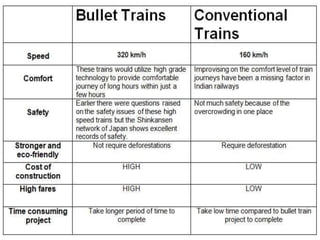






What is Bullet Train ?
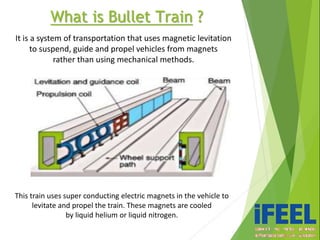
It is a system of transportation that uses magnetic levitation
to suspend, guide and propel vehicles from magnets
rather than using mechanical methods.
This train uses super conducting electric magnets in the vehicle to
levitate and propel the train. These magnets are cooled
by liquid helium or liquid nitrogen.
About Bullet Train Globally :
 Globally only 16 nations have high speed railways.
 China has the worlds longest network with 27,000Km of
such tracks
 Japan, Spain, France and Germany are the other countries
where tracks dedicated for high-speed trains stretch over 1000Km.
 The first high speed network was built in japan where line is in
between Tokyo and Osaka was inaugurated in 1964 and the train
named as shinkansen.
 The total length of high-speed rail lines across the world is
about 43,000Km.
 China has 65% of this network, and accounts for over 60% of global
high-speed passenger traffic.
Indian prime Minister visited Japan in May 2013
there the prime minister of both the countries
decided to bring Bullet train to India and the
line is from Mumbai- Ahmedabad.
The Japan International Cooperation Agency
(JICA) was given the go-ahead for the study in
September 2013.
The proposed 534Km Mumbai-Ahmedabad
high speed link, which is in early stage of
development, will be India’s maiden high speed
rail project.
The decision to carry out its feasibility study
was taken in September 2013.
• The Mumbai–Ahmedabad corridor was introduced for
a feasibility study in the 2009–2010 Rail Budget.
• A 650 km long high-speed rail corridor was proposed
to run from Pune Railway station to Ahmedabad
Railway station via Mumbai.
• Later, they excluded Pune and confirmed Mumbai-
Ahmedabad.
• India and Japan signed a MoU to undertake a joint
feasibility study of the Mumbai-Ahmedabad route in
New Delhi in September 2013.
• The cost of the study (¥500 million) was borne
equally by India and Japan.
Back Ground
• JICA officials visited Mumbai in January 2014
proposed to originate the corridor at the Bandra
Kurla Complex (BKC) in Mumbai.
• Japanese-Indian survey team recommended
a Shinkansen-style system for the Mumbai-
Ahmedabad line, including the adoption
of Automatic Train control and dedicated tracks.
Planning
• The bullet train in India will be based on japan
shinkansen network which is known for its
punctuality and cutting edge technology. In japan,
shinkansen means a new trunk line.
• The shinkansen uses 1,435mm standard guage
tracks in contrast to the 1,067mm narrow guage.
• The shinkansen uses an automatic train control
system, thereby, doing with the need for trackside
signals.
Technology
• Estimated cost 1.1lakh crores (17 billion USD)
• The cost includes interest during construction and
import duties
• To reduce land acquisition elevated corridor will be
constructed which raised an additional cost of 10k Cr.
• 20% of components used on the corridor are supplied
by Japan and manufactured in India
Cost
Pay Back Period
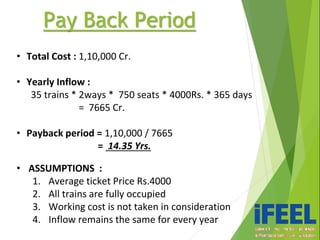
• Total Cost : 1,10,000 Cr.
• Yearly Inflow :
35 trains * 2ways * 750 seats * 4000Rs. * 365 days
= 7665 Cr.
• Payback period = 1,10,000 / 7665
= 14.35 Yrs.
• ASSUMPTIONS :
1. Average ticket Price Rs.4000
2. All trains are fully occupied
3. Working cost is not taken in consideration
4. Inflow remains the same for every year
Financing
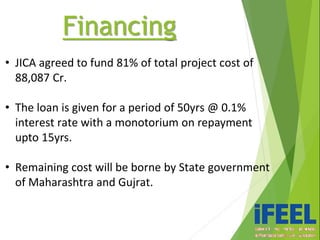
• JICA agreed to fund 81% of total project cost of
88,087 Cr.
• The loan is given for a period of 50yrs @ 0.1%
interest rate with a monotorium on repayment
upto 15yrs.
• Remaining cost will be borne by State government
of Maharashtra and Gujrat.
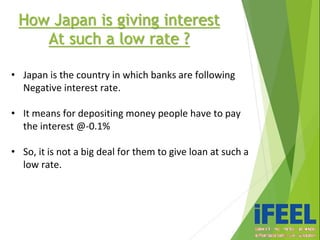
How Japan is giving interest
At such a low rate ?
• Japan is the country in which banks are following
Negative interest rate.
• It means for depositing money people have to pay
the interest @-0.1%
• So, it is not a big deal for them to give loan at such a
low rate.
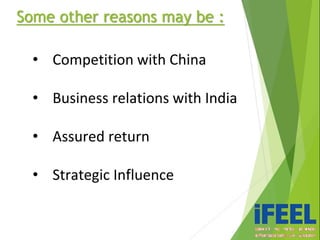
Some other reasons may be :
• Competition with China
• Business relations with India
• Assured return
• Strategic Influence
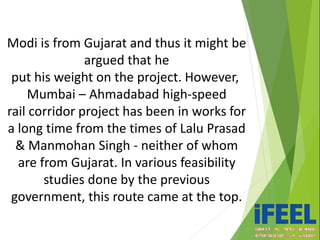
Modi is from Gujarat and thus it might be
argued that he
put his weight on the project. However,
Mumbai – Ahmadabad high-speed
rail corridor project has been in works for
a long time from the times of Lalu Prasad
& Manmohan Singh - neither of whom
are from Gujarat. In various feasibility
studies done by the previous
government, this route came at the top.
• FDI from JAPAN (88,000 crore @ 0.1% interest) due in
50 years & moratorium of 15 years.
• Reduction in Accidents, and saving fuel & time.
• Training institutes to take place in 2020, around 4000
people are to be trained before commissioning the
project.
• Employment
• Urban Expansion
• Comfort
• Safety
• Stronger & Eco-friendly
• Came in consideration after Japan’s success from
economic point of view. Since economic rate of
return is around 11.8%
• There shows a growth in areas where the High-
Speed Rail runs. As in Japan it is 150%, whereas
Normal Growth is 60-70%, thus creates
Development.
• The Bullet Train will have 12 stops of 165 seconds each.
It will take two hours and 58 minutes from Ahmedabad
to Mumbai if it stops at all 12.
• The Railways will run 35 bullet trains when it starts
operations, with about 70 trips per day. It plans to
increase the number to 105 trains by 2050.
• The Railways will only require around 825
hectares of land for the project as 92 per cent of
the route will be elevated, six per cent will go
through tunnels and only the remaining two per
cent will be on ground.
• A 21-km-long tunnel will built on the train
between Boisar and Bandra Kurla Complex in
Mumbai, of which seven km will be under the
sea.
• Initially, the train will have 10 coaches with a
total seating capacity of 750 passengers. Later, it is
proposed to have 16 coaches with a seating
capacity of 1,250 passengers.
• The train will require a cleaning time of 4 hours,
after running for 20 hours.
This is a wasteful project which only serves to deliver an illusory feel good
perception among the wealthy.
- D. Raghunandan
Director, Centre for technology and Development
High speed rail will increase investment in infrastructure, ignite the economy
and create the jobs.
- S.S. Khurana
Former railway board chairman
CURRENT RAIL NETWORK :-
For the bullet train project Japan is only funding upto ₹88000 crores & the
rest has to be arranged by the Indian railways due to which the expenditure
on the current railway network can be reduced, which requires quick updates
and maintenance.
DEMAND FACTOR :-
Due to high fares the demand for the bullet trains would be less, as many
people would not be able to afford it
Bullet train in India

Bullet train in India

  • 3.
    What is BulletTrain ? It is a system of transportation that uses magnetic levitation to suspend, guide and propel vehicles from magnets rather than using mechanical methods. This train uses super conducting electric magnets in the vehicle to levitate and propel the train. These magnets are cooled by liquid helium or liquid nitrogen.
  • 4.
    About Bullet TrainGlobally :  Globally only 16 nations have high speed railways.  China has the worlds longest network with 27,000Km of such tracks  Japan, Spain, France and Germany are the other countries where tracks dedicated for high-speed trains stretch over 1000Km.  The first high speed network was built in japan where line is in between Tokyo and Osaka was inaugurated in 1964 and the train named as shinkansen.  The total length of high-speed rail lines across the world is about 43,000Km.  China has 65% of this network, and accounts for over 60% of global high-speed passenger traffic.
  • 6.
    Indian prime Ministervisited Japan in May 2013 there the prime minister of both the countries decided to bring Bullet train to India and the line is from Mumbai- Ahmedabad. The Japan International Cooperation Agency (JICA) was given the go-ahead for the study in September 2013. The proposed 534Km Mumbai-Ahmedabad high speed link, which is in early stage of development, will be India’s maiden high speed rail project. The decision to carry out its feasibility study was taken in September 2013.
  • 8.
    • The Mumbai–Ahmedabadcorridor was introduced for a feasibility study in the 2009–2010 Rail Budget. • A 650 km long high-speed rail corridor was proposed to run from Pune Railway station to Ahmedabad Railway station via Mumbai. • Later, they excluded Pune and confirmed Mumbai- Ahmedabad. • India and Japan signed a MoU to undertake a joint feasibility study of the Mumbai-Ahmedabad route in New Delhi in September 2013. • The cost of the study (¥500 million) was borne equally by India and Japan. Back Ground
  • 9.
    • JICA officialsvisited Mumbai in January 2014 proposed to originate the corridor at the Bandra Kurla Complex (BKC) in Mumbai. • Japanese-Indian survey team recommended a Shinkansen-style system for the Mumbai- Ahmedabad line, including the adoption of Automatic Train control and dedicated tracks. Planning
  • 10.
    • The bullettrain in India will be based on japan shinkansen network which is known for its punctuality and cutting edge technology. In japan, shinkansen means a new trunk line. • The shinkansen uses 1,435mm standard guage tracks in contrast to the 1,067mm narrow guage. • The shinkansen uses an automatic train control system, thereby, doing with the need for trackside signals. Technology
  • 12.
    • Estimated cost1.1lakh crores (17 billion USD) • The cost includes interest during construction and import duties • To reduce land acquisition elevated corridor will be constructed which raised an additional cost of 10k Cr. • 20% of components used on the corridor are supplied by Japan and manufactured in India Cost
  • 13.
    Pay Back Period •Total Cost : 1,10,000 Cr. • Yearly Inflow : 35 trains * 2ways * 750 seats * 4000Rs. * 365 days = 7665 Cr. • Payback period = 1,10,000 / 7665 = 14.35 Yrs. • ASSUMPTIONS : 1. Average ticket Price Rs.4000 2. All trains are fully occupied 3. Working cost is not taken in consideration 4. Inflow remains the same for every year
  • 14.
    Financing • JICA agreedto fund 81% of total project cost of 88,087 Cr. • The loan is given for a period of 50yrs @ 0.1% interest rate with a monotorium on repayment upto 15yrs. • Remaining cost will be borne by State government of Maharashtra and Gujrat.
  • 15.
    How Japan isgiving interest At such a low rate ? • Japan is the country in which banks are following Negative interest rate. • It means for depositing money people have to pay the interest @-0.1% • So, it is not a big deal for them to give loan at such a low rate.
  • 16.
    Some other reasonsmay be : • Competition with China • Business relations with India • Assured return • Strategic Influence
  • 20.
    Modi is fromGujarat and thus it might be argued that he put his weight on the project. However, Mumbai – Ahmadabad high-speed rail corridor project has been in works for a long time from the times of Lalu Prasad & Manmohan Singh - neither of whom are from Gujarat. In various feasibility studies done by the previous government, this route came at the top.
  • 22.
    • FDI fromJAPAN (88,000 crore @ 0.1% interest) due in 50 years & moratorium of 15 years. • Reduction in Accidents, and saving fuel & time. • Training institutes to take place in 2020, around 4000 people are to be trained before commissioning the project. • Employment • Urban Expansion • Comfort • Safety • Stronger & Eco-friendly
  • 24.
    • Came inconsideration after Japan’s success from economic point of view. Since economic rate of return is around 11.8% • There shows a growth in areas where the High- Speed Rail runs. As in Japan it is 150%, whereas Normal Growth is 60-70%, thus creates Development. • The Bullet Train will have 12 stops of 165 seconds each. It will take two hours and 58 minutes from Ahmedabad to Mumbai if it stops at all 12. • The Railways will run 35 bullet trains when it starts operations, with about 70 trips per day. It plans to increase the number to 105 trains by 2050.
  • 25.
    • The Railwayswill only require around 825 hectares of land for the project as 92 per cent of the route will be elevated, six per cent will go through tunnels and only the remaining two per cent will be on ground. • A 21-km-long tunnel will built on the train between Boisar and Bandra Kurla Complex in Mumbai, of which seven km will be under the sea. • Initially, the train will have 10 coaches with a total seating capacity of 750 passengers. Later, it is proposed to have 16 coaches with a seating capacity of 1,250 passengers. • The train will require a cleaning time of 4 hours, after running for 20 hours.
  • 27.
    This is awasteful project which only serves to deliver an illusory feel good perception among the wealthy. - D. Raghunandan Director, Centre for technology and Development High speed rail will increase investment in infrastructure, ignite the economy and create the jobs. - S.S. Khurana Former railway board chairman CURRENT RAIL NETWORK :- For the bullet train project Japan is only funding upto ₹88000 crores & the rest has to be arranged by the Indian railways due to which the expenditure on the current railway network can be reduced, which requires quick updates and maintenance. DEMAND FACTOR :- Due to high fares the demand for the bullet trains would be less, as many people would not be able to afford it