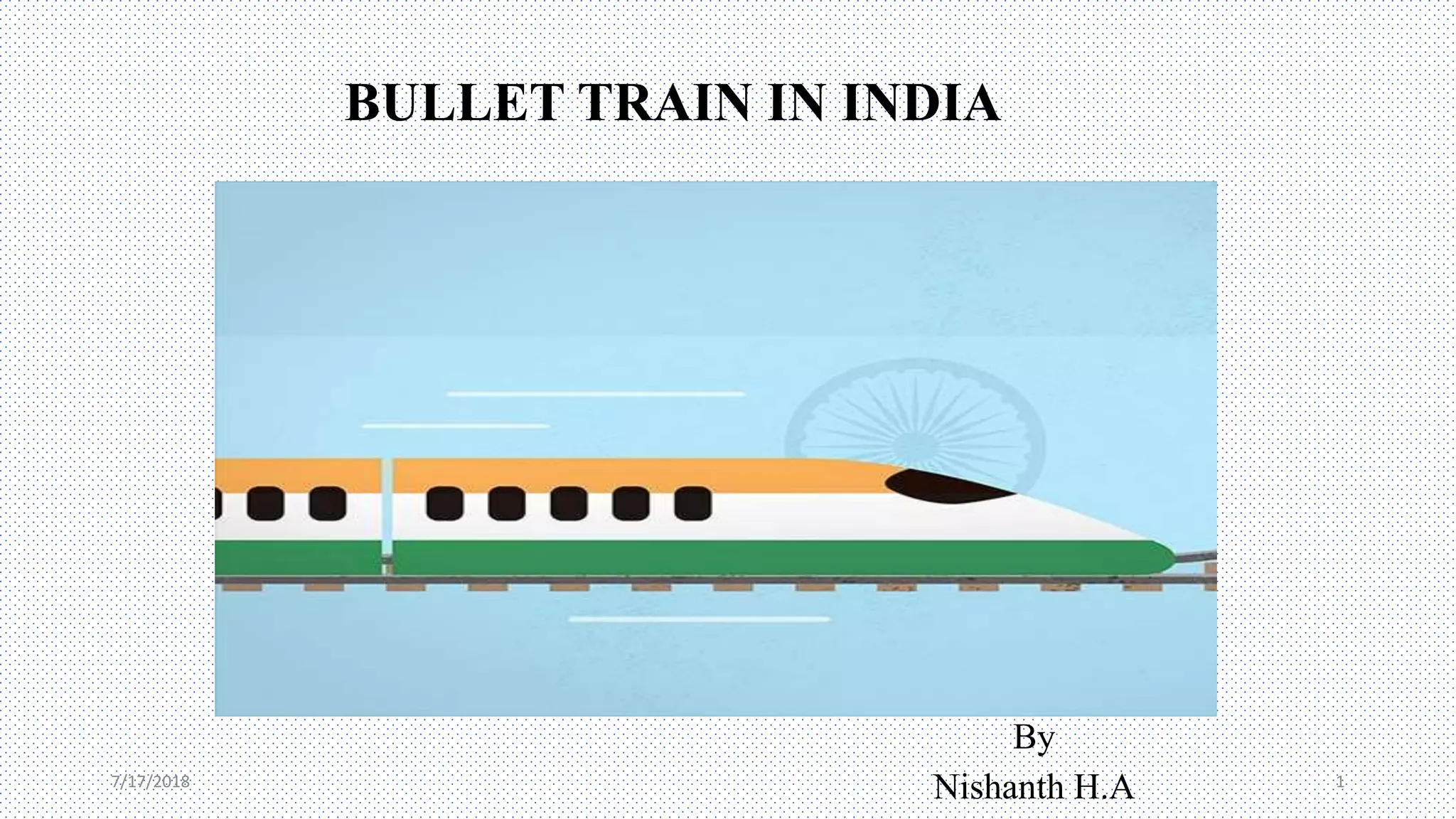
BULLET TRAIN IN INDIA
By
Nishanth H.A 17/17/2018
CONTENTS
• Abstract
• Introduction
• Type Of Magnet Used In Bullet Track
• Mechanism
• Bullet Train Technologies
• Electromagnetic Suspension (EMS)
• Electrodynamic Suspension (EDS)
• Bullet vs. Conventional Trains
• Seating Capacity & Classes
• Features Of The India’s First Bullet Train
• Adavantages and disadvantages
• Conclusion and Refereneces
7/17/2018 2
ABSTRACT
Indian railway network is one of the biggest transportation network in India and is the third largest
railway network in the world. Mail/express trains are regular express rail service of India. Express
trains make small number of stops, unlike passenger trains. The Duronto express trains introduced in
2009 (which run between major cities without any intermediate halts) are projected to be the fastest
train in India introduced with a higher speed limit of 120-130 km/h. Bullet trains in India will become
an engine of economic transformation in India .
37/17/2018
INTRODUCTION
• BULLET TRAIN is a type of rail transport significantly faster than traditional rail traffic, using an integrated
system of specialized rolling stock and dedicated tracks.
• Started in japan in 1964, from shinkansen to Tokyo, with speed of 145 km/ h.
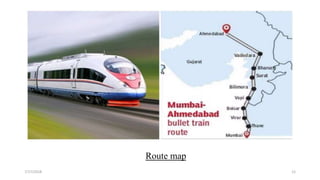
• The Proposed 534km Mumbai- Ahmadabad High-Speed Link, Which Is In Early Stage Of Development, Will Be
India's High-Speed Rail Project. The Decision To Carry Out Its Feasibility Study Was Taken In September 2014.
• During the Indian prime minister's visit to Japan in May 2014, the prime ministers of both countries decided to
co-finance a detailed joint feasibility study for the Mumbai- Ahmadabad HSR.
• There are a total of 12 stations on the route — four of which are in Maharashtra and eight in Gujarat.
47/17/2018
TYPE OF MAGNET USED IN BULLET TRACK
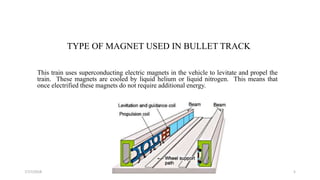
This train uses superconducting electric magnets in the vehicle to levitate and propel the
train. These magnets are cooled by liquid helium or liquid nitrogen. This means that
once electrified these magnets do not require additional energy.
57/17/2018
MECHANISM
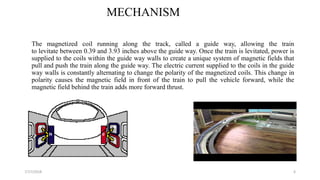
The magnetized coil running along the track, called a guide way, allowing the train
to levitate between 0.39 and 3.93 inches above the guide way. Once the train is levitated, power is
supplied to the coils within the guide way walls to create a unique system of magnetic fields that
pull and push the train along the guide way. The electric current supplied to the coils in the guide
way walls is constantly alternating to change the polarity of the magnetized coils. This change in
polarity causes the magnetic field in front of the train to pull the vehicle forward, while the
magnetic field behind the train adds more forward thrust.
67/17/2018
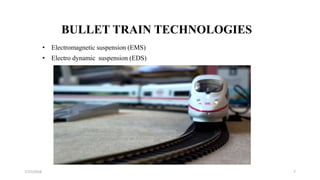
BULLET TRAIN TECHNOLOGIES
• Electromagnetic suspension (EMS)
• Electro dynamic suspension (EDS)
77/17/2018
ELECTROMAGNETIC SUSPENSION (EMS)
In current electromagnetic suspension (EMS) systems, the train levitates above a steel
rail while electromagnets, attached to the train, are oriented toward the rail from below.
The system is typically arranged on a series of C-shaped arms, with the upper portion
of the arm attached to the vehicle, and the lower inside edge containing the magnets.
The rail is situated between the upper and lower edges.
87/17/2018
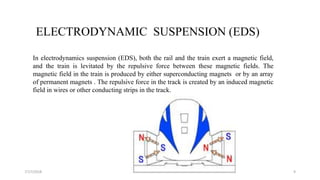
ELECTRODYNAMIC SUSPENSION (EDS)
In electrodynamics suspension (EDS), both the rail and the train exert a magnetic field,
and the train is levitated by the repulsive force between these magnetic fields. The
magnetic field in the train is produced by either superconducting magnets or by an array
of permanent magnets . The repulsive force in the track is created by an induced magnetic
field in wires or other conducting strips in the track.
97/17/2018
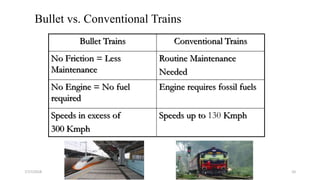
Bullet vs. Conventional Trains
Bullet Trains Conventional Trains
No Friction = Less
Maintenance
Routine Maintenance
Needed
No Engine = No fuel
required
Engine requires fossil fuels
Speeds in excess of
300 Kmph
Speeds up to 130 Kmph
107/17/2018
7/17/2018 11
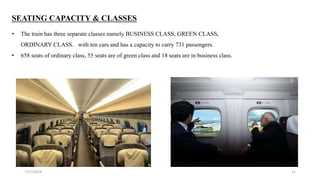
SEATING CAPACITY & CLASSES
• The train has three separate classes namely BUSINESS CLASS, GREEN CLASS,
ORDINARY CLASS. with ten cars and has a capacity to carry 731 passengers.
• 658 seats of ordinary class, 55 seats are of green class and 18 seats are in business class.
7/17/2018 12
Route map
7/17/2018 13
FEATURES OF THE INDIA’S FIRST BULLET TRAIN:
1. Proposed halts would Bandra Kurla Complex (BKC) in Mumbai- Thane-Virar-Boisar-Vapi-Surat-
Bharuch-Vadodara-Anand- Ahmadabad.
2. The highest speed of the bullet train is 350 kmph.
3. Travel Time is reduced to 2 hours from the current 6-7 hours by train.
4. Mumbai-Ahmadabad rail corridor work would begin in 2018.
5. Mumbai-Ahmadabad Bullet train is expected to set tracks in 2023.
6. Fare of the bullet train is likely to be same as the AC train fare.
7. The cost estimation of India’s first bullet train is about Rs 97,636 crore.
8. 81% of funding would come by way of a loan provided by Japan
9. 80% of Main parts produced in India under Make in India Project
ADVANTAGES
• Requires no fossil fuel which can harm the environment.
• Less energy consumption because no rail-track friction
• Less noise pollution since the train never hits the track
• Bullet train guide ways and trains take up less space than conventional trains
• Fast growth in transportation industry economy
• Can provide word class amenities and experience to our Indian customers at a price of A/C
first class and but reducing travel time by more than half.
• Government Tax on project
• Track design of bullet trains should be given priority by Indian institutes
• Employment about 20000 workers
• Bullet Trains 15 times less polluting than aero plane
• 80% of parts will produced in india under make in india project
• High speed rail training institute At Vadodara to come up by 2020
147/17/2018
DISADVANTAGES:
• Cost of construction: The cost of laying a bullet-train corridor is estimated to cost up to Rs 100 crore a
kilometer. After summing up the costs of signals, rolling stock, etc, the cost can rise up to Rs 115 crore a km.
Operation and maintenance costs would also be high.
• High fares: Fares of these trains would be high too in order to compensate the expenses and maintenance.
One way fare on Mumbai-Ahmadabad route is projected to be around Rs 5,000. Quite few Indians would be
able to afford travelling with these expenses. And even those who would be willing to pay such a high price
might prefer travelling planes instead. If this factor is not considered, then the project might prove to be a
loss for the government.
• Time consuming project: The project is at its initial level of planning and it is predicted that the
implementation of the plan would take years. In between if there is a change in government, and then the
project could face the consequences.
• Land acquisition: For laying tracks, there would be issues of land acquisition which might trigger anger
amongst commoners whose everyday living might come under menace. For instance laying these tracks in
Mumbai would require acquisition of land which has the largest slums in the city.
• Other issues: This project might have other issues under India’s present condition including plaguing of
power sector, choice of speed and gauge, minimum length of the route for the viability of the project, etc. It
is important to understand whether or not India is ready for this change.
157/17/2018
7/17/2018 16
CONCLUSION
• We are hoping that this project will revolutionize rail travel experience in INDIA and
will write a new chapter in history of India .
• We will provide word class amenities and experience to our Indian customers at a price
of A/C first class and but reducing travel time by more than half.
• We are sure that this venture will be profitable to both the developers/ investors and
consumers and it will be a win- win situation for all including government
7/17/2018 17
REFRENCES:
• Selladurai muthusamy, periyar A study on high speed rails in india E.V.R college.
• Shubham sharma future of high speed trains in india and its comparative study
• J priyadarshini IIT Delhi, bullet train in india.
• J central “about the shinkansen outline”
THANK YOU
187/17/2018

Bullet train in india

  • 1.
    BULLET TRAIN ININDIA By Nishanth H.A 17/17/2018
  • 2.
    CONTENTS • Abstract • Introduction •Type Of Magnet Used In Bullet Track • Mechanism • Bullet Train Technologies • Electromagnetic Suspension (EMS) • Electrodynamic Suspension (EDS) • Bullet vs. Conventional Trains • Seating Capacity & Classes • Features Of The India’s First Bullet Train • Adavantages and disadvantages • Conclusion and Refereneces 7/17/2018 2
  • 3.
    ABSTRACT Indian railway networkis one of the biggest transportation network in India and is the third largest railway network in the world. Mail/express trains are regular express rail service of India. Express trains make small number of stops, unlike passenger trains. The Duronto express trains introduced in 2009 (which run between major cities without any intermediate halts) are projected to be the fastest train in India introduced with a higher speed limit of 120-130 km/h. Bullet trains in India will become an engine of economic transformation in India . 37/17/2018
  • 4.
    INTRODUCTION • BULLET TRAINis a type of rail transport significantly faster than traditional rail traffic, using an integrated system of specialized rolling stock and dedicated tracks. • Started in japan in 1964, from shinkansen to Tokyo, with speed of 145 km/ h. • The Proposed 534km Mumbai- Ahmadabad High-Speed Link, Which Is In Early Stage Of Development, Will Be India's High-Speed Rail Project. The Decision To Carry Out Its Feasibility Study Was Taken In September 2014. • During the Indian prime minister's visit to Japan in May 2014, the prime ministers of both countries decided to co-finance a detailed joint feasibility study for the Mumbai- Ahmadabad HSR. • There are a total of 12 stations on the route — four of which are in Maharashtra and eight in Gujarat. 47/17/2018
  • 5.
    TYPE OF MAGNETUSED IN BULLET TRACK This train uses superconducting electric magnets in the vehicle to levitate and propel the train. These magnets are cooled by liquid helium or liquid nitrogen. This means that once electrified these magnets do not require additional energy. 57/17/2018
  • 6.
    MECHANISM The magnetized coilrunning along the track, called a guide way, allowing the train to levitate between 0.39 and 3.93 inches above the guide way. Once the train is levitated, power is supplied to the coils within the guide way walls to create a unique system of magnetic fields that pull and push the train along the guide way. The electric current supplied to the coils in the guide way walls is constantly alternating to change the polarity of the magnetized coils. This change in polarity causes the magnetic field in front of the train to pull the vehicle forward, while the magnetic field behind the train adds more forward thrust. 67/17/2018
  • 7.
    BULLET TRAIN TECHNOLOGIES •Electromagnetic suspension (EMS) • Electro dynamic suspension (EDS) 77/17/2018
  • 8.
    ELECTROMAGNETIC SUSPENSION (EMS) Incurrent electromagnetic suspension (EMS) systems, the train levitates above a steel rail while electromagnets, attached to the train, are oriented toward the rail from below. The system is typically arranged on a series of C-shaped arms, with the upper portion of the arm attached to the vehicle, and the lower inside edge containing the magnets. The rail is situated between the upper and lower edges. 87/17/2018
  • 9.
    ELECTRODYNAMIC SUSPENSION (EDS) Inelectrodynamics suspension (EDS), both the rail and the train exert a magnetic field, and the train is levitated by the repulsive force between these magnetic fields. The magnetic field in the train is produced by either superconducting magnets or by an array of permanent magnets . The repulsive force in the track is created by an induced magnetic field in wires or other conducting strips in the track. 97/17/2018
  • 10.
    Bullet vs. ConventionalTrains Bullet Trains Conventional Trains No Friction = Less Maintenance Routine Maintenance Needed No Engine = No fuel required Engine requires fossil fuels Speeds in excess of 300 Kmph Speeds up to 130 Kmph 107/17/2018
  • 11.
    7/17/2018 11 SEATING CAPACITY& CLASSES • The train has three separate classes namely BUSINESS CLASS, GREEN CLASS, ORDINARY CLASS. with ten cars and has a capacity to carry 731 passengers. • 658 seats of ordinary class, 55 seats are of green class and 18 seats are in business class.
  • 12.
  • 13.
    7/17/2018 13 FEATURES OFTHE INDIA’S FIRST BULLET TRAIN: 1. Proposed halts would Bandra Kurla Complex (BKC) in Mumbai- Thane-Virar-Boisar-Vapi-Surat- Bharuch-Vadodara-Anand- Ahmadabad. 2. The highest speed of the bullet train is 350 kmph. 3. Travel Time is reduced to 2 hours from the current 6-7 hours by train. 4. Mumbai-Ahmadabad rail corridor work would begin in 2018. 5. Mumbai-Ahmadabad Bullet train is expected to set tracks in 2023. 6. Fare of the bullet train is likely to be same as the AC train fare. 7. The cost estimation of India’s first bullet train is about Rs 97,636 crore. 8. 81% of funding would come by way of a loan provided by Japan 9. 80% of Main parts produced in India under Make in India Project
  • 14.
    ADVANTAGES • Requires nofossil fuel which can harm the environment. • Less energy consumption because no rail-track friction • Less noise pollution since the train never hits the track • Bullet train guide ways and trains take up less space than conventional trains • Fast growth in transportation industry economy • Can provide word class amenities and experience to our Indian customers at a price of A/C first class and but reducing travel time by more than half. • Government Tax on project • Track design of bullet trains should be given priority by Indian institutes • Employment about 20000 workers • Bullet Trains 15 times less polluting than aero plane • 80% of parts will produced in india under make in india project • High speed rail training institute At Vadodara to come up by 2020 147/17/2018
  • 15.
    DISADVANTAGES: • Cost ofconstruction: The cost of laying a bullet-train corridor is estimated to cost up to Rs 100 crore a kilometer. After summing up the costs of signals, rolling stock, etc, the cost can rise up to Rs 115 crore a km. Operation and maintenance costs would also be high. • High fares: Fares of these trains would be high too in order to compensate the expenses and maintenance. One way fare on Mumbai-Ahmadabad route is projected to be around Rs 5,000. Quite few Indians would be able to afford travelling with these expenses. And even those who would be willing to pay such a high price might prefer travelling planes instead. If this factor is not considered, then the project might prove to be a loss for the government. • Time consuming project: The project is at its initial level of planning and it is predicted that the implementation of the plan would take years. In between if there is a change in government, and then the project could face the consequences. • Land acquisition: For laying tracks, there would be issues of land acquisition which might trigger anger amongst commoners whose everyday living might come under menace. For instance laying these tracks in Mumbai would require acquisition of land which has the largest slums in the city. • Other issues: This project might have other issues under India’s present condition including plaguing of power sector, choice of speed and gauge, minimum length of the route for the viability of the project, etc. It is important to understand whether or not India is ready for this change. 157/17/2018
  • 16.
    7/17/2018 16 CONCLUSION • Weare hoping that this project will revolutionize rail travel experience in INDIA and will write a new chapter in history of India . • We will provide word class amenities and experience to our Indian customers at a price of A/C first class and but reducing travel time by more than half. • We are sure that this venture will be profitable to both the developers/ investors and consumers and it will be a win- win situation for all including government
  • 17.
    7/17/2018 17 REFRENCES: • Selladuraimuthusamy, periyar A study on high speed rails in india E.V.R college. • Shubham sharma future of high speed trains in india and its comparative study • J priyadarshini IIT Delhi, bullet train in india. • J central “about the shinkansen outline”
  • 18.