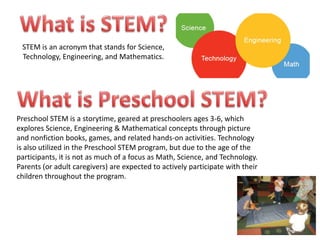
STEM is an acronym that stands for Science,
 Technology, Engineering, and Mathematics.


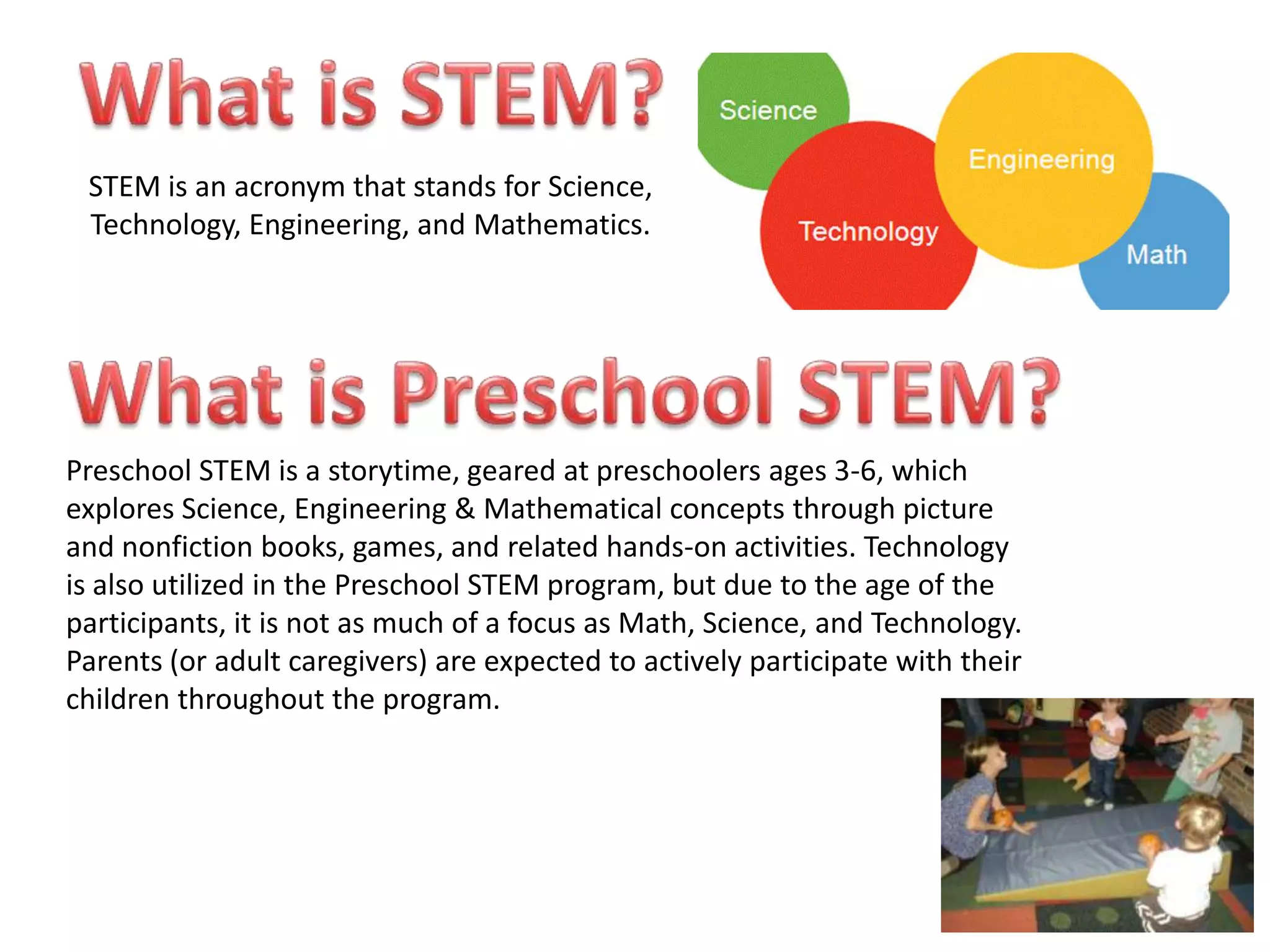
Preschool STEM is a storytime, geared at preschoolers ages 3-6, which
explores Science, Engineering & Mathematical concepts through picture
and nonfiction books, games, and related hands-on activities. Technology
is also utilized in the Preschool STEM program, but due to the age of the
participants, it is not as much of a focus as Math, Science, and Technology.
Parents (or adult caregivers) are expected to actively participate with their
children throughout the program.
In 2010, Ohio public schools began using academic standards known as
the Common Core. “The Common Core State Standards provide a
consistent, clear understanding of what students are expected to learn, so
teachers and parents know what they need to do to help them. The
standards are designed to be robust and relevant to the real world…” The
new Common Core State Standards encourage teachers to focus on skills
such as creative thinking, investigation, conversations, and connections
outside the classroom.


                       Common Core Standards
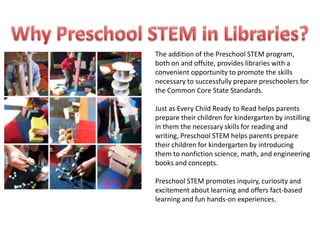
The addition of the Preschool STEM program,
both on and offsite, provides libraries with a
convenient opportunity to promote the skills
necessary to successfully prepare preschoolers for
the Common Core State Standards.

Just as Every Child Ready to Read helps parents
prepare their children for kindergarten by instilling
in them the necessary skills for reading and
writing, Preschool STEM helps parents prepare
their children for kindergarten by introducing
them to nonfiction science, math, and engineering
books and concepts.

Preschool STEM promotes inquiry, curiosity and
excitement about learning and offers fact-based
learning and fun hands-on experiences.
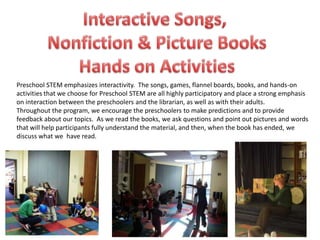
Preschool STEM emphasizes interactivity. The songs, games, flannel boards, books, and hands-on
activities that we choose for Preschool STEM are all highly participatory and place a strong emphasis
on interaction between the preschoolers and the librarian, as well as with their adults.
Throughout the program, we encourage the preschoolers to make predictions and to provide
feedback about our topics. As we read the books, we ask questions and point out pictures and words
that will help participants fully understand the material, and then, when the book has ended, we
discuss what we have read.
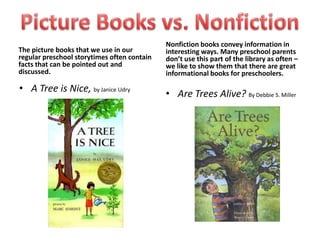
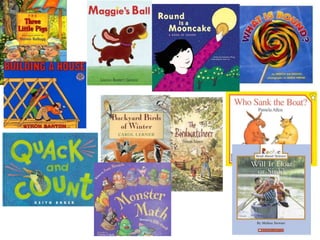
Nonfiction books convey information in
The picture books that we use in our         interesting ways. Many preschool parents
regular preschool storytimes often contain   don’t use this part of the library as often –
facts that can be pointed out and            we like to show them that there are great
discussed.                                   informational books for preschoolers.

• A Tree is Nice, by Janice Udry             • Are Trees Alive? By Debbie S. Miller
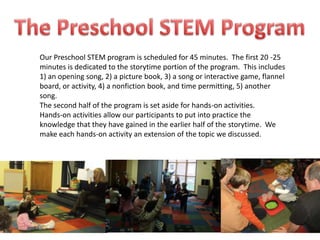
Our Preschool STEM program is scheduled for 45 minutes. The first 20 -25
minutes is dedicated to the storytime portion of the program. This includes
1) an opening song, 2) a picture book, 3) a song or interactive game, flannel
board, or activity, 4) a nonfiction book, and time permitting, 5) another
song.
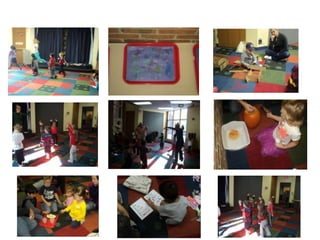
The second half of the program is set aside for hands-on activities.
Hands-on activities allow our participants to put into practice the
knowledge that they have gained in the earlier half of the storytime. We
make each hands-on activity an extension of the topic we discussed.
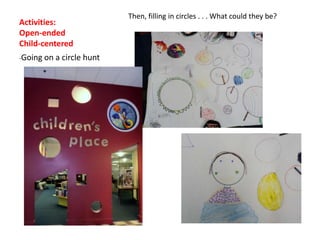
Then, filling in circles . . . What could they be?
Activities:
Open-ended
Child-centered
-Going   on a circle hunt
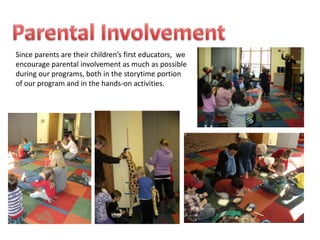
Since parents are their children’s first educators, we
encourage parental involvement as much as possible
during our programs, both in the storytime portion
of our program and in the hands-on activities.
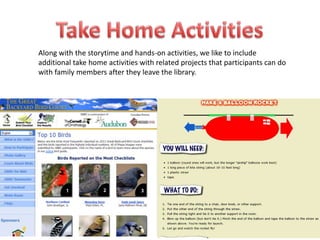
Along with the storytime and hands-on activities, we like to include
additional take home activities with related projects that participants can do
with family members after they leave the library.
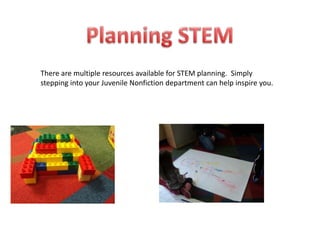
There are multiple resources available for STEM planning. Simply
stepping into your Juvenile Nonfiction department can help inspire you.
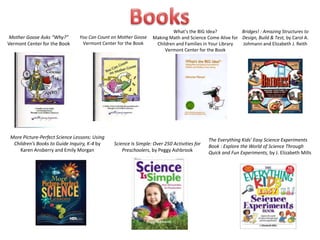
What’s the BIG Idea?           Bridges! : Amazing Structures to
Mother Goose Asks “Why?”        You Can Count on Mother Goose    Making Math and Science Come Alive for Design, Build & Test, by Carol A.
Vermont Center for the Book      Vermont Center for the Book      Children and Families in Your Library Johmann and Elizabeth J. Reith
                                                                      Vermont Center for the Book


 More Picture-Perfect Science Lessons: Using
                                                                                            The Everything Kids' Easy Science Experiments
  Children’s Books to Guide Inquiry, K-4 by    Science Is Simple: Over 250 Activities for   Book : Explore the World of Science Through
     Karen Ansberry and Emily Morgan               Preschoolers, by Peggy Ashbrook          Quick and Fun Experiments, by J. Elizabeth Mills
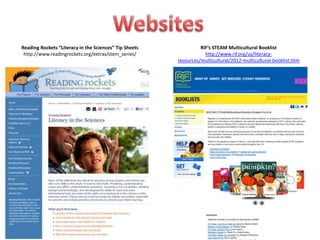
Reading Rockets “Literacy in the Sciences” Tip Sheets             RIF’s STEAM Multicultural Booklist
 http://www.readingrockets.org/extras/stem_series/                  http://www.rif.org/us/literacy-
                                                        resources/multicultural/2012-multicultural-booklist.htm
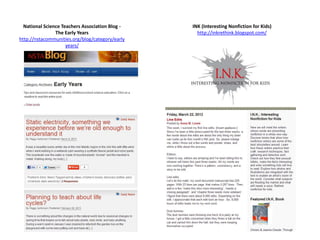
National Science Teachers Association Blog -   INK (Interesting Nonfiction for Kids)
                The Early Years                    http://inkrethink.blogspot.com/
http://nstacommunities.org/blog/category/early
                     years/
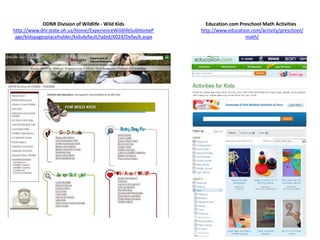
ODNR Division of Wildlife - Wild Kids                Education.com Preschool Math Activities
http://www.dnr.state.oh.us/Home/ExperienceWildlifeSubHomeP      http://www.education.com/activity/preschool/
 age/kidspagesplaceholder/kidsdefault/tabid/6024/Default.aspx                     math/
Knowledge Matters: Public Library Programming for        Library Makers {hands-on learning for all ages] :
              Young Knowledge Seekers                    Wonderworks
        https://kmatters0to6.wordpress.com/              http://librarymakers.blogspot.com/search/label/Won
Christina Jones, Children’s Services Librarian, Monroe   derWorks
     County Public Library, Bloomington, Indiana         Youth Services Librarian, Madison, Wisconsin
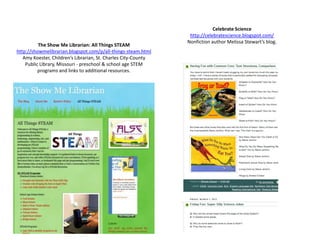
Celebrate Science
                                                                 http://celebratescience.blogspot.com/
                                                                Nonfiction author Melissa Stewart’s blog.
          The Show Me Librarian: All Things STEAM
http://showmelibrarian.blogspot.com/p/all-things-steam.html
   Amy Koester, Children’s Librarian, St. Charles City-County
    Public LIbrary, Missouri - preschool & school age STEM
          programs and links to additional resources.
Robert F. Sibert Informational Book Medal                              50 Books about Science and Scientists
http://www.ala.org/alsc/awardsgrants/bookmedia/sibertmedal            http://www.education.wisc.edu/ccbc/books/detailListBooks.a
    For most distinguished informational book for children,                              sp?idBookLists=76
 administered by ALSC. Most of these are older than preschool
                           audience.

 Orbis Pictus Award for Outstanding Nonfiction for Children                     Books Count! Number Fun for Children
        NCTE (National Council of Teachers of English)                http://www.education.wisc.edu/ccbc/books/detailListBooks.as
           http://www.ncte.org/awards/orbispictus                                         p?idBookLists=148


     Outstanding Science Trade Books for Students K-12                          Math & Science Booklists for Preschoolers
National Science Teacher’s Association (in cooperation with the       http://www.mothergooseprograms.org/math_science_book_lists
                    Children’s Book Council)                                                     .php
            http://www.nsta.org/publications/ostb/
                                                                                         Big Idea Booklists
                                                                                           Topics include:
    The Cook Prize http://bankstreet.edu/center-childrens-        Patterns, Mapping, Weather, Trees, Measurement, Shapes and many
                     literature/cook-prize/                                                     more!
 Bank Street College of Education, for the best STEM (Science,      http://www.mothergooseprograms.org/Big_idea_book_lists.php
Technology, Engineering and Math) picture books for ages 8-10.
                         Begun in 2012.
STEM Storytime: Preschool Fun with Science, Technology, Engineering, and Math

STEM Storytime: Preschool Fun with Science, Technology, Engineering, and Math

  • 1.
    STEM is anacronym that stands for Science, Technology, Engineering, and Mathematics. Preschool STEM is a storytime, geared at preschoolers ages 3-6, which explores Science, Engineering & Mathematical concepts through picture and nonfiction books, games, and related hands-on activities. Technology is also utilized in the Preschool STEM program, but due to the age of the participants, it is not as much of a focus as Math, Science, and Technology. Parents (or adult caregivers) are expected to actively participate with their children throughout the program.
  • 2.
    In 2010, Ohiopublic schools began using academic standards known as the Common Core. “The Common Core State Standards provide a consistent, clear understanding of what students are expected to learn, so teachers and parents know what they need to do to help them. The standards are designed to be robust and relevant to the real world…” The new Common Core State Standards encourage teachers to focus on skills such as creative thinking, investigation, conversations, and connections outside the classroom. Common Core Standards
  • 3.
    The addition ofthe Preschool STEM program, both on and offsite, provides libraries with a convenient opportunity to promote the skills necessary to successfully prepare preschoolers for the Common Core State Standards. Just as Every Child Ready to Read helps parents prepare their children for kindergarten by instilling in them the necessary skills for reading and writing, Preschool STEM helps parents prepare their children for kindergarten by introducing them to nonfiction science, math, and engineering books and concepts. Preschool STEM promotes inquiry, curiosity and excitement about learning and offers fact-based learning and fun hands-on experiences.
  • 4.
    Preschool STEM emphasizesinteractivity. The songs, games, flannel boards, books, and hands-on activities that we choose for Preschool STEM are all highly participatory and place a strong emphasis on interaction between the preschoolers and the librarian, as well as with their adults. Throughout the program, we encourage the preschoolers to make predictions and to provide feedback about our topics. As we read the books, we ask questions and point out pictures and words that will help participants fully understand the material, and then, when the book has ended, we discuss what we have read.
  • 5.
    Nonfiction books conveyinformation in The picture books that we use in our interesting ways. Many preschool parents regular preschool storytimes often contain don’t use this part of the library as often – facts that can be pointed out and we like to show them that there are great discussed. informational books for preschoolers. • A Tree is Nice, by Janice Udry • Are Trees Alive? By Debbie S. Miller
  • 7.
    Our Preschool STEMprogram is scheduled for 45 minutes. The first 20 -25 minutes is dedicated to the storytime portion of the program. This includes 1) an opening song, 2) a picture book, 3) a song or interactive game, flannel board, or activity, 4) a nonfiction book, and time permitting, 5) another song. The second half of the program is set aside for hands-on activities. Hands-on activities allow our participants to put into practice the knowledge that they have gained in the earlier half of the storytime. We make each hands-on activity an extension of the topic we discussed.
  • 8.
    Then, filling incircles . . . What could they be? Activities: Open-ended Child-centered -Going on a circle hunt
  • 9.
    Since parents aretheir children’s first educators, we encourage parental involvement as much as possible during our programs, both in the storytime portion of our program and in the hands-on activities.
  • 10.
    Along with thestorytime and hands-on activities, we like to include additional take home activities with related projects that participants can do with family members after they leave the library.
  • 11.
    There are multipleresources available for STEM planning. Simply stepping into your Juvenile Nonfiction department can help inspire you.
  • 12.
    What’s the BIGIdea? Bridges! : Amazing Structures to Mother Goose Asks “Why?” You Can Count on Mother Goose Making Math and Science Come Alive for Design, Build & Test, by Carol A. Vermont Center for the Book Vermont Center for the Book Children and Families in Your Library Johmann and Elizabeth J. Reith Vermont Center for the Book More Picture-Perfect Science Lessons: Using The Everything Kids' Easy Science Experiments Children’s Books to Guide Inquiry, K-4 by Science Is Simple: Over 250 Activities for Book : Explore the World of Science Through Karen Ansberry and Emily Morgan Preschoolers, by Peggy Ashbrook Quick and Fun Experiments, by J. Elizabeth Mills
  • 13.
    Reading Rockets “Literacyin the Sciences” Tip Sheets RIF’s STEAM Multicultural Booklist http://www.readingrockets.org/extras/stem_series/ http://www.rif.org/us/literacy- resources/multicultural/2012-multicultural-booklist.htm
  • 15.
    National Science TeachersAssociation Blog - INK (Interesting Nonfiction for Kids) The Early Years http://inkrethink.blogspot.com/ http://nstacommunities.org/blog/category/early years/
  • 16.
    ODNR Division ofWildlife - Wild Kids Education.com Preschool Math Activities http://www.dnr.state.oh.us/Home/ExperienceWildlifeSubHomeP http://www.education.com/activity/preschool/ age/kidspagesplaceholder/kidsdefault/tabid/6024/Default.aspx math/
  • 17.
    Knowledge Matters: PublicLibrary Programming for Library Makers {hands-on learning for all ages] : Young Knowledge Seekers Wonderworks https://kmatters0to6.wordpress.com/ http://librarymakers.blogspot.com/search/label/Won Christina Jones, Children’s Services Librarian, Monroe derWorks County Public Library, Bloomington, Indiana Youth Services Librarian, Madison, Wisconsin
  • 18.
    Celebrate Science http://celebratescience.blogspot.com/ Nonfiction author Melissa Stewart’s blog. The Show Me Librarian: All Things STEAM http://showmelibrarian.blogspot.com/p/all-things-steam.html Amy Koester, Children’s Librarian, St. Charles City-County Public LIbrary, Missouri - preschool & school age STEM programs and links to additional resources.
  • 19.
    Robert F. SibertInformational Book Medal 50 Books about Science and Scientists http://www.ala.org/alsc/awardsgrants/bookmedia/sibertmedal http://www.education.wisc.edu/ccbc/books/detailListBooks.a For most distinguished informational book for children, sp?idBookLists=76 administered by ALSC. Most of these are older than preschool audience. Orbis Pictus Award for Outstanding Nonfiction for Children Books Count! Number Fun for Children NCTE (National Council of Teachers of English) http://www.education.wisc.edu/ccbc/books/detailListBooks.as http://www.ncte.org/awards/orbispictus p?idBookLists=148 Outstanding Science Trade Books for Students K-12 Math & Science Booklists for Preschoolers National Science Teacher’s Association (in cooperation with the http://www.mothergooseprograms.org/math_science_book_lists Children’s Book Council) .php http://www.nsta.org/publications/ostb/ Big Idea Booklists Topics include: The Cook Prize http://bankstreet.edu/center-childrens- Patterns, Mapping, Weather, Trees, Measurement, Shapes and many literature/cook-prize/ more! Bank Street College of Education, for the best STEM (Science, http://www.mothergooseprograms.org/Big_idea_book_lists.php Technology, Engineering and Math) picture books for ages 8-10. Begun in 2012.