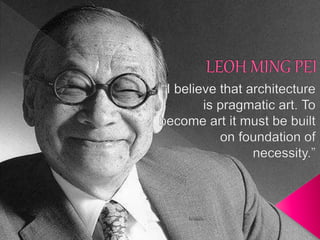
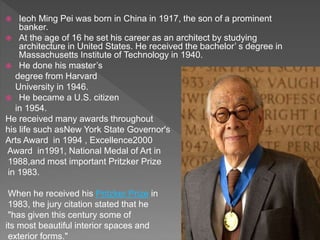
 Ieoh Ming Pei was born in China in 1917, the son of a prominent
banker.
 At the age of 16 he set his career as an architect by studying
architecture in United States. He received the bachelor’ s degree in
Massachusetts Institute of Technology in 1940.
 He done his master’s
degree from Harvard
University in 1946.
 He became a U.S. citizen
in 1954.
He received many awards throughout
his life such asNew York State Governor's
Arts Award in 1994 , Excellence2000
Award in1991, National Medal of Art in
1988,and most important Pritzker Prize
in 1983.
When he received his Pritzker Prize in
1983, the jury citation stated that he
"has given this century some of
its most beautiful interior spaces and
exterior forms."
 “To me architecture is something you do to serve a
certain function, it is for people, it have to somehow
relate for life itself of that particular time and place.”
 “There is no such things like modern architecture, post
modern,deconstructivism.You can use all the isms you
want, I don’t believe in any of them. They came and
they go and the one that survive is architecture,
architecture of that time.”
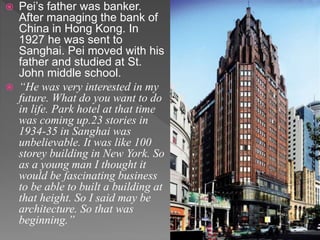
 Pei’s father was banker.
After managing the bank of
China in Hong Kong. In
1927 he was sent to
Sanghai. Pei moved with his
father and studied at St.
John middle school.
 “He was very interested in my
future. What do you want to do
in life. Park hotel at that time
was coming up.23 stories in
1934-35 in Sanghai was
unbelievable. It was like 100
storey building in New York. So
as a young man I thought it
would be fascinating business
to be able to built a building at
that height. So I said may be
architecture. So that was
beginning.”
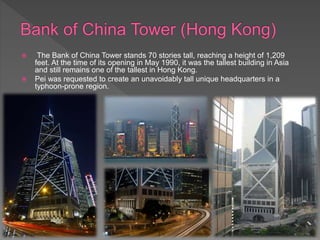
 The Bank of China Tower stands 70 stories tall, reaching a height of 1,209
feet. At the time of its opening in May 1990, it was the tallest building in Asia
and still remains one of the tallest in Hong Kong.
 Pei was requested to create an unavoidably tall unique headquarters in a
typhoon-prone region.
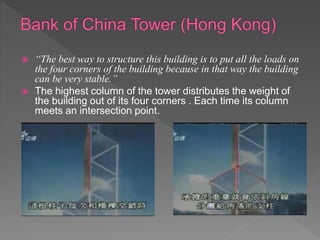
 “The best way to structure this building is to put all the loads on
the four corners of the building because in that way the building
can be very stable.”
 The highest column of the tower distributes the weight of
the building out of its four corners . Each time its column
meets an intersection point.
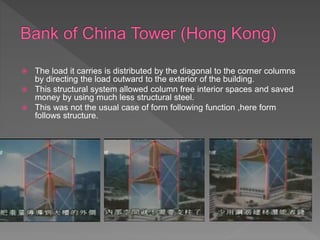
 The load it carries is distributed by the diagonal to the corner columns
by directing the load outward to the exterior of the building.
 This structural system allowed column free interior spaces and saved
money by using much less structural steel.
 This was not the usual case of form following function ,here form
follows structure.
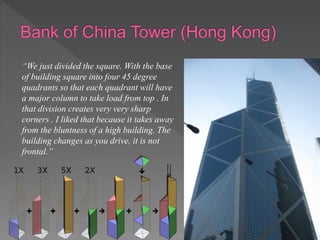
“We just divided the square. With the base
of building square into four 45 degree
quadrants so that each quadrant will have
a major column to take load from top . In
that division creates very very sharp
corners . I liked that because it takes away
from the bluntness of a high building. The
building changes as you drive, it is not
frontal.”
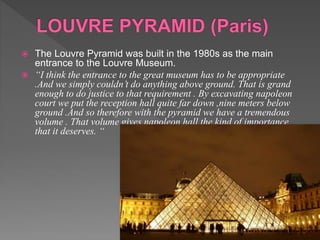
 The Louvre Pyramid was built in the 1980s as the main
entrance to the Louvre Museum.
 “I think the entrance to the great museum has to be appropriate
.And we simply couldn’t do anything above ground. That is grand
enough to do justice to that requirement . By excavating napoleon
court we put the reception hall quite far down ,nine meters below
ground .And so therefore with the pyramid we have a tremendous
volume . That volume gives napoleon hall the kind of importance
that it deserves. “
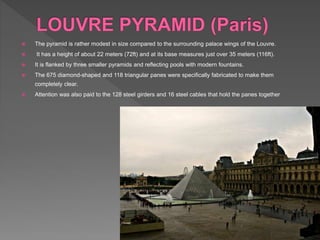
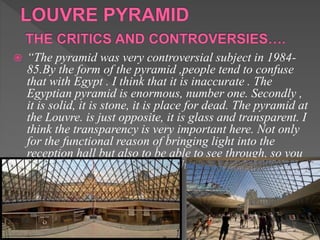
 The pyramid is rather modest in size compared to the surrounding palace wings of the Louvre.
 It has a height of about 22 meters (72ft) and at its base measures just over 35 meters (116ft).
 It is flanked by three smaller pyramids and reflecting pools with modern fountains.
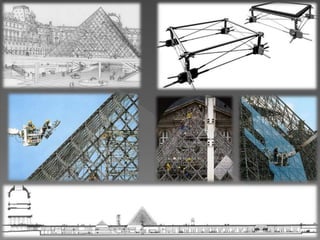
 The 675 diamond-shaped and 118 triangular panes were specifically fabricated to make them
completely clear.
 Attention was also paid to the 128 steel girders and 16 steel cables that hold the panes together
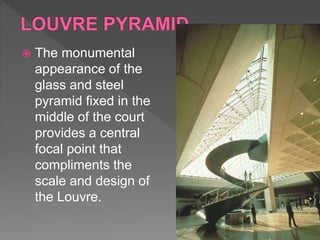
 The monumental
appearance of the
glass and steel
pyramid fixed in the
middle of the court
provides a central
focal point that
compliments the
scale and design of
the Louvre.
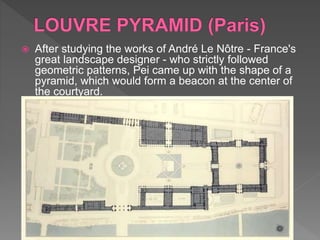
 After studying the works of André Le Nôtre - France's
great landscape designer - who strictly followed
geometric patterns, Pei came up with the shape of a
pyramid, which would form a beacon at the center of
the courtyard.
 “The pyramid was very controversial subject in 1984-
85.By the form of the pyramid ,people tend to confuse
that with Egypt . I think that it is inaccurate . The
Egyptian pyramid is enormous, number one. Secondly ,
it is solid, it is stone, it is place for dead. The pyramid at
the Louvre. is just opposite, it is glass and transparent. I
think the transparency is very important here. Not only
for the functional reason of bringing light into the
reception hall but also to be able to see through, so you
can see the entire complex of the Louvre.”
 Once upon a time there was a fisherman in Buryo, East China, who was fishing
by a stream in the mountains and accidentally found a wonderful orchard full of
peach trees in bloom. Impressed by the beauty of this springtime scene, he
continued paddling to the end of the grove, where he noticed a ray of light
coming from a small cave at the foot of a mountain. He jumped out of his boat
and entered the cave that, through a narrow road, led him into a splendid town
with a beautiful countryside and hospitable people who welcomed him for
several days.
 This is the beginning of the popular "The Tale of Peach Blossom Spring " a
very famous folk story from the Jin Dynasty in China. Taking this tale into
account the renowned Chinese-American architect I.M. Pei designed the
museum Miho, in Shiga Prefecture, Japan.
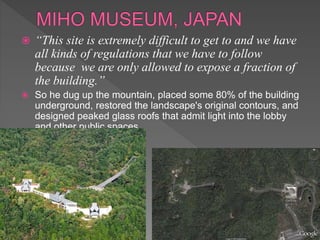
 “This site is extremely difficult to get to and we have
all kinds of regulations that we have to follow
because we are only allowed to expose a fraction of
the building.”
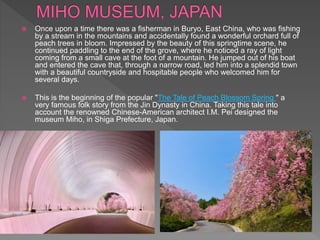
 So he dug up the mountain, placed some 80% of the building
underground, restored the landscape's original contours, and
designed peaked glass roofs that admit light into the lobby
and other public spaces
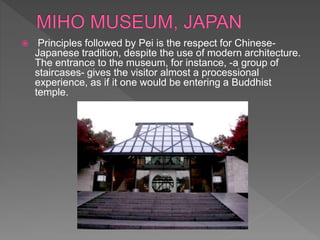
 Principles followed by Pei is the respect for Chinese-
Japanese tradition, despite the use of modern architecture.
The entrance to the museum, for instance, -a group of
staircases- gives the visitor almost a processional
experience, as if it one would be entering a Buddhist
temple.
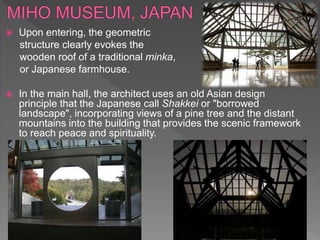
 Upon entering, the geometric
structure clearly evokes the
wooden roof of a traditional minka,
or Japanese farmhouse.
 In the main hall, the architect uses an old Asian design
principle that the Japanese call Shakkei or "borrowed
landscape", incorporating views of a pine tree and the distant
mountains into the building that provides the scenic framework
to reach peace and spirituality.

Im pei

  • 2.
     Ieoh MingPei was born in China in 1917, the son of a prominent banker.  At the age of 16 he set his career as an architect by studying architecture in United States. He received the bachelor’ s degree in Massachusetts Institute of Technology in 1940.  He done his master’s degree from Harvard University in 1946.  He became a U.S. citizen in 1954. He received many awards throughout his life such asNew York State Governor's Arts Award in 1994 , Excellence2000 Award in1991, National Medal of Art in 1988,and most important Pritzker Prize in 1983. When he received his Pritzker Prize in 1983, the jury citation stated that he "has given this century some of its most beautiful interior spaces and exterior forms."
  • 3.
     “To mearchitecture is something you do to serve a certain function, it is for people, it have to somehow relate for life itself of that particular time and place.”  “There is no such things like modern architecture, post modern,deconstructivism.You can use all the isms you want, I don’t believe in any of them. They came and they go and the one that survive is architecture, architecture of that time.”
  • 4.
     Pei’s fatherwas banker. After managing the bank of China in Hong Kong. In 1927 he was sent to Sanghai. Pei moved with his father and studied at St. John middle school.  “He was very interested in my future. What do you want to do in life. Park hotel at that time was coming up.23 stories in 1934-35 in Sanghai was unbelievable. It was like 100 storey building in New York. So as a young man I thought it would be fascinating business to be able to built a building at that height. So I said may be architecture. So that was beginning.”
  • 5.
     The Bankof China Tower stands 70 stories tall, reaching a height of 1,209 feet. At the time of its opening in May 1990, it was the tallest building in Asia and still remains one of the tallest in Hong Kong.  Pei was requested to create an unavoidably tall unique headquarters in a typhoon-prone region.
  • 6.
     “The bestway to structure this building is to put all the loads on the four corners of the building because in that way the building can be very stable.”  The highest column of the tower distributes the weight of the building out of its four corners . Each time its column meets an intersection point.
  • 7.
     The loadit carries is distributed by the diagonal to the corner columns by directing the load outward to the exterior of the building.  This structural system allowed column free interior spaces and saved money by using much less structural steel.  This was not the usual case of form following function ,here form follows structure.
  • 8.
    “We just dividedthe square. With the base of building square into four 45 degree quadrants so that each quadrant will have a major column to take load from top . In that division creates very very sharp corners . I liked that because it takes away from the bluntness of a high building. The building changes as you drive, it is not frontal.”
  • 9.
     The LouvrePyramid was built in the 1980s as the main entrance to the Louvre Museum.  “I think the entrance to the great museum has to be appropriate .And we simply couldn’t do anything above ground. That is grand enough to do justice to that requirement . By excavating napoleon court we put the reception hall quite far down ,nine meters below ground .And so therefore with the pyramid we have a tremendous volume . That volume gives napoleon hall the kind of importance that it deserves. “
  • 10.
     The pyramidis rather modest in size compared to the surrounding palace wings of the Louvre.  It has a height of about 22 meters (72ft) and at its base measures just over 35 meters (116ft).  It is flanked by three smaller pyramids and reflecting pools with modern fountains.  The 675 diamond-shaped and 118 triangular panes were specifically fabricated to make them completely clear.  Attention was also paid to the 128 steel girders and 16 steel cables that hold the panes together
  • 11.
     The monumental appearanceof the glass and steel pyramid fixed in the middle of the court provides a central focal point that compliments the scale and design of the Louvre.
  • 12.
     After studyingthe works of André Le Nôtre - France's great landscape designer - who strictly followed geometric patterns, Pei came up with the shape of a pyramid, which would form a beacon at the center of the courtyard.
  • 13.
     “The pyramidwas very controversial subject in 1984- 85.By the form of the pyramid ,people tend to confuse that with Egypt . I think that it is inaccurate . The Egyptian pyramid is enormous, number one. Secondly , it is solid, it is stone, it is place for dead. The pyramid at the Louvre. is just opposite, it is glass and transparent. I think the transparency is very important here. Not only for the functional reason of bringing light into the reception hall but also to be able to see through, so you can see the entire complex of the Louvre.”
  • 15.
     Once upona time there was a fisherman in Buryo, East China, who was fishing by a stream in the mountains and accidentally found a wonderful orchard full of peach trees in bloom. Impressed by the beauty of this springtime scene, he continued paddling to the end of the grove, where he noticed a ray of light coming from a small cave at the foot of a mountain. He jumped out of his boat and entered the cave that, through a narrow road, led him into a splendid town with a beautiful countryside and hospitable people who welcomed him for several days.  This is the beginning of the popular "The Tale of Peach Blossom Spring " a very famous folk story from the Jin Dynasty in China. Taking this tale into account the renowned Chinese-American architect I.M. Pei designed the museum Miho, in Shiga Prefecture, Japan.
  • 16.
     “This siteis extremely difficult to get to and we have all kinds of regulations that we have to follow because we are only allowed to expose a fraction of the building.”  So he dug up the mountain, placed some 80% of the building underground, restored the landscape's original contours, and designed peaked glass roofs that admit light into the lobby and other public spaces
  • 17.
     Principles followedby Pei is the respect for Chinese- Japanese tradition, despite the use of modern architecture. The entrance to the museum, for instance, -a group of staircases- gives the visitor almost a processional experience, as if it one would be entering a Buddhist temple.
  • 18.
     Upon entering,the geometric structure clearly evokes the wooden roof of a traditional minka, or Japanese farmhouse.  In the main hall, the architect uses an old Asian design principle that the Japanese call Shakkei or "borrowed landscape", incorporating views of a pine tree and the distant mountains into the building that provides the scenic framework to reach peace and spirituality.