School of Architecture, Building and Design
Bachelor of Science(Hons) in Architecture
Building Construction I (BLD60303)
Project 1: Experiencing Construction
SEOW KOJI TAKEHIRA 0320816
ALISON TANG ING EE 0323705
CHLOE TEH SHU-ERN 0324101
CRYSLYN TAN ZHIA LYN 0324249
DANA KAN JIA TORNG 0323648
DANICA GAN JIA-EN 0323708
DARREN TAN YONG TEE 0323398
LIM XIU QING 0323214
No. Section Task Done by: Page No.
1.0
1.1
2.0
2.1
3.0
3.1
4.0
4.1
4.2
5.0
5.1
5.2
5.3
6.0
7.0
7.1
7.2
8.0
8.1
Introduction to Group Member and Detail
Introduction to Site
Site and Safety
Plants and Machinery
Preliminaries Work
Site Layout, Setting out and Earth Work etc.
Foundation
Foundation type and construction process (from reference)
Foundation type and construction process (from site visit)
Superstructure (from site visit and reference)
Beam and Column
Slab
Wall & Staircase
Doors and Windows
Roof
Roof type and construction process (from site visit)
Roof type and construction process (from reference)
Summary
Reference
Danica Gan Jia-En
Dana Kan Jia Torng
Darren Tan Yong Tee
Cryslyn Tan Zhia Lyn
Seow Koji Takehira
Chloe Teh Shu-En
Lim Xiu Qing
Alison Tang Ing Ee
3
4 - 12
13 - 21
22 - 27
28 - 32
33 - 38
39 - 46
47 - 50
51 - 55
56
57
Table of Content
1.0 Introduction
This is a group project,where our task is to decide an ongoing construction site
which includes what we had learned in the syllabus. We had selected a site, which
is located in Bangi south view city, under project name as Avens . This site is
considered to be built with medium to low rise buildings, which are one of the
projects by Mah Sing Group.
We were required identify different type of building elements and its construction
process, details and materials. In addition, we were to study and record
construction of different building elements as detailed as possible. Our group
consists of 8 members where each of them are responsible for different
construction process and its elements.
Group Members:
Seow Koji Takehira 0320816
Lim Xiu Qing 0323214
Cryslyn Tan Zhia Lyn 0324249
Chloe Teh Shu-Ern 0324101
Alison Tang Ing En 0323705
Danica Gan Jia-En 0323708
Darren Tan Yong Tee 0323398
Dana Kan Jia Torng 0323648
3
1.1 INTRODUCTION TO SITE
In a building construction, the structure of the building is divided into two
parts. The substructure and the super structure. Any part that transmit the
load of the superstructure to the foundation soil is called sub-structure and the
portion of the building which is above the substructure is called super
structure. The weight of superstructure is affected by the foundation hence the
foundation should be strong enough to sustain the load of the super structure.
1.1(a) Requirements of Foundation
The foundation of substructure distributes the load of the building evenly on
the soil in such a way according to the maximum allowable bearing capacity
of soil. This is to strengthen the building against lateral forces caused due to
natural disasters such as tornado, earthquakes and tsunami. It provides
strong surface for the construction of proposed structure, and to provide
safety to the structure, preventing it from collapsing.
1.1 (b) Aim of Super Structure
The aim of providing super-structure is to provide support in the construction
of building as designed by the Architect and the Engineer itself.
Super-structure includes elements such columns, beams, stairs and walls.
These are designed to provide strength for carrying the dead load and live
load expected to come on different parts of the structure in a safe and well
distributed manner.
1.1 (c) Aim of Site Inspection
In every construction project, inspection of site are required to analyse:
- Behaviour of soil near proposed wall and thickness of layers of soil deposits.
- Changes in soil behaviour and in depth of water Table.
- Direction of flow of water and its drainage
- Movement in earth layer due to any reason if any.
SITE AND SAFETY
Danica Gan Jia-En
0323708
4
2.0 Site and Safety
2.0.1 Introduction
Nearly 6.5 million people work at approximately 252,000 construction sites across the
nation everyday. The fatal injury rate for the construction industry is higher than any other
industries.Potential hazards for workers in construction include:
■ Falls (from heights);
■ Scaffold collapse;
■ Electric shock
■ Failure to use proper personal protective equipment; and
■ Repetitive motion injuries.
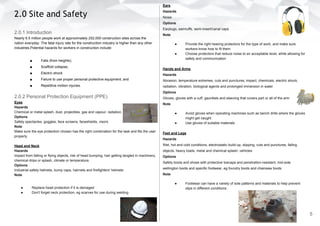
2.0.2 Personal Protection Equipment (PPE)
Eyes
Hazards
Chemical or metal splash, dust, projectiles, gas and vapour, radiation.
Options
Safety spectacles, goggles, face screens, faceshields, visors
Note
Make sure the eye protection chosen has the right combination for the task and fits the user
properly.
Head and Neck
Hazards
Impact from falling or flying objects, risk of head bumping, hair getting tangled in machinery,
chemical drips or splash, climate or temperature.
Options
Industrial safety helmets, bump caps, hairnets and firefighters' helmets
Note
● Replace head protection if it is damaged
● Don't forget neck protection, eg scarves for use during welding
Ears
Hazards
Noise
Options
Earplugs, earmuffs, semi-insert/canal caps
Note
● Provide the right hearing protectors for the type of work, and make sure
workers know how to fit them
● Choose protectors that reduce noise to an acceptable level, while allowing for
safety and communication
Hands and Arms
Hazards
Abrasion, temperature extremes, cuts and punctures, impact, chemicals, electric shock,
radiation, vibration, biological agents and prolonged immersion in water
Options
Gloves, gloves with a cuff, gauntlets and sleeving that covers part or all of the arm
Note
● Avoid gloves when operating machines such as bench drills where the gloves
might get caught
● Use gloves of suitable materials
Feet and Legs
Hazards
Wet, hot and cold conditions, electrostatic build-up, slipping, cuts and punctures, falling
objects, heavy loads, metal and chemical splash, vehicles
Options
Safety boots and shoes with protective toecaps and penetration-resistant, mid-sole
wellington boots and specific footwear, eg foundry boots and chainsaw boots
Note
● Footwear can have a variety of sole patterns and materials to help prevent
slips in different conditions.
5
Lungs
Hazards
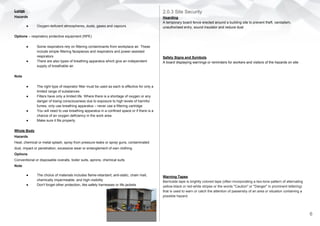
● Oxygen-deficient atmospheres, dusts, gases and vapours
Options – respiratory protective equipment (RPE)
● Some respirators rely on filtering contaminants from workplace air. These
include simple filtering facepieces and respirators and power-assisted
respirators
● There are also types of breathing apparatus which give an independent
supply of breathable air.
Note
● The right type of respirator filter must be used as each is effective for only a
limited range of substances
● Filters have only a limited life. Where there is a shortage of oxygen or any
danger of losing consciousness due to exposure to high levels of harmful
fumes, only use breathing apparatus – never use a filtering cartridge
● You will need to use breathing apparatus in a confined space or if there is a
chance of an oxygen deficiency in the work area
● Make sure it fits properly.
Whole Body
Hazards
Heat, chemical or metal splash, spray from pressure leaks or spray guns, contaminated
dust, impact or penetration, excessive wear or entanglement of own clothing
Options
Conventional or disposable overalls, boiler suits, aprons, chemical suits
Note
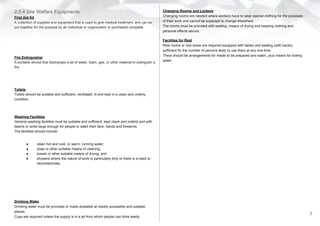
● The choice of materials includes flame-retardant, anti-static, chain mail,
chemically impermeable, and high-visibility
● Don't forget other protection, like safety harnesses or life jackets
2.0.3 Site Security
Hoarding
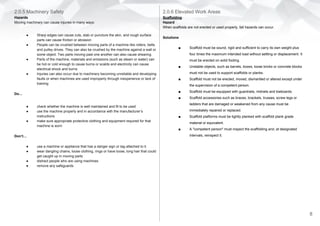
A temporary board fence erected around a building site to prevent theft, vandalism,
unauthorised entry, sound insulator and reduce dust
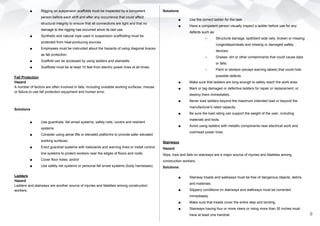
Safety Signs and Symbols
A board displaying warnings or reminders for workers and visitors of the hazards on site
Warning Tapes
Barricade tape is brightly colored tape (often incorporating a two-tone pattern of alternating
yellow-black or red-white stripes or the words "Caution" or "Danger" in prominent lettering)
that is used to warn or catch the attention of passersby of an area or situation containing a
possible hazard.
6
2.0.4 Site Welfare Equipments
First Aid Kit
A collection of supplies and equipment that is used to give medical treatment, and can be
put together for the purpose by an individual or organization or purchased complete.
Fire Extinguisher
A portable device that discharges a jet of water, foam, gas, or other material to extinguish a
fire
Toilets
Toilets should be suitable and sufficient, ventilated, lit and kept in a clean and orderly
condition.
Washing Facilities
General washing facilities must be suitable and sufficient, kept clean and orderly and with
basins or sinks large enough for people to wash their face, hands and forearms.
The facilities should include:
● clean hot and cold, or warm, running water;
● soap or other suitable means of cleaning;
● towels or other suitable means of drying; and
● showers where the nature of work is particularly dirty or there is a need to
decontaminate.
Drinking Water
Drinking water must be provided or made available at readily accessible and suitable
places.
Cups are required unless the supply is in a jet from which people can drink easily.
Changing Rooms and Lockers
Changing rooms are needed where workers have to wear special clothing for the purposes
of their work and cannot be expected to change elsewhere.
The rooms must be provided with seating, means of drying and keeping clothing and
personal effects secure.
Facilities for Rest
Rest rooms or rest areas are required equipped with tables and seating (with backs)
sufficient for the number of persons likely to use them at any one time.
There should be arrangements for meals to be prepared and eaten, plus means for boiling
water.
7
2.0.5 Machinery Safety
Hazards
Moving machinery can cause injuries in many ways:
● Sharp edges can cause cuts, stab or puncture the skin, and rough surface
parts can cause friction or abrasion
● People can be crushed between moving parts of a machine like rollers, belts
and pulley drives. They can also be crushed by the machine against a wall or
some object. Two parts moving past one another can also cause shearing.
● Parts of the machine, materials and emissions (such as steam or water) can
be hot or cold enough to cause burns or scalds and electricity can cause
electrical shock and burns
● Injuries can also occur due to machinery becoming unreliable and developing
faults or when machines are used improperly through inexperience or lack of
training
Do…
● check whether the machine is well maintained and fit to be used
● use the machine properly and in accordance with the manufacturer’s
instructions
● make sure appropriate protective clothing and equipment required for that
machine is worn
Don’t…
● use a machine or appliance that has a danger sign or tag attached to it.
● wear dangling chains, loose clothing, rings or have loose, long hair that could
get caught up in moving parts
● distract people who are using machines
● remove any safeguards
2.0.6 Elevated Work Areas
Scaffolding
Hazard
When scaffolds are not erected or used properly, fall hazards can occur.
Solutions
■ Scaffold must be sound, rigid and sufficient to carry its own weight plus
four times the maximum intended load without settling or displacement. It
must be erected on solid footing.
■ Unstable objects, such as barrels, boxes, loose bricks or concrete blocks
must not be used to support scaffolds or planks.
■ Scaffold must not be erected, moved, dismantled or altered except under
the supervision of a competent person.
■ Scaffold must be equipped with guardrails, midrails and toeboards.
■ Scaffold accessories such as braces, brackets, trusses, screw legs or
ladders that are damaged or weakened from any cause must be
immediately repaired or replaced.
■ Scaffold platforms must be tightly planked with scaffold plank grade
material or equivalent.
■ A "competent person" must inspect the scaffolding and, at designated
intervals, reinspect it.
8
■ Rigging on suspension scaffolds must be inspected by a competent
person before each shift and after any occurrence that could affect
structural integrity to ensure that all connections are tight and that no
damage to the rigging has occurred since its last use.
■ Synthetic and natural rope used in suspension scaffolding must be
protected from heat-producing sources.
■ Employees must be instructed about the hazards of using diagonal braces
as fall protection.
■ Scaffold can be accessed by using ladders and stairwells.
■ Scaffolds must be at least 10 feet from electric power lines at all times.
Fall Protection
Hazard
A number of factors are often involved in falls, including unstable working surfaces, misuse
or failure to use fall protection equipment and human error.
Solutions
■ Use guardrails, fall arrest systems, safety nets, covers and restraint
systems
■ Consider using aerial lifts or elevated platforms to provide safer elevated
working surfaces;
■ Erect guardrail systems with toeboards and warning lines or install control
line systems to protect workers near the edges of floors and roofs;
■ Cover floor holes; and/or
■ Use safety net systems or personal fall arrest systems (body harnesses).
Ladders
Hazard
Ladders and stairways are another source of injuries and fatalities among construction
workers.
Solutions
■ Use the correct ladder for the task
■ Have a competent person visually inspect a ladder before use for any
defects such as:
○ Structural damage, split/bent side rails, broken or missing
rungs/steps/cleats and missing or damaged safety
devices;
○ Grease, dirt or other contaminants that could cause slips
or falls;
○ Paint or stickers (except warning labels) that could hide
possible defects
■ Make sure that ladders are long enough to safely reach the work area.
■ Mark or tag damaged or defective ladders for repair or replacement, or
destroy them immediately.
■ Never load ladders beyond the maximum intended load or beyond the
manufacturer's rated capacity.
■ Be sure the load rating can support the weight of the user, including
materials and tools.
■ Avoid using ladders with metallic components near electrical work and
overhead power lines.
Stairways
Hazard
Slips, trips and falls on stairways are a major source of injuries and fatalities among
construction workers.
Solutions
■ Stairway treads and walkways must be free of dangerous objects, debris
and materials.
■ Slippery conditions on stairways and walkways must be corrected
immediately.
■ Make sure that treads cover the entire step and landing.
■ Stairways having four or more risers or rising more than 30 inches must
have at least one handrail. 9
2.1 Plants and Machinery
2.1.1 Construction Regulation for Plants and Machinery
Under the construction regulations;
On all construction sites on which transport vehicles, earth-moving or
materials-handling machinery or locomotives are used, the project supervisor for the
construction stage shall ensure that: (a) safe and suitable access ways are provided
for them; (b) traffic and pedestrian routes are so organized and controlled including,
where appropriate, by the provision of a traffic and pedestrian management plan, as
to secure their safe operation.
2.1.2 Earth Moving and Excavating Equipment
Heavy equipment refers to heavy-duty vehicles, specially designed for executing
construction tasks, most frequently ones involving earthwork operations. They usually
comprise five equipment systems: implement, traction, structure, power train, control and
information. Heavy equipment functions through the mechanical advantage of a simple
machine, the ratio between input force applied and force exerted is multiplied. Some
equipment uses hydraulic drives as a primary source of motion.
2.1.2.1 Types and Examples of Earth Moving and Excavating
Equipment
Loader
A type of heavy equipment machine used in construction to move aside or load
materials such as asphalt, demolition debris, dirt, snow, feed, gravel, logs, raw
minerals, recycled material, rock, sand, woodchips, etc. into or onto another type
of machinery
Backhoe loader
A mechanical excavator that draws toward itself a bucket attached to a hinged
boom.
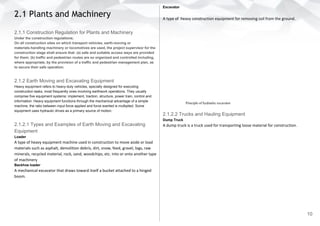
Excavator
A type of heavy construction equipment for removing soil from the ground.
Principle of hydraulic excavator
2.1.2.2 Trucks and Hauling Equipment
Dump Truck
A dump truck is a truck used for transporting loose material for construction.
10
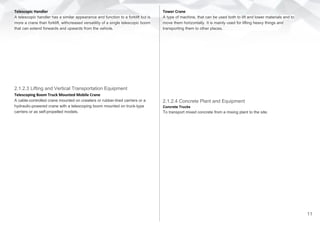
Telescopic Handler
A telescopic handler has a similar appearance and function to a forklift but is
more a crane than forklift, withcreased versatility of a single telescopic boom
that can extend forwards and upwards from the vehicle.
2.1.2.3 Lifting and Vertical Transportation Equipment
Telescoping Boom Truck Mounted Mobile Crane
A cable-controlled crane mounted on crawlers or rubber-tired carriers or a
hydraulic-powered crane with a telescoping boom mounted on truck-type
carriers or as self-propelled models.
Tower Crane
A type of machine, that can be used both to lift and lower materials and to
move them horizontally. It is mainly used for lifting heavy things and
transporting them to other places.
2.1.2.4 Concrete Plant and Equipment
Concrete Trucks
To transport mixed concrete from a mixing plant to the site.
11
2.1.2.6 Other Equipments
Tandem Vibratory Roller
Tandem vibratory rollers compact freshly placed asphalt mats to specific densities
using two, smooth steel drums that vibrate to consolidate the material.
Vibratory Plate Compators
Vibratory plate compactors are engine-powered, walk-behind machines that
impart powerful vibratory compaction effort to loose materials and asphalt via a
bottom-mounted steel plate that might vary in area from 1.5 to 3 square feet.
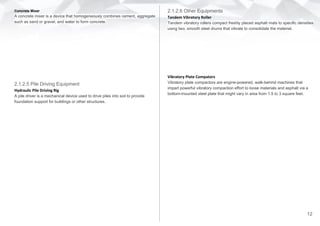
Concrete Mixer
A concrete mixer is a device that homogeneously combines cement, aggregate
such as sand or gravel, and water to form concrete.
2.1.2.5 Pile Driving Equipment
Hydraulic Pile Driving Rig
A pile driver is a mechanical device used to drive piles into soil to provide
foundation support for buildings or other structures.
12
PRELIMINARY WORKS
Dana Kan Jia Torng
0323648
13
3.1 Site Clearance
Site clearance is the compulsory procedure to remove any obstructing
elements such as vegetation found on site to prepare for excavation or
structure building. It involves:
-demolition and removal of existing buildings and structures;
-grubbing out of bushes and trees;
-removal of topsoil to reduce levels..
STEPS:
3.0 PRELIMINARY WORKS
3.0.1 Introduction
Preliminary works in a construction means all activities and preparation that has to be carried out before the main construction work commences in order for it
to go smoothly.
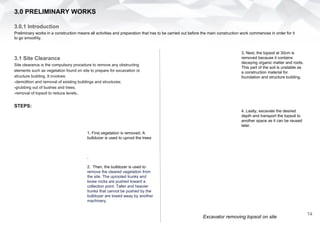
1. First,vegetation is removed. A
bulldozer is used to uproot the trees
.
2. Then, the bulldozer is used to
remove the cleared vegetation from
the site. The uprooted trunks and
loose rocks are pushed toward a
collection point. Taller and heavier
trunks that cannot be pushed by the
bulldozer are towed away by another
machinery.
Excavator removing topsoil on site
3. Next, the topsoil at 30cm is
removed because it contains
decaying organic matter and roots.
This part of the soil is unstable as
a construction material for
foundation and structure building.
4. Lastly, excavate the desired
depth and transport the topsoil to
another space as it can be reused
later.
14
3.0 PRELIMINARY WORKS
3.2 Site Investigation
15
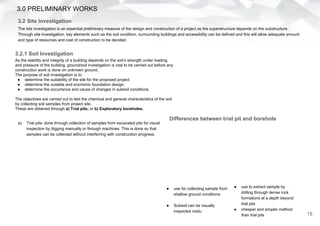
The site investigation is an essential preliminary measure of the design and construction of a project as the superstructure depends on the substructure .
Through site investigation, key elements such as the soil condition, surrounding buildings and accessibility can be defined and this will allow adequate amount
and type of resources and cost of construction to be decided.
3.2.1 Soil Investigation
As the stability and integrity of a building depends on the soil’s strength under loading
and pressure of the building, ground/soil investigation is vital to be carried out before any
construction work is done on unknown ground.
The purpose of soil investigation is to:
● determine the suitability of the site for the proposed project
● determine the suitable and economic foundation design.
● determine the occurrence and cause of changes in subsoil conditions.
The objectives are carried out to test the chemical and general characteristics of the soil
by collecting soil samples from project site.
These are obtained through a) Trial pits; or b) Exploratory boreholes.
a) Trial pits- done through collection of samples from excavated pits for visual
inspection by digging manually or through machines. This is done so that
samples can be collected without interferring with construction progress.
● use for collecting sample from
shallow ground conditions
● Subsoil can be visually
inspected insitu
● use to extract sample by
drilling through dense rock
formations at a depth beyond
trial pits
● cheaper and simpler method
than trial pits
Differences between trial pit and borehole
3.3 Setting Out
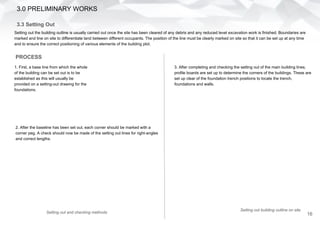
Setting out the building outline is usually carried out once the site has been cleared of any debris and any reduced level excavation work is finished. Boundaries are
marked and line on site to differentiate land between different occupants. The position of the line must be clearly marked on site so that it can be set up at any time
and to ensure the correct positioning of various elements of the building plot.
PROCESS
1. First, a base line from which the whole
of the building can be set out is to be
established as this will usually be
provided on a setting-out drawing for the
foundations.
2. After the baseline has been set out, each corner should be marked with a
corner peg. A check should now be made of the setting out lines for right-angles
and correct lengths.
Setting out and checking methods
3. After completing and checking the setting out of the main building lines,
profile boards are set up to determine the corners of the buildings. These are
set up clear of the foundation trench positions to locate the trench,
foundations and walls.
3.0 PRELIMINARY WORKS
Setting out building outline on site
16
3.0 PRELIMINARY WORKS
Site 1 (Single Bungalow Construction)
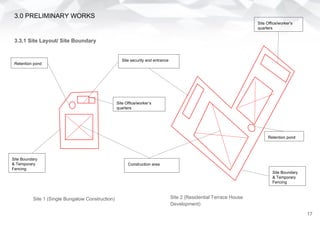
3.3.1 Site Layout/ Site Boundary
Site 2 (Residential Terrace House
Development)
Construction area
Site security and entrance
Site Office/worker’s
quarters
Site Office/worker’s
quarters
Retention pond
Retention pond
Site Boundary
& Temporary
Fencing
Site Boundary
& Temporary
Fencing
17
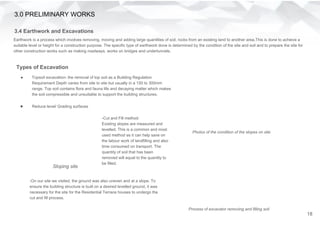
Earthwork is a process which involves removing, moving and adding large quantities of soil, rocks from an existing land to another area.This is done to achieve a
suitable level or height for a construction purpose. The specific type of earthwork done is determined by the condition of the site and soil and to prepare the site for
other construction works such as making roadways, works on bridges and undertunnels.
3.0 PRELIMINARY WORKS
3.4 Earthwork and Excavations
Types of Excavation
● Topsoil excavation- the removal of top soil as a Building Regulation
Requirement Depth varies from site to site but usually in a 150 to 300mm
range. Top soil contains flora and fauna life and decaying matter which makes
the soil compressible and unsuitable to support the building structures.
● Reduce level/ Grading surfaces
-Cut and Fill method:
Existing slopes are measured and
levelled. This is a common and most
used method as it can help save on
the labour work of landfilling and also
time consumed on transport. The
quantity of soil that has been
removed will equal to the quantity to
be filled.
-On our site we visited, the ground was also uneven and at a slope. To
ensure the building structure is built on a desired levelled ground, it was
necessary for the site for the Residential Terrace houses to undergo the
cut and fill process.
Sloping site
Photos of the condition of the slopes on site
Process of excavator removing and filling soil
18
3.0 PRELIMINARY WORKS
● Trench Excavations- narrow excavations primarily for strip
foundations and buried services.
- The sides and top of the excavations
needs to be stable and be able to support
to:
- protect the workers while
working in the excavation;
- keep the excavation open by
acting as a retaining wall to the
sides of the trench;
- prevent any hazard falling into
the excavation.
Trench Excavation found on site Excavation work carried out by machine.
- Before a foundation can be laid, it is necessary to excavate a trench of required depth and width. It is a
type of temporary earthwork support and the type and amount needed depends on the type of soil, depth
and nature of subsoil, depth of excavation, weather condition and duration.
- The centre rod moves up and down the excavation checking depth; the two side rails are placed in the
ground next to the excavation.
OBJECTIVE
Figures below shows details of the excavation.
19
3.0 PRELIMINARY WORKS
3.5 Site Preparation
TEMPORARY INFRASTRUCTURES
Temporary infrastructures erected at the site
before construction works commence. These
are preparations done to ensure the safety of
the public, construction workers and to ensure
materials are not damaged.
Proper signage is set outside the hoarding to
inform the public and limit passage into the
construction site.
INFORMATION SITE BOARD
HOARDING/ FENCING
Temporary fencing erected around perimeter of
construction site to prevent unauthorised access and
to shield the construction site from public view to
cause less disturbance.
Open storage area for materials that are heavy
and bulky and more weather resistant. Less
durable and more expensive materials are kept in
the storage cabin. The method of stacking and
bundling up is used also to lessen damage and to
ready for easy use as it is neatly stacked and does
not cause any obstruction in the construction site.
MATERIAL STORAGE
SCAFFOLDING
WASTAGE DISPOSAL
A large container is placed outside the
construction site to collect waste and
construction debris produced on site to be later
disposed off. This is also to ensure the
cleanliness of the site is maintained.
Temporary structure
made of wooden
planks and metal
used for ease of
access upwards
during construction of
the building.
20
TEMPORARY SERVICES
3.0 PRELIMINARY WORKS
SITE OFFICE
Site office to accommodate site managers to hold meetings and to store
construction site documentations. The working space has to be fairly accessible
and practical, and has neccessary working furnishings.
Temporary shelter for construction workers to rest and stay on site during construction phase.
Basic needs provided for the workers include bedroom, kitchen, storage facilities and toilet.
These shelters need to fulfill criterias such as being weatherproof, fire-proof, located at a safe
distance away from construction work and good ventilation and insulation purposes.
Site toilet for contractors and
worker’s use. Aesthetic purposes
are not the focus as they are only
temporary. Temporary water
supply is also provided for
funtional and hygenic purposes.
WORKER’S QUARTERS
TEMPORARY TOILET
ELECTRICAL SUPPLY
For constant and ready
supply of electrical energy
to power many construction
machineries operations to
enhance work efficiency
and reduce workload..
21
FOUNDATION
Darren Tan Yong Tee
0323398
22
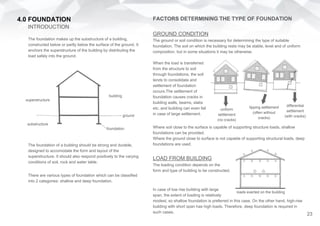
FACTORS DETERMINING THE TYPE OF FOUNDATION
GROUND CONDITION
The ground or soil condition is necessary for determining the type of suitable
foundation. The soil on which the building rests may be stable, level and of uniform
composition, but in some situations it may be otherwise.
When the load is transferred
from the structure to soil
through foundations, the soil
tends to consolidate and
settlement of foundation
occurs.The settlement of
foundation causes cracks in
building walls, beams, slabs
etc. and building can even fail
in case of large settlement.
Where soil close to the surface is capable of supporting structure loads, shallow
foundations can be provided.
Where the ground close to surface is not capable of supporting structural loads, deep
foundations are used.
LOAD FROM BUILDING
The loading condition depends on the
form and type of building to be constructed.
In case of low rise building with large
span, the extent of loading is relatively
modest, so shallow foundation is preferred in this case. On the other hand, high-rise
building with short span has high loads. Therefore, deep foundation is required in
such cases.
The foundation makes up the substructure of a building,
constructed below or partly below the surface of the ground. It
anchors the superstructure of the building by distributing the
load safely into the ground.
The foundation of a building should be strong and durable,
designed to accomodate the form and layout of the
superstructure. It should also respond positively to the varying
conditions of soil, rock and water table.
There are various types of foundation which can be classified
into 2 categories: shallow and deep foundation.
INTRODUCTION
23
4.0 FOUNDATION
uniform
settlement
(no cracks)
tipping settlement
(often without
cracks)
differential
settlement
(with cracks)
loads exerted on the building
superstructure
substructure
foundation
ground
building
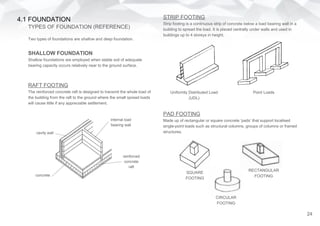
4.1 FOUNDATION STRIP FOOTING
Strip footing is a continuous strip of concrete below a load bearing wall in a
building to spread the load. It is placed centrally under walls and used in
buildings up to 4 storeys in height.
PAD FOOTING
Made up of rectangular or square concrete ‘pads’ that support localised
single-point loads such as structural columns, groups of columns or framed
structures.
Two types of foundations are shallow and deep foundation.
SHALLOW FOUNDATION
Shallow foundations are employed when stable soil of adequate
bearing capacity occurs relatively near to the ground surface.
RAFT FOOTING
The reinforced concrete raft is designed to transmit the whole load of
the building from the raft to the ground where the small spread loads
will cause little if any appreciable settlement.
TYPES OF FOUNDATION (REFERENCE)
cavity wall
concrete
internal load
bearing wall
reinforced
concrete
raft
24
Uniformly Distributed Load
(UDL)
Point Loads
SQUARE
FOOTING
RECTANGULAR
FOOTING
CIRCULAR
FOOTING
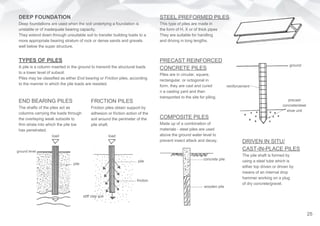
STEEL PREFORMED PILES
This type of piles are made in
the form of H, X or of thick pipes
They are suitable for handling
and driving in long lengths.
PRECAST REINFORCED
CONCRETE PILES
Piles are in circular, square,
rectangular, or octogonal in
form. they are cast and cured
n a casting yard and then
transported to the site for piling.
COMPOSITE PILES
Made up of a combination of
materials - steel piles are used
above the ground water level to
prevent insect attack and decay.
DEEP FOUNDATION
Deep foundations are used when the soil underlying a foundation is
unstable or of inadequate bearing capacity.
They extend down through unsuitable soil to transfer building loads to a
more appropriate bearing stratum of rock or dense sands and gravels
well below the super structure.
TYPES OF PILES
A pile is a column inserted in the ground to transmit the structural loads
to a lower level of subsoil.
Piles may be classified as either End bearing or Friction piles, according
to the manner in which the pile loads are resisted.
END BEARING PILES
The shafts of the piles act as
columns carrying the loads through
the overlaying weak subsoils to
firm strata into which the pile toe
has penetrated.
FRICTION PILES
Friction piles obtain support by
adhesion or friction action of the
soil around the perimeter of the
pile shaft.
pile
ground level
load
stiff clay soil
pile
load
friction
25
precast
concrete/steel
shoe unit
reinforcement
ground
DRIVEN IN SITU/
CAST-IN-PLACE PILES
The pile shaft is formed by
using a steel tube which is
either top driven or driven by
means of an internal drop
hammer working on a plug
of dry concrete/gravel.
concrete pile
wooden pile
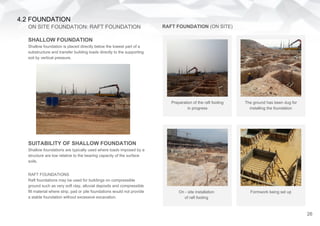
RAFT FOUNDATION (ON SITE)
SHALLOW FOUNDATION
Shallow foundation is placed directly below the lowest part of a
substructure and transfer building loads directly to the supporting
soil by vertical pressure.
SUITABILITY OF SHALLOW FOUNDATION
Shallow foundations are typically used where loads imposed by a
structure are low relative to the bearing capacity of the surface
soils.
RAFT FOUNDATIONS
Raft foundations may be used for buildings on compressible
ground such as very soft clay, alluvial deposits and compressible
fill material where strip, pad or pile foundations would not provide
a stable foundation without excessive excavation.
ON SITE FOUNDATION: RAFT FOUNDATION
On - site installation
of raft footing
Preparation of the raft footing
in progress
Formwork being set up
The ground has been dug for
installing the foundation
26
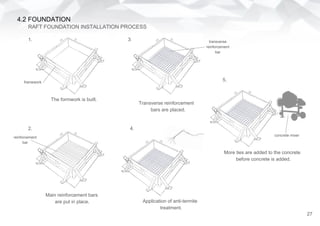
4.2 FOUNDATION
5.
More ties are added to the concrete
before concrete is added.
1.
The formwork is built.
2. 4.
Main reinforcement bars
are put in place.
RAFT FOUNDATION INSTALLATION PROCESS
27
4.2 FOUNDATION
3.
Transverse reinforcement
bars are placed.
Application of anti-termite
treatment.
framework
reinforcement
bar
concrete mixer
transverse
reinforcement
bar
BEAMS AND COLUMNS
Cryslyn Tan Zhia Lyn
0324249
28
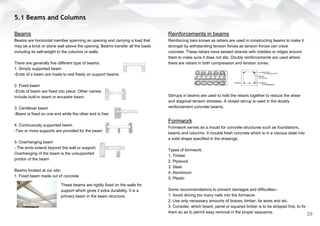
5.1 Beams and Columns
Beams
Beams are horizontal member spanning an opening and carrying a load that
may be a brick or stone wall above the opening. Beams transfer all the loads
including its self-weight to the columns or walls.
There are generally five different type of beams:
1. Simply supported beam
-Ends of a beam are made to rest freely on support beams
2. Fixed beam
-Ends of beam are fixed into place. Other names
include built-in beam or encastre beam.
3. Cantilever beam
-Beam is fixed on one end while the other end is free
4. Continuously supported beam
-Two or more supports are provided for the beam
5. Overhanging beam
- The ends extend beyond the wall or support.
Overhanging of the beam is the unsupported
portion of the beam
Beams located at our site:
1. Fixed beam made out of concrete
Reinforcements in beams
Reinforcing bars knows as rebars are used in constructing beams to make it
stronger by withstanding tension forces as tension forces can crack
concrete. These rebars have twisted strands with nobbles or ridges around
them to make sure it does not slip. Doubly reinforcements are used where
there are rebars in both compression and tension zones.
Stirrups in beams are used to hold the rebars together to reduce the shear
and diagonal tension stresses. A closed stirrup is used in the doubly
reinforcement concrete beams.
Formwork
Formwork serves as a mould for concrete structures such as foundations,
beams and columns. It moulds fresh concrete which is in a viscous state into
a solid shape specified in the drawings.
Types of formwork:
1. Timber
2. Plywood
3. Steel
4. Aluminium
5. Plastic
Some recommendations to prevent damages and difficulties:-
1. Avoid driving too many nails into the formwork
2. Use only necessary amounts of braces, timber, tie wires and etc.
3. Consider, which board, panel or squared timber is to be stripped first, to fix
them so as to permit easy removal in the proper sequence.
These beams are rigidly fixed on the walls for
support which gives it extra durability. It is a
primary beam in the beam structure.
29
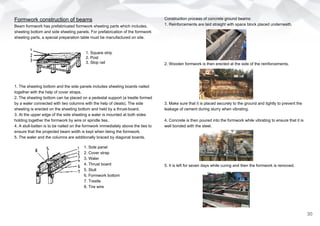
Formwork construction of beams
Beam formwork has prefabricated formwork sheeting parts which includes,
sheeting bottom and side sheeting panels. For prefabrication of the formwork
sheeting parts, a special preparation table must be manufactured on site.
1. The sheeting bottom and the side panels includes sheeting boards nailed
together with the help of cover straps.
2. The sheeting bottom can be placed on a pedestal support (a trestle formed
by a waler connected with two columns with the help of cleats). The side
sheeting is erected on the sheeting bottom and held by a thrust-board.
3. At the upper edge of the side sheeting a waler is mounted at both sides
holding together the formwork by wire or spindle ties.
4. A stull-batten is to be nailed on the formwork immediately above the ties to
ensure that the projected beam width is kept when tieing the formwork.
5. The waler and the columns are additionally braced by diagonal boards.
Construction process of concrete ground beams:
1. Reinforcements are laid straight with space block placed underneath.
2. Wooden formwork is then erected at the side of the reinforcements.
3. Make sure that it is placed securely to the ground and tightly to prevent the
leakage of cement during slurry when vibrating.
4. Concrete is then poured into the formwork while vibrating to ensure that it is
well bonded with the steel.
5. It is left for seven days while curing and then the formwork is removed.
1. Square strip
2. Post
3. Stop rail
1. Side panel
2. Cover strap
3. Waler
4. Thrust board
5. Stull
6. Formwork bottom
7. Trestle
8. Tire wire
30
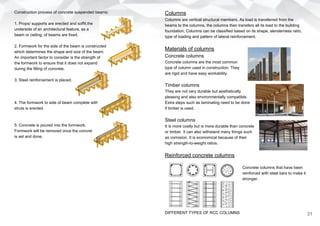
Construction process of concrete suspended beams:
1. Props/ supports are erected and soffit,the
underside of an architectural feature, as a
beam or ceiling, of beams are fixed.
2. Formwork for the side of the beam is constructed
which determines the shape and size of the beam.
An important factor to consider is the strength of
the formwork to ensure that it does not expand
during the filling of concrete.
3. Steel reinforcement is placed.
4. The formwork to side of beam complete with
struts is erected.
5. Concrete is poured into the formwork.
Formwork will be removed once the concrete
is set and done.
Columns
Columns are vertical structural members. As load is transferred from the
beams to the columns, the columns then transfers all its load to the building
foundation. Columns can be classified based on its shape, slenderness ratio,
type of loading and pattern of lateral reinforcement.
Materials of columns
Concrete columns
Concrete columns are the most common
type of column used in construction. They
are rigid and have easy workability.
Timber columns
They are not very durable but aesthetically
pleasing and also environmentally compatible.
Extra steps such as laminating need to be done
if timber is used.
Steel columns
It is more costly but is more durable than concrete
or timber. It can also withstand many things such
as corrosion. It is economical because of their
high strength-to-weight ratios.
Reinforced concrete columns
Concrete columns that have been
reinforced with steel bars to make it
stronger.
DIFFERENT TYPES OF RCC COLUMNS 31
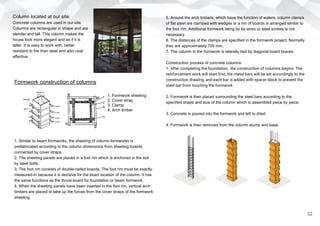
Formwork construction of columns
1. Similar to beam formworks, the sheeting of column formworks is
prefabricated according to the column dimensions from sheeting boards
connected by cover straps.
2. The sheeting panels are placed in a foot rim which is anchored in the soil
by steel bolts.
3. The foot rim consists of double-nailed boards. The foot rim must be exactly
measured-in because it is decisive for the exact location of the column. It has
the same functions as the thrust-board for foundation or beam formwork.
4. When the sheeting panels have been inserted in the foot rim, vertical arch
timbers are placed to take up the forces from the cover straps of the formwork
sheeting.
5. Around the arch timbers, which have the function of walers, column clamps
of flat steel are clamped with wedges or a rim of boards is arranged similar to
the foot rim. Additional formwork tieing by tie wires or steel screws is not
necessary.
6. The distances of the clamps are specified in the formwork project. Normally
they are approximately 700 mm.
7. The column in the formwork is laterally tied by diagonal board braces.
Construction process of concrete columns:
1. After completing the foundation, the construction of columns begins. The
reinforcement work will start first, the metal bars will be set accordingly to the
construction drawing, and each bar is added with spacer block to prevent the
steel bar from touching the formwork
2. Formwork is then placed surrounding the steel bars according to the
specified shape and size of the column which is assembled piece by peice.
3. Concrete is poured into the formwork and left to dried
4. Formwork is then removed from the column stump and base.
1. Formwork sheeting
2. Cover strap
3. Clamp
4. Arch timber
32
Column located at our site:
Concrete columns are used in our site.
Columns are rectangular in shape and are
slender and tall. This column makes the
house look more elegant and as if it is
taller. It is easy to work with, better
resistant to fire than steel and also coat
effective.
SLAB
Seow Koji Takehira
0320816
33
5.2.2 (a) Concrete Slab
Concrete is a material which is strong is compression but weak in tension. As
shown in diagram 5.2.a, it is a slab with only concrete itself, and if the member
is overloaded its tensile resistance may be put to a stress which cause
structural failure
Thus, concrete slabs are normally incoorperated with reinforcement such as
steel bars which are to provide additional tensile strength for durability.
Reinforcement
A rebar, or reinforcing bar is a common steel bar, and is commonly used in
reinforced concrete and reinforced masonry structures.
It is usually formed with carbon steel, they are produced by hot rolling process
with subsequent superficial hardening by heat treatment. It is the best material
to use as reinforcement because the coefficients of expansion of steel and the
concrete are considered almost the same.
5.2 Slabs
5.2.1 Introduction
A slab is a common structural element of modern buildings which are often
used to construct floors and ceilings, while thinner slabs can be used as
exterior paving. These slabs are supported by foundations or directly on the
subsoil, is used to construct the ground floor of a building. There are
different types of slabs where each have its own characteristics and
differences.
The purpose of slabs is to:
- Strength to support dead and live loads
- Maintaining its elasticity
- Resist fire
- Sound Insulation
- Thermal Insulation
- Durability
- Damp and Ground Gas Resistance
5.2.2 Type of Slabs
Composite Decking Concrete Slabs
Precast Concrete Wood Subflooring Different size of gaps and opening
has different kinds of usage. 34
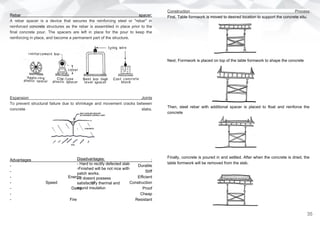
Rebar spacer:
A rebar spacer is a device that secures the reinforcing steel or "rebar" in
reinforced concrete structures as the rebar is assembled in place prior to the
final concrete pour. The spacers are left in place for the pour to keep the
reinforcing in place, and become a permanent part of the structure.
Expansion Joints
To prevent structural failure due to shrinkage and movement cracks between
concrete slabs.
Advantages :
- Durable
- Stiff
- Energy Efficient
- Speed of Construction
- Damp Proof
- Cheap
- Fire Resistant
Disadvantages:
- Hard to rectify defected slab
-Finished will be not nice with
patch works.
- It doesnt possess
satisfactory thermal and
sound insulation
Construction Process
First, Table formwork is moved to desired location to support the concrete situ.
Next, Formwork is placed on top of the table formwork to shape the concrete
Then, steel rebar with additional spacer is placed to float and reinforce the
concrete
Finally, concrete is poured in and settled. After when the concrete is dried, the
table formwork will be removed from the slab.
35
5.2.2 (b) Composite Decking
The deck act as part of a structural system with steel beams. The deck is
placed on top of the steel beam and steel ‘shear studs’ are welded through the
deck and onto the top of flange of the beam. Then, perforations to bond the
deck with the concrete.After the concrete is placed and cured, it will hold the
studs and act compositely with the steel beam and greatly increase the load
carrying capacity.
Advantages:
- Light weight and strong
- Precise and predictable
- Fast Assembly
- Long span and height
Construction Process
First, steel deck is placed on top of the steel
beam
Then, steel rebar with rebar spacer is placed
for additional reinforcement
Finally, concrete is poured in and the steel
deck itself act as a permanent formwork
Disadvantages:
- Expensive
- Lose Strength in Fire
- Susceptible to corrosion
Open Web Steel Joist Framing
Precast concrete is a construction product produced by casting concrete in a
reusable mold or "form" which is then cured in a controlled environment,
transported to the construction site and lifted into place. In this case, it is used
as a underlay to pour concrete on top and act as a one way load distribution.
Advantages:
- Light Weight
- Alternative to Beams
- Span up to 40m
- Typical Spacing of Joist up to 12m
Construction Process
Similar to composite decking, it is supported by steel joist insteadof metal
decking and beams.
Disadvantages:
- Increased Floor Depth
- Difficult Fireproofing
36
5.2.2 (d) Wood Subflooring
Subflooring is the structural member that spans perpendiculary across the floor
joists. It serves as a base for the floor finishes, the subfloor can work in tandem
with joist to create a structural diaphragm to transfer lateral forces to shear
walls. Material commonly used are plywood and particle board, which can be
connected by glues, nails and screws.
Advantages:
- Light weight and strong
- Fast Construction time
Construction Process:
Concrete blocks are formed to shape and laid
under the wooden subloor first to receive
the dead and live loads.
Then, Wooden beam and joist are placed,
so the wooden decking can laid on top.
Disadvantages:
- Might deform over time
- Weak in Fire
- Susceptible to termites and
moist condition.
5.2.2 (c) Precast Concrete
Precast concrete is a construction product produced by casting concrete in a
reusable mold or "form" which is then cured in a controlled environment,
transported to the construction site and lifted into place. In this case, it is used
as a underlay to pour concrete on top and act as a one way load distribution.
Advantages:
- Easy to Manufacture
- Good Quality Control
- Rapid Speed of erection
- Controllable condition
Construction Process
First, the precasted ‘form’ of concrete slab is
arranged in sequence and organised.
then, reinforcement and rebar spacer are placed
on top for additional strength and tensile strength.
Structural concrete is poured in and cured, where
the precasted form of concrete slab act as a
permanent formwork with the structural concrete.
Disadvantages:
- Very heavy members
- Camber in beam and slabs
- Connection may be difficult
37
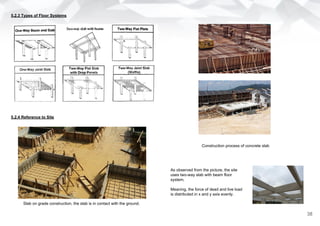
5.2.3 Types of Floor Systems
5.2.4 Reference to Site
Slab on grade construction, the slab is in contact with the ground.
Construction process of concrete slab
As observed from the picture, the site
uses two-way slab with beam floor
system.
Meaning, the force of dead and live load
is distributed in x and y axis evenly.
38
WALLS AND STAIRCASE
Chloe Teh Shu-Ern
0323708
39
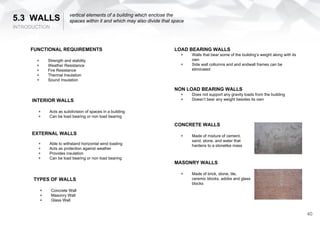
5.3 WALLS
INTRODUCTION
vertical elements of a building which enclose the
spaces within it and which may also divide that space
FUNCTIONAL REQUIREMENTS
+ Strength and stability
+ Weather Resistance
+ Fire Resistance
+ Thermal Insulation
+ Sound Insulation
INTERIOR WALLS
+ Acts as subdivision of spaces in a building
+ Can be load bearing or non load bearing
EXTERNAL WALLS
+ Able to withstand horizontal wind loading
+ Acts as protection against weather
+ Provides insulation
+ Can be load bearing or non load bearing
TYPES OF WALLS
+ Concrete Wall
+ Masonry Wall
+ Glass Wall
LOAD BEARING WALLS
+ Walls that bear some of the building’s weight along with its
own
+ Side wall collumns and and endwall frames can be
eliminated
NON LOAD BEARING WALLS
+ Does not support any gravity loads from the building
+ Doesn’t bear any weight besides its own
CONCRETE WALLS
+ Made of mixture of cement,
sand, stone, and water that
hardens to a stonelike mass
MASONRY WALLS
+ Made of brick, stone, tile,
ceremic blocks, adobe and glass
blocks
40
5.3 WALLS
TECHNIQUES
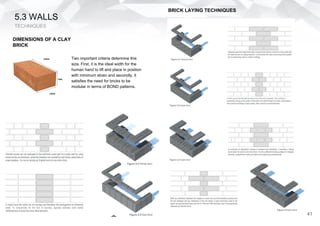
DIMENSIONS OF A CLAY
BRICK
Two important criteria determine this
size. First, it is the ideal width for the
human hand to lift and place in position
with minimum strain and secondly, it
satisfies the need for bricks to be
modular in terms of BOND patterns.
BRICK LAYING TECHNIQUES
41
5.3 WALLS
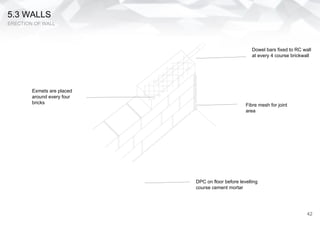
ERECTION OF WALL
Dowel bars fixed to RC wall
at every 4 course brickwall
Fibre mesh for joint
area
DPC on floor before levelling
course cement mortar
Exmets are placed
around every four
bricks
42
5.3 WALLS
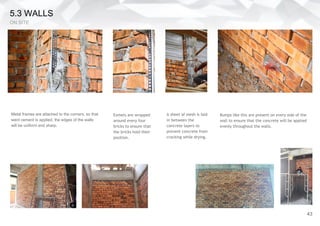
ON SITE
Metal frames are attached to the corners, so that
went cement is applied, the edges of the walls
will be uniform and sharp.
Exmets are wrapped
around every four
bricks to ensure that
the bricks hold their
position.
A sheet of mesh is laid
in between the
concrete layers to
prevent concrete from
cracking while drying.
Bumps like this are present on every side of the
wall to ensure that the concrete will be applied
evenly throughout the walls.
43
5.4 STAIRCASE
INTRODUCTION
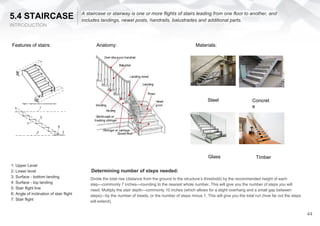
A staircase or stairway is one or more flights of stairs leading from one floor to another, and
includes landings, newel posts, handrails, balustrades and additional parts.
Features of stairs:
1: Upper Level
2: Lower level
3: Surface - bottom landing
4: Surface - top landing
5: Stair flight line
6: Angle of inclination of stair flight
7: Stair flight
Anatomy:
Determining number of steps needed:
Divide the total rise (distance from the ground to the structure’s threshold) by the recommended height of each
step—commonly 7 inches—rounding to the nearest whole number. This will give you the number of steps you will
need. Multiply the stair depth—commonly 10 inches (which allows for a slight overhang and a small gap between
steps)—by the number of treads, or the number of steps minus 1. This will give you the total run (how far out the steps
will extend).
Materials:
Steel Concret
e
Glass Timber
44
5.4 STAIRCASE
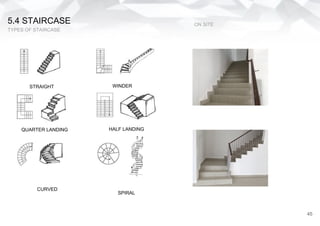
TYPES OF STAIRCASE
STRAIGHT
QUARTER LANDING
CURVED
WINDER
HALF LANDING
SPIRAL
ON SITE
45
STAIRCASE
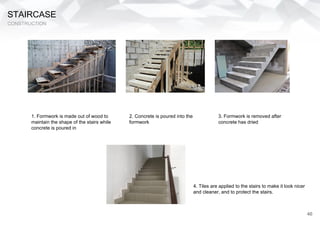
CONSTRUCTION
1. Formwork is made out of wood to
maintain the shape of the stairs while
concrete is poured in
2. Concrete is poured into the
formwork
3. Formwork is removed after
concrete has dried
4. Tiles are applied to the stairs to make it look nicer
and cleaner, and to protect the stairs.
46
DOORS AND WINDOWS
Lim Xiu Qing
0323214
47
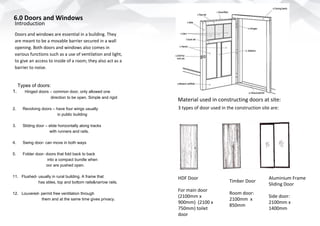
6.0 Doors and Windows
Material used in constructing doors at site:
3 types of door used in the construction site are:
Introduction
Doors and windows are essential in a building. They
are meant to be a movable barrier secured in a wall
opening. Both doors and windows also comes in
various functions such as a use of ventilation and light,
to give an access to inside of a room; they also act as a
barrier to noise.
HDF Door
For main door
(2100mm x
900mm) (2100 x
750mm) toilet
door
Timber Door
Room door:
2100mm x
850mm
Aluminium Frame
Sliding Door
Side door:
2100mm x
1400mm
Types of doors:
1. Hinged doors – common door, only allowed one
direction to be open. Simple and rigid
2. Revolving doors – have four wings usually
in public building
3. Sliding door – slide horizontally along tracks
with runners and rails.
4. Swing door- can move in both ways
5. Folder door- doors that fold back to back
into a compact bundle when
oor are pushed open.
11. Flushed- usually in rural building. A frame that
has stiles, top and bottom rails&narrow rails.
12. Louvered- permit free ventilation through
them and at the same time gives privacy.
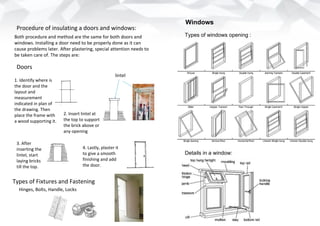
Procedure of insulating a doors and windows:
Both procedure and method are the same for both doors and
windows. Installing a door need to be properly done as it can
cause problems later. After plastering, special attention needs to
be taken care of. The steps are:
1. Identify where is
the door and the
layout and
measurement
indicated in plan of
the drawing. Then
place the frame with
a wood supporting it.
2. Insert lintel at
the top to support
the brick above or
any opening
3. After
inserting the
lintel, start
laying bricks
till the top.
4. Lastly, plaster it
to give a smooth
finishing and add
the door.
lintel
Types of Fixtures and Fastening
Hinges, Bolts, Handle, Locks
Doors
Windows
Types of windows opening :
Details in a window:
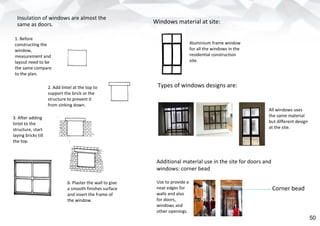
Windows material at site:
Aluminium frame window
for all the windows in the
residential construction
site.
Types of windows designs are:
All windows uses
the same material
but different design
at the site.
Additional material use in the site for doors and
windows: corner bead
Use to provide a
neat edges for
walls and also
for doors,
windows and
other openings.
Corner bead
1. Before
constructing the
window,
measurement and
layout need to be
the same compare
to the plan.
2. Add lintel at the top to
support the brick or the
structure to prevent it
from sinking down.
3. After adding
lintel to the
structure, start
laying bricks till
the top.
6. Plaster the wall to give
a smooth finishes surface
and insert the frame of
the window.
Insulation of windows are almost the
same as doors.
50
ROOF
Alison Tang Ing Ee
0323705
51
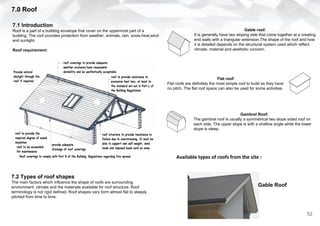
7.0 Roof
7.1 Introduction
Roof is a part of a building envelope that cover on the uppermost part of a
building. The roof provides protection from weather, animals, rain, snow,heat,wind
and sunlight.
Roof requirement:
Gable roof:
It is generally have two sloping side that come together at a creating
end walls with a triangular extension.The shape of the roof and how
it is detailed depends on the structural system used which reflect
climate, material and aesthetic concern.
Flat roof:
Flat roofs are definitely the most simple roof to build as they have
no pitch. The flat roof space can also be used for some activities.
Gambrel Roof:
The gambrel roof is usually a symmetrical two slope sided roof on
each side. The upper slope is with a shallow angle while the lower
slope is steep.
7.2 Types of roof shapes
The main factors which influence the shape of roofs are surrounding
environment, climate and the materials available for roof structure. Roof
terminology is not rigid defined. Roof shapes vary form almost flat to steeply
pitched from time to time.
Available types of roofs from the site :
Gable Roof
52
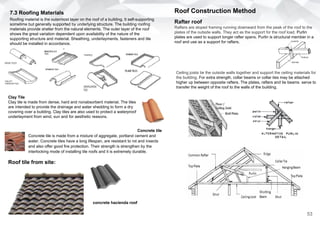
7.3 Roofing Materials
Roofing material is the outermost layer on the roof of a building. It self-supporting
sometime but generally supported by underlying structure. The building roofing
materials provide shelter from the natural elements. The outer layer of the roof
shows the great variation dependent upon availability of the nature of the
supporting structure and material. Sheathing, underlayments, fasteners and tile
should be installed in accordance.
Clay Tile
Clay tile is made from dense, hard and nonabsorbent material. The tiles
are intended to provide the drainage and water shedding to form a dry
covering over a building. Clay tiles are also used to protect a waterproof
underlayment from wind, sun and for aesthetic reasons.
Concrete tile
Concrete tile is made from a mixture of aggregate, portland cement and
water. Concrete tiles have a long lifespan, are resistant to rot and insects
and also offer good fire protection. Their strength is strengthen by the
interlocking mode of installing tile roofs and it is extremely durable.
Roof tile from site:
concrete hacienda roof
Roof Construction Method
Rafter roof
Rafters are sloped framing running downward from the peak of the roof to the
plates of the outside walls. They act as the support for the roof load. Purlin
plates are used to support longer rafter spans. Purlin is structural member in a
roof and use as a support for rafters.
Ceiling joists tie the outside walls together and support the ceiling materials for
the building. For extra strength, collar beams or collar ties may be attached
higher up between opposite rafters. The plates, rafters and tie beams serve to
transfer the weight of the roof to the walls of the building.
53
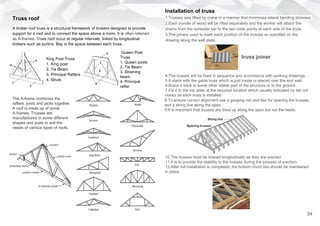
Truss roof
A timber roof truss is a structural framework of timbers designed to provide
support for a roof and to connect the space above a room. It is often referred
as A-frames. Truss roof occur at regular intervals, linked by longitudinal
timbers such as purlins. Bay is the space between each truss.
Queen Post
Truss
1. Queen posts
2. Tie Beam
3. Straining
beam
4. Principal
rafter
King Post Truss
1. King post
2. Tie Beam
3. Principal Rafters
4. Struts
The A-frame combines the
rafters, joists and jacks together.
A roof is made up of some
A-frames. Trusses are
manufactured in some different
shapes and sizes to suit the
needs of various types of roofs.
Installation of truss
1.Trusses was lifted by crane in a manner that minimises lateral bending stresses.
2.Each bundle of wood will be lifted separately and the worker will attach the
chains from the spreader bar to the two node points at each side of the truss.
3.The joiners used to mark each position of the trusses as specified on the
drawing along the wall plate.
truss joiner
4.The trusses will be fixed in sequence and accordance with working drawings.
5.It starts with the gable truss which is just inside or placed over the end wall.
6.Brace it back to some other stable part of the structure or to the ground.
7.Fix it to the top plate at the required location which usually indicated by set out
marks as each truss is installed.
8.To ensure correct alignment,use a gauging rod and ties for spacing the trusses,
and a string line along the apex.
9.It is important that trusses are lined up along the apex but not the heels.
10.The trusses must be braced longitudinally as they are erected.
11.It is to provide the stability to the trusses during the process of erection.
12.After full installation is completed, the bottom chord ties should be maintained
in place.
54
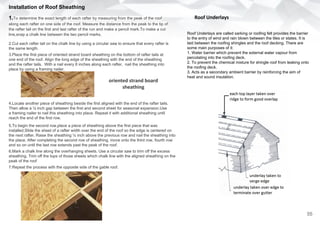
Installation of Roof Sheathing
1.To determine the exact length of each rafter by measuring from the peak of the roof
along each rafter on one side of the roof. Measure the distance from the peak to the tip of
the rafter tail on the first and last rafter of the run and make a pencil mark.To make a cut
line,snap a chalk line between the two pencil marks.
2.Cut each rafter tail on the chalk line by using a circular saw to ensure that every rafter is
the same length.
3.Place the first piece of oriented strand board sheathing on the bottom of rafter tails at
one end of the roof. Align the long edge of the sheathing with the end of the sheathing
and the rafter tails. With a nail every 6 inches along each rafter, nail the sheathing into
place by using a framing nailer.
oriented strand board
sheathing
5.To begin the second row,place a piece of sheathing above the first piece that was
installed.Slide the sheet of a rafter width over the end of the roof so the edge is centered on
the next rafter. Raise the sheathing ⅛ inch above the previous row and nail the sheathing into
the place. After completing the second row of sheathing, move onto the third row, fourth row
and so on until the last row extends past the peak of the roof.
6.Mark a chalk line along the overhanging sheets. Use a circular saw to trim off the excess
sheathing. Trim off the tops of those sheets which chalk line with the aligned sheathing on the
peak of the roof
7.Repeat the process with the opposite side of the gable roof.
4.Locate another piece of sheathing beside the first aligned with the end of the rafter tails.
Then allow a ⅛ inch gap between the first and second sheet for seasonal expansion.Use
a framing nailer to nail this sheathing into place. Repeat it with additional sheathing until
reach the end of the first row.
Roof Underlays
Roof Underlays are called sarking or roofing felt provides the barrier
to the entry of wind and rain blown between the tiles or states. It is
laid between the roofing shingles and the roof decking. There are
some main purposes of it:
1. Water barrier which prevent the external water vapour from
percolating into the roofing deck.
2. To prevent the chemical mixture for shingle roof from leaking onto
the roofing deck.
3. Acts as a secondary ambient barrier by reinforcing the aim of
heat and sound insulation.
55
56
8.0 Summary
In this project, we had learn the skills to analyse, compare and to refer
different elements of building construction in terms of its process,
method, materials, and the necessary tools.
This report includes the detail and the summary of the available building
construction method, which is widely used in the modern construction
industry.
This project enables us to have insight and build knowledge on how the
process of each and different construction phase can affect time, cost
and resources spent.
8.1 Reference
Site and Safety
Chudley, R., & Greeno, R. (2008). Building construction handbook. Oxford:
Butterworth-Heinemann.
Personal protective equipment (PPE). (n.d.). Retrieved September 22, 2016,
from http://www.hse.gov.uk/toolbox/ppe.htm
Traffic Management | Contractors Equipment | Greenham | Greenham Site.
(n.d.). Retrieved September 22, 2016, from
http://www.greenham.com/Contractors-Equipment/Traffic-Management~c~CA
Organising site welfare. (n.d.). Retrieved September 29, 2016, from
http://www.hse.gov.uk/construction/safetytopics/welfare.htm
Why is machinery safety important? (n.d.). Retrieved September 29, 2016,
from http://www.hse.gov.uk/toolbox/machinery/safety.htm
UNITED STATES DEPARTMENT OF LABOR. (n.d.). Retrieved October 6,
2016, from https://www.osha.gov/Publications/OSHA3252/3252.html
Tandem Vibratory Rollers. (n.d.). Retrieved October 6, 2016, from
http://www.constructionequipment.com/tandem-vibratory-rollers
Vibratory Plate Compactors. (n.d.). Retrieved October 13, 2016, from
http://www.constructionequipment.com/vibratory-plate-compactors
Health and Safety (Safety Signs and Signals Regulations) 1996. (n.d.).
Retrieved October 13, 2016, from
http://www.firesafe.org.uk/health-and-safety-safety-signs-and-signals-regulatio
ns-1996/
Preliminaries Work
Chudley, R., & Greeno, R. (2008). Building construction handbook (8th ed.).
Oxford: Butterworth-Heinemann.
Chudley, R., Greeno, R., Hurst, M., & Topliss, S. (2011). Construction
Technology(5th ed.). Edinburgh gate, Harlow: Pearson education limited.
Setting Out the Building Outline. (n.d.). Retrieved October 16, 2016, from
http://www.buildersengineer.info/2014/01/setting-out-building-outline.html
Setting Out Trenches. (n.d.). Retrieved October 16, 2016, from
http://www.buildersengineer.info/2014/01/setting-out-trenches.htm
Sheau Hui Tan Follow. (2015). Building Construction Report. Retrieved
October 16, 2016, from
http://www.slideshare.net/tansheauhui/building-construction-report-55776562
CalvinSuah Follow. (2015). Building Construction 1: Experiencing
Construction. Retrieved October 16, 2016, from
http://www.slideshare.net/CalvinSuah/building-construction-1-experiencing-con
struction
Designing Buildings Wiki The construction industry knowledge base. (n.d.).
Retrieved October 16, 2016, from
http://www.designingbuildings.co.uk/wiki/Hoarding_for_construction_sites
@. (2010). WORK PROCEDURE - EXCAVATION. Retrieved October 16,
2016, from
http://theconstructor.org/practical-guide/work-procedure-excavation/1632/
57
Foundation
Raft foundation. (n.d.). Retrieved October 7, 2016, from
http://civilconstructiontips.blogspot.my/2011/06/raft-foundation.html
FOUNDATION SELECTION CRITERIA FOR BUILDINGS. (2014). Retrieved
October 12, 2016, from
http://theconstructor.org/geotechnical/foundation-selection-criteria/6971/
FACTORS AFFECTING SELECTION OF FOUNDATION FOR BUILDINGS.
(2015). Retrieved October 15, 2016, from
http://theconstructor.org/geotechnical/factors-affecting-selection-of-foundation-f
or-buildings/10504/
Beam and Column
Ching, Francis D.K. Building Construction Illustrated. 5th ed. 2014. Print.
4. Types of Formwork. Retrieved October 17, 2016, from Ukrainian Library for
Schools, http://collections.infocollections.org/ukedu/en/d/Jgtz025be/4.html
Civil Engineering (Beams,Columns). (2011, June 2). Retrieved October 17,
2016, from Slideshare,
http://www.slideshare.net/mbrsalman/civil-engineering-beamscolumns
Slab
Chudley, R., & Greeno, R. (2008). Building construction handbook. Oxford:
Butterworth-Heinemann.
Chudley, R., & Greeno, R. (2004). Building construction handbook. Oxford:
Elsevier Butterworth-Heinemann.
Emmitt, S., Gorse, C. A., & Barry, R. (2006). Barry's advanced construction of
buildings. Oxford: Blackwell Pub.
Chudley, R., & Greeno, R. (1999). Construction technology. Harlow: Longman.
Grundy, J. T. (1977). Construction technology. London: Edward Arnold.
Guide for concrete floor and slab construction. (1997). Detroit, MI: American
Concrete Institute.
Padhi, S. (2013, April 1). CivilBlog.Org. Retrieved September 30, 2016, from
http://civilblog.org/
Mishra, G. (2011). COMPOSITE STEEL JOISTS. Retrieved October 10, 2016,
from http://theconstructor.org/structural-engg/composite-steel-joists/5895/
58
Staircase and Walls
http://www.popularmechanics.com/home/how-to-plans/how-to/a2145/4224738/
http://schools.ednet.ns.ca/avrsb/133/ritchiek/notes/Text/grade10/stairconstructi
on.htm
http://extremehowto.com/how-to-build-stairs/
http://civilblog.org/2015/09/28/10-different-types-of-stairs-commonly-designed-f
or-buildings/
http://www.understandconstruction.com/walls.html
https://www.thebalance.com/exterior-wall-materials-used-in-building-constructi
on-844846
http://www.nucorbuildingsystems.com/builder/engineeringtips/1.13.pdf
http://www.understandconstruction.com/walls.html
http://theconstructor.org/building/types-of-masonry-walls/10800/
Doors and Windows
Francis D.K. Ching, 2008, Building Construction Illustrated. Fouth
Edition.
Roofs
https://www.thisoldhouse.com/ideas/roof-shapes
https://www.carpentry-pro-framer.com/Roof-Framing.html
http://www.pole-barn.info/building-rafters.html
http://www.thisiscarpentry.com/2012/11/09/common-rafter-framing/
http://www.diynetwork.com/how-to/rooms-and-spaces/exterior/all-about-roofs-p
itches-trusses-and-framing
http://www.pryda.com.au/architects-builders-designers-engineers/product-infor
mation/roof-trusses/
http://www.probuilder.com/5-steps-proper-roof-sheathing-installation
http://homeguides.sfgate.com/install-roof-sheathing-50736.html
Simmon,H.Leslie,2001. Construction: Principles,Materials and Method. 7th
Edition. New York. John Wiley&Sons.
59

BUILDING CONSTRUCTION PROJECT 1

  • 1.
    School of Architecture,Building and Design Bachelor of Science(Hons) in Architecture Building Construction I (BLD60303) Project 1: Experiencing Construction SEOW KOJI TAKEHIRA 0320816 ALISON TANG ING EE 0323705 CHLOE TEH SHU-ERN 0324101 CRYSLYN TAN ZHIA LYN 0324249 DANA KAN JIA TORNG 0323648 DANICA GAN JIA-EN 0323708 DARREN TAN YONG TEE 0323398 LIM XIU QING 0323214
  • 2.
    No. Section TaskDone by: Page No. 1.0 1.1 2.0 2.1 3.0 3.1 4.0 4.1 4.2 5.0 5.1 5.2 5.3 6.0 7.0 7.1 7.2 8.0 8.1 Introduction to Group Member and Detail Introduction to Site Site and Safety Plants and Machinery Preliminaries Work Site Layout, Setting out and Earth Work etc. Foundation Foundation type and construction process (from reference) Foundation type and construction process (from site visit) Superstructure (from site visit and reference) Beam and Column Slab Wall & Staircase Doors and Windows Roof Roof type and construction process (from site visit) Roof type and construction process (from reference) Summary Reference Danica Gan Jia-En Dana Kan Jia Torng Darren Tan Yong Tee Cryslyn Tan Zhia Lyn Seow Koji Takehira Chloe Teh Shu-En Lim Xiu Qing Alison Tang Ing Ee 3 4 - 12 13 - 21 22 - 27 28 - 32 33 - 38 39 - 46 47 - 50 51 - 55 56 57 Table of Content
  • 3.
    1.0 Introduction This isa group project,where our task is to decide an ongoing construction site which includes what we had learned in the syllabus. We had selected a site, which is located in Bangi south view city, under project name as Avens . This site is considered to be built with medium to low rise buildings, which are one of the projects by Mah Sing Group. We were required identify different type of building elements and its construction process, details and materials. In addition, we were to study and record construction of different building elements as detailed as possible. Our group consists of 8 members where each of them are responsible for different construction process and its elements. Group Members: Seow Koji Takehira 0320816 Lim Xiu Qing 0323214 Cryslyn Tan Zhia Lyn 0324249 Chloe Teh Shu-Ern 0324101 Alison Tang Ing En 0323705 Danica Gan Jia-En 0323708 Darren Tan Yong Tee 0323398 Dana Kan Jia Torng 0323648 3 1.1 INTRODUCTION TO SITE In a building construction, the structure of the building is divided into two parts. The substructure and the super structure. Any part that transmit the load of the superstructure to the foundation soil is called sub-structure and the portion of the building which is above the substructure is called super structure. The weight of superstructure is affected by the foundation hence the foundation should be strong enough to sustain the load of the super structure. 1.1(a) Requirements of Foundation The foundation of substructure distributes the load of the building evenly on the soil in such a way according to the maximum allowable bearing capacity of soil. This is to strengthen the building against lateral forces caused due to natural disasters such as tornado, earthquakes and tsunami. It provides strong surface for the construction of proposed structure, and to provide safety to the structure, preventing it from collapsing. 1.1 (b) Aim of Super Structure The aim of providing super-structure is to provide support in the construction of building as designed by the Architect and the Engineer itself. Super-structure includes elements such columns, beams, stairs and walls. These are designed to provide strength for carrying the dead load and live load expected to come on different parts of the structure in a safe and well distributed manner. 1.1 (c) Aim of Site Inspection In every construction project, inspection of site are required to analyse: - Behaviour of soil near proposed wall and thickness of layers of soil deposits. - Changes in soil behaviour and in depth of water Table. - Direction of flow of water and its drainage - Movement in earth layer due to any reason if any.
  • 4.
    SITE AND SAFETY DanicaGan Jia-En 0323708 4
  • 5.
    2.0 Site andSafety 2.0.1 Introduction Nearly 6.5 million people work at approximately 252,000 construction sites across the nation everyday. The fatal injury rate for the construction industry is higher than any other industries.Potential hazards for workers in construction include: ■ Falls (from heights); ■ Scaffold collapse; ■ Electric shock ■ Failure to use proper personal protective equipment; and ■ Repetitive motion injuries. 2.0.2 Personal Protection Equipment (PPE) Eyes Hazards Chemical or metal splash, dust, projectiles, gas and vapour, radiation. Options Safety spectacles, goggles, face screens, faceshields, visors Note Make sure the eye protection chosen has the right combination for the task and fits the user properly. Head and Neck Hazards Impact from falling or flying objects, risk of head bumping, hair getting tangled in machinery, chemical drips or splash, climate or temperature. Options Industrial safety helmets, bump caps, hairnets and firefighters' helmets Note ● Replace head protection if it is damaged ● Don't forget neck protection, eg scarves for use during welding Ears Hazards Noise Options Earplugs, earmuffs, semi-insert/canal caps Note ● Provide the right hearing protectors for the type of work, and make sure workers know how to fit them ● Choose protectors that reduce noise to an acceptable level, while allowing for safety and communication Hands and Arms Hazards Abrasion, temperature extremes, cuts and punctures, impact, chemicals, electric shock, radiation, vibration, biological agents and prolonged immersion in water Options Gloves, gloves with a cuff, gauntlets and sleeving that covers part or all of the arm Note ● Avoid gloves when operating machines such as bench drills where the gloves might get caught ● Use gloves of suitable materials Feet and Legs Hazards Wet, hot and cold conditions, electrostatic build-up, slipping, cuts and punctures, falling objects, heavy loads, metal and chemical splash, vehicles Options Safety boots and shoes with protective toecaps and penetration-resistant, mid-sole wellington boots and specific footwear, eg foundry boots and chainsaw boots Note ● Footwear can have a variety of sole patterns and materials to help prevent slips in different conditions. 5
  • 6.
    Lungs Hazards ● Oxygen-deficient atmospheres,dusts, gases and vapours Options – respiratory protective equipment (RPE) ● Some respirators rely on filtering contaminants from workplace air. These include simple filtering facepieces and respirators and power-assisted respirators ● There are also types of breathing apparatus which give an independent supply of breathable air. Note ● The right type of respirator filter must be used as each is effective for only a limited range of substances ● Filters have only a limited life. Where there is a shortage of oxygen or any danger of losing consciousness due to exposure to high levels of harmful fumes, only use breathing apparatus – never use a filtering cartridge ● You will need to use breathing apparatus in a confined space or if there is a chance of an oxygen deficiency in the work area ● Make sure it fits properly. Whole Body Hazards Heat, chemical or metal splash, spray from pressure leaks or spray guns, contaminated dust, impact or penetration, excessive wear or entanglement of own clothing Options Conventional or disposable overalls, boiler suits, aprons, chemical suits Note ● The choice of materials includes flame-retardant, anti-static, chain mail, chemically impermeable, and high-visibility ● Don't forget other protection, like safety harnesses or life jackets 2.0.3 Site Security Hoarding A temporary board fence erected around a building site to prevent theft, vandalism, unauthorised entry, sound insulator and reduce dust Safety Signs and Symbols A board displaying warnings or reminders for workers and visitors of the hazards on site Warning Tapes Barricade tape is brightly colored tape (often incorporating a two-tone pattern of alternating yellow-black or red-white stripes or the words "Caution" or "Danger" in prominent lettering) that is used to warn or catch the attention of passersby of an area or situation containing a possible hazard. 6
  • 7.
    2.0.4 Site WelfareEquipments First Aid Kit A collection of supplies and equipment that is used to give medical treatment, and can be put together for the purpose by an individual or organization or purchased complete. Fire Extinguisher A portable device that discharges a jet of water, foam, gas, or other material to extinguish a fire Toilets Toilets should be suitable and sufficient, ventilated, lit and kept in a clean and orderly condition. Washing Facilities General washing facilities must be suitable and sufficient, kept clean and orderly and with basins or sinks large enough for people to wash their face, hands and forearms. The facilities should include: ● clean hot and cold, or warm, running water; ● soap or other suitable means of cleaning; ● towels or other suitable means of drying; and ● showers where the nature of work is particularly dirty or there is a need to decontaminate. Drinking Water Drinking water must be provided or made available at readily accessible and suitable places. Cups are required unless the supply is in a jet from which people can drink easily. Changing Rooms and Lockers Changing rooms are needed where workers have to wear special clothing for the purposes of their work and cannot be expected to change elsewhere. The rooms must be provided with seating, means of drying and keeping clothing and personal effects secure. Facilities for Rest Rest rooms or rest areas are required equipped with tables and seating (with backs) sufficient for the number of persons likely to use them at any one time. There should be arrangements for meals to be prepared and eaten, plus means for boiling water. 7
  • 8.
    2.0.5 Machinery Safety Hazards Movingmachinery can cause injuries in many ways: ● Sharp edges can cause cuts, stab or puncture the skin, and rough surface parts can cause friction or abrasion ● People can be crushed between moving parts of a machine like rollers, belts and pulley drives. They can also be crushed by the machine against a wall or some object. Two parts moving past one another can also cause shearing. ● Parts of the machine, materials and emissions (such as steam or water) can be hot or cold enough to cause burns or scalds and electricity can cause electrical shock and burns ● Injuries can also occur due to machinery becoming unreliable and developing faults or when machines are used improperly through inexperience or lack of training Do… ● check whether the machine is well maintained and fit to be used ● use the machine properly and in accordance with the manufacturer’s instructions ● make sure appropriate protective clothing and equipment required for that machine is worn Don’t… ● use a machine or appliance that has a danger sign or tag attached to it. ● wear dangling chains, loose clothing, rings or have loose, long hair that could get caught up in moving parts ● distract people who are using machines ● remove any safeguards 2.0.6 Elevated Work Areas Scaffolding Hazard When scaffolds are not erected or used properly, fall hazards can occur. Solutions ■ Scaffold must be sound, rigid and sufficient to carry its own weight plus four times the maximum intended load without settling or displacement. It must be erected on solid footing. ■ Unstable objects, such as barrels, boxes, loose bricks or concrete blocks must not be used to support scaffolds or planks. ■ Scaffold must not be erected, moved, dismantled or altered except under the supervision of a competent person. ■ Scaffold must be equipped with guardrails, midrails and toeboards. ■ Scaffold accessories such as braces, brackets, trusses, screw legs or ladders that are damaged or weakened from any cause must be immediately repaired or replaced. ■ Scaffold platforms must be tightly planked with scaffold plank grade material or equivalent. ■ A "competent person" must inspect the scaffolding and, at designated intervals, reinspect it. 8
  • 9.
    ■ Rigging onsuspension scaffolds must be inspected by a competent person before each shift and after any occurrence that could affect structural integrity to ensure that all connections are tight and that no damage to the rigging has occurred since its last use. ■ Synthetic and natural rope used in suspension scaffolding must be protected from heat-producing sources. ■ Employees must be instructed about the hazards of using diagonal braces as fall protection. ■ Scaffold can be accessed by using ladders and stairwells. ■ Scaffolds must be at least 10 feet from electric power lines at all times. Fall Protection Hazard A number of factors are often involved in falls, including unstable working surfaces, misuse or failure to use fall protection equipment and human error. Solutions ■ Use guardrails, fall arrest systems, safety nets, covers and restraint systems ■ Consider using aerial lifts or elevated platforms to provide safer elevated working surfaces; ■ Erect guardrail systems with toeboards and warning lines or install control line systems to protect workers near the edges of floors and roofs; ■ Cover floor holes; and/or ■ Use safety net systems or personal fall arrest systems (body harnesses). Ladders Hazard Ladders and stairways are another source of injuries and fatalities among construction workers. Solutions ■ Use the correct ladder for the task ■ Have a competent person visually inspect a ladder before use for any defects such as: ○ Structural damage, split/bent side rails, broken or missing rungs/steps/cleats and missing or damaged safety devices; ○ Grease, dirt or other contaminants that could cause slips or falls; ○ Paint or stickers (except warning labels) that could hide possible defects ■ Make sure that ladders are long enough to safely reach the work area. ■ Mark or tag damaged or defective ladders for repair or replacement, or destroy them immediately. ■ Never load ladders beyond the maximum intended load or beyond the manufacturer's rated capacity. ■ Be sure the load rating can support the weight of the user, including materials and tools. ■ Avoid using ladders with metallic components near electrical work and overhead power lines. Stairways Hazard Slips, trips and falls on stairways are a major source of injuries and fatalities among construction workers. Solutions ■ Stairway treads and walkways must be free of dangerous objects, debris and materials. ■ Slippery conditions on stairways and walkways must be corrected immediately. ■ Make sure that treads cover the entire step and landing. ■ Stairways having four or more risers or rising more than 30 inches must have at least one handrail. 9
  • 10.
    2.1 Plants andMachinery 2.1.1 Construction Regulation for Plants and Machinery Under the construction regulations; On all construction sites on which transport vehicles, earth-moving or materials-handling machinery or locomotives are used, the project supervisor for the construction stage shall ensure that: (a) safe and suitable access ways are provided for them; (b) traffic and pedestrian routes are so organized and controlled including, where appropriate, by the provision of a traffic and pedestrian management plan, as to secure their safe operation. 2.1.2 Earth Moving and Excavating Equipment Heavy equipment refers to heavy-duty vehicles, specially designed for executing construction tasks, most frequently ones involving earthwork operations. They usually comprise five equipment systems: implement, traction, structure, power train, control and information. Heavy equipment functions through the mechanical advantage of a simple machine, the ratio between input force applied and force exerted is multiplied. Some equipment uses hydraulic drives as a primary source of motion. 2.1.2.1 Types and Examples of Earth Moving and Excavating Equipment Loader A type of heavy equipment machine used in construction to move aside or load materials such as asphalt, demolition debris, dirt, snow, feed, gravel, logs, raw minerals, recycled material, rock, sand, woodchips, etc. into or onto another type of machinery Backhoe loader A mechanical excavator that draws toward itself a bucket attached to a hinged boom. Excavator A type of heavy construction equipment for removing soil from the ground. Principle of hydraulic excavator 2.1.2.2 Trucks and Hauling Equipment Dump Truck A dump truck is a truck used for transporting loose material for construction. 10
  • 11.
    Telescopic Handler A telescopichandler has a similar appearance and function to a forklift but is more a crane than forklift, withcreased versatility of a single telescopic boom that can extend forwards and upwards from the vehicle. 2.1.2.3 Lifting and Vertical Transportation Equipment Telescoping Boom Truck Mounted Mobile Crane A cable-controlled crane mounted on crawlers or rubber-tired carriers or a hydraulic-powered crane with a telescoping boom mounted on truck-type carriers or as self-propelled models. Tower Crane A type of machine, that can be used both to lift and lower materials and to move them horizontally. It is mainly used for lifting heavy things and transporting them to other places. 2.1.2.4 Concrete Plant and Equipment Concrete Trucks To transport mixed concrete from a mixing plant to the site. 11
  • 12.
    2.1.2.6 Other Equipments TandemVibratory Roller Tandem vibratory rollers compact freshly placed asphalt mats to specific densities using two, smooth steel drums that vibrate to consolidate the material. Vibratory Plate Compators Vibratory plate compactors are engine-powered, walk-behind machines that impart powerful vibratory compaction effort to loose materials and asphalt via a bottom-mounted steel plate that might vary in area from 1.5 to 3 square feet. Concrete Mixer A concrete mixer is a device that homogeneously combines cement, aggregate such as sand or gravel, and water to form concrete. 2.1.2.5 Pile Driving Equipment Hydraulic Pile Driving Rig A pile driver is a mechanical device used to drive piles into soil to provide foundation support for buildings or other structures. 12
  • 13.
    PRELIMINARY WORKS Dana KanJia Torng 0323648 13
  • 14.
    3.1 Site Clearance Siteclearance is the compulsory procedure to remove any obstructing elements such as vegetation found on site to prepare for excavation or structure building. It involves: -demolition and removal of existing buildings and structures; -grubbing out of bushes and trees; -removal of topsoil to reduce levels.. STEPS: 3.0 PRELIMINARY WORKS 3.0.1 Introduction Preliminary works in a construction means all activities and preparation that has to be carried out before the main construction work commences in order for it to go smoothly. 1. First,vegetation is removed. A bulldozer is used to uproot the trees . 2. Then, the bulldozer is used to remove the cleared vegetation from the site. The uprooted trunks and loose rocks are pushed toward a collection point. Taller and heavier trunks that cannot be pushed by the bulldozer are towed away by another machinery. Excavator removing topsoil on site 3. Next, the topsoil at 30cm is removed because it contains decaying organic matter and roots. This part of the soil is unstable as a construction material for foundation and structure building. 4. Lastly, excavate the desired depth and transport the topsoil to another space as it can be reused later. 14
  • 15.
    3.0 PRELIMINARY WORKS 3.2Site Investigation 15 The site investigation is an essential preliminary measure of the design and construction of a project as the superstructure depends on the substructure . Through site investigation, key elements such as the soil condition, surrounding buildings and accessibility can be defined and this will allow adequate amount and type of resources and cost of construction to be decided. 3.2.1 Soil Investigation As the stability and integrity of a building depends on the soil’s strength under loading and pressure of the building, ground/soil investigation is vital to be carried out before any construction work is done on unknown ground. The purpose of soil investigation is to: ● determine the suitability of the site for the proposed project ● determine the suitable and economic foundation design. ● determine the occurrence and cause of changes in subsoil conditions. The objectives are carried out to test the chemical and general characteristics of the soil by collecting soil samples from project site. These are obtained through a) Trial pits; or b) Exploratory boreholes. a) Trial pits- done through collection of samples from excavated pits for visual inspection by digging manually or through machines. This is done so that samples can be collected without interferring with construction progress. ● use for collecting sample from shallow ground conditions ● Subsoil can be visually inspected insitu ● use to extract sample by drilling through dense rock formations at a depth beyond trial pits ● cheaper and simpler method than trial pits Differences between trial pit and borehole
  • 16.
    3.3 Setting Out Settingout the building outline is usually carried out once the site has been cleared of any debris and any reduced level excavation work is finished. Boundaries are marked and line on site to differentiate land between different occupants. The position of the line must be clearly marked on site so that it can be set up at any time and to ensure the correct positioning of various elements of the building plot. PROCESS 1. First, a base line from which the whole of the building can be set out is to be established as this will usually be provided on a setting-out drawing for the foundations. 2. After the baseline has been set out, each corner should be marked with a corner peg. A check should now be made of the setting out lines for right-angles and correct lengths. Setting out and checking methods 3. After completing and checking the setting out of the main building lines, profile boards are set up to determine the corners of the buildings. These are set up clear of the foundation trench positions to locate the trench, foundations and walls. 3.0 PRELIMINARY WORKS Setting out building outline on site 16
  • 17.
    3.0 PRELIMINARY WORKS Site1 (Single Bungalow Construction) 3.3.1 Site Layout/ Site Boundary Site 2 (Residential Terrace House Development) Construction area Site security and entrance Site Office/worker’s quarters Site Office/worker’s quarters Retention pond Retention pond Site Boundary & Temporary Fencing Site Boundary & Temporary Fencing 17
  • 18.
    Earthwork is aprocess which involves removing, moving and adding large quantities of soil, rocks from an existing land to another area.This is done to achieve a suitable level or height for a construction purpose. The specific type of earthwork done is determined by the condition of the site and soil and to prepare the site for other construction works such as making roadways, works on bridges and undertunnels. 3.0 PRELIMINARY WORKS 3.4 Earthwork and Excavations Types of Excavation ● Topsoil excavation- the removal of top soil as a Building Regulation Requirement Depth varies from site to site but usually in a 150 to 300mm range. Top soil contains flora and fauna life and decaying matter which makes the soil compressible and unsuitable to support the building structures. ● Reduce level/ Grading surfaces -Cut and Fill method: Existing slopes are measured and levelled. This is a common and most used method as it can help save on the labour work of landfilling and also time consumed on transport. The quantity of soil that has been removed will equal to the quantity to be filled. -On our site we visited, the ground was also uneven and at a slope. To ensure the building structure is built on a desired levelled ground, it was necessary for the site for the Residential Terrace houses to undergo the cut and fill process. Sloping site Photos of the condition of the slopes on site Process of excavator removing and filling soil 18
  • 19.
    3.0 PRELIMINARY WORKS ●Trench Excavations- narrow excavations primarily for strip foundations and buried services. - The sides and top of the excavations needs to be stable and be able to support to: - protect the workers while working in the excavation; - keep the excavation open by acting as a retaining wall to the sides of the trench; - prevent any hazard falling into the excavation. Trench Excavation found on site Excavation work carried out by machine. - Before a foundation can be laid, it is necessary to excavate a trench of required depth and width. It is a type of temporary earthwork support and the type and amount needed depends on the type of soil, depth and nature of subsoil, depth of excavation, weather condition and duration. - The centre rod moves up and down the excavation checking depth; the two side rails are placed in the ground next to the excavation. OBJECTIVE Figures below shows details of the excavation. 19
  • 20.
    3.0 PRELIMINARY WORKS 3.5Site Preparation TEMPORARY INFRASTRUCTURES Temporary infrastructures erected at the site before construction works commence. These are preparations done to ensure the safety of the public, construction workers and to ensure materials are not damaged. Proper signage is set outside the hoarding to inform the public and limit passage into the construction site. INFORMATION SITE BOARD HOARDING/ FENCING Temporary fencing erected around perimeter of construction site to prevent unauthorised access and to shield the construction site from public view to cause less disturbance. Open storage area for materials that are heavy and bulky and more weather resistant. Less durable and more expensive materials are kept in the storage cabin. The method of stacking and bundling up is used also to lessen damage and to ready for easy use as it is neatly stacked and does not cause any obstruction in the construction site. MATERIAL STORAGE SCAFFOLDING WASTAGE DISPOSAL A large container is placed outside the construction site to collect waste and construction debris produced on site to be later disposed off. This is also to ensure the cleanliness of the site is maintained. Temporary structure made of wooden planks and metal used for ease of access upwards during construction of the building. 20
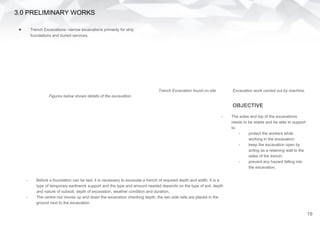
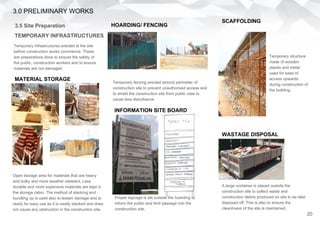
  • 21.
    TEMPORARY SERVICES 3.0 PRELIMINARYWORKS SITE OFFICE Site office to accommodate site managers to hold meetings and to store construction site documentations. The working space has to be fairly accessible and practical, and has neccessary working furnishings. Temporary shelter for construction workers to rest and stay on site during construction phase. Basic needs provided for the workers include bedroom, kitchen, storage facilities and toilet. These shelters need to fulfill criterias such as being weatherproof, fire-proof, located at a safe distance away from construction work and good ventilation and insulation purposes. Site toilet for contractors and worker’s use. Aesthetic purposes are not the focus as they are only temporary. Temporary water supply is also provided for funtional and hygenic purposes. WORKER’S QUARTERS TEMPORARY TOILET ELECTRICAL SUPPLY For constant and ready supply of electrical energy to power many construction machineries operations to enhance work efficiency and reduce workload.. 21
  • 22.
  • 23.
    FACTORS DETERMINING THETYPE OF FOUNDATION GROUND CONDITION The ground or soil condition is necessary for determining the type of suitable foundation. The soil on which the building rests may be stable, level and of uniform composition, but in some situations it may be otherwise. When the load is transferred from the structure to soil through foundations, the soil tends to consolidate and settlement of foundation occurs.The settlement of foundation causes cracks in building walls, beams, slabs etc. and building can even fail in case of large settlement. Where soil close to the surface is capable of supporting structure loads, shallow foundations can be provided. Where the ground close to surface is not capable of supporting structural loads, deep foundations are used. LOAD FROM BUILDING The loading condition depends on the form and type of building to be constructed. In case of low rise building with large span, the extent of loading is relatively modest, so shallow foundation is preferred in this case. On the other hand, high-rise building with short span has high loads. Therefore, deep foundation is required in such cases. The foundation makes up the substructure of a building, constructed below or partly below the surface of the ground. It anchors the superstructure of the building by distributing the load safely into the ground. The foundation of a building should be strong and durable, designed to accomodate the form and layout of the superstructure. It should also respond positively to the varying conditions of soil, rock and water table. There are various types of foundation which can be classified into 2 categories: shallow and deep foundation. INTRODUCTION 23 4.0 FOUNDATION uniform settlement (no cracks) tipping settlement (often without cracks) differential settlement (with cracks) loads exerted on the building superstructure substructure foundation ground building
  • 24.
    4.1 FOUNDATION STRIPFOOTING Strip footing is a continuous strip of concrete below a load bearing wall in a building to spread the load. It is placed centrally under walls and used in buildings up to 4 storeys in height. PAD FOOTING Made up of rectangular or square concrete ‘pads’ that support localised single-point loads such as structural columns, groups of columns or framed structures. Two types of foundations are shallow and deep foundation. SHALLOW FOUNDATION Shallow foundations are employed when stable soil of adequate bearing capacity occurs relatively near to the ground surface. RAFT FOOTING The reinforced concrete raft is designed to transmit the whole load of the building from the raft to the ground where the small spread loads will cause little if any appreciable settlement. TYPES OF FOUNDATION (REFERENCE) cavity wall concrete internal load bearing wall reinforced concrete raft 24 Uniformly Distributed Load (UDL) Point Loads SQUARE FOOTING RECTANGULAR FOOTING CIRCULAR FOOTING
  • 25.
    STEEL PREFORMED PILES Thistype of piles are made in the form of H, X or of thick pipes They are suitable for handling and driving in long lengths. PRECAST REINFORCED CONCRETE PILES Piles are in circular, square, rectangular, or octogonal in form. they are cast and cured n a casting yard and then transported to the site for piling. COMPOSITE PILES Made up of a combination of materials - steel piles are used above the ground water level to prevent insect attack and decay. DEEP FOUNDATION Deep foundations are used when the soil underlying a foundation is unstable or of inadequate bearing capacity. They extend down through unsuitable soil to transfer building loads to a more appropriate bearing stratum of rock or dense sands and gravels well below the super structure. TYPES OF PILES A pile is a column inserted in the ground to transmit the structural loads to a lower level of subsoil. Piles may be classified as either End bearing or Friction piles, according to the manner in which the pile loads are resisted. END BEARING PILES The shafts of the piles act as columns carrying the loads through the overlaying weak subsoils to firm strata into which the pile toe has penetrated. FRICTION PILES Friction piles obtain support by adhesion or friction action of the soil around the perimeter of the pile shaft. pile ground level load stiff clay soil pile load friction 25 precast concrete/steel shoe unit reinforcement ground DRIVEN IN SITU/ CAST-IN-PLACE PILES The pile shaft is formed by using a steel tube which is either top driven or driven by means of an internal drop hammer working on a plug of dry concrete/gravel. concrete pile wooden pile
  • 26.
    RAFT FOUNDATION (ONSITE) SHALLOW FOUNDATION Shallow foundation is placed directly below the lowest part of a substructure and transfer building loads directly to the supporting soil by vertical pressure. SUITABILITY OF SHALLOW FOUNDATION Shallow foundations are typically used where loads imposed by a structure are low relative to the bearing capacity of the surface soils. RAFT FOUNDATIONS Raft foundations may be used for buildings on compressible ground such as very soft clay, alluvial deposits and compressible fill material where strip, pad or pile foundations would not provide a stable foundation without excessive excavation. ON SITE FOUNDATION: RAFT FOUNDATION On - site installation of raft footing Preparation of the raft footing in progress Formwork being set up The ground has been dug for installing the foundation 26 4.2 FOUNDATION
  • 27.
    5. More ties areadded to the concrete before concrete is added. 1. The formwork is built. 2. 4. Main reinforcement bars are put in place. RAFT FOUNDATION INSTALLATION PROCESS 27 4.2 FOUNDATION 3. Transverse reinforcement bars are placed. Application of anti-termite treatment. framework reinforcement bar concrete mixer transverse reinforcement bar
  • 28.
    BEAMS AND COLUMNS CryslynTan Zhia Lyn 0324249 28
  • 29.
    5.1 Beams andColumns Beams Beams are horizontal member spanning an opening and carrying a load that may be a brick or stone wall above the opening. Beams transfer all the loads including its self-weight to the columns or walls. There are generally five different type of beams: 1. Simply supported beam -Ends of a beam are made to rest freely on support beams 2. Fixed beam -Ends of beam are fixed into place. Other names include built-in beam or encastre beam. 3. Cantilever beam -Beam is fixed on one end while the other end is free 4. Continuously supported beam -Two or more supports are provided for the beam 5. Overhanging beam - The ends extend beyond the wall or support. Overhanging of the beam is the unsupported portion of the beam Beams located at our site: 1. Fixed beam made out of concrete Reinforcements in beams Reinforcing bars knows as rebars are used in constructing beams to make it stronger by withstanding tension forces as tension forces can crack concrete. These rebars have twisted strands with nobbles or ridges around them to make sure it does not slip. Doubly reinforcements are used where there are rebars in both compression and tension zones. Stirrups in beams are used to hold the rebars together to reduce the shear and diagonal tension stresses. A closed stirrup is used in the doubly reinforcement concrete beams. Formwork Formwork serves as a mould for concrete structures such as foundations, beams and columns. It moulds fresh concrete which is in a viscous state into a solid shape specified in the drawings. Types of formwork: 1. Timber 2. Plywood 3. Steel 4. Aluminium 5. Plastic Some recommendations to prevent damages and difficulties:- 1. Avoid driving too many nails into the formwork 2. Use only necessary amounts of braces, timber, tie wires and etc. 3. Consider, which board, panel or squared timber is to be stripped first, to fix them so as to permit easy removal in the proper sequence. These beams are rigidly fixed on the walls for support which gives it extra durability. It is a primary beam in the beam structure. 29
  • 30.
    Formwork construction ofbeams Beam formwork has prefabricated formwork sheeting parts which includes, sheeting bottom and side sheeting panels. For prefabrication of the formwork sheeting parts, a special preparation table must be manufactured on site. 1. The sheeting bottom and the side panels includes sheeting boards nailed together with the help of cover straps. 2. The sheeting bottom can be placed on a pedestal support (a trestle formed by a waler connected with two columns with the help of cleats). The side sheeting is erected on the sheeting bottom and held by a thrust-board. 3. At the upper edge of the side sheeting a waler is mounted at both sides holding together the formwork by wire or spindle ties. 4. A stull-batten is to be nailed on the formwork immediately above the ties to ensure that the projected beam width is kept when tieing the formwork. 5. The waler and the columns are additionally braced by diagonal boards. Construction process of concrete ground beams: 1. Reinforcements are laid straight with space block placed underneath. 2. Wooden formwork is then erected at the side of the reinforcements. 3. Make sure that it is placed securely to the ground and tightly to prevent the leakage of cement during slurry when vibrating. 4. Concrete is then poured into the formwork while vibrating to ensure that it is well bonded with the steel. 5. It is left for seven days while curing and then the formwork is removed. 1. Square strip 2. Post 3. Stop rail 1. Side panel 2. Cover strap 3. Waler 4. Thrust board 5. Stull 6. Formwork bottom 7. Trestle 8. Tire wire 30
  • 31.
    Construction process ofconcrete suspended beams: 1. Props/ supports are erected and soffit,the underside of an architectural feature, as a beam or ceiling, of beams are fixed. 2. Formwork for the side of the beam is constructed which determines the shape and size of the beam. An important factor to consider is the strength of the formwork to ensure that it does not expand during the filling of concrete. 3. Steel reinforcement is placed. 4. The formwork to side of beam complete with struts is erected. 5. Concrete is poured into the formwork. Formwork will be removed once the concrete is set and done. Columns Columns are vertical structural members. As load is transferred from the beams to the columns, the columns then transfers all its load to the building foundation. Columns can be classified based on its shape, slenderness ratio, type of loading and pattern of lateral reinforcement. Materials of columns Concrete columns Concrete columns are the most common type of column used in construction. They are rigid and have easy workability. Timber columns They are not very durable but aesthetically pleasing and also environmentally compatible. Extra steps such as laminating need to be done if timber is used. Steel columns It is more costly but is more durable than concrete or timber. It can also withstand many things such as corrosion. It is economical because of their high strength-to-weight ratios. Reinforced concrete columns Concrete columns that have been reinforced with steel bars to make it stronger. DIFFERENT TYPES OF RCC COLUMNS 31
  • 32.
    Formwork construction ofcolumns 1. Similar to beam formworks, the sheeting of column formworks is prefabricated according to the column dimensions from sheeting boards connected by cover straps. 2. The sheeting panels are placed in a foot rim which is anchored in the soil by steel bolts. 3. The foot rim consists of double-nailed boards. The foot rim must be exactly measured-in because it is decisive for the exact location of the column. It has the same functions as the thrust-board for foundation or beam formwork. 4. When the sheeting panels have been inserted in the foot rim, vertical arch timbers are placed to take up the forces from the cover straps of the formwork sheeting. 5. Around the arch timbers, which have the function of walers, column clamps of flat steel are clamped with wedges or a rim of boards is arranged similar to the foot rim. Additional formwork tieing by tie wires or steel screws is not necessary. 6. The distances of the clamps are specified in the formwork project. Normally they are approximately 700 mm. 7. The column in the formwork is laterally tied by diagonal board braces. Construction process of concrete columns: 1. After completing the foundation, the construction of columns begins. The reinforcement work will start first, the metal bars will be set accordingly to the construction drawing, and each bar is added with spacer block to prevent the steel bar from touching the formwork 2. Formwork is then placed surrounding the steel bars according to the specified shape and size of the column which is assembled piece by peice. 3. Concrete is poured into the formwork and left to dried 4. Formwork is then removed from the column stump and base. 1. Formwork sheeting 2. Cover strap 3. Clamp 4. Arch timber 32 Column located at our site: Concrete columns are used in our site. Columns are rectangular in shape and are slender and tall. This column makes the house look more elegant and as if it is taller. It is easy to work with, better resistant to fire than steel and also coat effective.
  • 33.
  • 34.
    5.2.2 (a) ConcreteSlab Concrete is a material which is strong is compression but weak in tension. As shown in diagram 5.2.a, it is a slab with only concrete itself, and if the member is overloaded its tensile resistance may be put to a stress which cause structural failure Thus, concrete slabs are normally incoorperated with reinforcement such as steel bars which are to provide additional tensile strength for durability. Reinforcement A rebar, or reinforcing bar is a common steel bar, and is commonly used in reinforced concrete and reinforced masonry structures. It is usually formed with carbon steel, they are produced by hot rolling process with subsequent superficial hardening by heat treatment. It is the best material to use as reinforcement because the coefficients of expansion of steel and the concrete are considered almost the same. 5.2 Slabs 5.2.1 Introduction A slab is a common structural element of modern buildings which are often used to construct floors and ceilings, while thinner slabs can be used as exterior paving. These slabs are supported by foundations or directly on the subsoil, is used to construct the ground floor of a building. There are different types of slabs where each have its own characteristics and differences. The purpose of slabs is to: - Strength to support dead and live loads - Maintaining its elasticity - Resist fire - Sound Insulation - Thermal Insulation - Durability - Damp and Ground Gas Resistance 5.2.2 Type of Slabs Composite Decking Concrete Slabs Precast Concrete Wood Subflooring Different size of gaps and opening has different kinds of usage. 34
  • 35.
    Rebar spacer: A rebarspacer is a device that secures the reinforcing steel or "rebar" in reinforced concrete structures as the rebar is assembled in place prior to the final concrete pour. The spacers are left in place for the pour to keep the reinforcing in place, and become a permanent part of the structure. Expansion Joints To prevent structural failure due to shrinkage and movement cracks between concrete slabs. Advantages : - Durable - Stiff - Energy Efficient - Speed of Construction - Damp Proof - Cheap - Fire Resistant Disadvantages: - Hard to rectify defected slab -Finished will be not nice with patch works. - It doesnt possess satisfactory thermal and sound insulation Construction Process First, Table formwork is moved to desired location to support the concrete situ. Next, Formwork is placed on top of the table formwork to shape the concrete Then, steel rebar with additional spacer is placed to float and reinforce the concrete Finally, concrete is poured in and settled. After when the concrete is dried, the table formwork will be removed from the slab. 35
  • 36.
    5.2.2 (b) CompositeDecking The deck act as part of a structural system with steel beams. The deck is placed on top of the steel beam and steel ‘shear studs’ are welded through the deck and onto the top of flange of the beam. Then, perforations to bond the deck with the concrete.After the concrete is placed and cured, it will hold the studs and act compositely with the steel beam and greatly increase the load carrying capacity. Advantages: - Light weight and strong - Precise and predictable - Fast Assembly - Long span and height Construction Process First, steel deck is placed on top of the steel beam Then, steel rebar with rebar spacer is placed for additional reinforcement Finally, concrete is poured in and the steel deck itself act as a permanent formwork Disadvantages: - Expensive - Lose Strength in Fire - Susceptible to corrosion Open Web Steel Joist Framing Precast concrete is a construction product produced by casting concrete in a reusable mold or "form" which is then cured in a controlled environment, transported to the construction site and lifted into place. In this case, it is used as a underlay to pour concrete on top and act as a one way load distribution. Advantages: - Light Weight - Alternative to Beams - Span up to 40m - Typical Spacing of Joist up to 12m Construction Process Similar to composite decking, it is supported by steel joist insteadof metal decking and beams. Disadvantages: - Increased Floor Depth - Difficult Fireproofing 36
  • 37.
    5.2.2 (d) WoodSubflooring Subflooring is the structural member that spans perpendiculary across the floor joists. It serves as a base for the floor finishes, the subfloor can work in tandem with joist to create a structural diaphragm to transfer lateral forces to shear walls. Material commonly used are plywood and particle board, which can be connected by glues, nails and screws. Advantages: - Light weight and strong - Fast Construction time Construction Process: Concrete blocks are formed to shape and laid under the wooden subloor first to receive the dead and live loads. Then, Wooden beam and joist are placed, so the wooden decking can laid on top. Disadvantages: - Might deform over time - Weak in Fire - Susceptible to termites and moist condition. 5.2.2 (c) Precast Concrete Precast concrete is a construction product produced by casting concrete in a reusable mold or "form" which is then cured in a controlled environment, transported to the construction site and lifted into place. In this case, it is used as a underlay to pour concrete on top and act as a one way load distribution. Advantages: - Easy to Manufacture - Good Quality Control - Rapid Speed of erection - Controllable condition Construction Process First, the precasted ‘form’ of concrete slab is arranged in sequence and organised. then, reinforcement and rebar spacer are placed on top for additional strength and tensile strength. Structural concrete is poured in and cured, where the precasted form of concrete slab act as a permanent formwork with the structural concrete. Disadvantages: - Very heavy members - Camber in beam and slabs - Connection may be difficult 37
  • 38.
    5.2.3 Types ofFloor Systems 5.2.4 Reference to Site Slab on grade construction, the slab is in contact with the ground. Construction process of concrete slab As observed from the picture, the site uses two-way slab with beam floor system. Meaning, the force of dead and live load is distributed in x and y axis evenly. 38
  • 39.
    WALLS AND STAIRCASE ChloeTeh Shu-Ern 0323708 39
  • 40.
    5.3 WALLS INTRODUCTION vertical elementsof a building which enclose the spaces within it and which may also divide that space FUNCTIONAL REQUIREMENTS + Strength and stability + Weather Resistance + Fire Resistance + Thermal Insulation + Sound Insulation INTERIOR WALLS + Acts as subdivision of spaces in a building + Can be load bearing or non load bearing EXTERNAL WALLS + Able to withstand horizontal wind loading + Acts as protection against weather + Provides insulation + Can be load bearing or non load bearing TYPES OF WALLS + Concrete Wall + Masonry Wall + Glass Wall LOAD BEARING WALLS + Walls that bear some of the building’s weight along with its own + Side wall collumns and and endwall frames can be eliminated NON LOAD BEARING WALLS + Does not support any gravity loads from the building + Doesn’t bear any weight besides its own CONCRETE WALLS + Made of mixture of cement, sand, stone, and water that hardens to a stonelike mass MASONRY WALLS + Made of brick, stone, tile, ceremic blocks, adobe and glass blocks 40
  • 41.
    5.3 WALLS TECHNIQUES DIMENSIONS OFA CLAY BRICK Two important criteria determine this size. First, it is the ideal width for the human hand to lift and place in position with minimum strain and secondly, it satisfies the need for bricks to be modular in terms of BOND patterns. BRICK LAYING TECHNIQUES 41
  • 42.
    5.3 WALLS ERECTION OFWALL Dowel bars fixed to RC wall at every 4 course brickwall Fibre mesh for joint area DPC on floor before levelling course cement mortar Exmets are placed around every four bricks 42
  • 43.
    5.3 WALLS ON SITE Metalframes are attached to the corners, so that went cement is applied, the edges of the walls will be uniform and sharp. Exmets are wrapped around every four bricks to ensure that the bricks hold their position. A sheet of mesh is laid in between the concrete layers to prevent concrete from cracking while drying. Bumps like this are present on every side of the wall to ensure that the concrete will be applied evenly throughout the walls. 43
  • 44.
    5.4 STAIRCASE INTRODUCTION A staircaseor stairway is one or more flights of stairs leading from one floor to another, and includes landings, newel posts, handrails, balustrades and additional parts. Features of stairs: 1: Upper Level 2: Lower level 3: Surface - bottom landing 4: Surface - top landing 5: Stair flight line 6: Angle of inclination of stair flight 7: Stair flight Anatomy: Determining number of steps needed: Divide the total rise (distance from the ground to the structure’s threshold) by the recommended height of each step—commonly 7 inches—rounding to the nearest whole number. This will give you the number of steps you will need. Multiply the stair depth—commonly 10 inches (which allows for a slight overhang and a small gap between steps)—by the number of treads, or the number of steps minus 1. This will give you the total run (how far out the steps will extend). Materials: Steel Concret e Glass Timber 44
  • 45.
    5.4 STAIRCASE TYPES OFSTAIRCASE STRAIGHT QUARTER LANDING CURVED WINDER HALF LANDING SPIRAL ON SITE 45
  • 46.
    STAIRCASE CONSTRUCTION 1. Formwork ismade out of wood to maintain the shape of the stairs while concrete is poured in 2. Concrete is poured into the formwork 3. Formwork is removed after concrete has dried 4. Tiles are applied to the stairs to make it look nicer and cleaner, and to protect the stairs. 46
  • 47.
    DOORS AND WINDOWS LimXiu Qing 0323214 47
  • 48.
    6.0 Doors andWindows Material used in constructing doors at site: 3 types of door used in the construction site are: Introduction Doors and windows are essential in a building. They are meant to be a movable barrier secured in a wall opening. Both doors and windows also comes in various functions such as a use of ventilation and light, to give an access to inside of a room; they also act as a barrier to noise. HDF Door For main door (2100mm x 900mm) (2100 x 750mm) toilet door Timber Door Room door: 2100mm x 850mm Aluminium Frame Sliding Door Side door: 2100mm x 1400mm Types of doors: 1. Hinged doors – common door, only allowed one direction to be open. Simple and rigid 2. Revolving doors – have four wings usually in public building 3. Sliding door – slide horizontally along tracks with runners and rails. 4. Swing door- can move in both ways 5. Folder door- doors that fold back to back into a compact bundle when oor are pushed open. 11. Flushed- usually in rural building. A frame that has stiles, top and bottom rails&narrow rails. 12. Louvered- permit free ventilation through them and at the same time gives privacy.
  • 49.
    Procedure of insulatinga doors and windows: Both procedure and method are the same for both doors and windows. Installing a door need to be properly done as it can cause problems later. After plastering, special attention needs to be taken care of. The steps are: 1. Identify where is the door and the layout and measurement indicated in plan of the drawing. Then place the frame with a wood supporting it. 2. Insert lintel at the top to support the brick above or any opening 3. After inserting the lintel, start laying bricks till the top. 4. Lastly, plaster it to give a smooth finishing and add the door. lintel Types of Fixtures and Fastening Hinges, Bolts, Handle, Locks Doors Windows Types of windows opening : Details in a window:
  • 50.
    Windows material atsite: Aluminium frame window for all the windows in the residential construction site. Types of windows designs are: All windows uses the same material but different design at the site. Additional material use in the site for doors and windows: corner bead Use to provide a neat edges for walls and also for doors, windows and other openings. Corner bead 1. Before constructing the window, measurement and layout need to be the same compare to the plan. 2. Add lintel at the top to support the brick or the structure to prevent it from sinking down. 3. After adding lintel to the structure, start laying bricks till the top. 6. Plaster the wall to give a smooth finishes surface and insert the frame of the window. Insulation of windows are almost the same as doors. 50
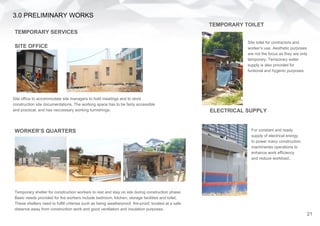
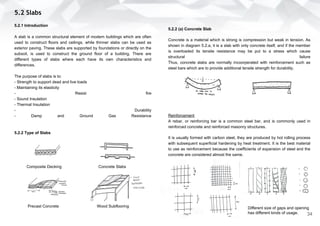
  • 51.
    ROOF Alison Tang IngEe 0323705 51
  • 52.
    7.0 Roof 7.1 Introduction Roofis a part of a building envelope that cover on the uppermost part of a building. The roof provides protection from weather, animals, rain, snow,heat,wind and sunlight. Roof requirement: Gable roof: It is generally have two sloping side that come together at a creating end walls with a triangular extension.The shape of the roof and how it is detailed depends on the structural system used which reflect climate, material and aesthetic concern. Flat roof: Flat roofs are definitely the most simple roof to build as they have no pitch. The flat roof space can also be used for some activities. Gambrel Roof: The gambrel roof is usually a symmetrical two slope sided roof on each side. The upper slope is with a shallow angle while the lower slope is steep. 7.2 Types of roof shapes The main factors which influence the shape of roofs are surrounding environment, climate and the materials available for roof structure. Roof terminology is not rigid defined. Roof shapes vary form almost flat to steeply pitched from time to time. Available types of roofs from the site : Gable Roof 52
  • 53.
    7.3 Roofing Materials Roofingmaterial is the outermost layer on the roof of a building. It self-supporting sometime but generally supported by underlying structure. The building roofing materials provide shelter from the natural elements. The outer layer of the roof shows the great variation dependent upon availability of the nature of the supporting structure and material. Sheathing, underlayments, fasteners and tile should be installed in accordance. Clay Tile Clay tile is made from dense, hard and nonabsorbent material. The tiles are intended to provide the drainage and water shedding to form a dry covering over a building. Clay tiles are also used to protect a waterproof underlayment from wind, sun and for aesthetic reasons. Concrete tile Concrete tile is made from a mixture of aggregate, portland cement and water. Concrete tiles have a long lifespan, are resistant to rot and insects and also offer good fire protection. Their strength is strengthen by the interlocking mode of installing tile roofs and it is extremely durable. Roof tile from site: concrete hacienda roof Roof Construction Method Rafter roof Rafters are sloped framing running downward from the peak of the roof to the plates of the outside walls. They act as the support for the roof load. Purlin plates are used to support longer rafter spans. Purlin is structural member in a roof and use as a support for rafters. Ceiling joists tie the outside walls together and support the ceiling materials for the building. For extra strength, collar beams or collar ties may be attached higher up between opposite rafters. The plates, rafters and tie beams serve to transfer the weight of the roof to the walls of the building. 53
  • 54.
    Truss roof A timberroof truss is a structural framework of timbers designed to provide support for a roof and to connect the space above a room. It is often referred as A-frames. Truss roof occur at regular intervals, linked by longitudinal timbers such as purlins. Bay is the space between each truss. Queen Post Truss 1. Queen posts 2. Tie Beam 3. Straining beam 4. Principal rafter King Post Truss 1. King post 2. Tie Beam 3. Principal Rafters 4. Struts The A-frame combines the rafters, joists and jacks together. A roof is made up of some A-frames. Trusses are manufactured in some different shapes and sizes to suit the needs of various types of roofs. Installation of truss 1.Trusses was lifted by crane in a manner that minimises lateral bending stresses. 2.Each bundle of wood will be lifted separately and the worker will attach the chains from the spreader bar to the two node points at each side of the truss. 3.The joiners used to mark each position of the trusses as specified on the drawing along the wall plate. truss joiner 4.The trusses will be fixed in sequence and accordance with working drawings. 5.It starts with the gable truss which is just inside or placed over the end wall. 6.Brace it back to some other stable part of the structure or to the ground. 7.Fix it to the top plate at the required location which usually indicated by set out marks as each truss is installed. 8.To ensure correct alignment,use a gauging rod and ties for spacing the trusses, and a string line along the apex. 9.It is important that trusses are lined up along the apex but not the heels. 10.The trusses must be braced longitudinally as they are erected. 11.It is to provide the stability to the trusses during the process of erection. 12.After full installation is completed, the bottom chord ties should be maintained in place. 54
  • 55.
    Installation of RoofSheathing 1.To determine the exact length of each rafter by measuring from the peak of the roof along each rafter on one side of the roof. Measure the distance from the peak to the tip of the rafter tail on the first and last rafter of the run and make a pencil mark.To make a cut line,snap a chalk line between the two pencil marks. 2.Cut each rafter tail on the chalk line by using a circular saw to ensure that every rafter is the same length. 3.Place the first piece of oriented strand board sheathing on the bottom of rafter tails at one end of the roof. Align the long edge of the sheathing with the end of the sheathing and the rafter tails. With a nail every 6 inches along each rafter, nail the sheathing into place by using a framing nailer. oriented strand board sheathing 5.To begin the second row,place a piece of sheathing above the first piece that was installed.Slide the sheet of a rafter width over the end of the roof so the edge is centered on the next rafter. Raise the sheathing ⅛ inch above the previous row and nail the sheathing into the place. After completing the second row of sheathing, move onto the third row, fourth row and so on until the last row extends past the peak of the roof. 6.Mark a chalk line along the overhanging sheets. Use a circular saw to trim off the excess sheathing. Trim off the tops of those sheets which chalk line with the aligned sheathing on the peak of the roof 7.Repeat the process with the opposite side of the gable roof. 4.Locate another piece of sheathing beside the first aligned with the end of the rafter tails. Then allow a ⅛ inch gap between the first and second sheet for seasonal expansion.Use a framing nailer to nail this sheathing into place. Repeat it with additional sheathing until reach the end of the first row. Roof Underlays Roof Underlays are called sarking or roofing felt provides the barrier to the entry of wind and rain blown between the tiles or states. It is laid between the roofing shingles and the roof decking. There are some main purposes of it: 1. Water barrier which prevent the external water vapour from percolating into the roofing deck. 2. To prevent the chemical mixture for shingle roof from leaking onto the roofing deck. 3. Acts as a secondary ambient barrier by reinforcing the aim of heat and sound insulation. 55
  • 56.
    56 8.0 Summary In thisproject, we had learn the skills to analyse, compare and to refer different elements of building construction in terms of its process, method, materials, and the necessary tools. This report includes the detail and the summary of the available building construction method, which is widely used in the modern construction industry. This project enables us to have insight and build knowledge on how the process of each and different construction phase can affect time, cost and resources spent.
  • 57.
    8.1 Reference Site andSafety Chudley, R., & Greeno, R. (2008). Building construction handbook. Oxford: Butterworth-Heinemann. Personal protective equipment (PPE). (n.d.). Retrieved September 22, 2016, from http://www.hse.gov.uk/toolbox/ppe.htm Traffic Management | Contractors Equipment | Greenham | Greenham Site. (n.d.). Retrieved September 22, 2016, from http://www.greenham.com/Contractors-Equipment/Traffic-Management~c~CA Organising site welfare. (n.d.). Retrieved September 29, 2016, from http://www.hse.gov.uk/construction/safetytopics/welfare.htm Why is machinery safety important? (n.d.). Retrieved September 29, 2016, from http://www.hse.gov.uk/toolbox/machinery/safety.htm UNITED STATES DEPARTMENT OF LABOR. (n.d.). Retrieved October 6, 2016, from https://www.osha.gov/Publications/OSHA3252/3252.html Tandem Vibratory Rollers. (n.d.). Retrieved October 6, 2016, from http://www.constructionequipment.com/tandem-vibratory-rollers Vibratory Plate Compactors. (n.d.). Retrieved October 13, 2016, from http://www.constructionequipment.com/vibratory-plate-compactors Health and Safety (Safety Signs and Signals Regulations) 1996. (n.d.). Retrieved October 13, 2016, from http://www.firesafe.org.uk/health-and-safety-safety-signs-and-signals-regulatio ns-1996/ Preliminaries Work Chudley, R., & Greeno, R. (2008). Building construction handbook (8th ed.). Oxford: Butterworth-Heinemann. Chudley, R., Greeno, R., Hurst, M., & Topliss, S. (2011). Construction Technology(5th ed.). Edinburgh gate, Harlow: Pearson education limited. Setting Out the Building Outline. (n.d.). Retrieved October 16, 2016, from http://www.buildersengineer.info/2014/01/setting-out-building-outline.html Setting Out Trenches. (n.d.). Retrieved October 16, 2016, from http://www.buildersengineer.info/2014/01/setting-out-trenches.htm Sheau Hui Tan Follow. (2015). Building Construction Report. Retrieved October 16, 2016, from http://www.slideshare.net/tansheauhui/building-construction-report-55776562 CalvinSuah Follow. (2015). Building Construction 1: Experiencing Construction. Retrieved October 16, 2016, from http://www.slideshare.net/CalvinSuah/building-construction-1-experiencing-con struction Designing Buildings Wiki The construction industry knowledge base. (n.d.). Retrieved October 16, 2016, from http://www.designingbuildings.co.uk/wiki/Hoarding_for_construction_sites @. (2010). WORK PROCEDURE - EXCAVATION. Retrieved October 16, 2016, from http://theconstructor.org/practical-guide/work-procedure-excavation/1632/ 57
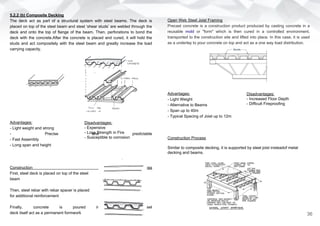
  • 58.
    Foundation Raft foundation. (n.d.).Retrieved October 7, 2016, from http://civilconstructiontips.blogspot.my/2011/06/raft-foundation.html FOUNDATION SELECTION CRITERIA FOR BUILDINGS. (2014). Retrieved October 12, 2016, from http://theconstructor.org/geotechnical/foundation-selection-criteria/6971/ FACTORS AFFECTING SELECTION OF FOUNDATION FOR BUILDINGS. (2015). Retrieved October 15, 2016, from http://theconstructor.org/geotechnical/factors-affecting-selection-of-foundation-f or-buildings/10504/ Beam and Column Ching, Francis D.K. Building Construction Illustrated. 5th ed. 2014. Print. 4. Types of Formwork. Retrieved October 17, 2016, from Ukrainian Library for Schools, http://collections.infocollections.org/ukedu/en/d/Jgtz025be/4.html Civil Engineering (Beams,Columns). (2011, June 2). Retrieved October 17, 2016, from Slideshare, http://www.slideshare.net/mbrsalman/civil-engineering-beamscolumns Slab Chudley, R., & Greeno, R. (2008). Building construction handbook. Oxford: Butterworth-Heinemann. Chudley, R., & Greeno, R. (2004). Building construction handbook. Oxford: Elsevier Butterworth-Heinemann. Emmitt, S., Gorse, C. A., & Barry, R. (2006). Barry's advanced construction of buildings. Oxford: Blackwell Pub. Chudley, R., & Greeno, R. (1999). Construction technology. Harlow: Longman. Grundy, J. T. (1977). Construction technology. London: Edward Arnold. Guide for concrete floor and slab construction. (1997). Detroit, MI: American Concrete Institute. Padhi, S. (2013, April 1). CivilBlog.Org. Retrieved September 30, 2016, from http://civilblog.org/ Mishra, G. (2011). COMPOSITE STEEL JOISTS. Retrieved October 10, 2016, from http://theconstructor.org/structural-engg/composite-steel-joists/5895/ 58
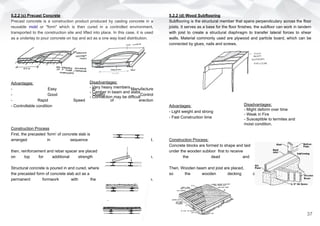

  • 59.
    Staircase and Walls http://www.popularmechanics.com/home/how-to-plans/how-to/a2145/4224738/ http://schools.ednet.ns.ca/avrsb/133/ritchiek/notes/Text/grade10/stairconstructi on.htm http://extremehowto.com/how-to-build-stairs/ http://civilblog.org/2015/09/28/10-different-types-of-stairs-commonly-designed-f or-buildings/ http://www.understandconstruction.com/walls.html https://www.thebalance.com/exterior-wall-materials-used-in-building-constructi on-844846 http://www.nucorbuildingsystems.com/builder/engineeringtips/1.13.pdf http://www.understandconstruction.com/walls.html http://theconstructor.org/building/types-of-masonry-walls/10800/ Doorsand Windows Francis D.K. Ching, 2008, Building Construction Illustrated. Fouth Edition. Roofs https://www.thisoldhouse.com/ideas/roof-shapes https://www.carpentry-pro-framer.com/Roof-Framing.html http://www.pole-barn.info/building-rafters.html http://www.thisiscarpentry.com/2012/11/09/common-rafter-framing/ http://www.diynetwork.com/how-to/rooms-and-spaces/exterior/all-about-roofs-p itches-trusses-and-framing http://www.pryda.com.au/architects-builders-designers-engineers/product-infor mation/roof-trusses/ http://www.probuilder.com/5-steps-proper-roof-sheathing-installation http://homeguides.sfgate.com/install-roof-sheathing-50736.html Simmon,H.Leslie,2001. Construction: Principles,Materials and Method. 7th Edition. New York. John Wiley&Sons. 59