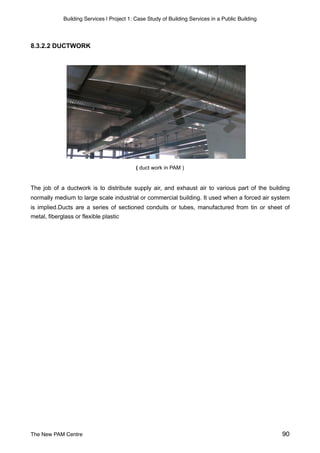
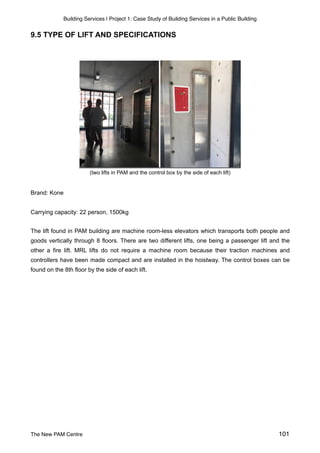
Building Services | Project 1: Case Study of Building Services in a Public Building
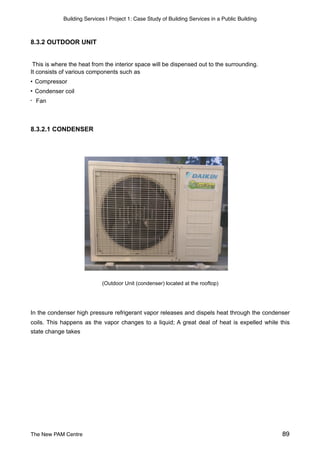
The New PAM Centre 1
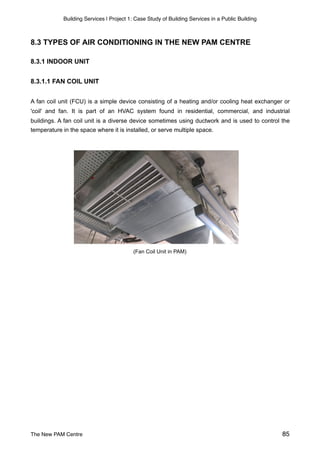
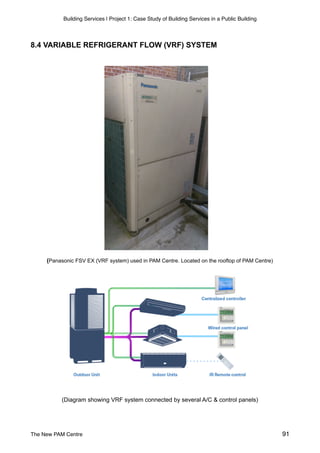
Building Services | Project 1: Case Study of Building Services in a Public Building
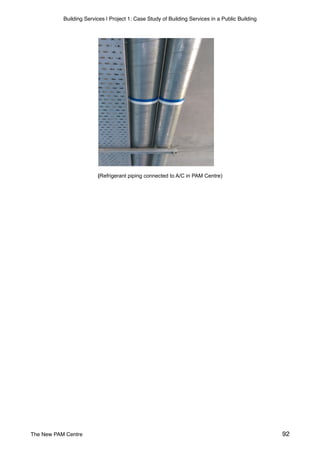
CONTENT PAGE
1.0 Abstract 6
2.0 Acknowledgement 7
3.0 Introduction to the New PAM Centre 8
4.0 Methodology 12
5.0 Limitation of Study 12
6.0 Active and Passive Fire Protection 13
6.1 Introduction
6.2 Literature Review
6.2.1 Active Fire Protection
6.2.1.1 Fire Detection System
6.2.1.2 Fire Notification System
6.2.1.3 Fire Fighting System
6.2.2 Passive Fire Protection
6.2.2.1 Means of Escape and Firefighter Access
6.2.2.2 Compartmentation
6.2.2.3 Fire Rated Building Materials
6.3 Active Fire Protection in New PAM Centre
6.3.1 Fire Detection Systems in New PAM Centre
6.3.1.1 Addressable Smoke Detector
6.3.2 Fire Notification Systems in New PAM Centre
6.3.2.1 Fire Alarm Bell
6.3.2.2 Manual Call Point
6.3.2.3 Main Fire Alarm Panel
6.3.2.4 Fire Emergency Light
6.3.2.5 Fireman Switch
6.3.2.6 Fireman Intercom
6.3.3 Fire Fighting Systems in New PAM Centre
6.3.3.1 Dry Riser System
The New PAM Centre 2
Building Services | Project 1: Case Study of Building Services in a Public Building
6.3.3.2 Hose Reel System
6.3.3.3 Fire Extinguisher
6.4 Passive Fire Protection in New PAM Centre
6.4.1 Means of Escape and Firefighter Access
6.4.1.1 Fire Escape Staircase
6.4.1.2 Fire Doors
6.4.1.3 Door Release Mechanism
6.4.1.4 Exit Sign
6.4.1.5 Fire Escape Plan
6.4.2 Compartmentation
6.4.2.1 Escape Travel Distances
6.4.3 Fire Rated Building Materials
6.4.3.1 Pre-cast Concrete
6.4.3.2 Masonry
6.4.3.3 Steel Elements
6.4.3.4 Aluminium Cladding
7.0 Mechanical Ventilation Systems 52
7.1 Introduction
7.2 UBBL Compliance
7.3 Literature Review
7.3.1 Basic Ventilation Systems
7.3.2 Types of Mechanical Ventilation Systems
7.3.2.1 Spot Ventilation Systems
7.3.2.2 Exhaust Ventilation Systems
7.3.2.3 Supply Ventilation Systems
7.3.2.4 Balanced Ventilation Systems
7.3.2.5 Energy Recovery Systems
7.3.3 Components of Mechanical Ventilation Systems
7.3.2.1 Fans
7.3.2.2 Filters
7.3.2.3 Ductwork
7.3.2.4 Fire Damper
7.3.2.5 Diffuser
7.4 Mechanical Ventilation Systems in New PAM Centre
The New PAM Centre 3
Building Services | Project 1: Case Study of Building Services in a Public Building
7.4.1 Spot Ventilation System
7.4.2 Air Handling Unit (AHU)
7.4.3 Propeller Fans
7.5 Conclusion
8.0 Air-Conditioning Systems 70
8.1 Introduction
8.2 Literature Review
8.2.1 Operating Principles of Air Cooling
8.2.1.1 Refrigeration Cycle
8.2.1.2 Components of Refrigeration Cycle
8.2.2 Air Cycle Process
8.2.2.1 Components of Air Cycle Process
8.2.1.2 Components of Refrigeration Cycle
8.2.3 Types of Air Conditioning Systems
8.2.3.1 Types of VRF
8.3 Types of Air Conditioning Systems in the New PAM Centre
8.3.1 Indoor Unit
8.3.1.1 Fan Coil Unit
8.3.1.1.1 Components of Fan Coil Unit
8.3.1.1.2 Cooling Process
8.3.1.2 Cassette Unit
8.3.1.3 Remote Control Unit
8.3.2 Outdoor Unit
8.3.2.1 Condenser
8.3.2.2 Ductwork
8.4 Variable Refrigerant Flow (VRF) Systems
8.4.1 Variable Refrigerant Flow (VRF) Systems
8.4.2 VRF Systems In the New PAM Centre
9.0 Mechanical Transportation Systems 94
9.1 Introduction
9.2 Literature Review
9.3 Standard Main Components
9.3.1 Car
The New PAM Centre 4
Building Services | Project 1: Case Study of Building Services in a Public Building
9.3.2 Hoistway
9.3.3 Counterweight
9.3.4 Machine/ Drive System
9.3.5 Control System
9.3.6 Safety System
9.3.7 Buffer
9.4 Overview of Arrangement
9.5 Type of Lift and Specifications
9.5.1 How the Lift Works
9.6 Components of a Lift
9.6.1 Two Panel, Centre-Opening Doors
9.6.2 Buttons
9.6.3 Floor Indicator
9.6.4 Handrail
9.6.5 Fire Resistant Padding
9.7 UBBL Compliance
10.0 Mechanical Parking Systems 109
10.1 Introduction
10.2 Literature Review
10.2.1 AGV System
10.2.2 Crane System
10.2.3 Puzzle System
10.2.4 Silo System
10.2.5 Tower System
10.2.6 Stack Parking System
10.3 Type of Mechanical Parking System in New PAM Building
10.4 Safety System
10.5 Operation and Maintenance
11.0 References 121
The New PAM Centre 5
Building Services | Project 1: Case Study of Building Services in a Public Building
1.0 ABSTRACT
This project requires students in groups of 4-5, to analyse the services in a public building of our
choice. Each group is tasked to observe and analyse the following systems through conducting a
thorough investigation that is later expressed into a report. All the services are in response to the
requirement of the UBBL 1984:
a. Fire protection (active and passive fire protection system)
b. Mechanical ventilation
c. Air-conditioning system
d. Mechanical transportation system
With the report we were able to link real-life case-studies to theories learnt during this course. This
gave us a better understanding on how a building is constructed. Whether it being the skeletal
frame, the building fabric, the circulatory system and most importantly the building services. The
New PAM building, our chosen case study, is a perfect example of a modern building that complies
with all UBBL requirements while maintaining green efforts that resulted in a platinum certification
by the Green Building Index. This project also allowed us to gain deeper knowledge in local
regulations such as the UBBL and MS1525 that would be of great help when we are practising
architects.
The New PAM Centre 6
Building Services | Project 1: Case Study of Building Services in a Public Building
2.0 ACKNOWLEDGMENT
Without the guidance of tutors and the co-operation of all the teammates, the completion of this
assignment could not have been possible. Their efforts and contributions are sincerely and
gratefully appreciated. Therefore, this team, would like to express our undying gratitude to
everyone who has guided us, particular to the following,
The staff from PAM Building especially, Madeline Ham and Muhammad Asadi, for being keen and
accommodating in providing related information that has helped us in our data collection, while
also taking us around with a bright smile and enthusiasm. The module co-ordinator, Ar. Sateerah
Hassan, for giving us this opportunity to experience and to develop understanding in building
service through live case studies. The tutor, Mr. Azim Sulaiman, for his constant support, guidance
and persistence throughout this project. Without him, our group would have not been clear on the
task and would not be able to link information given. Lastly the lovely team members, for the
teamwork and motivating team spirit through the entirety of this project.
The New PAM Centre 7
Building Services | Project 1: Case Study of Building Services in a Public Building
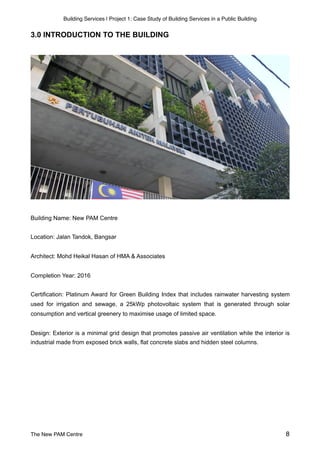
3.0 INTRODUCTION TO THE BUILDING
Building Name: New PAM Centre
Location: Jalan Tandok, Bangsar
Architect: Mohd Heikal Hasan of HMA & Associates
Completion Year: 2016
Certification: Platinum Award for Green Building Index that includes rainwater harvesting system
used for irrigation and sewage, a 25kWp photovoltaic system that is generated through solar
consumption and vertical greenery to maximise usage of limited space.

Design: Exterior is a minimal grid design that promotes passive air ventilation while the interior is
industrial made from exposed brick walls, flat concrete slabs and hidden steel columns.
The New PAM Centre 8
Building Services | Project 1: Case Study of Building Services in a Public Building
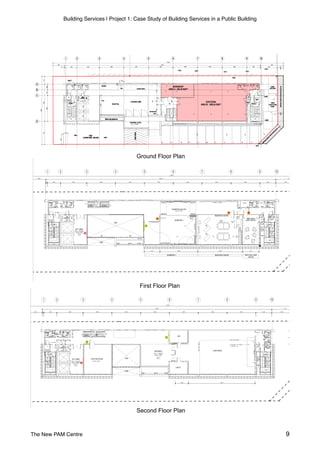
Ground Floor Plan
First Floor Plan
Second Floor Plan
The New PAM Centre 9
M&E
RISERS
LV
ELV
INTERIOR ARCHITECTURE
PROJECT MANAGEMENT
RETAIL PLANNING DESIGNIN
EXCELLA BUSINESS PA
UNIT F, F-5, JALAN AMPANG
TAMAN AMPANG HILIR, 55100 KU
TEL : 03-42705290 FAX : 03
(No.Syarikat.374182-V)
INTERIOR DE
SFSB/PAM-JALAN TAND
(2014)/331/ID-105-3
SIGNAGE LAYOUT -
FIRST FLOOR PLAN
M&E
RISERS
INTERIOR ARCHITECTURE
PROJECT MANAGEMENT
RETAIL PLANNING DESIGNING
EXCELLA BUSINESS PARK
UNIT F, F-5, JALAN AMPANG PUT
TAMAN AMPANG HILIR, 55100 KUALA
TEL : 03-42705290 FAX : 03-427
(No.Syarikat.374182-V)
INTERIOR DESIGNE
SFSB/PAM-JALAN TANDUK
(2014)/331/ID-105-4
SIGNAGE LAYOUT -
SECOND FLOOR PLAN
Building Services | Project 1: Case Study of Building Services in a Public Building


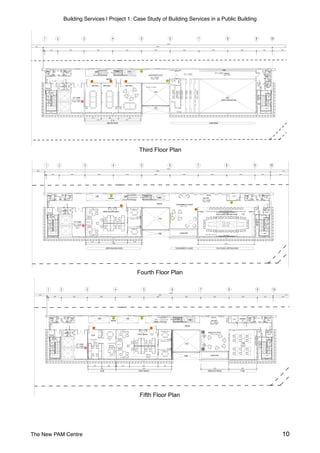
Third Floor Plan
Fourth Floor Plan
Fifth Floor Plan
The New PAM Centre 10
M&E
RISERS
INTERIOR ARCHITECTURE
PROJECT MANAGEMENT
RETAIL PLANNING DESIGNING
EXCELLA BUSINESS PARK
UNIT F, F-5, JALAN AMPANG PUT
TAMAN AMPANG HILIR, 55100 KUALA
TEL : 03-42705290 FAX : 03-427
(No.Syarikat.374182-V)
INTERIOR DESIGNE
SFSB/PAM-JALAN TANDUK
(2014)/331/ID-105-5
SIGNAGE LAYOUT -
THIRD FLOOR PLAN
M&E
RISERS
INTERIOR ARCHITECTURE
PROJECT MANAGEMENT
RETAIL PLANNING DESIGNING
EXCELLA BUSINESS PARK
UNIT F, F-5, JALAN AMPANG PUTRA,
TAMAN AMPANG HILIR, 55100 KUALA LUMP
TEL : 03-42705290 FAX : 03-42705289
(No.Syarikat.374182-V)
INTERIOR DESIGNERS
FOURTH FLOOR PLAN
SFSB/PAM-JALAN TANDUK/KL
(2014)/331/ID-105-6
SIGNAGE LAYOUT -
M&E
RISERS INTERIOR ARCHITECTURE
PROJECT MANAGEMENT
RETAIL PLANNING DESIGNING
EXCELLA BUSINESS PARK
UNIT F, F-5, JALAN AMPANG PUTR
TAMAN AMPANG HILIR, 55100 KUALA L
TEL : 03-42705290 FAX : 03-4270
(No.Syarikat.374182-V)
INTERIOR DESIGNERS
FIFTH FLOOR PLAN
SFSB/PAM-JALAN TANDUK
(2014)/331/ID-105-7
SIGNAGE LAYOUT -
Building Services | Project 1: Case Study of Building Services in a Public Building
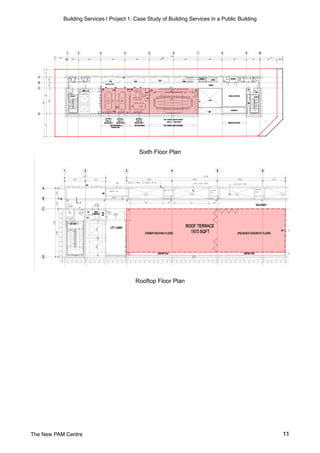
Sixth Floor Plan
Rooftop Floor Plan
The New PAM Centre 11
Building Services | Project 1: Case Study of Building Services in a Public Building
4.0 METHODOLOGY
This project was conducted as a thorough study of the services which is located at the New PAM
Centre building , Bangsar. The project was carried out in phases; literature review, the site visit and
observation- data recording and reporting. Literature review compromises of research from online
sources, publications, books and journals that source on all four topics; fire protection systems,
mechanical ventilation, air-conditioning and mechanical transportation systems. The team was
then divided, which made the workflow and scope of work simpler and more manageable. The site
visit was a tour conducted by Mr. Muhammad Asadi that showed us the works of the building. With
the data collected, members of the team write their own part of report, resulting in a final
compilation in the end.
5.0 LIMITATION OF STUDY
The group encountered some minor issues during the research process which may have slightly
delayed the preparation of the report. The New PAM building was our final choice as before this,
when choosing the building, our first choices did not allow the visitation for this project. Another
limitation was that we were not able to develop full analysis of the New PAM Building as a few of
the AHU rooms (located on third floor) was not accessible. However, we did manage to figure out
the possible ducting routes and specifications of the AHU room. Finally, while investigating the
elevator, the switch box could not be opened, therefore not allowing us to record and fully
understand the operations of the lift, till we took extra initiative to do further reading.
The New PAM Centre 12
Building Services | Project 1: Case Study of Building Services in a Public Building
6.0 ACTIVE AND PASSIVE FIRE
PROTECTION SYSTEM
BY: HOH JEAN MING (ACTIVE) & MUHAMMAD NAZMI (PASSIVE)
The New PAM Centre 13
Building Services | Project 1: Case Study of Building Services in a Public Building
6.1 INTRODUCTION
Fire protection system are an effective safety and security measure that intends to minimize the
risk of fire spreading throughout the building and also its effects by providing certain means to
combat and escape from it. It stresses the importance of the safety of people (inhabitants) first and
then their property whenever possible. Fire protection system works by mitigating the unwanted
effects of potentially destructive fire. This include investigation of the mechanism of fire in terms of
the building, how to successfully suppresses, delay or deter it through the application of different
device, strategies and testing. There are two types of fire protection system:
● Active fire protection system
● Passive fire protection system
In any modern structures, it must be constructed in accordance with different building code and
laws that is in effect, such as UBBL 1984, when an application for a building permit is made.
Building inspectors, prominently from Malaysia’s Fire and Rescue Department (Bomba), check on
compliance of the building under construction using the building code. Once it is complete, the
building must be maintained in accordance with the respective building code and laws at all times.
Whenever there is a fire emergencies, a team of firefighters, fire investigators, and other personnel
are called to mitigate, investigate and learn from the damage of a fire. In case of any breakthrough,
overlooked aspect or loopholes, the building code will be amended and updated.
The New PAM Centre 14
Building Services | Project 1: Case Study of Building Services in a Public Building
6.2 LITERATURE REVIEW
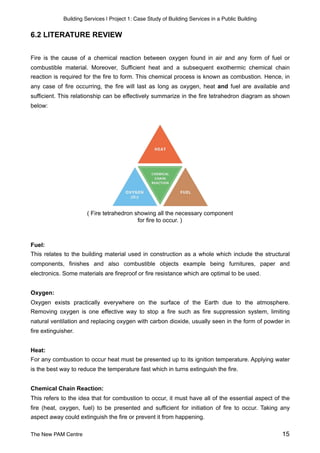
Fire is the cause of a chemical reaction between oxygen found in air and any form of fuel or
combustible material. Moreover, Sufficient heat and a subsequent exothermic chemical chain
reaction is required for the fire to form. This chemical process is known as combustion. Hence, in
any case of fire occurring, the fire will last as long as oxygen, heat and fuel are available and
sufficient. This relationship can be effectively summarize in the fire tetrahedron diagram as shown
below:
( Fire tetrahedron showing all the necessary component
for fire to occur. )
Fuel:
This relates to the building material used in construction as a whole which include the structural
components, finishes and also combustible objects example being furnitures, paper and
electronics. Some materials are fireproof or fire resistance which are optimal to be used.
Oxygen:
Oxygen exists practically everywhere on the surface of the Earth due to the atmosphere.
Removing oxygen is one effective way to stop a fire such as fire suppression system, limiting
natural ventilation and replacing oxygen with carbon dioxide, usually seen in the form of powder in
fire extinguisher.
Heat:
For any combustion to occur heat must be presented up to its ignition temperature. Applying water
is the best way to reduce the temperature fast which in turns extinguish the fire.
Chemical Chain Reaction:
This refers to the idea that for combustion to occur, it must have all of the essential aspect of the
fire (heat, oxygen, fuel) to be presented and sufficient for initiation of fire to occur. Taking any
aspect away could extinguish the fire or prevent it from happening.
The New PAM Centre 15
Building Services | Project 1: Case Study of Building Services in a Public Building
6.2.1 ACTIVE FIRE PROTECTION
Active Fire Protection (AFP) is the component of fire detection and prevention which reacts to
action or motion. AFP is a group of systems that require some amount of action or motion in order
to work efficiently in the event of a fire. Actions may be manually operated, like a fire extinguisher
or automatic, like a sprinkler, but either way they require some amount of action. It is crucial for a
building equipped with systems capable of immediately detecting any potential fire hazards, in
order to protect both said furnishings and the people making use of them. Active Fire Protection
can be categorized in 3 types:
● Fire Detection System
● Fire Notification System
● Fire Fighting System
6.2.1.1 FIRE DETECTION SYSTEM
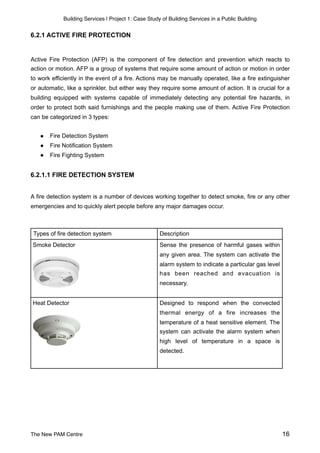
A fire detection system is a number of devices working together to detect smoke, fire or any other
emergencies and to quickly alert people before any major damages occur.
Types of fire detection system Description
Sense the presence of harmful gases within
any given area. The system can activate the
alarm system to indicate a particular gas level
has been reached and evacuation is
necessary.
Designed to respond when the convected
thermal energy of a fire increases the
temperature of a heat sensitive element. The
system can activate the alarm system when
high level of temperature in a space is
detected.
Smoke Detector
Heat Detector
The New PAM Centre 16
Building Services | Project 1: Case Study of Building Services in a Public Building
6.2.1.2 FIRE NOTIFICATION SYSTEM
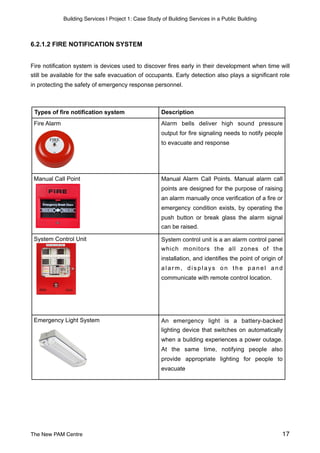
Fire notification system is devices used to discover fires early in their development when time will
still be available for the safe evacuation of occupants. Early detection also plays a significant role
in protecting the safety of emergency response personnel.
Types of fire notification system Description
Alarm bells deliver high sound pressure
output for fire signaling needs to notify people
to evacuate and response
Manual Alarm Call Points. Manual alarm call
points are designed for the purpose of raising
an alarm manually once verification of a fire or
emergency condition exists, by operating the
push button or break glass the alarm signal
can be raised.
System control unit is a an alarm control panel
which monitors the all zones of the
installation, and identifies the point of origin of
a l a r m , d i s p l a y s o n t h e p a n e l a n d
communicate with remote control location.
An emergency light is a battery-backed
lighting device that switches on automatically
when a building experiences a power outage.
At the same time, notifying people also
provide appropriate lighting for people to
evacuate
System Control Unit
Fire Alarm
Emergency Light System
Manual Call Point
The New PAM Centre 17
Building Services | Project 1: Case Study of Building Services in a Public Building
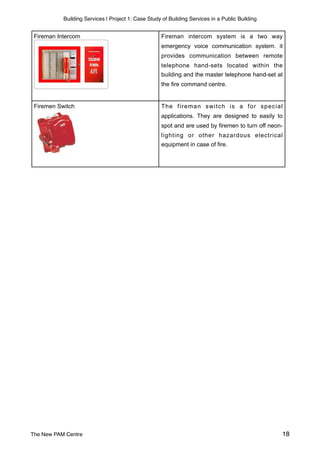
Fireman intercom system is a two way
emergency voice communication system. it
provides communication between remote
telephone hand-sets located within the
building and the master telephone hand-set at
the fire command centre.
The fireman switch is a for special
applications. They are designed to easily to
spot and are used by firemen to turn off neon-
lighting or other hazardous electrical
equipment in case of fire.
Firemen Switch
Fireman Intercom
The New PAM Centre 18
Building Services | Project 1: Case Study of Building Services in a Public Building
6.2.1.3 FIRE FIGHTING SYSTEM
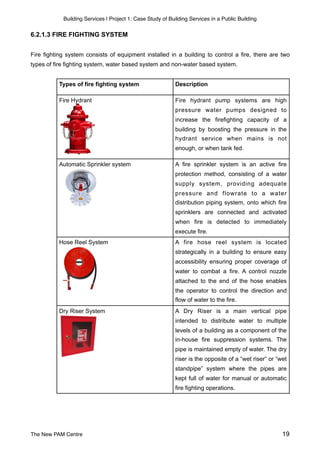
Fire fighting system consists of equipment installed in a building to control a fire, there are two
types of fire fighting system, water based system and non-water based system.
Types of fire fighting system Description
Fire hydrant pump systems are high
pressure water pumps designed to
increase the firefighting capacity of a
building by boosting the pressure in the
hydrant service when mains is not
enough, or when tank fed.
A fire sprinkler system is an active fire
protection method, consisting of a water
supply system, providing adequate
pressure and flowrate to a water
distribution piping system, onto which fire
sprinklers are connected and activated
when fire is detected to immediately
execute fire.
A fire hose reel system is located
strategically in a building to ensure easy
accessibility ensuring proper coverage of
water to combat a fire. A control nozzle
attached to the end of the hose enables
the operator to control the direction and
flow of water to the fire.
A Dry Riser is a main vertical pipe
intended to distribute water to multiple
levels of a building as a component of the
in-house fire suppression systems. The
pipe is maintained empty of water. The dry
riser is the opposite of a “wet riser” or “wet
standpipe” system where the pipes are
kept full of water for manual or automatic
fire fighting operations.
Hose Reel System
Fire Hydrant
Dry Riser System
Automatic Sprinkler system
The New PAM Centre 19
Building Services | Project 1: Case Study of Building Services in a Public Building
A Dry Riser is a system of valves and
pipework which enables the Fire Service
to pump water into the upper floors of a
building. A Wet Riser is a system of valves
and pipework which are kept permanently
charged with water to be prepared for any
fire combatting.
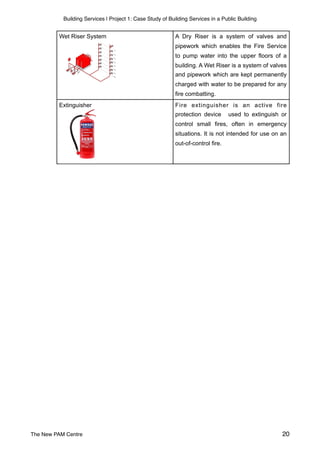
Fire extinguisher is an active fire
protection device used to extinguish or
control small fires, often in emergency
situations. It is not intended for use on an
out-of-control fire.
Extinguisher
Wet Riser System
The New PAM Centre 20
Building Services | Project 1: Case Study of Building Services in a Public Building
6.2.2 PASSIVE FIRE PROTECTION
Passive fire protection (PFP) is an integral component in structural fire protection and fire safety in
any building. PFP works by containing fires to slow the spread, generally done by
compartmentation of the building through the use of high fire rated structural components such as
walls, floors and doors. The compartment also allows for smoke to not overwhelm the building by
diverting it outside which is vital as estimated death from smoke related injuries during fire account
for more than 50%. It also work by allowing a safe escape passage in case of fire emergency and
efficient access route for the firefighters and their equipments. Unlike AFP, it does not take any
type of action during any fire events. Therefore, it can be said that both AFP and PFP are meant to
work together during a fire, not one in place of the other.
Careful measures are specially paid attention on passive fire protection through simulation and
comprehensive testing to ensure that it is suitable and work as intended should any fire emergency
events arose. It is worth noting that these passive fire protection should function in extreme heat
condition for a specific amount of time before failing. This is known as fire resistance ratings which
are expressed in terms of how many hours it can last (example: 30 minute, 1 hour, 1.5 hour, 2
hour, 4 hour etc…). Both AFP and PFP are heavily regulated and monitored through UBBL 1984
and its compliance are checked thoroughly by the authorities before construction began to ensure
its effectiveness as expected by the building codes.
6.2.2.1 MEANS OF ESCAPE & FIREFIGHTER ACCESS
This refers to any route that one can take to go in and out of building safely during the occurrence
of fire. Evacuation routes are always clearly defined through a fire escape staircase in every
medium to high-rise building and is used to direct to occupants directly towards an exit point
without any obstruction in between. Furthermore, there would also be an assembly point whereby
people would gather after they escaped from the building.
UBBL 1884 Section 166 mentioned that no less than two separate exits shall be provided from
each storey together with such additional exits as may be necessary. This exits are required to be
accessible at all times without obstructions. Moreover, Section 169 also said to maintain the
accessibility of the paths, all fire evacuation routes are required to have a consistent width along its
path of travel from the storey exit to the final exit.
The New PAM Centre 21
Building Services | Project 1: Case Study of Building Services in a Public Building
6.2.2.2 COMPARTMENTATION
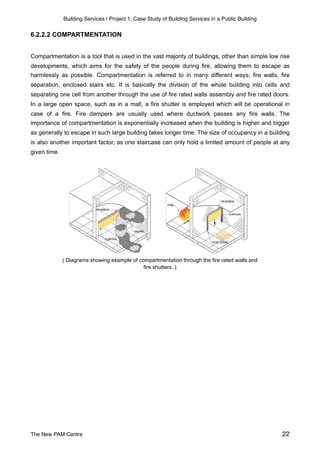
Compartmentation is a tool that is used in the vast majority of buildings, other than simple low rise
developments, which aims for the safety of the people during fire, allowing them to escape as
harmlessly as possible. Compartmentation is referred to in many different ways: fire walls, fire
separation, enclosed stairs etc. It is basically the division of the whole building into cells and
separating one cell from another through the use of fire rated walls assembly and fire rated doors.
In a large open space, such as in a mall, a fire shutter is employed which will be operational in
case of a fire. Fire dampers are usually used where ductwork passes any fire walls. The
importance of compartmentation is exponentially increased when the building is higher and bigger
as generally to escape in such large building takes longer time. The size of occupancy in a building
is also another important factor, as one staircase can only hold a limited amount of people at any
given time.
( Diagrams showing example of compartmentation through the fire rated walls and
fire shutters. )
The New PAM Centre 22
Building Services | Project 1: Case Study of Building Services in a Public Building
6.2.2.3 FIRE RATED BUILDING MATERIALS
Choosing the right building materials are the most effective methods contributing towards passive
fire protection. Different materials has a different rate in which fire spread or different properties
that may withstand heat and burns for a specified amount of time. This is known as fire resistance
ratings which are usually expressed in terms of how many hours it can last (example: 30 minute, 1
hour, 1.5 hour, 2 hour, 4 hour). These ratings are pre-determined as per Ninth Schedule of the
UBBL. The by-laws also mention the specific building typologies and their required minimum period
of fire resistance in relations to its dimensions. For example, small residential with less than three
storeys has a minimum period of fire resistance of 30 minute for the structural elements whereas
office building with more than 28m high or 5000m² floor area or 14000m³ volume should have a
minimum period of fire resistance of 1.5 hours (basement 2 hours). This indicate that larger
buildings with more occupants should be constructed with stronger fire-resistant material which
allows more time for evacuation and prevent the fire from spreading too fast.
Generally speaking, good example of fire resistance rated materials are reinforced concrete and
most type of masonry primarily ones that composed of stone or clay bricks. Determining the exact
fire resistance rating for these material can be difficult as it depends on several factors such as the
type of aggregates used, materials grading and amount of materials used (thickness). In terms of
structural steel, it is required to be fireproofed since steel by itself is very vulnerable due to high
thermal conductivity and also because it loses majority of its strength at higher temperature. The
three methods to fireproof steel are:
● Dense Concrete: inexpensive, withstand extremely high temperature. Heavy, may form
cracks following a fire events.
● Cementitious Coating: lightweight cementitious fireproofing retains the benefit of being
based on inexpensive raw materials and without the problems associated with extreme
weight. May also cracks following a fire events.
● Intumescent Coating: application of a coating onto the steel material which rapidly expand
in the present of extreme heat. This expansion of the coating, typically 25 times bigger than
their original thickness provides a barrier between the flames and the steel. Additionally,
since they are applied directly to steel, no gap is created in which moisture can penetrate
and cause corrosion.
The New PAM Centre 23
Building Services | Project 1: Case Study of Building Services in a Public Building
6.3 ACTIVE FIRE PROTECTION IN PAM CENTRE
6.3.1 FIRE DETECTION SYSTEMS IN PAM CENTRE
6.3.1.1 ADDRESSABLE SMOKE DETECTOR
( Addressable Smoke Detector in PAM Centre. )
The fire detection system used in the New PAM centre is an addressable smoke detector. A smoke
detector is a device that senses smoke, or harmful gas particles, typically as an indicator of fire.
Commercial security devices issue a signal to a fire alarm control panel as part of a fire alarm
system. The differences between a smoke detector and an addressable smoke detector is that with
addressable fire alarm systems, you can pinpoint exactly which device has been activated. In PAM
Centre, smokes detectors are placed in every room and corridors, smoke detectors are also placed
in control rooms, such as electrical rooms which has high possibility of fire. The distance between
every smoke detectors are less than 10m away from one another. Below is the placement of
addressable smoke detectors placed in third floor of PAM Centre.
( PAM Centre third floor plan showing the location of all addressable smoke detector. )
The New PAM Centre 24
Building Services | Project 1: Case Study of Building Services in a Public Building
6.3.2 FIRE NOTIFICATION SYSTEMS IN PAM CENTRE
6.3.2.1 FIRE ALARM BELL
( Fire alarm bell & Manual call point in PAM Centre. )
Fire alarm bell is activated when it is triggered by the detection devices. It serves to alert the
occupants to evacuate as soon as possible and to send signals to authorities to take action for fire
combatting. In New PAM Centre, fire alarm bells are located at both end of each floor of the
building as well as the centre of every floor together with a manual call point as well as an
extinguisher. Therefore, it is easily accessed and occupants of the building will be informed as
soon as possible if there’s an emergency.
Reference to UBBL 1984 (as at 1st November 2013):
Part Vlll, Clause 237: Fire Alarms.
(1) Fire alarms shall be provided in accordance with the Tenth Schedule to these
By-laws.
(2) All premises and buildings with gross floor area excluding car park and storage
areas exceeding 9290 square metres or exceeding 30.5 metres in height shall
be provided with a two-stage alarm system with evacuation (continuous signal)
to be given immediately in the affected section of the premises while an alert
(intermittent signal) be given in adjoining section.
The New PAM Centre 25
Building Services | Project 1: Case Study of Building Services in a Public Building
( PAM Centre fifth floor plan Indicating Placement of Alarm Bell & Manual Call Point. )
6.3.2.2 MANUAL CALL POINT
( Manual Call Point in PAM Centre. )
A manual call point is usually connected to central fire alarm panel, it is used to activate the alarm
by simply breaking the glass or pressing a button to trigger the alarm, in New PAM centre, most of
the manual call points are located where fire alarm bells are. When activated, an indicator will
appear on the control panel to show the location of activation and action will be taken. Also the
manual call points are located at both end of each floors as well as the centre of every floors.
The New PAM Centre 26
Building Services | Project 1: Case Study of Building Services in a Public Building
6.3.2.3 MAIN FIRE ALARM PANEL
The main fire alarm panel is located at the lower ground floor of New PAM Centre in the control
room. The main fire alarm control panel process results detected by sensors, control alarm
devices and set off alarms to permanently manned stations and the fire department. They
continuously monitor extinguishing systems for functionality and trigger them electrically if
necessary. In case of danger, it receives signals from the fire alarm bell, detectors and manual call
point as well as monitors and provides notifications to the occupants in the building.
Through the main fire alarm panel, it has access to control HVAC systems, building automation
controllers, access points, and elevators to isolate the fire or route personnel during an emergency.
( [left] Fire Alarm Panel in PAM Centre. [right] Main fire alarm panel in PAM Centre control room. )
The New PAM Centre 27
Building Services | Project 1: Case Study of Building Services in a Public Building
6.3.2.4 FIRE EMERGENCY LIGHT
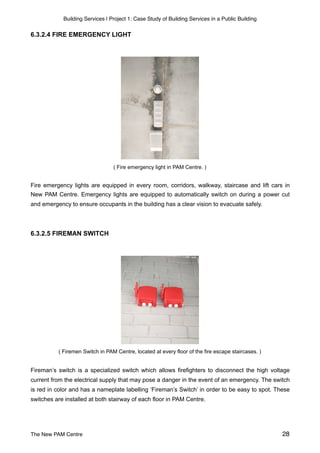
( Fire emergency light in PAM Centre. )
Fire emergency lights are equipped in every room, corridors, walkway, staircase and lift cars in
New PAM Centre. Emergency lights are equipped to automatically switch on during a power cut
and emergency to ensure occupants in the building has a clear vision to evacuate safely.
6.3.2.5 FIREMAN SWITCH
( Firemen Switch in PAM Centre, located at every floor of the fire escape staircases. )
Fireman’s switch is a specialized switch which allows firefighters to disconnect the high voltage
current from the electrical supply that may pose a danger in the event of an emergency. The switch
is red in color and has a nameplate labelling ‘Fireman’s Switch’ in order to be easy to spot. These
switches are installed at both stairway of each floor in PAM Centre.
The New PAM Centre 28
Building Services | Project 1: Case Study of Building Services in a Public Building
( Fifth floor plan indicating location of firemen switch on every floor )
6.3.2.6 FIREMAN INTERCOM
( [Left] Firemen intercom in PAM Centre. [Right] Main firemen intercom system in PAM Centre control room. )
Firemen intercom system provides a two-way communication between the Remote Telephone
Headset(s) located in the building and the Master Telephone Headset located at the fire command
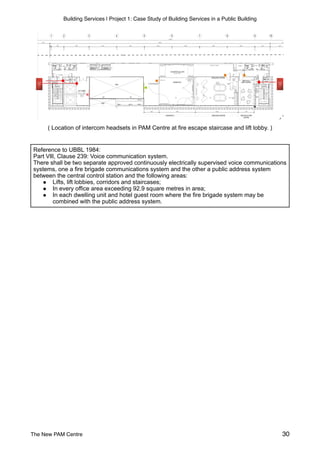
centre. The intercom headsets are located at both stairway of each floor and lift lobbies whereas
the master telephone headset is located at the lower ground floor in the control room of PAM
Centre.
The New PAM Centre 29
Building Services | Project 1: Case Study of Building Services in a Public Building
( Location of intercom headsets in PAM Centre at fire escape staircase and lift lobby. )
Reference to UBBL 1984:
Part Vlll, Clause 239: Voice communication system.
There shall be two separate approved continuously electrically supervised voice communications
systems, one a fire brigade communications system and the other a public address system
between the central control station and the following areas:
● Lifts, lift lobbies, corridors and staircases;
● In every office area exceeding 92.9 square metres in area;
● In each dwelling unit and hotel guest room where the fire brigade system may be
combined with the public address system.
The New PAM Centre 30
Building Services | Project 1: Case Study of Building Services in a Public Building
6.3.3 FIRE FIGHING SYSTEM IN PAM CENTRE 

6.3.3.1 DRY RISER SYSTEM
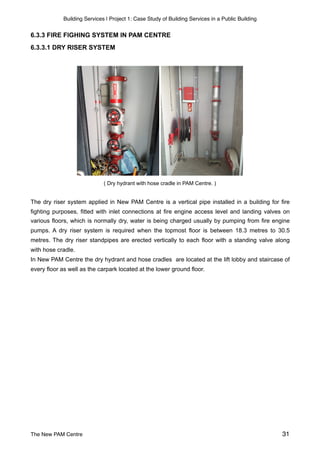
( Dry hydrant with hose cradle in PAM Centre. )
The dry riser system applied in New PAM Centre is a vertical pipe installed in a building for fire
fighting purposes, fitted with inlet connections at fire engine access level and landing valves on
various floors, which is normally dry, water is being charged usually by pumping from fire engine
pumps. A dry riser system is required when the topmost floor is between 18.3 metres to 30.5
metres. The dry riser standpipes are erected vertically to each floor with a standing valve along
with hose cradle.
In New PAM Centre the dry hydrant and hose cradles are located at the lift lobby and staircase of
every floor as well as the carpark located at the lower ground floor.
The New PAM Centre 31
Building Services | Project 1: Case Study of Building Services in a Public Building
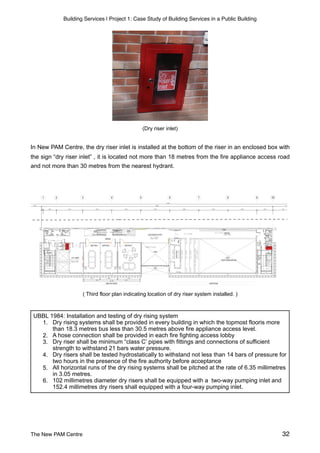
(Dry riser inlet)
In New PAM Centre, the dry riser inlet is installed at the bottom of the riser in an enclosed box with
the sign “dry riser inlet” , it is located not more than 18 metres from the fire appliance access road
and not more than 30 metres from the nearest hydrant.
( Third floor plan indicating location of dry riser system installed. )
UBBL 1984: Installation and testing of dry rising system
1. Dry rising systems shall be provided in every building in which the topmost flooris more
than 18.3 metres bus less than 30.5 metres above fire appliance access level.
2. A hose connection shall be provided in each fire fighting access lobby
3. Dry riser shall be minimum “class C’ pipes with fittings and connections of sufficient
strength to withstand 21 bars water pressure.
4. Dry risers shall be tested hydrostatically to withstand not less than 14 bars of pressure for
two hours in the presence of the fire authority before acceptance
5. All horizontal runs of the dry rising systems shall be pitched at the rate of 6.35 millimetres
in 3.05 metres.
6. 102 millimetres diameter dry risers shall be equipped with a two-way pumping inlet and
152.4 millimetres dry risers shall equipped with a four-way pumping inlet.
The New PAM Centre 32
Building Services | Project 1: Case Study of Building Services in a Public Building
6.3.3.2 HOSE REEL SYSTEM
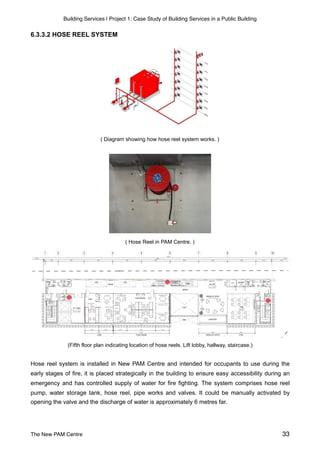
( Diagram showing how hose reel system works. )
( Hose Reel in PAM Centre. )
(Fifth floor plan indicating location of hose reels. Lift lobby, hallway, staircase.)
Hose reel system is installed in New PAM Centre and intended for occupants to use during the
early stages of fire, it is placed strategically in the building to ensure easy accessibility during an
emergency and has controlled supply of water for fire fighting. The system comprises hose reel
pump, water storage tank, hose reel, pipe works and valves. It could be manually activated by
opening the valve and the discharge of water is approximately 6 metres far.
The New PAM Centre 33
Building Services | Project 1: Case Study of Building Services in a Public Building
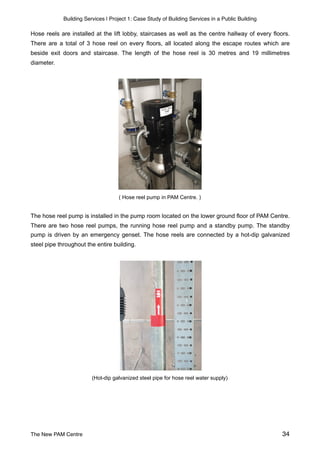
Hose reels are installed at the lift lobby, staircases as well as the centre hallway of every floors.
There are a total of 3 hose reel on every floors, all located along the escape routes which are
beside exit doors and staircase. The length of the hose reel is 30 metres and 19 millimetres
diameter.
( Hose reel pump in PAM Centre. )
The hose reel pump is installed in the pump room located on the lower ground floor of PAM Centre.
There are two hose reel pumps, the running hose reel pump and a standby pump. The standby
pump is driven by an emergency genset. The hose reels are connected by a hot-dip galvanized
steel pipe throughout the entire building.
(Hot-dip galvanized steel pipe for hose reel water supply)
The New PAM Centre 34
Building Services | Project 1: Case Study of Building Services in a Public Building
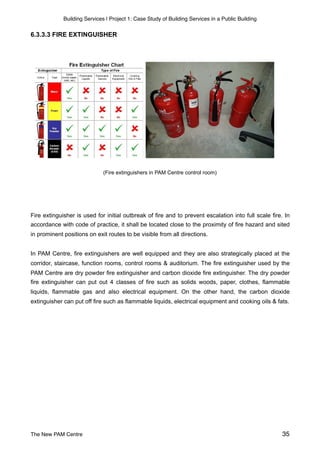
6.3.3.3 FIRE EXTINGUISHER
(Fire extinguishers in PAM Centre control room)
Fire extinguisher is used for initial outbreak of fire and to prevent escalation into full scale fire. In
accordance with code of practice, it shall be located close to the proximity of fire hazard and sited
in prominent positions on exit routes to be visible from all directions.
In PAM Centre, fire extinguishers are well equipped and they are also strategically placed at the
corridor, staircase, function rooms, control rooms & auditorium. The fire extinguisher used by the
PAM Centre are dry powder fire extinguisher and carbon dioxide fire extinguisher. The dry powder
fire extinguisher can put out 4 classes of fire such as solids woods, paper, clothes, flammable
liquids, flammable gas and also electrical equipment. On the other hand, the carbon dioxide
extinguisher can put off fire such as flammable liquids, electrical equipment and cooking oils & fats.
The New PAM Centre 35
Building Services | Project 1: Case Study of Building Services in a Public Building
6.4 PASSIVE FIRE PROTECTION IN PAM CENTRE
6.4.1 MEANS OF ESCAPE & FIREFIGHTERS ACCESS
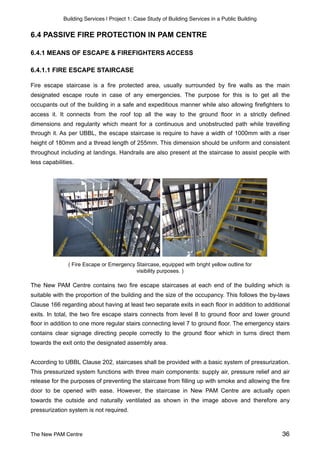
6.4.1.1 FIRE ESCAPE STAIRCASE
Fire escape staircase is a fire protected area, usually surrounded by fire walls as the main
designated escape route in case of any emergencies. The purpose for this is to get all the
occupants out of the building in a safe and expeditious manner while also allowing firefighters to
access it. It connects from the roof top all the way to the ground floor in a strictly defined
dimensions and regularity which meant for a continuous and unobstructed path while travelling
through it. As per UBBL, the escape staircase is require to have a width of 1000mm with a riser
height of 180mm and a thread length of 255mm. This dimension should be uniform and consistent
throughout including at landings. Handrails are also present at the staircase to assist people with
less capabilities.
( Fire Escape or Emergency Staircase, equipped with bright yellow outline for
visibility purposes. )
The New PAM Centre contains two fire escape staircases at each end of the building which is
suitable with the proportion of the building and the size of the occupancy. This follows the by-laws
Clause 166 regarding about having at least two separate exits in each floor in addition to additional
exits. In total, the two fire escape stairs connects from level 8 to ground floor and lower ground
floor in addition to one more regular stairs connecting level 7 to ground floor. The emergency stairs
contains clear signage directing people correctly to the ground floor which in turns direct them
towards the exit onto the designated assembly area.
According to UBBL Clause 202, staircases shall be provided with a basic system of pressurization.
This pressurized system functions with three main components: supply air, pressure relief and air
release for the purposes of preventing the staircase from filling up with smoke and allowing the fire
door to be opened with ease. However, the staircase in New PAM Centre are actually open
towards the outside and naturally ventilated as shown in the image above and therefore any
pressurization system is not required.
The New PAM Centre 36
Building Services | Project 1: Case Study of Building Services in a Public Building
Reference to UBBL 1984 (as at 1st November 2013):
Part VII, Clause 166. Exits to be accessible at all times.
(1) Except as permitted by By-law 167 not less than two separate exits shall be
provided from each storey together with such additional exits as may be
necessary.
(2) The exists shall be so sited and the exit access shall be so arranged that the
exits are within the limits of travel distance as specified in the Seventh
Schedule to these By-laws and are readily accessible at all times.
Part VII, Clause 168. Staircases.
(1) Except as provided for in by-law 194 every upper floor shall have means of
egress via at least two separate staircases.
(2) Staircases shall be of such width that in the event of any one staircase not
being available for escape purposes the remaining staircases shall
accommodate the highest occupancy load of any one floor discharging into it
calculated in accordance with provisions in the Seventh schedule to these By-
laws.
(3) The required width of a staircase shall be the clear width between walls but
handrails may be permitted to encroach on this width to a maximum of 75mm.
(4) The required width of a staircase shall be maintained throughout its length
including at landing.
(5) Doors giving access to staircases shall be so positioned that their swing shall at
no point encroach on the required width of the staircase or landing.
Part VII, Clause 169. Exits route.
No exit route may reduce in width along its path of travel from the storey exit to the
final exit.
Part VII, Clause 190. External Staircase.
Any permanently installed external staircase is acceptable as a required exit under the
same condition as an internal staircase:
Provided that such staircase shall comply with all the requirements for internal
staircases. External staircases shall be separated from the interior of the building by
walls and fire doors of the same fire resistance rating as required for internal
staircases.
The New PAM Centre 37
Building Services | Project 1: Case Study of Building Services in a Public Building
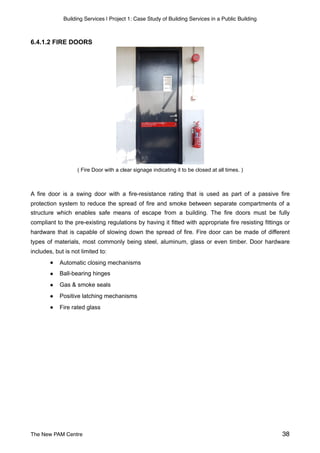
6.4.1.2 FIRE DOORS
( Fire Door with a clear signage indicating it to be closed at all times. )
A fire door is a swing door with a fire-resistance rating that is used as part of a passive fire
protection system to reduce the spread of fire and smoke between separate compartments of a
structure which enables safe means of escape from a building. The fire doors must be fully
compliant to the pre-existing regulations by having it fitted with appropriate fire resisting fittings or
hardware that is capable of slowing down the spread of fire. Fire door can be made of different
types of materials, most commonly being steel, aluminum, glass or even timber. Door hardware
includes, but is not limited to:
● Automatic closing mechanisms
● Ball-bearing hinges
● Gas & smoke seals
● Positive latching mechanisms
● Fire rated glass

The New PAM Centre 38
Building Services | Project 1: Case Study of Building Services in a Public Building
( [Left] Smoke Seal. [Middle] Automatic Door closing mechanism. [Right] Lock mechanism. )
New PAM Centre contains both single swing fire door and double swing fire door. Doors that are
specifically being used in the building is made out of solid hardwood core with assumpted fire-
resistance rating of half hour based on provision given in UBBL Clause 163, Half hour and one
hour doors. Vision panel or small windows is glazed with 6mm Georgian Wire Glass to prevent
hitting or obstructing another person while evacuating. Furthermore, it is equipped with automatic
door closers of the hydraulically spring operated type. This allows the doors to be closed at all
times whenever no one is using it to prevent fire entering the closure.
The New PAM Centre 39
Building Services | Project 1: Case Study of Building Services in a Public Building
6.4.1.3 DOOR RELEASE MECHANISM
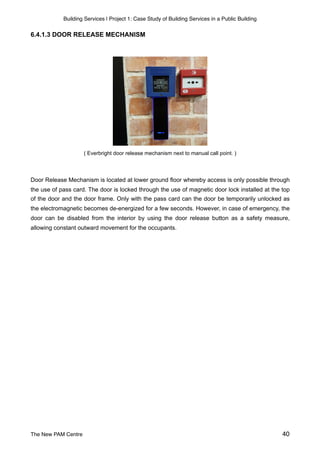
( Everbright door release mechanism next to manual call point. )
Door Release Mechanism is located at lower ground floor whereby access is only possible through
the use of pass card. The door is locked through the use of magnetic door lock installed at the top
of the door and the door frame. Only with the pass card can the door be temporarily unlocked as
the electromagnetic becomes de-energized for a few seconds. However, in case of emergency, the
door can be disabled from the interior by using the door release button as a safety measure,
allowing constant outward movement for the occupants.
The New PAM Centre 40
Building Services | Project 1: Case Study of Building Services in a Public Building
Reference to UBBL 1984 (as at 1st November 2013):
Part VII, Clause 162. Fire doors in compartment walls and separating walls.
(1) Fire doors of the appropriate Fire-rated Protection (FRP) shall be provided
(2) Openings in compartment walls and separating walls shall be protected by a
fire door having FRP in accordance with the requirements for that wall specified
in the Ninth Schedule to these By-laws.
(3) Openings in protecting structures shall be protected by fire doors having FRP
of not less than half the requirement for the surrounding wall specified in the
Ninth Schedule to these By-laws but in no case less than half hour.
(4) Openings in partitions enclosing a protected corridor or lobby shall be protected
by fire doors having FRP of half-hour.
(5) Fire doors including frames shall be constructed to a specification which can be
shown to meet the requirements for the relevant FRP when tested in
accordance with Section 3 of BS 476:1951.
Part VII, Clause 163. Half hour & One hour doors.
Fire doors conforming to the method of construction as stipulated below shall be
deemed to meet the requirements of the specified FRP:
(a) Doors and frames constructed in accordance with one of the following
specifications shall be deemed to satisfy the requirements for door having FRP
of half-hour:
(1) A single door 900mm wide x 2100mm high maximum or double doors
1800mm x 2100 high maximum constructed of solid hardwood core of
not less than 37mm laminated with adhesives conforming to either BS
745 “Animal Glues”, or BS 1204, “Synthetic resin adhesives (phenolic
and aminoplastic) for wood” Part 1, “Gap-filling adhesives”, or BS 1444,
“Cold-setting casein glue for wood”, faced both sides with plywood to a
total thickness of not less than 43mm with all edges finished with a solid
edge strip full width of the door. The meeting stiles of double doors shall
be rabbeted 12mm deep or may be butted provided the clearance is
kept to a minimum;
(2) Doors may be double swing provided they are mounted on hydraulic
floor springs and clearance at floor not exceeding 4.77mm and frames
and meeting stiles not exceeding 3mm;
(3) A vision panel may be incorporated provided it does not exceed 0.065
square metre per leaf with no dimension more than 1370mm and it is
glazed with 6mm Georgian Wired Glass in hardwood stops;
(4) Doors constructed in accordance with BS No. 456: Part 3: 1951 Fire
Check Flush Doors and Wood and Metal Frames (Half-Hour Type);
(5) Timber frames for single swing half-hour fire doors of overall width of
The New PAM Centre 41
Building Services | Project 1: Case Study of Building Services in a Public Building
6.4.1.4 EXIT SIGN
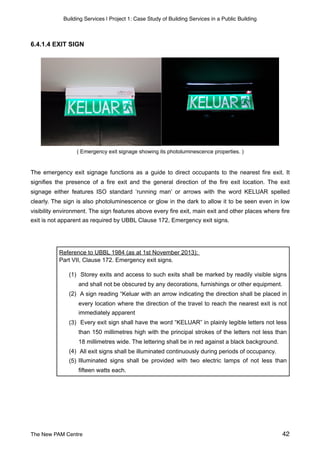
( Emergency exit signage showing its photoluminescence properties. )
The emergency exit signage functions as a guide to direct occupants to the nearest fire exit. It
signifies the presence of a fire exit and the general direction of the fire exit location. The exit
signage either features ISO standard ‘running man’ or arrows with the word KELUAR spelled
clearly. The sign is also photoluminescence or glow in the dark to allow it to be seen even in low
visibility environment. The sign features above every fire exit, main exit and other places where fire
exit is not apparent as required by UBBL Clause 172, Emergency exit signs.
Reference to UBBL 1984 (as at 1st November 2013):
Part VII, Clause 172. Emergency exit signs.
(1) Storey exits and access to such exits shall be marked by readily visible signs
and shall not be obscured by any decorations, furnishings or other equipment.
(2) A sign reading “Keluar with an arrow indicating the direction shall be placed in
every location where the direction of the travel to reach the nearest exit is not
immediately apparent
(3) Every exit sign shall have the word “KELUAR” in plainly legible letters not less
than 150 millimetres high with the principal strokes of the letters not less than
18 millimetres wide. The lettering shall be in red against a black background.
(4) All exit signs shall be illuminated continuously during periods of occupancy.
(5) Illuminated signs shall be provided with two electric lamps of not less than
fifteen watts each.
The New PAM Centre 42
Building Services | Project 1: Case Study of Building Services in a Public Building
6.4.1.5 FIRE ESCAPE PLAN
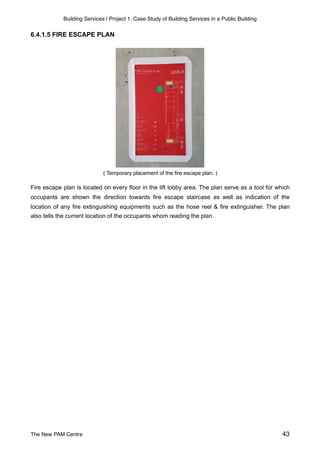
( Temporary placement of the fire escape plan. )
Fire escape plan is located on every floor in the lift lobby area. The plan serve as a tool for which
occupants are shown the direction towards fire escape staircase as well as indication of the
location of any fire extinguishing equipments such as the hose reel & fire extinguisher. The plan
also tells the current location of the occupants whom reading the plan.
The New PAM Centre 43
Building Services | Project 1: Case Study of Building Services in a Public Building
6.4.2 COMPARTMENTATION
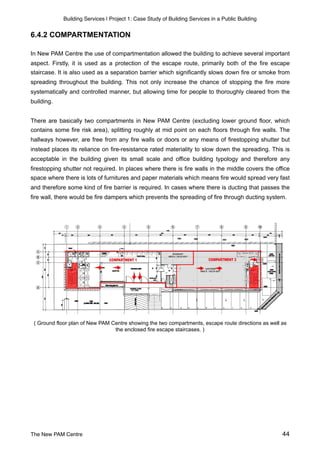
In New PAM Centre the use of compartmentation allowed the building to achieve several important
aspect. Firstly, it is used as a protection of the escape route, primarily both of the fire escape
staircase. It is also used as a separation barrier which significantly slows down fire or smoke from
spreading throughout the building. This not only increase the chance of stopping the fire more
systematically and controlled manner, but allowing time for people to thoroughly cleared from the
building.
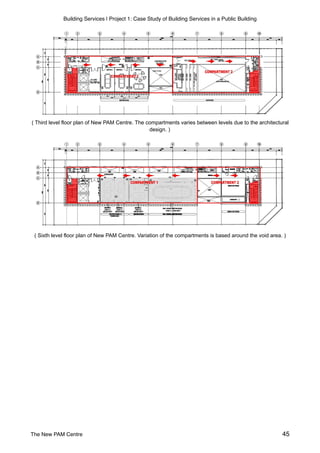
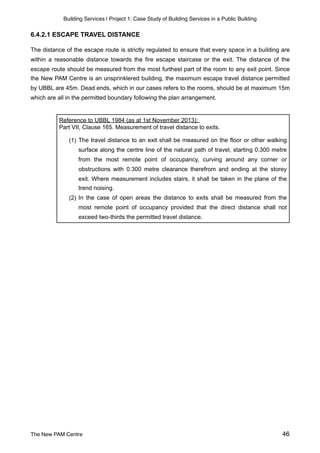
There are basically two compartments in New PAM Centre (excluding lower ground floor, which
contains some fire risk area), splitting roughly at mid point on each floors through fire walls. The
hallways however, are free from any fire walls or doors or any means of firestopping shutter but
instead places its reliance on fire-resistance rated materiality to slow down the spreading. This is
acceptable in the building given its small scale and office building typology and therefore any
firestopping shutter not required. In places where there is fire walls in the middle covers the office
space where there is lots of furnitures and paper materials which means fire would spread very fast
and therefore some kind of fire barrier is required. In cases where there is ducting that passes the
fire wall, there would be fire dampers which prevents the spreading of fire through ducting system.
( Ground floor plan of New PAM Centre showing the two compartments, escape route directions as well as
the enclosed fire escape staircases. )
The New PAM Centre 44
Building Services | Project 1: Case Study of Building Services in a Public Building
( Third level floor plan of New PAM Centre. The compartments varies between levels due to the architectural
design. )
( Sixth level floor plan of New PAM Centre. Variation of the compartments is based around the void area. )
The New PAM Centre 45
Building Services | Project 1: Case Study of Building Services in a Public Building
6.4.2.1 ESCAPE TRAVEL DISTANCE
The distance of the escape route is strictly regulated to ensure that every space in a building are
within a reasonable distance towards the fire escape staircase or the exit. The distance of the
escape route should be measured from the most furthest part of the room to any exit point. Since
the New PAM Centre is an unsprinklered building, the maximum escape travel distance permitted
by UBBL are 45m. Dead ends, which in our cases refers to the rooms, should be at maximum 15m
which are all in the permitted boundary following the plan arrangement.
Reference to UBBL 1984 (as at 1st November 2013):
Part VII, Clause 165. Measurement of travel distance to exits.
(1) The travel distance to an exit shall be measured on the floor or other walking
surface along the centre line of the natural path of travel, starting 0.300 metre
from the most remote point of occupancy, curving around any corner or
obstructions with 0.300 metre clearance therefrom and ending at the storey
exit. Where measurement includes stairs, it shall be taken in the plane of the
trend noising.
(2) In the case of open areas the distance to exits shall be measured from the
most remote point of occupancy provided that the direct distance shall not
exceed two-thirds the permitted travel distance.
The New PAM Centre 46
Building Services | Project 1: Case Study of Building Services in a Public Building
6.4.3 FIRE RATED BUILDING MATERIAL
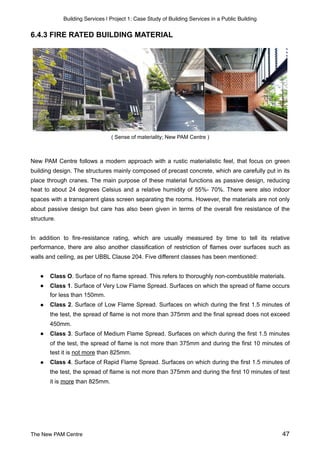
( Sense of materiality; New PAM Centre )
New PAM Centre follows a modern approach with a rustic materialistic feel, that focus on green
building design. The structures mainly composed of precast concrete, which are carefully put in its
place through cranes. The main purpose of these material functions as passive design, reducing
heat to about 24 degrees Celsius and a relative humidity of 55%- 70%. There were also indoor
spaces with a transparent glass screen separating the rooms. However, the materials are not only
about passive design but care has also been given in terms of the overall fire resistance of the
structure.
In addition to fire-resistance rating, which are usually measured by time to tell its relative
performance, there are also another classification of restriction of flames over surfaces such as
walls and ceiling, as per UBBL Clause 204. Five different classes has been mentioned:
● Class O. Surface of no flame spread. This refers to thoroughly non-combustible materials.
● Class 1. Surface of Very Low Flame Spread. Surfaces on which the spread of flame occurs
for less than 150mm.
● Class 2. Surface of Low Flame Spread. Surfaces on which during the first 1.5 minutes of
the test, the spread of flame is not more than 375mm and the final spread does not exceed
450mm.
● Class 3. Surface of Medium Flame Spread. Surfaces on which during the first 1.5 minutes
of the test, the spread of flame is not more than 375mm and during the first 10 minutes of
test it is not more than 825mm.
● Class 4. Surface of Rapid Flame Spread. Surfaces on which during the first 1.5 minutes of
the test, the spread of flame is not more than 375mm and during the first 10 minutes of test
it is more than 825mm.
The New PAM Centre 47
Building Services | Project 1: Case Study of Building Services in a Public Building
6.4.3.1 PRE-CAST CONCRETE
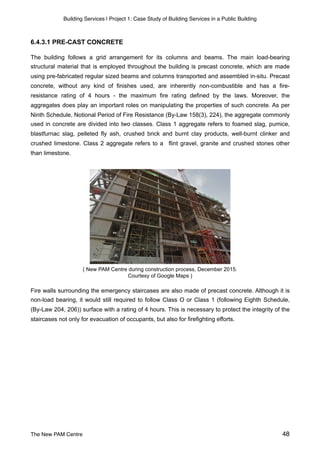
The building follows a grid arrangement for its columns and beams. The main load-bearing
structural material that is employed throughout the building is precast concrete, which are made
using pre-fabricated regular sized beams and columns transported and assembled in-situ. Precast
concrete, without any kind of finishes used, are inherently non-combustible and has a fire-
resistance rating of 4 hours - the maximum fire rating defined by the laws. Moreover, the
aggregates does play an important roles on manipulating the properties of such concrete. As per
Ninth Schedule, Notional Period of Fire Resistance (By-Law 158(3), 224), the aggregate commonly
used in concrete are divided into two classes. Class 1 aggregate refers to foamed slag, pumice,
blastfurnac slag, pelleted fly ash, crushed brick and burnt clay products, well-burnt clinker and
crushed limestone. Class 2 aggregate refers to a flint gravel, granite and crushed stones other
than limestone.


( New PAM Centre during construction process, December 2015.
Courtesy of Google Maps )
Fire walls surrounding the emergency staircases are also made of precast concrete. Although it is
non-load bearing, it would still required to follow Class O or Class 1 (following Eighth Schedule,
(By-Law 204, 206)) surface with a rating of 4 hours. This is necessary to protect the integrity of the
staircases not only for evacuation of occupants, but also for firefighting efforts.
The New PAM Centre 48
Building Services | Project 1: Case Study of Building Services in a Public Building
6.4.3.2 MASONRY
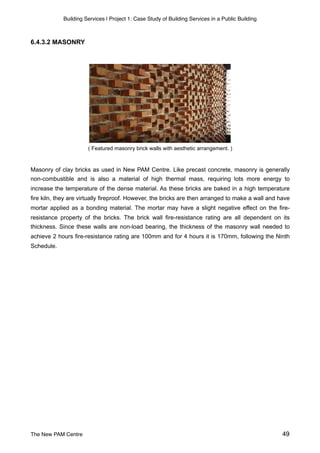
( Featured masonry brick walls with aesthetic arrangement. )
Masonry of clay bricks as used in New PAM Centre. Like precast concrete, masonry is generally
non-combustible and is also a material of high thermal mass, requiring lots more energy to
increase the temperature of the dense material. As these bricks are baked in a high temperature
fire kiln, they are virtually fireproof. However, the bricks are then arranged to make a wall and have
mortar applied as a bonding material. The mortar may have a slight negative effect on the fire-
resistance property of the bricks. The brick wall fire-resistance rating are all dependent on its
thickness. Since these walls are non-load bearing, the thickness of the masonry wall needed to
achieve 2 hours fire-resistance rating are 100mm and for 4 hours it is 170mm, following the Ninth
Schedule.
The New PAM Centre 49
Building Services | Project 1: Case Study of Building Services in a Public Building
6.4.3.3 STEEL ELEMENTS
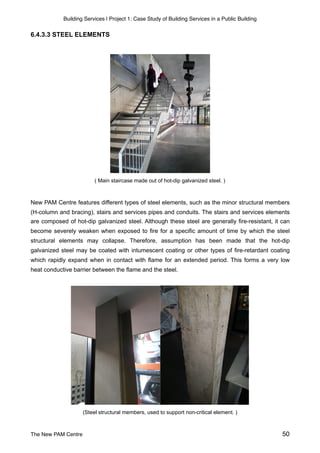
( Main staircase made out of hot-dip galvanized steel. )
New PAM Centre features different types of steel elements, such as the minor structural members
(H-column and bracing), stairs and services pipes and conduits. The stairs and services elements
are composed of hot-dip galvanized steel. Although these steel are generally fire-resistant, it can
become severely weaken when exposed to fire for a specific amount of time by which the steel
structural elements may collapse. Therefore, assumption has been made that the hot-dip
galvanized steel may be coated with intumescent coating or other types of fire-retardant coating
which rapidly expand when in contact with flame for an extended period. This forms a very low
heat conductive barrier between the flame and the steel.
(Steel structural members, used to support non-critical element. )
The New PAM Centre 50
Building Services | Project 1: Case Study of Building Services in a Public Building
In terms of steel structural members, there are two method employed as means of making it fire-
resistance. First is the application of intumescent fire-retardant coating as mentioned above.
Second is the use of solid protection through concrete not leaner than 1:2:4 mix. This allows the
steel members to achieve up to 2 hours and 4 hours of fire-resistance period respectively,
depending on thickness of protection material.
6.4.3.4 ALUMINIUM CLADDING
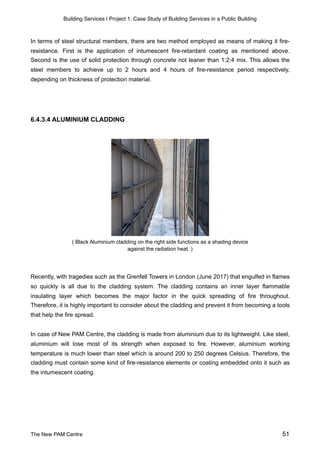
( Black Aluminium cladding on the right side functions as a shading device
against the radiation heat. )
Recently, with tragedies such as the Grenfell Towers in London (June 2017) that engulfed in flames
so quickly is all due to the cladding system. The cladding contains an inner layer flammable
insulating layer which becomes the major factor in the quick spreading of fire throughout.
Therefore, it is highly important to consider about the cladding and prevent it from becoming a tools
that help the fire spread.
In case of New PAM Centre, the cladding is made from aluminium due to its lightweight. Like steel,
aluminium will lose most of its strength when exposed to fire. However, aluminium working
temperature is much lower than steel which is around 200 to 250 degrees Celsius. Therefore, the
cladding must contain some kind of fire-resistance elements or coating embedded onto it such as
the intumescent coating.
The New PAM Centre 51
Building Services | Project 1: Case Study of Building Services in a Public Building
7.0 MECHANICAL VENTILATION
SYSTEMS
BY: PREMDYL SINGH SHADAN
The New PAM Centre 52
Building Services | Project 1: Case Study of Building Services in a Public Building
7.1 INTRODUCTION
Ventilation is the intentional process where fresh air is introduced into a building or a space to
control indoor air quality by diluting or removing indoor pollutants. Ventilation is not only a process
to ensure hygiene but also to improve thermal comfort, humidity, odours and the prevention of
mould. The creation and movement of air between indoor and outdoor allows this to happen.
When designing a building, there are certain requirements for the amount of fresh air supplied into
the building depending on the usage and function of that particular space and or room.
Ventilation can be classified into two categories; natural or mechanical. Natural Ventilation, or
commonly known as passive ventilation, heavily relies on the natural outside air movement and
pressure differences to both passively cool and ventilate a building. Buildings in hot or tropical
regions, such as Malaysia, try to implement the usage of natural ventilation to help with building's
cooling loads while being ‘energy-saving’ as the usage of mechanical air conditioning systems
decrease.
On the other hand, mechanical ventilation, other known as forced ventilation, is controlled by the
usage by mechanical means such as fans, air conditioning units, etc. Mechanical ventilation is
used in buildings when in certain cases, natural ventilation is not efficient enough- for example:
1. The building is too deep to ventilate from the perimeter.
2. The building’s surrounding air quality and noise are poor.
3. The density of the area is dense leading to the lack of natural wind from entering.
4. Privacy is compromised if natural ventilation is used.
5. Too many partition within the buildings floor span, leading to blocked air paths.
6. Density and usage of building creates high heat loads that is not able to be removed efficiently
with natural ventilation.
The New PAM Centre 53
Building Services | Project 1: Case Study of Building Services in a Public Building
7.2 UBBL COMPLIANCE
According to the UBBL 1984 Mechanical Ventilation and Air Conditioning (41.), these are the
requirements a building in Malaysia must follow:
1. Where permanent mechanical ventilation or air-conditioning is intended, the relevant building
by-laws relating to natural-ventilation, natural lighting and heights of rooms may be waived at
the discretion of the local authority.
2. Any application for the waiver of the relevant by-laws shall only be considered if in addition to
the permanent air-conditioning system there is provided alternative approved means of
ventilating the air-conditioned enclosure, such that within half an hour of the air-conditioning
system failing, not less than the stipulated volume of fresh air specified here in a after shall be
introduced into the enclosure during the period when the air-conditioning system is not
functioning.
3. The provisions of the Third Schedule to these By-laws shall apply to buildings which are
mechanical ventilated or air-conditioned.
4. Where permanent mechanical ventilation in respect of lavatories, water-closets, bathrooms or
corridors is provided for and maintained in accordance with the requirements of the Third
Schedule to these By-laws, the provisions of these By-laws relating to natural ventilation and
natural lighting shall to apply to such lavatories, water-closets, bathrooms or corridors. 

The New PAM Centre 54
Building Services | Project 1: Case Study of Building Services in a Public Building
7.3 LITERATURE REVIEW
Mechanical ventilation systems allow fresh air using ducts and fans rather than relying on natural
airflow through small holes in a building’s roof, windows or wall. The system not only allows the
input of fresh air, however removes the stale air trapped indoor, keeping distant from ‘sick building’
syndrome. Mechanical Ventilation allows homeowners to breath easier knowing that there is
constant distribution of clean air indoors.
7.3.1 BASIC VENTILATION SYSTEMS
The basic ventilation system mainly have two components; the fan and a makeup supply. The fan
is used to remove stale, unwanted and polluted air from inside the building whilst the makeup
supply restores fresh air supply back into the building. The air taken by the makeup supply is taken
from the exterior atmosphere of the building. The suction of the air created by the fan creates
pressure within the space, forcing air to travel form the supply point (exterior) to the pickup point
(interior). The extractor fan, the most basic mechanical ventilation system, is found mainly in
domestic bathrooms and kitchens to remove unwanted smells and fumes from the space.
7.3.2 TYPES OF MECHANICAL VENTILATION SYSTEMS
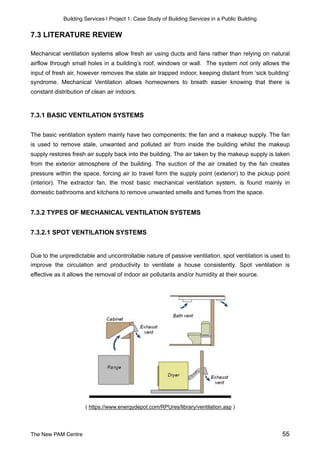
7.3.2.1 SPOT VENTILATION SYSTEMS
Due to the unpredictable and uncontrollable nature of passive ventilation, spot ventilation is used to
improve the circulation and productivity to ventilate a house consistently. Spot ventilation is
effective as it allows the removal of indoor air pollutants and/or humidity at their source.
( https://www.energydepot.com/RPUres/library/ventilation.asp )
The New PAM Centre 55
Building Services | Project 1: Case Study of Building Services in a Public Building
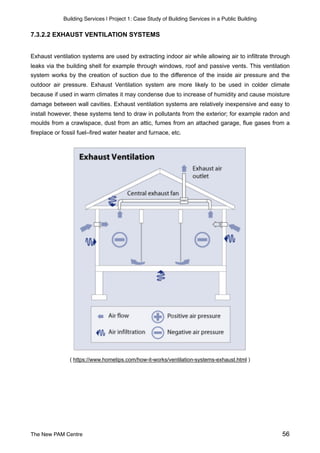
7.3.2.2 EXHAUST VENTILATION SYSTEMS
Exhaust ventilation systems are used by extracting indoor air while allowing air to infiltrate through
leaks via the building shell for example through windows, roof and passive vents. This ventilation
system works by the creation of suction due to the difference of the inside air pressure and the
outdoor air pressure. Exhaust Ventilation system are more likely to be used in colder climate
because if used in warm climates it may condense due to increase of humidity and cause moisture
damage between wall cavities. Exhaust ventilation systems are relatively inexpensive and easy to
install however, these systems tend to draw in pollutants from the exterior; for example radon and
moulds from a crawlspace, dust from an attic, fumes from an attached garage, flue gases from a
fireplace or fossil fuel–fired water heater and furnace, etc.
( https://www.hometips.com/how-it-works/ventilation-systems-exhaust.html )
The New PAM Centre 56
Building Services | Project 1: Case Study of Building Services in a Public Building
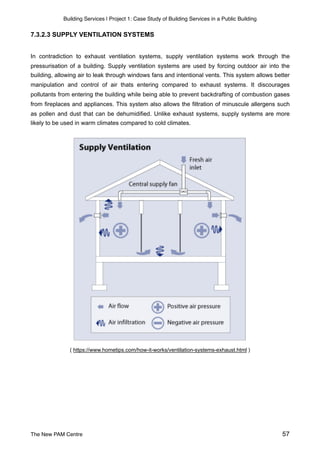
7.3.2.3 SUPPLY VENTILATION SYSTEMS
In contradiction to exhaust ventilation systems, supply ventilation systems work through the
pressurisation of a building. Supply ventilation systems are used by forcing outdoor air into the
building, allowing air to leak through windows fans and intentional vents. This system allows better
manipulation and control of air thats entering compared to exhaust systems. It discourages
pollutants from entering the building while being able to prevent backdrafting of combustion gases
from fireplaces and appliances. This system also allows the filtration of minuscule allergens such
as pollen and dust that can be dehumidified. Unlike exhaust systems, supply systems are more
likely to be used in warm climates compared to cold climates.
( https://www.hometips.com/how-it-works/ventilation-systems-exhaust.html )
The New PAM Centre 57
Building Services | Project 1: Case Study of Building Services in a Public Building
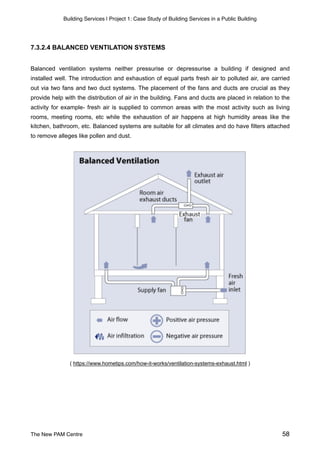
7.3.2.4 BALANCED VENTILATION SYSTEMS
Balanced ventilation systems neither pressurise or depressurise a building if designed and
installed well. The introduction and exhaustion of equal parts fresh air to polluted air, are carried
out via two fans and two duct systems. The placement of the fans and ducts are crucial as they
provide help with the distribution of air in the building. Fans and ducts are placed in relation to the
activity for example- fresh air is supplied to common areas with the most activity such as living
rooms, meeting rooms, etc while the exhaustion of air happens at high humidity areas like the
kitchen, bathroom, etc. Balanced systems are suitable for all climates and do have filters attached
to remove alleges like pollen and dust.
( https://www.hometips.com/how-it-works/ventilation-systems-exhaust.html )
The New PAM Centre 58
Building Services | Project 1: Case Study of Building Services in a Public Building
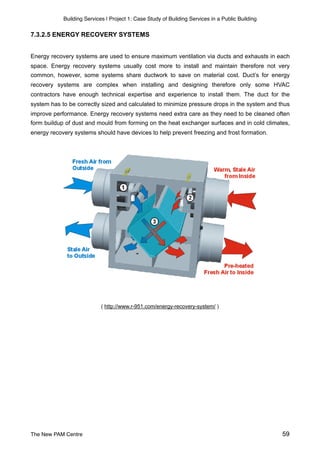
7.3.2.5 ENERGY RECOVERY SYSTEMS
Energy recovery systems are used to ensure maximum ventilation via ducts and exhausts in each
space. Energy recovery systems usually cost more to install and maintain therefore not very
common, however, some systems share ductwork to save on material cost. Duct’s for energy
recovery systems are complex when installing and designing therefore only some HVAC
contractors have enough technical expertise and experience to install them. The duct for the
system has to be correctly sized and calculated to minimize pressure drops in the system and thus
improve performance. Energy recovery systems need extra care as they need to be cleaned often
form buildup of dust and mould from forming on the heat exchanger surfaces and in cold climates,
energy recovery systems should have devices to help prevent freezing and frost formation.
( http://www.r-951.com/energy-recovery-system/ )
The New PAM Centre 59
Building Services | Project 1: Case Study of Building Services in a Public Building
7.3.3 TYPES OF MECHANICAL VENTILATION SYSTEMS
There are 5 components that can be found in a complete mechanical ventilation system:
1. Fan
2. Filter
3. Ductwork
4. Fire Damper
5. Diffuser
7.3.3.1 FAN
One of the most important components in a mechanical ventilation system as the fan provides
sufficient extraction and supply to the building. The fan forces air through inlets that spread through
the building allowing ventilation in all spaces. There are three types of fans being:
1. Propellor Fan
2. Axial Fan
3. Centrifugal Fan
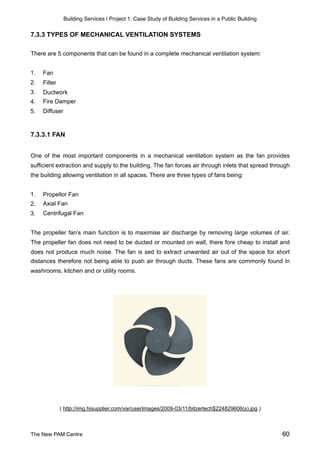
The propeller fan’s main function is to maximise air discharge by removing large volumes of air.
The propeller fan does not need to be ducted or mounted on wall, there fore cheap to install and
does not produce much noise. The fan is sed to extract unwanted air out of the space for short
distances therefore not being able to push air through ducts. These fans are commonly found in
washrooms, kitchen and or utility rooms.
( http://img.hisupplier.com/var/userImages/2009-03/11/bitzertech$224829606(s).jpg )
The New PAM Centre 60
Building Services | Project 1: Case Study of Building Services in a Public Building
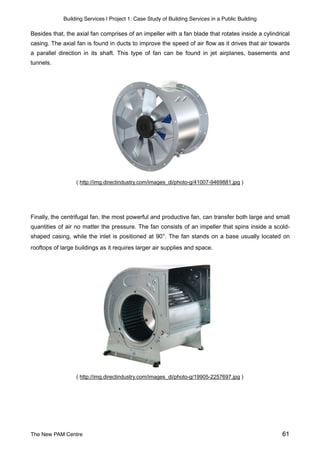
Besides that, the axial fan comprises of an impeller with a fan blade that rotates inside a cylindrical
casing. The axial fan is found in ducts to improve the speed of air flow as it drives that air towards
a parallel direction in its shaft. This type of fan can be found in jet airplanes, basements and
tunnels.
( http://img.directindustry.com/images_di/photo-g/41007-9469881.jpg )
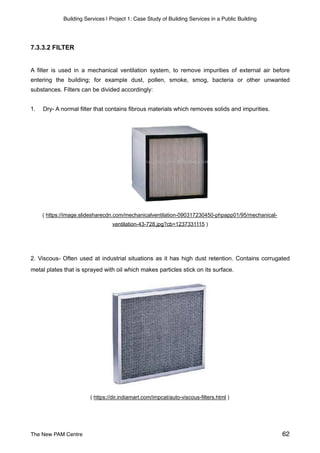
Finally, the centrifugal fan, the most powerful and productive fan, can transfer both large and small
quantities of air no matter the pressure. The fan consists of an impeller that spins inside a scold-
shaped casing, while the inlet is positioned at 90°. The fan stands on a base usually located on
rooftops of large buildings as it requires larger air supplies and space.
( http://img.directindustry.com/images_di/photo-g/19905-2257697.jpg )
The New PAM Centre 61
Building Services | Project 1: Case Study of Building Services in a Public Building
7.3.3.2 FILTER
A filter is used in a mechanical ventilation system, to remove impurities of external air before
entering the building; for example dust, pollen, smoke, smog, bacteria or other unwanted
substances. Filters can be divided accordingly:
1. Dry- A normal filter that contains fibrous materials which removes solids and impurities.
( https://image.slidesharecdn.com/mechanicalventilation-090317230450-phpapp01/95/mechanical-
ventilation-43-728.jpg?cb=1237331115 )
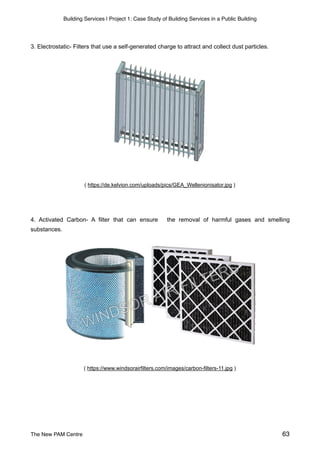
2. Viscous- Often used at industrial situations as it has high dust retention. Contains corrugated
metal plates that is sprayed with oil which makes particles stick on its surface.
( https://dir.indiamart.com/impcat/auto-viscous-filters.html )
The New PAM Centre 62
Building Services | Project 1: Case Study of Building Services in a Public Building
3. Electrostatic- Filters that use a self-generated charge to attract and collect dust particles.
( https://de.kelvion.com/uploads/pics/GEA_Wellenionisator.jpg )
4. Activated Carbon- A filter that can ensure the removal of harmful gases and smelling
substances.
( https://www.windsorairfilters.com/images/carbon-filters-11.jpg )
The New PAM Centre 63
Building Services | Project 1: Case Study of Building Services in a Public Building
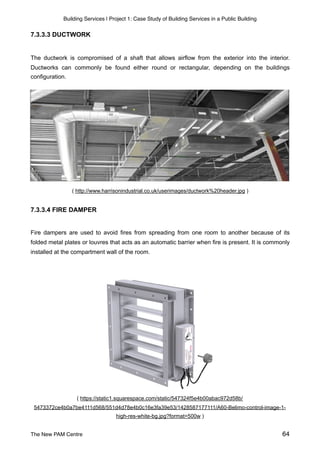
7.3.3.3 DUCTWORK
The ductwork is compromised of a shaft that allows airflow from the exterior into the interior.
Ductworks can commonly be found either round or rectangular, depending on the buildings
configuration.
( http://www.harrisonindustrial.co.uk/userimages/ductwork%20header.jpg )
7.3.3.4 FIRE DAMPER
Fire dampers are used to avoid fires from spreading from one room to another because of its
folded metal plates or louvres that acts as an automatic barrier when fire is present. It is commonly
installed at the compartment wall of the room.
( https://static1.squarespace.com/static/547324f5e4b00abac972d58b/
5473372ce4b0a7be4111d568/551d4d78e4b0c16e3fa39e53/1428587177111/A60-Belimo-control-image-1-
high-res-white-bg.jpg?format=500w )
The New PAM Centre 64
Building Services | Project 1: Case Study of Building Services in a Public Building
7.3.3.5 DIFFUSER
The diffuser, also known as a grille, is located at the edge of the ductwork where the air is released
into the room to evenly spread out the airflow into the space .
( http://img.archiexpo.com/images_ae/photo-g/62712-2211315.jpg )
The New PAM Centre 65
Building Services | Project 1: Case Study of Building Services in a Public Building
7.4 MECHANICAL VENTILATION IN THE NEW PAM BUILDING
The New PAM building is an excellent building that serves as a case-study for all buildings to follow
as low energy building as mentioned before. Therefore, this Platinum rated building, by the Green
Building Index, uses plenty of passive ventilation in its design to reduce the dependence on
mechanical ventilation thus, only using certain types of systems, being- propeller fans and the spot
ventilation system. Although it does not require much assistance of mechanical ventilation system,
the New PAM Building provides occupants with ultimate safety and comfort.
7.4.1 SPOT VENTILATION SYSTEMS
The New PAM Centre uses extract spot ventilation in certain areas- washing area inside the prayer
room and the cafe’s kitchen. The reason for using this type of mechanical ventilation system, can
tell us that this enclosed space lacks of good airflow, thus resulting in the addition of the system.
The lack of airflow without the system, may cause the enclosed space to always remain wet,
leading to a stench and high humidity that can result in the growth of mound and decay of walls.
( Spot Ventilation System that was spotted in the kitchen )
The New PAM Centre 66
Building Services | Project 1: Case Study of Building Services in a Public Building
7.4.2 AIR HANDLING UNIT (AHU)
The function of the Air Handling Unit (AHU) is to distribute clean cold or hot air (depending on the
climate) within the building. Each AHU distributes fresh air to the floor level where it’s placed,
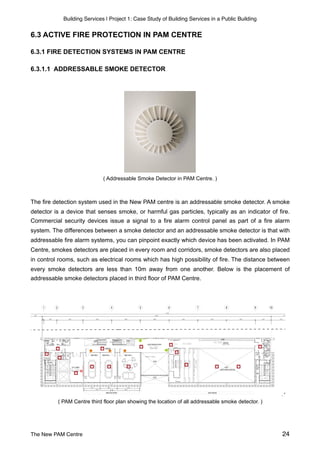
however in the New PAM building there are AHU units located on level 8, the rooftop. From there,
the ducts distribute and extract air into different spaces on the other floors. In the AHU unit, an
axial fan is used to ensures the proper cooling of the unit.
( Axial Fan that was spotted in the AHU )
The New PAM Centre 67
Building Services | Project 1: Case Study of Building Services in a Public Building
7.4.3 PROPELLER FANS
The New PAM Centre uses big ceiling propeller fans that is placed at every open space of the
building, to improve cool the surrounding air by aiding natural ventilation. The propeller fan uses
the wind chill effect, where as the fan runs anti-clockwise, the air is pushed down, forcing the
space to be cooler than usual.
( Propeller Fan that was spotted in open spaces )
The New PAM Centre 68
Building Services | Project 1: Case Study of Building Services in a Public Building
7.5 CONCLUSION
In conclusion, mechanical ventilation systems are vital to a building as without it, the supply of air
into the building is not sufficient enough and not safe enough for human usage. The New PAM
Building, is a good example of the integration of mechanical ventilation systems and passive
ventilation as it helps strengthen each other, rather than trying to dispose of one another. The
mechanical ventilation systems used all follow the UBBL requirements as each system is equipped
with a readily accessible switch or other means for shut-off or volume reduction when ventilation is
not required. Therefore, the New PAM Building has heavily taken mechanical ventilation systems
into the design considerations of the building.
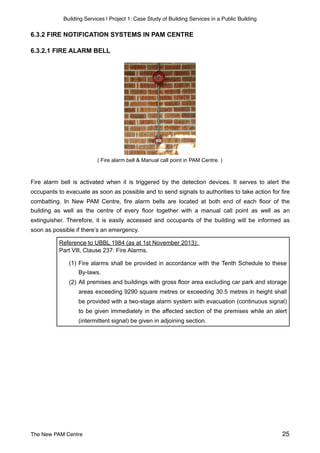
The New PAM Centre 69
Building Services | Project 1: Case Study of Building Services in a Public Building
8.0 AIR-CONDITIONING
SYSTEMS
BY: NEVILLE GEOFFERY SOMI
The New PAM Centre 70
Building Services | Project 1: Case Study of Building Services in a Public Building
8.1 INTRODUCTION
Air Conditioning (AC) serves the main purpose of achieving thermal comfort and maintaining the
indoor quality within a building, it is described as the technology of indoor and vernacular comfort.
It achieves its goal by replacing the indoor air with fresh air as well as changing the air properties
within the building by controlling the temperature, humidity to a more suitable and comfort
environment. In common use an air conditioner is a device that removes heat from the air inside a
building thus lowering the air temperature. The cooling is typically achieved through a refrigeration
cycle.
8.2 LITERATURE REVIEW
The main use of air conditioning is to control the air within the building. Air conditioning is the
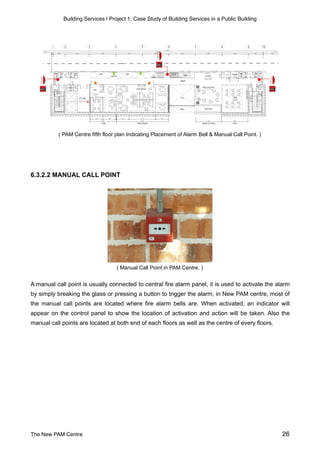
process of altering the properties of air primarily the temperature and humidity through mechanical
means.it can also be referred as the total control of temperature, air humidity and air cleanliness.
Every building that uses air conditioner has its own conditioning system that can convert the
humidity and temperature in a building as well as air ducts that control the flow of air within the
building, different air conditioning system has different advantages and is chosen depending on
requirements of the building. AIr conditioning basically work by removing heat from the air inside
the room and releasing this collected heat into the air outdoors.
8.2.1 OPERATING PRINCIPLES OF AIR COOLING
Air particles change from gas state to liquid state at certain point under compression.
During the process, latent heat is released from the gas whereas large amount of latent
heat is absorbed when the pressure is decreased in liquid particles as vaporization occurs
in gas.
Air conditioning system works in a way that it absorbs heat in a room, collects and
releases to the outside. The system is constantly circulating air in the room and
temperature is constantly decreasing.
The types of air conditioning that are being used are split system, windowed or VRF
system. The systems utilized are refrigeration cycle and air cycle.
The New PAM Centre 71
Building Services | Project 1: Case Study of Building Services in a Public Building
8.2.1.1 REFRIGERATION CYCLE
(Process of extracting heat from a lower temperature heat source/cooling medium and transferring
it to a higher temperature heat.)
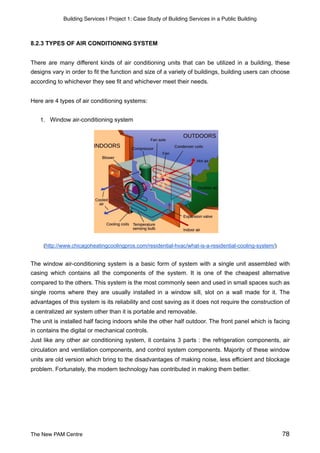
Refrigeration Cycle Process:
● The refrigerant comes into the compressor as a low-pressure gas, it is compressed and
then moves out of the compressor as a high-pressure gas.
● The gas then flows to the condenser. Here the gas condenses to a liquid, and gives off its
heat to the outside air.
● The liquid then moves to the expansion valve under high pressure. This valve restricts the
flow of the fluid, and lowers its pressure as it leaves the expansion valve.
● The low-pressure liquid then moves to the evaporator, where heat from the inside air is
absorbed and changes it from a liquid to a gas.
● As a hot low-pressure gas, the refrigerant moves to the compressor where the entire cycle
is repeated.
The New PAM Centre 72
Building Services | Project 1: Case Study of Building Services in a Public Building
8.2.1.2 COMPONENTS OF A REFRIGERATION CYCLE
Types of components Function
A c o m p r e s s o r c o m p r e s s e s t h e
refrigerant vapor from the evaporator
and pumps the refrigerant throughout the
system.
The vapor is pumped into the condenser
after compression when the vapor
reaches temperature as high as 200’F
The refrigerant changes from vapor to
liquid in the condenser. While this
change of state is taking place, a great
amount of heat is released.
A valve or small fixed-size tubing or
orifice that meters liquid refrigerant into
the evaporator which allows expansion
by removing pressure.
Expansion Valve
Compressor
Condenser
The New PAM Centre 73
Building Services | Project 1: Case Study of Building Services in a Public Building
The function of an evaporator is to
provide a heat-absorbing surface. A coil
of pipe where the refrigerant inside is
vaporizing and absorbing heat, while the
air blown over the surface of this pipe is
cooled .
Evaporator
The New PAM Centre 74
Building Services | Project 1: Case Study of Building Services in a Public Building
8.2.2 AIR CYCLE PROCESS
(Example of air cycle between room and the air handling unit (AHU))
Air cycle is a process to distribute treated air into the room that needs to be conditioned. Latent
heat inside the room is removed when the return air is absorbed by the evaporator. The medium to
absorb the heat can be either air or water. Distribution of air can be either through ducts or chilled
water pipes. Heat inside the room is removed and slowly the internal air becomes cooler. The
system works by compressing air and removing the heat contained, then expands the air to a lower
temperature.
The New PAM Centre 75
Building Services | Project 1: Case Study of Building Services in a Public Building
8.2.2.1 COMPONENTS IN AIR CYCLE
Components Function
The main function of air
handling unit is to control the
airflow in a room or space. It
heats, cools, humidifies,
dehumidifies, filters and
distributes air. AHU is also used
for recycling the return air.
Air filter is used for cleaning air
or filtering dust and unwanted
chemical particles from the air. It
purifies air and reduces the
amount of dust and pollutants in
a space.
It circulates air for distribution
which work in two ways. One of
them is a separated ventilation
fan that is frequently seen which
can propel a larger amount of air
in shorter span of time. The
other one is a propeller fan
which is used specifically to
r e l e a s e h e a t f r o m t h e
condenser.
3. Blower Fan
1. Air Handling Unit (AHU)
2. Air Filter
The New PAM Centre 76
Building Services | Project 1: Case Study of Building Services in a Public Building
They transfer circulation air into
air conditioned rooms to be
distributed. The diffusers then
lets air flows out of the duct.
T h e s e c o m p o n e n t s a r e
positioned in a false suspended
ceiling to be unseen.
Air circulation
It is where distribution of clean
air occurs when fresh air is
circulated. The hot and dirty air
will be expelled outside while
fresh clean air is mixed into the
existing air.
5. Humidifiers and Dehumidifiers It is required to help ventilate
and humidify the air especially in
areas with bad ventilation and
areas that are always wet.
Ductwork and Diffusers
4. Fresh Air Intake
The New PAM Centre 77
Building Services | Project 1: Case Study of Building Services in a Public Building
8.2.3 TYPES OF AIR CONDITIONING SYSTEM
There are many different kinds of air conditioning units that can be utilized in a building, these
designs vary in order to fit the function and size of a variety of buildings, building users can choose
according to whichever they see fit and whichever meet their needs.
Here are 4 types of air conditioning systems:
1. Window air-conditioning system
(http://www.chicagoheatingcoolingpros.com/residential-hvac/what-is-a-residential-cooling-system/)
The window air-conditioning system is a basic form of system with a single unit assembled with
casing which contains all the components of the system. It is one of the cheapest alternative
compared to the others. This system is the most commonly seen and used in small spaces such as
single rooms where they are usually installed in a window sill, slot on a wall made for it. The
advantages of this system is its reliability and cost saving as it does not require the construction of
a centralized air system other than it is portable and removable.
The unit is installed half facing indoors while the other half outdoor. The front panel which is facing
in contains the digital or mechanical controls.
Just like any other air conditioning system, it contains 3 parts : the refrigeration components, air
circulation and ventilation components, and control system components. Majority of these window
units are old version which bring to the disadvantages of making noise, less efficient and blockage
problem. Fortunately, the modern technology has contributed in making them better.
The New PAM Centre 78
Building Services | Project 1: Case Study of Building Services in a Public Building
2. Multi-split air conditioning system
(https://modernize.com/hvac/central-air-condition-repair-installation/multi-split)
The similarity between a multi-split air conditioning system and a regular split air conditioning
system is the design. What makes the multi-split air conditioning system is its capability to have up
to 4 indoor air outlet unit to one compressor instead of one air outlet to one compressor. Not only
does it cut down on cost, it makes the system more efficient.
Ductwork is not a requirement in this system and each indoor unit can be controlled individually
depending on the user’s needs.
The New PAM Centre 79
Building Services | Project 1: Case Study of Building Services in a Public Building
3. Split air conditioning system
(http://countdowndeals.com.au/midea-mmso70-high-wall-split-system-air-conditioner-indoor-unit-only.html)
The split air conditioning system is renowned as the most popular among the other choices of air
conditioning system. It operates in silence and having a hole in the wall is not a requirement for
installation. A condenser, the outdoor unit is usually connected by copper tubing to indoor units.
(https://www.indiamart.com/jaepan/innovative-split-ac-outdoor-unit.html)
The outdoor units are made up of compressor and condenser which are the main mechanical
components of air conditioning system. High amount of heat generation cannot be avoided during
the process. The compressor, condenser, an expansion valve and a cooling fan are components of
an outdoor air conditioning system
The New PAM Centre 80
Building Services | Project 1: Case Study of Building Services in a Public Building
.
(https://ductless.ca/mitsubishi-ductless-faq/)
The indoor units are the sides which are commonly visible to users. It functions as the cooler and
conditioner of the room. It has evaporator, blower fan, air filter, return air grille, drain pipe, supply
air louvers and a control panel. The air from the room is absorbed into the blower fan to be filtered
and evaporated. This process releases heat and produces the cooling effect.
The New PAM Centre 81
Building Services | Project 1: Case Study of Building Services in a Public Building
4. Variable Refrigerant Flow System, (VRF)
( VRF system operation )
The variable refrigerant flow system is an air conditioning system of advanced technology.
The principles of this system are:
1. Refrigerant is used as the cooling medium in the system instead of air and chilled water.
2. A few air handler units (AHU)are used in a single refrigerant cycle.
3. When inverter compressors are being used, the power consumption decreases with partial
cooling/heating loads.
4. The system can grow when modular expansion is allowed for more units to be fit into the
refrigerant cycle. This system is useful for large scale projects.
.
The components of VRF system are outdoor unit with several indoor units, specialized
communication wiring and copper refrigerant piping. This system is converted with a two-wired
cable linked from outdoor to all indoor units communication wiring.
Every indoor unit has a control panel of its own which comes with remote controls and centralized
controllers. The system is computerized by its original manufacturer where it gets inputs from the
user as well as the external surrounding. As a means to obtain the desired comfort conditions, the
system will operate according to the data implemented.
The New PAM Centre 82
Building Services | Project 1: Case Study of Building Services in a Public Building
(Components in a VRF system , http://www.fujitsu-general.com/eu/products/vrf/v3-tropical/index.html)
The New PAM Centre 83
Building Services | Project 1: Case Study of Building Services in a Public Building
8.2.3.1 TYPES OF VRF
VRF Heat Pump system
Also known as the two pipe system allow for either heating or cooling in all the indoor units but not
at the same time. The indoor units act as evaporators in cooling mode and as condenser in heating
mode.VRF heat pump systems is usually applied in open plan areas that require only either cooling
or heating in a particular period.
Heat Recovery VRF system
It can operate in heating and cooling mode for different indoor units at the same time. This allows
heat from the condenser to be used rather than dissipated as it would be in traditional heat pump
systems. VRF-HR systems are normally equipped with inverter drives, pulse modulating electronic
expansion valves and distributed controls that allows the system to operate in net heating or net
cooling mode as needed by a particular space.
Consideration Of Ubbl:
Third schedule,Clause 41 Mechanical Ventilation and Air Conditioning
Where permanent mechanical ventilation or air conditioning is intended, the relevant
building by-laws relating to natural ventilation, natural lighting and height of the
rooms may be waived at the discretion of the local authority
The New PAM Centre 84
Building Services | Project 1: Case Study of Building Services in a Public Building
8.3 TYPES OF AIR CONDITIONING IN THE NEW PAM CENTRE
8.3.1 INDOOR UNIT
8.3.1.1 FAN COIL UNIT
A fan coil unit (FCU) is a simple device consisting of a heating and/or cooling heat exchanger or
'coil' and fan. It is part of an HVAC system found in residential, commercial, and industrial
buildings. A fan coil unit is a diverse device sometimes using ductwork and is used to control the
temperature in the space where it is installed, or serve multiple space.
(Fan Coil Unit in PAM)
The New PAM Centre 85
Building Services | Project 1: Case Study of Building Services in a Public Building
8.3.1.1.1 COMPONENTS OF FAN COIL UNIT (FCU)
• ACCESS PANEL - Removable sheet metal section allows access to internal mechanical and
electrical components
• BLOWER/FAN - Multi bladed driven rotor enclosed so that air from an inlet is compressed to a
higher discharge pressure
• COIL - A heat exchanger in which liquid is circulated to provide heating or cooling to the air
which passes through the heat sink fins
• CONTROL EXPOSURE – Sheet metal shroud which houses the electrical connections, speed
controller and transformer
• DISCHARGE COLLAR – Rectangular fitting attached to the unit outlet allowing for quick
attachment of downstream ductwork.
• DRAIN PAN – Pan located under the cooling coil to catch condensate formed during cooling.
• FILTER RACK – Tray in which a filter can be pulled out for maintenance or replacement
• MOTOR – Electrical component of an air movement device that provides work to turn the blade
assembly.
8.3.1.1.2 COOLING PROCESS
( Diagram of cooling process )
The New PAM Centre 86
Building Services | Project 1: Case Study of Building Services in a Public Building
8.3.1.2 CASSETTE UNIT
One of the most modern designs of internal units, it can cool large spaces in four directions with its
wide airflow distribution ensuring even temperature distribution more efficiently, adjustable
thermostats and variable speed fans. Ceiling Cassette are exceptionally energy efficient.
(Cassette unit Air conditioning found in level 6 and ground level)
The New PAM Centre 87
Building Services | Project 1: Case Study of Building Services in a Public Building
8.3.1.3 REMOTE CONTROL UNIT
( Picture of control panel )
In every room of PAM Centre that has air conditioning system installed, the remote control
panel is attached to the wall and occupants of the building can adjust the it to their desired
temperature.
The New PAM Centre 88
Building Services | Project 1: Case Study of Building Services in a Public Building
8.3.2 OUTDOOR UNIT
This is where the heat from the interior space will be dispensed out to the surrounding.
It consists of various components such as
• Compressor
• Condenser coil
• Fan
8.3.2.1 CONDENSER
(Outdoor Unit (condenser) located at the rooftop)
In the condenser high pressure refrigerant vapor releases and dispels heat through the condenser
coils. This happens as the vapor changes to a liquid; A great deal of heat is expelled while this
state change takes
The New PAM Centre 89
Building Services | Project 1: Case Study of Building Services in a Public Building
8.3.2.2 DUCTWORK
( duct work in PAM )
The job of a ductwork is to distribute supply air, and exhaust air to various part of the building
normally medium to large scale industrial or commercial building. It used when a forced air system
is implied.Ducts are a series of sectioned conduits or tubes, manufactured from tin or sheet of
metal, fiberglass or flexible plastic


The New PAM Centre 90
Building Services | Project 1: Case Study of Building Services in a Public Building
8.4 VARIABLE REFRIGERANT FLOW (VRF) SYSTEM
(Panasonic FSV EX (VRF system) used in PAM Centre. Located on the rooftop of PAM Centre)
(Diagram showing VRF system connected by several A/C & control panels)
The New PAM Centre 91
Building Services | Project 1: Case Study of Building Services in a Public Building
(Refrigerant piping connected to A/C in PAM Centre)
The New PAM Centre 92
Building Services | Project 1: Case Study of Building Services in a Public Building
8.4.1 VARIABLE REFRIGERANT FLOW (VRF) SYSTEM
It consists of an outdoor unit paired with several indoor units, copper refrigerant piping and
specialized communication wiring consisting of a two wired cable linking outdoor to all indoor unit.
Each indoor unit has its own control panel while remote controls or centralized controllers are also
available. The VRF system is programmed by its respective manufacturer.The system gets inputs
from the user (eg temperature preference) as well as from the natural external environment
(outside ambient temperature)
8.4.2 VRF SYSTEM IN PAM
The VRF system used in PAM centre is a panasonic FSV EX. It is a highly advanced VRF system
whereby it has most importantly extraordinary power saving as PAM Centre is a green building
index building. Also, the VRF system is more space efficient as it could be connected with up to 64
indoor units, and also advanced control solution to meet different applications.
The PAM Center uses a variable refrigerant flow air conditioning system that allows one outdoor
condensing unit to serve multiple indoor units. This is possible due to the ability of the system to
control the amount of refrigerant flowing to the multiple evaporators (indoor unit), enabling the use
of many evaporators of differing capacities and configurations to connect via separate Air Handling
Unit (AHU) to a single condensing unit. The arrangement provides each space with its own
temperature controls, allowing for variations in cooling different zones.
The New PAM Centre 93
Building Services | Project 1: Case Study of Building Services in a Public Building
MECHANICAL
TRANSPORTATION SYSTEMS
BY: CRYSLYN TAN ZHIA-LYN & RACHEL YEO CHI XUAN
The New PAM Centre 94
Building Services | Project 1: Case Study of Building Services in a Public Building
9.1 INTRODUCTION
Mechanical transportation plays a vital role in a building as it serves as a means of efficient and
safe movement of people and goods especially in high rise buildings. There are three different
types of mechanical transportation that can be found in buildings; travelators, escalators and
elevators. In our chosen building, Pertubuhan Arkitek Malaysia, the only mechanical transportation
that can be found is the elevator.
Efficient vertical transportation is central to the success of a building, and getting the right advice at
the pre-planning stage is crucial to ensure that the other design team members can proceed,
confident that the individual buildings have adequate space provision for effective movement of
people and goods.
The New PAM Centre 95
Building Services | Project 1: Case Study of Building Services in a Public Building
9.2 LITERATURE REVIEW
There are generally two categories of elevators being electric lifts, which include traction with a
machine room, machine-room-less traction, and hydraulic lifts.
Lifted by ropes which pass over a wheel
that is connected to a motor, usually an
electric motor, that is located in a
machine room above the elevator shaft.
These types of elevators are most
commonly used in mid and high rise
application, as they can attain quicker
travel speeds than most other types of
elevators. In most cases a counter
weight is also used, so that the motor’s
load is eased. Traction elevators can be
geared, or gearless, depending on their
application.
Mostly used in mid rise buildings up to or
around 250 feet. These elevators are
also traction elevators, but instead of
having a dedicated machine room, the
machinery necessary to operate the
elevator sits at the top of the shaft in an
override space that is accessed through
the top of the elevator car, anytime
repairs or maintenance is necessary. A
separate control room will be needed at
the top floor as well, and is usually
located within 150 feet of the elevator.
These elevators require less space than
conventional traction elevators and are
quite energy efficient.
Traction with a machine room lifts
(http://blog.wegowise.com/2011-10-12-elevator-
energy-use-hydraulic-elevators-vs.-traction-
elevators)
Machine room-less traction lifts
(http://www.archiexpo.com/prod/thyssen-krupp-
elevator/product-49335-884194.html)
The New PAM Centre 96
Building Services | Project 1: Case Study of Building Services in a Public Building
Supported from the bottom by a piston
that pushes the elevator upward as an
electric motor pumps hydraulic fluid into
the piston. The elevator will descend as
the fluid is released. These types of
elevators are more commonplace in low
rise buildings as they have a slower
speed and can only reach about 80 feet.
They look just like stairs, however, they
move mechanically upwards or
downwards for people to reach different
levels without stopping. They are usually
found in public buildings such as malls.
Escalators
(http://www.otisworldwide.com/k3-
escalators.html)
Hydraulic elevators
(https://www.indiamart.com/wingselevator-
kolkata/hydraulic-elevator.html)
The New PAM Centre 97
Building Services | Project 1: Case Study of Building Services in a Public Building
9.3 STANDARD MAIN COMPONENTS
(http://www.electrical-knowhow.com/2012/04/basic-elevator-components-part-one.html)
The standard elevators will include the following basic components;
9.3.1 CAR
It is usually made of a heavy steel frame surrounding a cage of metal and wood panels which travels
between the different elevator stops carrying passengers and/or goods.
9.3.2 HOISTWAY
It is the space where the car travels vertically, enclosed by fireproof walls and elevator doors for the travel of
one or more elevators.
9.3.3 COUNTERWEIGHT
It functions to provide traction and to balance the mass of the complete car and a portion of rated load, and
it will be equal to the dead weight of the car plus about 40% of the rated load.
9.3.4 MACHINE/DRIVE SYSTEM
It is the power unit of the elevator, and usually located at the elevator machine room. It is used to refer to the
collection of components that raise or lower the elevator.
The New PAM Centre 98
Building Services | Project 1: Case Study of Building Services in a Public Building
9.3.5 CONTROL SYSTEM
It is the system responsible for coordinating all aspects of elevator service such as travel, speed, and
accelerating, decelerating, door opening speed and delay, leveling and hall lantern signals.
9.3.6 SAFETY SYSTEM
All the safety components used in electrical traction elevator safety system include; device for locking
landing doors (Hoistway Door Interlock), progressive safety gear, overspeed governor, buffers, final Limit
switches and other safety devices and switches.
9.3.7 BUFFER
It is a device designed to stop a descending car or counterweight beyond its normal limit and to soften the
force with which the elevator runs into the pit during an emergency
The New PAM Centre 99
Building Services | Project 1: Case Study of Building Services in a Public Building
9.4 OVERVIEW OF ARRANGEMENT
Passenger lift
Fire lift
The lifts are placed side by side which is the ideal arrangement as grouping of these mechanisms
improves the efficiency of circulation throughout the building. The lifts move vertically from the
ground floor all the way to the 8th floor, making it a one system zone elevator.
The New PAM Centre 100
Building Services | Project 1: Case Study of Building Services in a Public Building
9.5 TYPE OF LIFT AND SPECIFICATIONS
(two lifts in PAM and the control box by the side of each lift)
Brand: Kone
Carrying capacity: 22 person, 1500kg
The lift found in PAM building are machine room-less elevators which transports both people and
goods vertically through 8 floors. There are two different lifts, one being a passenger lift and the
other a fire lift. MRL lifts do not require a machine room because their traction machines and
controllers have been made compact and are installed in the hoistway. The control boxes can be
found on the 8th floor by the side of each lift. 


The New PAM Centre 101
Building Services | Project 1: Case Study of Building Services in a Public Building
9.5.1 HOW THE LIFT WORKS
PAM building uses the machine room-less (MRL) elevators which does not require a machine
room. Most machine roomless elevators are used for low to mid rise buildings. Machine room-less
lifts can usually serve up to 20 floors in mid-rise buildings, in this case only serving 8 floors.
Pam building emphasizes on a green technology as the system used is the energy efficient brand,
‘KONE’.Lights signalization and ventilation can consume a considerable amount of energy even
when the elevator is not in movement. However, in this system, the lift is always on standby mode.
Unnecessary cost can be saved when signalization display are dimmed while the car fan is turned
off when the lift is not in use.
Besides that, the lift system works by the ‘first call system’ whereby the lift operates depending on
the occupant who presses the operating button first. It operates on the first come first serve basis.
The New PAM Centre 102
Building Services | Project 1: Case Study of Building Services in a Public Building
9.6 COMPONENTS OF LIFT
9.6.1 TWO PANEL, CENTRE-OPENING DOORS
(door panel of lift)
These doors are highly efficient, as passengers can enter and exit the elevator before the doors
are fully open. Elevators use two different sets of doors: doors on the cars and doors opening into
the elevator shaft. The doors on the cars are operated by an electric motor, which is hooked up to
the elevator computer. The electric motor turns a wheel, which is attached to a long metal arm. The
metal arm is linked to another arm, which is attached to the door. The door can slide back and forth
on a metal rail.
When the motor turns the wheel, it rotates the first metal arm, which pulls the second metal arm
and the attached door to the left. The door is made of two panels that close in on each other when
the door opens and extend out when the door closes. The computer turns the motor to open the
doors when the car arrives at a floor and close the doors before the car starts moving again. Many
elevators have a motion sensor system that keeps the doors from closing if somebody is between
them.
The car doors have a clutch mechanism that unlocks the outer doors at each floor and pulls them
open. In this way, the outer doors will only open if there is a car at that floor (or if they are forced
open). This keeps the outer doors from opening up into an empty elevator shaft.
The New PAM Centre 103
Building Services | Project 1: Case Study of Building Services in a Public Building
9.6.2 BUTTONS
(Front panel of buttons, side panel of buttons for the handicapped)
There are two sets of buttons in each lift one being the standard buttons and the other for the
disabled. The buttons consists of buttons which are used to press in order for the car to move to
the desired floor, emergency bell button incase there is an emergency and operation buttons to
open and close the doors. Braille plates are required by national elevator codes and are
recommended for all elevator implications. This allows visually impaired to utilize the lift safely and
efficiently.
The New PAM Centre 104
Building Services | Project 1: Case Study of Building Services in a Public Building
9.6.3 FLOOR INDICATOR
(Interior and exterior LED floor indicator)
Floor indicators are usually placed above or by the side of the exterior lift with one in the interior. It
is essential because it allows user to be aware of the floor the lift is at. Speakers are also located in
the interior which helps the visually impaired.
The New PAM Centre 105
Building Services | Project 1: Case Study of Building Services in a Public Building
9.6.4 HANDRAIL
(Handrail in lift)
Handrails are placed on the car wall at the height of 30 inches from the floor as a safety factor. It is
important that the handrail is smooth and are absent of sharp corners. Passengers can hold onto
the handrail in case an emergency was to happen.
The New PAM Centre 106
Building Services | Project 1: Case Study of Building Services in a Public Building
9.6.5 FIRE RESISTANT PADDING
(Fire resistant padding located in fire lift)
Elevator protection pads usually insulate the cars of elevators to protect valuable cargo during
transportation. Elevator pads provide heavy-duty padding that prevents damage during operation.
These pads are fire retarded which adds another layer protection incase there is an emergency.
The New PAM Centre 107
Building Services | Project 1: Case Study of Building Services in a Public Building
9.7 UBBL COMPLIANCE
Reference to UBBL 1984 (as at 1st November 2013)
Part VI, Clause 124, Lifts
For all non-residential buildings exceeding 4 storeys above or below the main access level at least
one lift shall be provided.
Reference to UBBL 1984 (as at 1st November 2013)
Part VII, Clause 152, Opening in lift shafts
(1) Every opening in a lift shaft or lift entrance shall open into a protected lobby unless
other suitable means of protection to the opening to the satisfaction of the local authority is
provided. These requirements shall not apply to open type industrial and other special buildings as
may be approved by the D.G.F.S.
(2) Landing doors shall have a FRP of not less than half the FRP of the hoistway
structure with a minimum FRP of half hour.
Reference to UBBL 1984 (as at 1st November)
Part VII, Clause 243, Fire lifts
(1) In a building where the top occupied floor is 18.5 metres above the fire appliance
access level fire lifts shall be provided.
(3) The fire lifts shall be located within a separate protected shaft if it opens into a
separate lobby.
(4) Fire lifts shall be provided at the rate of one lift in every group of lifts which discharge
into the same protected enclosure or smoke lobby containing the rising main, provided that the fire
lifts are located not more than 61 metres travel distance from the furthermost point of the floor.
The New PAM Centre 108
Building Services | Project 1: Case Study of Building Services in a Public Building
MECHANICAL PARKING
SYSTEMS
BY: CRYSLYN TAN ZHIA-LYN & RACHEL YEO CHI XUAN
The New PAM Centre 109
Building Services | Project 1: Case Study of Building Services in a Public Building
10.1 INTRODUCTION
Parking zone is a place designated to accommodate parked vehicles. Parking zones are usually on
large area la1nds in a garage, parking venue or along the road. With the constant increase number
of vehicles on the road, new technology has been introduced for the convenience of motorists.
Mechanical parking includes a variety of choices to save costs and spaces in order to hold more
vehicles.
A mechanical parking system is an automated system functions to hold maximum number of cars
with minimal spaces. They are usually built like a multi-storey garage. The system operates a
mechanical system to haul cars to and from parking spots without the drivers.
The New PAM Centre 110
Building Services | Project 1: Case Study of Building Services in a Public Building
10.2 LITERATURE REVIEW
Generally, there are six types of mechanical parking systems which are AGV, Crane, Puzzle, Silo
and Tower.
10.2.1 AGV SYSTEM
(Vehicle on AGV Parking System , https://www.youtube.com/watch?v=XdjvWigALI4)
AGV is an automated guided vehicle system which is not only limited to move on one steel rail
lane. An AGV system utilizes robotic technology to operate in all directions and every angle in
order to function efficiently when transporting the vehicles to and from the multi-storey slabs.
AGVs have been manipulated when automated-mechanism is needed in depot implementation. A
concept is applied where the vehicles are parked automatically in individual cabins on platforms.
The system works in a way that the vehicle is collected, lifted and transferred into and out of the
cabin. There is no limitation to the number of AGVs in a system as it depends on various factors
such as budgets and requirements.
Without using large turning radiuses, AGVs move in all directions in a concrete platform similar to
warehouse systems. If the volume of spaces allows, vehicle rotation can function in a straight line
along the AGVs path from all 4 directions (left, right, front and back). Various AGVs may facilitate
developments with each other amid concurrent solicitations, use a huge number of exchange
pathways, and additionally help with extricating vehicles put behind each other.
This concept increasing speed and work efficiencies in the system.
The New PAM Centre 111
Building Services | Project 1: Case Study of Building Services in a Public Building
10.2.2 CRANE SYSTEM
(Vehicles in Crane System, http://www.automatedroboticparking.com/parking-equipment-types/crane/)
Crane parking systems employ central lifting and positioning mechanism to park and retrieve
vehicles in the parking system. The mechanisms are built-in to the centre isle of the structure,
making the horizontal and vertical movements fast and precise.
The crane mechanism is installed either on the floor or at the ceiling connecting to the centre of the
isle. The function of this mechanism is to position vehicles on the parking platforms. The cranes
are located in the center of the aisle to operate from floor-to-ceiling.
This system has the ability to operate the crane up, down and left, right at the same time
automated by itself. Usually only one crane is installed in for one rail set.
The New PAM Centre 112
Building Services | Project 1: Case Study of Building Services in a Public Building
10.2.3 PUZZLE SYSTEM
( Puzzle system with vehicles, https://www.youtube.com/watch?v=Ke_mnng5OuU)
Puzzle system is the heaviest automated parking that takes out approximately 95% of the ground
area. A set of rollers and belts are used to support the horizontal puzzle system which contains a
pallet-covered solid floor and a steel frame. The vehicle is transported on a pallet with the help of
rollers and belt until the pallet has reach the required destination of the vehicle. There are pallet
support frames installed in every parking slots however there are two pallets lesser than the
support frames in each floor to provide sufficient spaces for the movement of pallets.
There is no fixed and systematic way of parking vehicles as the system is highly accommodating
as the pallet can be moved from on support frame to another one in all directions. The system
shifts in various directions, it can move in the shape of “T”, “U”, “L” and “H” instead of moving
geometrically. The system can move in any direction from their current location to the desired
location as long as the support frame permits.
Scissor lifts are practically utilized in puzzle system to help the pallets move in every direction no
matter on or off the lift platforms.
The New PAM Centre 113
Building Services | Project 1: Case Study of Building Services in a Public Building
10.2.4 SILO SYSTEM
( Silo parking in cylindrical system, https://www.pinterest.com/pin/269160515204837164/)
Silo systems utilizes a centrally positioned mechanism in cylindrical systems with only one
mechanism to park and retrieve vehicles. Moving vertically and rotating simultaneously, the central
mechanism allows the vehicle platform to move from one parking spot to another in a shorter time
frame. Silo systems can be installed above ground but are usually installed underground where the
soil conditions are inappropriate.
Silo systems can operate in both single and multiple parking modules however no more than one
vehicle is allowed to be parked and retrieved at once as there is only one mechanism is used for
the park and retrieve function. Mechanical failure may happen if more than one mechanism were to
be added into the system.
The New PAM Centre 114
Building Services | Project 1: Case Study of Building Services in a Public Building
10.2.5 TOWER SYSTEM
(Tower System with elevator, http://www.aolidaelevator.com/pid18088434/Speedy+Tower+Parking.htm)
Tower systems has an elevator for vehicles with a parking space adjacent to the elevator shaft.
The layout of the parking tower is made up of a number of levels. A parking module is located on
the ground floor to transport the vehicle after it is turned and raised by the elevator to one of the
parking levels to be placed into the parking slot. This process is done in an opposite way to retrieve
a vehicle.
System redundancy is a problem as there is only one mechanism to park and retrieve vehicle at
once in tower systems.
The New PAM Centre 115
Building Services | Project 1: Case Study of Building Services in a Public Building
10.2.6 STACK PARKING SYSTEM
(Stack Parking System, https://www.indiamart.com/orione-hydropower/hydraulic-car-stack-parking-
system.html)
This mechanism is a two in one parking system whereby the upper deck does not entail a pit.
However, when the upper deck needs to be lowered, the vehicle in the lower deck has to be driven
out in order to necessitate lowering the upper deck to the ground level. There are safety sensors in
place to make sure no accidents happen while lowering. This type of parking service is usually
used together with valet services.
The New PAM Centre 116
Building Services | Project 1: Case Study of Building Services in a Public Building
10.3 TYPE OF MECHANISM PARKING SYSTEM IN PAM BUILDING
(Stack parking system)
Stack parking system brand - Doppeldecker
PAM building is a contemporary building with limited area of land for car parking. Hence,
mechanical parking is the solution to insufficient parking spots as it can fit more cars. In PAM
building, the mechanical system used is the stack parking system which has two parking spaces
instead of one. With the area needed to park one vehicle, two vehicles can be accommodated.
However, the vehicle on top will only be able to leave when the vehicle at the bottom leaves before
lowering the upper deck. There are safety sensors to ensure that the upper deck will not be
lowered down when there is a car on ground level. Sharing of posts is available among two parking
spaces to save costs and land. Before the initiation of work, each individual for whom the
establishment of a double-decker car park is to be done must assign an authorized person or a
structural engineer. The nominated person should hand in a proposal along with corresponding
structural justification to the building authority proving the stability of the car system and the
suitability of the mechanism in the appointed building.
Hydraulic double stage cylinder gives the double-decker system a higher speed when lifting. The
upper deck is moved down by gravity instead of electricity so there is no electricity consumption in
the process of lowering down the platform. In case of mechanical failure, another way to retrieve
the upper car is to manually transport it to the ground with the operation of a solenoid valve.
The New PAM Centre 117
Building Services | Project 1: Case Study of Building Services in a Public Building
( Mechanical features and Specification, http://www.mhe-demag.com/PageDisplay.aspx?
aid=644FA8DE-094C-4DDA-99E5-98DBDF7CE211&action=ShowItemDetail&lang=&tid=0&oid=0&id=4ac7e
134-d239-4a26-8c6a-2ae72b2e128a&rid=F843929B-CCA4-4ED3-AD28-
EC8BC98CA4E5&sid=5ee8ec7e-7da2-4ad8-92df-71dcdde194260)
The New PAM Centre 118
Building Services | Project 1: Case Study of Building Services in a Public Building
10.4 SAFETY SYSTEM
( Mechanic lock, http://www.asedeals.com/store/bendpak-4-post-extended-length-car-lift-14-000-lb-capacity-
hds-14x/)
There are safety features built in the system to provide security and safety. For every 10cm, there
is a dynamic locking device with a lock block. An emergency button is attached to the system to
stop the platform from lifting when it has reached the maximum height. The upper deck is made to
be lowered down only when there is no car on the ground floor where it is controlled by a photocell
switch. Emergency button in the lifting system stops functions to stop all operations instantly.
The New PAM Centre 119
Building Services | Project 1: Case Study of Building Services in a Public Building
10.5 OPERATION AND MAINTENANCE
1. The double decker car park is not made for lifting human or vehicle with human due to the
safety of both the human and the mechanism.
2. The deck shall not be used to lift oversized or overweight vehicles.
3. The platforms shall not be lowered down when the space below is occupied.
4. The parking system should always be in good condition by following the contractor’s
instruction.
5. Maintenance and check ups are to be done from time to time.
( Emergency Stop Button (Left), Stack Parking System in PAM building (Middle), Hydraulic System for Car lift
(Right) )
The New PAM Centre 120
Building Services | Project 1: Case Study of Building Services in a Public Building
11.0 REFERENCES
The New PAM Centre 121
Building Services | Project 1: Case Study of Building Services in a Public Building
Book
Uniform building by-laws 1984 : (as at 1st November 2013). (2013). Petaling Jaya: International
Law Book Services.
Lecture Slides
Hassan, S. (2017, September 15). BLD60903: Building Services, week 3: Air-conditioning Systems
[PowerPoint slides]. Retrieved from https://www.facebook.com/download/preview/
322961031509384
Hassan, S. (2017, September 15). BLD60903: Building Services, week 3: Air-conditioning:
Packaged and Plant Systems [PowerPoint slides]. Retrieved from https://www.facebook.com/
download/preview/828826777277610
Hassan, S. (2017, September 29). BLD60903: Building Services, week 5: Fire Protection in
Buildings (Active) [PowerPoint slides]. Retrieved from https://www.facebook.com/download/
preview/1499538896807550
Hassan, S. (2017, October 6). BLD60903: Building Services, week 6: Fire Protection in Buildings
(Part 1) [PowerPoint slides]. Retrieved from https://www.facebook.com/download/preview/
138941643392817
Rabu, A. (2017, September 29). BLD60903: Building Services, week 5: Active Fire Protection
System [PowerPoint slides]. Retrieved from https://www.facebook.com/download/preview/
1825576184180831
Sulaiman, A. (2017, September 2). BLD60903: Building Services, week 2: Mechanical
Transportation [PowerPoint slides]. Retrieved from https://www.facebook.com/download/preview/
214486499086719
Sulaiman, A. (2017, September 22). BLD60903: Building Services, week 4: Mechanical Ventilation
[PowerPoint slides]. Retrieved from https://www.facebook.com/download/preview/
1138758546261026
The New PAM Centre 122
Building Services | Project 1: Case Study of Building Services in a Public Building
Websites
(n.d.). Retrieved October 12, 2017, from http://www.pam.org.my/index.php/the-institute/new-pam-
centre
(n.d.). Retrieved October 12, 2017, from https://sustainabilityworkshop.autodesk.com/buildings/
natural-ventilation
Atkinson, J. (1970, January 01). Concepts and types of ventilation. Retrieved October 12, 2017,
from https://www.ncbi.nlm.nih.gov/books/NBK143277/
Designing Buildings Wiki The construction industry knowledge base. (n.d.). Retrieved October 12,
2017, from https://www.designingbuildings.co.uk/wiki/Mechanical_ventilation_of_buildings
Edge, L. E. (n.d.). Air Filter Types and Application. Retrieved October 12, 2017, from https://
www.engineersedge.com/filtration/air_filter_types.htm
FIRE DOORS. (n.d.). Retrieved October 12, 2017, from https://www.mielepremiumpartner.com/fire-
doors.html
Fire Precautions - Compartmentation. (n.d.). Retrieved October 12, 2017, from http://
www.lwf.co.uk/bulletin/fire-precautions-compartmentation/
Information about the Fire Triangle/Tetrahedron and Combustion. (n.d.). Retrieved October 12,
2017, from https://www.firesafe.org.uk/information-about-the-fire-triangletetrahedron-and-
combustion/
Intumescent Coating vs. Cementitious Coating. (n.d.). Retrieved October 12, 2017, from http://
www.uscoatings.com/blog/cementitious-coating-v-intumescent-coating/
M. Arkam C. Munaaim PhD, PEng, IntPE., Director (North Office) at Mega Jati Consult Sdn Bhd.
Follow. (2009, March 17). Mechanical Ventilation. Retrieved October 12, 2017, from https://
www.slideshare.net/arkam_slideshare/mechanical-ventilation
Noorule Inie Osman, Lecturer at Inti International University Follow. (2013, September 05).
Ventilation system. Retrieved October 12, 2017, from https://www.slideshare.net/
NooruleInieOsman/ventilation-system-25941705
The New PAM Centre 123
Building Services | Project 1: Case Study of Building Services in a Public Building
Noorule Inie Osman, Lecturer at Inti International University Follow. (2013, September 05).
Ventilation system. Retrieved October 12, 2017, from https://www.slideshare.net/
NooruleInieOsman/ventilation-system-25941705
L. (n.d.). Passive Fire Protection vs. Active Fire Protection. Retrieved October 12, 2017, from http://
news.lifesafetyservices.com/blog/active-vs-passive-fire-protection-2
What are the advantages of a controlled room ventilation system? (n.d.). Retrieved October 12,
2017, from http://www.pluggit.com/portal/en/what-are-the-advantages-of-a-controlled-room-
ventilation-system--2621
What is ventilation? | AIVC. (n.d.). Retrieved October 12, 2017, from https://www.aivc.org/
resources/faqs/what-ventilation
The New PAM Centre 124

PAM centre (building services)

  • 1.
    Building Services |Project 1: Case Study of Building Services in a Public Building The New PAM Centre 1
  • 2.
    Building Services |Project 1: Case Study of Building Services in a Public Building CONTENT PAGE 1.0 Abstract 6 2.0 Acknowledgement 7 3.0 Introduction to the New PAM Centre 8 4.0 Methodology 12 5.0 Limitation of Study 12 6.0 Active and Passive Fire Protection 13 6.1 Introduction 6.2 Literature Review 6.2.1 Active Fire Protection 6.2.1.1 Fire Detection System 6.2.1.2 Fire Notification System 6.2.1.3 Fire Fighting System 6.2.2 Passive Fire Protection 6.2.2.1 Means of Escape and Firefighter Access 6.2.2.2 Compartmentation 6.2.2.3 Fire Rated Building Materials 6.3 Active Fire Protection in New PAM Centre 6.3.1 Fire Detection Systems in New PAM Centre 6.3.1.1 Addressable Smoke Detector 6.3.2 Fire Notification Systems in New PAM Centre 6.3.2.1 Fire Alarm Bell 6.3.2.2 Manual Call Point 6.3.2.3 Main Fire Alarm Panel 6.3.2.4 Fire Emergency Light 6.3.2.5 Fireman Switch 6.3.2.6 Fireman Intercom 6.3.3 Fire Fighting Systems in New PAM Centre 6.3.3.1 Dry Riser System The New PAM Centre 2
  • 3.
    Building Services |Project 1: Case Study of Building Services in a Public Building 6.3.3.2 Hose Reel System 6.3.3.3 Fire Extinguisher 6.4 Passive Fire Protection in New PAM Centre 6.4.1 Means of Escape and Firefighter Access 6.4.1.1 Fire Escape Staircase 6.4.1.2 Fire Doors 6.4.1.3 Door Release Mechanism 6.4.1.4 Exit Sign 6.4.1.5 Fire Escape Plan 6.4.2 Compartmentation 6.4.2.1 Escape Travel Distances 6.4.3 Fire Rated Building Materials 6.4.3.1 Pre-cast Concrete 6.4.3.2 Masonry 6.4.3.3 Steel Elements 6.4.3.4 Aluminium Cladding 7.0 Mechanical Ventilation Systems 52 7.1 Introduction 7.2 UBBL Compliance 7.3 Literature Review 7.3.1 Basic Ventilation Systems 7.3.2 Types of Mechanical Ventilation Systems 7.3.2.1 Spot Ventilation Systems 7.3.2.2 Exhaust Ventilation Systems 7.3.2.3 Supply Ventilation Systems 7.3.2.4 Balanced Ventilation Systems 7.3.2.5 Energy Recovery Systems 7.3.3 Components of Mechanical Ventilation Systems 7.3.2.1 Fans 7.3.2.2 Filters 7.3.2.3 Ductwork 7.3.2.4 Fire Damper 7.3.2.5 Diffuser 7.4 Mechanical Ventilation Systems in New PAM Centre The New PAM Centre 3
  • 4.
    Building Services |Project 1: Case Study of Building Services in a Public Building 7.4.1 Spot Ventilation System 7.4.2 Air Handling Unit (AHU) 7.4.3 Propeller Fans 7.5 Conclusion 8.0 Air-Conditioning Systems 70 8.1 Introduction 8.2 Literature Review 8.2.1 Operating Principles of Air Cooling 8.2.1.1 Refrigeration Cycle 8.2.1.2 Components of Refrigeration Cycle 8.2.2 Air Cycle Process 8.2.2.1 Components of Air Cycle Process 8.2.1.2 Components of Refrigeration Cycle 8.2.3 Types of Air Conditioning Systems 8.2.3.1 Types of VRF 8.3 Types of Air Conditioning Systems in the New PAM Centre 8.3.1 Indoor Unit 8.3.1.1 Fan Coil Unit 8.3.1.1.1 Components of Fan Coil Unit 8.3.1.1.2 Cooling Process 8.3.1.2 Cassette Unit 8.3.1.3 Remote Control Unit 8.3.2 Outdoor Unit 8.3.2.1 Condenser 8.3.2.2 Ductwork 8.4 Variable Refrigerant Flow (VRF) Systems 8.4.1 Variable Refrigerant Flow (VRF) Systems 8.4.2 VRF Systems In the New PAM Centre 9.0 Mechanical Transportation Systems 94 9.1 Introduction 9.2 Literature Review 9.3 Standard Main Components 9.3.1 Car The New PAM Centre 4
  • 5.
    Building Services |Project 1: Case Study of Building Services in a Public Building 9.3.2 Hoistway 9.3.3 Counterweight 9.3.4 Machine/ Drive System 9.3.5 Control System 9.3.6 Safety System 9.3.7 Buffer 9.4 Overview of Arrangement 9.5 Type of Lift and Specifications 9.5.1 How the Lift Works 9.6 Components of a Lift 9.6.1 Two Panel, Centre-Opening Doors 9.6.2 Buttons 9.6.3 Floor Indicator 9.6.4 Handrail 9.6.5 Fire Resistant Padding 9.7 UBBL Compliance 10.0 Mechanical Parking Systems 109 10.1 Introduction 10.2 Literature Review 10.2.1 AGV System 10.2.2 Crane System 10.2.3 Puzzle System 10.2.4 Silo System 10.2.5 Tower System 10.2.6 Stack Parking System 10.3 Type of Mechanical Parking System in New PAM Building 10.4 Safety System 10.5 Operation and Maintenance 11.0 References 121 The New PAM Centre 5
  • 6.
    Building Services |Project 1: Case Study of Building Services in a Public Building 1.0 ABSTRACT This project requires students in groups of 4-5, to analyse the services in a public building of our choice. Each group is tasked to observe and analyse the following systems through conducting a thorough investigation that is later expressed into a report. All the services are in response to the requirement of the UBBL 1984: a. Fire protection (active and passive fire protection system) b. Mechanical ventilation c. Air-conditioning system d. Mechanical transportation system With the report we were able to link real-life case-studies to theories learnt during this course. This gave us a better understanding on how a building is constructed. Whether it being the skeletal frame, the building fabric, the circulatory system and most importantly the building services. The New PAM building, our chosen case study, is a perfect example of a modern building that complies with all UBBL requirements while maintaining green efforts that resulted in a platinum certification by the Green Building Index. This project also allowed us to gain deeper knowledge in local regulations such as the UBBL and MS1525 that would be of great help when we are practising architects. The New PAM Centre 6
  • 7.
    Building Services |Project 1: Case Study of Building Services in a Public Building 2.0 ACKNOWLEDGMENT Without the guidance of tutors and the co-operation of all the teammates, the completion of this assignment could not have been possible. Their efforts and contributions are sincerely and gratefully appreciated. Therefore, this team, would like to express our undying gratitude to everyone who has guided us, particular to the following, The staff from PAM Building especially, Madeline Ham and Muhammad Asadi, for being keen and accommodating in providing related information that has helped us in our data collection, while also taking us around with a bright smile and enthusiasm. The module co-ordinator, Ar. Sateerah Hassan, for giving us this opportunity to experience and to develop understanding in building service through live case studies. The tutor, Mr. Azim Sulaiman, for his constant support, guidance and persistence throughout this project. Without him, our group would have not been clear on the task and would not be able to link information given. Lastly the lovely team members, for the teamwork and motivating team spirit through the entirety of this project. The New PAM Centre 7
  • 8.
    Building Services |Project 1: Case Study of Building Services in a Public Building 3.0 INTRODUCTION TO THE BUILDING Building Name: New PAM Centre Location: Jalan Tandok, Bangsar Architect: Mohd Heikal Hasan of HMA & Associates Completion Year: 2016 Certification: Platinum Award for Green Building Index that includes rainwater harvesting system used for irrigation and sewage, a 25kWp photovoltaic system that is generated through solar consumption and vertical greenery to maximise usage of limited space.
 Design: Exterior is a minimal grid design that promotes passive air ventilation while the interior is industrial made from exposed brick walls, flat concrete slabs and hidden steel columns. The New PAM Centre 8
  • 9.
    Building Services |Project 1: Case Study of Building Services in a Public Building Ground Floor Plan First Floor Plan Second Floor Plan The New PAM Centre 9 M&E RISERS LV ELV INTERIOR ARCHITECTURE PROJECT MANAGEMENT RETAIL PLANNING DESIGNIN EXCELLA BUSINESS PA UNIT F, F-5, JALAN AMPANG TAMAN AMPANG HILIR, 55100 KU TEL : 03-42705290 FAX : 03 (No.Syarikat.374182-V) INTERIOR DE SFSB/PAM-JALAN TAND (2014)/331/ID-105-3 SIGNAGE LAYOUT - FIRST FLOOR PLAN M&E RISERS INTERIOR ARCHITECTURE PROJECT MANAGEMENT RETAIL PLANNING DESIGNING EXCELLA BUSINESS PARK UNIT F, F-5, JALAN AMPANG PUT TAMAN AMPANG HILIR, 55100 KUALA TEL : 03-42705290 FAX : 03-427 (No.Syarikat.374182-V) INTERIOR DESIGNE SFSB/PAM-JALAN TANDUK (2014)/331/ID-105-4 SIGNAGE LAYOUT - SECOND FLOOR PLAN
  • 10.
    Building Services |Project 1: Case Study of Building Services in a Public Building 
 Third Floor Plan Fourth Floor Plan Fifth Floor Plan The New PAM Centre 10 M&E RISERS INTERIOR ARCHITECTURE PROJECT MANAGEMENT RETAIL PLANNING DESIGNING EXCELLA BUSINESS PARK UNIT F, F-5, JALAN AMPANG PUT TAMAN AMPANG HILIR, 55100 KUALA TEL : 03-42705290 FAX : 03-427 (No.Syarikat.374182-V) INTERIOR DESIGNE SFSB/PAM-JALAN TANDUK (2014)/331/ID-105-5 SIGNAGE LAYOUT - THIRD FLOOR PLAN M&E RISERS INTERIOR ARCHITECTURE PROJECT MANAGEMENT RETAIL PLANNING DESIGNING EXCELLA BUSINESS PARK UNIT F, F-5, JALAN AMPANG PUTRA, TAMAN AMPANG HILIR, 55100 KUALA LUMP TEL : 03-42705290 FAX : 03-42705289 (No.Syarikat.374182-V) INTERIOR DESIGNERS FOURTH FLOOR PLAN SFSB/PAM-JALAN TANDUK/KL (2014)/331/ID-105-6 SIGNAGE LAYOUT - M&E RISERS INTERIOR ARCHITECTURE PROJECT MANAGEMENT RETAIL PLANNING DESIGNING EXCELLA BUSINESS PARK UNIT F, F-5, JALAN AMPANG PUTR TAMAN AMPANG HILIR, 55100 KUALA L TEL : 03-42705290 FAX : 03-4270 (No.Syarikat.374182-V) INTERIOR DESIGNERS FIFTH FLOOR PLAN SFSB/PAM-JALAN TANDUK (2014)/331/ID-105-7 SIGNAGE LAYOUT -
  • 11.
    Building Services |Project 1: Case Study of Building Services in a Public Building Sixth Floor Plan Rooftop Floor Plan The New PAM Centre 11
  • 12.
    Building Services |Project 1: Case Study of Building Services in a Public Building 4.0 METHODOLOGY This project was conducted as a thorough study of the services which is located at the New PAM Centre building , Bangsar. The project was carried out in phases; literature review, the site visit and observation- data recording and reporting. Literature review compromises of research from online sources, publications, books and journals that source on all four topics; fire protection systems, mechanical ventilation, air-conditioning and mechanical transportation systems. The team was then divided, which made the workflow and scope of work simpler and more manageable. The site visit was a tour conducted by Mr. Muhammad Asadi that showed us the works of the building. With the data collected, members of the team write their own part of report, resulting in a final compilation in the end. 5.0 LIMITATION OF STUDY The group encountered some minor issues during the research process which may have slightly delayed the preparation of the report. The New PAM building was our final choice as before this, when choosing the building, our first choices did not allow the visitation for this project. Another limitation was that we were not able to develop full analysis of the New PAM Building as a few of the AHU rooms (located on third floor) was not accessible. However, we did manage to figure out the possible ducting routes and specifications of the AHU room. Finally, while investigating the elevator, the switch box could not be opened, therefore not allowing us to record and fully understand the operations of the lift, till we took extra initiative to do further reading. The New PAM Centre 12
  • 13.
    Building Services |Project 1: Case Study of Building Services in a Public Building 6.0 ACTIVE AND PASSIVE FIRE PROTECTION SYSTEM BY: HOH JEAN MING (ACTIVE) & MUHAMMAD NAZMI (PASSIVE) The New PAM Centre 13
  • 14.
    Building Services |Project 1: Case Study of Building Services in a Public Building 6.1 INTRODUCTION Fire protection system are an effective safety and security measure that intends to minimize the risk of fire spreading throughout the building and also its effects by providing certain means to combat and escape from it. It stresses the importance of the safety of people (inhabitants) first and then their property whenever possible. Fire protection system works by mitigating the unwanted effects of potentially destructive fire. This include investigation of the mechanism of fire in terms of the building, how to successfully suppresses, delay or deter it through the application of different device, strategies and testing. There are two types of fire protection system: ● Active fire protection system ● Passive fire protection system In any modern structures, it must be constructed in accordance with different building code and laws that is in effect, such as UBBL 1984, when an application for a building permit is made. Building inspectors, prominently from Malaysia’s Fire and Rescue Department (Bomba), check on compliance of the building under construction using the building code. Once it is complete, the building must be maintained in accordance with the respective building code and laws at all times. Whenever there is a fire emergencies, a team of firefighters, fire investigators, and other personnel are called to mitigate, investigate and learn from the damage of a fire. In case of any breakthrough, overlooked aspect or loopholes, the building code will be amended and updated. The New PAM Centre 14
  • 15.
    Building Services |Project 1: Case Study of Building Services in a Public Building 6.2 LITERATURE REVIEW Fire is the cause of a chemical reaction between oxygen found in air and any form of fuel or combustible material. Moreover, Sufficient heat and a subsequent exothermic chemical chain reaction is required for the fire to form. This chemical process is known as combustion. Hence, in any case of fire occurring, the fire will last as long as oxygen, heat and fuel are available and sufficient. This relationship can be effectively summarize in the fire tetrahedron diagram as shown below: ( Fire tetrahedron showing all the necessary component for fire to occur. ) Fuel: This relates to the building material used in construction as a whole which include the structural components, finishes and also combustible objects example being furnitures, paper and electronics. Some materials are fireproof or fire resistance which are optimal to be used. Oxygen: Oxygen exists practically everywhere on the surface of the Earth due to the atmosphere. Removing oxygen is one effective way to stop a fire such as fire suppression system, limiting natural ventilation and replacing oxygen with carbon dioxide, usually seen in the form of powder in fire extinguisher. Heat: For any combustion to occur heat must be presented up to its ignition temperature. Applying water is the best way to reduce the temperature fast which in turns extinguish the fire. Chemical Chain Reaction: This refers to the idea that for combustion to occur, it must have all of the essential aspect of the fire (heat, oxygen, fuel) to be presented and sufficient for initiation of fire to occur. Taking any aspect away could extinguish the fire or prevent it from happening. The New PAM Centre 15
  • 16.
    Building Services |Project 1: Case Study of Building Services in a Public Building 6.2.1 ACTIVE FIRE PROTECTION Active Fire Protection (AFP) is the component of fire detection and prevention which reacts to action or motion. AFP is a group of systems that require some amount of action or motion in order to work efficiently in the event of a fire. Actions may be manually operated, like a fire extinguisher or automatic, like a sprinkler, but either way they require some amount of action. It is crucial for a building equipped with systems capable of immediately detecting any potential fire hazards, in order to protect both said furnishings and the people making use of them. Active Fire Protection can be categorized in 3 types: ● Fire Detection System ● Fire Notification System ● Fire Fighting System 6.2.1.1 FIRE DETECTION SYSTEM A fire detection system is a number of devices working together to detect smoke, fire or any other emergencies and to quickly alert people before any major damages occur. Types of fire detection system Description Sense the presence of harmful gases within any given area. The system can activate the alarm system to indicate a particular gas level has been reached and evacuation is necessary. Designed to respond when the convected thermal energy of a fire increases the temperature of a heat sensitive element. The system can activate the alarm system when high level of temperature in a space is detected. Smoke Detector Heat Detector The New PAM Centre 16
  • 17.
    Building Services |Project 1: Case Study of Building Services in a Public Building 6.2.1.2 FIRE NOTIFICATION SYSTEM Fire notification system is devices used to discover fires early in their development when time will still be available for the safe evacuation of occupants. Early detection also plays a significant role in protecting the safety of emergency response personnel. Types of fire notification system Description Alarm bells deliver high sound pressure output for fire signaling needs to notify people to evacuate and response Manual Alarm Call Points. Manual alarm call points are designed for the purpose of raising an alarm manually once verification of a fire or emergency condition exists, by operating the push button or break glass the alarm signal can be raised. System control unit is a an alarm control panel which monitors the all zones of the installation, and identifies the point of origin of a l a r m , d i s p l a y s o n t h e p a n e l a n d communicate with remote control location. An emergency light is a battery-backed lighting device that switches on automatically when a building experiences a power outage. At the same time, notifying people also provide appropriate lighting for people to evacuate System Control Unit Fire Alarm Emergency Light System Manual Call Point The New PAM Centre 17
  • 18.
    Building Services |Project 1: Case Study of Building Services in a Public Building Fireman intercom system is a two way emergency voice communication system. it provides communication between remote telephone hand-sets located within the building and the master telephone hand-set at the fire command centre. The fireman switch is a for special applications. They are designed to easily to spot and are used by firemen to turn off neon- lighting or other hazardous electrical equipment in case of fire. Firemen Switch Fireman Intercom The New PAM Centre 18
  • 19.
    Building Services |Project 1: Case Study of Building Services in a Public Building 6.2.1.3 FIRE FIGHTING SYSTEM Fire fighting system consists of equipment installed in a building to control a fire, there are two types of fire fighting system, water based system and non-water based system. Types of fire fighting system Description Fire hydrant pump systems are high pressure water pumps designed to increase the firefighting capacity of a building by boosting the pressure in the hydrant service when mains is not enough, or when tank fed. A fire sprinkler system is an active fire protection method, consisting of a water supply system, providing adequate pressure and flowrate to a water distribution piping system, onto which fire sprinklers are connected and activated when fire is detected to immediately execute fire. A fire hose reel system is located strategically in a building to ensure easy accessibility ensuring proper coverage of water to combat a fire. A control nozzle attached to the end of the hose enables the operator to control the direction and flow of water to the fire. A Dry Riser is a main vertical pipe intended to distribute water to multiple levels of a building as a component of the in-house fire suppression systems. The pipe is maintained empty of water. The dry riser is the opposite of a “wet riser” or “wet standpipe” system where the pipes are kept full of water for manual or automatic fire fighting operations. Hose Reel System Fire Hydrant Dry Riser System Automatic Sprinkler system The New PAM Centre 19
  • 20.
    Building Services |Project 1: Case Study of Building Services in a Public Building A Dry Riser is a system of valves and pipework which enables the Fire Service to pump water into the upper floors of a building. A Wet Riser is a system of valves and pipework which are kept permanently charged with water to be prepared for any fire combatting. Fire extinguisher is an active fire protection device used to extinguish or control small fires, often in emergency situations. It is not intended for use on an out-of-control fire. Extinguisher Wet Riser System The New PAM Centre 20
  • 21.
    Building Services |Project 1: Case Study of Building Services in a Public Building 6.2.2 PASSIVE FIRE PROTECTION Passive fire protection (PFP) is an integral component in structural fire protection and fire safety in any building. PFP works by containing fires to slow the spread, generally done by compartmentation of the building through the use of high fire rated structural components such as walls, floors and doors. The compartment also allows for smoke to not overwhelm the building by diverting it outside which is vital as estimated death from smoke related injuries during fire account for more than 50%. It also work by allowing a safe escape passage in case of fire emergency and efficient access route for the firefighters and their equipments. Unlike AFP, it does not take any type of action during any fire events. Therefore, it can be said that both AFP and PFP are meant to work together during a fire, not one in place of the other. Careful measures are specially paid attention on passive fire protection through simulation and comprehensive testing to ensure that it is suitable and work as intended should any fire emergency events arose. It is worth noting that these passive fire protection should function in extreme heat condition for a specific amount of time before failing. This is known as fire resistance ratings which are expressed in terms of how many hours it can last (example: 30 minute, 1 hour, 1.5 hour, 2 hour, 4 hour etc…). Both AFP and PFP are heavily regulated and monitored through UBBL 1984 and its compliance are checked thoroughly by the authorities before construction began to ensure its effectiveness as expected by the building codes. 6.2.2.1 MEANS OF ESCAPE & FIREFIGHTER ACCESS This refers to any route that one can take to go in and out of building safely during the occurrence of fire. Evacuation routes are always clearly defined through a fire escape staircase in every medium to high-rise building and is used to direct to occupants directly towards an exit point without any obstruction in between. Furthermore, there would also be an assembly point whereby people would gather after they escaped from the building. UBBL 1884 Section 166 mentioned that no less than two separate exits shall be provided from each storey together with such additional exits as may be necessary. This exits are required to be accessible at all times without obstructions. Moreover, Section 169 also said to maintain the accessibility of the paths, all fire evacuation routes are required to have a consistent width along its path of travel from the storey exit to the final exit. The New PAM Centre 21
  • 22.
    Building Services |Project 1: Case Study of Building Services in a Public Building 6.2.2.2 COMPARTMENTATION Compartmentation is a tool that is used in the vast majority of buildings, other than simple low rise developments, which aims for the safety of the people during fire, allowing them to escape as harmlessly as possible. Compartmentation is referred to in many different ways: fire walls, fire separation, enclosed stairs etc. It is basically the division of the whole building into cells and separating one cell from another through the use of fire rated walls assembly and fire rated doors. In a large open space, such as in a mall, a fire shutter is employed which will be operational in case of a fire. Fire dampers are usually used where ductwork passes any fire walls. The importance of compartmentation is exponentially increased when the building is higher and bigger as generally to escape in such large building takes longer time. The size of occupancy in a building is also another important factor, as one staircase can only hold a limited amount of people at any given time. ( Diagrams showing example of compartmentation through the fire rated walls and fire shutters. ) The New PAM Centre 22
  • 23.
    Building Services |Project 1: Case Study of Building Services in a Public Building 6.2.2.3 FIRE RATED BUILDING MATERIALS Choosing the right building materials are the most effective methods contributing towards passive fire protection. Different materials has a different rate in which fire spread or different properties that may withstand heat and burns for a specified amount of time. This is known as fire resistance ratings which are usually expressed in terms of how many hours it can last (example: 30 minute, 1 hour, 1.5 hour, 2 hour, 4 hour). These ratings are pre-determined as per Ninth Schedule of the UBBL. The by-laws also mention the specific building typologies and their required minimum period of fire resistance in relations to its dimensions. For example, small residential with less than three storeys has a minimum period of fire resistance of 30 minute for the structural elements whereas office building with more than 28m high or 5000m² floor area or 14000m³ volume should have a minimum period of fire resistance of 1.5 hours (basement 2 hours). This indicate that larger buildings with more occupants should be constructed with stronger fire-resistant material which allows more time for evacuation and prevent the fire from spreading too fast. Generally speaking, good example of fire resistance rated materials are reinforced concrete and most type of masonry primarily ones that composed of stone or clay bricks. Determining the exact fire resistance rating for these material can be difficult as it depends on several factors such as the type of aggregates used, materials grading and amount of materials used (thickness). In terms of structural steel, it is required to be fireproofed since steel by itself is very vulnerable due to high thermal conductivity and also because it loses majority of its strength at higher temperature. The three methods to fireproof steel are: ● Dense Concrete: inexpensive, withstand extremely high temperature. Heavy, may form cracks following a fire events. ● Cementitious Coating: lightweight cementitious fireproofing retains the benefit of being based on inexpensive raw materials and without the problems associated with extreme weight. May also cracks following a fire events. ● Intumescent Coating: application of a coating onto the steel material which rapidly expand in the present of extreme heat. This expansion of the coating, typically 25 times bigger than their original thickness provides a barrier between the flames and the steel. Additionally, since they are applied directly to steel, no gap is created in which moisture can penetrate and cause corrosion. The New PAM Centre 23
  • 24.
    Building Services |Project 1: Case Study of Building Services in a Public Building 6.3 ACTIVE FIRE PROTECTION IN PAM CENTRE 6.3.1 FIRE DETECTION SYSTEMS IN PAM CENTRE 6.3.1.1 ADDRESSABLE SMOKE DETECTOR ( Addressable Smoke Detector in PAM Centre. ) The fire detection system used in the New PAM centre is an addressable smoke detector. A smoke detector is a device that senses smoke, or harmful gas particles, typically as an indicator of fire. Commercial security devices issue a signal to a fire alarm control panel as part of a fire alarm system. The differences between a smoke detector and an addressable smoke detector is that with addressable fire alarm systems, you can pinpoint exactly which device has been activated. In PAM Centre, smokes detectors are placed in every room and corridors, smoke detectors are also placed in control rooms, such as electrical rooms which has high possibility of fire. The distance between every smoke detectors are less than 10m away from one another. Below is the placement of addressable smoke detectors placed in third floor of PAM Centre. ( PAM Centre third floor plan showing the location of all addressable smoke detector. ) The New PAM Centre 24
  • 25.
    Building Services |Project 1: Case Study of Building Services in a Public Building 6.3.2 FIRE NOTIFICATION SYSTEMS IN PAM CENTRE 6.3.2.1 FIRE ALARM BELL ( Fire alarm bell & Manual call point in PAM Centre. ) Fire alarm bell is activated when it is triggered by the detection devices. It serves to alert the occupants to evacuate as soon as possible and to send signals to authorities to take action for fire combatting. In New PAM Centre, fire alarm bells are located at both end of each floor of the building as well as the centre of every floor together with a manual call point as well as an extinguisher. Therefore, it is easily accessed and occupants of the building will be informed as soon as possible if there’s an emergency. Reference to UBBL 1984 (as at 1st November 2013): Part Vlll, Clause 237: Fire Alarms. (1) Fire alarms shall be provided in accordance with the Tenth Schedule to these By-laws. (2) All premises and buildings with gross floor area excluding car park and storage areas exceeding 9290 square metres or exceeding 30.5 metres in height shall be provided with a two-stage alarm system with evacuation (continuous signal) to be given immediately in the affected section of the premises while an alert (intermittent signal) be given in adjoining section. The New PAM Centre 25
  • 26.
    Building Services |Project 1: Case Study of Building Services in a Public Building ( PAM Centre fifth floor plan Indicating Placement of Alarm Bell & Manual Call Point. ) 6.3.2.2 MANUAL CALL POINT ( Manual Call Point in PAM Centre. ) A manual call point is usually connected to central fire alarm panel, it is used to activate the alarm by simply breaking the glass or pressing a button to trigger the alarm, in New PAM centre, most of the manual call points are located where fire alarm bells are. When activated, an indicator will appear on the control panel to show the location of activation and action will be taken. Also the manual call points are located at both end of each floors as well as the centre of every floors. The New PAM Centre 26
  • 27.
    Building Services |Project 1: Case Study of Building Services in a Public Building 6.3.2.3 MAIN FIRE ALARM PANEL The main fire alarm panel is located at the lower ground floor of New PAM Centre in the control room. The main fire alarm control panel process results detected by sensors, control alarm devices and set off alarms to permanently manned stations and the fire department. They continuously monitor extinguishing systems for functionality and trigger them electrically if necessary. In case of danger, it receives signals from the fire alarm bell, detectors and manual call point as well as monitors and provides notifications to the occupants in the building. Through the main fire alarm panel, it has access to control HVAC systems, building automation controllers, access points, and elevators to isolate the fire or route personnel during an emergency. ( [left] Fire Alarm Panel in PAM Centre. [right] Main fire alarm panel in PAM Centre control room. ) The New PAM Centre 27
  • 28.
    Building Services |Project 1: Case Study of Building Services in a Public Building 6.3.2.4 FIRE EMERGENCY LIGHT ( Fire emergency light in PAM Centre. ) Fire emergency lights are equipped in every room, corridors, walkway, staircase and lift cars in New PAM Centre. Emergency lights are equipped to automatically switch on during a power cut and emergency to ensure occupants in the building has a clear vision to evacuate safely. 6.3.2.5 FIREMAN SWITCH ( Firemen Switch in PAM Centre, located at every floor of the fire escape staircases. ) Fireman’s switch is a specialized switch which allows firefighters to disconnect the high voltage current from the electrical supply that may pose a danger in the event of an emergency. The switch is red in color and has a nameplate labelling ‘Fireman’s Switch’ in order to be easy to spot. These switches are installed at both stairway of each floor in PAM Centre. The New PAM Centre 28
  • 29.
    Building Services |Project 1: Case Study of Building Services in a Public Building ( Fifth floor plan indicating location of firemen switch on every floor ) 6.3.2.6 FIREMAN INTERCOM ( [Left] Firemen intercom in PAM Centre. [Right] Main firemen intercom system in PAM Centre control room. ) Firemen intercom system provides a two-way communication between the Remote Telephone Headset(s) located in the building and the Master Telephone Headset located at the fire command centre. The intercom headsets are located at both stairway of each floor and lift lobbies whereas the master telephone headset is located at the lower ground floor in the control room of PAM Centre. The New PAM Centre 29
  • 30.
    Building Services |Project 1: Case Study of Building Services in a Public Building ( Location of intercom headsets in PAM Centre at fire escape staircase and lift lobby. ) Reference to UBBL 1984: Part Vlll, Clause 239: Voice communication system. There shall be two separate approved continuously electrically supervised voice communications systems, one a fire brigade communications system and the other a public address system between the central control station and the following areas: ● Lifts, lift lobbies, corridors and staircases; ● In every office area exceeding 92.9 square metres in area; ● In each dwelling unit and hotel guest room where the fire brigade system may be combined with the public address system. The New PAM Centre 30
  • 31.
    Building Services |Project 1: Case Study of Building Services in a Public Building 6.3.3 FIRE FIGHING SYSTEM IN PAM CENTRE 
 6.3.3.1 DRY RISER SYSTEM ( Dry hydrant with hose cradle in PAM Centre. ) The dry riser system applied in New PAM Centre is a vertical pipe installed in a building for fire fighting purposes, fitted with inlet connections at fire engine access level and landing valves on various floors, which is normally dry, water is being charged usually by pumping from fire engine pumps. A dry riser system is required when the topmost floor is between 18.3 metres to 30.5 metres. The dry riser standpipes are erected vertically to each floor with a standing valve along with hose cradle. In New PAM Centre the dry hydrant and hose cradles are located at the lift lobby and staircase of every floor as well as the carpark located at the lower ground floor. The New PAM Centre 31
  • 32.
    Building Services |Project 1: Case Study of Building Services in a Public Building (Dry riser inlet) In New PAM Centre, the dry riser inlet is installed at the bottom of the riser in an enclosed box with the sign “dry riser inlet” , it is located not more than 18 metres from the fire appliance access road and not more than 30 metres from the nearest hydrant. ( Third floor plan indicating location of dry riser system installed. ) UBBL 1984: Installation and testing of dry rising system 1. Dry rising systems shall be provided in every building in which the topmost flooris more than 18.3 metres bus less than 30.5 metres above fire appliance access level. 2. A hose connection shall be provided in each fire fighting access lobby 3. Dry riser shall be minimum “class C’ pipes with fittings and connections of sufficient strength to withstand 21 bars water pressure. 4. Dry risers shall be tested hydrostatically to withstand not less than 14 bars of pressure for two hours in the presence of the fire authority before acceptance 5. All horizontal runs of the dry rising systems shall be pitched at the rate of 6.35 millimetres in 3.05 metres. 6. 102 millimetres diameter dry risers shall be equipped with a two-way pumping inlet and 152.4 millimetres dry risers shall equipped with a four-way pumping inlet. The New PAM Centre 32
  • 33.
    Building Services |Project 1: Case Study of Building Services in a Public Building 6.3.3.2 HOSE REEL SYSTEM ( Diagram showing how hose reel system works. ) ( Hose Reel in PAM Centre. ) (Fifth floor plan indicating location of hose reels. Lift lobby, hallway, staircase.) Hose reel system is installed in New PAM Centre and intended for occupants to use during the early stages of fire, it is placed strategically in the building to ensure easy accessibility during an emergency and has controlled supply of water for fire fighting. The system comprises hose reel pump, water storage tank, hose reel, pipe works and valves. It could be manually activated by opening the valve and the discharge of water is approximately 6 metres far. The New PAM Centre 33
  • 34.
    Building Services |Project 1: Case Study of Building Services in a Public Building Hose reels are installed at the lift lobby, staircases as well as the centre hallway of every floors. There are a total of 3 hose reel on every floors, all located along the escape routes which are beside exit doors and staircase. The length of the hose reel is 30 metres and 19 millimetres diameter. ( Hose reel pump in PAM Centre. ) The hose reel pump is installed in the pump room located on the lower ground floor of PAM Centre. There are two hose reel pumps, the running hose reel pump and a standby pump. The standby pump is driven by an emergency genset. The hose reels are connected by a hot-dip galvanized steel pipe throughout the entire building. (Hot-dip galvanized steel pipe for hose reel water supply) The New PAM Centre 34
  • 35.
    Building Services |Project 1: Case Study of Building Services in a Public Building 6.3.3.3 FIRE EXTINGUISHER (Fire extinguishers in PAM Centre control room) Fire extinguisher is used for initial outbreak of fire and to prevent escalation into full scale fire. In accordance with code of practice, it shall be located close to the proximity of fire hazard and sited in prominent positions on exit routes to be visible from all directions. In PAM Centre, fire extinguishers are well equipped and they are also strategically placed at the corridor, staircase, function rooms, control rooms & auditorium. The fire extinguisher used by the PAM Centre are dry powder fire extinguisher and carbon dioxide fire extinguisher. The dry powder fire extinguisher can put out 4 classes of fire such as solids woods, paper, clothes, flammable liquids, flammable gas and also electrical equipment. On the other hand, the carbon dioxide extinguisher can put off fire such as flammable liquids, electrical equipment and cooking oils & fats. The New PAM Centre 35
  • 36.
    Building Services |Project 1: Case Study of Building Services in a Public Building 6.4 PASSIVE FIRE PROTECTION IN PAM CENTRE 6.4.1 MEANS OF ESCAPE & FIREFIGHTERS ACCESS 6.4.1.1 FIRE ESCAPE STAIRCASE Fire escape staircase is a fire protected area, usually surrounded by fire walls as the main designated escape route in case of any emergencies. The purpose for this is to get all the occupants out of the building in a safe and expeditious manner while also allowing firefighters to access it. It connects from the roof top all the way to the ground floor in a strictly defined dimensions and regularity which meant for a continuous and unobstructed path while travelling through it. As per UBBL, the escape staircase is require to have a width of 1000mm with a riser height of 180mm and a thread length of 255mm. This dimension should be uniform and consistent throughout including at landings. Handrails are also present at the staircase to assist people with less capabilities. ( Fire Escape or Emergency Staircase, equipped with bright yellow outline for visibility purposes. ) The New PAM Centre contains two fire escape staircases at each end of the building which is suitable with the proportion of the building and the size of the occupancy. This follows the by-laws Clause 166 regarding about having at least two separate exits in each floor in addition to additional exits. In total, the two fire escape stairs connects from level 8 to ground floor and lower ground floor in addition to one more regular stairs connecting level 7 to ground floor. The emergency stairs contains clear signage directing people correctly to the ground floor which in turns direct them towards the exit onto the designated assembly area. According to UBBL Clause 202, staircases shall be provided with a basic system of pressurization. This pressurized system functions with three main components: supply air, pressure relief and air release for the purposes of preventing the staircase from filling up with smoke and allowing the fire door to be opened with ease. However, the staircase in New PAM Centre are actually open towards the outside and naturally ventilated as shown in the image above and therefore any pressurization system is not required. The New PAM Centre 36
  • 37.
    Building Services |Project 1: Case Study of Building Services in a Public Building Reference to UBBL 1984 (as at 1st November 2013): Part VII, Clause 166. Exits to be accessible at all times. (1) Except as permitted by By-law 167 not less than two separate exits shall be provided from each storey together with such additional exits as may be necessary. (2) The exists shall be so sited and the exit access shall be so arranged that the exits are within the limits of travel distance as specified in the Seventh Schedule to these By-laws and are readily accessible at all times. Part VII, Clause 168. Staircases. (1) Except as provided for in by-law 194 every upper floor shall have means of egress via at least two separate staircases. (2) Staircases shall be of such width that in the event of any one staircase not being available for escape purposes the remaining staircases shall accommodate the highest occupancy load of any one floor discharging into it calculated in accordance with provisions in the Seventh schedule to these By- laws. (3) The required width of a staircase shall be the clear width between walls but handrails may be permitted to encroach on this width to a maximum of 75mm. (4) The required width of a staircase shall be maintained throughout its length including at landing. (5) Doors giving access to staircases shall be so positioned that their swing shall at no point encroach on the required width of the staircase or landing. Part VII, Clause 169. Exits route. No exit route may reduce in width along its path of travel from the storey exit to the final exit. Part VII, Clause 190. External Staircase. Any permanently installed external staircase is acceptable as a required exit under the same condition as an internal staircase: Provided that such staircase shall comply with all the requirements for internal staircases. External staircases shall be separated from the interior of the building by walls and fire doors of the same fire resistance rating as required for internal staircases. The New PAM Centre 37
  • 38.
    Building Services |Project 1: Case Study of Building Services in a Public Building 6.4.1.2 FIRE DOORS ( Fire Door with a clear signage indicating it to be closed at all times. ) A fire door is a swing door with a fire-resistance rating that is used as part of a passive fire protection system to reduce the spread of fire and smoke between separate compartments of a structure which enables safe means of escape from a building. The fire doors must be fully compliant to the pre-existing regulations by having it fitted with appropriate fire resisting fittings or hardware that is capable of slowing down the spread of fire. Fire door can be made of different types of materials, most commonly being steel, aluminum, glass or even timber. Door hardware includes, but is not limited to: ● Automatic closing mechanisms ● Ball-bearing hinges ● Gas & smoke seals ● Positive latching mechanisms ● Fire rated glass
 The New PAM Centre 38
  • 39.
    Building Services |Project 1: Case Study of Building Services in a Public Building ( [Left] Smoke Seal. [Middle] Automatic Door closing mechanism. [Right] Lock mechanism. ) New PAM Centre contains both single swing fire door and double swing fire door. Doors that are specifically being used in the building is made out of solid hardwood core with assumpted fire- resistance rating of half hour based on provision given in UBBL Clause 163, Half hour and one hour doors. Vision panel or small windows is glazed with 6mm Georgian Wire Glass to prevent hitting or obstructing another person while evacuating. Furthermore, it is equipped with automatic door closers of the hydraulically spring operated type. This allows the doors to be closed at all times whenever no one is using it to prevent fire entering the closure. The New PAM Centre 39
  • 40.
    Building Services |Project 1: Case Study of Building Services in a Public Building 6.4.1.3 DOOR RELEASE MECHANISM ( Everbright door release mechanism next to manual call point. ) Door Release Mechanism is located at lower ground floor whereby access is only possible through the use of pass card. The door is locked through the use of magnetic door lock installed at the top of the door and the door frame. Only with the pass card can the door be temporarily unlocked as the electromagnetic becomes de-energized for a few seconds. However, in case of emergency, the door can be disabled from the interior by using the door release button as a safety measure, allowing constant outward movement for the occupants. The New PAM Centre 40
  • 41.
    Building Services |Project 1: Case Study of Building Services in a Public Building Reference to UBBL 1984 (as at 1st November 2013): Part VII, Clause 162. Fire doors in compartment walls and separating walls. (1) Fire doors of the appropriate Fire-rated Protection (FRP) shall be provided (2) Openings in compartment walls and separating walls shall be protected by a fire door having FRP in accordance with the requirements for that wall specified in the Ninth Schedule to these By-laws. (3) Openings in protecting structures shall be protected by fire doors having FRP of not less than half the requirement for the surrounding wall specified in the Ninth Schedule to these By-laws but in no case less than half hour. (4) Openings in partitions enclosing a protected corridor or lobby shall be protected by fire doors having FRP of half-hour. (5) Fire doors including frames shall be constructed to a specification which can be shown to meet the requirements for the relevant FRP when tested in accordance with Section 3 of BS 476:1951. Part VII, Clause 163. Half hour & One hour doors. Fire doors conforming to the method of construction as stipulated below shall be deemed to meet the requirements of the specified FRP: (a) Doors and frames constructed in accordance with one of the following specifications shall be deemed to satisfy the requirements for door having FRP of half-hour: (1) A single door 900mm wide x 2100mm high maximum or double doors 1800mm x 2100 high maximum constructed of solid hardwood core of not less than 37mm laminated with adhesives conforming to either BS 745 “Animal Glues”, or BS 1204, “Synthetic resin adhesives (phenolic and aminoplastic) for wood” Part 1, “Gap-filling adhesives”, or BS 1444, “Cold-setting casein glue for wood”, faced both sides with plywood to a total thickness of not less than 43mm with all edges finished with a solid edge strip full width of the door. The meeting stiles of double doors shall be rabbeted 12mm deep or may be butted provided the clearance is kept to a minimum; (2) Doors may be double swing provided they are mounted on hydraulic floor springs and clearance at floor not exceeding 4.77mm and frames and meeting stiles not exceeding 3mm; (3) A vision panel may be incorporated provided it does not exceed 0.065 square metre per leaf with no dimension more than 1370mm and it is glazed with 6mm Georgian Wired Glass in hardwood stops; (4) Doors constructed in accordance with BS No. 456: Part 3: 1951 Fire Check Flush Doors and Wood and Metal Frames (Half-Hour Type); (5) Timber frames for single swing half-hour fire doors of overall width of The New PAM Centre 41
  • 42.
    Building Services |Project 1: Case Study of Building Services in a Public Building 6.4.1.4 EXIT SIGN ( Emergency exit signage showing its photoluminescence properties. ) The emergency exit signage functions as a guide to direct occupants to the nearest fire exit. It signifies the presence of a fire exit and the general direction of the fire exit location. The exit signage either features ISO standard ‘running man’ or arrows with the word KELUAR spelled clearly. The sign is also photoluminescence or glow in the dark to allow it to be seen even in low visibility environment. The sign features above every fire exit, main exit and other places where fire exit is not apparent as required by UBBL Clause 172, Emergency exit signs. Reference to UBBL 1984 (as at 1st November 2013): Part VII, Clause 172. Emergency exit signs. (1) Storey exits and access to such exits shall be marked by readily visible signs and shall not be obscured by any decorations, furnishings or other equipment. (2) A sign reading “Keluar with an arrow indicating the direction shall be placed in every location where the direction of the travel to reach the nearest exit is not immediately apparent (3) Every exit sign shall have the word “KELUAR” in plainly legible letters not less than 150 millimetres high with the principal strokes of the letters not less than 18 millimetres wide. The lettering shall be in red against a black background. (4) All exit signs shall be illuminated continuously during periods of occupancy. (5) Illuminated signs shall be provided with two electric lamps of not less than fifteen watts each. The New PAM Centre 42
  • 43.
    Building Services |Project 1: Case Study of Building Services in a Public Building 6.4.1.5 FIRE ESCAPE PLAN ( Temporary placement of the fire escape plan. ) Fire escape plan is located on every floor in the lift lobby area. The plan serve as a tool for which occupants are shown the direction towards fire escape staircase as well as indication of the location of any fire extinguishing equipments such as the hose reel & fire extinguisher. The plan also tells the current location of the occupants whom reading the plan. The New PAM Centre 43
  • 44.
    Building Services |Project 1: Case Study of Building Services in a Public Building 6.4.2 COMPARTMENTATION In New PAM Centre the use of compartmentation allowed the building to achieve several important aspect. Firstly, it is used as a protection of the escape route, primarily both of the fire escape staircase. It is also used as a separation barrier which significantly slows down fire or smoke from spreading throughout the building. This not only increase the chance of stopping the fire more systematically and controlled manner, but allowing time for people to thoroughly cleared from the building. There are basically two compartments in New PAM Centre (excluding lower ground floor, which contains some fire risk area), splitting roughly at mid point on each floors through fire walls. The hallways however, are free from any fire walls or doors or any means of firestopping shutter but instead places its reliance on fire-resistance rated materiality to slow down the spreading. This is acceptable in the building given its small scale and office building typology and therefore any firestopping shutter not required. In places where there is fire walls in the middle covers the office space where there is lots of furnitures and paper materials which means fire would spread very fast and therefore some kind of fire barrier is required. In cases where there is ducting that passes the fire wall, there would be fire dampers which prevents the spreading of fire through ducting system. ( Ground floor plan of New PAM Centre showing the two compartments, escape route directions as well as the enclosed fire escape staircases. ) The New PAM Centre 44
  • 45.
    Building Services |Project 1: Case Study of Building Services in a Public Building ( Third level floor plan of New PAM Centre. The compartments varies between levels due to the architectural design. ) ( Sixth level floor plan of New PAM Centre. Variation of the compartments is based around the void area. ) The New PAM Centre 45
  • 46.
    Building Services |Project 1: Case Study of Building Services in a Public Building 6.4.2.1 ESCAPE TRAVEL DISTANCE The distance of the escape route is strictly regulated to ensure that every space in a building are within a reasonable distance towards the fire escape staircase or the exit. The distance of the escape route should be measured from the most furthest part of the room to any exit point. Since the New PAM Centre is an unsprinklered building, the maximum escape travel distance permitted by UBBL are 45m. Dead ends, which in our cases refers to the rooms, should be at maximum 15m which are all in the permitted boundary following the plan arrangement. Reference to UBBL 1984 (as at 1st November 2013): Part VII, Clause 165. Measurement of travel distance to exits. (1) The travel distance to an exit shall be measured on the floor or other walking surface along the centre line of the natural path of travel, starting 0.300 metre from the most remote point of occupancy, curving around any corner or obstructions with 0.300 metre clearance therefrom and ending at the storey exit. Where measurement includes stairs, it shall be taken in the plane of the trend noising. (2) In the case of open areas the distance to exits shall be measured from the most remote point of occupancy provided that the direct distance shall not exceed two-thirds the permitted travel distance. The New PAM Centre 46
  • 47.
    Building Services |Project 1: Case Study of Building Services in a Public Building 6.4.3 FIRE RATED BUILDING MATERIAL ( Sense of materiality; New PAM Centre ) New PAM Centre follows a modern approach with a rustic materialistic feel, that focus on green building design. The structures mainly composed of precast concrete, which are carefully put in its place through cranes. The main purpose of these material functions as passive design, reducing heat to about 24 degrees Celsius and a relative humidity of 55%- 70%. There were also indoor spaces with a transparent glass screen separating the rooms. However, the materials are not only about passive design but care has also been given in terms of the overall fire resistance of the structure. In addition to fire-resistance rating, which are usually measured by time to tell its relative performance, there are also another classification of restriction of flames over surfaces such as walls and ceiling, as per UBBL Clause 204. Five different classes has been mentioned: ● Class O. Surface of no flame spread. This refers to thoroughly non-combustible materials. ● Class 1. Surface of Very Low Flame Spread. Surfaces on which the spread of flame occurs for less than 150mm. ● Class 2. Surface of Low Flame Spread. Surfaces on which during the first 1.5 minutes of the test, the spread of flame is not more than 375mm and the final spread does not exceed 450mm. ● Class 3. Surface of Medium Flame Spread. Surfaces on which during the first 1.5 minutes of the test, the spread of flame is not more than 375mm and during the first 10 minutes of test it is not more than 825mm. ● Class 4. Surface of Rapid Flame Spread. Surfaces on which during the first 1.5 minutes of the test, the spread of flame is not more than 375mm and during the first 10 minutes of test it is more than 825mm. The New PAM Centre 47
  • 48.
    Building Services |Project 1: Case Study of Building Services in a Public Building 6.4.3.1 PRE-CAST CONCRETE The building follows a grid arrangement for its columns and beams. The main load-bearing structural material that is employed throughout the building is precast concrete, which are made using pre-fabricated regular sized beams and columns transported and assembled in-situ. Precast concrete, without any kind of finishes used, are inherently non-combustible and has a fire- resistance rating of 4 hours - the maximum fire rating defined by the laws. Moreover, the aggregates does play an important roles on manipulating the properties of such concrete. As per Ninth Schedule, Notional Period of Fire Resistance (By-Law 158(3), 224), the aggregate commonly used in concrete are divided into two classes. Class 1 aggregate refers to foamed slag, pumice, blastfurnac slag, pelleted fly ash, crushed brick and burnt clay products, well-burnt clinker and crushed limestone. Class 2 aggregate refers to a flint gravel, granite and crushed stones other than limestone. 
 ( New PAM Centre during construction process, December 2015. Courtesy of Google Maps ) Fire walls surrounding the emergency staircases are also made of precast concrete. Although it is non-load bearing, it would still required to follow Class O or Class 1 (following Eighth Schedule, (By-Law 204, 206)) surface with a rating of 4 hours. This is necessary to protect the integrity of the staircases not only for evacuation of occupants, but also for firefighting efforts. The New PAM Centre 48
  • 49.
    Building Services |Project 1: Case Study of Building Services in a Public Building 6.4.3.2 MASONRY ( Featured masonry brick walls with aesthetic arrangement. ) Masonry of clay bricks as used in New PAM Centre. Like precast concrete, masonry is generally non-combustible and is also a material of high thermal mass, requiring lots more energy to increase the temperature of the dense material. As these bricks are baked in a high temperature fire kiln, they are virtually fireproof. However, the bricks are then arranged to make a wall and have mortar applied as a bonding material. The mortar may have a slight negative effect on the fire- resistance property of the bricks. The brick wall fire-resistance rating are all dependent on its thickness. Since these walls are non-load bearing, the thickness of the masonry wall needed to achieve 2 hours fire-resistance rating are 100mm and for 4 hours it is 170mm, following the Ninth Schedule. The New PAM Centre 49
  • 50.
    Building Services |Project 1: Case Study of Building Services in a Public Building 6.4.3.3 STEEL ELEMENTS ( Main staircase made out of hot-dip galvanized steel. ) New PAM Centre features different types of steel elements, such as the minor structural members (H-column and bracing), stairs and services pipes and conduits. The stairs and services elements are composed of hot-dip galvanized steel. Although these steel are generally fire-resistant, it can become severely weaken when exposed to fire for a specific amount of time by which the steel structural elements may collapse. Therefore, assumption has been made that the hot-dip galvanized steel may be coated with intumescent coating or other types of fire-retardant coating which rapidly expand when in contact with flame for an extended period. This forms a very low heat conductive barrier between the flame and the steel. (Steel structural members, used to support non-critical element. ) The New PAM Centre 50
  • 51.
    Building Services |Project 1: Case Study of Building Services in a Public Building In terms of steel structural members, there are two method employed as means of making it fire- resistance. First is the application of intumescent fire-retardant coating as mentioned above. Second is the use of solid protection through concrete not leaner than 1:2:4 mix. This allows the steel members to achieve up to 2 hours and 4 hours of fire-resistance period respectively, depending on thickness of protection material. 6.4.3.4 ALUMINIUM CLADDING ( Black Aluminium cladding on the right side functions as a shading device against the radiation heat. ) Recently, with tragedies such as the Grenfell Towers in London (June 2017) that engulfed in flames so quickly is all due to the cladding system. The cladding contains an inner layer flammable insulating layer which becomes the major factor in the quick spreading of fire throughout. Therefore, it is highly important to consider about the cladding and prevent it from becoming a tools that help the fire spread. In case of New PAM Centre, the cladding is made from aluminium due to its lightweight. Like steel, aluminium will lose most of its strength when exposed to fire. However, aluminium working temperature is much lower than steel which is around 200 to 250 degrees Celsius. Therefore, the cladding must contain some kind of fire-resistance elements or coating embedded onto it such as the intumescent coating. The New PAM Centre 51
  • 52.
    Building Services |Project 1: Case Study of Building Services in a Public Building 7.0 MECHANICAL VENTILATION SYSTEMS BY: PREMDYL SINGH SHADAN The New PAM Centre 52
  • 53.
    Building Services |Project 1: Case Study of Building Services in a Public Building 7.1 INTRODUCTION Ventilation is the intentional process where fresh air is introduced into a building or a space to control indoor air quality by diluting or removing indoor pollutants. Ventilation is not only a process to ensure hygiene but also to improve thermal comfort, humidity, odours and the prevention of mould. The creation and movement of air between indoor and outdoor allows this to happen. When designing a building, there are certain requirements for the amount of fresh air supplied into the building depending on the usage and function of that particular space and or room. Ventilation can be classified into two categories; natural or mechanical. Natural Ventilation, or commonly known as passive ventilation, heavily relies on the natural outside air movement and pressure differences to both passively cool and ventilate a building. Buildings in hot or tropical regions, such as Malaysia, try to implement the usage of natural ventilation to help with building's cooling loads while being ‘energy-saving’ as the usage of mechanical air conditioning systems decrease. On the other hand, mechanical ventilation, other known as forced ventilation, is controlled by the usage by mechanical means such as fans, air conditioning units, etc. Mechanical ventilation is used in buildings when in certain cases, natural ventilation is not efficient enough- for example: 1. The building is too deep to ventilate from the perimeter. 2. The building’s surrounding air quality and noise are poor. 3. The density of the area is dense leading to the lack of natural wind from entering. 4. Privacy is compromised if natural ventilation is used. 5. Too many partition within the buildings floor span, leading to blocked air paths. 6. Density and usage of building creates high heat loads that is not able to be removed efficiently with natural ventilation. The New PAM Centre 53
  • 54.
    Building Services |Project 1: Case Study of Building Services in a Public Building 7.2 UBBL COMPLIANCE According to the UBBL 1984 Mechanical Ventilation and Air Conditioning (41.), these are the requirements a building in Malaysia must follow: 1. Where permanent mechanical ventilation or air-conditioning is intended, the relevant building by-laws relating to natural-ventilation, natural lighting and heights of rooms may be waived at the discretion of the local authority. 2. Any application for the waiver of the relevant by-laws shall only be considered if in addition to the permanent air-conditioning system there is provided alternative approved means of ventilating the air-conditioned enclosure, such that within half an hour of the air-conditioning system failing, not less than the stipulated volume of fresh air specified here in a after shall be introduced into the enclosure during the period when the air-conditioning system is not functioning. 3. The provisions of the Third Schedule to these By-laws shall apply to buildings which are mechanical ventilated or air-conditioned. 4. Where permanent mechanical ventilation in respect of lavatories, water-closets, bathrooms or corridors is provided for and maintained in accordance with the requirements of the Third Schedule to these By-laws, the provisions of these By-laws relating to natural ventilation and natural lighting shall to apply to such lavatories, water-closets, bathrooms or corridors. 
 The New PAM Centre 54
  • 55.
    Building Services |Project 1: Case Study of Building Services in a Public Building 7.3 LITERATURE REVIEW Mechanical ventilation systems allow fresh air using ducts and fans rather than relying on natural airflow through small holes in a building’s roof, windows or wall. The system not only allows the input of fresh air, however removes the stale air trapped indoor, keeping distant from ‘sick building’ syndrome. Mechanical Ventilation allows homeowners to breath easier knowing that there is constant distribution of clean air indoors. 7.3.1 BASIC VENTILATION SYSTEMS The basic ventilation system mainly have two components; the fan and a makeup supply. The fan is used to remove stale, unwanted and polluted air from inside the building whilst the makeup supply restores fresh air supply back into the building. The air taken by the makeup supply is taken from the exterior atmosphere of the building. The suction of the air created by the fan creates pressure within the space, forcing air to travel form the supply point (exterior) to the pickup point (interior). The extractor fan, the most basic mechanical ventilation system, is found mainly in domestic bathrooms and kitchens to remove unwanted smells and fumes from the space. 7.3.2 TYPES OF MECHANICAL VENTILATION SYSTEMS 7.3.2.1 SPOT VENTILATION SYSTEMS Due to the unpredictable and uncontrollable nature of passive ventilation, spot ventilation is used to improve the circulation and productivity to ventilate a house consistently. Spot ventilation is effective as it allows the removal of indoor air pollutants and/or humidity at their source. ( https://www.energydepot.com/RPUres/library/ventilation.asp ) The New PAM Centre 55
  • 56.
    Building Services |Project 1: Case Study of Building Services in a Public Building 7.3.2.2 EXHAUST VENTILATION SYSTEMS Exhaust ventilation systems are used by extracting indoor air while allowing air to infiltrate through leaks via the building shell for example through windows, roof and passive vents. This ventilation system works by the creation of suction due to the difference of the inside air pressure and the outdoor air pressure. Exhaust Ventilation system are more likely to be used in colder climate because if used in warm climates it may condense due to increase of humidity and cause moisture damage between wall cavities. Exhaust ventilation systems are relatively inexpensive and easy to install however, these systems tend to draw in pollutants from the exterior; for example radon and moulds from a crawlspace, dust from an attic, fumes from an attached garage, flue gases from a fireplace or fossil fuel–fired water heater and furnace, etc. ( https://www.hometips.com/how-it-works/ventilation-systems-exhaust.html ) The New PAM Centre 56
  • 57.
    Building Services |Project 1: Case Study of Building Services in a Public Building 7.3.2.3 SUPPLY VENTILATION SYSTEMS In contradiction to exhaust ventilation systems, supply ventilation systems work through the pressurisation of a building. Supply ventilation systems are used by forcing outdoor air into the building, allowing air to leak through windows fans and intentional vents. This system allows better manipulation and control of air thats entering compared to exhaust systems. It discourages pollutants from entering the building while being able to prevent backdrafting of combustion gases from fireplaces and appliances. This system also allows the filtration of minuscule allergens such as pollen and dust that can be dehumidified. Unlike exhaust systems, supply systems are more likely to be used in warm climates compared to cold climates. ( https://www.hometips.com/how-it-works/ventilation-systems-exhaust.html ) The New PAM Centre 57
  • 58.
    Building Services |Project 1: Case Study of Building Services in a Public Building 7.3.2.4 BALANCED VENTILATION SYSTEMS Balanced ventilation systems neither pressurise or depressurise a building if designed and installed well. The introduction and exhaustion of equal parts fresh air to polluted air, are carried out via two fans and two duct systems. The placement of the fans and ducts are crucial as they provide help with the distribution of air in the building. Fans and ducts are placed in relation to the activity for example- fresh air is supplied to common areas with the most activity such as living rooms, meeting rooms, etc while the exhaustion of air happens at high humidity areas like the kitchen, bathroom, etc. Balanced systems are suitable for all climates and do have filters attached to remove alleges like pollen and dust. ( https://www.hometips.com/how-it-works/ventilation-systems-exhaust.html ) The New PAM Centre 58
  • 59.
    Building Services |Project 1: Case Study of Building Services in a Public Building 7.3.2.5 ENERGY RECOVERY SYSTEMS Energy recovery systems are used to ensure maximum ventilation via ducts and exhausts in each space. Energy recovery systems usually cost more to install and maintain therefore not very common, however, some systems share ductwork to save on material cost. Duct’s for energy recovery systems are complex when installing and designing therefore only some HVAC contractors have enough technical expertise and experience to install them. The duct for the system has to be correctly sized and calculated to minimize pressure drops in the system and thus improve performance. Energy recovery systems need extra care as they need to be cleaned often form buildup of dust and mould from forming on the heat exchanger surfaces and in cold climates, energy recovery systems should have devices to help prevent freezing and frost formation. ( http://www.r-951.com/energy-recovery-system/ ) The New PAM Centre 59
  • 60.
    Building Services |Project 1: Case Study of Building Services in a Public Building 7.3.3 TYPES OF MECHANICAL VENTILATION SYSTEMS There are 5 components that can be found in a complete mechanical ventilation system: 1. Fan 2. Filter 3. Ductwork 4. Fire Damper 5. Diffuser 7.3.3.1 FAN One of the most important components in a mechanical ventilation system as the fan provides sufficient extraction and supply to the building. The fan forces air through inlets that spread through the building allowing ventilation in all spaces. There are three types of fans being: 1. Propellor Fan 2. Axial Fan 3. Centrifugal Fan The propeller fan’s main function is to maximise air discharge by removing large volumes of air. The propeller fan does not need to be ducted or mounted on wall, there fore cheap to install and does not produce much noise. The fan is sed to extract unwanted air out of the space for short distances therefore not being able to push air through ducts. These fans are commonly found in washrooms, kitchen and or utility rooms. ( http://img.hisupplier.com/var/userImages/2009-03/11/bitzertech$224829606(s).jpg ) The New PAM Centre 60
  • 61.
    Building Services |Project 1: Case Study of Building Services in a Public Building Besides that, the axial fan comprises of an impeller with a fan blade that rotates inside a cylindrical casing. The axial fan is found in ducts to improve the speed of air flow as it drives that air towards a parallel direction in its shaft. This type of fan can be found in jet airplanes, basements and tunnels. ( http://img.directindustry.com/images_di/photo-g/41007-9469881.jpg ) Finally, the centrifugal fan, the most powerful and productive fan, can transfer both large and small quantities of air no matter the pressure. The fan consists of an impeller that spins inside a scold- shaped casing, while the inlet is positioned at 90°. The fan stands on a base usually located on rooftops of large buildings as it requires larger air supplies and space. ( http://img.directindustry.com/images_di/photo-g/19905-2257697.jpg ) The New PAM Centre 61
  • 62.
    Building Services |Project 1: Case Study of Building Services in a Public Building 7.3.3.2 FILTER A filter is used in a mechanical ventilation system, to remove impurities of external air before entering the building; for example dust, pollen, smoke, smog, bacteria or other unwanted substances. Filters can be divided accordingly: 1. Dry- A normal filter that contains fibrous materials which removes solids and impurities. ( https://image.slidesharecdn.com/mechanicalventilation-090317230450-phpapp01/95/mechanical- ventilation-43-728.jpg?cb=1237331115 ) 2. Viscous- Often used at industrial situations as it has high dust retention. Contains corrugated metal plates that is sprayed with oil which makes particles stick on its surface. ( https://dir.indiamart.com/impcat/auto-viscous-filters.html ) The New PAM Centre 62
  • 63.
    Building Services |Project 1: Case Study of Building Services in a Public Building 3. Electrostatic- Filters that use a self-generated charge to attract and collect dust particles. ( https://de.kelvion.com/uploads/pics/GEA_Wellenionisator.jpg ) 4. Activated Carbon- A filter that can ensure the removal of harmful gases and smelling substances. ( https://www.windsorairfilters.com/images/carbon-filters-11.jpg ) The New PAM Centre 63
  • 64.
    Building Services |Project 1: Case Study of Building Services in a Public Building 7.3.3.3 DUCTWORK The ductwork is compromised of a shaft that allows airflow from the exterior into the interior. Ductworks can commonly be found either round or rectangular, depending on the buildings configuration. ( http://www.harrisonindustrial.co.uk/userimages/ductwork%20header.jpg ) 7.3.3.4 FIRE DAMPER Fire dampers are used to avoid fires from spreading from one room to another because of its folded metal plates or louvres that acts as an automatic barrier when fire is present. It is commonly installed at the compartment wall of the room. ( https://static1.squarespace.com/static/547324f5e4b00abac972d58b/ 5473372ce4b0a7be4111d568/551d4d78e4b0c16e3fa39e53/1428587177111/A60-Belimo-control-image-1- high-res-white-bg.jpg?format=500w ) The New PAM Centre 64
  • 65.
    Building Services |Project 1: Case Study of Building Services in a Public Building 7.3.3.5 DIFFUSER The diffuser, also known as a grille, is located at the edge of the ductwork where the air is released into the room to evenly spread out the airflow into the space . ( http://img.archiexpo.com/images_ae/photo-g/62712-2211315.jpg ) The New PAM Centre 65
  • 66.
    Building Services |Project 1: Case Study of Building Services in a Public Building 7.4 MECHANICAL VENTILATION IN THE NEW PAM BUILDING The New PAM building is an excellent building that serves as a case-study for all buildings to follow as low energy building as mentioned before. Therefore, this Platinum rated building, by the Green Building Index, uses plenty of passive ventilation in its design to reduce the dependence on mechanical ventilation thus, only using certain types of systems, being- propeller fans and the spot ventilation system. Although it does not require much assistance of mechanical ventilation system, the New PAM Building provides occupants with ultimate safety and comfort. 7.4.1 SPOT VENTILATION SYSTEMS The New PAM Centre uses extract spot ventilation in certain areas- washing area inside the prayer room and the cafe’s kitchen. The reason for using this type of mechanical ventilation system, can tell us that this enclosed space lacks of good airflow, thus resulting in the addition of the system. The lack of airflow without the system, may cause the enclosed space to always remain wet, leading to a stench and high humidity that can result in the growth of mound and decay of walls. ( Spot Ventilation System that was spotted in the kitchen ) The New PAM Centre 66
  • 67.
    Building Services |Project 1: Case Study of Building Services in a Public Building 7.4.2 AIR HANDLING UNIT (AHU) The function of the Air Handling Unit (AHU) is to distribute clean cold or hot air (depending on the climate) within the building. Each AHU distributes fresh air to the floor level where it’s placed, however in the New PAM building there are AHU units located on level 8, the rooftop. From there, the ducts distribute and extract air into different spaces on the other floors. In the AHU unit, an axial fan is used to ensures the proper cooling of the unit. ( Axial Fan that was spotted in the AHU ) The New PAM Centre 67
  • 68.
    Building Services |Project 1: Case Study of Building Services in a Public Building 7.4.3 PROPELLER FANS The New PAM Centre uses big ceiling propeller fans that is placed at every open space of the building, to improve cool the surrounding air by aiding natural ventilation. The propeller fan uses the wind chill effect, where as the fan runs anti-clockwise, the air is pushed down, forcing the space to be cooler than usual. ( Propeller Fan that was spotted in open spaces ) The New PAM Centre 68
  • 69.
    Building Services |Project 1: Case Study of Building Services in a Public Building 7.5 CONCLUSION In conclusion, mechanical ventilation systems are vital to a building as without it, the supply of air into the building is not sufficient enough and not safe enough for human usage. The New PAM Building, is a good example of the integration of mechanical ventilation systems and passive ventilation as it helps strengthen each other, rather than trying to dispose of one another. The mechanical ventilation systems used all follow the UBBL requirements as each system is equipped with a readily accessible switch or other means for shut-off or volume reduction when ventilation is not required. Therefore, the New PAM Building has heavily taken mechanical ventilation systems into the design considerations of the building. The New PAM Centre 69
  • 70.
    Building Services |Project 1: Case Study of Building Services in a Public Building 8.0 AIR-CONDITIONING SYSTEMS BY: NEVILLE GEOFFERY SOMI The New PAM Centre 70
  • 71.
    Building Services |Project 1: Case Study of Building Services in a Public Building 8.1 INTRODUCTION Air Conditioning (AC) serves the main purpose of achieving thermal comfort and maintaining the indoor quality within a building, it is described as the technology of indoor and vernacular comfort. It achieves its goal by replacing the indoor air with fresh air as well as changing the air properties within the building by controlling the temperature, humidity to a more suitable and comfort environment. In common use an air conditioner is a device that removes heat from the air inside a building thus lowering the air temperature. The cooling is typically achieved through a refrigeration cycle. 8.2 LITERATURE REVIEW The main use of air conditioning is to control the air within the building. Air conditioning is the process of altering the properties of air primarily the temperature and humidity through mechanical means.it can also be referred as the total control of temperature, air humidity and air cleanliness. Every building that uses air conditioner has its own conditioning system that can convert the humidity and temperature in a building as well as air ducts that control the flow of air within the building, different air conditioning system has different advantages and is chosen depending on requirements of the building. AIr conditioning basically work by removing heat from the air inside the room and releasing this collected heat into the air outdoors. 8.2.1 OPERATING PRINCIPLES OF AIR COOLING Air particles change from gas state to liquid state at certain point under compression. During the process, latent heat is released from the gas whereas large amount of latent heat is absorbed when the pressure is decreased in liquid particles as vaporization occurs in gas. Air conditioning system works in a way that it absorbs heat in a room, collects and releases to the outside. The system is constantly circulating air in the room and temperature is constantly decreasing. The types of air conditioning that are being used are split system, windowed or VRF system. The systems utilized are refrigeration cycle and air cycle. The New PAM Centre 71
  • 72.
    Building Services |Project 1: Case Study of Building Services in a Public Building 8.2.1.1 REFRIGERATION CYCLE (Process of extracting heat from a lower temperature heat source/cooling medium and transferring it to a higher temperature heat.) Refrigeration Cycle Process: ● The refrigerant comes into the compressor as a low-pressure gas, it is compressed and then moves out of the compressor as a high-pressure gas. ● The gas then flows to the condenser. Here the gas condenses to a liquid, and gives off its heat to the outside air. ● The liquid then moves to the expansion valve under high pressure. This valve restricts the flow of the fluid, and lowers its pressure as it leaves the expansion valve. ● The low-pressure liquid then moves to the evaporator, where heat from the inside air is absorbed and changes it from a liquid to a gas. ● As a hot low-pressure gas, the refrigerant moves to the compressor where the entire cycle is repeated. The New PAM Centre 72
  • 73.
    Building Services |Project 1: Case Study of Building Services in a Public Building 8.2.1.2 COMPONENTS OF A REFRIGERATION CYCLE Types of components Function A c o m p r e s s o r c o m p r e s s e s t h e refrigerant vapor from the evaporator and pumps the refrigerant throughout the system. The vapor is pumped into the condenser after compression when the vapor reaches temperature as high as 200’F The refrigerant changes from vapor to liquid in the condenser. While this change of state is taking place, a great amount of heat is released. A valve or small fixed-size tubing or orifice that meters liquid refrigerant into the evaporator which allows expansion by removing pressure. Expansion Valve Compressor Condenser The New PAM Centre 73
  • 74.
    Building Services |Project 1: Case Study of Building Services in a Public Building The function of an evaporator is to provide a heat-absorbing surface. A coil of pipe where the refrigerant inside is vaporizing and absorbing heat, while the air blown over the surface of this pipe is cooled . Evaporator The New PAM Centre 74
  • 75.
    Building Services |Project 1: Case Study of Building Services in a Public Building 8.2.2 AIR CYCLE PROCESS (Example of air cycle between room and the air handling unit (AHU)) Air cycle is a process to distribute treated air into the room that needs to be conditioned. Latent heat inside the room is removed when the return air is absorbed by the evaporator. The medium to absorb the heat can be either air or water. Distribution of air can be either through ducts or chilled water pipes. Heat inside the room is removed and slowly the internal air becomes cooler. The system works by compressing air and removing the heat contained, then expands the air to a lower temperature. The New PAM Centre 75
  • 76.
    Building Services |Project 1: Case Study of Building Services in a Public Building 8.2.2.1 COMPONENTS IN AIR CYCLE Components Function The main function of air handling unit is to control the airflow in a room or space. It heats, cools, humidifies, dehumidifies, filters and distributes air. AHU is also used for recycling the return air. Air filter is used for cleaning air or filtering dust and unwanted chemical particles from the air. It purifies air and reduces the amount of dust and pollutants in a space. It circulates air for distribution which work in two ways. One of them is a separated ventilation fan that is frequently seen which can propel a larger amount of air in shorter span of time. The other one is a propeller fan which is used specifically to r e l e a s e h e a t f r o m t h e condenser. 3. Blower Fan 1. Air Handling Unit (AHU) 2. Air Filter The New PAM Centre 76
  • 77.
    Building Services |Project 1: Case Study of Building Services in a Public Building They transfer circulation air into air conditioned rooms to be distributed. The diffusers then lets air flows out of the duct. T h e s e c o m p o n e n t s a r e positioned in a false suspended ceiling to be unseen. Air circulation It is where distribution of clean air occurs when fresh air is circulated. The hot and dirty air will be expelled outside while fresh clean air is mixed into the existing air. 5. Humidifiers and Dehumidifiers It is required to help ventilate and humidify the air especially in areas with bad ventilation and areas that are always wet. Ductwork and Diffusers 4. Fresh Air Intake The New PAM Centre 77
  • 78.
    Building Services |Project 1: Case Study of Building Services in a Public Building 8.2.3 TYPES OF AIR CONDITIONING SYSTEM There are many different kinds of air conditioning units that can be utilized in a building, these designs vary in order to fit the function and size of a variety of buildings, building users can choose according to whichever they see fit and whichever meet their needs. Here are 4 types of air conditioning systems: 1. Window air-conditioning system (http://www.chicagoheatingcoolingpros.com/residential-hvac/what-is-a-residential-cooling-system/) The window air-conditioning system is a basic form of system with a single unit assembled with casing which contains all the components of the system. It is one of the cheapest alternative compared to the others. This system is the most commonly seen and used in small spaces such as single rooms where they are usually installed in a window sill, slot on a wall made for it. The advantages of this system is its reliability and cost saving as it does not require the construction of a centralized air system other than it is portable and removable. The unit is installed half facing indoors while the other half outdoor. The front panel which is facing in contains the digital or mechanical controls. Just like any other air conditioning system, it contains 3 parts : the refrigeration components, air circulation and ventilation components, and control system components. Majority of these window units are old version which bring to the disadvantages of making noise, less efficient and blockage problem. Fortunately, the modern technology has contributed in making them better. The New PAM Centre 78
  • 79.
    Building Services |Project 1: Case Study of Building Services in a Public Building 2. Multi-split air conditioning system (https://modernize.com/hvac/central-air-condition-repair-installation/multi-split) The similarity between a multi-split air conditioning system and a regular split air conditioning system is the design. What makes the multi-split air conditioning system is its capability to have up to 4 indoor air outlet unit to one compressor instead of one air outlet to one compressor. Not only does it cut down on cost, it makes the system more efficient. Ductwork is not a requirement in this system and each indoor unit can be controlled individually depending on the user’s needs. The New PAM Centre 79
  • 80.
    Building Services |Project 1: Case Study of Building Services in a Public Building 3. Split air conditioning system (http://countdowndeals.com.au/midea-mmso70-high-wall-split-system-air-conditioner-indoor-unit-only.html) The split air conditioning system is renowned as the most popular among the other choices of air conditioning system. It operates in silence and having a hole in the wall is not a requirement for installation. A condenser, the outdoor unit is usually connected by copper tubing to indoor units. (https://www.indiamart.com/jaepan/innovative-split-ac-outdoor-unit.html) The outdoor units are made up of compressor and condenser which are the main mechanical components of air conditioning system. High amount of heat generation cannot be avoided during the process. The compressor, condenser, an expansion valve and a cooling fan are components of an outdoor air conditioning system The New PAM Centre 80
  • 81.
    Building Services |Project 1: Case Study of Building Services in a Public Building . (https://ductless.ca/mitsubishi-ductless-faq/) The indoor units are the sides which are commonly visible to users. It functions as the cooler and conditioner of the room. It has evaporator, blower fan, air filter, return air grille, drain pipe, supply air louvers and a control panel. The air from the room is absorbed into the blower fan to be filtered and evaporated. This process releases heat and produces the cooling effect. The New PAM Centre 81
  • 82.
    Building Services |Project 1: Case Study of Building Services in a Public Building 4. Variable Refrigerant Flow System, (VRF) ( VRF system operation ) The variable refrigerant flow system is an air conditioning system of advanced technology. The principles of this system are: 1. Refrigerant is used as the cooling medium in the system instead of air and chilled water. 2. A few air handler units (AHU)are used in a single refrigerant cycle. 3. When inverter compressors are being used, the power consumption decreases with partial cooling/heating loads. 4. The system can grow when modular expansion is allowed for more units to be fit into the refrigerant cycle. This system is useful for large scale projects. . The components of VRF system are outdoor unit with several indoor units, specialized communication wiring and copper refrigerant piping. This system is converted with a two-wired cable linked from outdoor to all indoor units communication wiring. Every indoor unit has a control panel of its own which comes with remote controls and centralized controllers. The system is computerized by its original manufacturer where it gets inputs from the user as well as the external surrounding. As a means to obtain the desired comfort conditions, the system will operate according to the data implemented. The New PAM Centre 82
  • 83.
    Building Services |Project 1: Case Study of Building Services in a Public Building (Components in a VRF system , http://www.fujitsu-general.com/eu/products/vrf/v3-tropical/index.html) The New PAM Centre 83
  • 84.
    Building Services |Project 1: Case Study of Building Services in a Public Building 8.2.3.1 TYPES OF VRF VRF Heat Pump system Also known as the two pipe system allow for either heating or cooling in all the indoor units but not at the same time. The indoor units act as evaporators in cooling mode and as condenser in heating mode.VRF heat pump systems is usually applied in open plan areas that require only either cooling or heating in a particular period. Heat Recovery VRF system It can operate in heating and cooling mode for different indoor units at the same time. This allows heat from the condenser to be used rather than dissipated as it would be in traditional heat pump systems. VRF-HR systems are normally equipped with inverter drives, pulse modulating electronic expansion valves and distributed controls that allows the system to operate in net heating or net cooling mode as needed by a particular space. Consideration Of Ubbl: Third schedule,Clause 41 Mechanical Ventilation and Air Conditioning Where permanent mechanical ventilation or air conditioning is intended, the relevant building by-laws relating to natural ventilation, natural lighting and height of the rooms may be waived at the discretion of the local authority The New PAM Centre 84
  • 85.
    Building Services |Project 1: Case Study of Building Services in a Public Building 8.3 TYPES OF AIR CONDITIONING IN THE NEW PAM CENTRE 8.3.1 INDOOR UNIT 8.3.1.1 FAN COIL UNIT A fan coil unit (FCU) is a simple device consisting of a heating and/or cooling heat exchanger or 'coil' and fan. It is part of an HVAC system found in residential, commercial, and industrial buildings. A fan coil unit is a diverse device sometimes using ductwork and is used to control the temperature in the space where it is installed, or serve multiple space. (Fan Coil Unit in PAM) The New PAM Centre 85
  • 86.
    Building Services |Project 1: Case Study of Building Services in a Public Building 8.3.1.1.1 COMPONENTS OF FAN COIL UNIT (FCU) • ACCESS PANEL - Removable sheet metal section allows access to internal mechanical and electrical components • BLOWER/FAN - Multi bladed driven rotor enclosed so that air from an inlet is compressed to a higher discharge pressure • COIL - A heat exchanger in which liquid is circulated to provide heating or cooling to the air which passes through the heat sink fins • CONTROL EXPOSURE – Sheet metal shroud which houses the electrical connections, speed controller and transformer • DISCHARGE COLLAR – Rectangular fitting attached to the unit outlet allowing for quick attachment of downstream ductwork. • DRAIN PAN – Pan located under the cooling coil to catch condensate formed during cooling. • FILTER RACK – Tray in which a filter can be pulled out for maintenance or replacement • MOTOR – Electrical component of an air movement device that provides work to turn the blade assembly. 8.3.1.1.2 COOLING PROCESS ( Diagram of cooling process ) The New PAM Centre 86
  • 87.
    Building Services |Project 1: Case Study of Building Services in a Public Building 8.3.1.2 CASSETTE UNIT One of the most modern designs of internal units, it can cool large spaces in four directions with its wide airflow distribution ensuring even temperature distribution more efficiently, adjustable thermostats and variable speed fans. Ceiling Cassette are exceptionally energy efficient. (Cassette unit Air conditioning found in level 6 and ground level) The New PAM Centre 87
  • 88.
    Building Services |Project 1: Case Study of Building Services in a Public Building 8.3.1.3 REMOTE CONTROL UNIT ( Picture of control panel ) In every room of PAM Centre that has air conditioning system installed, the remote control panel is attached to the wall and occupants of the building can adjust the it to their desired temperature. The New PAM Centre 88
  • 89.
    Building Services |Project 1: Case Study of Building Services in a Public Building 8.3.2 OUTDOOR UNIT This is where the heat from the interior space will be dispensed out to the surrounding. It consists of various components such as • Compressor • Condenser coil • Fan 8.3.2.1 CONDENSER (Outdoor Unit (condenser) located at the rooftop) In the condenser high pressure refrigerant vapor releases and dispels heat through the condenser coils. This happens as the vapor changes to a liquid; A great deal of heat is expelled while this state change takes The New PAM Centre 89
  • 90.
    Building Services |Project 1: Case Study of Building Services in a Public Building 8.3.2.2 DUCTWORK ( duct work in PAM ) The job of a ductwork is to distribute supply air, and exhaust air to various part of the building normally medium to large scale industrial or commercial building. It used when a forced air system is implied.Ducts are a series of sectioned conduits or tubes, manufactured from tin or sheet of metal, fiberglass or flexible plastic 
 The New PAM Centre 90
  • 91.
    Building Services |Project 1: Case Study of Building Services in a Public Building 8.4 VARIABLE REFRIGERANT FLOW (VRF) SYSTEM (Panasonic FSV EX (VRF system) used in PAM Centre. Located on the rooftop of PAM Centre) (Diagram showing VRF system connected by several A/C & control panels) The New PAM Centre 91
  • 92.
    Building Services |Project 1: Case Study of Building Services in a Public Building (Refrigerant piping connected to A/C in PAM Centre) The New PAM Centre 92
  • 93.
    Building Services |Project 1: Case Study of Building Services in a Public Building 8.4.1 VARIABLE REFRIGERANT FLOW (VRF) SYSTEM It consists of an outdoor unit paired with several indoor units, copper refrigerant piping and specialized communication wiring consisting of a two wired cable linking outdoor to all indoor unit. Each indoor unit has its own control panel while remote controls or centralized controllers are also available. The VRF system is programmed by its respective manufacturer.The system gets inputs from the user (eg temperature preference) as well as from the natural external environment (outside ambient temperature) 8.4.2 VRF SYSTEM IN PAM The VRF system used in PAM centre is a panasonic FSV EX. It is a highly advanced VRF system whereby it has most importantly extraordinary power saving as PAM Centre is a green building index building. Also, the VRF system is more space efficient as it could be connected with up to 64 indoor units, and also advanced control solution to meet different applications. The PAM Center uses a variable refrigerant flow air conditioning system that allows one outdoor condensing unit to serve multiple indoor units. This is possible due to the ability of the system to control the amount of refrigerant flowing to the multiple evaporators (indoor unit), enabling the use of many evaporators of differing capacities and configurations to connect via separate Air Handling Unit (AHU) to a single condensing unit. The arrangement provides each space with its own temperature controls, allowing for variations in cooling different zones. The New PAM Centre 93
  • 94.
    Building Services |Project 1: Case Study of Building Services in a Public Building MECHANICAL TRANSPORTATION SYSTEMS BY: CRYSLYN TAN ZHIA-LYN & RACHEL YEO CHI XUAN The New PAM Centre 94
  • 95.
    Building Services |Project 1: Case Study of Building Services in a Public Building 9.1 INTRODUCTION Mechanical transportation plays a vital role in a building as it serves as a means of efficient and safe movement of people and goods especially in high rise buildings. There are three different types of mechanical transportation that can be found in buildings; travelators, escalators and elevators. In our chosen building, Pertubuhan Arkitek Malaysia, the only mechanical transportation that can be found is the elevator. Efficient vertical transportation is central to the success of a building, and getting the right advice at the pre-planning stage is crucial to ensure that the other design team members can proceed, confident that the individual buildings have adequate space provision for effective movement of people and goods. The New PAM Centre 95
  • 96.
    Building Services |Project 1: Case Study of Building Services in a Public Building 9.2 LITERATURE REVIEW There are generally two categories of elevators being electric lifts, which include traction with a machine room, machine-room-less traction, and hydraulic lifts. Lifted by ropes which pass over a wheel that is connected to a motor, usually an electric motor, that is located in a machine room above the elevator shaft. These types of elevators are most commonly used in mid and high rise application, as they can attain quicker travel speeds than most other types of elevators. In most cases a counter weight is also used, so that the motor’s load is eased. Traction elevators can be geared, or gearless, depending on their application. Mostly used in mid rise buildings up to or around 250 feet. These elevators are also traction elevators, but instead of having a dedicated machine room, the machinery necessary to operate the elevator sits at the top of the shaft in an override space that is accessed through the top of the elevator car, anytime repairs or maintenance is necessary. A separate control room will be needed at the top floor as well, and is usually located within 150 feet of the elevator. These elevators require less space than conventional traction elevators and are quite energy efficient. Traction with a machine room lifts (http://blog.wegowise.com/2011-10-12-elevator- energy-use-hydraulic-elevators-vs.-traction- elevators) Machine room-less traction lifts (http://www.archiexpo.com/prod/thyssen-krupp- elevator/product-49335-884194.html) The New PAM Centre 96
  • 97.
    Building Services |Project 1: Case Study of Building Services in a Public Building Supported from the bottom by a piston that pushes the elevator upward as an electric motor pumps hydraulic fluid into the piston. The elevator will descend as the fluid is released. These types of elevators are more commonplace in low rise buildings as they have a slower speed and can only reach about 80 feet. They look just like stairs, however, they move mechanically upwards or downwards for people to reach different levels without stopping. They are usually found in public buildings such as malls. Escalators (http://www.otisworldwide.com/k3- escalators.html) Hydraulic elevators (https://www.indiamart.com/wingselevator- kolkata/hydraulic-elevator.html) The New PAM Centre 97
  • 98.
    Building Services |Project 1: Case Study of Building Services in a Public Building 9.3 STANDARD MAIN COMPONENTS (http://www.electrical-knowhow.com/2012/04/basic-elevator-components-part-one.html) The standard elevators will include the following basic components; 9.3.1 CAR It is usually made of a heavy steel frame surrounding a cage of metal and wood panels which travels between the different elevator stops carrying passengers and/or goods. 9.3.2 HOISTWAY It is the space where the car travels vertically, enclosed by fireproof walls and elevator doors for the travel of one or more elevators. 9.3.3 COUNTERWEIGHT It functions to provide traction and to balance the mass of the complete car and a portion of rated load, and it will be equal to the dead weight of the car plus about 40% of the rated load. 9.3.4 MACHINE/DRIVE SYSTEM It is the power unit of the elevator, and usually located at the elevator machine room. It is used to refer to the collection of components that raise or lower the elevator. The New PAM Centre 98
  • 99.
    Building Services |Project 1: Case Study of Building Services in a Public Building 9.3.5 CONTROL SYSTEM It is the system responsible for coordinating all aspects of elevator service such as travel, speed, and accelerating, decelerating, door opening speed and delay, leveling and hall lantern signals. 9.3.6 SAFETY SYSTEM All the safety components used in electrical traction elevator safety system include; device for locking landing doors (Hoistway Door Interlock), progressive safety gear, overspeed governor, buffers, final Limit switches and other safety devices and switches. 9.3.7 BUFFER It is a device designed to stop a descending car or counterweight beyond its normal limit and to soften the force with which the elevator runs into the pit during an emergency The New PAM Centre 99
  • 100.
    Building Services |Project 1: Case Study of Building Services in a Public Building 9.4 OVERVIEW OF ARRANGEMENT Passenger lift Fire lift The lifts are placed side by side which is the ideal arrangement as grouping of these mechanisms improves the efficiency of circulation throughout the building. The lifts move vertically from the ground floor all the way to the 8th floor, making it a one system zone elevator. The New PAM Centre 100
  • 101.
    Building Services |Project 1: Case Study of Building Services in a Public Building 9.5 TYPE OF LIFT AND SPECIFICATIONS (two lifts in PAM and the control box by the side of each lift) Brand: Kone Carrying capacity: 22 person, 1500kg The lift found in PAM building are machine room-less elevators which transports both people and goods vertically through 8 floors. There are two different lifts, one being a passenger lift and the other a fire lift. MRL lifts do not require a machine room because their traction machines and controllers have been made compact and are installed in the hoistway. The control boxes can be found on the 8th floor by the side of each lift. 
 
 The New PAM Centre 101
  • 102.
    Building Services |Project 1: Case Study of Building Services in a Public Building 9.5.1 HOW THE LIFT WORKS PAM building uses the machine room-less (MRL) elevators which does not require a machine room. Most machine roomless elevators are used for low to mid rise buildings. Machine room-less lifts can usually serve up to 20 floors in mid-rise buildings, in this case only serving 8 floors. Pam building emphasizes on a green technology as the system used is the energy efficient brand, ‘KONE’.Lights signalization and ventilation can consume a considerable amount of energy even when the elevator is not in movement. However, in this system, the lift is always on standby mode. Unnecessary cost can be saved when signalization display are dimmed while the car fan is turned off when the lift is not in use. Besides that, the lift system works by the ‘first call system’ whereby the lift operates depending on the occupant who presses the operating button first. It operates on the first come first serve basis. The New PAM Centre 102
  • 103.
    Building Services |Project 1: Case Study of Building Services in a Public Building 9.6 COMPONENTS OF LIFT 9.6.1 TWO PANEL, CENTRE-OPENING DOORS (door panel of lift) These doors are highly efficient, as passengers can enter and exit the elevator before the doors are fully open. Elevators use two different sets of doors: doors on the cars and doors opening into the elevator shaft. The doors on the cars are operated by an electric motor, which is hooked up to the elevator computer. The electric motor turns a wheel, which is attached to a long metal arm. The metal arm is linked to another arm, which is attached to the door. The door can slide back and forth on a metal rail. When the motor turns the wheel, it rotates the first metal arm, which pulls the second metal arm and the attached door to the left. The door is made of two panels that close in on each other when the door opens and extend out when the door closes. The computer turns the motor to open the doors when the car arrives at a floor and close the doors before the car starts moving again. Many elevators have a motion sensor system that keeps the doors from closing if somebody is between them. The car doors have a clutch mechanism that unlocks the outer doors at each floor and pulls them open. In this way, the outer doors will only open if there is a car at that floor (or if they are forced open). This keeps the outer doors from opening up into an empty elevator shaft. The New PAM Centre 103
  • 104.
    Building Services |Project 1: Case Study of Building Services in a Public Building 9.6.2 BUTTONS (Front panel of buttons, side panel of buttons for the handicapped) There are two sets of buttons in each lift one being the standard buttons and the other for the disabled. The buttons consists of buttons which are used to press in order for the car to move to the desired floor, emergency bell button incase there is an emergency and operation buttons to open and close the doors. Braille plates are required by national elevator codes and are recommended for all elevator implications. This allows visually impaired to utilize the lift safely and efficiently. The New PAM Centre 104
  • 105.
    Building Services |Project 1: Case Study of Building Services in a Public Building 9.6.3 FLOOR INDICATOR (Interior and exterior LED floor indicator) Floor indicators are usually placed above or by the side of the exterior lift with one in the interior. It is essential because it allows user to be aware of the floor the lift is at. Speakers are also located in the interior which helps the visually impaired. The New PAM Centre 105
  • 106.
    Building Services |Project 1: Case Study of Building Services in a Public Building 9.6.4 HANDRAIL (Handrail in lift) Handrails are placed on the car wall at the height of 30 inches from the floor as a safety factor. It is important that the handrail is smooth and are absent of sharp corners. Passengers can hold onto the handrail in case an emergency was to happen. The New PAM Centre 106
  • 107.
    Building Services |Project 1: Case Study of Building Services in a Public Building 9.6.5 FIRE RESISTANT PADDING (Fire resistant padding located in fire lift) Elevator protection pads usually insulate the cars of elevators to protect valuable cargo during transportation. Elevator pads provide heavy-duty padding that prevents damage during operation. These pads are fire retarded which adds another layer protection incase there is an emergency. The New PAM Centre 107
  • 108.
    Building Services |Project 1: Case Study of Building Services in a Public Building 9.7 UBBL COMPLIANCE Reference to UBBL 1984 (as at 1st November 2013) Part VI, Clause 124, Lifts For all non-residential buildings exceeding 4 storeys above or below the main access level at least one lift shall be provided. Reference to UBBL 1984 (as at 1st November 2013) Part VII, Clause 152, Opening in lift shafts (1) Every opening in a lift shaft or lift entrance shall open into a protected lobby unless other suitable means of protection to the opening to the satisfaction of the local authority is provided. These requirements shall not apply to open type industrial and other special buildings as may be approved by the D.G.F.S. (2) Landing doors shall have a FRP of not less than half the FRP of the hoistway structure with a minimum FRP of half hour. Reference to UBBL 1984 (as at 1st November) Part VII, Clause 243, Fire lifts (1) In a building where the top occupied floor is 18.5 metres above the fire appliance access level fire lifts shall be provided. (3) The fire lifts shall be located within a separate protected shaft if it opens into a separate lobby. (4) Fire lifts shall be provided at the rate of one lift in every group of lifts which discharge into the same protected enclosure or smoke lobby containing the rising main, provided that the fire lifts are located not more than 61 metres travel distance from the furthermost point of the floor. The New PAM Centre 108
  • 109.
    Building Services |Project 1: Case Study of Building Services in a Public Building MECHANICAL PARKING SYSTEMS BY: CRYSLYN TAN ZHIA-LYN & RACHEL YEO CHI XUAN The New PAM Centre 109
  • 110.
    Building Services |Project 1: Case Study of Building Services in a Public Building 10.1 INTRODUCTION Parking zone is a place designated to accommodate parked vehicles. Parking zones are usually on large area la1nds in a garage, parking venue or along the road. With the constant increase number of vehicles on the road, new technology has been introduced for the convenience of motorists. Mechanical parking includes a variety of choices to save costs and spaces in order to hold more vehicles. A mechanical parking system is an automated system functions to hold maximum number of cars with minimal spaces. They are usually built like a multi-storey garage. The system operates a mechanical system to haul cars to and from parking spots without the drivers. The New PAM Centre 110
  • 111.
    Building Services |Project 1: Case Study of Building Services in a Public Building 10.2 LITERATURE REVIEW Generally, there are six types of mechanical parking systems which are AGV, Crane, Puzzle, Silo and Tower. 10.2.1 AGV SYSTEM (Vehicle on AGV Parking System , https://www.youtube.com/watch?v=XdjvWigALI4) AGV is an automated guided vehicle system which is not only limited to move on one steel rail lane. An AGV system utilizes robotic technology to operate in all directions and every angle in order to function efficiently when transporting the vehicles to and from the multi-storey slabs. AGVs have been manipulated when automated-mechanism is needed in depot implementation. A concept is applied where the vehicles are parked automatically in individual cabins on platforms. The system works in a way that the vehicle is collected, lifted and transferred into and out of the cabin. There is no limitation to the number of AGVs in a system as it depends on various factors such as budgets and requirements. Without using large turning radiuses, AGVs move in all directions in a concrete platform similar to warehouse systems. If the volume of spaces allows, vehicle rotation can function in a straight line along the AGVs path from all 4 directions (left, right, front and back). Various AGVs may facilitate developments with each other amid concurrent solicitations, use a huge number of exchange pathways, and additionally help with extricating vehicles put behind each other. This concept increasing speed and work efficiencies in the system. The New PAM Centre 111
  • 112.
    Building Services |Project 1: Case Study of Building Services in a Public Building 10.2.2 CRANE SYSTEM (Vehicles in Crane System, http://www.automatedroboticparking.com/parking-equipment-types/crane/) Crane parking systems employ central lifting and positioning mechanism to park and retrieve vehicles in the parking system. The mechanisms are built-in to the centre isle of the structure, making the horizontal and vertical movements fast and precise. The crane mechanism is installed either on the floor or at the ceiling connecting to the centre of the isle. The function of this mechanism is to position vehicles on the parking platforms. The cranes are located in the center of the aisle to operate from floor-to-ceiling. This system has the ability to operate the crane up, down and left, right at the same time automated by itself. Usually only one crane is installed in for one rail set. The New PAM Centre 112
  • 113.
    Building Services |Project 1: Case Study of Building Services in a Public Building 10.2.3 PUZZLE SYSTEM ( Puzzle system with vehicles, https://www.youtube.com/watch?v=Ke_mnng5OuU) Puzzle system is the heaviest automated parking that takes out approximately 95% of the ground area. A set of rollers and belts are used to support the horizontal puzzle system which contains a pallet-covered solid floor and a steel frame. The vehicle is transported on a pallet with the help of rollers and belt until the pallet has reach the required destination of the vehicle. There are pallet support frames installed in every parking slots however there are two pallets lesser than the support frames in each floor to provide sufficient spaces for the movement of pallets. There is no fixed and systematic way of parking vehicles as the system is highly accommodating as the pallet can be moved from on support frame to another one in all directions. The system shifts in various directions, it can move in the shape of “T”, “U”, “L” and “H” instead of moving geometrically. The system can move in any direction from their current location to the desired location as long as the support frame permits. Scissor lifts are practically utilized in puzzle system to help the pallets move in every direction no matter on or off the lift platforms. The New PAM Centre 113
  • 114.
    Building Services |Project 1: Case Study of Building Services in a Public Building 10.2.4 SILO SYSTEM ( Silo parking in cylindrical system, https://www.pinterest.com/pin/269160515204837164/) Silo systems utilizes a centrally positioned mechanism in cylindrical systems with only one mechanism to park and retrieve vehicles. Moving vertically and rotating simultaneously, the central mechanism allows the vehicle platform to move from one parking spot to another in a shorter time frame. Silo systems can be installed above ground but are usually installed underground where the soil conditions are inappropriate. Silo systems can operate in both single and multiple parking modules however no more than one vehicle is allowed to be parked and retrieved at once as there is only one mechanism is used for the park and retrieve function. Mechanical failure may happen if more than one mechanism were to be added into the system. The New PAM Centre 114
  • 115.
    Building Services |Project 1: Case Study of Building Services in a Public Building 10.2.5 TOWER SYSTEM (Tower System with elevator, http://www.aolidaelevator.com/pid18088434/Speedy+Tower+Parking.htm) Tower systems has an elevator for vehicles with a parking space adjacent to the elevator shaft. The layout of the parking tower is made up of a number of levels. A parking module is located on the ground floor to transport the vehicle after it is turned and raised by the elevator to one of the parking levels to be placed into the parking slot. This process is done in an opposite way to retrieve a vehicle. System redundancy is a problem as there is only one mechanism to park and retrieve vehicle at once in tower systems. The New PAM Centre 115
  • 116.
    Building Services |Project 1: Case Study of Building Services in a Public Building 10.2.6 STACK PARKING SYSTEM (Stack Parking System, https://www.indiamart.com/orione-hydropower/hydraulic-car-stack-parking- system.html) This mechanism is a two in one parking system whereby the upper deck does not entail a pit. However, when the upper deck needs to be lowered, the vehicle in the lower deck has to be driven out in order to necessitate lowering the upper deck to the ground level. There are safety sensors in place to make sure no accidents happen while lowering. This type of parking service is usually used together with valet services. The New PAM Centre 116
  • 117.
    Building Services |Project 1: Case Study of Building Services in a Public Building 10.3 TYPE OF MECHANISM PARKING SYSTEM IN PAM BUILDING (Stack parking system) Stack parking system brand - Doppeldecker PAM building is a contemporary building with limited area of land for car parking. Hence, mechanical parking is the solution to insufficient parking spots as it can fit more cars. In PAM building, the mechanical system used is the stack parking system which has two parking spaces instead of one. With the area needed to park one vehicle, two vehicles can be accommodated. However, the vehicle on top will only be able to leave when the vehicle at the bottom leaves before lowering the upper deck. There are safety sensors to ensure that the upper deck will not be lowered down when there is a car on ground level. Sharing of posts is available among two parking spaces to save costs and land. Before the initiation of work, each individual for whom the establishment of a double-decker car park is to be done must assign an authorized person or a structural engineer. The nominated person should hand in a proposal along with corresponding structural justification to the building authority proving the stability of the car system and the suitability of the mechanism in the appointed building. Hydraulic double stage cylinder gives the double-decker system a higher speed when lifting. The upper deck is moved down by gravity instead of electricity so there is no electricity consumption in the process of lowering down the platform. In case of mechanical failure, another way to retrieve the upper car is to manually transport it to the ground with the operation of a solenoid valve. The New PAM Centre 117
  • 118.
    Building Services |Project 1: Case Study of Building Services in a Public Building ( Mechanical features and Specification, http://www.mhe-demag.com/PageDisplay.aspx? aid=644FA8DE-094C-4DDA-99E5-98DBDF7CE211&action=ShowItemDetail&lang=&tid=0&oid=0&id=4ac7e 134-d239-4a26-8c6a-2ae72b2e128a&rid=F843929B-CCA4-4ED3-AD28- EC8BC98CA4E5&sid=5ee8ec7e-7da2-4ad8-92df-71dcdde194260) The New PAM Centre 118
  • 119.
    Building Services |Project 1: Case Study of Building Services in a Public Building 10.4 SAFETY SYSTEM ( Mechanic lock, http://www.asedeals.com/store/bendpak-4-post-extended-length-car-lift-14-000-lb-capacity- hds-14x/) There are safety features built in the system to provide security and safety. For every 10cm, there is a dynamic locking device with a lock block. An emergency button is attached to the system to stop the platform from lifting when it has reached the maximum height. The upper deck is made to be lowered down only when there is no car on the ground floor where it is controlled by a photocell switch. Emergency button in the lifting system stops functions to stop all operations instantly. The New PAM Centre 119
  • 120.
    Building Services |Project 1: Case Study of Building Services in a Public Building 10.5 OPERATION AND MAINTENANCE 1. The double decker car park is not made for lifting human or vehicle with human due to the safety of both the human and the mechanism. 2. The deck shall not be used to lift oversized or overweight vehicles. 3. The platforms shall not be lowered down when the space below is occupied. 4. The parking system should always be in good condition by following the contractor’s instruction. 5. Maintenance and check ups are to be done from time to time. ( Emergency Stop Button (Left), Stack Parking System in PAM building (Middle), Hydraulic System for Car lift (Right) ) The New PAM Centre 120
  • 121.
    Building Services |Project 1: Case Study of Building Services in a Public Building 11.0 REFERENCES The New PAM Centre 121
  • 122.
    Building Services |Project 1: Case Study of Building Services in a Public Building Book Uniform building by-laws 1984 : (as at 1st November 2013). (2013). Petaling Jaya: International Law Book Services. Lecture Slides Hassan, S. (2017, September 15). BLD60903: Building Services, week 3: Air-conditioning Systems [PowerPoint slides]. Retrieved from https://www.facebook.com/download/preview/ 322961031509384 Hassan, S. (2017, September 15). BLD60903: Building Services, week 3: Air-conditioning: Packaged and Plant Systems [PowerPoint slides]. Retrieved from https://www.facebook.com/ download/preview/828826777277610 Hassan, S. (2017, September 29). BLD60903: Building Services, week 5: Fire Protection in Buildings (Active) [PowerPoint slides]. Retrieved from https://www.facebook.com/download/ preview/1499538896807550 Hassan, S. (2017, October 6). BLD60903: Building Services, week 6: Fire Protection in Buildings (Part 1) [PowerPoint slides]. Retrieved from https://www.facebook.com/download/preview/ 138941643392817 Rabu, A. (2017, September 29). BLD60903: Building Services, week 5: Active Fire Protection System [PowerPoint slides]. Retrieved from https://www.facebook.com/download/preview/ 1825576184180831 Sulaiman, A. (2017, September 2). BLD60903: Building Services, week 2: Mechanical Transportation [PowerPoint slides]. Retrieved from https://www.facebook.com/download/preview/ 214486499086719 Sulaiman, A. (2017, September 22). BLD60903: Building Services, week 4: Mechanical Ventilation [PowerPoint slides]. Retrieved from https://www.facebook.com/download/preview/ 1138758546261026 The New PAM Centre 122
  • 123.
    Building Services |Project 1: Case Study of Building Services in a Public Building Websites (n.d.). Retrieved October 12, 2017, from http://www.pam.org.my/index.php/the-institute/new-pam- centre (n.d.). Retrieved October 12, 2017, from https://sustainabilityworkshop.autodesk.com/buildings/ natural-ventilation Atkinson, J. (1970, January 01). Concepts and types of ventilation. Retrieved October 12, 2017, from https://www.ncbi.nlm.nih.gov/books/NBK143277/ Designing Buildings Wiki The construction industry knowledge base. (n.d.). Retrieved October 12, 2017, from https://www.designingbuildings.co.uk/wiki/Mechanical_ventilation_of_buildings Edge, L. E. (n.d.). Air Filter Types and Application. Retrieved October 12, 2017, from https:// www.engineersedge.com/filtration/air_filter_types.htm FIRE DOORS. (n.d.). Retrieved October 12, 2017, from https://www.mielepremiumpartner.com/fire- doors.html Fire Precautions - Compartmentation. (n.d.). Retrieved October 12, 2017, from http:// www.lwf.co.uk/bulletin/fire-precautions-compartmentation/ Information about the Fire Triangle/Tetrahedron and Combustion. (n.d.). Retrieved October 12, 2017, from https://www.firesafe.org.uk/information-about-the-fire-triangletetrahedron-and- combustion/ Intumescent Coating vs. Cementitious Coating. (n.d.). Retrieved October 12, 2017, from http:// www.uscoatings.com/blog/cementitious-coating-v-intumescent-coating/ M. Arkam C. Munaaim PhD, PEng, IntPE., Director (North Office) at Mega Jati Consult Sdn Bhd. Follow. (2009, March 17). Mechanical Ventilation. Retrieved October 12, 2017, from https:// www.slideshare.net/arkam_slideshare/mechanical-ventilation Noorule Inie Osman, Lecturer at Inti International University Follow. (2013, September 05). Ventilation system. Retrieved October 12, 2017, from https://www.slideshare.net/ NooruleInieOsman/ventilation-system-25941705 The New PAM Centre 123
  • 124.
    Building Services |Project 1: Case Study of Building Services in a Public Building Noorule Inie Osman, Lecturer at Inti International University Follow. (2013, September 05). Ventilation system. Retrieved October 12, 2017, from https://www.slideshare.net/ NooruleInieOsman/ventilation-system-25941705 L. (n.d.). Passive Fire Protection vs. Active Fire Protection. Retrieved October 12, 2017, from http:// news.lifesafetyservices.com/blog/active-vs-passive-fire-protection-2 What are the advantages of a controlled room ventilation system? (n.d.). Retrieved October 12, 2017, from http://www.pluggit.com/portal/en/what-are-the-advantages-of-a-controlled-room- ventilation-system--2621 What is ventilation? | AIVC. (n.d.). Retrieved October 12, 2017, from https://www.aivc.org/ resources/faqs/what-ventilation The New PAM Centre 124