Er. Tushar Harihar Sonawane
( Member : IEI , IAENG)
Civil Engineering Department,
SNJB’s KBJ COE Chandwad
+91 9657688220
tusharhsonawane.wordpress.com
sonawane.thcoe@snjb.org
Prepared for, tusharhsonawane.wordpress.com 1
 Fresh or Plastic concrete is a freshly mixed
material which can be molded into any
shape.
 It is a concrete mixed and ready for
placement in the formwork
 Properties of Fresh Concrete
1. Workability of concrete
2. Segregation of concrete
3. Bleeding of Concrete
4. Hydration of concrete
5. Air Entrainment
Prepared for, tusharhsonawane.wordpress.com 2
 Workability of concrete is defined as that
property of fresh concrete which determines
the ease and homogeneity.
 Workability is the ease with which concrete
is placed in the formwork and compacted is
called workability.
 It is composed of two parameters,
1. Consistency 2. Homogeneity
 Consistency is the ability of a fresh concrete
to flow
 Homogeneity is the stable / uniform
distribution of ingredients of concrete.
Prepared for, tusharhsonawane.wordpress.com 3
1. Water Content
2. Size and Shape of aggregate
3. Shape of Aggregate
4. Mix Proportion
5. Surface texture of aggregate
6. Grading of aggregate
7. Use of admixture
8. Environmental condition
9. Time
Prepared for, tusharhsonawane.wordpress.com 4
 Slump-cone Test Slump Test video
 Compaction Factor Test C F Test Video
 Flow Test Concrete Flow Testing.mp4
 Kelly ball test Kelly Ball.mp4
 Vee-Bee consistometer vee bee.mp4
Prepared for, tusharhsonawane.wordpress.com 5
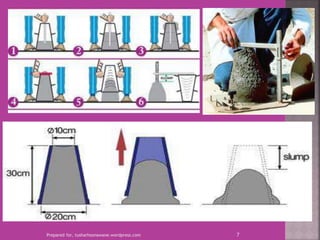
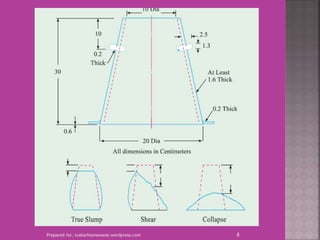
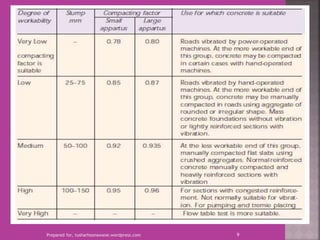
 Slump test is the most commonly used method of
measuring consistency of concrete which can be
employed either in laboratory or at site of work.
 It is not a suitable method for very wet or very
dry concrete.
 Additional information on workability and quality
of concrete can be obtained by observing the
manner in which concrete slumps.
 Quality of concrete can also be further assessed
by giving a few tappings or blows by tamping rod
to the base plate.
 The deformation shows the characteristics of
concrete with respect to tendency for
segregation.
Prepared for, tusharhsonawane.wordpress.com 6
Prepared for, tusharhsonawane.wordpress.com 7
Prepared for, tusharhsonawane.wordpress.com 8
Prepared for, tusharhsonawane.wordpress.com 9
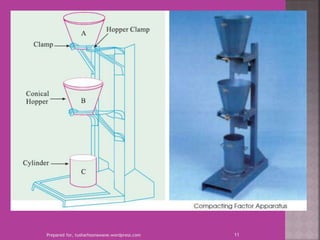
 It is more precise and sensitive than the slump
test and is particularly useful for concrete mixes
of very low workability as are normally used when
concrete is to be compacted by vibration.
 The compacting factor test has been developed at
the Road Research Laboratory U.K.
 This test works on the principle of determining the
degree of compaction achieved by a standard
amount of work done by allowing the concrete to
fall through a standard height.
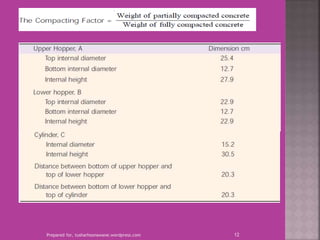
 The degree of compaction, called the compacting
factor is measured by the density ratio i.e., the
ratio of the density actually achieved in the test
to density of same concrete fully compacted
Prepared for, tusharhsonawane.wordpress.com 10
Prepared for, tusharhsonawane.wordpress.com 11
Prepared for, tusharhsonawane.wordpress.com 12
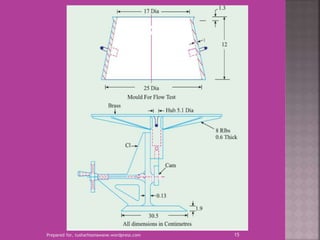
 This is a laboratory test, which gives an
indication of the quality of concrete with
respect to consistency, cohesiveness and the
proneness to segregation.
 The table top is cleaned of all gritty material
and is wetted. The mould is kept on the
centre of the table, firmly held and is filled
in two layers.
 Each layer is compacted 25 times with a
tamping rod 1.6 cm in diameter and 61 cm
long rounded at the lower tamping end.
 The mould is lifted vertically upward and the
concrete stands on its own without support
Prepared for, tusharhsonawane.wordpress.com 13
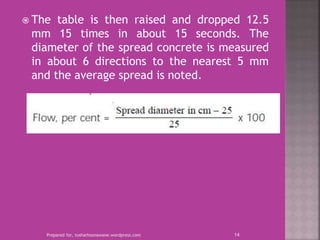
 The table is then raised and dropped 12.5
mm 15 times in about 15 seconds. The
diameter of the spread concrete is measured
in about 6 directions to the nearest 5 mm
and the average spread is noted.
Prepared for, tusharhsonawane.wordpress.com 14
Prepared for, tusharhsonawane.wordpress.com 15
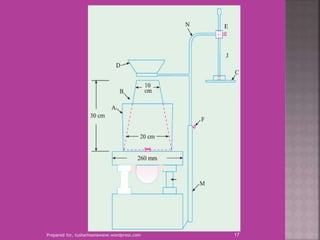
 This is a good laboratory test to measure
indirectly the workability of concrete.
 This test consists of a vibrating table, a metal
pot, a sheet metal cone, a standard iron rod.
 The time required for the shape of concrete to
change from slump cone shape to cylindrical
shape in seconds is known as Vee Bee Degree.
 This method is very suitable for very dry
concrete whose slump value cannot be measured
by Slump Test, but the vibration is too vigorous
for concrete with a slump greater than about 50
mm.
Prepared for, tusharhsonawane.wordpress.com 16
Prepared for, tusharhsonawane.wordpress.com 17
 Segregation can be defined as the separation
of the constituent materials of concrete.
 A good concrete is one in which all the
ingredients are properly distributed to make
a homogeneous mixture.
 There are considerable differences in the
sizes and specific gravities of the constituent
ingredients of concrete.
 Therefore, it is natural that the materials
show a tendency to fall apart.
Prepared for, tusharhsonawane.wordpress.com 18
 Badly proportioned mix where sufficient
matrix is not there to bind and contain the
aggregates
 Insufficiently mixed concrete with excess
water content
 Dropping of concrete from heights as in the
case of placing concrete in column
concreting
 When concrete is discharged from a badly
designed mixer, or from a mixer with worn
out blades
 Conveyance of concrete by conveyor belts,
wheel barrow, long distance haul by dumper,
long lift by skip and hoist are the other
situations promoting segregation of concrete
Prepared for, tusharhsonawane.wordpress.com 19
 Bleeding is sometimes referred as water
gain. It is a particular form of segregation, in
which some of the water from the concrete
comes out to the surface of the concrete,
being of the lowest specific gravity among all
the ingredients of concrete.
 Bleeding is predominantly observed in a
highly wet mix, badly proportioned and
insufficiently mixed concrete.
 In thin members like roof slab or road slabs
and when concrete is placed in sunny
weather show excessive bleeding.
Prepared for, tusharhsonawane.wordpress.com 20
 If certain quantity of cement along with
water comes out to the surface, it forms a
cement paste at the top of concrete surface.
This formation of cement paste at the
surface is known as Laitance.
 The top surface of concrete in that case will
not have good quality
 It may produce dust in summer and mud in
rainy season. Due to higher powder there will
be higher shrinkage.
 Laitance can create a plane of weakness at
the lift and the bond with the next lift would
be poor. This can be avoided by removing the
laitance fully before pouring the next lift.
Prepared for, tusharhsonawane.wordpress.com 21
Procurement of
Ingredients of
Concrete
Storage and
Handling
Batching
MixingTransportationPlacing
Compaction Curing Finishing
Prepared for, tusharhsonawane.wordpress.com 22
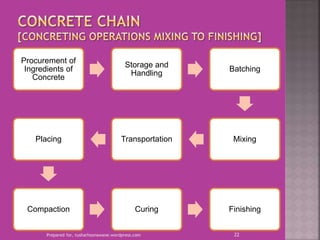
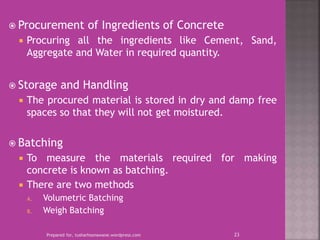
 Procurement of Ingredients of Concrete
 Procuring all the ingredients like Cement, Sand,
Aggregate and Water in required quantity.
 Storage and Handling
 The procured material is stored in dry and damp free
spaces so that they will not get moistured.
 Batching
 To measure the materials required for making
concrete is known as batching.
 There are two methods
A. Volumetric Batching
B. Weigh Batching
Prepared for, tusharhsonawane.wordpress.com 23
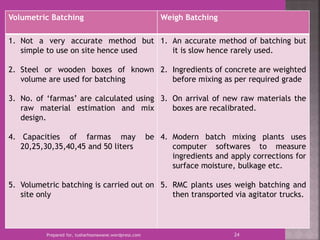
Volumetric Batching Weigh Batching
1. Not a very accurate method but
simple to use on site hence used
2. Steel or wooden boxes of known
volume are used for batching
3. No. of ‘farmas’ are calculated using
raw material estimation and mix
design.
4. Capacities of farmas may be
20,25,30,35,40,45 and 50 liters
5. Volumetric batching is carried out on
site only
1. An accurate method of batching but
it is slow hence rarely used.
2. Ingredients of concrete are weighted
before mixing as per required grade
3. On arrival of new raw materials the
boxes are recalibrated.
4. Modern batch mixing plants uses
computer softwares to measure
ingredients and apply corrections for
surface moisture, bulkage etc.
5. RMC plants uses weigh batching and
then transported via agitator trucks.
Prepared for, tusharhsonawane.wordpress.com 24
 Mixing
 Mixing plays an important role in as far as
concreting work is concerned.
 It can be done by two ways
A. Hand Mixing – Mixing done by hand
B. Machine Mixing – Mixing done using mechanical mixers
 The mechanical mixers can be more efficient and
produces uniform mix.
 Types of mixers
 The tilting drum type [Rotating]
 The non tilting type [Rotating]
 Pan type mixer
 The paddle type
Prepared for, tusharhsonawane.wordpress.com 25
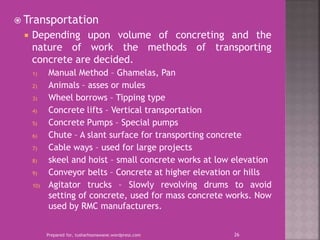
 Transportation
 Depending upon volume of concreting and the
nature of work the methods of transporting
concrete are decided.
1) Manual Method – Ghamelas, Pan
2) Animals – asses or mules
3) Wheel borrows – Tipping type
4) Concrete lifts – Vertical transportation
5) Concrete Pumps – Special pumps
6) Chute – A slant surface for transporting concrete
7) Cable ways – used for large projects
8) skeel and hoist – small concrete works at low elevation
9) Conveyor belts – Concrete at higher elevation or hills
10) Agitator trucks – Slowly revolving drums to avoid
setting of concrete, used for mass concrete works. Now
used by RMC manufacturers.
Prepared for, tusharhsonawane.wordpress.com 26
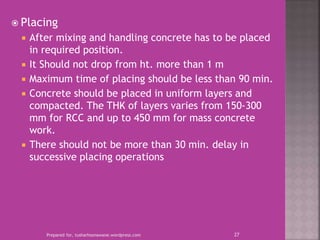
 Placing
 After mixing and handling concrete has to be placed
in required position.
 It Should not drop from ht. more than 1 m
 Maximum time of placing should be less than 90 min.
 Concrete should be placed in uniform layers and
compacted. The THK of layers varies from 150-300
mm for RCC and up to 450 mm for mass concrete
work.
 There should not be more than 30 min. delay in
successive placing operations
Prepared for, tusharhsonawane.wordpress.com 27
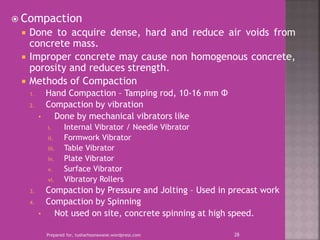
 Compaction
 Done to acquire dense, hard and reduce air voids from
concrete mass.
 Improper concrete may cause non homogenous concrete,
porosity and reduces strength.
 Methods of Compaction
1. Hand Compaction – Tamping rod, 10-16 mm Φ
2. Compaction by vibration
• Done by mechanical vibrators like
i. Internal Vibrator / Needle Vibrator
ii. Formwork Vibrator
iii. Table Vibrator
iv. Plate Vibrator
v. Surface Vibrator
vi. Vibratory Rollers
3. Compaction by Pressure and Jolting – Used in precast work
4. Compaction by Spinning
• Not used on site, concrete spinning at high speed.
Prepared for, tusharhsonawane.wordpress.com 28
 Curing
 It is the process of keeping the concrete surface
wet for specific period considering hydration
process.
 Curing helps in dissipating heat evolved in
hydration process.
 Hydration is a continuous process and rate of
reaction reduces after 28 days.
 Necessary to avoid shrinkage of concrete till full
strength* is achieved.
 It prevents water loss by evaporation and helps
in maintaining process of hydration.
Prepared for, tusharhsonawane.wordpress.com 29
 Methods of curing
1. Sprinkling Water
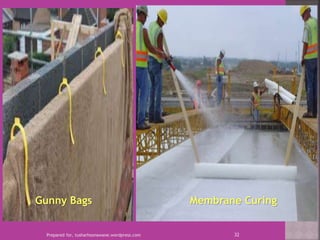
2. Membrane Curing – Membrane formed by
chemicals, sheet of polythene etc.
3. Steam Curing – Used for precast concrete
1. High Pressure Steam Curing
• Steaming at 8 atmospheres i.e., 800 kN/m²
• Rapid rise of Temp. can cause loss of strength.
2. Low Pressure steam curing
• Done at atmospheric temp.
• 70 % strength of 28 days can be obtained in 16-24 hrs
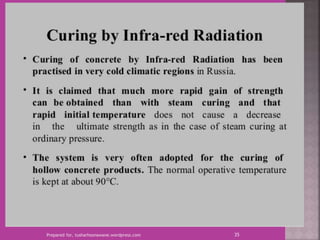
4. Infra red radiations – used for hollow concrete
5. Wet gunny bags – vertical surfaces
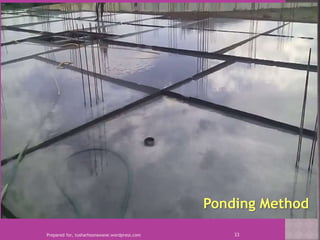
6. Ponding Method – min. 50 mm water stored like
ponds, used for slabs, road work etc.
Prepared for, tusharhsonawane.wordpress.com 30
Prepared for, tusharhsonawane.wordpress.com 31
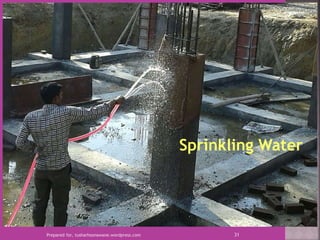
Sprinkling Water
Prepared for, tusharhsonawane.wordpress.com 32
Gunny Bags Membrane Curing
Prepared for, tusharhsonawane.wordpress.com 33
Ponding Method
Prepared for, tusharhsonawane.wordpress.com 34
Infra Red CuringSteam Curing
Prepared for, tusharhsonawane.wordpress.com 35
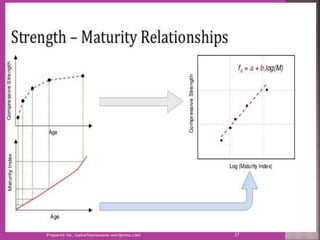
 Concrete maturity indicates how far curing
has progressed.
 Maturity is the relationship between
concrete temperature, time, and strength
gain.
 It is represented by an index value that can
be measured in real time in the field.
 This method was developed to work on
steam curing in 1940s
 Saul maturity rule states, “Concrete of the
same mix at the same maturity has
approximately the same strength whatever
combination of temperature and time go to
make up that maturity.”
Prepared for, tusharhsonawane.wordpress.com 36
Prepared for, tusharhsonawane.wordpress.com 37
Prepared for, tusharhsonawane.wordpress.com 38

Fresh concrete

  • 1.
    Er. Tushar HariharSonawane ( Member : IEI , IAENG) Civil Engineering Department, SNJB’s KBJ COE Chandwad +91 9657688220 tusharhsonawane.wordpress.com sonawane.thcoe@snjb.org Prepared for, tusharhsonawane.wordpress.com 1
  • 2.
     Fresh orPlastic concrete is a freshly mixed material which can be molded into any shape.  It is a concrete mixed and ready for placement in the formwork  Properties of Fresh Concrete 1. Workability of concrete 2. Segregation of concrete 3. Bleeding of Concrete 4. Hydration of concrete 5. Air Entrainment Prepared for, tusharhsonawane.wordpress.com 2
  • 3.
     Workability ofconcrete is defined as that property of fresh concrete which determines the ease and homogeneity.  Workability is the ease with which concrete is placed in the formwork and compacted is called workability.  It is composed of two parameters, 1. Consistency 2. Homogeneity  Consistency is the ability of a fresh concrete to flow  Homogeneity is the stable / uniform distribution of ingredients of concrete. Prepared for, tusharhsonawane.wordpress.com 3
  • 4.
    1. Water Content 2.Size and Shape of aggregate 3. Shape of Aggregate 4. Mix Proportion 5. Surface texture of aggregate 6. Grading of aggregate 7. Use of admixture 8. Environmental condition 9. Time Prepared for, tusharhsonawane.wordpress.com 4
  • 5.
     Slump-cone TestSlump Test video  Compaction Factor Test C F Test Video  Flow Test Concrete Flow Testing.mp4  Kelly ball test Kelly Ball.mp4  Vee-Bee consistometer vee bee.mp4 Prepared for, tusharhsonawane.wordpress.com 5
  • 6.
     Slump testis the most commonly used method of measuring consistency of concrete which can be employed either in laboratory or at site of work.  It is not a suitable method for very wet or very dry concrete.  Additional information on workability and quality of concrete can be obtained by observing the manner in which concrete slumps.  Quality of concrete can also be further assessed by giving a few tappings or blows by tamping rod to the base plate.  The deformation shows the characteristics of concrete with respect to tendency for segregation. Prepared for, tusharhsonawane.wordpress.com 6
  • 7.
  • 8.
  • 9.
  • 10.
     It ismore precise and sensitive than the slump test and is particularly useful for concrete mixes of very low workability as are normally used when concrete is to be compacted by vibration.  The compacting factor test has been developed at the Road Research Laboratory U.K.  This test works on the principle of determining the degree of compaction achieved by a standard amount of work done by allowing the concrete to fall through a standard height.  The degree of compaction, called the compacting factor is measured by the density ratio i.e., the ratio of the density actually achieved in the test to density of same concrete fully compacted Prepared for, tusharhsonawane.wordpress.com 10
  • 11.
  • 12.
  • 13.
     This isa laboratory test, which gives an indication of the quality of concrete with respect to consistency, cohesiveness and the proneness to segregation.  The table top is cleaned of all gritty material and is wetted. The mould is kept on the centre of the table, firmly held and is filled in two layers.  Each layer is compacted 25 times with a tamping rod 1.6 cm in diameter and 61 cm long rounded at the lower tamping end.  The mould is lifted vertically upward and the concrete stands on its own without support Prepared for, tusharhsonawane.wordpress.com 13
  • 14.
     The tableis then raised and dropped 12.5 mm 15 times in about 15 seconds. The diameter of the spread concrete is measured in about 6 directions to the nearest 5 mm and the average spread is noted. Prepared for, tusharhsonawane.wordpress.com 14
  • 15.
  • 16.
     This isa good laboratory test to measure indirectly the workability of concrete.  This test consists of a vibrating table, a metal pot, a sheet metal cone, a standard iron rod.  The time required for the shape of concrete to change from slump cone shape to cylindrical shape in seconds is known as Vee Bee Degree.  This method is very suitable for very dry concrete whose slump value cannot be measured by Slump Test, but the vibration is too vigorous for concrete with a slump greater than about 50 mm. Prepared for, tusharhsonawane.wordpress.com 16
  • 17.
  • 18.
     Segregation canbe defined as the separation of the constituent materials of concrete.  A good concrete is one in which all the ingredients are properly distributed to make a homogeneous mixture.  There are considerable differences in the sizes and specific gravities of the constituent ingredients of concrete.  Therefore, it is natural that the materials show a tendency to fall apart. Prepared for, tusharhsonawane.wordpress.com 18
  • 19.
     Badly proportionedmix where sufficient matrix is not there to bind and contain the aggregates  Insufficiently mixed concrete with excess water content  Dropping of concrete from heights as in the case of placing concrete in column concreting  When concrete is discharged from a badly designed mixer, or from a mixer with worn out blades  Conveyance of concrete by conveyor belts, wheel barrow, long distance haul by dumper, long lift by skip and hoist are the other situations promoting segregation of concrete Prepared for, tusharhsonawane.wordpress.com 19
  • 20.
     Bleeding issometimes referred as water gain. It is a particular form of segregation, in which some of the water from the concrete comes out to the surface of the concrete, being of the lowest specific gravity among all the ingredients of concrete.  Bleeding is predominantly observed in a highly wet mix, badly proportioned and insufficiently mixed concrete.  In thin members like roof slab or road slabs and when concrete is placed in sunny weather show excessive bleeding. Prepared for, tusharhsonawane.wordpress.com 20
  • 21.
     If certainquantity of cement along with water comes out to the surface, it forms a cement paste at the top of concrete surface. This formation of cement paste at the surface is known as Laitance.  The top surface of concrete in that case will not have good quality  It may produce dust in summer and mud in rainy season. Due to higher powder there will be higher shrinkage.  Laitance can create a plane of weakness at the lift and the bond with the next lift would be poor. This can be avoided by removing the laitance fully before pouring the next lift. Prepared for, tusharhsonawane.wordpress.com 21
  • 22.
    Procurement of Ingredients of Concrete Storageand Handling Batching MixingTransportationPlacing Compaction Curing Finishing Prepared for, tusharhsonawane.wordpress.com 22
  • 23.
     Procurement ofIngredients of Concrete  Procuring all the ingredients like Cement, Sand, Aggregate and Water in required quantity.  Storage and Handling  The procured material is stored in dry and damp free spaces so that they will not get moistured.  Batching  To measure the materials required for making concrete is known as batching.  There are two methods A. Volumetric Batching B. Weigh Batching Prepared for, tusharhsonawane.wordpress.com 23
  • 24.
    Volumetric Batching WeighBatching 1. Not a very accurate method but simple to use on site hence used 2. Steel or wooden boxes of known volume are used for batching 3. No. of ‘farmas’ are calculated using raw material estimation and mix design. 4. Capacities of farmas may be 20,25,30,35,40,45 and 50 liters 5. Volumetric batching is carried out on site only 1. An accurate method of batching but it is slow hence rarely used. 2. Ingredients of concrete are weighted before mixing as per required grade 3. On arrival of new raw materials the boxes are recalibrated. 4. Modern batch mixing plants uses computer softwares to measure ingredients and apply corrections for surface moisture, bulkage etc. 5. RMC plants uses weigh batching and then transported via agitator trucks. Prepared for, tusharhsonawane.wordpress.com 24
  • 25.
     Mixing  Mixingplays an important role in as far as concreting work is concerned.  It can be done by two ways A. Hand Mixing – Mixing done by hand B. Machine Mixing – Mixing done using mechanical mixers  The mechanical mixers can be more efficient and produces uniform mix.  Types of mixers  The tilting drum type [Rotating]  The non tilting type [Rotating]  Pan type mixer  The paddle type Prepared for, tusharhsonawane.wordpress.com 25
  • 26.
     Transportation  Dependingupon volume of concreting and the nature of work the methods of transporting concrete are decided. 1) Manual Method – Ghamelas, Pan 2) Animals – asses or mules 3) Wheel borrows – Tipping type 4) Concrete lifts – Vertical transportation 5) Concrete Pumps – Special pumps 6) Chute – A slant surface for transporting concrete 7) Cable ways – used for large projects 8) skeel and hoist – small concrete works at low elevation 9) Conveyor belts – Concrete at higher elevation or hills 10) Agitator trucks – Slowly revolving drums to avoid setting of concrete, used for mass concrete works. Now used by RMC manufacturers. Prepared for, tusharhsonawane.wordpress.com 26
  • 27.
     Placing  Aftermixing and handling concrete has to be placed in required position.  It Should not drop from ht. more than 1 m  Maximum time of placing should be less than 90 min.  Concrete should be placed in uniform layers and compacted. The THK of layers varies from 150-300 mm for RCC and up to 450 mm for mass concrete work.  There should not be more than 30 min. delay in successive placing operations Prepared for, tusharhsonawane.wordpress.com 27
  • 28.
     Compaction  Doneto acquire dense, hard and reduce air voids from concrete mass.  Improper concrete may cause non homogenous concrete, porosity and reduces strength.  Methods of Compaction 1. Hand Compaction – Tamping rod, 10-16 mm Φ 2. Compaction by vibration • Done by mechanical vibrators like i. Internal Vibrator / Needle Vibrator ii. Formwork Vibrator iii. Table Vibrator iv. Plate Vibrator v. Surface Vibrator vi. Vibratory Rollers 3. Compaction by Pressure and Jolting – Used in precast work 4. Compaction by Spinning • Not used on site, concrete spinning at high speed. Prepared for, tusharhsonawane.wordpress.com 28
  • 29.
     Curing  Itis the process of keeping the concrete surface wet for specific period considering hydration process.  Curing helps in dissipating heat evolved in hydration process.  Hydration is a continuous process and rate of reaction reduces after 28 days.  Necessary to avoid shrinkage of concrete till full strength* is achieved.  It prevents water loss by evaporation and helps in maintaining process of hydration. Prepared for, tusharhsonawane.wordpress.com 29
  • 30.
     Methods ofcuring 1. Sprinkling Water 2. Membrane Curing – Membrane formed by chemicals, sheet of polythene etc. 3. Steam Curing – Used for precast concrete 1. High Pressure Steam Curing • Steaming at 8 atmospheres i.e., 800 kN/m² • Rapid rise of Temp. can cause loss of strength. 2. Low Pressure steam curing • Done at atmospheric temp. • 70 % strength of 28 days can be obtained in 16-24 hrs 4. Infra red radiations – used for hollow concrete 5. Wet gunny bags – vertical surfaces 6. Ponding Method – min. 50 mm water stored like ponds, used for slabs, road work etc. Prepared for, tusharhsonawane.wordpress.com 30
  • 31.
  • 32.
    Prepared for, tusharhsonawane.wordpress.com32 Gunny Bags Membrane Curing
  • 33.
  • 34.
    Prepared for, tusharhsonawane.wordpress.com34 Infra Red CuringSteam Curing
  • 35.
  • 36.
     Concrete maturityindicates how far curing has progressed.  Maturity is the relationship between concrete temperature, time, and strength gain.  It is represented by an index value that can be measured in real time in the field.  This method was developed to work on steam curing in 1940s  Saul maturity rule states, “Concrete of the same mix at the same maturity has approximately the same strength whatever combination of temperature and time go to make up that maturity.” Prepared for, tusharhsonawane.wordpress.com 36
  • 37.
  • 38.