Translucent concrete
Prepared by :Nabaz Salih Hussien
What is the translucent concrete?
• Transparent material means which can be seen from one part to
another part.
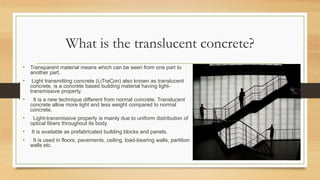
• Light transmitting concrete (LiTraCon) also known as translucent
concrete, is a concrete based building material having light-
transmissive property.
• It is a new technique different from normal concrete. Translucent
concrete allow more light and less weight compared to normal
concrete.
• Light-transmissive property is mainly due to uniform distribution of
optical fibers throughout its body.
• It is available as prefabricated building blocks and panels.
• It is used in floors, pavements, ceiling, load-bearing walls, partition
walls etc.
History
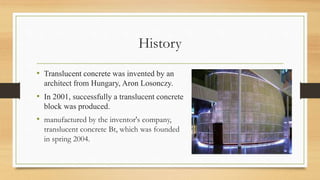
• Translucent concrete was invented by an
architect from Hungary, Aron Losonczy.
• In 2001, successfully a translucent concrete
block was produced.
• manufactured by the inventor's company,
translucent concrete Bt, which was founded
in spring 2004.
Materials used for translucent concrete
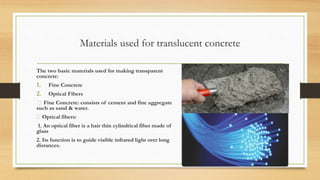
The two basic materials used for making transparent
concrete:
1. Fine Concrete
2. Optical Fibers
Fine Concrete: consists of cement and fine aggregate
such as sand & water.
Optical fibers:
1. An optical fiber is a hair thin cylindrical fiber made of
glass
2. Its function is to guide visible infrared light over long
distances.
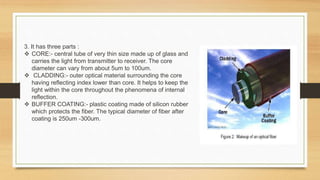
3. It has three parts :
 CORE:- central tube of very thin size made up of glass and
carries the light from transmitter to receiver. The core
diameter can vary from about 5um to 100um.
 CLADDING:- outer optical material surrounding the core
having reflecting index lower than core. It helps to keep the
light within the core throughout the phenomena of internal
reflection.
 BUFFER COATING:- plastic coating made of silicon rubber
which protects the fiber. The typical diameter of fiber after
coating is 250um -300um.
Materials used for translucent concrete
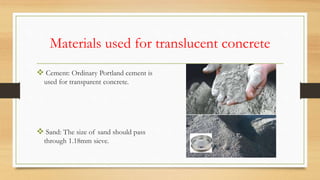
 Cement: Ordinary Portland cement is
used for transparent concrete.
 Sand: The size of sand should pass
through 1.18mm sieve.
Materials used for translucent concrete
 Water: Water to be used for transparent concrete should be of
drinking water quality.
 Optical fibers: Thickness of the optical fibers can be varied
between 2 µm and 2 mm.
Properties of translucent concrete
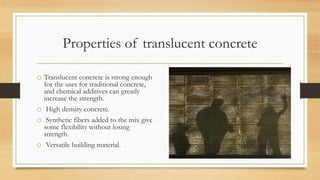
o Translucent concrete is strong enough
for the uses for traditional concrete,
and chemical additives can greatly
increase the strength.
o High density concrete.
o Synthetic fibers added to the mix give
some flexibility without losing
strength.
o Versatile building material.
Properties of translucent concrete
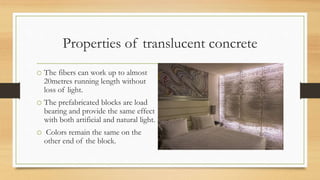
o The fibers can work up to almost
20metres running length without
loss of light.
o The prefabricated blocks are load
bearing and provide the same effect
with both artificial and natural light.
o Colors remain the same on the
other end of the block.
Applications
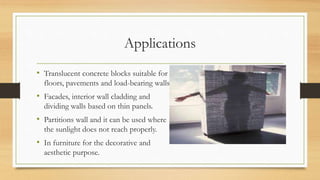
• Translucent concrete blocks suitable for
floors, pavements and load-bearing walls.
• Facades, interior wall cladding and
dividing walls based on thin panels.
• Partitions wall and it can be used where
the sunlight does not reach properly.
• In furniture for the decorative and
aesthetic purpose.
Applications
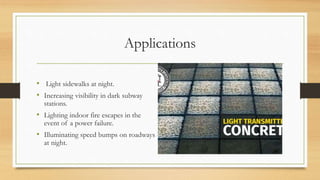
• Light sidewalks at night.
• Increasing visibility in dark subway
stations.
• Lighting indoor fire escapes in the
event of a power failure.
• Illuminating speed bumps on roadways
at night.
ADVANTAGES
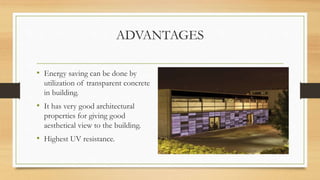
• Energy saving can be done by
utilization of transparent concrete
in building.
• It has very good architectural
properties for giving good
aesthetical view to the building.
• Highest UV resistance.
Disadvantage
• Very high cost about $1000/m2.
• Labors with technical skills are
required to use it.
Examples
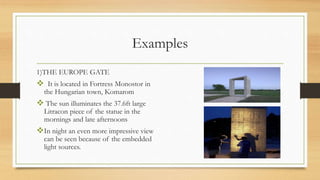
1)THE EUROPE GATE
 It is located in Fortress Monostor in
the Hungarian town, Komarom
 The sun illuminates the 37.6ft large
Litracon piece of the statue in the
mornings and late afternoons
In night an even more impressive view
can be seen because of the embedded
light sources.
Examples
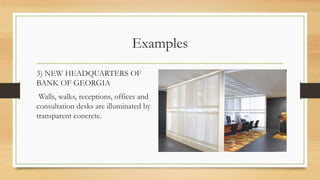
3) NEW HEADQUARTERS OF
BANK OF GEORGIA
Walls, walks, receptions, offices and
consultation desks are illuminated by
transparent concrete.
Examples
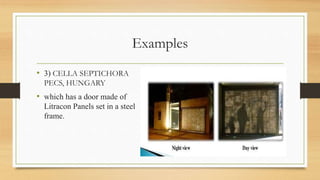
• 3) CELLA SEPTICHORA
PECS, HUNGARY
• which has a door made of
Litracon Panels set in a steel
frame.
Conclusions
 Light transmitting concrete is an emerging trend in concrete technology.
 Its initial cost is high. But, routine maintenance is not required and in long run it may be
advantageous.
 It’s a green building material reducing the lightning cost during day time. It’s proved to
provide both aesthetic appearance and structural stability.
 In future the it’s cost is expected to decrease.
 It is one of the best applications of optical glass fibers which is related to technical textiles.
References
• https://www.slideshare.net/transparent-concrete
• Https://en.wikipedia.org/wiki/Translucent_concrete
• https://www.youtube.com/watch?v=dzULTrCEHjE
• https://youtu.be/v6v-DXMK5w8
• https://en.wikipedia.org/wiki/Optical_fiber
• www.powershow.com/view/.../Translucent Concrete power point PPT
presentation
• https://theconstructor.org/concrete/transparent-concrete-light-
transmitting- concrete/92
• https://study.com/academy/lesson/what-is-optical-fiber-definition-
lesson- quiz.html
 translucent concrete

translucent concrete

  • 1.
  • 2.
    What is thetranslucent concrete? • Transparent material means which can be seen from one part to another part. • Light transmitting concrete (LiTraCon) also known as translucent concrete, is a concrete based building material having light- transmissive property. • It is a new technique different from normal concrete. Translucent concrete allow more light and less weight compared to normal concrete. • Light-transmissive property is mainly due to uniform distribution of optical fibers throughout its body. • It is available as prefabricated building blocks and panels. • It is used in floors, pavements, ceiling, load-bearing walls, partition walls etc.
  • 3.
    History • Translucent concretewas invented by an architect from Hungary, Aron Losonczy. • In 2001, successfully a translucent concrete block was produced. • manufactured by the inventor's company, translucent concrete Bt, which was founded in spring 2004.
  • 4.
    Materials used fortranslucent concrete The two basic materials used for making transparent concrete: 1. Fine Concrete 2. Optical Fibers Fine Concrete: consists of cement and fine aggregate such as sand & water. Optical fibers: 1. An optical fiber is a hair thin cylindrical fiber made of glass 2. Its function is to guide visible infrared light over long distances.
  • 5.
    3. It hasthree parts :  CORE:- central tube of very thin size made up of glass and carries the light from transmitter to receiver. The core diameter can vary from about 5um to 100um.  CLADDING:- outer optical material surrounding the core having reflecting index lower than core. It helps to keep the light within the core throughout the phenomena of internal reflection.  BUFFER COATING:- plastic coating made of silicon rubber which protects the fiber. The typical diameter of fiber after coating is 250um -300um.
  • 6.
    Materials used fortranslucent concrete  Cement: Ordinary Portland cement is used for transparent concrete.  Sand: The size of sand should pass through 1.18mm sieve.
  • 7.
    Materials used fortranslucent concrete  Water: Water to be used for transparent concrete should be of drinking water quality.  Optical fibers: Thickness of the optical fibers can be varied between 2 µm and 2 mm.
  • 8.
    Properties of translucentconcrete o Translucent concrete is strong enough for the uses for traditional concrete, and chemical additives can greatly increase the strength. o High density concrete. o Synthetic fibers added to the mix give some flexibility without losing strength. o Versatile building material.
  • 9.
    Properties of translucentconcrete o The fibers can work up to almost 20metres running length without loss of light. o The prefabricated blocks are load bearing and provide the same effect with both artificial and natural light. o Colors remain the same on the other end of the block.
  • 10.
    Applications • Translucent concreteblocks suitable for floors, pavements and load-bearing walls. • Facades, interior wall cladding and dividing walls based on thin panels. • Partitions wall and it can be used where the sunlight does not reach properly. • In furniture for the decorative and aesthetic purpose.
  • 11.
    Applications • Light sidewalksat night. • Increasing visibility in dark subway stations. • Lighting indoor fire escapes in the event of a power failure. • Illuminating speed bumps on roadways at night.
  • 12.
    ADVANTAGES • Energy savingcan be done by utilization of transparent concrete in building. • It has very good architectural properties for giving good aesthetical view to the building. • Highest UV resistance.
  • 13.
    Disadvantage • Very highcost about $1000/m2. • Labors with technical skills are required to use it.
  • 14.
    Examples 1)THE EUROPE GATE It is located in Fortress Monostor in the Hungarian town, Komarom  The sun illuminates the 37.6ft large Litracon piece of the statue in the mornings and late afternoons In night an even more impressive view can be seen because of the embedded light sources.
  • 15.
    Examples 3) NEW HEADQUARTERSOF BANK OF GEORGIA Walls, walks, receptions, offices and consultation desks are illuminated by transparent concrete.
  • 16.
    Examples • 3) CELLASEPTICHORA PECS, HUNGARY • which has a door made of Litracon Panels set in a steel frame.
  • 17.
    Conclusions  Light transmittingconcrete is an emerging trend in concrete technology.  Its initial cost is high. But, routine maintenance is not required and in long run it may be advantageous.  It’s a green building material reducing the lightning cost during day time. It’s proved to provide both aesthetic appearance and structural stability.  In future the it’s cost is expected to decrease.  It is one of the best applications of optical glass fibers which is related to technical textiles.
  • 18.
    References • https://www.slideshare.net/transparent-concrete • Https://en.wikipedia.org/wiki/Translucent_concrete •https://www.youtube.com/watch?v=dzULTrCEHjE • https://youtu.be/v6v-DXMK5w8 • https://en.wikipedia.org/wiki/Optical_fiber • www.powershow.com/view/.../Translucent Concrete power point PPT presentation • https://theconstructor.org/concrete/transparent-concrete-light- transmitting- concrete/92 • https://study.com/academy/lesson/what-is-optical-fiber-definition- lesson- quiz.html