Building Classroom Community:
Collaborative Technology in Use
Michael Rees
School of Information Technology
@mrees
Slides at go.mrees.com/bccslides
An Emerging Technologies Committee Talk
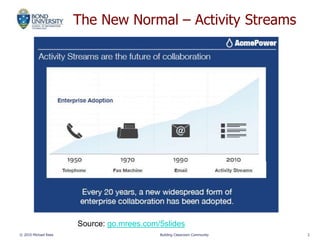
The New Normal – Activity Streams
© 2010 Michael Rees Building Classroom Community 2
Source: go.mrees.com/5slides
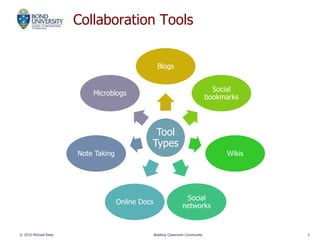
Collaboration Tools
© 2010 Michael Rees Building Classroom Community 3
Tool
Types
Blogs
Social
bookmarks
Wikis
Social
networks
Online Docs
Note Taking
Microblogs
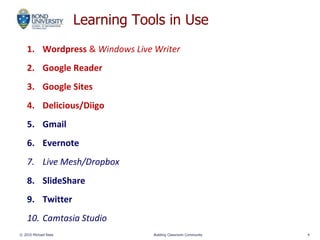
Learning Tools in Use
1. Wordpress & Windows Live Writer
2. Google Reader
3. Google Sites
4. Delicious/Diigo
5. Gmail
6. Evernote
7. Live Mesh/Dropbox
8. SlideShare
9. Twitter
10. Camtasia Studio
© 2010 Michael Rees Building Classroom Community 4
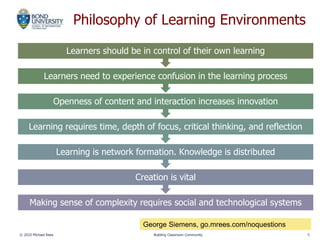
Philosophy of Learning Environments
Making sense of complexity requires social and technological systems
Creation is vital
Learning is network formation. Knowledge is distributed
Learning requires time, depth of focus, critical thinking, and reflection
Openness of content and interaction increases innovation
Learners need to experience confusion in the learning process
Learners should be in control of their own learning
© 2010 Michael Rees Building Classroom Community 5
George Siemens, go.mrees.com/noquestions
Questions Not To Ask!
Online learning more or less effective than learning in a classroom?
Does technology use vary by age?
Do learning styles influence learning online?
What role does xxx technology play in classroom or online
learning?
How can educators implement [whatever tool] into their teaching?
Is connectivism a learning theory?
© 2010 Michael Rees Building Classroom Community 6
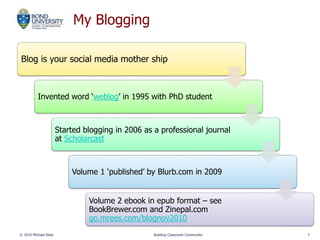
My Blogging
Blog is your social media mother ship
Invented word ‘weblog’ in 1995 with PhD student
Started blogging in 2006 as a professional journal
at Scholarcast
Volume 1 ‘published’ by Blurb.com in 2009
Volume 2 ebook in epub format – see
BookBrewer.com and Zinepal.com
go.mrees.com/blognov2010
© 2010 Michael Rees Building Classroom Community 7
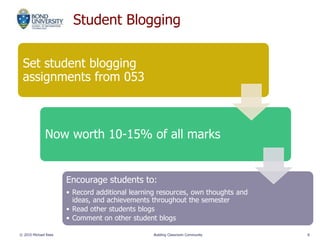
Student Blogging
© 2010 Michael Rees Building Classroom Community 8
Set student blogging
assignments from 053
Now worth 10-15% of all marks
Encourage students to:
• Record additional learning resources, own thoughts and
ideas, and achievements throughout the semester
• Read other students blogs
• Comment on other student blogs
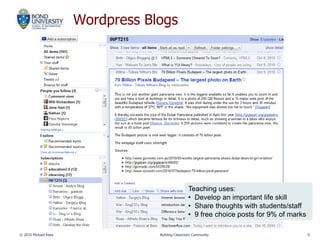
Wordpress Blogs
© 2010 Michael Rees Building Classroom Community 9
Teaching uses:
• Develop an important life skill
• Share thoughts with students/staff
• 9 free choice posts for 9% of marks
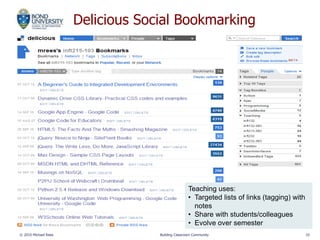
Delicious Social Bookmarking
© 2010 Michael Rees Building Classroom Community 10
Teaching uses:
• Targeted lists of links (tagging) with
notes
• Share with students/colleagues
• Evolve over semester
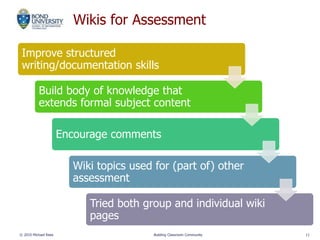
Wikis for Assessment
Improve structured
writing/documentation skills
Build body of knowledge that
extends formal subject content
Encourage comments
Wiki topics used for (part of) other
assessment
Tried both group and individual wiki
pages
© 2010 Michael Rees Building Classroom Community 11
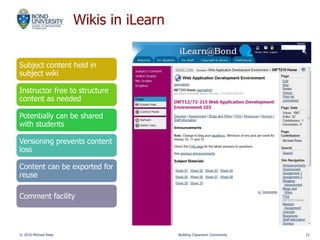
Wikis in iLearn
Subject content held in
subject wiki
Instructor free to structure
content as needed
Potentially can be shared
with students
Versioning prevents content
loss
Content can be exported for
reuse
Comment facility
© 2010 Michael Rees Building Classroom Community 12
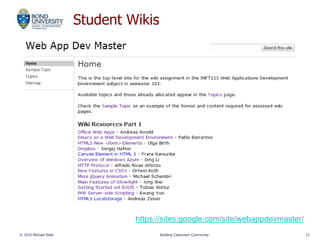
Student Wikis
© 2010 Michael Rees Building Classroom Community 13
https://sites.google.com/site/webappdevmaster/
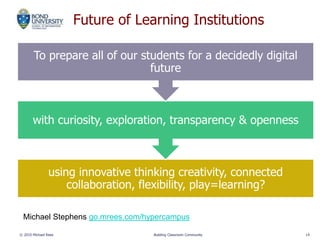
Future of Learning Institutions
using innovative thinking creativity, connected
collaboration, flexibility, play=learning?
with curiosity, exploration, transparency & openness
To prepare all of our students for a decidedly digital
future
© 2010 Michael Rees Building Classroom Community 14
Michael Stephens go.mrees.com/hypercampus
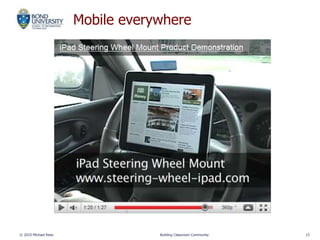
Mobile everywhere
© 2010 Michael Rees Building Classroom Community 15
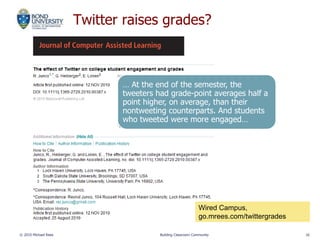
Twitter raises grades?
© 2010 Michael Rees Building Classroom Community 16
… At the end of the semester, the
tweeters had grade-point averages half a
point higher, on average, than their
nontweeting counterparts. And students
who tweeted were more engaged…
Wired Campus,
go.mrees.com/twittergrades
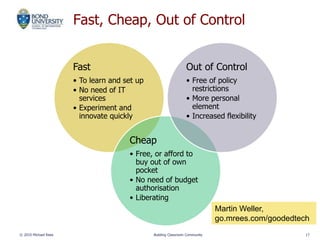
Fast, Cheap, Out of Control
Fast
• To learn and set up
• No need of IT
services
• Experiment and
innovate quickly
Cheap
• Free, or afford to
buy out of own
pocket
• No need of budget
authorisation
• Liberating
Out of Control
• Free of policy
restrictions
• More personal
element
• Increased flexibility
© 2010 Michael Rees Building Classroom Community 17
Martin Weller,
go.mrees.com/goodedtech
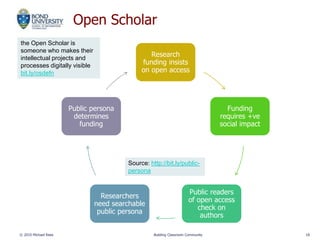
Open Scholar
Research
funding insists
on open access
Funding
requires +ve
social impact
Public readers
of open access
check on
authors
Researchers
need searchable
public persona
Public persona
determines
funding
© 2010 Michael Rees Building Classroom Community 18
Source: http://bit.ly/public-
persona
the Open Scholar is
someone who makes their
intellectual projects and
processes digitally visible
bit.ly/osdefn
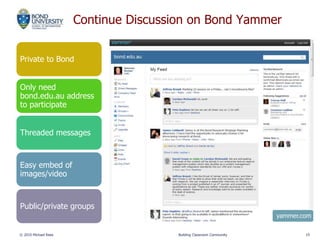
Continue Discussion on Bond Yammer
Private to Bond
Only need
bond.edu.au address
to participate
Threaded messages
Easy embed of
images/video
Public/private groups
© 2010 Michael Rees Building Classroom Community 19
yammer.com
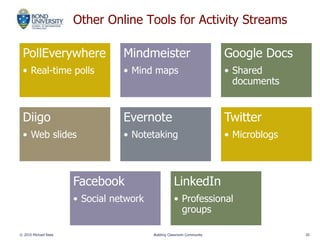
Other Online Tools for Activity Streams
PollEverywhere
• Real-time polls
Mindmeister
• Mind maps
Google Docs
• Shared
documents
Diigo
• Web slides
Evernote
• Notetaking
Twitter
• Microblogs
Facebook
• Social network
LinkedIn
• Professional
groups
© 2010 Michael Rees Building Classroom Community 20

Building Classroom Community

  • 1.
    Building Classroom Community: CollaborativeTechnology in Use Michael Rees School of Information Technology @mrees Slides at go.mrees.com/bccslides An Emerging Technologies Committee Talk
  • 2.
    The New Normal– Activity Streams © 2010 Michael Rees Building Classroom Community 2 Source: go.mrees.com/5slides
  • 3.
    Collaboration Tools © 2010Michael Rees Building Classroom Community 3 Tool Types Blogs Social bookmarks Wikis Social networks Online Docs Note Taking Microblogs
  • 4.
    Learning Tools inUse 1. Wordpress & Windows Live Writer 2. Google Reader 3. Google Sites 4. Delicious/Diigo 5. Gmail 6. Evernote 7. Live Mesh/Dropbox 8. SlideShare 9. Twitter 10. Camtasia Studio © 2010 Michael Rees Building Classroom Community 4
  • 5.
    Philosophy of LearningEnvironments Making sense of complexity requires social and technological systems Creation is vital Learning is network formation. Knowledge is distributed Learning requires time, depth of focus, critical thinking, and reflection Openness of content and interaction increases innovation Learners need to experience confusion in the learning process Learners should be in control of their own learning © 2010 Michael Rees Building Classroom Community 5 George Siemens, go.mrees.com/noquestions
  • 6.
    Questions Not ToAsk! Online learning more or less effective than learning in a classroom? Does technology use vary by age? Do learning styles influence learning online? What role does xxx technology play in classroom or online learning? How can educators implement [whatever tool] into their teaching? Is connectivism a learning theory? © 2010 Michael Rees Building Classroom Community 6
  • 7.
    My Blogging Blog isyour social media mother ship Invented word ‘weblog’ in 1995 with PhD student Started blogging in 2006 as a professional journal at Scholarcast Volume 1 ‘published’ by Blurb.com in 2009 Volume 2 ebook in epub format – see BookBrewer.com and Zinepal.com go.mrees.com/blognov2010 © 2010 Michael Rees Building Classroom Community 7
  • 8.
    Student Blogging © 2010Michael Rees Building Classroom Community 8 Set student blogging assignments from 053 Now worth 10-15% of all marks Encourage students to: • Record additional learning resources, own thoughts and ideas, and achievements throughout the semester • Read other students blogs • Comment on other student blogs
  • 9.
    Wordpress Blogs © 2010Michael Rees Building Classroom Community 9 Teaching uses: • Develop an important life skill • Share thoughts with students/staff • 9 free choice posts for 9% of marks
  • 10.
    Delicious Social Bookmarking ©2010 Michael Rees Building Classroom Community 10 Teaching uses: • Targeted lists of links (tagging) with notes • Share with students/colleagues • Evolve over semester
  • 11.
    Wikis for Assessment Improvestructured writing/documentation skills Build body of knowledge that extends formal subject content Encourage comments Wiki topics used for (part of) other assessment Tried both group and individual wiki pages © 2010 Michael Rees Building Classroom Community 11
  • 12.
    Wikis in iLearn Subjectcontent held in subject wiki Instructor free to structure content as needed Potentially can be shared with students Versioning prevents content loss Content can be exported for reuse Comment facility © 2010 Michael Rees Building Classroom Community 12
  • 13.
    Student Wikis © 2010Michael Rees Building Classroom Community 13 https://sites.google.com/site/webappdevmaster/
  • 14.
    Future of LearningInstitutions using innovative thinking creativity, connected collaboration, flexibility, play=learning? with curiosity, exploration, transparency & openness To prepare all of our students for a decidedly digital future © 2010 Michael Rees Building Classroom Community 14 Michael Stephens go.mrees.com/hypercampus
  • 15.
    Mobile everywhere © 2010Michael Rees Building Classroom Community 15
  • 16.
    Twitter raises grades? ©2010 Michael Rees Building Classroom Community 16 … At the end of the semester, the tweeters had grade-point averages half a point higher, on average, than their nontweeting counterparts. And students who tweeted were more engaged… Wired Campus, go.mrees.com/twittergrades
  • 17.
    Fast, Cheap, Outof Control Fast • To learn and set up • No need of IT services • Experiment and innovate quickly Cheap • Free, or afford to buy out of own pocket • No need of budget authorisation • Liberating Out of Control • Free of policy restrictions • More personal element • Increased flexibility © 2010 Michael Rees Building Classroom Community 17 Martin Weller, go.mrees.com/goodedtech
  • 18.
    Open Scholar Research funding insists onopen access Funding requires +ve social impact Public readers of open access check on authors Researchers need searchable public persona Public persona determines funding © 2010 Michael Rees Building Classroom Community 18 Source: http://bit.ly/public- persona the Open Scholar is someone who makes their intellectual projects and processes digitally visible bit.ly/osdefn
  • 19.
    Continue Discussion onBond Yammer Private to Bond Only need bond.edu.au address to participate Threaded messages Easy embed of images/video Public/private groups © 2010 Michael Rees Building Classroom Community 19 yammer.com
  • 20.
    Other Online Toolsfor Activity Streams PollEverywhere • Real-time polls Mindmeister • Mind maps Google Docs • Shared documents Diigo • Web slides Evernote • Notetaking Twitter • Microblogs Facebook • Social network LinkedIn • Professional groups © 2010 Michael Rees Building Classroom Community 20