Open cross-institutional academic CPD, expectations and value: a recent example – UNLOCKING THE POTENTIAL 
Chrissi Nerantzi 
Academic Developer 
Manchester Metropolitan University 
@chrissinerantzi 
Sue Beckingham 
Academic Developer 
Sheffield Hallam University 
@suebecks 
19th Annual SEDA Conference 13-14 November 2014, Nottingham 
artwork by Ellie Livermore
Learning outcomes 
•Explore the concept of open academic Continuous Professional Development (CPD) for personal and collective growth 
•Gain an insight into an open cross-institutional academic CPD initiative as normalised practice based on collaborative pedagogies and developed using social media. 
•Invite opportunities for further development of open cross-institutional CPD and wider collaboration among institutions
exploring open CPD
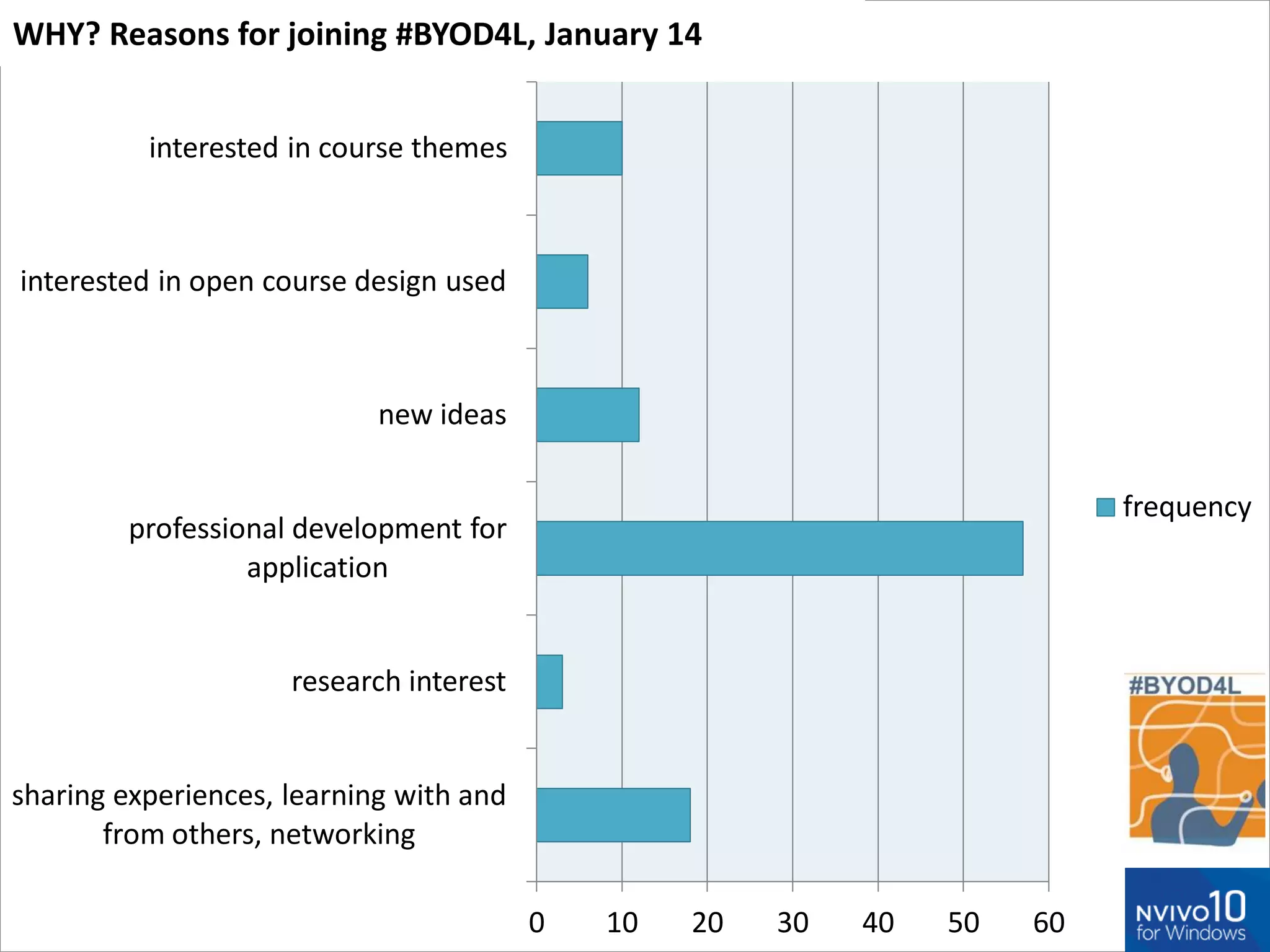
0 
10 
20 
30 
40 
50 
60 
sharing experiences, learning with and from others, networking 
research interest 
professional development for application 
new ideas 
interested in open course design used 
interested in course themes 
frequency 
frequency 
WHY? Reasons for joining #BYOD4L, January 14
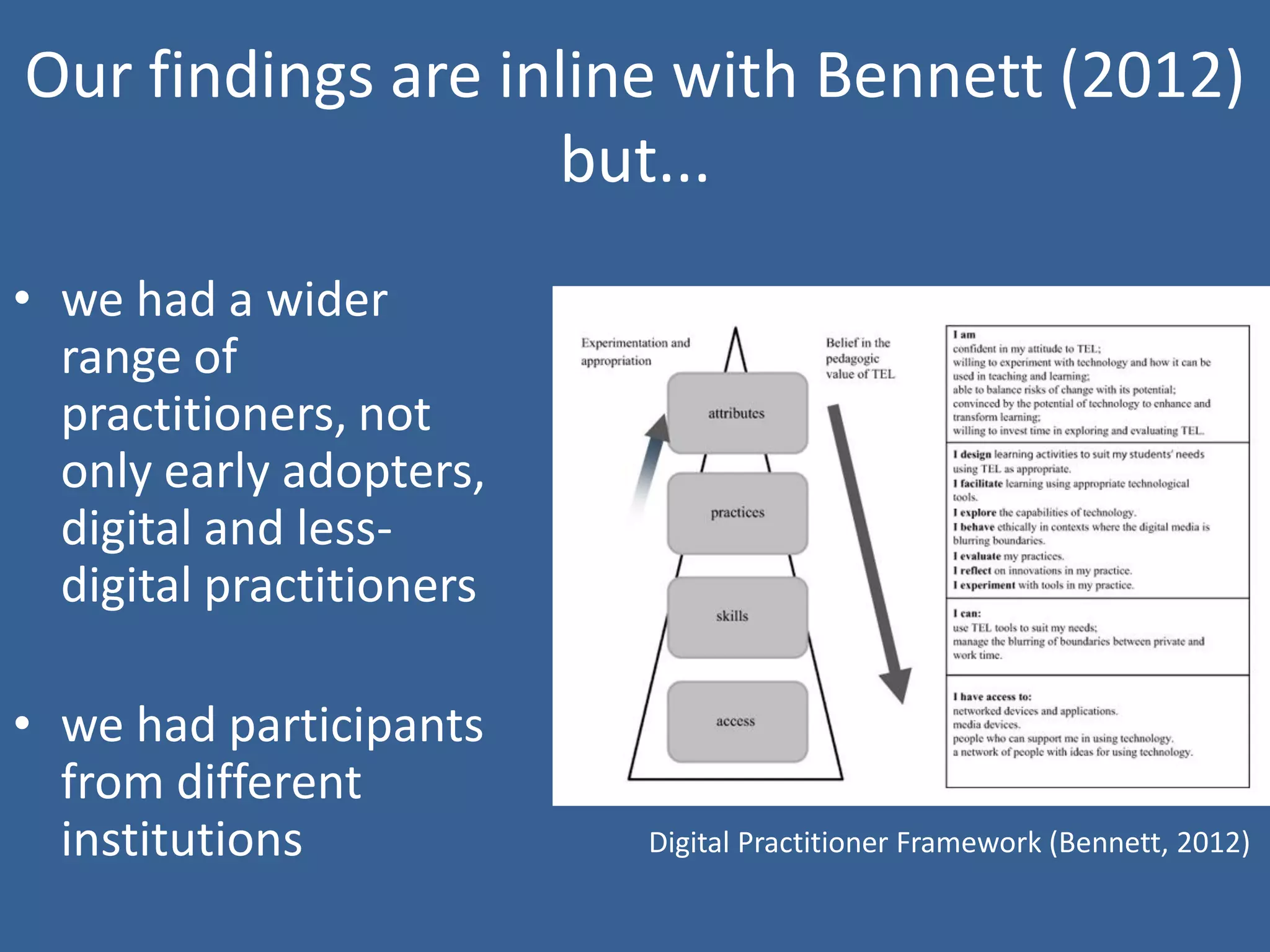
Our findings are inline with Bennett (2012) but... 
•we had a wider range of practitioners, not only early adopters, digital and less- digital practitioners 
•we had participants from different institutions 
Digital Practitioner Framework (Bennett, 2012) 
based on Beetham & Sharpe (2010)
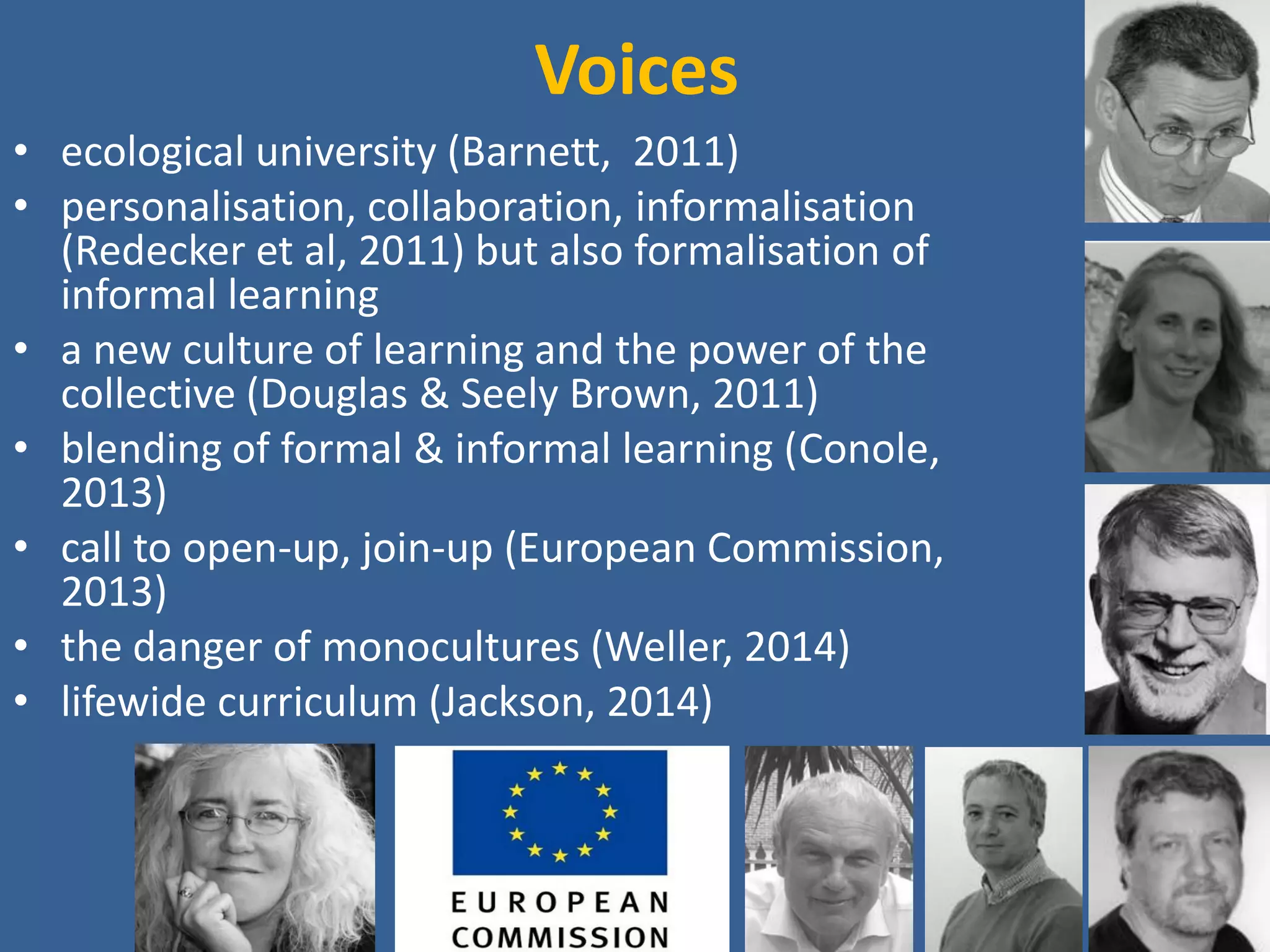
Voices 
•ecological university (Barnett, 2011) 
•personalisation, collaboration, informalisation (Redecker et al, 2011) but also formalisation of informal learning 
•a new culture of learning and the power of the collective (Douglas & Seely Brown, 2011) 
•a need for a national initiative on cost-effective teaching when resources are reduced (Gibbs, 2012) 
•blending of formal & informal learning (Conole, 2013) 
•call to open-up, join-up (European Commission, 2013) 
•the danger of monocultures (Weller, 2014) 
•lifewide curriculum (Jackson, 2014)
a scalable model for open cross-institutional CPD?
Starting here? Or...
BYOD4L: an example from practice
Bring Your Own Device for Learning
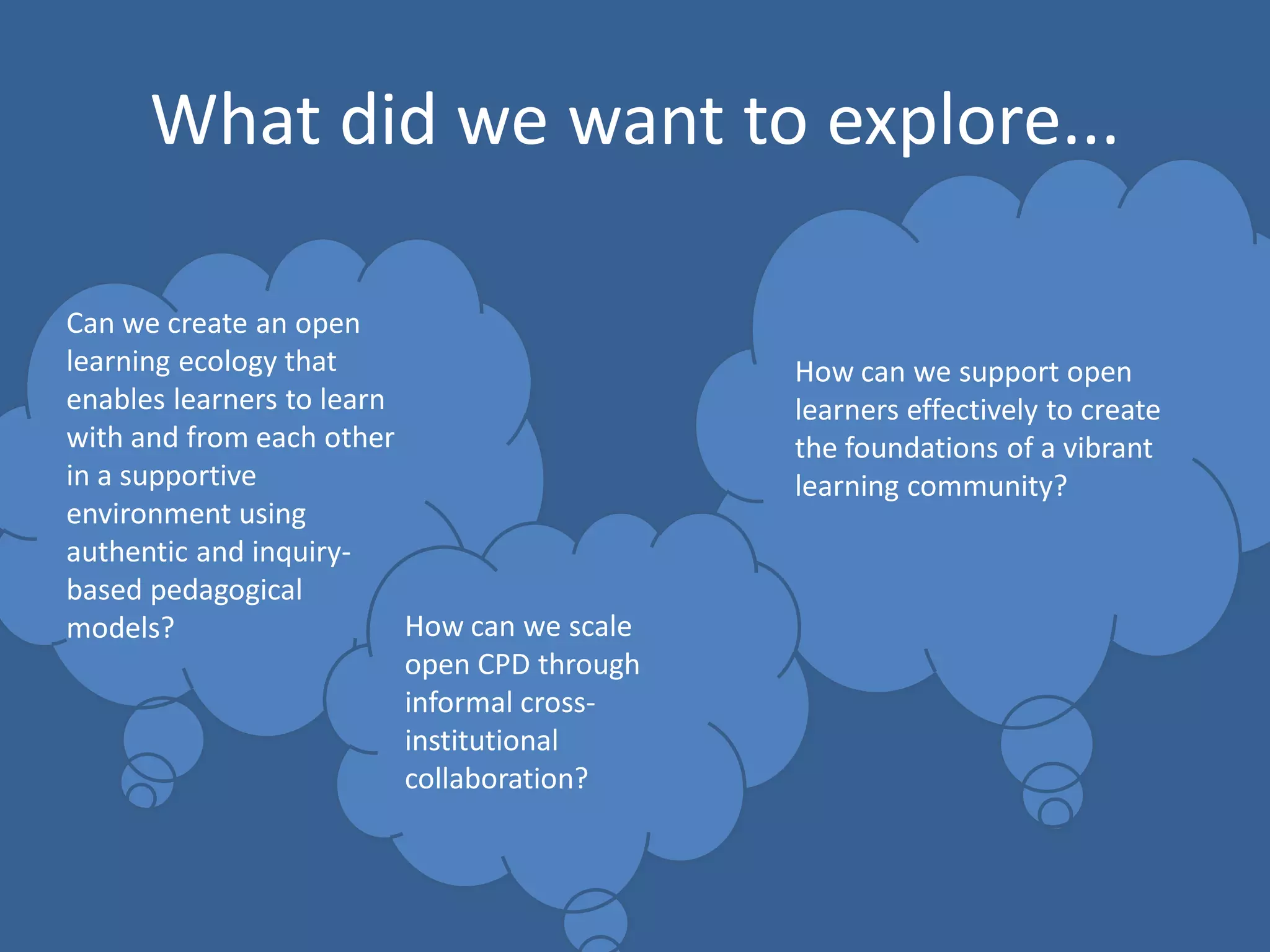
What did we want to explore... 
Can we create an open learning ecology that enables learners to learn with and from each other in a supportive environment using authentic and inquiry- based pedagogical models? 
How can we support open learners effectively to create the foundations of a vibrant learning community? 
How can we scale open CPD through informal cross- institutional collaboration?
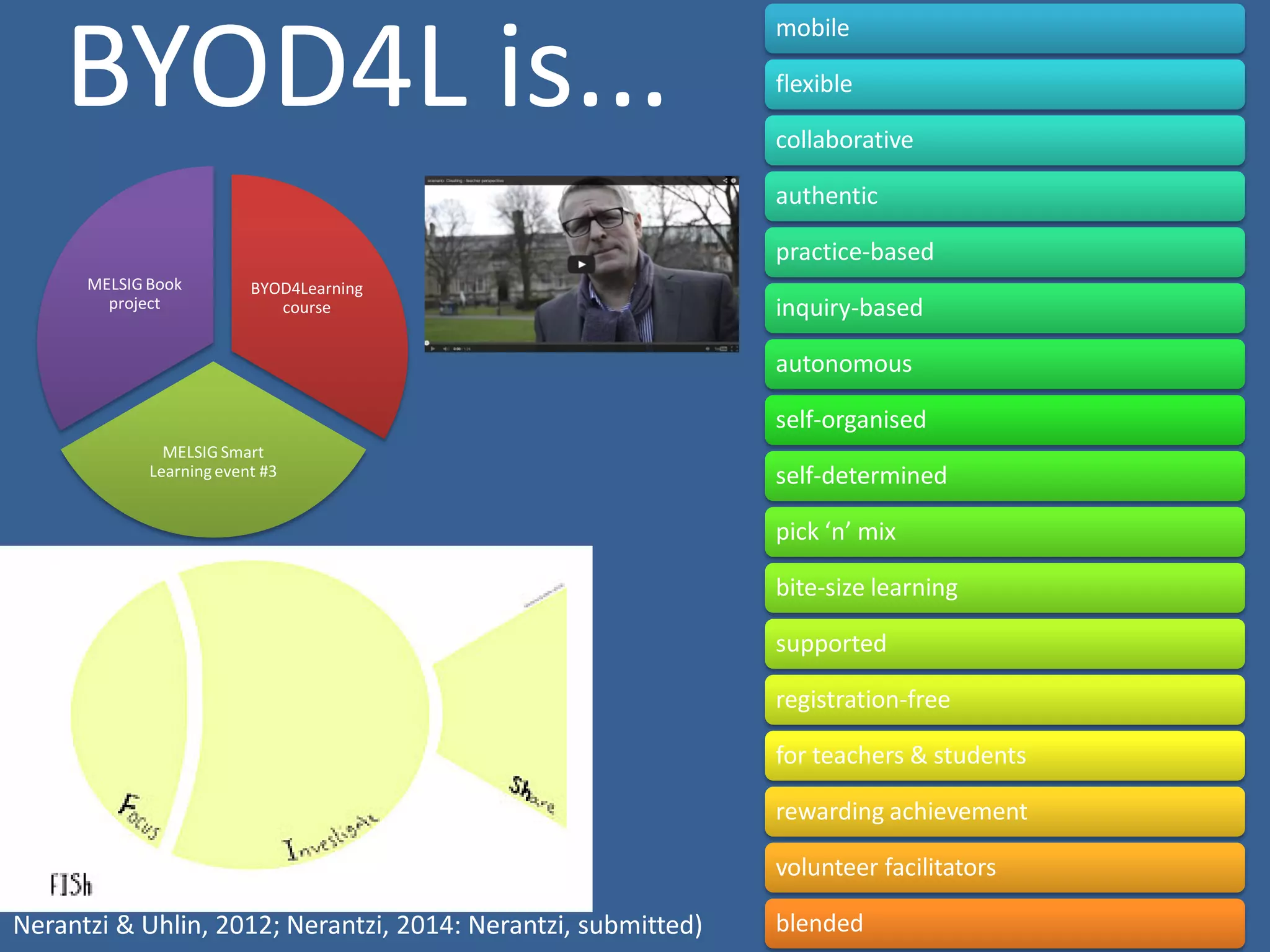
BYOD4L is... 
mobile 
flexible 
collaborative 
authentic 
practice-based 
inquiry-based 
autonomous 
self-organised 
self-determined 
pick ‘n’ mix 
bite-size learning 
supported 
registration-free 
for teachers & students 
rewarding achievement 
volunteer facilitators 
blended 
BYOD4Learning course 
MELSIG Smart Learning event #3 
MELSIG Book project 
Nerantzi & Uhlin, 2012; Nerantzi, 2014: Nerantzi, submitted)
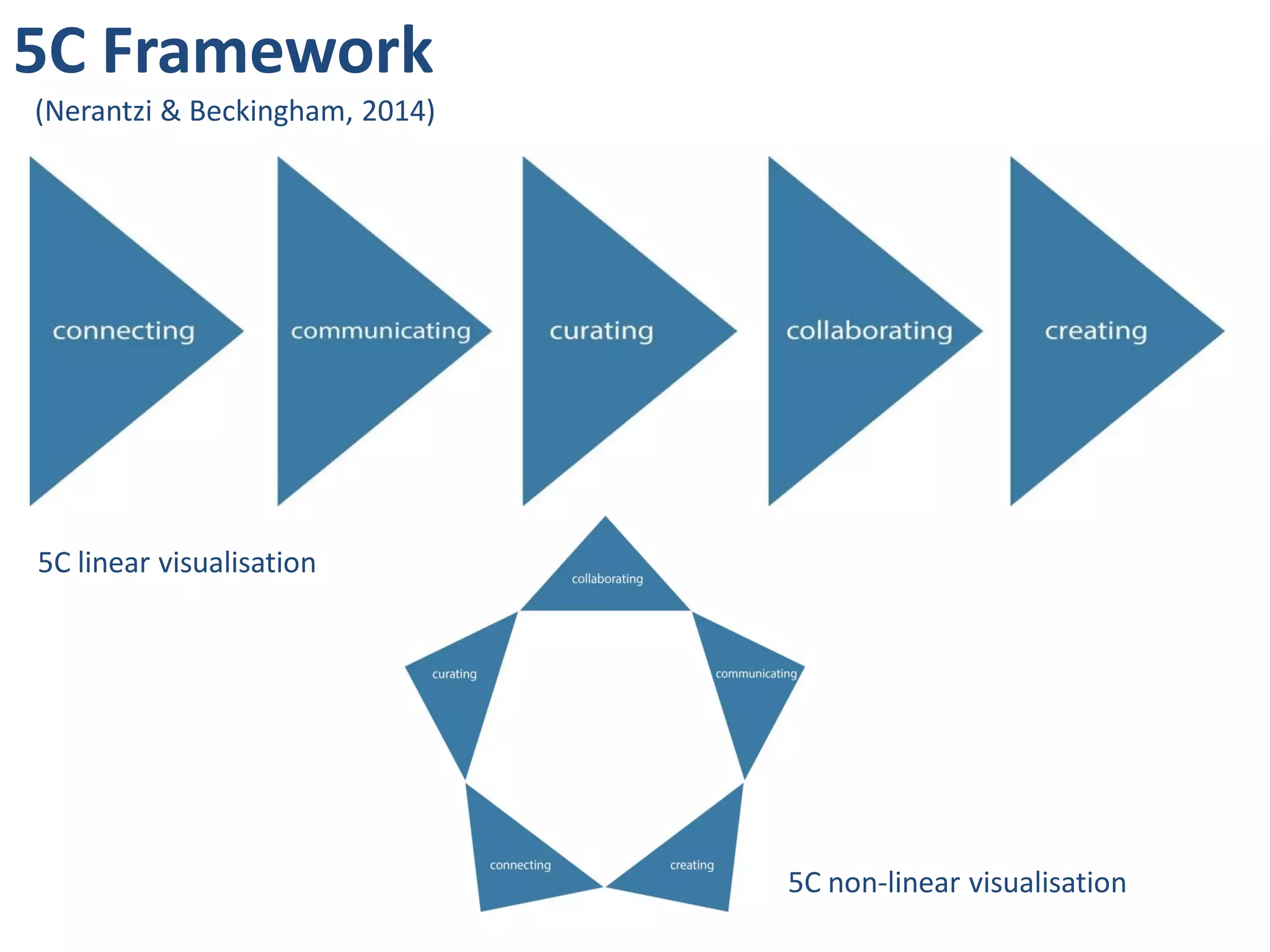
5C Framework 
(Nerantzi & Beckingham, 2014) 
5C linear visualisation 
5C non-linear visualisation
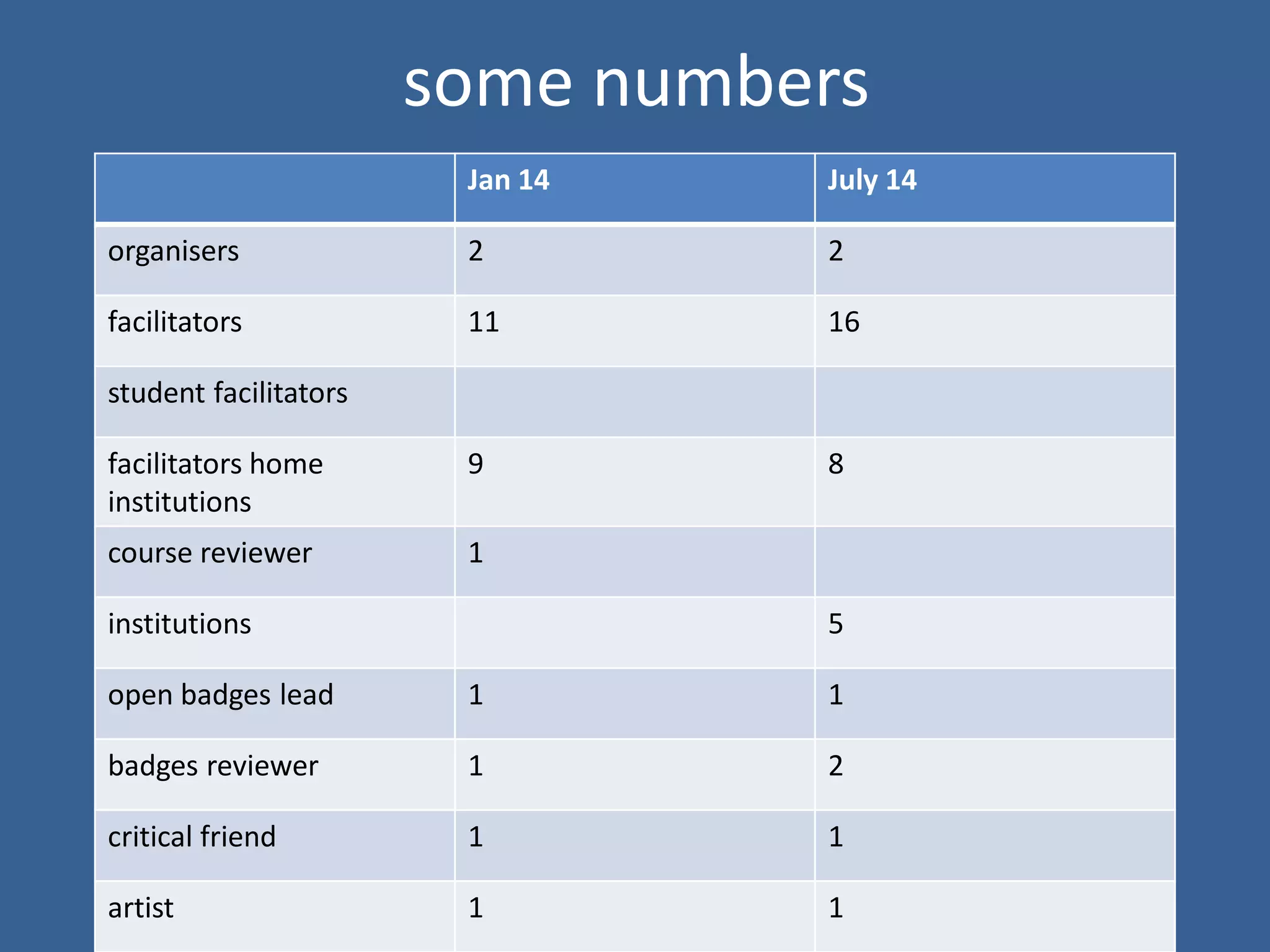
some numbers 
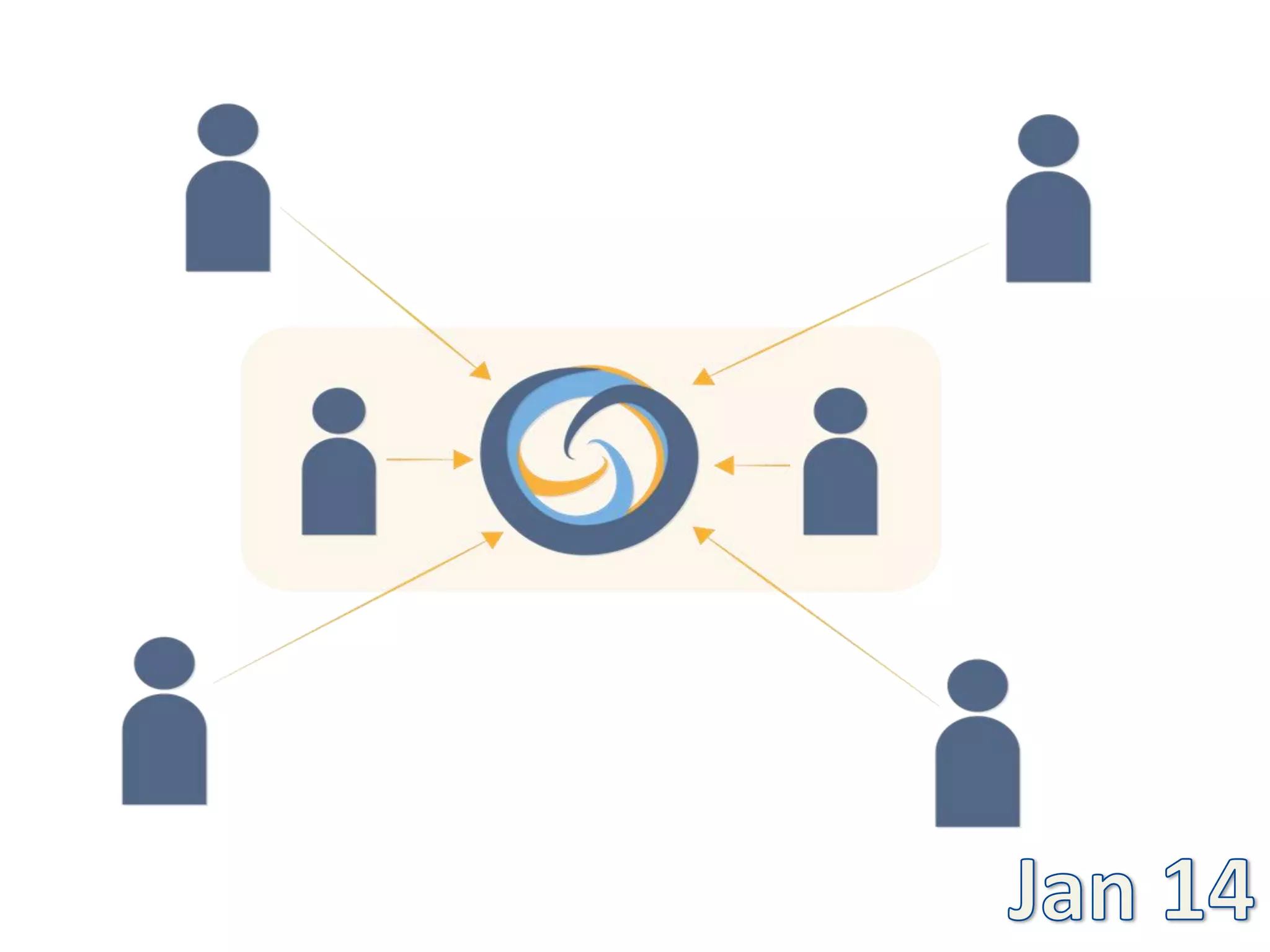
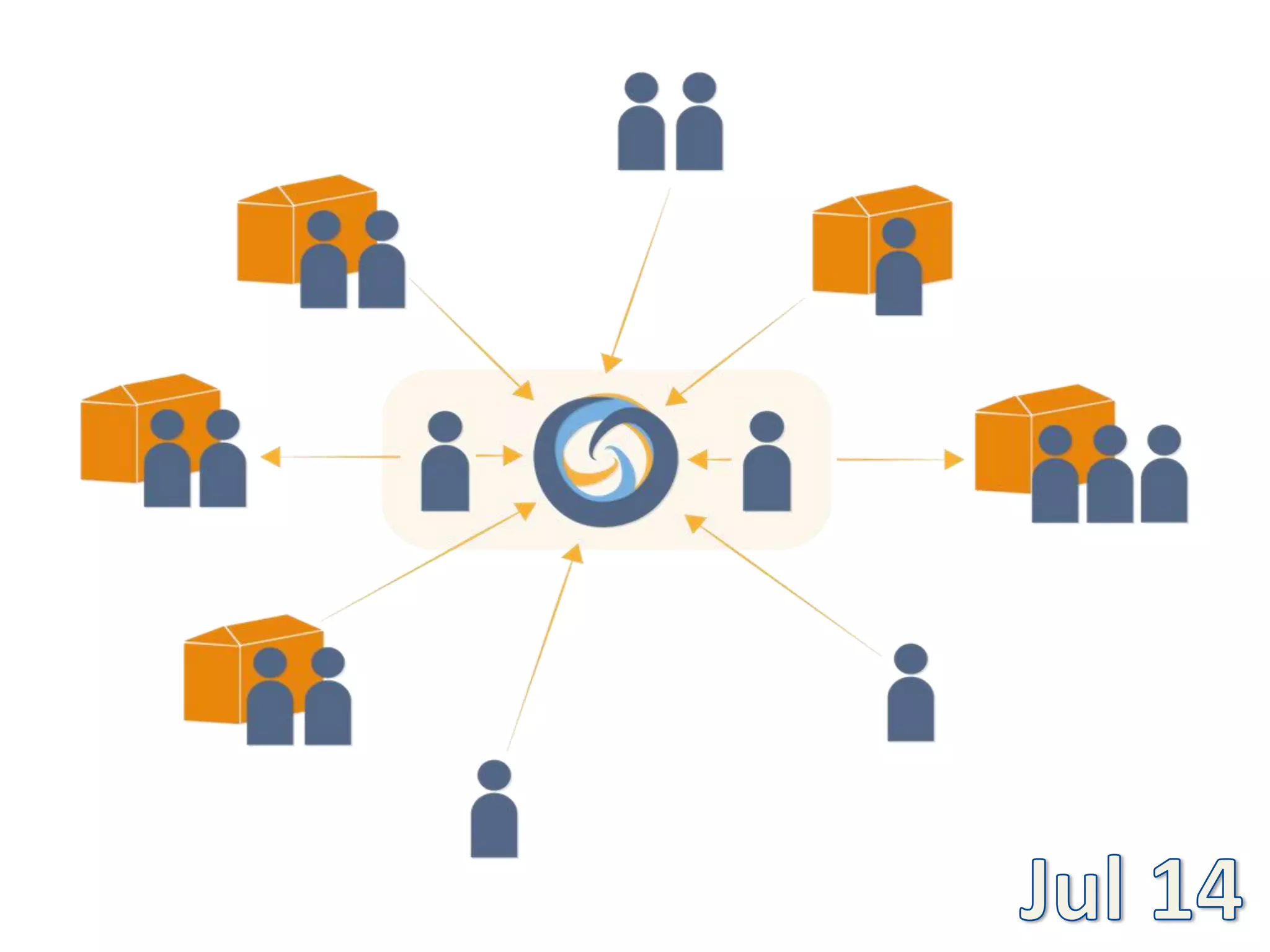
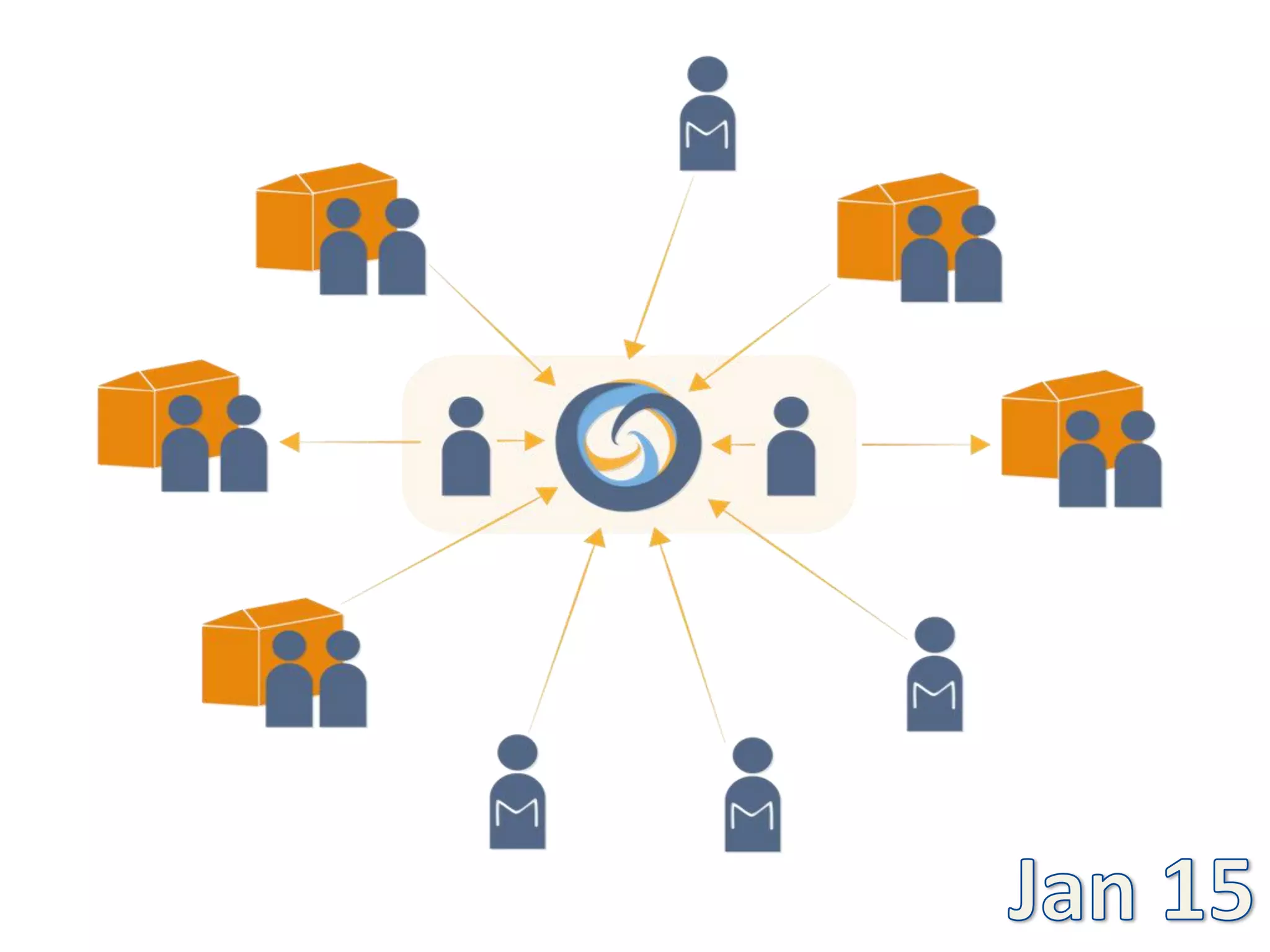
Jan 14 
July 14 
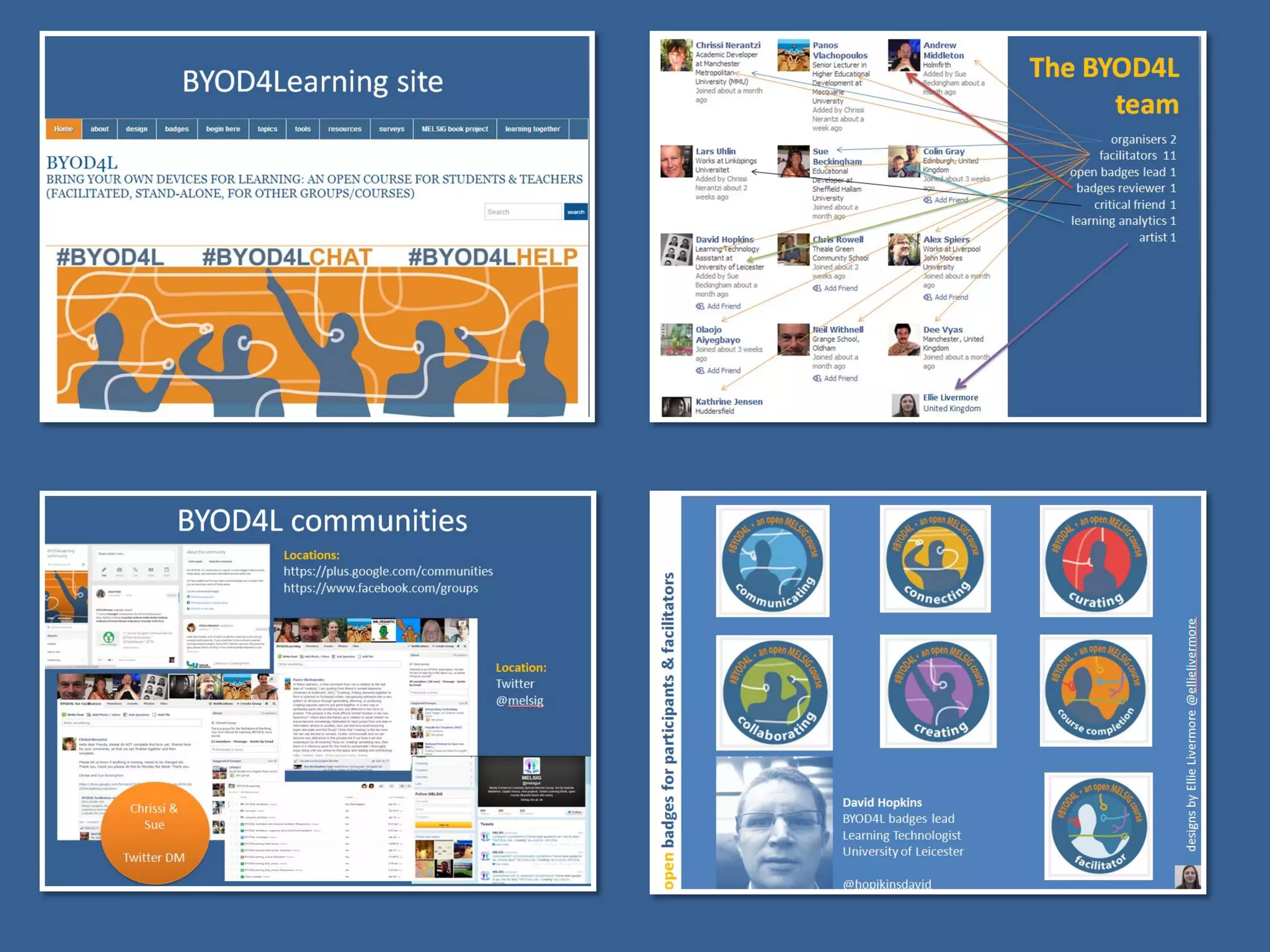
organisers 
2 
2 
facilitators 
11 
16 
student facilitators 
facilitators home institutions 
9 
8 
course reviewer 
1 
institutions 
5 
open badges lead 
1 
1 
badges reviewer 
1 
2 
critical friend 
1 
1 
artist 
1 
1
January 2014
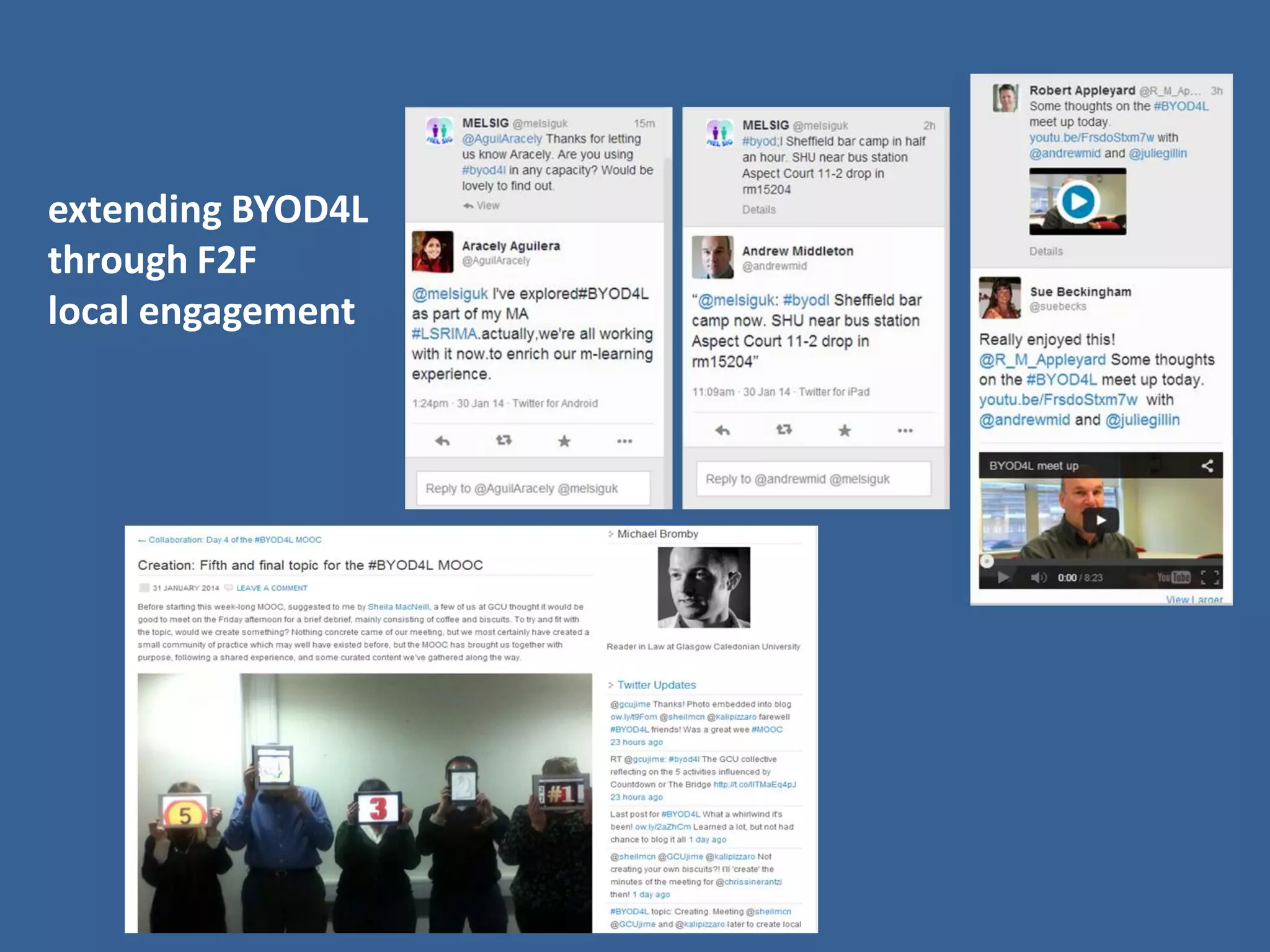
extending BYOD4L 
through F2F 
local engagement
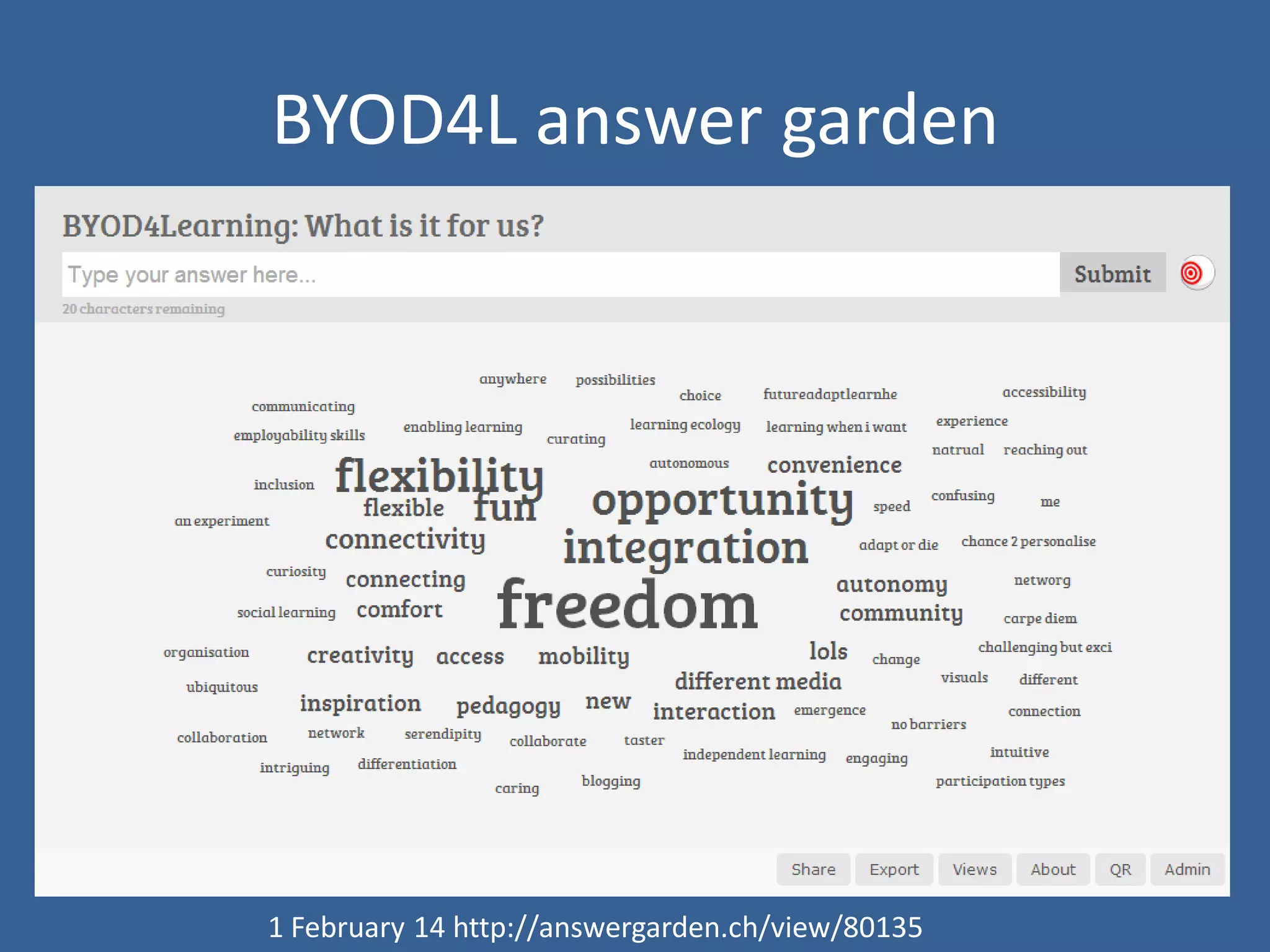
BYOD4L answer garden 
1 February 14 http://answergarden.ch/view/80135
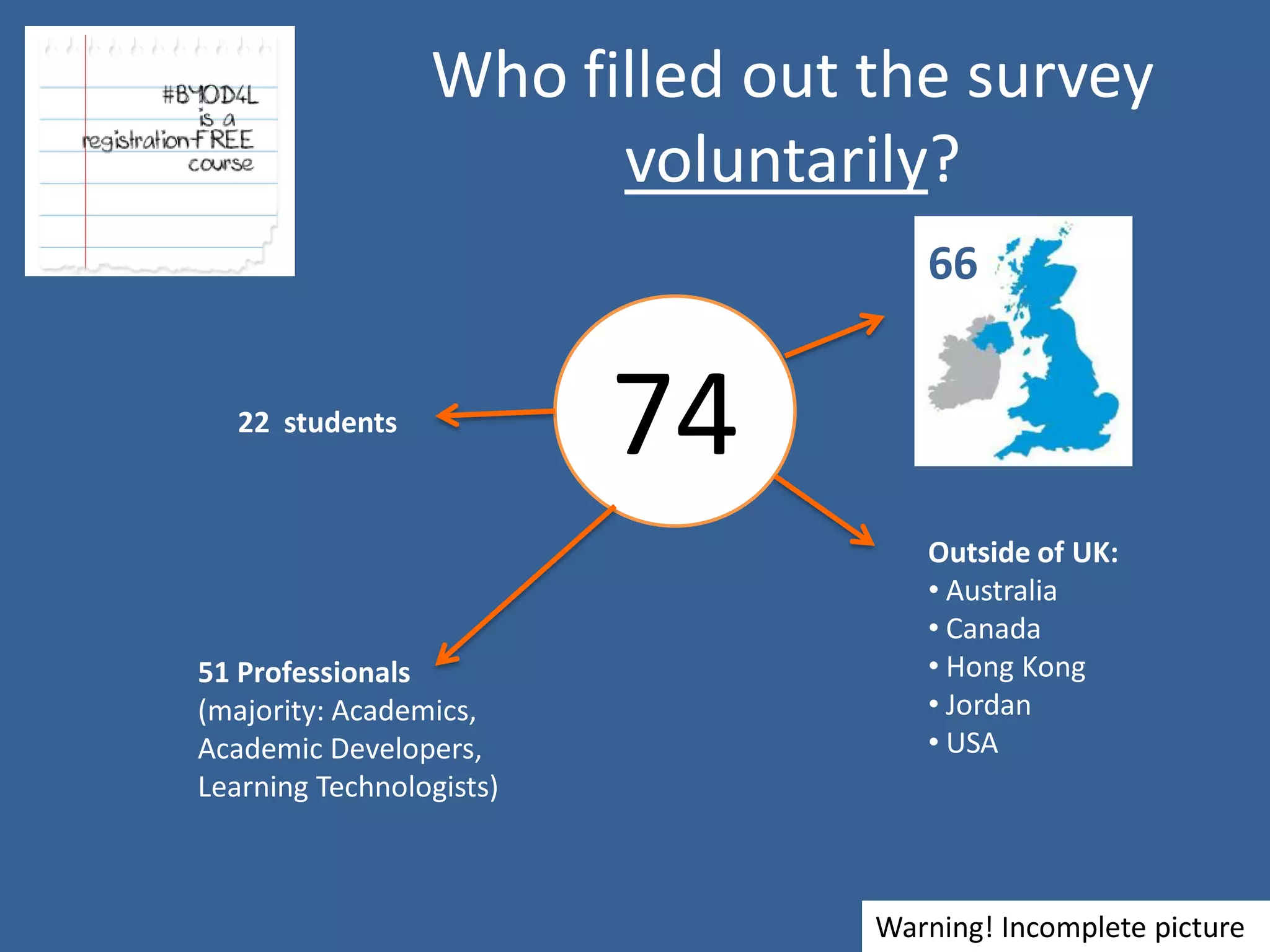
Who filled out the survey voluntarily? 
74 
66 
Outside of UK: 
• Australia 
• Canada 
• Hong Kong 
• Jordan 
• USA 
22 students 
51 Professionals 
(majority: Academics, Academic Developers, Learning Technologists) 
Warning! Incomplete picture
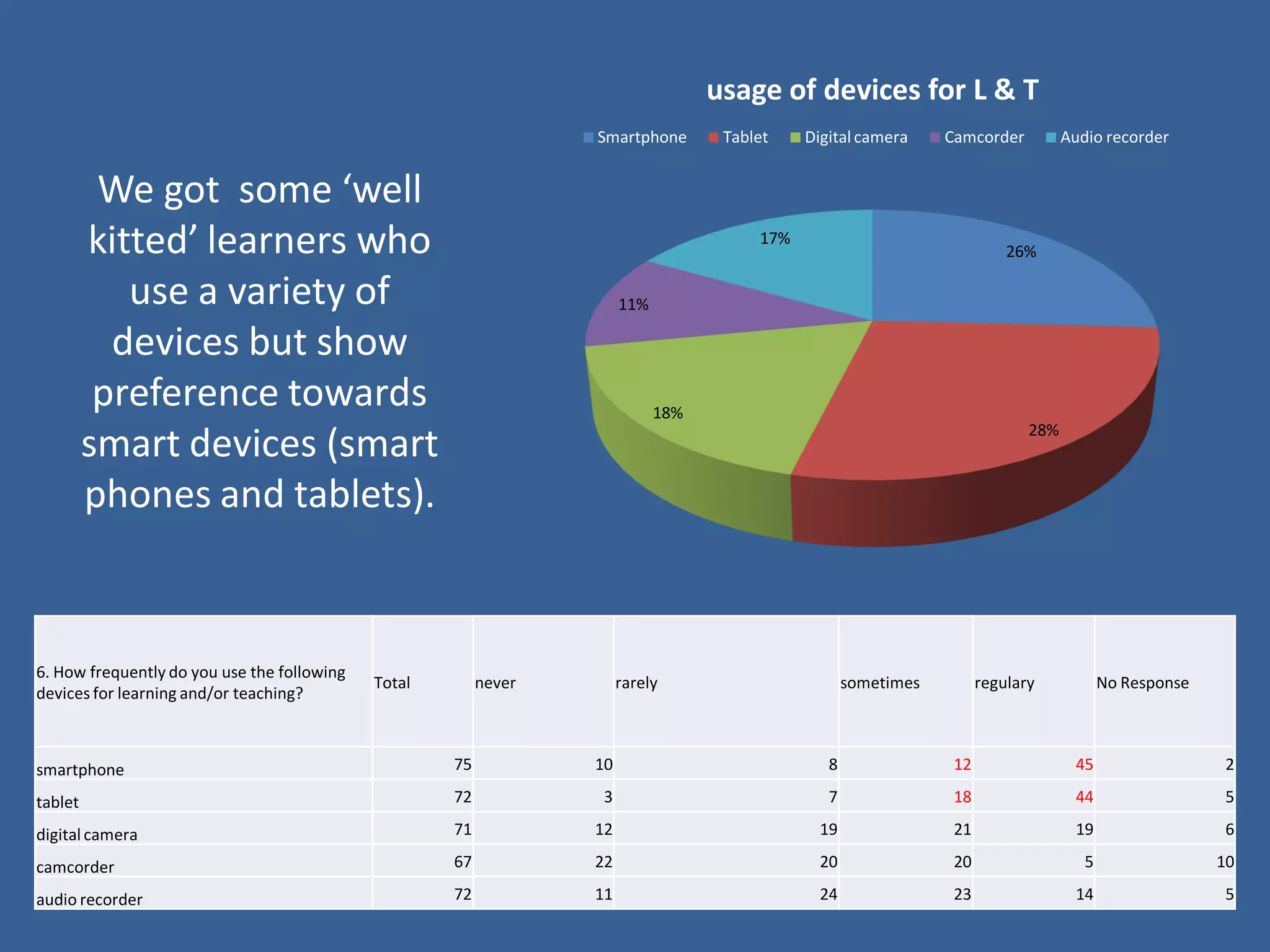
6. How frequently do you use the following devices for learning and/or teaching? 
Total 
never 
rarely 
sometimes 
regulary 
No Response 
smartphone 
75 
10 
8 
12 
45 
2 
tablet 
72 
3 
7 
18 
44 
5 
digital camera 
71 
12 
19 
21 
19 
6 
camcorder 
67 
22 
20 
20 
5 
10 
audio recorder 
72 
11 
24 
23 
14 
5 
We got some ‘well kitted’ learners who use a variety of devices but show preference towards smart devices (smart phones and tablets). 
26% 
28% 
18% 
11% 
17% 
usage of devices for L & T 
Smartphone 
Tablet 
Digital camera 
Camcorder 
Audio recorder
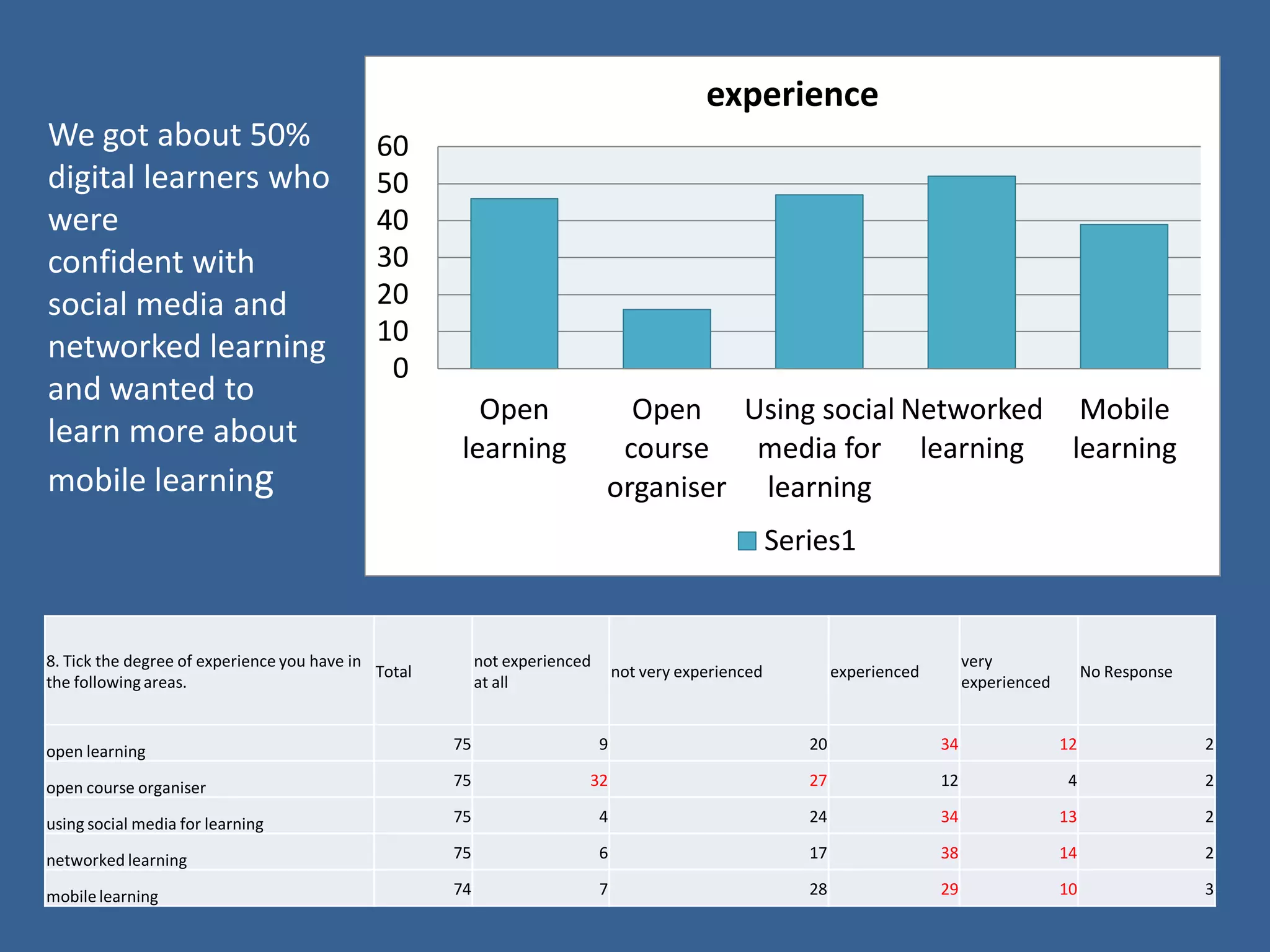
8. Tick the degree of experience you have in the following areas. 
Total 
not experienced at all 
not very experienced 
experienced 
very experienced 
No Response 
open learning 
75 
9 
20 
34 
12 
2 
open course organiser 
75 
32 
27 
12 
4 
2 
using social media for learning 
75 
4 
24 
34 
13 
2 
networked learning 
75 
6 
17 
38 
14 
2 
mobile learning 
74 
7 
28 
29 
10 
3 
We got about 50% digital learners who were confident with social media and networked learning and wanted to learn more about mobile learning 
0 
10 
20 
30 
40 
50 
60 
Open learning 
Open course organiser 
Using social media for learning 
Networked learning 
Mobile learning 
experience 
Series1
Individuals were confident, comfortable and experienced in such spaces and joined us for CPD (according to the initial survey). Question How can we attract individuals who are less confident and experienced?
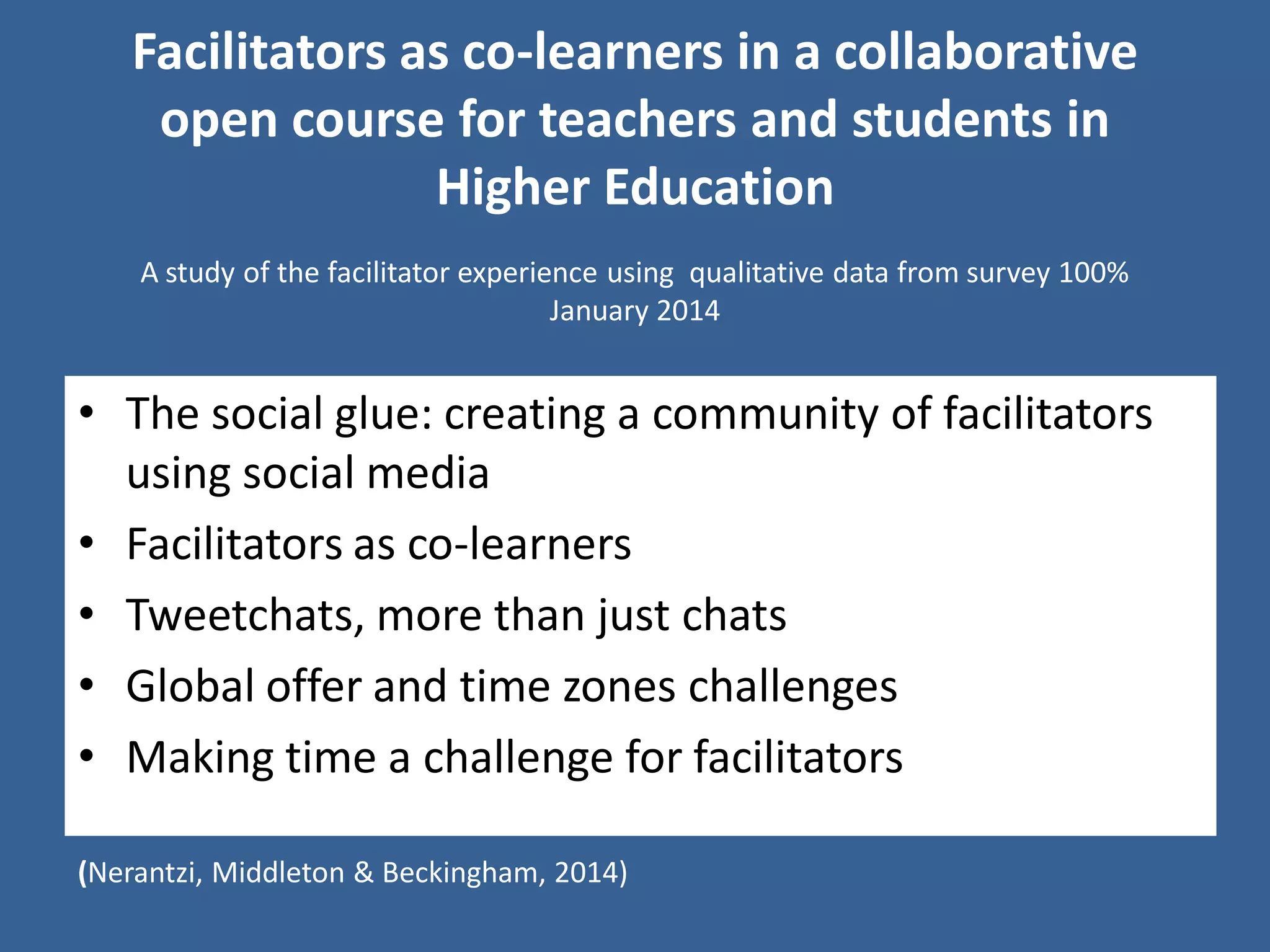
Facilitators as co-learners in a collaborative open course for teachers and students in Higher Education 
•The social glue: creating a community of facilitators using social media 
•Facilitators as co-learners 
•Tweetchats, more than just chats 
•Global offer and time zones challenges 
•Making time a challenge for facilitators 
(Nerantzi, Middleton & Beckingham, 2014) 
A study of the facilitator experience using qualitative data from survey 100% 
January 2014
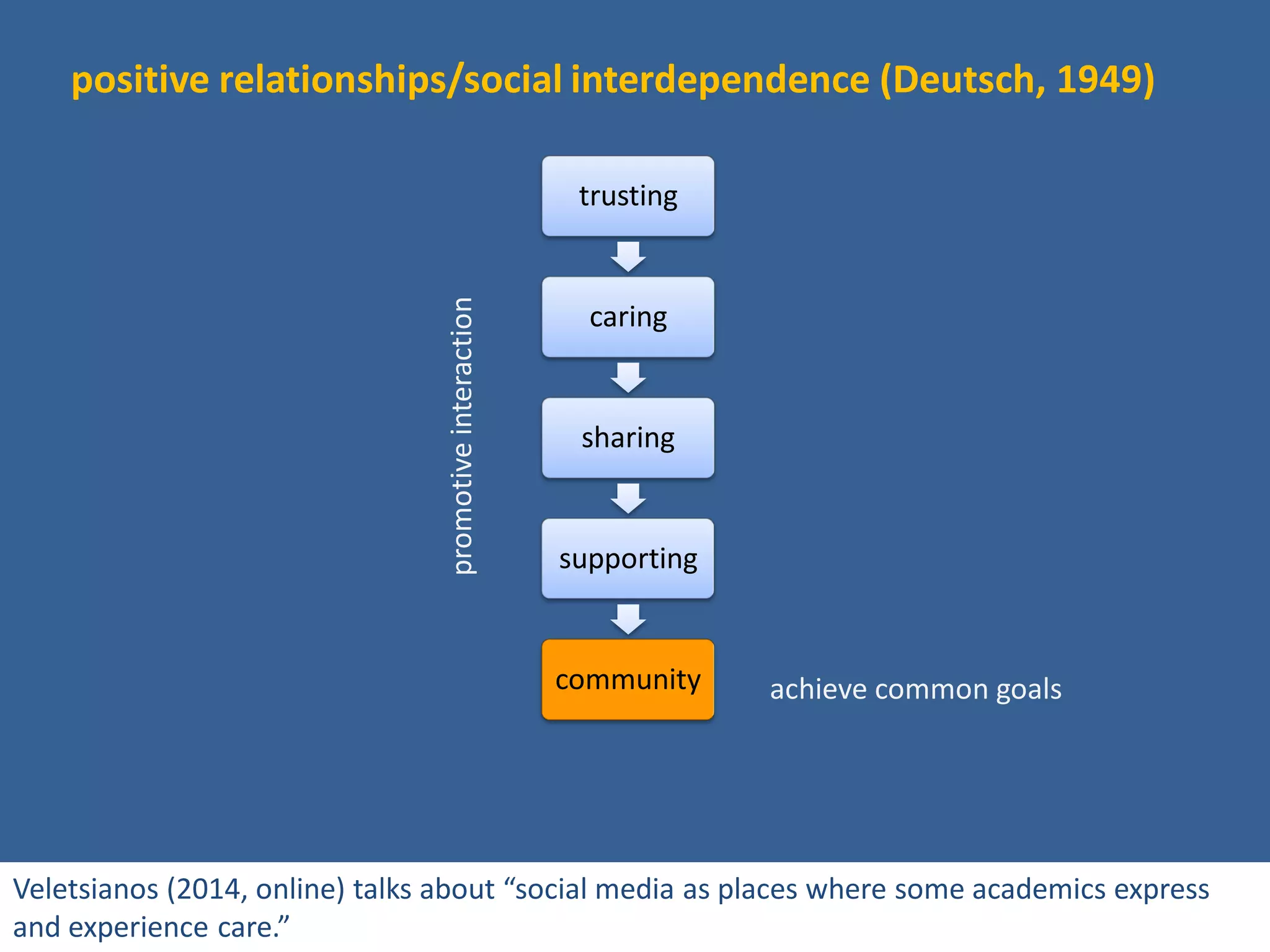
Veletsianos (2014, online) talks about “social media as places where some academics express and experience care.” 
promotive interaction 
trusting 
caring 
sharing 
supporting 
community 
positive relationships/social interdependence (Deutsch, 1949) 
achieve common goals
July 2014
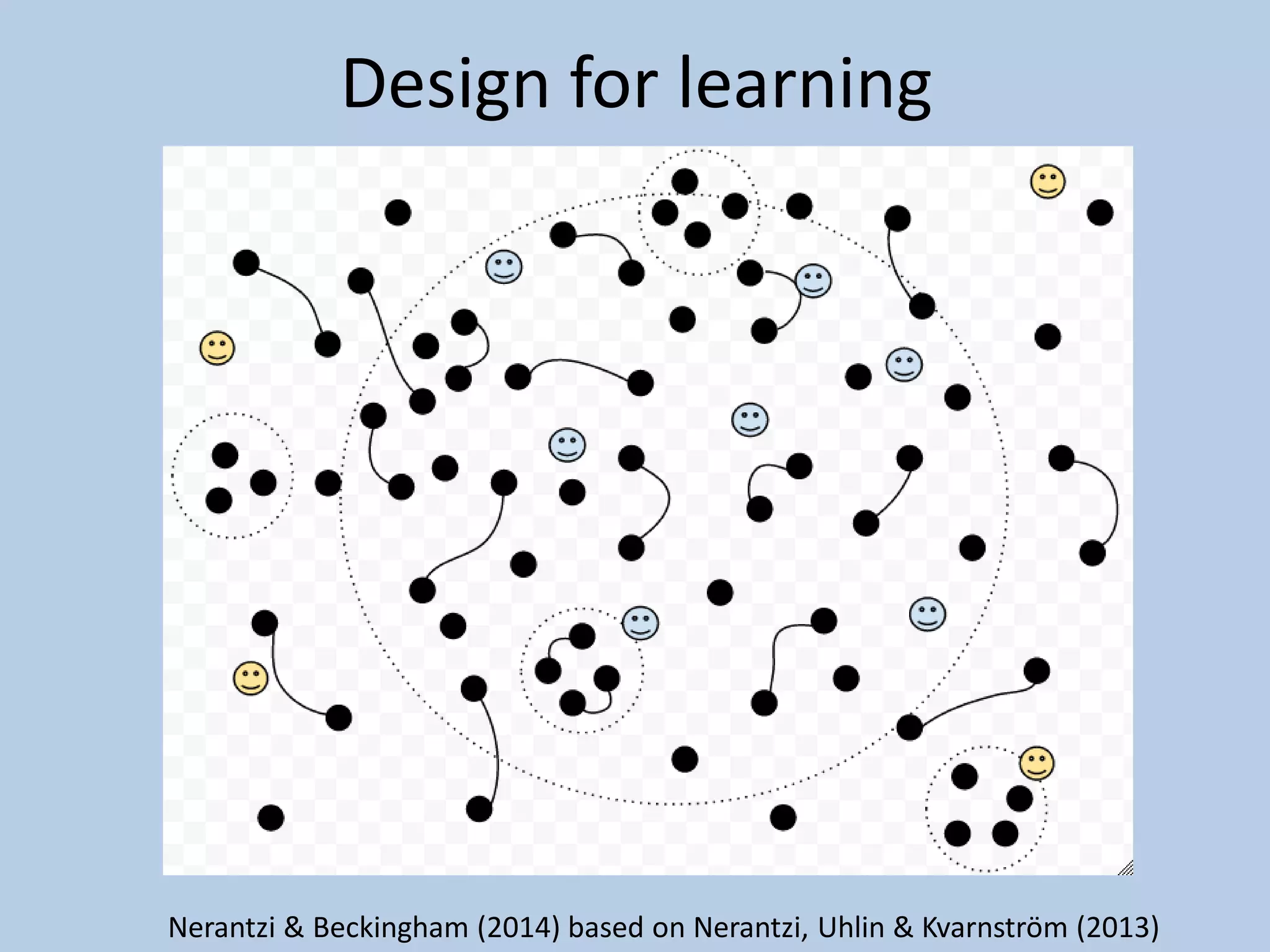
Design for learning 
Nerantzi & Beckingham (2014) based on Nerantzi, Uhlin & Kvarnström (2013)
open to all 5 institutions supporting BYOD4L
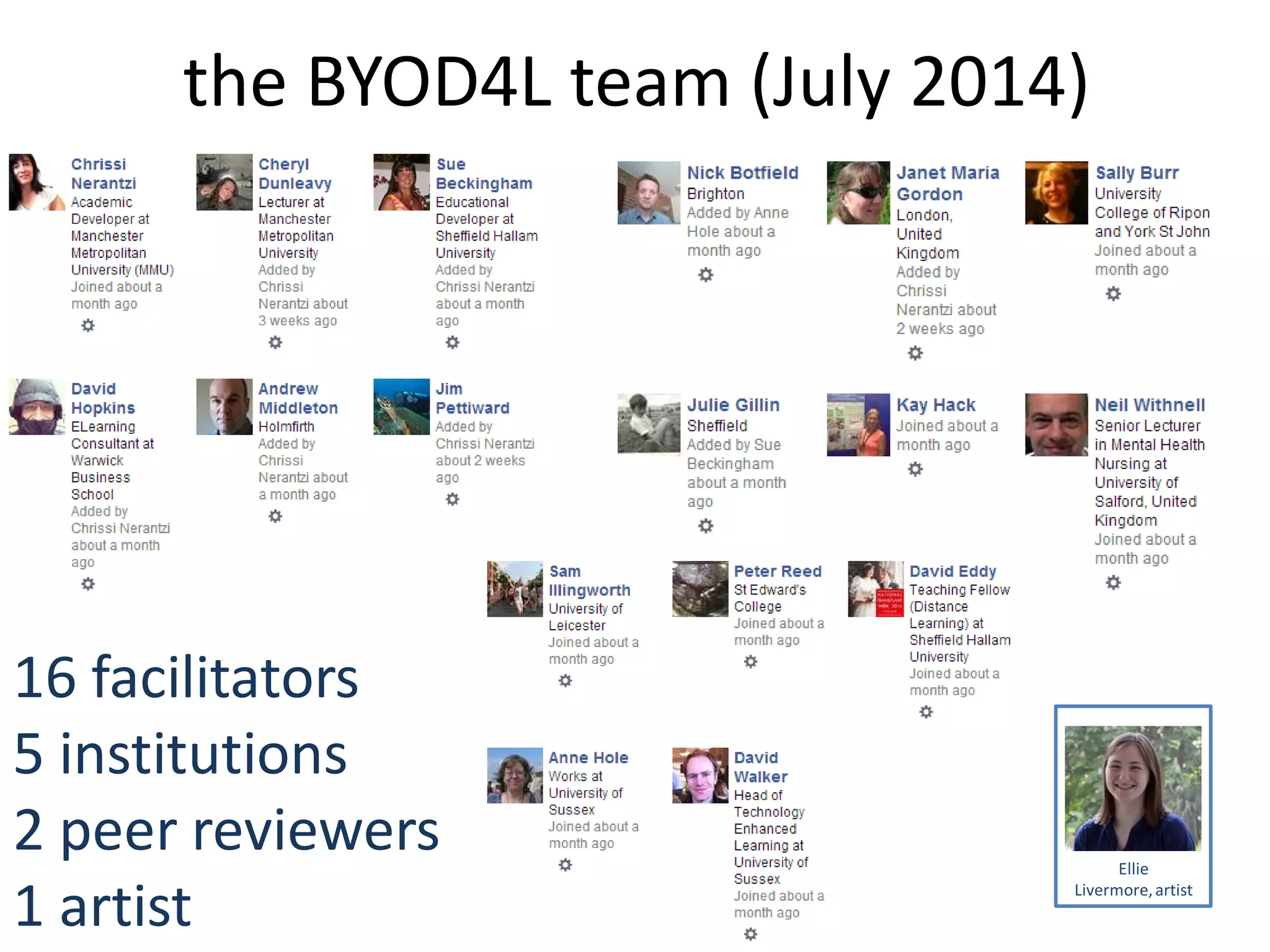
the BYOD4L team (July 2014) 
16 facilitators 
5 institutions 
2 peer reviewers 
1 artist 
Ellie 
Livermore, artist
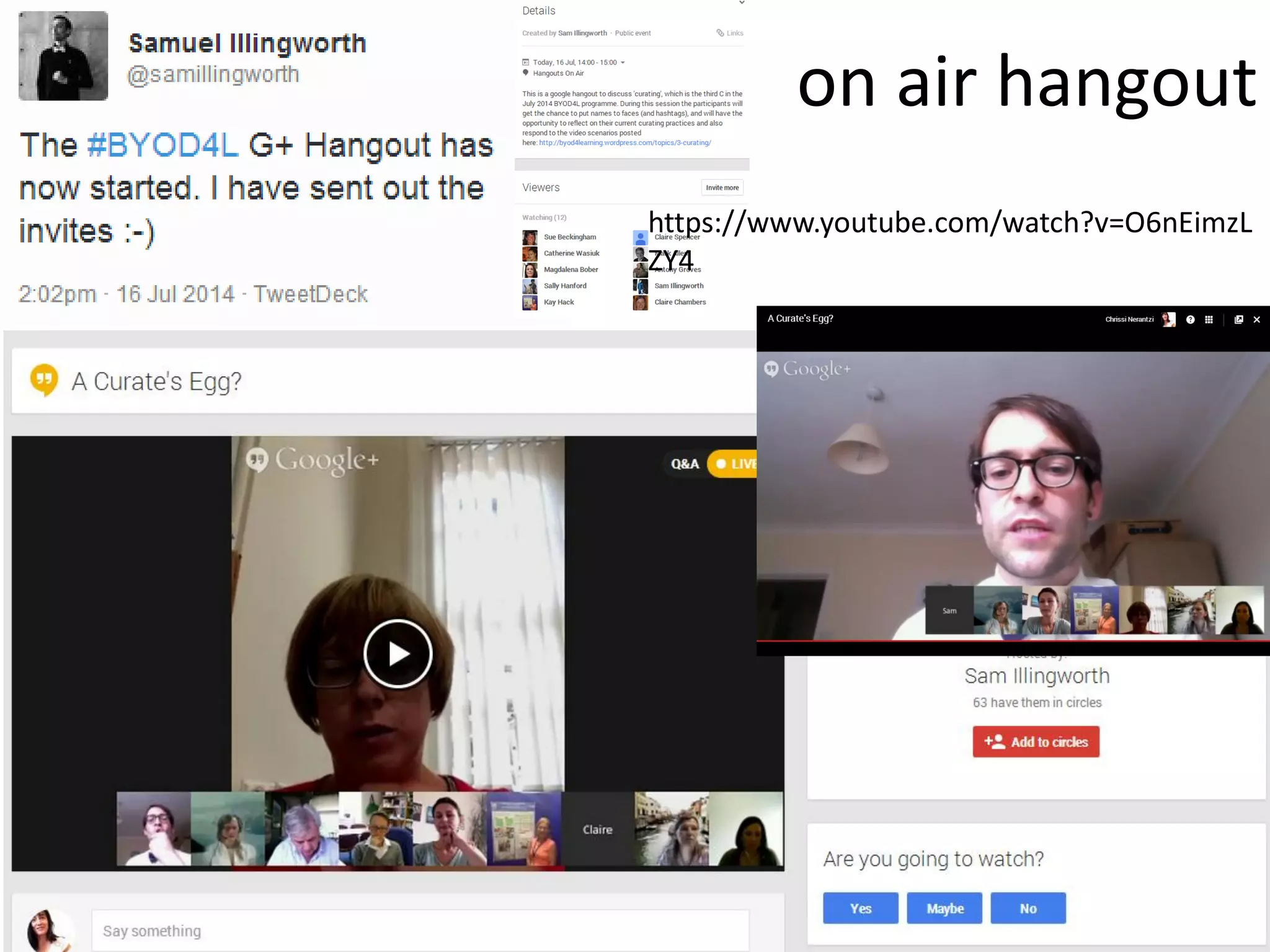
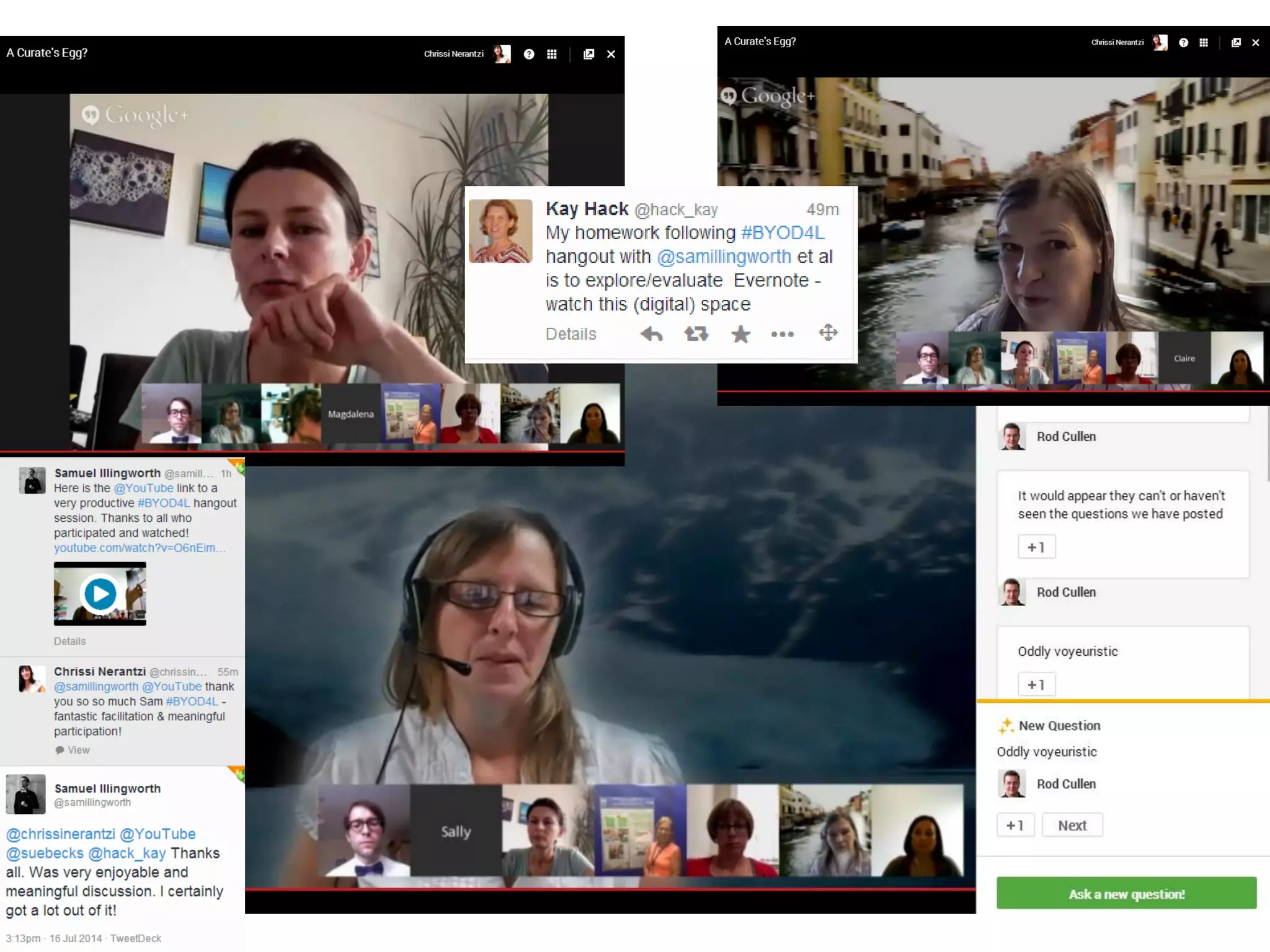
on air hangout 
https://www.youtube.com/watch?v=O6nEimzLZY4
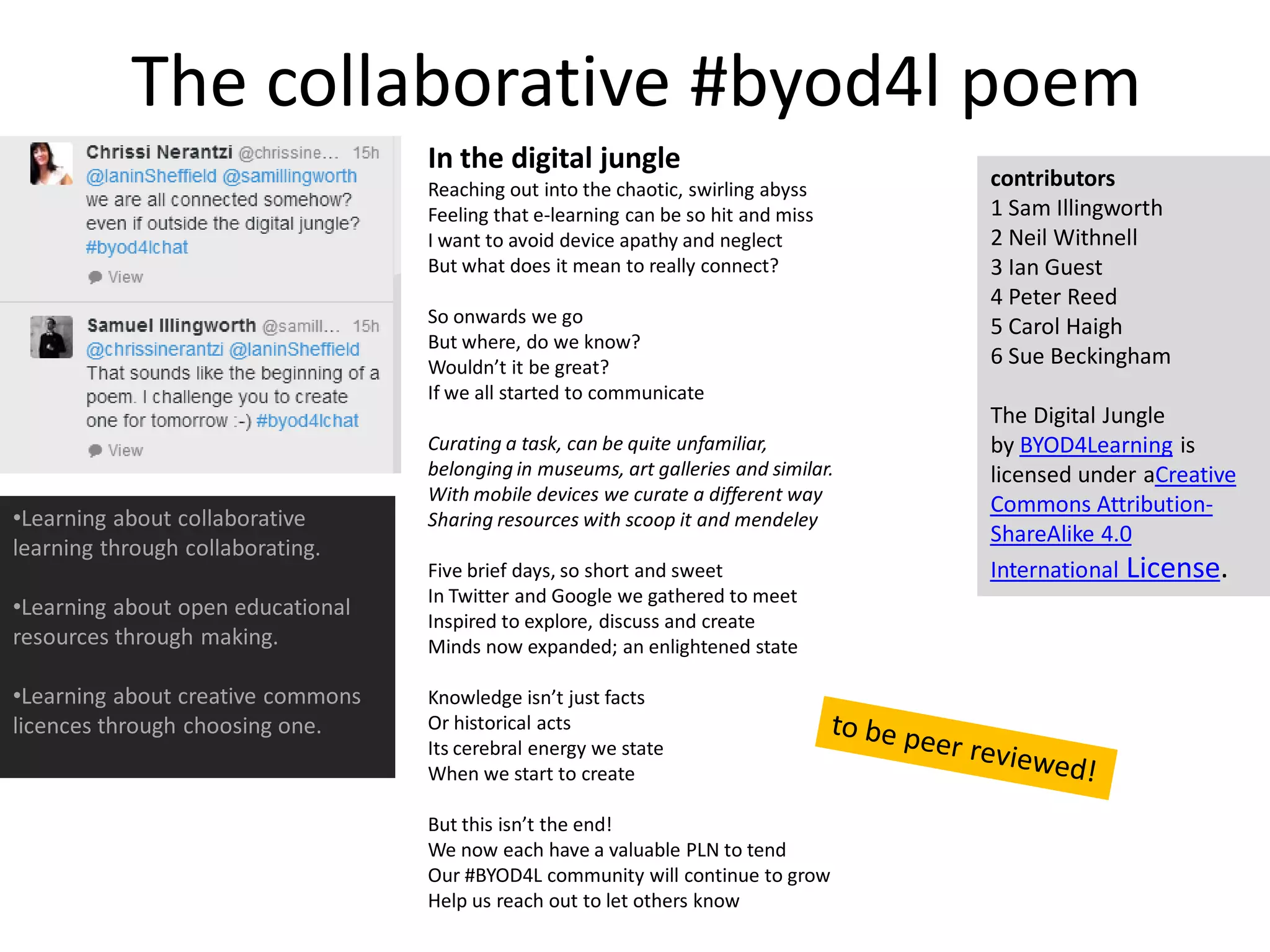
The collaborative #byod4l poem 
In the digital jungle 
Reaching out into the chaotic, swirling abyss 
Feeling that e-learning can be so hit and miss 
I want to avoid device apathy and neglect 
But what does it mean to really connect? 
So onwards we go 
But where, do we know? 
Wouldn’t it be great? 
If we all started to communicate 
Curating a task, can be quite unfamiliar, 
belonging in museums, art galleries and similar. 
With mobile devices we curate a different way 
Sharing resources with scoop it and mendeley 
Five brief days, so short and sweet 
In Twitter and Google we gathered to meet 
Inspired to explore, discuss and create 
Minds now expanded; an enlightened state 
Knowledge isn’t just facts 
Or historical acts 
Its cerebral energy we state 
When we start to create 
But this isn’t the end! 
We now each have a valuable PLN to tend 
Our #BYOD4L community will continue to grow 
Help us reach out to let others know 
contributors 
1 Sam Illingworth 
2 Neil Withnell 
3 Ian Guest 
4 Peter Reed 
5 Carol Haigh 
6 Sue Beckingham 
The Digital Jungle by BYOD4Learning is licensed under aCreative Commons Attribution- ShareAlike 4.0 International License. 
•Learning about collaborative learning through collaborating. 
•Learning about open educational resources through making. 
•Learning about creative commons licences through choosing one.
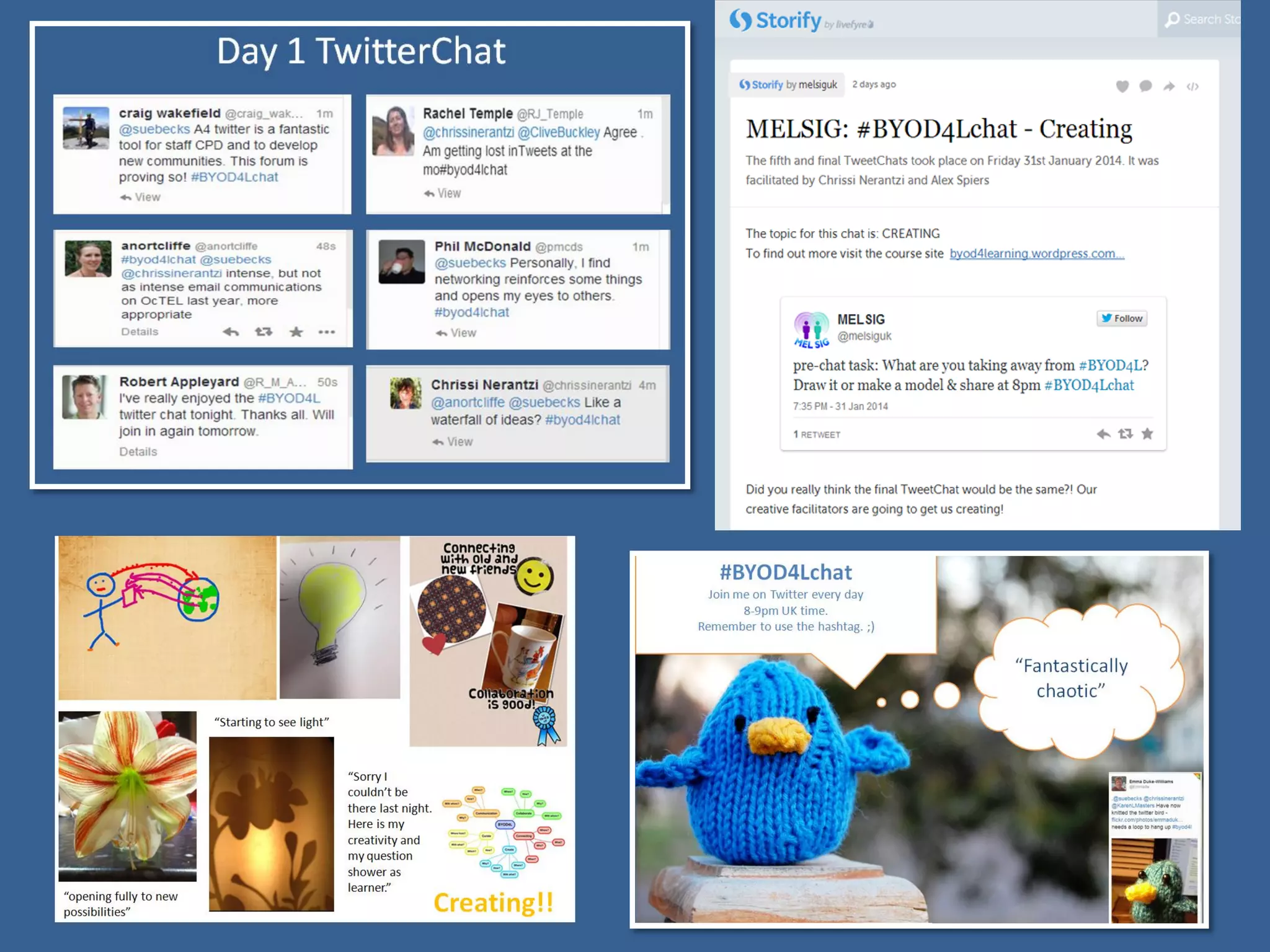
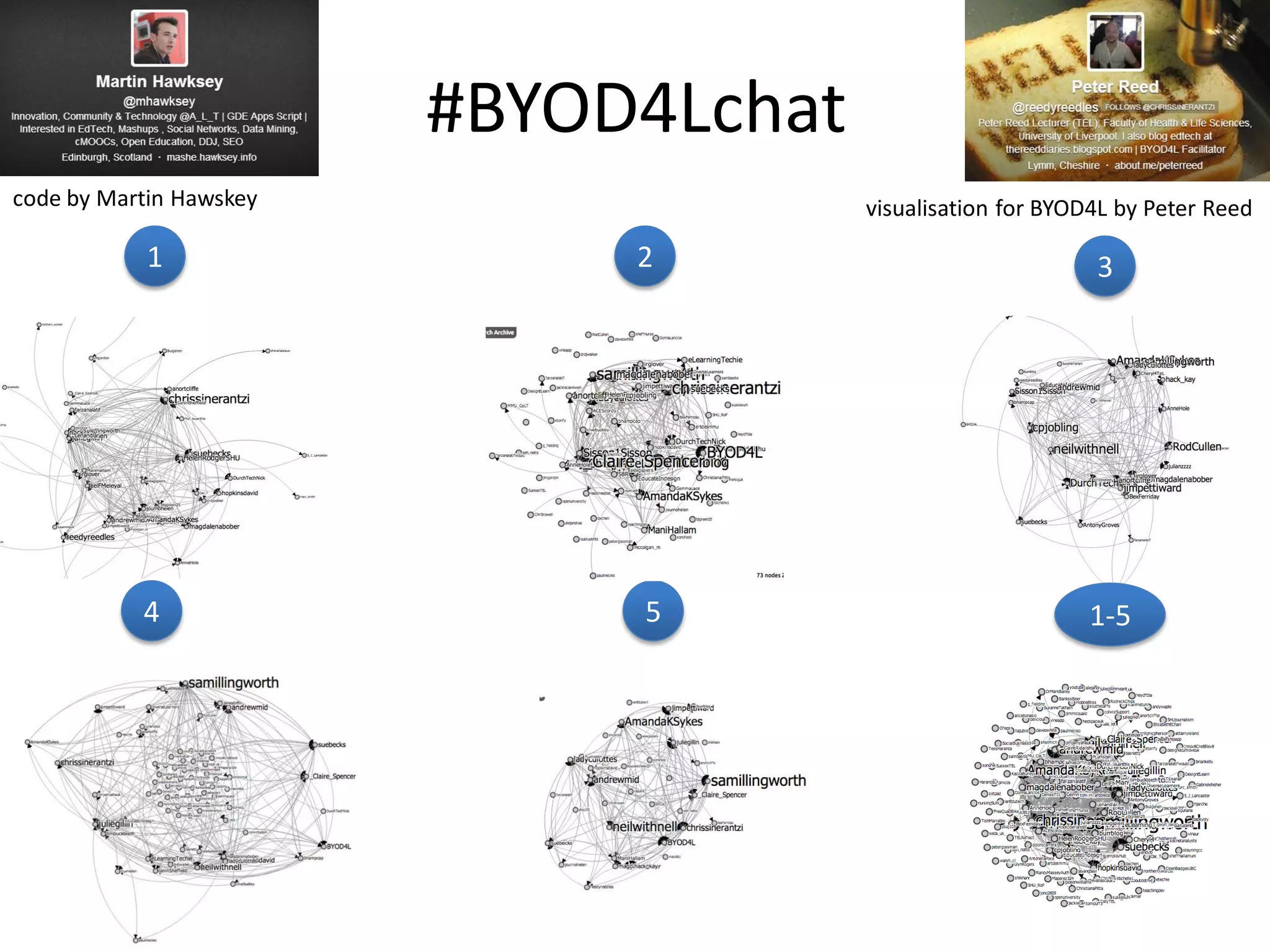
#BYOD4Lchat 
4 
5 
3 
2 
1 
code by Martin Hawskey 
visualisation for BYOD4L by Peter Reed 
1-5
open cross-institutional CPD: further opportunities
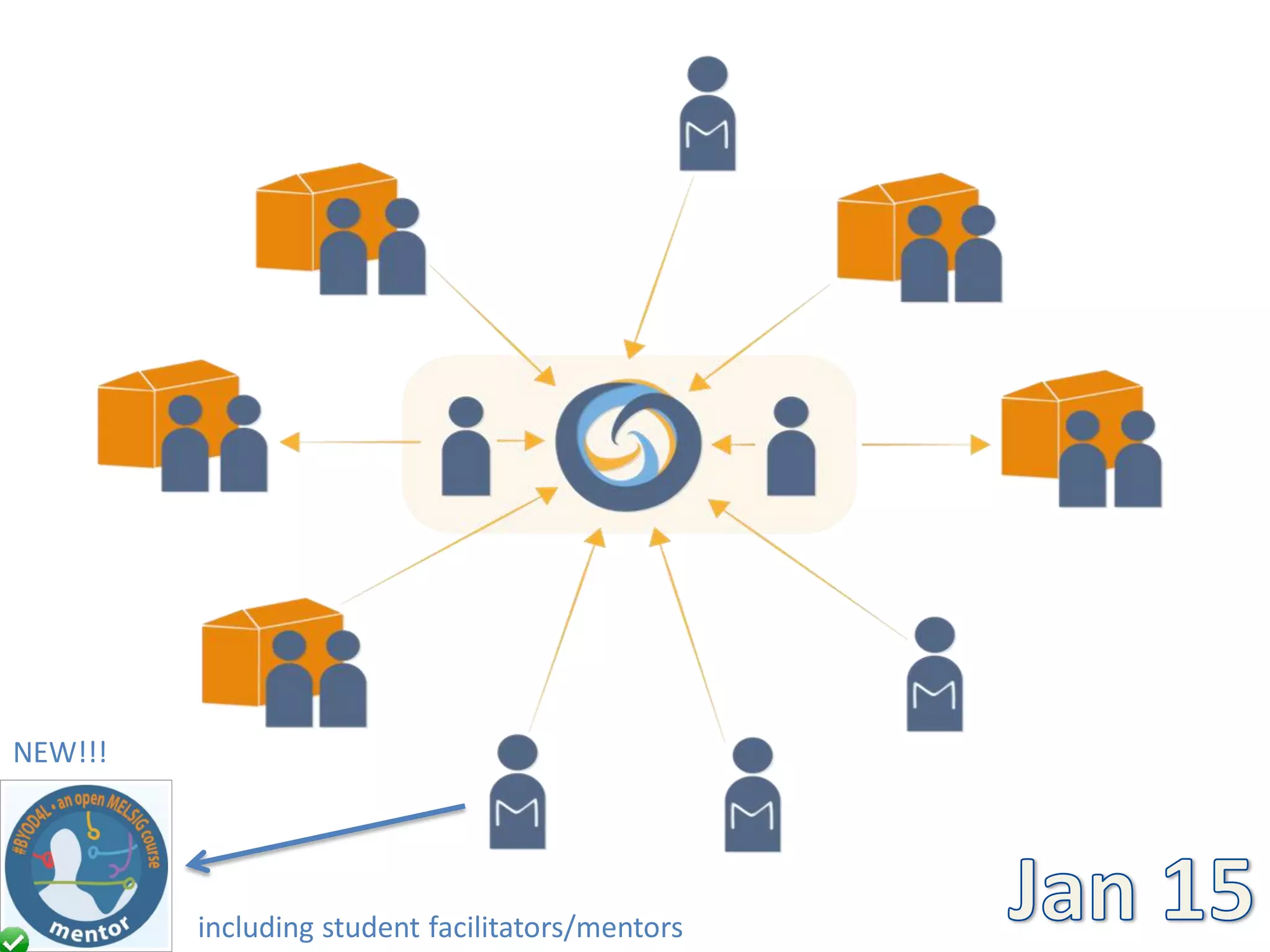
January 2015
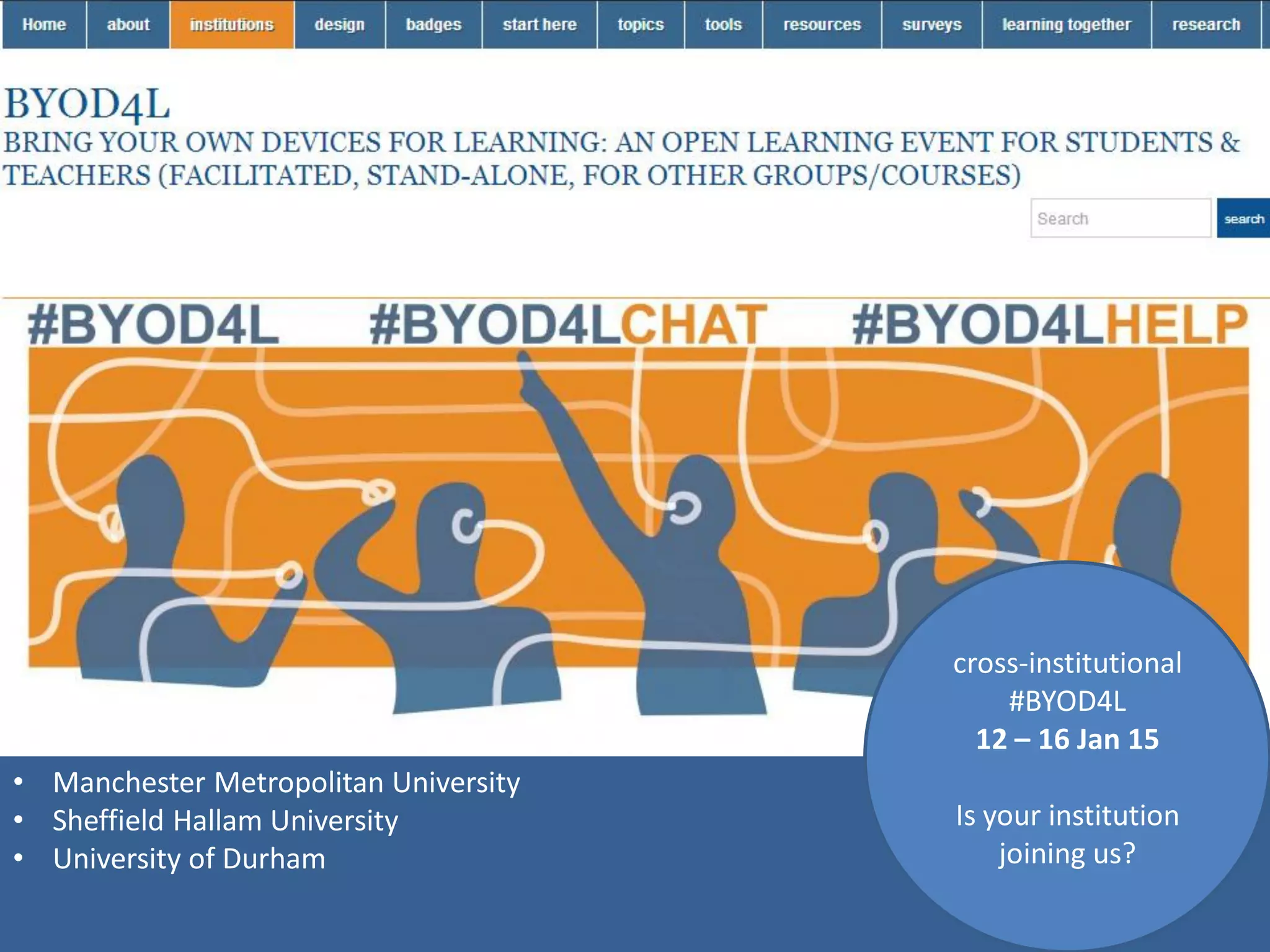
cross-institutional #BYOD4L 
12 – 16 Jan 15 
Is your institution joining us? 
•Manchester Metropolitan University 
•Sheffield Hallam University 
•University of Durham
NEW!!! 
including student facilitators/mentors
Are you interested in joining us? Still time!
What next? 
•Further research linked to the open scalable cross-institutional CPD model, open badges, Tweetchats 
•Open facilitators’ experiences project (work-in- progress) 
•Getting ready for BYOD4L in January 15!!! 
•…
special thank yous... 
... to all our collaborators, institutions, participants as well as our very own artist Ellie Livermore. 
We thank them all for embracing this project, their commitment and energy. 
BYOD4L would not have been possible without them!!! 
... the journey continues...
References 
Beetham and Sharpe, (2010), ‘Developing Digital Literacies Framework’, available fromhttp://jiscdesignstudio.pbworks.com/w/file/40474958/Literacies%20development%20framework.doc, date accessed 11th April 2014 
Bennett, L. (2012) Learning from the early adopters: Web2.0 tools, pedagogic patters and the development of the digital practitioner, Doctoral thesis, University of Huddersfield. 
Cormier, D. (2008) Rhizomatic Education: Community as Curriculum, Innovate. Journal of Online Education, V 4 No 5, Jun-Jul 2008, available at http://eric.ed.gov/?id=EJ840362 
Deutsch, M. (1949) A theory of cooperation and competition, in: Human Relations, 2, pp. 129-152. 
Dougkas, T. & Seely Brown, J. (2011) A new culture of learning. Cultivating the Imagination for a World of Constant Change, 
Galley, R., Conole, G, Dalziel, J and Ghiglione, E. (2010). Cloudworks as a ‘pedagogical wrapper’ for LAMS sequences: supporting the sharing of ideas across professional boundaries and facilitating collaborative design, evaluation and critical reflection. LAMS and Learning Design. A. Alexander, J. Dalziel, J. Krajka and R. Kiely. Nicosia, University of Nicosia Press. 2: pp. 37-50. 
Gibbs, G. (2012) Implications of ‘Dimensions of quality’ in a market environment, York: HEA. 
Jackson, N. J. (2013) The Concept of Learning Ecologies in N Jackson and G B Cooper (Eds) Lifewide Learning, Education and Personal Development E-Book. Chapter A5 available at http://www.lifewideebook.co.uk/uploads/1/0/8/4/10842717/chapter_a5.pdf [accessed 9 February 2014] 
Luckin, R., Clark, W., Garnett, F., Whitworth, A., Akass, J., Cook, J., Day, P., Ecclesfield, N., Hamilton, T. and Robertson, J. (2010) Learner Generated Contexts: a framework to support the effective use of technology to support learning, in: Lee, M. J. W. & McLoughlin, C. (eds) Web 2.0-Based E-Learning: Applying Social Informatics for Tertiary Teaching, IGI Global, pp. 70-84., available at http://knowledgeillusion.files.wordpress.com/2012/03/bookchapterluckin2009learnergeneratedcontexts.pdf [accessed 25 January 2014] 
Nerantzi, C. & Uhlin, L. (2012) FISh, available at http://fdol.wordpress.com/design/ 
Nerantzi, C. (submitted) Conceptions of open learners using FISh, a Problem-Based Learning design, used in a professional development course for teachers in higher education 
Nerantzi, C (2014) A personal journey of discoveries through a DIY open course development for professional development of teachers in Higher Education (invited paper),Journal of Pedagogic Development, University of Bedfordshire, Volume 4, Issue 2, pp. 42-58 http://www.beds.ac.uk/jpd 
Nerantzi, C., Middleton, A. & Beckingham, S. (i2014) Facilitators as co-learners in a collaborative open course for teachers and students in Higher Education, in: Learning in cyberphysical worlds, eLearning paper, issue No. 39. 
Nerantzi, C & Beckingham, S (2014) BYOD4L – Our Magical Open Box to Enhance Individuals’ Learning Ecologies, in: Jackson, N. & Willis, J. (eds.) Lifewide Learning and Education in Universities and Colleges E-Book, avaialable athttp://www.learninglives.co.uk/e-book.html. 
Siemens, G. (2002) "Elearning Course," elearnspace, August 27, 2002, available at http://www.elearnspace.org/Articles/elearningcourse.htm [accessed 8 February 2014]. 
Veletsianos, G. (2013). Learner Experiences with MOOCs and Open Online Learning. Hybrid Pedagogy. Available at http://learnerexperiences.hybridpedagogy.com [accessed6 May 2014] 
Wenger, E., White, N. & Smith J. D. (2009) Digital Habitats. Stewarding technology for communities, Portland: CPsquare.

Open cross-institutional academic CPD, expectations and value: a recent example – UNLOCKING THE POTENTIAL with Sue Beckingham

  • 1.
    Open cross-institutional academicCPD, expectations and value: a recent example – UNLOCKING THE POTENTIAL Chrissi Nerantzi Academic Developer Manchester Metropolitan University @chrissinerantzi Sue Beckingham Academic Developer Sheffield Hallam University @suebecks 19th Annual SEDA Conference 13-14 November 2014, Nottingham artwork by Ellie Livermore
  • 2.
    Learning outcomes •Explorethe concept of open academic Continuous Professional Development (CPD) for personal and collective growth •Gain an insight into an open cross-institutional academic CPD initiative as normalised practice based on collaborative pedagogies and developed using social media. •Invite opportunities for further development of open cross-institutional CPD and wider collaboration among institutions
  • 3.
  • 4.
    0 10 20 30 40 50 60 sharing experiences, learning with and from others, networking research interest professional development for application new ideas interested in open course design used interested in course themes frequency frequency WHY? Reasons for joining #BYOD4L, January 14
  • 5.
    Our findings areinline with Bennett (2012) but... •we had a wider range of practitioners, not only early adopters, digital and less- digital practitioners •we had participants from different institutions Digital Practitioner Framework (Bennett, 2012) based on Beetham & Sharpe (2010)
  • 6.
    Voices •ecological university(Barnett, 2011) •personalisation, collaboration, informalisation (Redecker et al, 2011) but also formalisation of informal learning •a new culture of learning and the power of the collective (Douglas & Seely Brown, 2011) •a need for a national initiative on cost-effective teaching when resources are reduced (Gibbs, 2012) •blending of formal & informal learning (Conole, 2013) •call to open-up, join-up (European Commission, 2013) •the danger of monocultures (Weller, 2014) •lifewide curriculum (Jackson, 2014)
  • 7.
    a scalable modelfor open cross-institutional CPD?
  • 8.
  • 12.
    BYOD4L: an examplefrom practice
  • 13.
    Bring Your OwnDevice for Learning
  • 14.
    What did wewant to explore... Can we create an open learning ecology that enables learners to learn with and from each other in a supportive environment using authentic and inquiry- based pedagogical models? How can we support open learners effectively to create the foundations of a vibrant learning community? How can we scale open CPD through informal cross- institutional collaboration?
  • 15.
    BYOD4L is... mobile flexible collaborative authentic practice-based inquiry-based autonomous self-organised self-determined pick ‘n’ mix bite-size learning supported registration-free for teachers & students rewarding achievement volunteer facilitators blended BYOD4Learning course MELSIG Smart Learning event #3 MELSIG Book project Nerantzi & Uhlin, 2012; Nerantzi, 2014: Nerantzi, submitted)
  • 16.
    5C Framework (Nerantzi& Beckingham, 2014) 5C linear visualisation 5C non-linear visualisation
  • 17.
    some numbers Jan14 July 14 organisers 2 2 facilitators 11 16 student facilitators facilitators home institutions 9 8 course reviewer 1 institutions 5 open badges lead 1 1 badges reviewer 1 2 critical friend 1 1 artist 1 1
  • 18.
  • 22.
    extending BYOD4L throughF2F local engagement
  • 23.
    BYOD4L answer garden 1 February 14 http://answergarden.ch/view/80135
  • 24.
    Who filled outthe survey voluntarily? 74 66 Outside of UK: • Australia • Canada • Hong Kong • Jordan • USA 22 students 51 Professionals (majority: Academics, Academic Developers, Learning Technologists) Warning! Incomplete picture
  • 25.
    6. How frequentlydo you use the following devices for learning and/or teaching? Total never rarely sometimes regulary No Response smartphone 75 10 8 12 45 2 tablet 72 3 7 18 44 5 digital camera 71 12 19 21 19 6 camcorder 67 22 20 20 5 10 audio recorder 72 11 24 23 14 5 We got some ‘well kitted’ learners who use a variety of devices but show preference towards smart devices (smart phones and tablets). 26% 28% 18% 11% 17% usage of devices for L & T Smartphone Tablet Digital camera Camcorder Audio recorder
  • 26.
    8. Tick thedegree of experience you have in the following areas. Total not experienced at all not very experienced experienced very experienced No Response open learning 75 9 20 34 12 2 open course organiser 75 32 27 12 4 2 using social media for learning 75 4 24 34 13 2 networked learning 75 6 17 38 14 2 mobile learning 74 7 28 29 10 3 We got about 50% digital learners who were confident with social media and networked learning and wanted to learn more about mobile learning 0 10 20 30 40 50 60 Open learning Open course organiser Using social media for learning Networked learning Mobile learning experience Series1
  • 27.
    Individuals were confident,comfortable and experienced in such spaces and joined us for CPD (according to the initial survey). Question How can we attract individuals who are less confident and experienced?
  • 28.
    Facilitators as co-learnersin a collaborative open course for teachers and students in Higher Education •The social glue: creating a community of facilitators using social media •Facilitators as co-learners •Tweetchats, more than just chats •Global offer and time zones challenges •Making time a challenge for facilitators (Nerantzi, Middleton & Beckingham, 2014) A study of the facilitator experience using qualitative data from survey 100% January 2014
  • 29.
    Veletsianos (2014, online)talks about “social media as places where some academics express and experience care.” promotive interaction trusting caring sharing supporting community positive relationships/social interdependence (Deutsch, 1949) achieve common goals
  • 30.
  • 31.
    Design for learning Nerantzi & Beckingham (2014) based on Nerantzi, Uhlin & Kvarnström (2013)
  • 32.
    open to all5 institutions supporting BYOD4L
  • 33.
    the BYOD4L team(July 2014) 16 facilitators 5 institutions 2 peer reviewers 1 artist Ellie Livermore, artist
  • 34.
    on air hangout https://www.youtube.com/watch?v=O6nEimzLZY4
  • 36.
    The collaborative #byod4lpoem In the digital jungle Reaching out into the chaotic, swirling abyss Feeling that e-learning can be so hit and miss I want to avoid device apathy and neglect But what does it mean to really connect? So onwards we go But where, do we know? Wouldn’t it be great? If we all started to communicate Curating a task, can be quite unfamiliar, belonging in museums, art galleries and similar. With mobile devices we curate a different way Sharing resources with scoop it and mendeley Five brief days, so short and sweet In Twitter and Google we gathered to meet Inspired to explore, discuss and create Minds now expanded; an enlightened state Knowledge isn’t just facts Or historical acts Its cerebral energy we state When we start to create But this isn’t the end! We now each have a valuable PLN to tend Our #BYOD4L community will continue to grow Help us reach out to let others know contributors 1 Sam Illingworth 2 Neil Withnell 3 Ian Guest 4 Peter Reed 5 Carol Haigh 6 Sue Beckingham The Digital Jungle by BYOD4Learning is licensed under aCreative Commons Attribution- ShareAlike 4.0 International License. •Learning about collaborative learning through collaborating. •Learning about open educational resources through making. •Learning about creative commons licences through choosing one.
  • 37.
    #BYOD4Lchat 4 5 3 2 1 code by Martin Hawskey visualisation for BYOD4L by Peter Reed 1-5
  • 40.
    open cross-institutional CPD:further opportunities
  • 41.
  • 42.
    cross-institutional #BYOD4L 12– 16 Jan 15 Is your institution joining us? •Manchester Metropolitan University •Sheffield Hallam University •University of Durham
  • 43.
    NEW!!! including studentfacilitators/mentors
  • 44.
    Are you interestedin joining us? Still time!
  • 45.
    What next? •Furtherresearch linked to the open scalable cross-institutional CPD model, open badges, Tweetchats •Open facilitators’ experiences project (work-in- progress) •Getting ready for BYOD4L in January 15!!! •…
  • 46.
    special thank yous... ... to all our collaborators, institutions, participants as well as our very own artist Ellie Livermore. We thank them all for embracing this project, their commitment and energy. BYOD4L would not have been possible without them!!! ... the journey continues...
  • 47.
    References Beetham andSharpe, (2010), ‘Developing Digital Literacies Framework’, available fromhttp://jiscdesignstudio.pbworks.com/w/file/40474958/Literacies%20development%20framework.doc, date accessed 11th April 2014 Bennett, L. (2012) Learning from the early adopters: Web2.0 tools, pedagogic patters and the development of the digital practitioner, Doctoral thesis, University of Huddersfield. Cormier, D. (2008) Rhizomatic Education: Community as Curriculum, Innovate. Journal of Online Education, V 4 No 5, Jun-Jul 2008, available at http://eric.ed.gov/?id=EJ840362 Deutsch, M. (1949) A theory of cooperation and competition, in: Human Relations, 2, pp. 129-152. Dougkas, T. & Seely Brown, J. (2011) A new culture of learning. Cultivating the Imagination for a World of Constant Change, Galley, R., Conole, G, Dalziel, J and Ghiglione, E. (2010). Cloudworks as a ‘pedagogical wrapper’ for LAMS sequences: supporting the sharing of ideas across professional boundaries and facilitating collaborative design, evaluation and critical reflection. LAMS and Learning Design. A. Alexander, J. Dalziel, J. Krajka and R. Kiely. Nicosia, University of Nicosia Press. 2: pp. 37-50. Gibbs, G. (2012) Implications of ‘Dimensions of quality’ in a market environment, York: HEA. Jackson, N. J. (2013) The Concept of Learning Ecologies in N Jackson and G B Cooper (Eds) Lifewide Learning, Education and Personal Development E-Book. Chapter A5 available at http://www.lifewideebook.co.uk/uploads/1/0/8/4/10842717/chapter_a5.pdf [accessed 9 February 2014] Luckin, R., Clark, W., Garnett, F., Whitworth, A., Akass, J., Cook, J., Day, P., Ecclesfield, N., Hamilton, T. and Robertson, J. (2010) Learner Generated Contexts: a framework to support the effective use of technology to support learning, in: Lee, M. J. W. & McLoughlin, C. (eds) Web 2.0-Based E-Learning: Applying Social Informatics for Tertiary Teaching, IGI Global, pp. 70-84., available at http://knowledgeillusion.files.wordpress.com/2012/03/bookchapterluckin2009learnergeneratedcontexts.pdf [accessed 25 January 2014] Nerantzi, C. & Uhlin, L. (2012) FISh, available at http://fdol.wordpress.com/design/ Nerantzi, C. (submitted) Conceptions of open learners using FISh, a Problem-Based Learning design, used in a professional development course for teachers in higher education Nerantzi, C (2014) A personal journey of discoveries through a DIY open course development for professional development of teachers in Higher Education (invited paper),Journal of Pedagogic Development, University of Bedfordshire, Volume 4, Issue 2, pp. 42-58 http://www.beds.ac.uk/jpd Nerantzi, C., Middleton, A. & Beckingham, S. (i2014) Facilitators as co-learners in a collaborative open course for teachers and students in Higher Education, in: Learning in cyberphysical worlds, eLearning paper, issue No. 39. Nerantzi, C & Beckingham, S (2014) BYOD4L – Our Magical Open Box to Enhance Individuals’ Learning Ecologies, in: Jackson, N. & Willis, J. (eds.) Lifewide Learning and Education in Universities and Colleges E-Book, avaialable athttp://www.learninglives.co.uk/e-book.html. Siemens, G. (2002) "Elearning Course," elearnspace, August 27, 2002, available at http://www.elearnspace.org/Articles/elearningcourse.htm [accessed 8 February 2014]. Veletsianos, G. (2013). Learner Experiences with MOOCs and Open Online Learning. Hybrid Pedagogy. Available at http://learnerexperiences.hybridpedagogy.com [accessed6 May 2014] Wenger, E., White, N. & Smith J. D. (2009) Digital Habitats. Stewarding technology for communities, Portland: CPsquare.